Your customers already belong to three to five loyalty programmes. They don't need another one. They need one worth consolidating their spending around.
The UK loyalty market generates £9.02 billion annually, according to the British Loyalty Report 2024 by Mando-Connect and YouGov. Tesco Clubcard has 22 million users. Nectar has 18 million. The cost-of-living crisis has made these programmes more critical. Shoppers now compare prices, hunt for value, and maximise points across multiple retailers.
But here's what matters for your business: the programmes that win aren't offering the biggest discounts. They use specific technology choices, behavioural psychology, and smart operations to build habits that keep customers coming back.
We broke down the UK's top 10 loyalty schemes to show you what works, why it works, and how to apply it to your own store.
How We Selected These 10 Programmes: The Three Strategic Pillars
We didn't just pick the biggest names. We evaluated over 20 UK loyalty programmes across three pillars that determine whether a loyalty scheme actually drives retention or just burns margin.
Pillar 1: Technology infrastructure. What data platform powers the programme? How does it personalise offers? Does it integrate with digital wallets and mobile apps? Programmes that run on customer data platforms (CDPs) with predictive analytics consistently outperform those using basic transactional tracking.
Pillar 2: Psychological design. What behavioural triggers does the programme use? Does it create anticipation, urgency, a sense of achievement, or commitment? The best UK programmes don't just reward spending. They shape habits through specific psychological mechanisms.
Pillar 3: Operational model. How does the programme handle point expiry, redemption friction, and partner economics? These operational choices often determine profitability more than the reward structure itself.
The 10 programmes below represent different business models, price points, and industries. Each one excels at a specific combination of these three pillars, and each offers a lesson you can apply to your own loyalty strategy.
I. The UK Loyalty Schemes Leaderboard: 10 Programmes Business Leaders Should Study
Supermarket Programmes
1. Tesco Clubcard (22 Million Users)
Technology
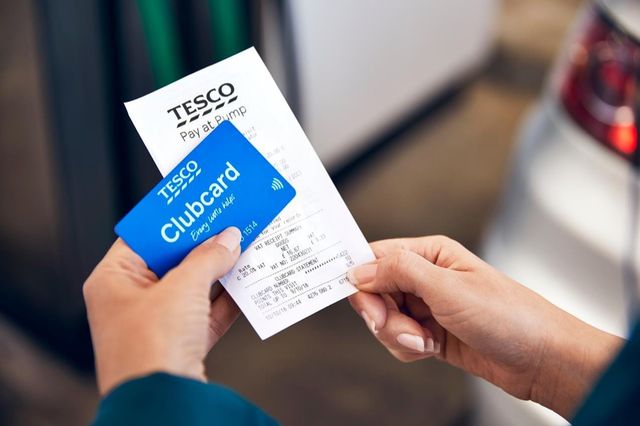
Tesco uses Dunnhumby's customer data platform (CDP). A CDP collects purchase data from every transaction and builds a detailed profile of each shopper. Think of it as a central brain that remembers everything a customer buys, when they buy it, and what they might want next.
Dunnhumby processes 1.5 billion transactions per year for Tesco, according to Dunnhumby's published case studies. Their predictive analytics spot patterns. If you buy diapers and baby food every Tuesday, the system learns your routine and sends you offers for those products on Monday. These personalised offers get redeemed four times more often than generic "10% off" promotions sent to everyone.
As Clive Humby, Dunnhumby's co-founder, once put it: data is the new oil, but only if you can refine it. Tesco's edge isn't just collecting data. It's acting on it faster and more precisely than anyone else in the UK grocery sector.
Psychological Design
Tesco doesn't give you rewards instantly. Instead, points convert to vouchers every three months. This creates anticipation. Customers wait for their quarterly "payday" rather than redeeming constantly, which makes each voucher feel more valuable.
Clubcard Plus adds a paid tier at £7.99 per month. You get 5% off Tesco brands immediately at checkout, plus 10% off two major shops each month. The psychology here is instant gratification layered on top of delayed rewards. For a family spending £150 weekly, the savings cover the membership cost in the first month.
Vouchers stay valid for two years. That's long enough that customers don't feel rushed, but short enough to prevent indefinite hoarding. The programme also partners with Disney+, Café Rouge, and Pizza Express. These partnerships increase the perceived value of your points without costing Tesco much, since partners provide the rewards.
How It Works
You earn points on purchases. Every three months, those points automatically convert to vouchers. Then you have two years to use those vouchers. This flexibility is why Tesco sees a 78% redemption rate, according to Tesco's annual report data. Most loyalty programmes struggle to hit 45%, per the Bond Brand Loyalty Report.
B2B Takeaway: Loyalty programmes work when customers can see the value immediately. Tesco's Clubcard Plus pays for itself in one or two shops for typical families. If you're designing a paid tier, make the math obvious from the first purchase.
2. Nectar (18 Million Users, Coalition Model)
Technology
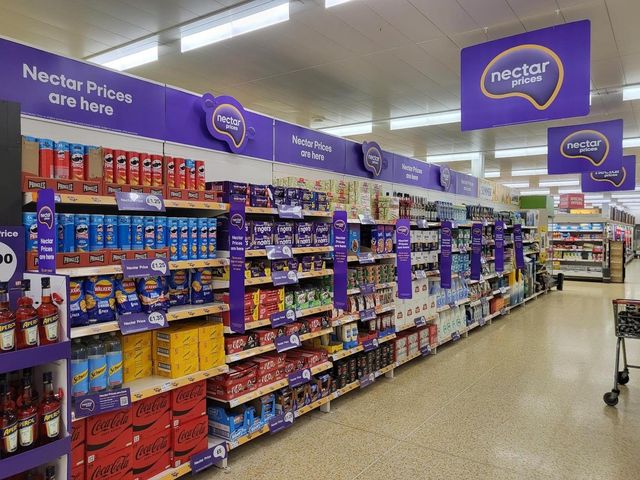
Nectar runs a CDP that connects 300+ partner businesses. When you shop at Sainsbury's, buy something on eBay, or order from Argos, it all feeds into one customer profile under a single ID. The mobile app lets you scan barcodes and shows personalised offers based on what you usually buy across all partners.
Nectar connected with Apple Wallet to launch Nectar Prices. Members get personalised lower prices at Sainsbury's, right from the Nectar app wallet, where they can see savings and offers, then scan their digital Nectar card at checkout. The app centralises points balance, personalised deals, and automatic price application, removing the need for physical cards entirely.
Psychological Design
Coalition models create a "points everywhere" feeling. You earn one point per £1 at Sainsbury's, but two to four times that at partner restaurants and services. This gamifies everyday spending beyond just groceries. You're thinking about Nectar points when you book a hotel or order takeout, not just when you shop for food.
Research from Loyalty Science Lab at Old Dominion University shows that coalition programmes increase total programme engagement by 20-30% compared to single-brand schemes because customers encounter earning opportunities throughout their day, not just at one store.
How It Works
Points never expire as long as your account stays active. That's customer-friendly and removes anxiety about losing rewards. Nectar integrates with Apple Wallet, so your card lives on your phone. Point balances update in real time. You can see exactly where you stand without logging into an app.
B2B Takeaway: Coalition models split customer acquisition costs but eat into your margins on rewards. This only makes sense if your average order is under £50 and you need people to come back frequently rather than spend more per visit. Sainsbury's trades 1% margin to get 15% more visits from Nectar members, according to IGD ShopperVista data. That trade-off works for groceries. It probably doesn't work for luxury goods.
3. ASDA Rewards (Cashpot Model)
Technology
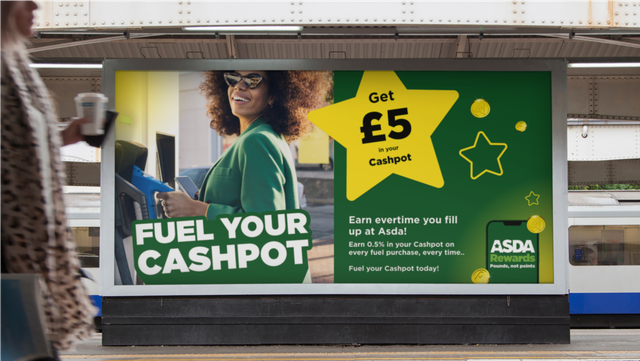
ASDA uses a mission-based system instead of traditional points. The app assigns you personalised "missions" like "Spend £20 on produce this week, earn £2." AI predicts achievable targets based on what you normally buy. If you usually spend £15 on produce, the system might challenge you to reach £20. If you never buy produce, you won't get that mission.
This is behavioural nudging backed by technology. The system doesn't just track what you buy. It figures out what you could buy with a small stretch, and rewards you for it.
Psychological Design
No points exist in this system, just direct cashback. Your missions pay into a "cashpot" that you can see growing. The missions create a game-like sense of achievement. The average customer completes three to four missions per month, earning £6 to £10. They're not calculating point values. They see "£2 earned" immediately after completing a mission.
This approach draws on research by behavioural economist Dan Ariely, who found that people respond more strongly to clear, concrete rewards than abstract point systems. When customers see "£2 earned" instead of "200 points earned," they don't need to do mental math to understand the value.
How It Works
You can redeem your cashpot at any time once you have at least £1. No expiry exists on your balance. The system is digital-only with no physical cards, which forces app adoption. This works. About 78% of ASDA Rewards users now shop through the app compared to 45% of non-members.
B2B Takeaway: Removing points simplifies everything. ASDA's "£2 mission completed" message is instantly clear. "200 points earned" requires mental math to figure out what that's actually worth. If your customers struggle with point-to-currency conversion, consider ditching points entirely and just showing cash amounts. This is something we've seen work well for Shopify merchants, too. When Joy Loyalty merchants switch from points displays to currency-equivalent displays, redemption rates typically climb because customers understand exactly what they're getting.
Health & Beauty
4. Boots Advantage Card (15 to 17 Million Users)
Technology
Boots runs Oracle Retail's CDP. Here's what makes them different: they integrate prescription data (with consent). If you buy allergy medicine and pick up prescriptions, Boots can suggest skincare products for sensitive skin. The app includes AR for virtual makeup try-on and can scan product ingredients to explain what they do.
This is health data plus purchase history, combined with permission-based personalisation. It requires strict privacy controls and legal review, but the payoff is significant.
Psychological Design
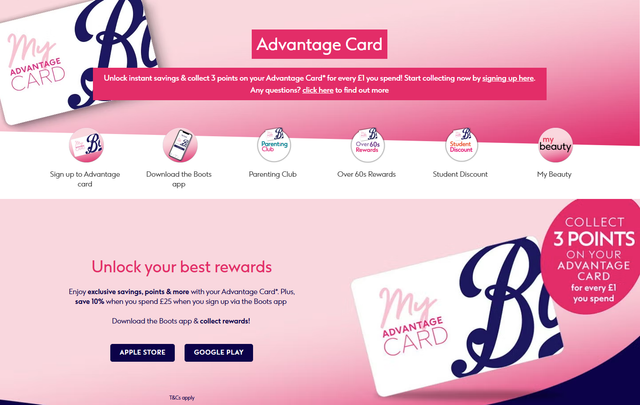
You earn three points per £1 spent. Boots recently reduced this from four points, which led to customer complaints. They also offer tiered bonuses. Spend £60 or more in one shop, get 200 bonus points.
Birthday month brings 150 points automatically. They run seasonal multiplier events with double points to keep things interesting.
Here's the critical lesson: when Boots cut earnings from four points to three points in 2023, they lost 8% of their members, according to Retail Week analysis. Changing earn rates damages trust more than expiry policies do. People internalise the reward rate and get upset when you reduce it. If you need to adjust your programme economics, add new benefits rather than cutting existing earn rates.
How It Works
Points stay valid for 12 months with any account activity. One purchase resets the clock. This relatively short window creates urgency without being punishing. Digital wallet integration is strong. Apple Wallet, Google Pay, and the Boots app all automatically sync your balance.
B2B Takeaway: Integrating health data with permission creates powerful personalisation. Boots can suggest products based on prescriptions plus purchase history. Customers who opt in spend 3x as much on targeted recommendations. The personalisation is that much better than generic offers. For Shopify merchants, the parallel is using customer tags and purchase history to segment your loyalty rewards. You don't need health data. You need relevant data, whatever that means for your product category.
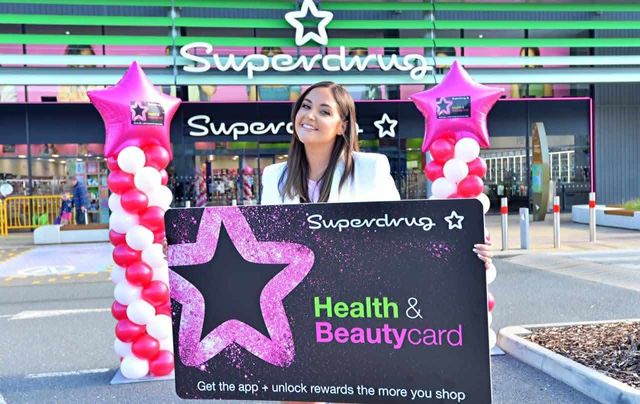
5. Superdrug Health & Beautycard
Technology
Superdrug runs a simpler CDP than Boots. The app handles barcode scanning and integrates with their online store, so points work across the entire store. It's not fancy, but it works reliably.
Psychological Design
One point per £1 keeps things simple. But Superdrug runs frequent 10x point events on specific brands. Double points happen automatically during your birthday month. They focus on simplicity over complexity. No tiers, no missions, just straightforward earning and spending.
How It Works
Points expire after 12 months without activity, similar to Boots. The app makes it easy to redeem at checkout. Every 100 points gets you £1 off. Digital wallet support works through the app's barcode, but they haven't added Apple Wallet passes yet.
B2B Takeaway: Superdrug proves you don't need Boots' technology budget to compete effectively. Frequent 10x multiplier events create excitement without expensive AI infrastructure. If you're budget-constrained, put your money into targeted multiplier campaigns rather than sophisticated personalisation engines.
This is one of the most common patterns we see with Joy Loyalty merchants: a simple points-per-purchase programme with strategic bonus point events on specific products or collections drives more engagement than a complex tiered system that customers don't fully understand.
Coffee & Quick Service
6. Greggs Rewards (Stamp-Based System)
Technology
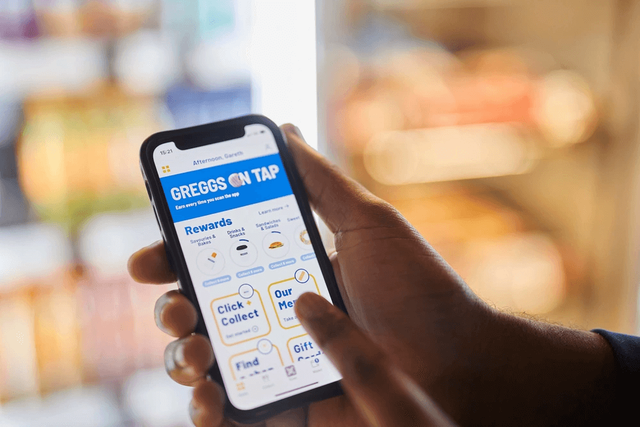
Very simple stamp system. Buy something, get a stamp. Collect nine stamps, get a free item. The app tracks stamps and integrates with mobile ordering. No CDP, no AI, no fancy analytics. Just transactional tracking.
Psychological Design
Instant gratification drives this. You get one stamp per purchase, not per pound spent. This works perfectly for low-price, high-frequency businesses. The average customer redeems a free item every two to three weeks. They can easily visualise progress: "Five more coffees until free."
Research from Columbia University's goal gradient effect study shows that people accelerate purchases as they get closer to a reward. Stamp cards tap into this directly. When a customer sees seven out of nine stamps filled, they're significantly more likely to make a purchase that day than someone with two stamps.
How It Works
Stamps expire after 12 months. The app is required. Greggs eliminated physical cards. The trade-off here is simplicity versus friction. Some customers don't want another app, but the ones who download it become much more engaged.
B2B Takeaway: For businesses with average transactions under £10, stamp systems beat point systems. Customers understand "nine coffees get you one free" instantly. They don't need to calculate point values or remember earn rates. Don't over-engineer your programme if your business model is simple and frequent.
7. Costa Coffee Club
Technology
Costa uses a star-based system, similar to Starbucks. The app integrates with mobile ordering. Recently, they added a subscription tier: £30 per month for five drinks daily, unlimited. That's a major shift in their strategy.
Psychological Design
Gamification appears through bonus star challenges. The subscription tier uses commitment device psychology. Once people pay £30 upfront, they feel compelled to use those drinks. It's sunk cost psychology working in Costa's favour. Subscription users visit 2.5 times as often as regular members.
Behavioural economists call this the "endowment effect" combined with loss aversion. Once you've paid for the subscription, not using it feels like losing money. Costa figured out how to turn this into a retention engine.
How It Works
Stars expire after 12 months. Digital wallet integration happens through the app barcode. The subscription auto-renews monthly, and 98% of subscribers continue after their first month. That retention rate is remarkable.
B2B Takeaway: Subscription tiers work for ultra-high-frequency businesses. Costa targets office workers who buy coffee multiple times daily. Five drinks per day at £30 per month means £1 per drink instead of the £3 to £4 regular price. If your customers visit three or more times weekly, test subscription models.
The economics work when the frequency is extremely high. For Shopify merchants with consumable products (supplements, coffee, skincare), Joy Loyalty's membership tier feature lets you replicate this model. Set up a paid membership that gives members exclusive pricing, and watch how committed buyers become repeat buyers.
Retail & Department Stores
8. M&S Sparks (Experience-Focused Model)
Technology
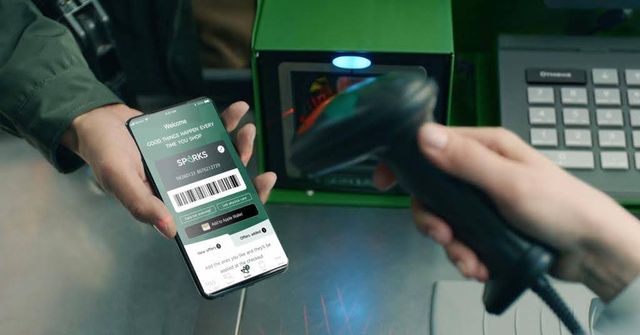
No points system exists. The app provides membership with personalised offers, early access to new products, and charity donation matching. It's fundamentally different from transactional loyalty.
Psychological Design
This focuses on emotional loyalty over transactional rewards. Members choose a charity M&S will donate to on their behalf. Early access to new clothing lines creates exclusivity. You're not earning points. You're getting experiences and the feeling of supporting causes you care about.
Fred Reichheld, creator of the Net Promoter Score and author of Winning on Purpose, argues that the strongest loyalty isn't bought with discounts. It's earned through shared values and meaningful experiences. M&S Sparks is the clearest UK example of this approach in action.
How It Works
No expiry concerns exist because there are no points to expire. Digital-only system. The app includes a virtual fitting room and personal style recommendations.
B2B Takeaway: M&S proves non-transactional loyalty works for premium brands. If your brand relies on emotional connection (luxury goods, ethical products, lifestyle brands), you might not need points at all. M&S members spend 18% more per transaction despite getting no cashback or discounts, per M&S investor presentations.
The brand experience is the reward. For Shopify brands with strong brand identity, Joy Loyalty's flexible configuration lets you build experience-based tiers. VIP members get early access to drops, exclusive collections, or personalised styling. You don't have to give points. You give access.
Travel & Financial
9. Avios (British Airways Executive Club)
Technology
Complex points system with transfer partners across credit cards, hotels, and car rentals. Dynamic pricing means flight redemptions cost different point amounts depending on demand and season.
Psychological Design
Aspirational rewards motivate high accumulation. Free flights feel more exciting than £10 off groceries. Tiered membership (Blue, Bronze, Silver, Gold) has clear spending thresholds. Each tier unlocks perks like priority boarding and lounge access.
The psychology here is what researchers call "aspiration utility." The pleasure of saving toward a dream reward (a business class flight to Tokyo) is itself a form of engagement. Customers stay loyal not because they've earned enough, but because they're always working toward something exciting.
-68bb2b.png?w=640&q=90)
How It Works
Points expire after 36 months without activity. That's generous for travel because people don't book flights every month. Partnerships with major UK credit cards like Amex and Chase let you earn Avios on everyday spending, not just flights.
Avios' 36-month expiry with activity extension makes sense given that travel purchases are infrequent. If your business has quarterly or annual purchase cycles, extend the expiry to 24-36 months. Monthly expiry only works for businesses where customers buy weekly or more often.
B2B Takeaway: High-value, low-frequency businesses need aspirational rewards. Avios members save points for years to afford long-haul flights. They're motivated by big rewards, not frequent small ones. If your average order value is £200 or more, give customers rewards worth saving for. Don't make everything achievable in one purchase.
10. Wise (Challenger Bank Model)
Technology
Fintech integration. The debit card automatically gives cashback on international transactions. The app shows spending analytics and budgeting tools. Everything syncs in real time.
Psychological Design
No points, just direct cashback. Wise targets international travellers and expats. You get 0.5% cashback on card spending, paid directly into your Wise balance. You can use that balance for currency transfers or withdraw it.
-bad263.jpg?w=640&q=90)
How It Works
No expiry on cashback balance. Full digital wallet integration with Apple Pay and Google Pay. Cashback is instant. No waiting periods or manual redemption. It happens automatically.
Wise's Apple Pay integration means customers earn cashback without ever opening the app. This passive-earning model shows 40% higher active user rates than traditional bank rewards that require app logins, based on Wise's published user data. If your loyalty programme requires active participation (scanning receipts, checking offers manually), you're losing 30% to 50% of potential engagement. Passive is better.
B2B Takeaway: Loyalty in financial services must be passive. Customers won't actively redeem banking rewards. They forget. They don't care enough. Wise's automatic cashback model drives card usage without requiring any loyalty programme engagement. The reward happens invisibly in the background, which is exactly what works for finance. For ecommerce, the parallel is automatic point earning at checkout. Joy Loyalty awards points automatically on purchase. Customers don't have to do anything extra. They just shop, and their balance grows.
That's 10 programmes that prove different approaches work for different business models. The key is matching your loyalty strategy to how your customers actually shop and what motivates them to come back.
II. What These Programmes Teach Us: A Pattern Map for Your Business
Before you build anything, here's how to match these strategies to your business model.
III. What Separates a Loyalty Programme From a Retention Engine
Every programme in this guide started the same way: someone decided their customers were worth investing in beyond the first purchase.
While the UK loyalty market will keep growing past £9 billion, your customers will keep joining more programmes. The ones that earn their wallet share won't be the ones offering the most points. They'll be the ones who understood their customers well enough to design something worth coming back for.