Your customers probably already belong to at least one gas rewards program. Shell, BP, Exxon, Circle K. They've all built loyalty programs that change how drivers pick a station. Instead of choosing the cheapest pump, millions now default to the station where their points are.
For fuel business owners, these programs aren't just competition. They're a blueprint.
We break down the eight best gas rewards programs, compare their mechanics, and explain how 'stacking' rewards has become the strategy that locks in repeat customers. Each program has trade-offs we'll call out honestly. But together, they show what works in fuel rewards today, and what you can do better.
I. The 8 Best Gas Rewards Programs at a Glance
Before we get into the details, here's how all eight programs compare side by side.
Every program on this list is free to join. No credit check required. That's table stakes now. The real differences are in how they handle earning, redemption, and long-term retention.
If you're building your own program, pay close attention to two columns: Reward Type and Tiered. Those two decisions shape everything else about your program's complexity and customer appeal.
II. The 8 Best Gas Rewards Programs
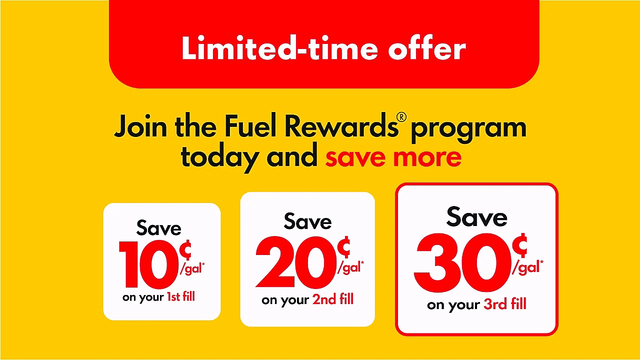
1. Shell Fuel Rewards: The Gold Standard for Tiered Loyalty
Shell doesn't just discount gas. It makes customers feel like they're losing something if they fill up anywhere else. That's what a well-built tier system does, and Shell's is the most structured one in fuel retail.
Silver: 3¢/gal — Sign up free — 20 gal cap | Gold: 5¢/gal — 6 fill-ups in 3 months — 20 gal cap | Platinum: 10¢/gal — Invite-only — 35 gal cap
Members also earn fuel discounts through partner spending: $50 at a participating restaurant = 10¢ off per gallon on your next fill.
What makes it effective: Shell offers a status you don't want to lose. Once a driver hits Gold, filling up at a competitor feels like a step backward. It's not about 5¢ per gallon. It's about the sunk cost of six fill-ups you already made to get there.
Here's the catch: The three-month rolling window cuts both ways. Travel, change your commute, or get busy, and you drop back to Silver. Platinum qualification is inconsistently documented. The 20-35 gallon cap means fleet customers max out fast.
Lesson for fuel business owners: Tiers work when progression feels achievable. Six fills over three months is two per month — realistic for most commuters. If your tiers demand behavior that doesn't match how customers actually drive, they won't motivate.
2. Earnify (BP/Amoco): The Power of Partner Stacking
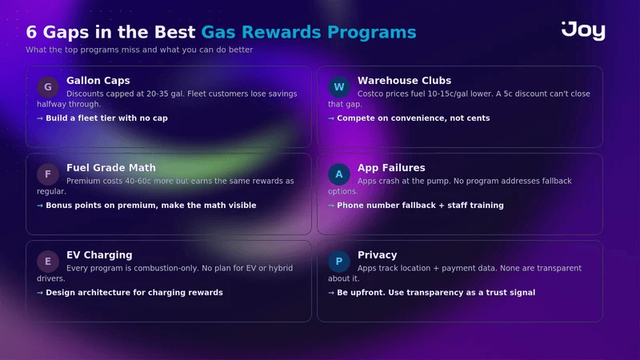
BP didn't try to out-discount Shell. It borrowed someone else's audience instead. The Earnify program's biggest move is a partnership with Amazon Prime that doubles the base savings without costing BP a cent.
Base fuel discount: 5¢ off/gal (always on) | With Amazon Prime: 10¢ off/gal | Welcome bonus: 250 points | Points on fuel: 1 per $1 | Points in-store: 2 per $1 | Reach: 7,000+ locations
What makes it effective: Amazon funds the extra 5¢ as a Prime member benefit. BP gains access to 200M+ Prime members who now have a reason to choose BP. That's customer acquisition through someone else's loyalty base. No ad spend required.
Here's the catch: Without Amazon Prime, Earnify is a 5¢/gallon program. App store reviews are full of complaints about payment failures at the pump.
Lesson for fuel business owners: Find a business whose customers overlap with yours. A local gym, car wash, or coffee shop. One partnership makes your program more valuable than the discount alone.
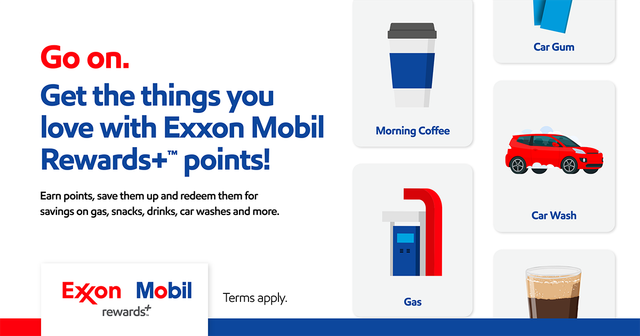
3. Exxon Mobil Rewards+: Points System With Smart Partnerships
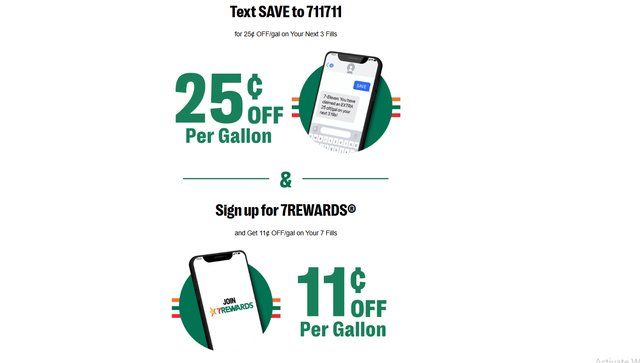
Where Shell uses tiers, and BP uses one big partner, Exxon runs a points system and segments its audience through multiple partnerships that each target a different type of driver.
Points on regular fuel: 3/gal | Premium: 6/gal | In-store: 2 per $1 | 100 pts = $1 off | AARP: 500-pt signup bonus | Walmart+ members: Flat 10¢ off/gal
What makes it effective: AARP reaches older, high-frequency drivers who fill up on routine. Walmart+ reaches budget-conscious families. That's smart customer segmentation through points, not just a blanket discount.
Here's the catch: Points require mental math. 3 points per gallon, 100 points = $1 off — most customers won't do the conversion. Points expire after one year of inactivity.
Lesson for fuel business owners: Points give you flexibility — double-points weekends, rewarding in-store spending differently. The trade-off is clarity. If customers can't quickly calculate what their points are worth, the program feels vague.
4. Circle K Inner Circle: The Aggressive Welcome Offer
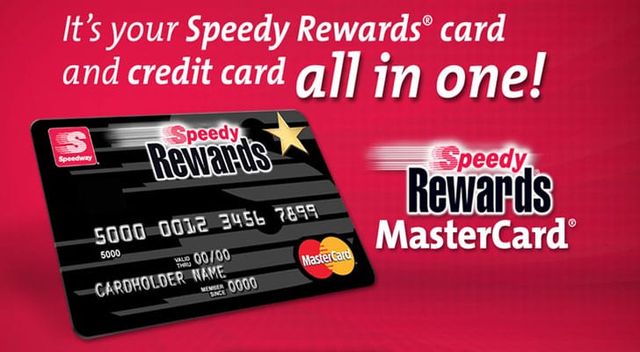
Circle K bets big on one thing: making the first five visits irresistible.
Welcome offer: 25¢ off/gal for first 5 fill-ups | Everyday: 3¢ off/gal | Premium: 5¢ off/gal | Premium qualification: $500 spend in 365 days | In-store clubs: Buy 5, get 6th free | 16M+ members across 4,000+ locations
What makes it effective: That 25¢ welcome offer is the highest first-fill discount of any major gas rewards program. On a 15-gallon fill, that's $3.75 saved immediately. The $500 spend threshold for Premium gives customers a visible goal.
Here's the catch: After five fills, savings drop from 25¢ to 3¢ per gallon — an 88% decrease. The gap between 'great trial offer' and 'okay ongoing program' is where Circle K loses people.
Lesson for fuel business owners: A generous welcome offer gets customers through the door. But the welcome offer and the long-term program need to be designed together. If ongoing value isn't clear before the welcome period ends, you're paying to acquire customers who churn.
5. Speedway Speedy Rewards: The In-Store Conversion Engine
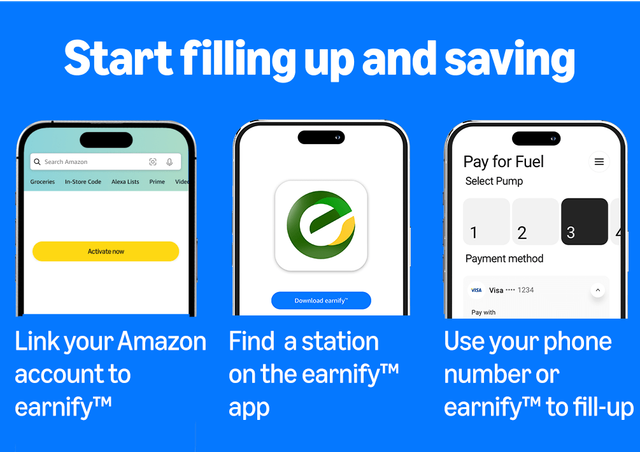
Most gas rewards programs treat the convenience store as an afterthought. Speedway built its entire program around it.
Points on fuel: 10/gal | On merchandise: 20 per $1 | Monthly Perks: Choose merchandise or fuel bonus | Speedy Clubs: Buy 6, get 1 free | Grocery partners: Remke, Martin's, Family Fare
What makes it effective: A customer who fills up and buys a $3 coffee earns 10 points per gallon plus 60 points on the coffee. The program treats the pump and store as one business. Monthly Perks give customers a reason to open the app every month.
Here's the catch: Points expire after nine months. Since 7-Eleven acquired Speedway, longtime customers have seen rewards options shrink and app features change.
Lesson for fuel business owners: If you run a convenience store alongside your pumps, your rewards program should cover both. In-store margins are significantly higher than fuel margins.
6. 7REWARDS (7-Eleven): Convenience-First Loyalty
7-Eleven flips the model entirely. Fuel isn't the main attraction. 7REWARDS earns points on everything with fuel discounts as a secondary benefit.
What makes it effective: The app rotates deals weekly — free Slurpee offers, discounted snacks, bonus point promotions. This constant rotation gives customers a reason to open the app regularly. Static programs get forgotten. Rotating offers stay top of mind.
Here's the catch: Fuel savings are vague. No clear 'X cents off per gallon' promise. For drivers who care primarily about fuel discounts, 7REWARDS doesn't compete on transparency.
Lesson for fuel business owners: Rotate your promotions weekly or monthly. Even small changes keep customers checking in. Engagement beats discount size.
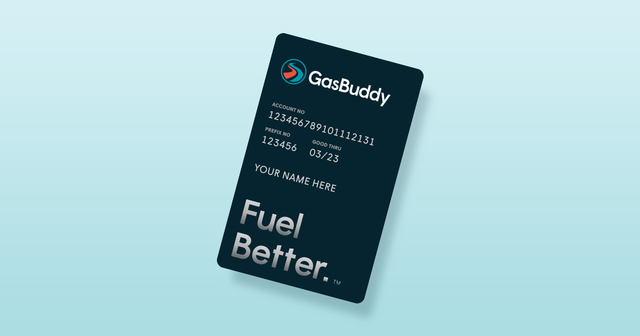
7. GasBuddy (Pay with GasBuddy+): The Aggregator Threat
GasBuddy isn't a loyalty program. It's a savings tool that works at any gas station. It's not a model to copy — it's the competition your program has to beat.
Savings: Up to 33¢/gal | Payment: Linked checking account, Mastercard | C-store bonus: 3¢/gal for every $25 in-store | Credit check: None | Station lock-in: None.
GasBuddy's price comparison feature drives millions of downloads. The payment card turns those downloads into savings at any station.
Here's the catch: GasBuddy doesn't build loyalty to any specific station. A customer will fill up wherever the price is lowest. No habit formation, no relationship.
Lesson for fuel business owners: GasBuddy proves drivers will use an app to save on gas. Your job is to give them a reason to choose your station over the cheapest option on the map.
8. Maverik Adventure Club: The Regional Playbook
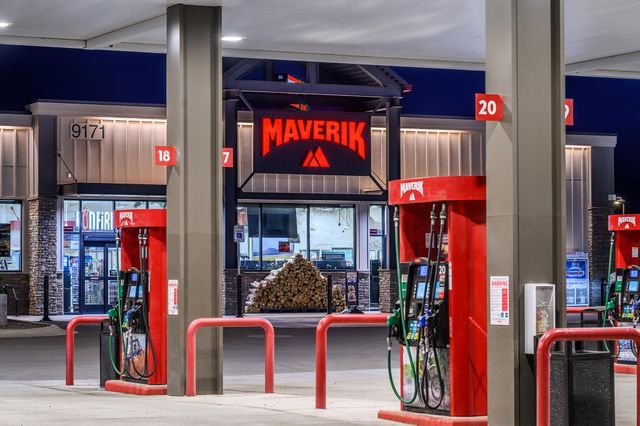
Maverik operates 800+ locations across 20 states in the Western US. It proves you don't need national scale to run a rewards program that works.
Adventure Club (Free): 2¢/gal, 2x Trail Points per $1, welcome: free fountain drink
Nitro (Linked Checking): 10¢+/gal + Instant Price Match, 4x Trail Points per $1, 25% off drinks/coffee, welcome: free BonFire burrito
What makes it effective: Nitro functions like a paid membership. The branding — 'Adventure Club,' 'Trail Points,' 'BonFire burrito' — reinforces Maverik's road trip identity. Customers don't just earn points. They earn Trail Points. That's memorable.
Lesson for fuel business owners: Branding matters more than most operators think. Give your program a name that reflects who you are. Joy lets you set custom point labels for exactly this reason.
III. How the Best Programs Handle Stacking (and Why Yours Must Too)
Every program on this list supports 'stacking' — a customer uses your loyalty discount and pays with a rewards credit card at the same time. They earn from both.
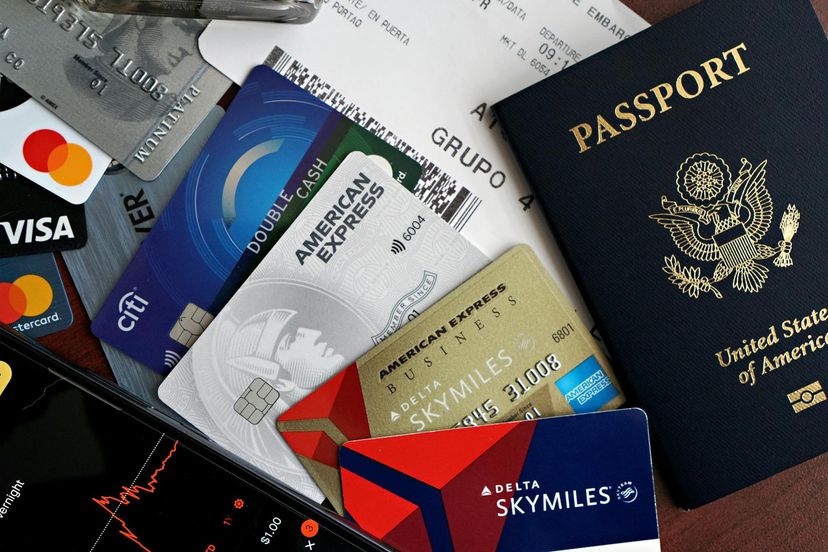
The math: A driver fills up at Shell Gold (5¢ off/gal) and pays with Blue Cash Preferred (3% back). On a 15-gallon fill at $3.50/gal — Shell Gold: $0.75 — Blue Cash Preferred: $1.58 — Total stacked: $2.33.
Biggest stacking partnerships: Amazon Prime + Earnify = 10¢/gal. Walmart+ + Exxon = 10¢/gal. AARP + Shell = complimentary Gold status.
Open-loop vs. closed-loop cards: Your POS needs to process loyalty rewards separately from credit card payment so both apply without friction.
The MCC factor: If your station is coded as a 'convenience store' instead of a 'gas station,' customers' cards might not give them their gas bonus. Check your MCC with your payment processor.
IV. What These Programs Get Wrong (Gaps You Can Fill)
The eight best gas rewards programs above aren't perfect. Each has blind spots an independent fuel business can turn into advantages.
V. Start Building Your Fuel Rewards Program
The best gas rewards programs share three things: dead simple to join, clear immediate value, and they work alongside whatever credit card the customer already carries.
Fuel businesses that get this right don't compete on price. They compete on habit. When a customer defaults to your station because that's where their rewards live, that's a relationship worth years of repeat visits.
Joy gives fuel businesses points or cents-off rewards, VIP tiers, POS integration, and the customer data to keep improving. Start building your program today.