Best Western Rewards is one of the few hotel loyalty programs with a dedicated B2B tier system built specifically for small businesses. That alone makes it worth studying if you're designing (or redesigning) a loyalty program for your own store.
The program covers 4,300+ properties across 100+ countries, runs on a flat 10-points-per-dollar earning rate, and offers points that never expire. Those are solid fundamentals.
But the real story is the Business Advantage program, a B2B extension that grants automatic Diamond status to business owners and Gold status to their employees. Most travel guides skip it. We won't. Here's how it works, what makes it smart, and what you can steal for your Shopify store.
I. How the Program Works: The Design Decisions That Matter
1. Flat earning rate: 10 points per dollar. One rate, every property, no mental math. The exception is SureStay brands, which earn only five points per dollar. That inconsistency is a design flaw worth noting. If you're building a points program, keep the earning rule universal.
2. Points never expire. No blackout dates. Both decisions reduce 'breakage anxiety,' the fear that rewards will vanish before you use them. Don't punish customers for going quiet. Let the points sit. They'll come back.
3. Four tiers, five-night gaps between each:
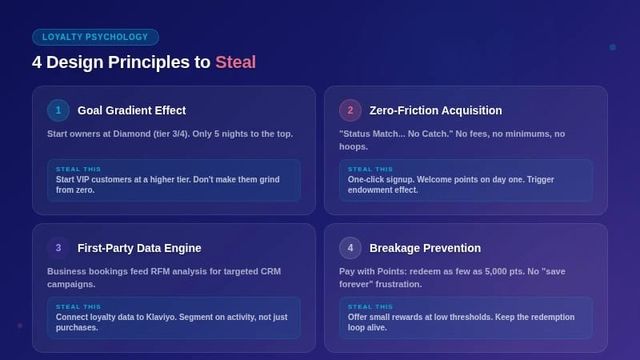
The five-night gap is deliberate. A customer at Gold can picture Platinum. A customer at Diamond can taste Diamond Select. Wide gaps kill momentum. Tight gaps sustain it.
Here's the catch: room upgrades at higher tiers are "subject to availability." Not guaranteed. If you're building tier benefits for your own program, make them concrete. "Free shipping on every order" beats "priority shipping when available."
4. Partial redemption starts at 5,000 points. Best Western calls it Pay with Points. Members can apply a small number of points toward any stay, even if they don't have enough for a full free night. That prevents the dead zone where customers have points but can't use them. Small, incremental redemptions keep the reward loop alive.
5. Point value: roughly 0.6 cents each. Buying points directly costs 1 cent per point. The math doesn't favor the buyer, and that's by design. The program rewards repeat behavior, not shortcuts. Same principle for e-commerce: don't make points too easy to buy, or you devalue the entire loop.
II. The Business Advantage Program: Best Western's B2B Loyalty Play
Most hotel loyalty guides skip this part. Only one out of three top-ranking articles even mentions it. But for ecommerce owners studying loyalty design, the Business Advantage program is the most interesting thing Best Western does.
1. The account owner gets automatic Diamond status
No stay requirements. No waiting period. The moment you enroll, you're tier three out of four. That's a deliberate choice: front-load the best perks to the decision-maker. Switching to a competitor means losing Diamond instantly. Asymmetric switching cost.
2. All registered employees get automatic Gold status
The owner chose the program, but everyone on the team benefits. Bonus points, priority service, complimentary perks. This creates organizational buy-in. Employees don't resist centralized booking when they personally gain from it.
3. The business earns a 10% bonus on all points from team travel
This is percentage-based, not flat, so it scales with spend. A five-person team spending $50,000 a year generates 550,000 points (500K base + 50K bonus). That's roughly 15-25 free nights the company can redeploy.
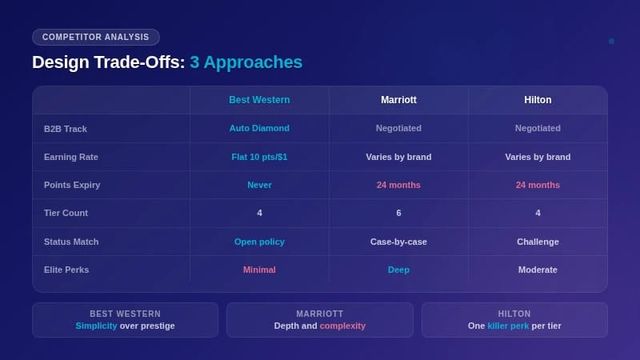
4. Only direct bookings earn points
OTA reservations through Expedia, Booking.com, or similar platforms don't count. Best Western uses the loyalty program to protect its direct channel and cut out intermediaries. The e-commerce parallel is clear: reward purchases made through your own store more generously than marketplace orders.
What competitors don't offer here?
Marriott and Hilton handle B2B through negotiated corporate rates. You need volume, contracts, and sales reps. Best Western gives automatic top-tier status to any small business that signs up. No negotiation. No minimum spend. That's a genuine differentiator for smaller companies.
If you sell to both consumers and businesses, this model is worth studying. A dedicated B2B loyalty track, separate from your consumer program, can create the kind of organizational stickiness that individual customer loyalty can't. Your wholesale buyers get VIP status. Their team members get baseline perks. Everyone has a reason to stay.
Related: How to build a loyalty program for small business
III. The Psychology Behind the Design (And What to Steal for Your Store)
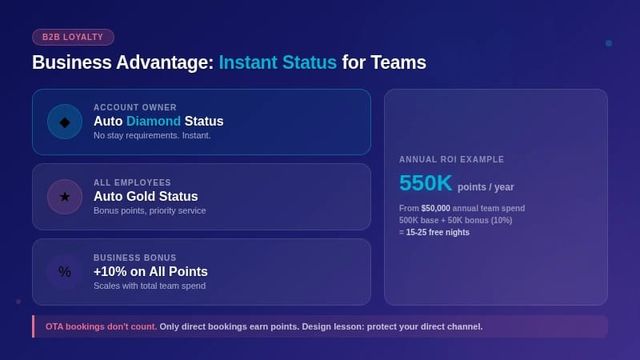
Best Western's program isn't flashy. But the behavioral psychology baked into its design is sharp. Here are four principles worth stealing.
1. Goal Gradient Effect
Business Advantage starts owners at Diamond, tier three out of four. Only five more nights to Diamond Select. Research shows people accelerate effort as they approach a goal. The closer the finish line feels, the harder they push.
Steal this: Start your highest-value customers at a higher tier. Don't make them grind from zero. Joy's VIP tier feature lets you assign starting tiers by customer segment.
2. Zero-Friction Acquisition
Best Western's "Status Match... No Catch" program has no fees, no minimum commitments, no hoops. You bring proof of status from another chain, you get matched. Done.
Steal this: Your loyalty program sign-up should take one click. Give new members welcome points on day one. Once customers own something, they don't want to lose it. That's the endowment effect working for you.
3. First-Party Data Engine
Every business booking feeds data into Best Western's CRM: travel frequency, preferred locations, spending patterns, and seasonal trends. They use RFM analysis (Recency, Frequency, Monetary) to target offers
Steal this: Your loyalty program is one of the richest first-party data sources you have. Connect it to Klaviyo or Omnisend and build segments based on loyalty activity, not just purchase history.
4. Breakage Prevention
Pay with Points lets members redeem as few as 5,000 points toward a stay. No "save up for six months" frustration. The reward loop stays active even for low-balance members.
Steal this: If your program only lets customers redeem at high thresholds, you're creating a frustration gap. Offer smaller rewards at lower point levels. A free sample at 100 points keeps people engaged better than a $20 discount at 500.
Related: How Customer Engagement Loyalty Programs Drive Repeat Business
IV. Best Western vs. Marriott vs. Hilton: Design Trade-Offs
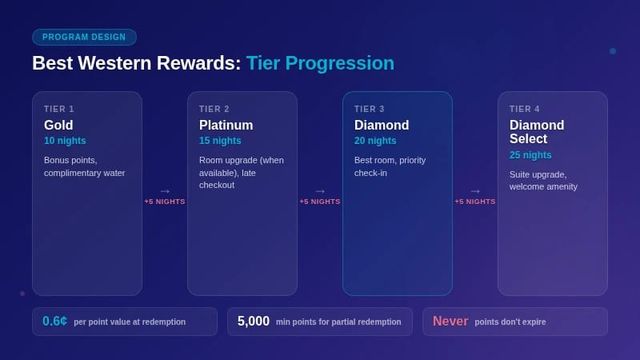
Three chains, three different bets on what makes a loyalty program work.
1. Best Western bet on simplicity
Flat earning rate. No expiration. Open status matching. A dedicated B2B track that doesn't require corporate negotiations. The trade-off? Elite perks are the weakest of the three. Industry sources call them "minimal." If your brand competes on value rather than luxury, this is the playbook: make the program easy to understand and generous enough to keep people coming back.
2. Marriott bet on depth
Six tiers, brand-specific earning rates, extensive elite benefits including suite upgrades and lounge access. It works because their portfolio supports it, from budget to luxury. The trade-off? Complexity. New members need a guide just to understand the program. For ecommerce: complex tier structures only make sense if you have enough differentiated rewards to fill each level. Don't add tiers just to have tiers.
3. Hilton bet on one killer perk per tier
Four tiers, like Best Western, but with sharper benefits. Free breakfast at Gold status is genuinely valuable and easy to understand. No fine print, no "subject to availability." The trade-off? Less differentiation at the top. For ecommerce: one standout benefit per tier (free shipping, early access, exclusive products) beats a long list of mediocre perks. Pick the thing customers actually care about and make it real.
The honest takeaway: Best Western won't win a feature-by-feature comparison against Marriott or Hilton. But for B2B accounts and budget-conscious segments, simplicity and accessibility beat prestige. The same logic applies to your store.
V. Conclusion
Best Western Rewards won't win on luxury perks. The upgrades are modest, the elite benefits are thin, and the property portfolio skews the budget.
But the design choices behind it are worth studying. Flat earnings. No expiration. Tight tier gaps. A B2B track that gives instant status without negotiation. These aren't hotel-specific ideas. They're loyalty architecture principles that work for any e-commerce store.
Building a loyalty program for your Shopify store? Joy Loyalty gives you tiered rewards, VIP memberships, and flexible point systems built on these same principles. Start free.