I'm a coffee lover, at least two cups a day, and I'm not alone. In 2024, 73% of Americans drink coffee every day, with 36% downing 3–5 cups. My morning stop at the local coffee shop is basically non-negotiable. And over the years, rewards programs have turned those daily visits into something more: free drinks, shorter lines, perks that actually fit how I order. For coffee shops, that's the whole point. You're not just building loyalty; you're building repeat-visit habits that compound into real CLV.
This guide covers everything you need to know about coffee shop rewards programs: how the best ones are structured, a head-to-head comparison of Starbucks, Dunkin', Peet's, Tim Hortons, and Caribou, and what any merchant can replicate in their own loyalty stack.
Key Takeaways
- The first-reward threshold is the most important number in your program. Programs where the first reward requires more than 3 average orders have chronically low redemption rates, regardless of how good the reward is. Peet's proves a $15 threshold works. Set yours before customers have a reason to forget you exist.
- Each mechanic optimizes for a different outcome, and copying the wrong one is expensive. Points-per-dollar rewards high-ticket orders. Points-per-visit drives frequency but kills upsell. Tiered programs build status loyalty. Subscription locks in recurring revenue. Choose based on your margin structure and customer behavior, not based on what Starbucks does.
- Loyalty data disconnected from email and checkout is the single most common reason well-designed programs underperform. The program mechanics can be perfect. If your loyalty platform doesn't talk to Klaviyo and your checkout, you're flying blind on which customers are close to churning, and you're missing every win-back window.
What Are Coffee Shop Rewards Programs?
Coffee shop rewards programs run on daily habits, not big spending. You don't have to buy something expensive. Showing up regularly earns free drinks, early access to new items, or exclusive discounts. That's what separates coffee loyalty from airline miles or fashion points, where meaningful rewards take months of accumulated spend.
In other industries, rewards require large outlays or long waits. Coffee programs compress that cycle dramatically. A customer who visits five times a week hits redemption thresholds in days, not quarters. That speed of payoff creates a compounding advantage: loyalty members visit more often and spend more per order than non-members.
Most programs run through a mobile app now: points tracked automatically, personalized offers pushed in real time, no punch cards to lose. Here's the trap, though. Loyalty data siloed from your email platform, and checkout is the single most common reason well-designed programs underperform. The program's right. The data plumbing is broken.
Benefits & Pain Points of Coffee Shop Rewards Programs
Loyalty programs for coffee shops deliver measurable revenue advantages. But only when designed for your customer base, not copied from a chain with 16,000 locations.
Benefits
- Increased Revenue: Loyalty programs drive 12–18% more revenue annually. Starbucks Rewards accounts for 57% of U.S. company-operated revenue as of FY2024, up from 41% just a few years prior. Members spend three times more and visit more frequently than non-members. That's not a rounding error.
- Customer Data: Apps collect purchase history, visit frequency, and preference data, which serve as inputs for targeted marketing and inventory optimization. Without loyalty data, you're running promotions blind.
- Operational Efficiency: Mobile ordering reduces in-store congestion, speeds up service (with average wait times of 2–3 minutes), and improves staff productivity (Source: Square).
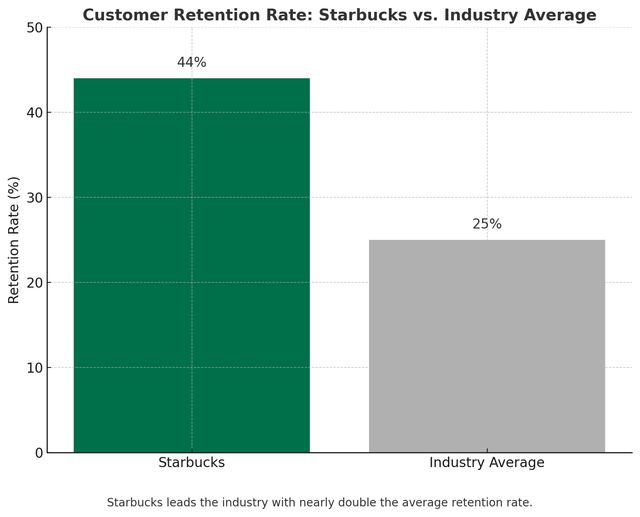
- Brand Retention: Personalized offers and exclusive perks strengthen emotional ties. For example, Starbucks achieves a 44% customer retention rate, far surpassing the industry average of 25%.
Pain Points
- Implementation Costs: App development and platform maintenance require upfront investment, especially for shops running on 6–18% profit margins (Source: Crimson Cup). The break-even calculation matters: a program that costs $150/month and generates $200 in incremental repeat revenue is profitable; one that costs the same and drives 2% visit lift is not.
- Customer Frustration: Complex redemption rules or first-reward thresholds that require 40+ visits to unlock create disengagement before a customer ever feels the benefit. Programs where the first reward requires more than 3 average orders to reach have chronically low redemption rates. Regardless of how good the reward is.
- Staff Training: Inconsistent application of rewards and missed scan prompts erode program economics. A barista who skips 50% of loyalty scans effectively cuts your enrolled member base in half.
- Ethical Expectations: Gen Z customers demand transparency into sustainability and sourcing practices. Programs with eco-friendly reward options (reusable cup discounts, carbon offset points) outperform generic discount structures with this segment.
5 Popular Types of Coffee Shop Rewards Programs
These five models cover nearly every coffee shop loyalty structure in use today. Each has a different mechanic, ROI profile, and failure mode. Know all five before you commit to one.
- Points-Per-Dollar Programs: Customers earn points based on spend: typically 1–2 points per $1. This model incentivizes higher-ticket orders and rewards customers who buy specialty drinks or food add-ons. It generates data on exactly what drives customer value. The failure mode: when the first reward requires too much cumulative spend, customers disengage before they feel any benefit.
- Points-Per-Visit Programs: Customers earn a fixed number of points per visit regardless of spend. This drives visit frequency, which makes it effective for shops targeting daily commuters. The trade-off: it doesn't incentivize upselling, and customers who realize they earn the same points for a $3 drip as for a $7 latte will never upgrade.
- Tiered Membership Programs: Customers progress through tiers based on cumulative spend or visits, unlocking better perks at each level. Tiered programs create identity loyalty: top-tier members don't just want the discount. They identify with the status. Removing a Gold member's tier hurts more than removing the perk itself. The design challenge: make tier thresholds achievable within 60 days of enrollment, or top-of-funnel churn will hollow out the program.
- Punch Card-Style Programs: Customers earn a free item after a set number of purchases, buy 9 drinks, and get the 10th free. Digital punch cards via app eliminate the lost-card problem. The ceiling is built in, though: once a customer redeems, there's no natural path to increased engagement unless you layer a second mechanic. Best positioned as an entry-level program before a full points infrastructure is ready.
- Subscription-Based Programs: Customers pay a monthly fee for unlimited coffee or a discounted bundle. A $15/month subscriber has already committed to coming back; they're a recurring revenue line, not a discretionary spend. Gaining traction in urban shops targeting professionals who treat it as a fixed monthly expense.
Comparison of Top 5 Coffee Shop Rewards Programs
| Program | Earn Rate | First Free Drink | Sign-Up Bonus | App Quality | Best For | Availability |
|---|---|---|---|---|---|---|
| Starbucks Rewards | 2 stars/$1 | 150 stars (~$75 spend) | Free drink | ⭐⭐⭐⭐⭐ | Specialty drink buyers, daily visitors | Nationwide |
| Dunkin' Perks | 10 points/$1 | 500 points (~$50 spend) | 200 bonus points | ⭐⭐⭐⭐ | Budget-conscious commuters, fast accumulators | Northeast, expanding |
| Peet's Peetnik | 1 point/$1 | 15 points (~$15 spend) | Free drink at 15 pts | ⭐⭐⭐ | Sustainability-focused, occasional visitors | West Coast |
| Tim Hortons Rewards | 10 points/$1 | 400 points (~$40 spend) | None | ⭐⭐ | Value-driven regulars, rural/suburban | Midwest/Northeast |
| Caribou Perks | 2 points/visit | 140 points (~70 visits) | None | ⭐⭐ | Community regulars, spend-agnostic earners |
Five programs. Five different mechanics. Here's what the data shows, and what any merchant building their own program can steal from each.
Starbucks Rewards
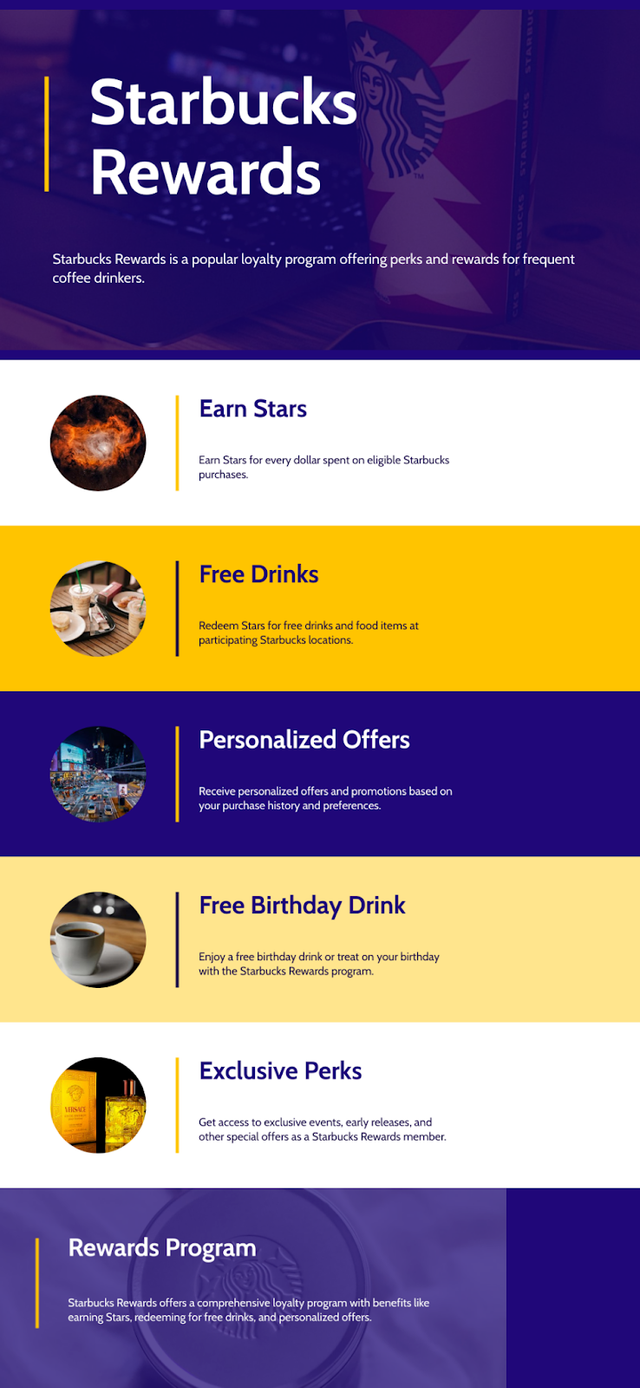
Starbucks, with over 16,000 U.S. locations, dominates the coffee industry through its premium brand and extensive digital ecosystem. Its Starbucks Rewards program is a gold standard, leveraging a sophisticated app to drive customer engagement and operational efficiency.
What makes it work mechanically:
AI-driven personalized offers push members toward their specific drink preferences at the exact moment they're most likely to act. Starbucks doesn't send the same promotion to every member. Their machine learning identifies which members respond to double-star days vs. new product launches vs. expiring rewards..
Highlights:
- Sign-Up: Easy via app/website; free drink for new members.
- Points: 2 stars/$1, frequent double-star promos.
- Redemption: 25–400 stars for add-ons to premium drinks.
- App: Mobile ordering, Apple Pay, AI-driven offers.
- Perks: Birthday rewards, eco-discounts, exclusive events.
- Availability: Nationwide.
Pros: Seamless app, personalized marketing.
Cons: High redemption thresholds, complex for small chains.
Merchant Takeaway: You don't need machine learning to do what Starbucks does. The underlying mechanic is segmentation: identify which members respond to scarcity (expiring rewards), which respond to acceleration (double-star days), and which respond to novelty (new product launches). Three automated triggers, three different member groups. That's the whole system.
Dunkin’ Perks
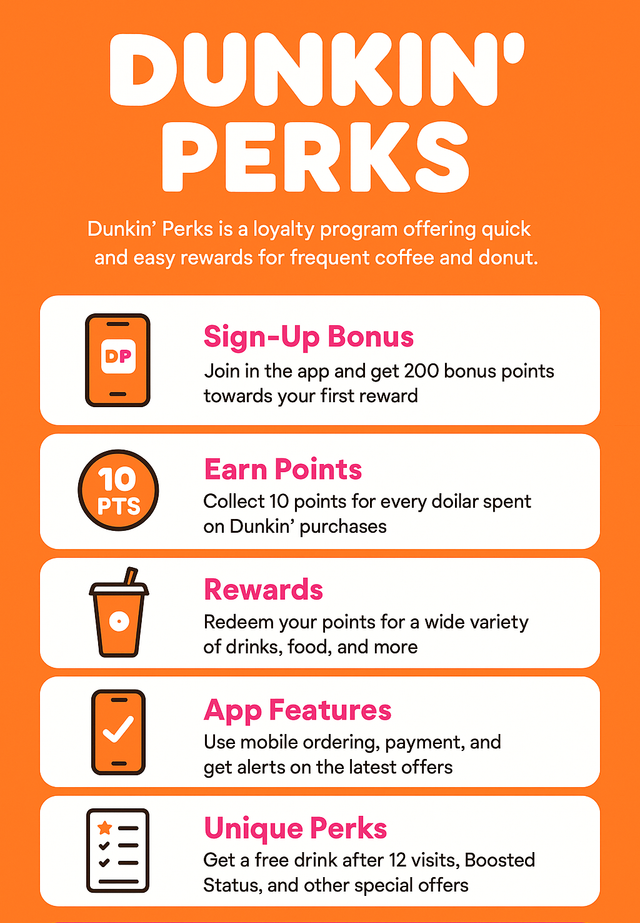
Dunkin' targets speed over sophistication: 10 points/$1 with low redemption thresholds (500 points = a free drink, achievable within a few weeks for daily visitors). The "Boosted Status" mechanic rewards customers who hit visit streaks with accelerated points during limited windows. It's a frequency driver, not a value driver. Optimizes for visit count, not order value.
Highlights:
- Sign-Up: App-based, 200 bonus points.
- Points: 10 points/$1, “Boosted Status” promos.
- Redemption: 200–900 points (e.g., 500 for a drink).
- App: Mobile ordering, stored payments, promos.
- Perks: Free drink after 12 visits, frequent promos.
- Availability: Strong in the Northeast, expanding.
Pros: High points rate, low redemption thresholds.
Cons: Regional focus, inconsistent rewards.
Merchant Takeaway: "Boosted Status" is the real lesson here, not the points rate. It rewards behavior customers are already doing (visiting frequently) rather than trying to manufacture new behavior. Time-limited acceleration on existing habits is one of the most cost-efficient mechanics in loyalty.
Peet’s Peetnik Rewards
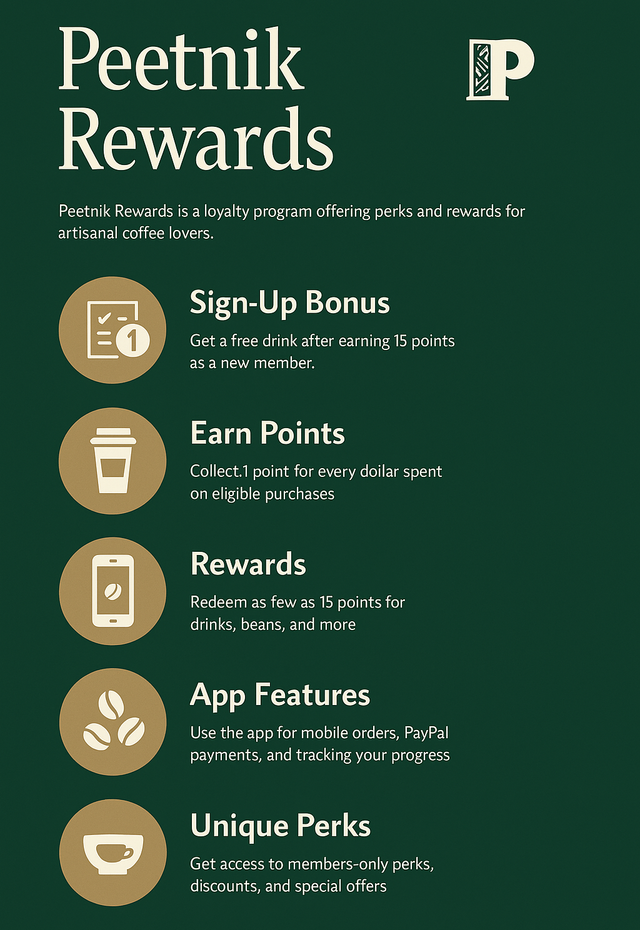
Peet’s Coffee, with 400+ West Coast locations, caters to coffee purists who value artisanal quality and ethical sourcing. Its Peetnik Rewards program targets sustainability-conscious customers, blending straightforward rewards with a focus on brand values. Peet’s smaller scale makes it a relevant case study for independent or regional coffee shops.
Highlights:
- Sign-Up: App/website, free drink after 15 points.
- Points: 1 point/$1, bonuses for beans.
- Redemption: 15–100 points (e.g., 15 for a drink).
- App: Mobile ordering, PayPal, basic tracking.
- Perks: Free beans, fair-trade branding, discounts.
- Availability: West Coast.
Pros: Low redemption, ethical appeal.
Cons: Limited reach, basic app.
Merchant Takeaway: A $15 first-reward threshold isn't generosity, as it's engineering. Customers who redeem once are significantly more likely to stay enrolled and redeem again. Peet's trades a small margin hit on the first reward for a much larger lifetime value gain on every redemption after it. Set your first threshold low enough that customers earn it within their first few visits, before they've had any reason to forget about your program
Tim Hortons Rewards
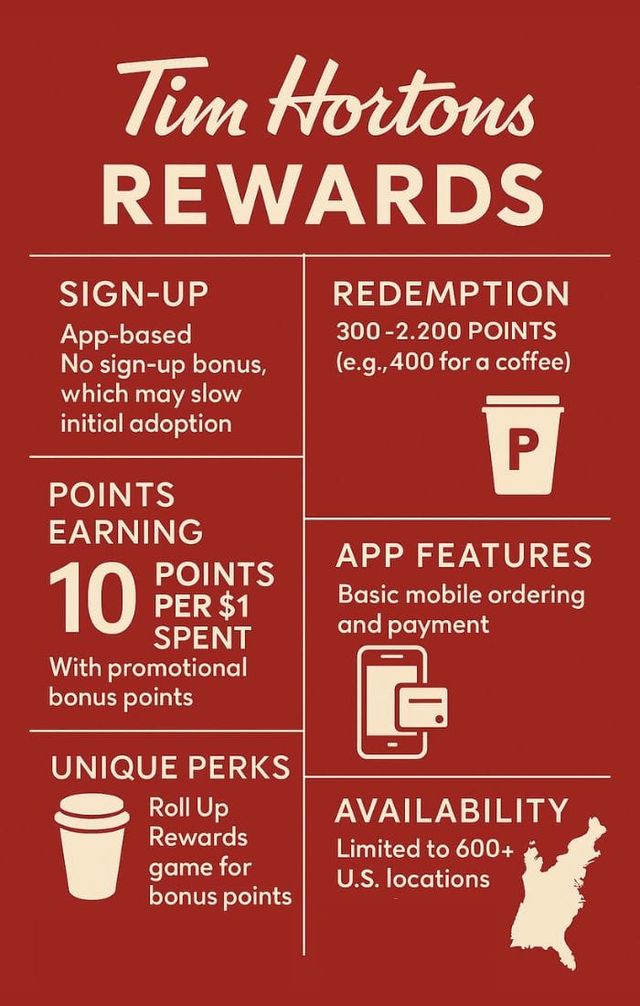
Tim Hortons, with 600+ U.S. locations in the Midwest and Northeast, focuses on value and accessibility, serving rural and suburban customers. Its rewards program is designed for cost-conscious regulars, offering basic incentives with minimal complexity. It’s a practical model for businesses in less urban markets.
Highlights:
- ign-Up: App-based, no bonus.
- Points: 10 points/$1, bonus promos.
- Redemption: 300–2,200 points (e.g., 400 for coffee).
- App: Basic ordering, payment, promos.
- Perks: Roll Up Rewards game for bonuses.
- Availability: Midwest/Northeast.
Pros: Simple, gamified.
Cons: High redemption thresholds, basic app.
Merchant Takeaway: Roll Up Rewards is a case study in using gamification to paper over a structural problem. When your first-reward threshold requires $40 in spend, customers disengage before they get there and a scratch card mechanic doesn't fix that. The lesson: solve the threshold problem first. Engagement mechanics work on top of a sound foundation; they don't replace one.
Caribou Perks
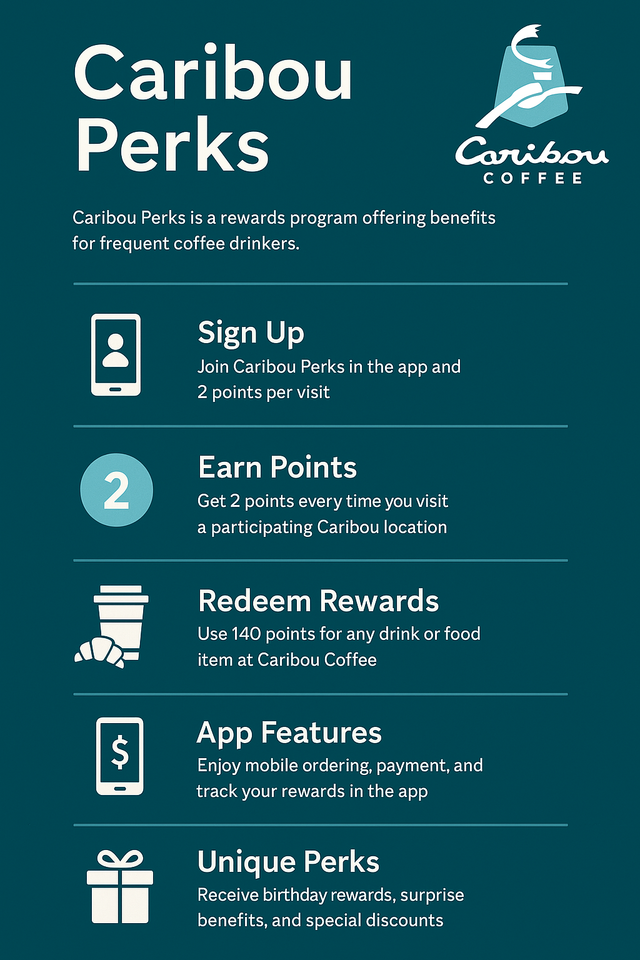
Caribou Coffee, with 800+ Midwest locations, emphasizes a cozy, community-oriented experience. Its Caribou Perks program targets suburban regulars, offering straightforward rewards that focus on simplicity. It’s a useful reference for mid-sized chains balancing accessibility and brand warmth.
- Sign-Up: App-based, 2 points/visit.
- Points: 2 points/visit, regardless of spend.
- Redemption: 140 points for any item.
- App: Mobile ordering, basic payments, tracking.
- Perks: Birthday treats, surprise rewards.
- Availability: Midwest.
Pros: Simple, community-focused.
Cons: Disadvantages for high spenders, basic app.
Merchant Takeaway: Per-visit earning is the fairest model you can run, as every customer gets the same reward regardless of what they spend. But fairness has a cost: 70 visits to first redemption is long enough that most customers will churn before they feel any payoff. If you borrow this mechanic, cut the redemption threshold in half. 35 visits is still achievable in 6–8 weeks for a daily regular, and that's the window where habits actually form.
How to Choose the Right Rewards Program for You
The best program depends on your visit frequency, location, and what you value in a loyalty relationship.
- Visit Frequency: Daily coffee drinkers benefit from programs with fast point-earning rates (e.g., Dunkin’ or Peet’s). Occasional visitors should pick programs with low redemption thresholds (e.g., Peet’s).
- Location: Ensure the coffee shop has locations near your home, work, or school. Starbucks is nearly ubiquitous, while Caribou and Tim Hortons are regional.
- Drink Preferences: If you love specialty drinks, choose programs that reward high-value items (e.g., Starbucks). For simple coffee, Dunkin’ or Tim Hortons suffice.
- App Usability: Prioritize apps with intuitive interfaces and mobile ordering. Starbucks and Dunkin’ lead here, while Tim Hortons’ app lags.
- Ethical Alignment: If sustainability matters, Peet’s fair-trade focus or Starbucks’ eco-friendly initiatives may align better with your values than those of less transparent chains.
For example, a student might choose Dunkin’ Perks for its quick rewards and budget-friendly menu, while a professional who values premium drinks and nationwide access might lean toward Starbucks Rewards. Gen Z users, who prioritize ethics, may gravitate to Peet’s for its sustainability focus. A 2023 consumer study by Loyalty360 noted that 65% of Millennials and Gen Z choose brands that align with their values, making this a key factor.
5 Tips to Maximize Your Rewards
Once you’ve joined a rewards program, use these strategies to get the most value from every visit. These tips address common pain points, such as slow point earning and redemption barriers, helping you save more.
- Use the App Consistently: Every in-app purchase counts toward your balance. Starbucks notifies you of double-star windows exclusively through the app, and members who miss those promotions are leaving points on the table every time.
- Stack Promotions: Double-point days and sign-up bonuses can compress your time to first redemption from weeks to days. Dunkin's "Boosted Status" windows are time-limited. Being aware of them matters.
- Redeem Strategically: 150 Starbucks stars for a $7 specialty latte is a better deal than 75 stars for a $3 drip. Save points for high-value items.
- Combine with Discounts: Student, healthcare, and corporate discounts stack with loyalty rewards at most chains. Starbucks' discount programs and rewards are fully combinable.
- Complete Feedback Requests: Peet's offers 5–10 bonus points for in-app surveys, the equivalent of $5–10 in spend for 90 seconds of your time. Worth doing.
These tips are grounded in program-specific promotions from coffee shop websites and user tips shared on X, ensuring practical, real-world advice.
Bottom Line
The best coffee shop rewards programs share three mechanics: a first-reward threshold customers can reach within 2–3 weeks of normal behavior, personalized promotion triggers based on individual purchase patterns, and loyalty data connected to checkout. Starbucks executes all three at scale. The gap between enterprise program sophistication and what any Shopify merchant can run today has never been smaller. Honestly.
If you're building a loyalty program for your own store, Joy delivers the same mechanics (points, tiers, referrals, and automated lifecycle triggers) to 30,000+ merchants without enterprise infrastructure costs.
Start your loyalty program with Joy - free install on Shopify
FAQs:
Which coffee shop has the best rewards program?
Starbucks Rewards delivers the most value for frequent specialty drink buyers: 2 stars/$1 with AI-driven personalized promotions and a redemption range starting at just 25 stars. For fast, low-threshold rewards, Dunkin' Perks earns 10 points/$1 with a free drink at 500 points. Peet's has the lowest first-reward threshold in the category at just 15 points. The right answer depends on which chain you actually visit and how fast you want to accumulate.
Does Starbucks still have a rewards program?
Yes. Starbucks Rewards has 34.3 million U.S. members as of 2024 (Source: Marketing Dive). You earn 2 stars per $1 spent, with redemption starting at 25 stars. The program runs regular double-star promotions that significantly compress earning timelines.
How do I start a loyalty program for my coffee shop?
Set your first-reward threshold below 3 average orders. Programs that require more have chronically low redemption rates. Choose a mechanic that fits your visit pattern: points-per-visit for high-frequency commuter shops, points-per-dollar for shops with diverse menus. Connect your loyalty platform to your email system so lapsed customers trigger automated win-back sequences at the 45-day mark. Joy handles all three on Shopify.
What makes a coffee loyalty program successful?
Three things: a first-reward threshold customers can reach within 2–3 weeks of normal behavior, personalized promotion triggers (not mass blasts), and loyalty data connected to your marketing stack. Programs with redemption rates above 30% consistently share all three. Programs below 15% typically fail on the first-reward threshold alone.
How many points do you need for a free Starbucks drink?
150 stars for a handcrafted drink (latte, cold brew, etc.). You earn 2 stars per $1, so $75 in purchases gets you there under normal conditions. During double-star days, which Starbucks runs several times per quarter, you earn 4 stars per $1, compressing the path to 150 stars to under $40 in spending.
Can small coffee shops compete with Starbucks Rewards?
On some mechanics, independent shops have a structural advantage. They can offer first-reward thresholds in 3–5 purchases rather than 12–15, create community-specific perks (regulars by name, local sourcing transparency, neighborhood events), and configure tiered programs through platforms like Joy without enterprise infrastructure costs. The chains win on AI personalization at scale. Independents win on speed, community, and the fact that your barista actually knows your name.