Grocery chains spend millions building loyalty programs. Some drive real repeat visits. Most don't. Most rankings of grocery loyalty programs are written for shoppers. They list earnings rates and perks but skip the strategy beneath.
Why does Kroger expire fuel points monthly? How does Target's coupon stacking create deeper engagement than a flat percentage back? Why does Costco's paid tier feel safe to try, while others feel like a risk?
We broke down the earning structures, redemption psychology, and paid-tier strategy behind eight major grocery loyalty programs to identify what shop owners can actually learn from them.
This guide analyzes each program through a business lens:
- What it's designed to do
- How it drives retention
- Where the design breaks down
I. What Makes a Grocery Loyalty Program Work
Before breaking down individual programs, it helps to understand the levers grocery chains actually pull to drive retention. These are the same levers that apply to any shop owner's loyalty program.
We evaluated every program in this guide on five criteria:
1. Earning structure design
This shapes how often customers return and how much they spend per visit. Most grocery programs follow a "$1 spent = 1 point" model, but the earning side is only half the equation.
A program that hands out points generously but makes redemption confusing won't change shopping behavior. The redemption side determines whether customers actually engage.
2. Redemption psychology
This is where programs win or lose. Fuel discounts create a reason to visit weekly. Store credit encourages the next purchase. Birthday perks build emotional connection.
The best programs make redemption feel like a reward, not a chore. When customers want to redeem, they come back more often to earn.
3. Paid tier monetization
This reveals how chains think about customer lifetime value.
- Walmart+: $98/year for delivery, fuel, and streaming
- Kroger Boost: $69/year for 2X fuel points and free delivery
- Costco Executive: $130/year for 2% back on all purchases
Each takes a different approach to segmenting high-value customers and giving them a reason to consolidate spending.
4. Digital engagement mechanics
The shift to app-exclusive deals isn't just a tech upgrade. It's a data collection strategy.
Every app open is a touchpoint. Every clipped coupon is a signal. That behavioral data funds the personalization that drives higher basket sizes.
5. Retention hooks
These are the specific design choices that keep customers coming back.
- Monthly point expiration at Kroger creates urgency
- Coupon stacking at Target rewards effort
- Weekly BOGOs at Publix build a shopping habit
Each hook solves a different retention problem. The question for shop owners: which problem are you solving?
II. Quick-Reference Comparison
Here's a snapshot of the six programs we cover in this guide. Scan for what interests you, then read the full breakdown below.
| Program | Cost | Core Strategy | Retention Hook | Design Weakness |
|---|---|---|---|---|
| Kroger Plus Card | Free | Fuel points drive weekly visits | Monthly expiration creates urgency | Lose-it-or-lose-it frustration |
| Target Circle | Free (360: $49-$99/yr) | Coupon stacking rewards engagement | Three-layer savings on single items | Smaller grocery selection limits frequency |
| Walmart+ | $98/year | All-in-one bundle reduces churn | Delivery + fuel + streaming locks families in | $35 minimum + price markups on delivery |
| Costco Executive | $130/year | 2% back rewards high spenders | Downgrade refund removes risk | Requires high spend to justify |
| Publix | Free | BOGO culture builds a weekly habit | Weekly ad planning = repeat visits | Higher base prices without deals |
| Safeway for U | Free | Personalized digital coupons | Purchase history drives relevance | Value varies by region |
III. Best Grocery Store Loyalty Programs: The Business Breakdown
1. Kroger Plus Card: How Fuel Points Drive Weekly Visits
The business logic: Kroger ties grocery spending directly to fuel savings. The earning structure is simple: 1 fuel point per $1 spent on groceries. Collect 100 points, get $0.10 off per gallon at Kroger fuel stations and participating Shell locations.
But the real strategy isn't the earning rate. It's the expiration design.
The retention mechanic: Fuel points expire at the end of each calendar month. That's intentional. Monthly expiration creates a recurring deadline that pushes customers to:
- Consolidate grocery spending at Kroger (not split across competitors)
- Fill up before the month ends (creating a predictable visit)
- Check the app regularly for fuel point bonus coupons (2X or 5X on specific items)
Each app open is a data touchpoint. Each bonus coupon redeemed is a signal Kroger uses to refine what it shows you next.
One widely cited figure puts average Kroger Plus savings at $576/year, but that number includes heavy digital coupon use and fuel discounts combined. Actual savings vary widely based on app engagement and fuel usage.
The paid tier: Kroger Boost Essential costs $69/year. It doubles fuel points and adds free next-day delivery on orders over $35. Break-even requires roughly two deliveries per month plus weekly fill-ups. The upgrade targets Kroger's most engaged customers and shifts them from in-store-only to omnichannel.
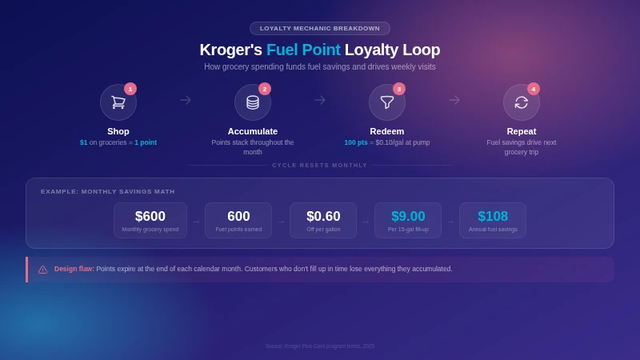
Design flaw: Monthly expiration punishes infrequent shoppers and light drivers. Customers who don't fill up regularly lose accumulated value. That breeds resentment, not loyalty. A rolling 60- or 90-day window would keep the urgency without the cliff.
Takeaway for shop owners: Tying rewards to a high-frequency need (like fuel) creates a natural visit cadence. But expiration rules need to match your customers' buying cycle. Too aggressive, and you punish the customers you're trying to keep.
2. Target Circle: Why Coupon Stacking Builds Deeper Engagement
Most grocery loyalty programs limit customers to one discount per item. Target lets them combine a store deal, a Circle offer, and a manufacturer's coupon on the same purchase. Three layers of savings on a single item.
That's the business logic worth studying. Stacking doesn't just save money. It rewards effort. Customers who learn the system feel like insiders, and that emotional investment is stickier than any flat percentage-back program.
The base earning rate is modest: 1% back on Target purchases as store credit. Unremarkable on its own. But a customer who clips coupons, loads Circle offers, and combines them with store deals can regularly save 15-25% on specific items.
Circle 360 ($49/year with a RedCard, $99 without) adds same-day delivery. It targets convenience shoppers who might otherwise drift to Walmart+ or Amazon.
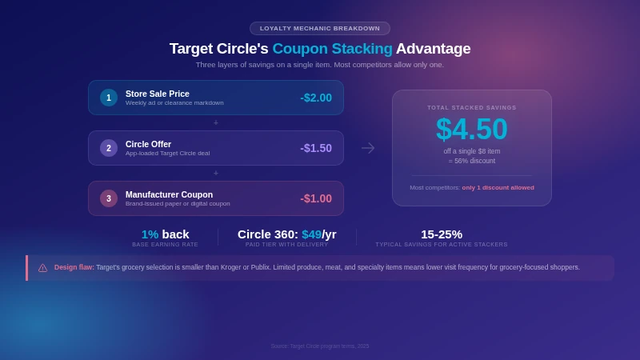
Design flaw: Target's grocery selection is smaller than Kroger's or Publix's. Limited produce, meat, and specialty items mean lower visit frequency for grocery-focused shoppers. No loyalty mechanic overcomes a product gap.
Takeaway for shop owners: Stacking rewards engagement, not just spending. If your program lets customers feel like they earned a deal through effort, you build emotional loyalty on top of transactional loyalty. Consider whether your reward structure rewards action (loading offers, sharing, reviewing) or just passive spending.
3. Walmart+: The Bundle Strategy That Locks Families In
Walmart+ isn't really a loyalty program. It's an everything bundle.
$98/year wraps grocery delivery, fuel discounts ($0.10/gallon), Paramount+ streaming, and scan-and-go checkout into a single membership. The strategy: make canceling feel like losing too much at once.
The break-even math works fast for families. Filling up 15 gallons per week at $0.10 off saves about $78/year on gas. Add two $50+ delivery orders per month, and total annual savings hit roughly $269 against the $98 fee.
Once a family pays the annual fee, they feel invested. Instead of comparing prices across stores, they shop at Walmart first because they've "already paid for it." The streaming add-on reinforces this. It's not a grocery perk, but it makes the membership touch daily life.
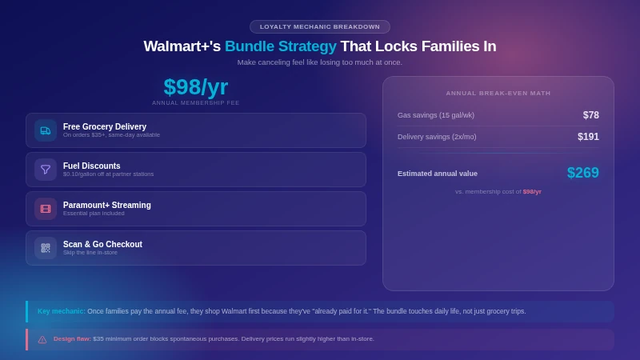
Design flaw: "Free delivery" requires a $35 minimum order, blocking spontaneous small purchases. Item prices on the delivery platform also run slightly higher than in-store. Both create quite a trust gap if customers notice them.
Takeaway for shop owners: Bundling multiple benefits into a single membership increases switching costs and reduces churn. Each perk in Walmart+ is modest individually. The bundle makes it feel like a steal. But every promise needs to deliver cleanly. Hidden minimums or price adjustments undermine the trust that makes bundles work.
4. Costco Executive Membership: Segmenting by Spend
Costco's Executive tier ($130/year versus $65 for Gold Star) offers 2% back on all purchases, capped at $1,250/year.
The real play is customer segmentation. The $65 upgrade fee is deliberately calibrated: you need roughly $271/month in Costco spending to break even. A household spending $500/month earns $120 back, netting $55 after the fee. Easy to hit for committed shoppers. Not worth it for casual visitors.
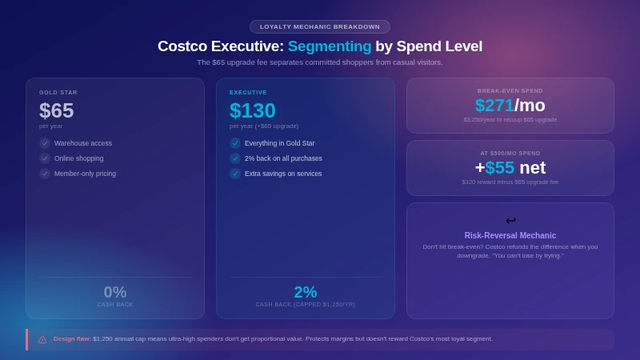
The part most analyses miss: the risk-reversal mechanic. If you don't hit break-even, Costco refunds the difference when you downgrade. The message to the customer: "You can't lose by trying." That removes the friction that kills most paid tier upgrades.
The 2% reward also creates an interesting psychological effect. The annual reward check feels like found money. Customers who receive $100+ at renewal don't think about whether the math justifies the fee. They think about what they'll buy with it.
Design flaw: The $1,250 annual cap means ultra-high spenders get the same reward as moderate-high spenders. It protects margins but doesn't scale for Costco's most loyal segment.
Takeaway for shop owners: Paid tiers work best when they segment customers by commitment level and remove friction from upgrading. Costco's downgrade refund is worth studying. If your paid tier feels risky to try, fewer people will try it. A guarantee, trial period, or break-even calculator can change that.
5. Publix: Building Loyalty Without Points
Publix builds strong loyalty without a points system, a loyalty card, or tiered memberships.
Instead: aggressive weekly BOGO deals, a digital coupon app, and small emotional touches like a free birthday bakery item. There's nothing to track, nothing to expire, nothing to game. The simplicity is the strategy.
The weekly BOGO rotation creates the retention cadence. Customers who plan meals around the deals visit Publix as a habit. Check the ad on Wednesday, shop on Thursday. That weekly rhythm is harder to disrupt than a points balance.
The birthday bakery item costs Publix almost nothing. A cookie or cake slice doesn't dent margins. But it creates a moment of genuine warmth, especially for families with kids. These emotional micro-moments build the kind of loyalty that points never will.
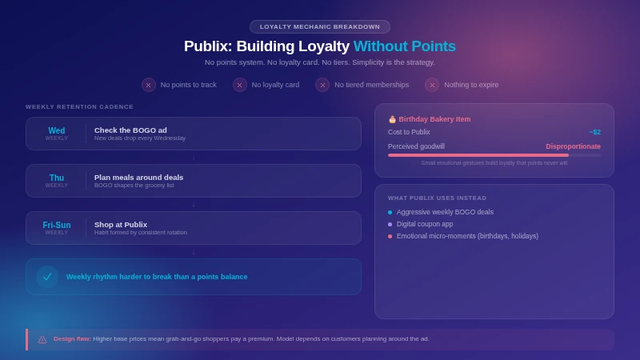
Design flaw: Publix's regular prices (before deals) run higher than Walmart, Aldi, or Kroger. The model depends on customers planning around the ad. Grab-and-go shoppers pay a premium. Publix also operates only in the Southeast.
Takeaway for shop owners: You don't need points to build loyalty. Consistent promotions with a predictable cadence can drive the same visit frequency. But base pricing needs to support the model. Also, don't underestimate small gestures. A birthday perk that costs you $2 can generate more goodwill than a $10 rewards balance.
6. Safeway for U: Personalization as Strategy
Safeway bets on personalized digital coupons driven by purchase history. The app learns what you buy and surfaces relevant deals.
Generic coupons get ignored. Coupons for products you already buy feel useful. Over time, the app's relevance builds a habit of checking before each trip. That pre-trip app open is a data touchpoint that feeds the personalization engine. More usage means better offers, which drives more usage. Self-reinforcing loop.
The fuel points program works like Kroger's: earn points on groceries, redeem for per-gallon discounts. Digital coupon volume is generous, and offers rotate frequently.
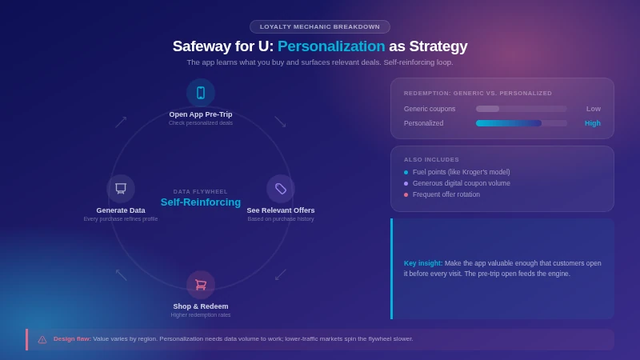
Design flaw: Value varies significantly by region. In markets where Safeway dominates and has strong fuel partnerships, the savings add up. In competitive markets, the discounts don't stand out. Personalization needs data volume to work, and lower-traffic markets spin the flywheel slower.
Takeaway for shop owners: Personalized offers based on purchase history consistently outperform generic discounts. If your loyalty platform supports behavioral segmentation (Joy does), use it. Relevant rewards get redeemed at higher rates. But personalization requires adoption first. Make the app valuable enough that customers open it before every visit, and the engine feeds itself.
IV. What Most Grocery Store Loyalty Program Rankings Don't Tell You
Most articles list features and earning rates. They skip the design problems. Every flaw below showed up in our analysis.
1. Expiration rules that punish instead of motivate
Kroger's fuel points expire at the end of every calendar month. Miss the deadline by a day? You lose everything.
Deadlines drive action. But too-tight windows don't motivate. They punish.
Fix: Match expiration to your customers' buying cycle. A rolling 60- or 90-day window keeps urgency without the cliff.
2. "Eligible purchases" that nobody defines
Most grocery programs exclude alcohol, tobacco, gift cards, and pharmacy from earning. Reasonable. The problem: they don't say so upfront.
Customers expect to earn on everything. When they don't, trust breaks.
Fix: List exclusions clearly on your rewards page. Transparency costs nothing.
3. App-only deals with no fallback
App-exclusive coupons are a data play. More usage, more purchase data, better personalization. It works.
But digital-only assumes every customer uses a smartphone. Older shoppers, often your highest spenders, may not.
Fix: One fallback closes the gap. Email deals, in-store signage, or account lookup at checkout.
4. Data collection without a visible trade
Every program here tracks purchases. Most don't show customers what they get in return.
Safeway does this right: your history directly improves the deals you see. Most others collect the same data silently.
Fix: Make the payoff obvious. Personalized deals, relevant recommendations, and faster reorder.
5. A loyalty program on top of a product problem
Target's grocery selection is smaller than Kroger's. No coupon stacking fixes that. Publix's base prices run higher than Walmart's. No BOGO changes the math for grab-and-go shoppers.
Fix: There isn't one at the program level. Fix the fundamentals first.
V. Build Your Own Grocery Store Loyalty Program
The best grocery store loyalty programs win because the earning structure, redemption design, and retention hooks match how customers actually shop. Not because they have the most features.
The same principles apply to any store. Start simple. Keep rules transparent. Reward engagement, not just spending.
Want to go deeper? Read our guides on how to create a loyalty program.
These programs change terms regularly. The best operators study what works, adapt, and keep testing.