Single-mechanic loyalty programs have a ceiling. You can add points for purchases and get a modest bump in repeat orders. But you won't build the kind of engagement that makes customers choose you over a competitor with a similar offer.
The brands with the strongest retention do something different. They combine multiple mechanics: points with tiers, gamification with referrals, experiential rewards with social impact, into hybrid programs that give customers more ways to engage and more reasons to stay.
According to Gallup research, fully engaged customers are 23% more profitable than average. The question isn't whether engagement works. It's how you build a program that creates it.
This guide breaks down seven hybrid loyalty programs, what mechanics they combine, why they work, and what you can copy on your Shopify store without enterprise budgets.
First, a quick definition so we're on the same page.
What Is a Hybrid Loyalty Program?
A traditional loyalty program uses one mechanic, usually points for purchases. A hybrid loyalty program combines two or more mechanics into a single system. It doesn't just reward spending. It rewards multiple behaviors and appeals to multiple motivations.
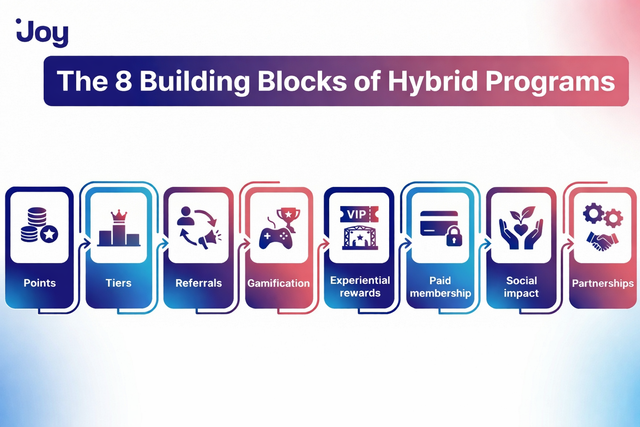
There are eight building blocks you can mix and match: points, tiers, referrals, gamification, experiential rewards, paid membership, social impact, and partnerships.
The upside is real. You can appeal to discount seekers, status seekers, and values-driven buyers all within the same program. Customers invested in multiple mechanics are harder to lose because they have more reasons to stay.
The downside? More complexity. More communication. According to the COLLOQUY study, nearly one-third of consumers don't even know which tier they belong to. If your members can't understand how to earn and redeem, the extra mechanics hurt more than they help.
The seven brands below figured out how to get the benefits while managing the complexity. Here's what they did and what you can take from each.
1. Starbucks Rewards: Points + Tiers + Gamification
Starbucks Rewards is probably the most recognized loyalty program in the world. It combines three mechanics that reinforce each other: Stars (points), tiered status levels, and personalized challenges (gamification).
How it works
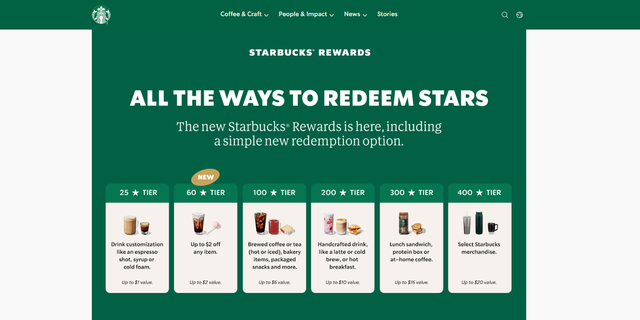
Members earn one Star per $1 when paying with cash or card, or two Stars per $1 when using a preloaded Starbucks Card. Redemption starts at just 25 Stars for a drink customization and goes up to 400 Stars for select merchandise. That low entry point matters. Customers feel rewarded quickly, which keeps them engaged early.
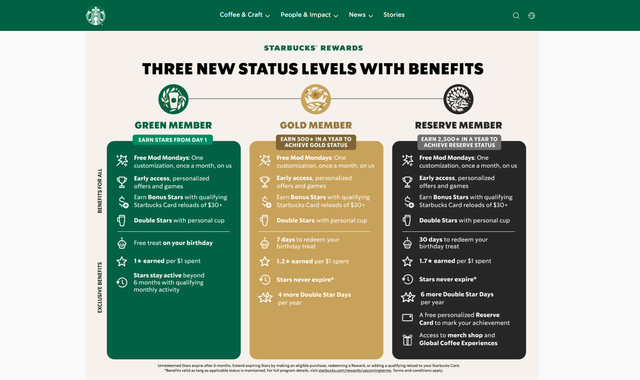
The tier system adds a longer-term goal. Earn enough Stars within 12 months, and you unlock Gold or Reserve Member status, which includes a free birthday drink, free refills, early access to new products, and personalized offers. You need to re-qualify each year, so there's always a reason to keep earning.
Then there's gamification. Starbucks layers in Double Star Days, AR games, and custom challenges like "Order two lattes within five days, earn 30 bonus Stars." These challenges are personalized to each member's habits, which makes them feel achievable rather than random.
Why it works
Starbucks turned a daily coffee run into a loop: earn Stars, check progress, complete challenges, repeat. The program now drives over 53% of Starbucks' U.S. revenue, and members spend roughly 3x more per visit than non-members.
The key insight isn't the app or the tech. It's the behavior loop. Every element -- the low redemption threshold, the time-limited challenges, the annual re-qualification -- keeps customers coming back on a short cycle.
What you can copy
You don't need a $200K app. A "Double Points Weekend" email campaign creates the same urgency Starbucks gets from its in-app challenges.
Here's how to run one: segment customers who haven't purchased in 30-60 days. Send an email announcing the promotion with a clear deadline (this weekend only). Reference their current point balance to increase the perceived value. "You have 320 points. This weekend, every purchase earns double. You're 180 points from a $10 reward."
Joy lets you set up bonus point campaigns like this from your dashboard -- no code needed. Create "Double Points Days" or "Bonus Points on Category X," attach a date range, and let the mechanic do the work. Then track whether it actually moves your repeat purchase rate.
Watch out for
Starbucks spends millions on app development. Building a similar app costs $200,000 to $400,000+, plus ongoing maintenance. Focus on the mechanics, not the tech. Test your program structure through email and SMS first. Only invest in custom development after proving the mechanics work.
2. Sephora Beauty Insider: Tiers + Experiential Rewards
Sephora Beauty Insider proves something important: high-value customers want status, not just savings. The program combines a three-tier structure with experiential rewards that make members feel recognized, not just discounted.
How it works
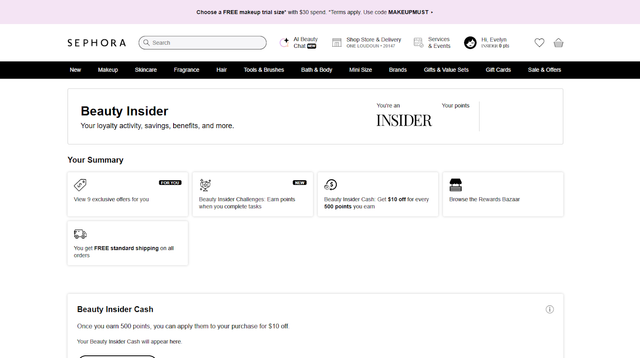
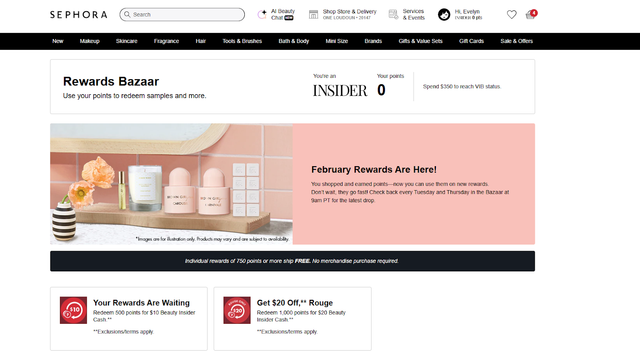
The program has three tiers based on annual spend. Insider is free to join and earns one point per $1. VIB (Very Important Beauty) requires $350/year and earns 1.25 points per $1, plus one free custom makeover annually and 15% off during seasonal sales. Rouge, the top tier at $1,000/year, earns 1.5 points per $1 and unlocks the best perks: 20% off during sales, free shipping with no minimum, unlimited custom makeovers, and early access to new products 24-48 hours before public launch.
What makes this program different is the focus on experiences over discounts. Rouge members get exclusive in-store events with brand representatives and influencers, premium birthday gifts, and full-size complimentary products instead of samples. These perks create an emotional connection that a flat percentage off can't match.
Why it works
Rouge members don't stay for 20% off. They stay because they're Rouge. The program has over 45 million members in North America, and the majority of Sephora's transactions come from Beauty Insider members.
Sephora's leadership has said repeatedly that emotional perks, not transactional ones, drive the strongest engagement. This matches broader research: brands that build emotional connections see roughly 2x the behavioral lift compared to traditional discount programs.
The takeaway for your store? If your best customers already love your brand, give them a way to feel that status. A VIP label and early access to a product drop can mean more than another 10% off.
What you can copy
Offer "VIP early access" to new products 24 hours before public launch. This costs you nothing but feels exclusive. Segment your email list by tier, send VIPs a link before everyone else, and include inventory count to create urgency ("Only 50 available before public launch").
Joy supports unlimited tiers with custom benefits. You can set up early access or "gift with purchase" at higher tiers without code. The trick is starting with one signature perk per tier and mastering it before adding more.
Watch out for
Experiential rewards require fulfillment. Custom makeovers need staff. Exclusive events need coordination. Sephora didn't launch all these perks at once. The program has evolved gradually since 2007. Start simple, prove the mechanic works, then layer in complexity.
3. Nike Membership: Content + Community + Early Access
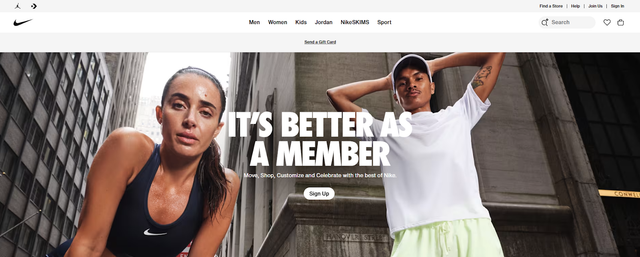
Nike takes a completely different approach to loyalty. Instead of rewarding purchases with points, they reward engagement with access. The program combines free fitness content, community features, and member-exclusive products into a system that keeps customers connected to the brand daily, whether they're buying or not.
How it works
Nike Membership spans four connected apps. Nike Training Club offers hundreds of free workouts led by Nike trainers and athletes. Nike Run Club tracks runs with GPS, provides audio-guided coaching, and hosts community challenges like monthly distance goals. The main Nike App delivers personalized product recommendations, member-exclusive pricing (10% off at all times), and birthday rewards. And SNKRS gives members early access to limited drops through an invite-only "Exclusive Access" system based on engagement history.
None of these apps require purchase to use. You can train with Nike Training Club for months without buying anything. That's the point. Nike builds daily habits first, then lets purchases follow naturally.
Why it works
Nike doesn't need you to buy every week. They need you to open the app every day. Once someone checks Nike Training Club five times a week for workouts and tracks runs daily with Nike Run Club, they're already invested. When a new product drops, the purchase feels like a natural extension of that relationship.
Nike members spend 3x more than non-members, and the program has over 300 million members worldwide.
The principle here is simple: attention builds loyalty. If customers interact with your brand daily for reasons beyond shopping, they'll buy more when the time comes.
What you can copy
Award points for non-purchase actions. Each action is a touchpoint that pulls customers deeper into your brand. Joy lets you reward account creation, reviews, social follows, birthdays, and referrals without code. For example: 50 points for account creation, ten points per review, 15 points for Instagram follow, and 50 points per successful referral.
You're not Nike, and you don't need four apps. Pick three to four non-purchase actions that matter to your brand and reward them through email, SMS, or your loyalty dashboard. Copy the principle (attention builds loyalty), not the tech.
Watch out for
Nike's four apps cost millions to build and maintain. The lesson isn't to replicate the ecosystem. It's to find your version of "daily value beyond shopping." For some brands, that's a weekly email with styling tips. For others, it's a community challenge. The mechanic matters less than the consistency.
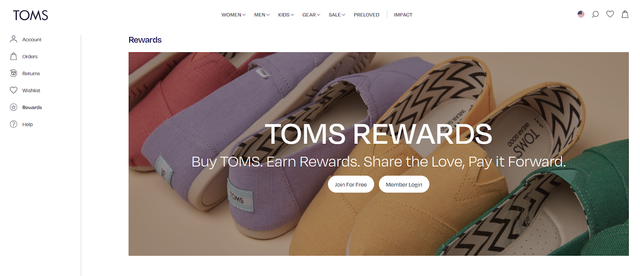
4. TOMS Passport Rewards: Points + Social Impact
Not every customer optimizes for discounts. Some choose brands based on values, not prices. TOMS Passport Rewards proves that social impact can be a loyalty mechanic, not just a marketing message.
How it works
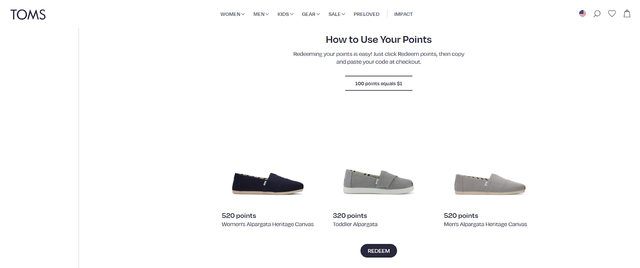
Members earn points on purchases at a standard rate (100 points = $10 in value). The program also includes a referral component: give 20% off, get 20% off.
What makes TOMS different is the redemption. Members can use points for discounts, or they can donate points to the TOMS Giving Fund. A $25 donation option lets members support U.S.-based community programs and after-school groups. The dashboard shows where donations go and the total community impact, so members can see their contributions add up over time.
Why it works
TOMS customers already buy for impact. The company was founded in 2006 on the One for One model, and that mission attracted a specific type of buyer. The loyalty program extends that identity by giving members a choice: take a discount or give back.
In a typical year, a small percentage of members donate their rewards. But when TOMS created a COVID-19 giving option in March 2020, participation surged – it became the most redeemed giving reward in TOMS history, raising over $42,000 in five months.
The deeper insight: emotionally connected customers are more valuable over time. They're more likely to spend, more likely to stay, and more likely to refer others. Giving them a way to act on their values through your program strengthens that connection.
What you can copy
Add one charity redemption option. Even a small donation per 100 points builds emotional connection. Joy allows custom reward types, so you can create "Donate $5 to [Organization]" as a redemption option alongside discounts.
Pick a cause aligned with your brand. Show members exactly what their donation supports. Track and share total community giving. The transparency is what makes this feel real instead of performative.
Watch out for
This only works if your brand has authentic value alignment. Consumers detect "purpose-washing" and view it as cynical. TOMS succeeds because impact was central to the brand from day one, not an afterthought. If you're adding charity redemption, commit to the cause first. Build an internal culture around it. Then invite customers to participate.
5. Amazon Prime: Paid Membership + Bundled Benefits
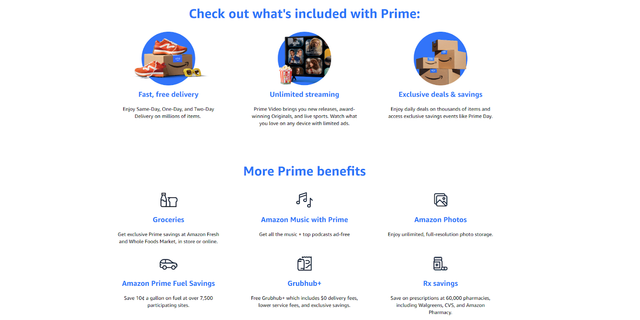
Free loyalty programs aren't the only model. Amazon Prime proves that customers will pay for membership if the benefits are obvious and immediate. The program bundles shipping, streaming, groceries, and exclusive deals into one subscription that makes shopping anywhere else feel like a downgrade.
How it works
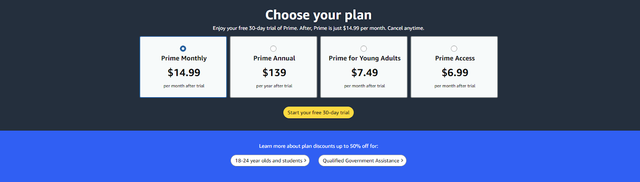
Prime costs $139/year (or $14.99/month). In return, members get free two-day shipping on over 300 million items, with same-day delivery available in 110+ metro areas. Beyond shipping, the membership bundles Prime Video, Prime Music, Whole Foods discounts, Prime Day access, and Grubhub+ at no extra cost.
The fee funds better benefits, and the benefits justify the fee. It's a self-reinforcing loop.
Why it works
The fee creates psychological commitment. Once you've paid $139, you want to "get your money's worth." This drives behavior change. According to Consumer Intelligence Research Partners (CIRP), Prime members spend roughly $1,170/year compared to $570 for non-members.
Research explains the psychology. Customers who pay for loyalty program participation perceive better value and show greater loyalty than free members. The payment itself becomes an anchor. Canceling feels like losing something, not just stopping something. Amazon reinforces this by stacking benefits until the math is obvious. J.P. Morgan estimates Prime delivers over $1,400 in annual value -- more than 10x the membership cost.
What you can copy
Test a paid VIP tier. A $4.99/month membership with free shipping and 10% off everything can work if your margins support it.
Joy supports paid VIP tiers where you set the monthly fee and exclusive benefits. The key is making the value obvious at a glance. If members need to pull out a calculator to figure out whether the tier is worth it, you've already lost them. Do the math before launching: calculate your average shipping cost per order, your typical discount amount, and expected order frequency. The value should be clear within two to three orders.
Watch out for
Paid tiers only work if benefits clearly exceed the fee. If members need to place 15+ orders annually just to break even, the tier will feel like a bad deal. Sunk cost psychology only works when customers feel the deal is fair. Overcharge, and trust erodes fast. Test with a small segment first and track retention over 90 days before rolling it out broadly.
6. REI Co-op: Lifetime Membership + Annual Dividend
REI takes a different approach entirely. Instead of annual subscriptions or points, they offer a one-time lifetime membership with an annual dividend. The result? Members don't feel like customers. They feel like owners.
How it works
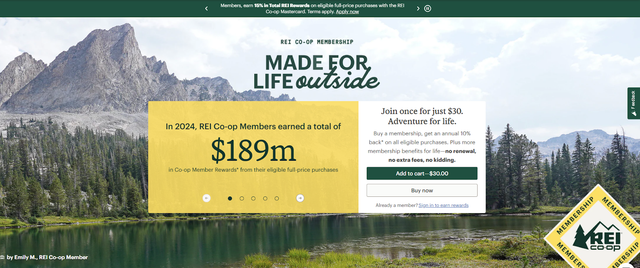
Members pay a $30 one-time fee that never expires. No annual renewal, no cancellation hassle. In return, they receive a 10% annual dividend on eligible full-price purchases, paid once per year (typically in March). The dividend arrives as store credit, not points.
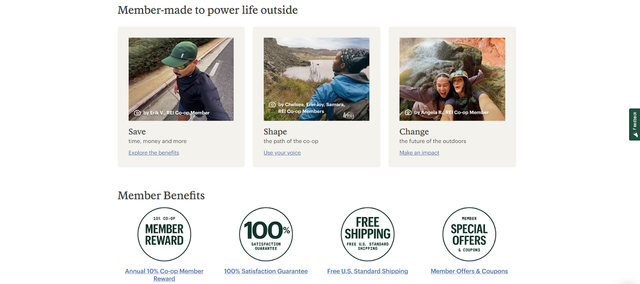
Beyond the dividend, members get free standard shipping with no minimum, access to member-only sales throughout the year, used gear through the Re/Supply program, up to 33% off gear rentals, and a full one-year return window. They can also vote on REI's board of directors because REI is an actual member-owned cooperative, not just a loyalty program dressed up as one.
Why it works
The language matters more than you'd expect. REI members don't "earn points." They "receive their dividend." That framing creates psychological ownership. Research shows that calling a benefit a "dividend" increases perceived value compared to identical benefits called "points." Members place dividends in a different mental category -- one that feels earned rather than spent.
This psychology drives real results. REI members spend significantly more annually than non-members. The program has 25 million members, and REI distributed over $210 million in member rewards and credit card rewards in recent years.
What you can copy
Consider a "Founder's Club" for your first 100 customers. One-time qualification, lifetime benefits. This creates scarcity ("only 100 spots"), rewards early adopters, and builds a founding community with shared identity.
Joy's tier system can replicate this model. Set a one-time purchase threshold or points requirement for permanent VIP status with no annual requalification. Think about your reward language too. "Your annual reward" sounds different from "your points balance." Small framing changes can shift how customers feel about your program.
Watch out for
Lifetime tiers reduce urgency. If members have benefits forever, what motivates them to engage now? REI solves this by layering time-limited perks on top of permanent benefits. Member Month (March) offers 20% off coupons. Seasonal sales create recurring engagement moments. Limited-edition products sell out quickly. Without these time-sensitive triggers, lifetime members can go inactive. Pair your permanent benefits with monthly challenges, seasonal exclusives, or surprise bonuses to maintain engagement.
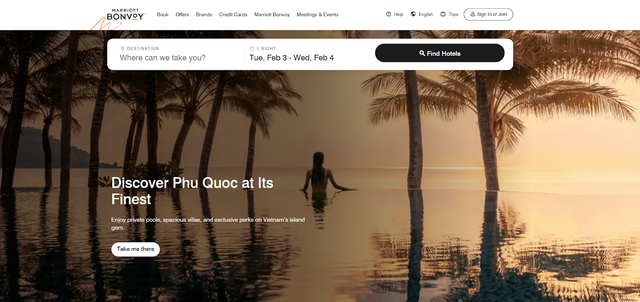
7. Marriott Bonvoy: Points + Tiers + Partnerships
Most hotel loyalty programs have a frequency problem: members don't stay often enough to earn meaningful rewards. Marriott Bonvoy solves this through partnerships. By extending earning opportunities beyond hotels, the program stays relevant even when members aren't traveling.
How it works
Members earn 2.5-10 points per $1 on hotel stays, depending on the property brand. Elite status adds bonus multipliers (up to 75% extra for Titanium Elite), meaning high-tier members can earn up to 17.5 points per $1.
But hotel stays are just the start. Marriott co-branded credit cards earn 3X-6X points on everyday purchases. United MileagePlus members can transfer miles to Marriott (and vice versa). Uber Eats orders earn Bonvoy points. In the UK, Nectar retail purchases convert to Marriott points. Starbucks even runs "Double Stars" promotions during Bonvoy Weeks.
The tier structure runs five levels: Silver (ten nights/year), Gold (25 nights), Platinum (50 nights), Titanium (75 nights), and Ambassador (100 nights plus $20,000 in annual spend). Each tier unlocks better perks: late checkout, room upgrades, lounge access, complimentary breakfast, and eventually a dedicated Ambassador concierge.
Why it works
Partnerships solve the frequency problem. Instead of waiting months between hotel stays, members earn points weekly through everyday purchases. That keeps the program top-of-mind and makes switching to a competitor feel costly.
When members see "earn Marriott points" at Uber checkout, brand awareness spikes. Points from groceries and rides feel incidental – almost free – which increases their perceived value compared to points earned through direct spending.
What you can copy
Partner with a complementary brand for cross-promotion. "Earn 100 bonus points when you shop at [Partner]" costs you almost nothing but adds perceived value and gives customers a reason to think about your brand between purchases.
Joy integrates with Shopify's ecosystem, so points can trigger Shopify Flow automations and sync with Klaviyo segments. While you won't have airline partnerships, you can create a "connected" program feel by rewarding purchases at complementary brands or linking your loyalty program to joint promotions.
Watch out for
Partnerships require negotiation, legal agreements, and attribution tracking. Marriott took 15+ years to build its current partner network. Start with one simple cross-promotion: a "bonus points on first purchase at [Partner]" offer for six months. Prove the model works with a single partner before trying to build a network.
How to Choose Your Hybrid Combination
Seven brands, seven industries, but clear patterns emerge. Here's how to decide which mechanics to combine for your store.
Match mechanics to your business model
Not every combination works for every brand. Here's a starting framework:
If you sell consumable or replenishable products (coffee, skincare, supplements), the Starbucks model fits best. Points + gamification create short purchase cycles. Double Points Days and time-limited challenges drive frequency.
If you sell premium or aspirational products (fashion, beauty, electronics), the Sephora model works. Tiers + experiential rewards give high-value customers a reason to consolidate spending with you. Early access and VIP events create emotional attachment.
If you have a content-rich or lifestyle brand (fitness, outdoor, hobby), the Nike model applies. Content + community + early access builds daily engagement that translates into purchases over time.
If your brand has strong values alignment (sustainability, social causes, ethical sourcing), the TOMS model fits. Points + social impact gives values-driven customers a way to express their identity through your program.
If you have high order frequency and strong margins, the Amazon model is worth testing. Paid membership + bundled benefits create commitment through sunk cost psychology.
If you want long-term community and loyalty with less churn management, the REI model works. Lifetime membership + annual rewards create ownership psychology.
If your purchase frequency is low (travel, furniture, luxury), the Marriott model helps. Partnerships extend earning opportunities beyond your store so the program stays relevant between purchases.
Start with two mechanics, then layer
Every brand in this guide started simpler than where it is today. Sephora launched with basic tiers in 2007 and added experiential rewards over the years. Amazon Prime started with just free shipping.
For most Shopify stores, the best starting combination is: points (earn on purchases) + tiers (three levels based on annual spend) + one non-purchase action (reviews or referrals).
Launch sequence: start with points and tiers in month one. Add referrals in month two. Introduce bonus campaigns (Double Points Days) in month three. This phased approach reduces confusion and lets you test what works.
The three things every successful hybrid program shares
Across all seven examples, three patterns hold:
Emotional connection beyond discounts. Every program gives customers a reason to care that isn't price. Starbucks creates rituals. Sephora sells status. Nike builds identity. TOMS aligns with values. REI creates ownership. Find yours.
Multiple touchpoints beyond purchases. The programs that retain best are the ones customers interact with between purchases. Whether that's checking a challenge, reading content, or tracking a dividend, non-purchase engagement predicts long-term retention.
Clear, simple communication. Complexity kills hybrid programs. Every brand on this list makes it obvious how to earn, what to earn, and why it matters. If your customers can't explain your program in one sentence, simplify it.
FAQs
How do I measure if my hybrid program is working?
Focus on three metrics. First, the redemption rate: target 20-40%. Below 20% means rewards feel out of reach. Above 50% means they're too easy to earn. Second, member vs. non-member purchase frequency. If your members aren't buying more often than non-members, the program needs work. Third, track how many customers actually move up tiers. If nobody's progressing, your thresholds might be too high or your benefits not compelling enough.
What's the minimum budget to test a hybrid approach?
You can start for free with Joy's free plan, which includes core hybrid mechanics. The real cost isn't software; it's the time to design your program structure, create the email campaigns around it, and analyze results. Budget two to four hours per week for the first three months to set up, communicate, and iterate.
Which mechanic should I add first if I already have points?
Tiers. They create aspiration and give your best customers a reason to spend more. Three tiers is the sweet spot -- easy to understand, clear progression. Name them something that fits your brand (not just Bronze/Silver/Gold). Then add referrals as your second mechanic, since they drive acquisition alongside retention.
Can I add a paid VIP tier?
Yes, if the math works. Calculate your average shipping cost, typical discount amount, and expected order frequency. If a member can recoup the fee within two to three orders, it's viable. If it takes 15+ orders, it's not. Test with a small segment first. Joy supports paid VIP tiers where you set the monthly fee and exclusive benefits.
Ready to build your hybrid program? Joy gives you the mechanics these brands use; points, tiers, referrals, and bonus campaigns; all configurable from your Shopify dashboard. Start with Joy's free plan and test what works for your store.