
Omnichannel Loyalty Programs: Best Programs by Industry (2026)
Your loyalty program might work on your website. But does it work in-store? On mobile? Across every channel your customers use?
Updated
Summarize this post with AI
If you're running a loyalty program for your store, you've probably hit this wall before: a customer earns points online, walks into your physical location, and has no idea those points exist. Or the reverse. They're a regular in-store buyer, but your website treats them like a stranger.
That disconnect doesn't just feel broken. It costs you repeat purchases. 73% of retail shoppers now interact with brands across multiple channels during a single purchase journey.
But here's what most guides on this topic get wrong: they treat omnichannel loyalty as one universal playbook. It's not. What works for a beauty brand looks nothing like what works for a gym or a grocery store.
So this guide skips the generic advice. Instead, you'll find specific omnichannel loyalty programs broken down by industry, with real brand examples and program mechanics you can actually adapt for your own store.
Key Takeaways
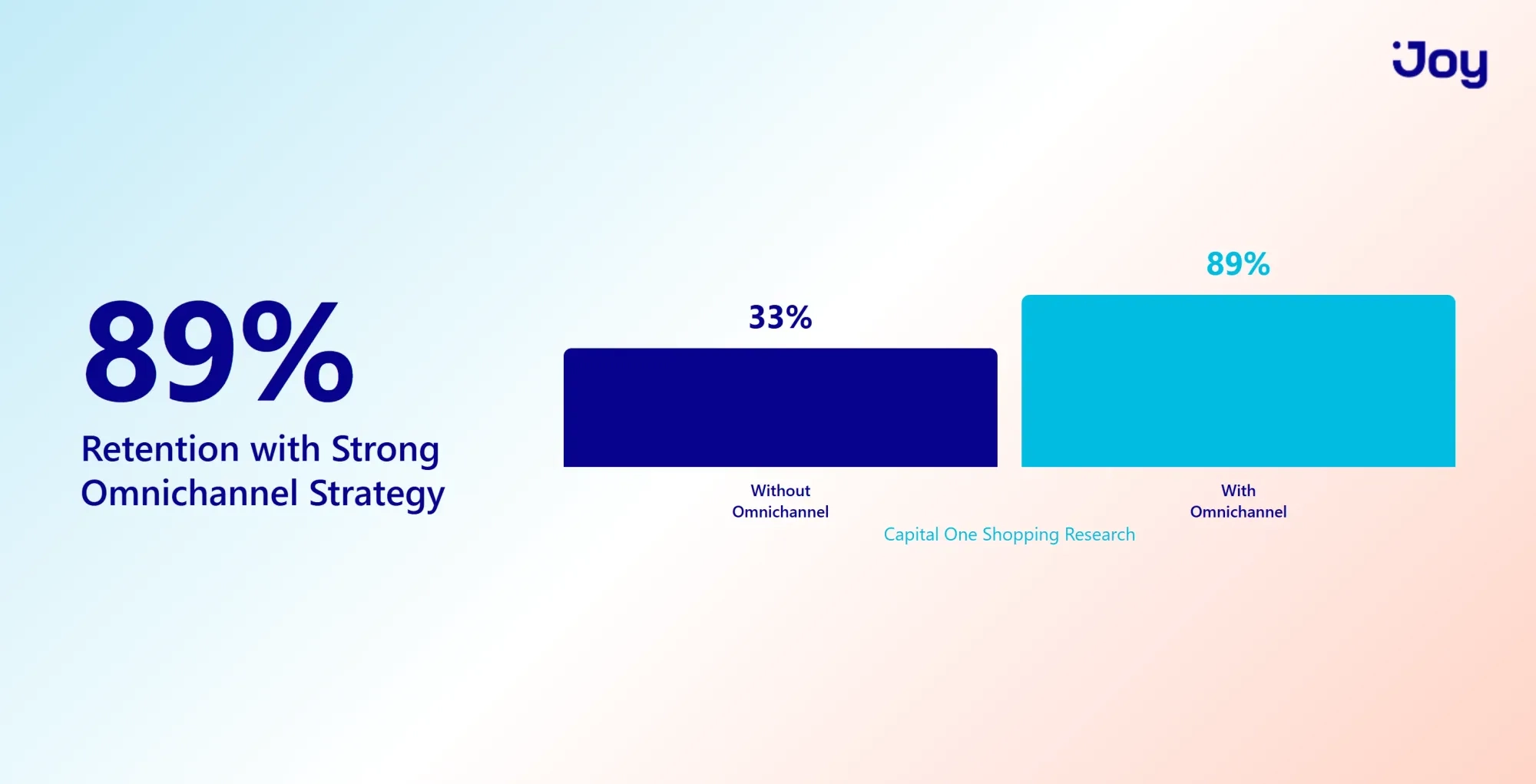
- One unified customer profile is the whole game. If your POS and your online store hold separate records, you don't have an omnichannel program. You have two disconnected ones. Companies with strong omnichannel retention keep 89% of customers, compared to 33% for those without it.
- The right mechanic depends on your industry. What drives repeat visits at a gym looks nothing like what works for a beauty brand or a grocery store. This guide breaks down real program structures by vertical so you can adapt the one that fits, not copy a generic playbook.
- Multi-channel shoppers are already worth more. Customers who engage across more than one channel shop 1.7 times more frequently than single-channel buyers. Your loyalty program's job is to connect those channels so that advantage compounds over time, not gets lost in data silos.
I. What Makes a Loyalty Program "Omnichannel" (and Why It Matters)
Here's a quick test:
Can a customer earn points at your physical register and redeem them on your website without creating a second account?
If not, you're running a multichannel program, not an omnichannel one.
The difference matters more than it sounds. Mulichannel means your loyalty program exists on multiple channels, but each one operates independently. Separate point balances. Separate customer profiles. Separate data. Your online store knows one version of the customer, and your POS knows another.
Omnichannel loyalty connects all of that into one system. One customer profile. One point balance. Every channel talks to every other channel in real time.
Here's a concrete example:
A customer signs up for your newsletter and gets a 10% discount. They walk into your store the next day to use it, and the cashier has no record of it. That's multichannel. In an omnichannel setup, the discount appears the moment the cashier pulls up the customer's profile, because the email platform and the POS share the same data.
Here's how the two compare side by side:
| Multichannel | Omnichannel | |
|---|---|---|
| Customer profiles | Separate per channel | One unified profile |
| Points and rewards | Channel-specific | Earn anywhere, redeem anywhere |
| Data | Siloed by platform | Synced in real time |
| Customer experience | Inconsistent | Consistent across touchpoints |
Why does this distinction drive results?
Companies with strong omnichannel strategies retain 89% of their customers,, compared to 33% for companies with weak omnichannel engagement. That gap isn't subtle. It's the difference between a loyalty program that builds your business and one that just takes up space in your tech stack.
Most programs fail at omnichannel not because the idea is complicated, but because the data stays trapped. The POS holds purchase history. The email platform holds engagement data. The online store holds browsing behavior. Nobody sees the full picture, and your customer feels the disconnect every time they switch channels.
The fix starts with three technical building blocks.
II. The 3 Technical Building Blocks Every Omnichannel Program Needs
Your loyalty program doesn't need an enterprise tech stack to go omnichannel. But it does need these three things working together. If anyone is missing, the experience breaks.
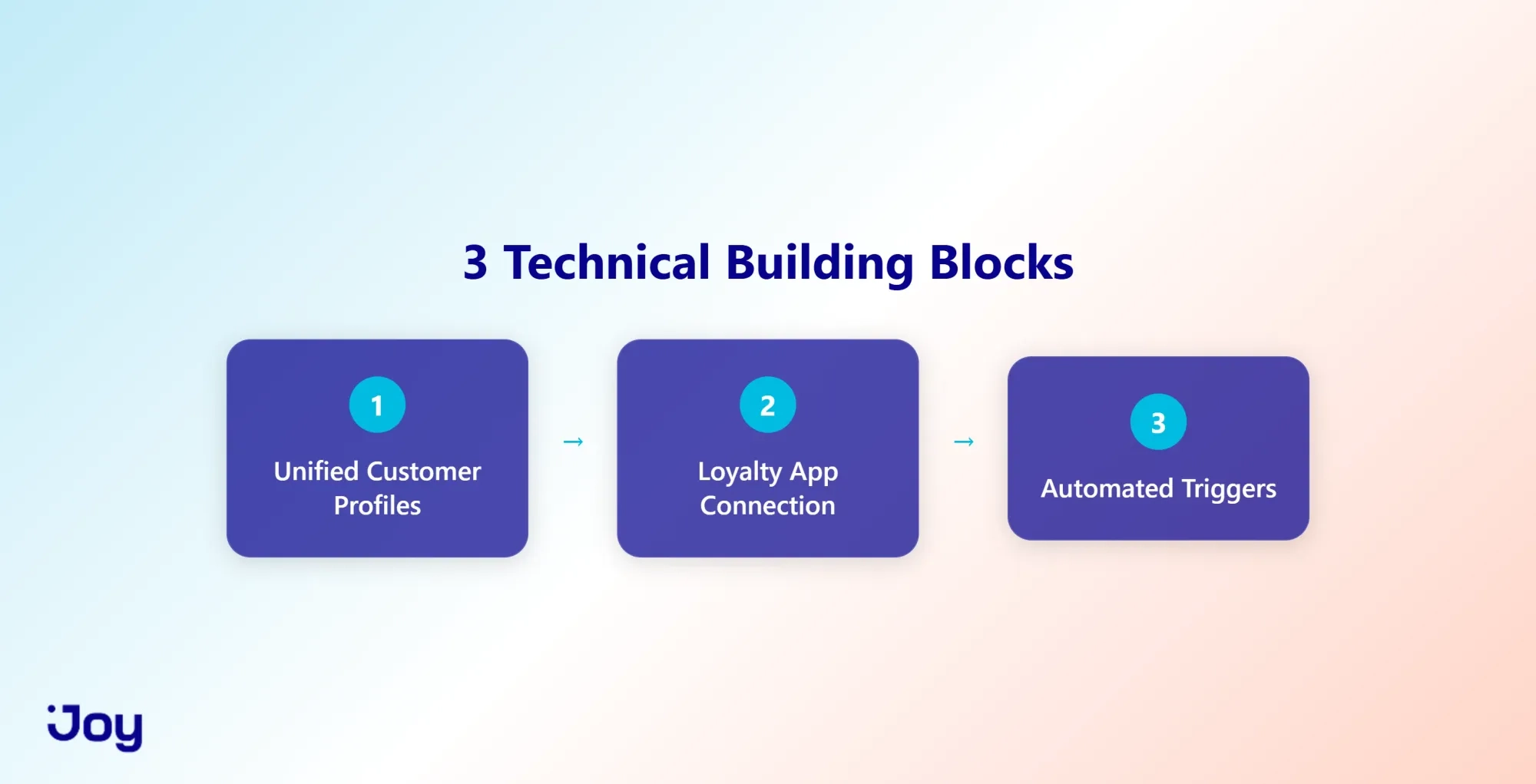
1. Unified customer profiles
Your POS, online store, and email platform all need to share the same customer record. Not a copy. Not a nightly sync. The same record, updated in real time.
On Shopify, this means a single customer database syncing between your online store and Shopify POS. When a customer checks out at your physical register, their loyalty points are updated instantly in their online account. No duplicate profiles. No mismatched balances
In a 2023 survey, 61% of Shopify merchants reported saving time on reporting and analytics after consolidating their POS and e-commerce data into a single system. That's not just a convenience win. Fewer data silos means your marketing team, store associates, and loyalty program all see the same customer.
2. A loyalty app that connects to your sales channels
This is where most setups quietly break. A merchant installs a loyalty app for their website, it works great online, then they discover it doesn't talk to their POS at all. Now they're running two disconnected systems, and the customer has no idea why their points didn't show up in-store.
Your loyalty app needs native integrations with your POS, your ecommerce platform, and your email or SMS tools. Before you commit to one, check whether it actually syncs point balances and customer data across all the channels you sell on. Not "coming soon." Not through a workaround. Right now.
3. Automated triggers across channels
Cross-channel triggers are what transform loyalty from a passive tracker into a retention engine. Points earned, rewards unlocked, tier upgrades, expiration reminders: all of it fires automatically, regardless of where the transaction happened.
Here's what that looks like in practice. A customer makes an in-store purchase and earns 50 points. Two hours later, they get an SMS with their updated balance and a note that they're 20 points from a reward. They didn't have to check an app or log into your website. The system reached them where they are.
That kind of cross-channel automation turns your loyalty program from a passive tracker into something that actively brings customers back.
III. Best Omnichannel Loyalty Programs by Industry
The programs below aren't theoretical. They're real examples from brands that connect loyalty across physical stores, online shops, and apps, along with the specific program mechanics behind each, so you can adapt the structure for your own store.
3.1 Fashion & Apparel
Fashion shoppers split their journey across channels. They browse online, try things on in-store, then buy wherever price or convenience wins. If your loyalty program only tracks one side of that behavior, you're seeing half the customer.
What works: Nordstrom's The Nordy Club
Members earn points per dollar across all channels (in-store, online, and Nordstrom Rack). The program has three tiers, with higher tiers unlocking perks such as free alterations, early access to the Anniversary Sale, and priority styling appointments.
The real omnichannel mechanic: personal stylists can see a customer's online wishlist and browsing history when they walk into a store. The in-store experience picks up where the online session left off.
Program structure to adapt:
- Points for purchases on any channel, plus bonus points for writing reviews and attending in-store events.
- Three tiers: a base tier for all members, a mid tier that unlocks service perks (free alterations or express shipping), and a top tier that grants early access to new collections.
- The detail that matters: Give in-store staff visibility into each customer's online activity. When an associate says, "I see you were looking at that jacket online," the experience feels personal rather than transactional. This is where most fashion loyalty programs stop short.
How Joy enables this on Shopify
Joy's POS integration lets store associates pull up a customer's full loyalty profile at checkout, including their online browsing history synced through Shopify's customer database.
Staff see the current point balance, tier status, and recent online purchases. The in-store experience picks up exactly where the online session left off. That's the Nordstrom mechanic, available to any Shopify merchant running Joy
3.2 Beauty & Cosmetics
Beauty has a natural advantage for omnichannel loyalty. Customers discover products online, test them in person, and reorder digitally. If your loyalty program connects all three moments, you capture the full relationship. Miss one, and you lose the reorder.
What works: Sephora Beauty Insider
Sephora's Beauty Insider is the most-studied loyalty program in retail for good reason. Three tiers (Insider, VIB, Rouge) where members earn points on every purchase, in-store and online.
Points unlock exclusive products, birthday gifts, early access to sales, and free beauty classes. The app shows a customer's complete purchase history across both channels, so beauty advisors can make personalized recommendations based on what someone actually owns.
Program structure to adapt:
- Points per dollar spent, plus bonus points for product reviews and a birthday reward.
- Mix experiential rewards with discounts, such as early access to new launches, exclusive events, and free consultations.
- The detail that matters: Sephora's program works because it rewards engagement, not just spending. You don't need Sephora's budget to replicate this. Start by rewarding reviews and social shares alongside purchases. Those actions cost nothing to both incentivize and build social proof.
Emotional loyalty programs generate 65% more repeat purchases than programs that only reward transactions. In beauty, where product discovery and personal recommendations drive the buying cycle, emotional connection trumps discounts.
3.3 Food & Beverage
The channel problem in the food and beverage industry is more fragmented than most industries. Customers order through your app, website, counter, drive-through, and third-party delivery platforms.
Most restaurant loyalty programs only track one or two of those channels. The customer ordering from you three times a week via a delivery app is completely invisible to your loyalty system.
What works: Starbucks Rewards
Members earn "Stars" per dollar spent through the app, in-store, or at the drive-through. Mobile ordering ties directly to loyalty, so placing an order and earning points happen in the same action. The key mechanic: the app combines payment and loyalty into a single scan. Zero extra effort from the customer.
Starbucks also uses gamification well. Bonus Star challenges ("Buy three lattes this week, earn 25 bonus Stars") create short-term engagement loops that bring people back before they drift.
Program structure to adapt:
- Points per dollar (not per visit) across all owned channels
- Short-term bonus challenges that create urgency and repeat visits
- The detail that matters: Starbucks won by making earning frictionless. One scan handles both payment and loyalty. Smaller cafes and restaurants can get close to this with QR-code-based loyalty tied to a phone number. No app download required. The customer scans at the register, and their points update instantly. That's the minimum bar for food and beverage loyalty in 2026.
3.4 Grocery
Grocery shoppers frequently buy and closely watch prices. A standard points program rarely shifts their behavior because margins are too thin and competition is too close. The real omnichannel loyalty play in grocery: personalized offers built from purchase history, served across every channel the customer uses.
What works: Target Circle
Members earn 1% back on every purchase, whether they shop online, in-store, or via curbside pickup. The program personalizes deals based on each member's purchase behavior. Before a shopping trip, the app surfaces relevant offers. At checkout, those offers apply automatically. No coupon codes. No extra steps.
That last part is critical. Customers who engage across multiple channels shop 1.7 times more frequently than single-channel shoppers. But grocery shoppers won't engage with a loyalty program that slows down the checkout line. Every extra tap, scan, or code entry is a reason to skip it.
Program structure to adapt:
- A percentage-back model instead of points (it's more intuitive for frequent, low-ticket purchases)
- Personalized weekly deals pulled from actual purchase history, not generic promotions
- The detail that matters: Redemption must happen at checkout with no extra steps. Auto-apply rewards when the customer is identified. Programs that require a separate redemption action lose grocery shoppers fast.
3.5 Health & Wellness
Wellness customers interact with brands across more touchpoints than almost any other industry: physical locations (gyms, studios, spas), online stores (supplements, gear, skincare), and apps (class booking, progress tracking). Most loyalty programs in this space only reward purchases. They ignore the engagement side entirely.
What works: Bergzeit's Strava integration
Outdoor retailer Bergzeit rewards customers for logging activities on Strava: points for hiking, cycling, and skiing, not just buying gear. The key mechanic: Bergzeit connected loyalty to a behavior customers already do (tracking workouts) instead of asking them to build a new habit. Lower bar for participation. Higher engagement as a result.
Program structure to adapt:
- Points for purchases, plus points for class attendance, check-ins, or health milestones.
- Tier structure tied to engagement frequency, not just total spend
- The detail that matters: Wellness loyalty hits harder when the reward supports the customer's health goals, not just their wallet. "Earn a free smoothie after 10 classes" feels like the brand is part of your routine. "Earn 500 points after spending $200" feels like a transaction.
One thing to watch: tracking fitness and wellness data for loyalty raises serious privacy concerns. If you're collecting location data, workout logs, or health-related activity, be upfront about it. Tell customers exactly what you collect, how you store it, and give them a clear opt-out. This isn't optional under GDPR and similar regulations.
3.6 Fitness
Gym and studio churn starts long before the cancellation call. Most members who cancel haven't visited for three or more weeks before making that decision. By the time they call, the relationship is already over.
A loyalty program that rewards consistent attendance (not just merch or supplement purchases) catches that drop-off early. It turns your points system into an early-warning system for retention.
Program structure that works:
- Points for check-ins, product purchases, and referrals
- Streak bonuses: "Visit four times this week and earn double points." Streaks create short-term motivation that builds long-term habits.
- Win-back triggers: If a member hasn't checked in for two weeks, auto-send a personalized nudge. A free guest pass, bonus points for their next visit, or a simple "We miss you" message can re-engage someone before they drift into cancellation.
The detail that matters: The best fitness loyalty programs don't just reward attendance. They use attendance data to identify who's about to leave and intervene before it happens. That's the difference between a loyalty program and a retention system.
Frequently Asked Questions
What is an omnichannel loyalty program?
An omnichannel loyalty program gives customers one unified experience across every channel they use: online, in-store, mobile, and email. Points earned in-store appear in their online account instantly.
Rewards earned online are redeemed at the physical register without extra steps. The defining feature is a single customer profile that every channel reads from and writes to in real time. Without that, you have a multichannel program, not an omnichannel one.
What's the difference between multichannel and omnichannel loyalty?
Multichannel loyalty means your program exists on multiple channels, but each runs independently: separate point balances, separate customer records, separate redemption rules.
Omnichannel loyalty unifies all of that: one profile, one balance, one redemption experience, regardless of where the customer shops. The practical difference shows up at the register: in a multichannel setup, your cashier can't see what the customer earned online. In an omnichannel setup, they can.
Which industries benefit most from omnichannel loyalty programs?
Fashion, beauty, food and beverage, grocery, and fitness all see measurable gains from omnichannel loyalty, but for different reasons. Fashion benefits from staff visibility into online browsing. Beauty captures the discover-test-reorder loop. Food and beverage closes the gap between app ordering and in-store earnings. Grocery automates redemption at checkout to reduce friction. Fitness uses attendance data to catch churn before it happens. The common thread: customers who engage across multiple channels shop 1.7 times more frequently than single-channel shoppers.
What does it take technically to run an omnichannel loyalty program on Shopify?
Three things: a unified customer database (Shopify handles this natively), a loyalty app with real POS integration (not just an API bridge), and automated cross-channel triggers. On Shopify, Joy connects all three: syncing point balances between your online store and POS in real time, and automatically firing Klaviyo or SMS triggers when customers hit earning milestones, regardless of which channel they used.
How do you measure whether your omnichannel loyalty program is working?
The right metrics are Assisted Orders (how many purchases the loyalty program directly influenced), active member rate (healthy programs run 35–45% active), and redemption rate (healthy range: 20–35%).
If your redemption rate sits below 15%, your program has an engagement problem: customers enrolled but never activated. If your active member rate is below 20%, you're likely acquiring the wrong members, or the first-reward threshold is too far away.
Can small Shopify brands run omnichannel loyalty without an enterprise budget?
Yes. The gap between enterprise and mid-market capability has closed significantly. On Shopify, a loyalty app with native POS support, Klaviyo integration, and Shopify Flow triggers covers most of what enterprise programs run. The architecture that Nordstrom and Sephora spent millions building is now available as a configurable loyalty platform. The remaining gap is staff training and data hygiene, not technology.
Related reading
 Loyalty Strategy
Customer Retention Goals: 5 Targets to Set (and How to Hit Them)
A goal-first guide to customer retention: the five targets worth setting, how to make each one SMART, and the strategy that hits it.
Thomas Nguyen Loyalty Strategy
Customer retention benchmarks for ecommerce: What's a good rate?
A clear-eyed look at ecommerce retention benchmarks: the one number worth trusting, why most by-industry tables mislead, and how to benchmark against yourself.
Thomas Nguyen Loyalty Strategy
How to set up customer retention automation (without a big team)
A step-by-step guide to automating customer retention across the customer lifecycle, from onboarding to win-back.
Thomas Nguyen