A strong restaurant loyalty program can drive repeat visits, higher spend, and better retention. A weak one does the opposite: it sits unused while the brand keeps giving away margin. That matters in a U.S. restaurant industry projected to reach $1.55 trillion in sales in 2026.
The demand is already there. The National Restaurant Association reports that 78% of customers are more likely to visit a restaurant where they can earn points, even if it is less convenient, while 81% of consumers not currently enrolled say they would likely join a program if one were offered at a favorite restaurant.
This is why studying the right restaurant loyalty program examples matters. In this article, we break down six real programs, what makes them work, and which tactics you can apply to build a more effective loyalty strategy for your own brand.
Key Takeaways
- Match your program type to your business model first. A fine dining restaurant copying Chipotle's gamification feels gimmicky.
- Three psychology principles drive every successful program: reciprocity (give first), goal-gradient (escalating rewards), and loss aversion (expiring points).
- Target a 5-12% effective reward rate. Below 5%, customers won't bother. Above 12%, you're bleeding margin.
- Enrollment friction kills programs. Every extra step costs 20-30% of potential sign-ups. QR code or text-to-join, under 10 seconds.
- The first reward should feel reachable within 2-3 visits. If the finish line is too far, people don't start running.
- Review and adjust quarterly. Starbucks has restructured its earning system three times since launch.
I. Why Restaurant Loyalty Programs Work: The Psychology Behind Repeat Visits
The restaurant loyalty programs that work usually lean on the same three psychological triggers. Not because customers are obsessed with points, but because people respond in pretty predictable ways when a reward feels close, when they get something first, or when they might lose value they already have.
- Goal-Gradient Effect. People speed up when the reward feels close. That’s been shown in loyalty research, and Chipotle uses the same pull in Rewards “Extras,” where members complete challenges for more points and badges. Its 2025 “Summer of Extras” campaign pushed that further with a seven-visit streak and milestone bonuses along the way.
- Reciprocity. Give customers something first, and they’re more open to coming back. Chili’s does this with free Chips & Salsa and a birthday dessert for My Chili’s members. The program feels rewarding early, which is the point.
- Loss Aversion. Once rewards feel like theirs, people don’t want to lose them. Cracker Barrel leans on that with Pegs that expire after 365 days, while bonus rewards can expire in as little as 30 to 180 days. That quiet deadline does more work than most generic promos.
In short, same psychology works in ecommerce too. Restaurants just get faster feedback because people come back sooner.
Get the Restaurant-to-Ecommerce Loyalty Playbook
Steal the psychology behind Chipotle, Chili's, and Capital Grille's loyalty programs and apply it to your Shopify store.
No spam. Unsubscribe anytime.
II. 5 Types of Restaurant Loyalty Programs (and Which Fits Your Restaurant)
Not every restaurant loyalty program fits every concept. A fine dining restaurant running a digital punch card can cheapen the experience. A neighborhood pizza shop with a complex VIP ladder can feel like overkill. Before you study individual examples, figure out which model actually matches how your restaurant sells, how often guests return, and what they expect from you.
| Program Type | How It Works | Best For | Example |
|---|---|---|---|
| Points-based | Guests earn points per dollar spent and redeem at set thresholds | Fast casual, casual dining, multi-brand groups | Chipotle Rewards, Cracker Barrel Rewards, Dine Rewards |
| Visit-based | Rewards are tied to visits or check-ins, not spend level | Full-service casual, routine-driven local spots | My Chili’s |
| Tiered | Guests unlock better perks as they spend more over time | Restaurant groups, premium casual, higher-frequency regulars | Marriott Bonvoy Dining-style partnerships, premium club structures |
| Membership / club | Guests join a free or paid club for recurring perks, exclusives, or special access | Casual dining, brands with strong promo calendars or event-based traffic | Club Applebee’s |
| Recognition-based | Loyalty is built through guest preferences, personalized service, and staff memory rather than points | Fine dining, upscale casual, hospitality-led concepts | The Capital Grille |
The table tells you what each model is really trying to do. Points-based drives spend. Visit-based drives frequency. Tiered pushes bigger long-term value. Membership keeps people engaged between visits. Recognition-based protects a more premium experience.
Here’s the short version:
- Points-based works when visits are frequent and the value needs to feel simple.
- Visit-based works when you want guests to come back, not do math.
- Tiered works when customers spend enough for status to matter.
- Membership works when exclusivity and ongoing perks matter more than points.
- Recognition-based works when service is the loyalty strategy.
The right fit comes down to three things: average ticket size, visit frequency, and customer expectations. Get that wrong, and the program feels off no matter how well it’s designed.
III. 6 Best Restaurant Loyalty Programs (and What You Can Steal From Each)
Each program below was picked for a specific lesson, not just brand recognition.
We break down how it works, how it's operated day to day, the psychology behind it, and what you can take from it. Whether you run a fast casual spot or a fine dining room, at least one of these maps applies to your business.
1. My Chili's Rewards: Why Every-Visit Rewards Beat Points Math
Type: Visit-based
The launch stumble
When Chili's first rolled out the program, servers pushed sign-ups so aggressively that add-on sales dropped during the rollout quarter. That mistake shaped how the program runs today.
How it works
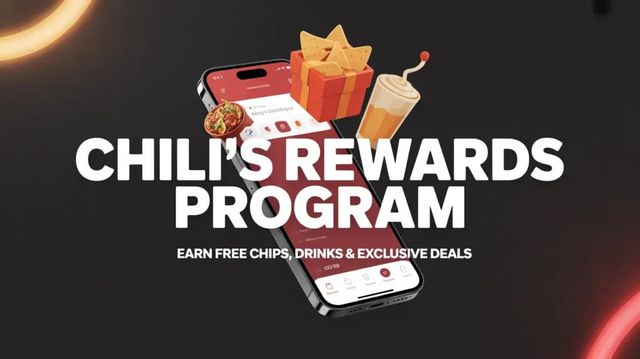
Members earn 1 point per $1 spent. At 75 points, they unlock a free reward. But the points aren't the draw. The real hook: free chips and salsa or a non-alcoholic beverage on every visit. No threshold. No waiting.
How it's operated
Chili's integrated loyalty into Ziosk tabletop tablets across 800+ locations. The tablet prompts sign-up, tracks points, and handles redemption. No server involvement needed. That removes enrollment friction for the guest and the awkward pitch for the server.
Why it works
Reciprocity. Give something before the customer has earned anything, and they feel compelled to come back. As Chili's CMO Steve Provost put it: "We heard the feedback loud and clear that loyalty programs feel too complicated."
What you can steal
If your guests find points confusing, try an every-visit reward. A free side or drink costs a few cents and triggers reciprocity without any math. But don't let enrollment pushes eat your upsells. Chili's learned that the hard way.
2. Chipotle Rewards: How Gamification Keeps a Loyalty Program Fresh
Type: Points-based
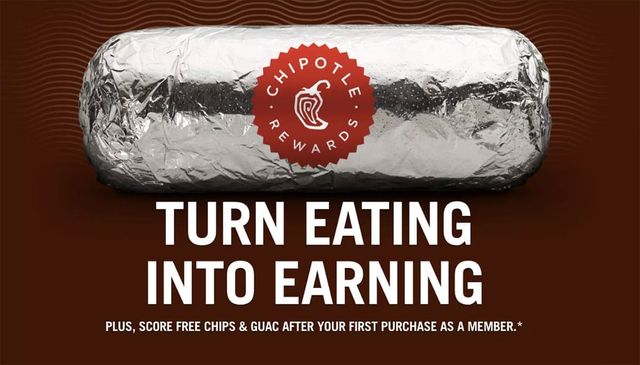
Chipotle Rewards has over 21 million active members. About 30% of total sales come through the program. But here's the telling stat: 90% of app transactions use rewards, compared with only 20% of in-restaurant transactions.
That's not a digital problem. It's a friction problem. App users earn automatically. Dine-in customers have to take an extra step. Remove the step, and adoption follows.
How it works
Members earn 10 points per $1 spent. At 1,250 points ($125 spent), they get a free entree. Chipotle layers on challenges and milestones to keep things moving: their "Summer of Extras" campaign offered 50 bonus points at visit 1, 100 at visit 3, and 250 at visit 7, plus a sweepstakes entry.
That's the goal-gradient effect. Each milestone feels closer than the last, pulling customers back faster.
How it's operated
Chipotle runs everything through the app. Challenges rotate monthly or seasonally. They also segment by audience: Chipotle U gives college students 12 points per dollar instead of 10. Smart targeting without overcomplicating the core program.
Honest caveat
Chipotle is planning a full program relaunch in 2026 because in-restaurant adoption is still low. Even with 21 million members, they haven't cracked the dine-in experience yet.
What you can steal
You don't need Chipotle's budget for milestone challenges. A simple "Visit 3 times this month, get a free appetizer" on a chalkboard or via text creates the same psychology. The bigger lesson: if earning requires effort, most dine-in customers won't bother. Make it automatic.
3. Cracker Barrel Rewards: How "Pegs" Turned a Generic Points Program Into Something Memorable
Type: Points-based
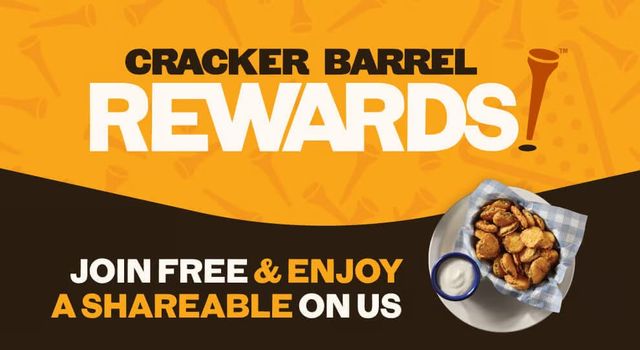
Name your points in a way that reflects your brand, not just "points." Cracker Barrel calls theirs "Pegs," after the peg game that's been on every table since 1969. A BBQ restaurant could use "Smoke Rings." A sushi spot could use "Rolls." Small detail, big memorability.
How it works
Members earn 1 Peg per $1 spent. Redemption is tiered: 75 Pegs for a side or drink, 150 for a breakfast entree, 225 for a dinner entree. Every tier is capped at a max value ($7.50 at 75 Pegs, $20 at 225 Pegs). That cap prevents customers from gaming the system by redeeming for the most expensive item on the menu.
How it's operated
Pegs are earned across restaurant meals, retail store purchases, and online orders. For restaurants that also sell merchandise or packaged food, this captures spending you'd otherwise miss. As VP of Marketing, Amy Barnett put it: "Cracker Barrel Rewards is an opportunity to thank our guests for their continued loyalty with even more care and appreciation, delivered in a way only Cracker Barrel can."
Why it works
Loss aversion. The 500 Peg accumulation cap and 5,000 annual earning limit create a quiet "use it or lose it" pressure. Customers treat earned Pegs like money they already have. Letting them expire stings.
Honest caveat
Those caps can frustrate heavy users. But for Cracker Barrel's typical monthly family-dining customer, the limits rarely matter.
What you can steal
Two things. First, brand your points. Second, always cap reward values. A $20 cap on a $225 spend means you control your cost per redemption regardless of menu prices.
4. Bloomin' Brands Dine Rewards: One Program, Four Restaurants
Type: Tiered
The cross-brand play
A customer earns points at Outback on Tuesday. Redeems them at Carrabba's on Friday. The parent company keeps customers in its ecosystem, regardless of what cuisine they crave.
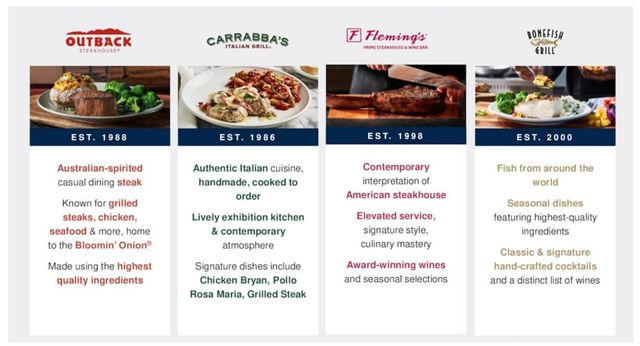
Bloomin' Brands runs one loyalty program across Outback Steakhouse, Carrabba's Italian Grill, Bonefish Grill, and Fleming's Prime Steakhouse. That's the standout feature.
How it works
Members earn 5 points per $1 on food and non-alcoholic beverages. At 350 points ($70 spent), they get a $5 reward. That's roughly a 7% return.
For context: QSR programs typically return 8-12% because visit frequency is high and ticket size is small. Casual dining lands around 5-8%. Fine dining is usually 2-4%. Bloomin' Brands sits at the generous end of casual dining, which makes sense for a $25+ average check.
How it's operated
Welcome offer: free Bloomin' Onion on first visit after sign-up. That's the endowed progress effect in action. A 2006 study by Nunes and Dreze found that a loyalty card starting at "2 out of 10" is completed more often than one starting at "0 out of 8," even though both require 8 more purchases. Giving something immediately after enrollment makes customers feel invested before they've started earning.
Honest caveat
The $5 reward on a $70 spend feels less rewarding than QSR programs, where you earn a free item after 5-6 visits. Full-service restaurants need to compensate with higher-value rewards or experiential perks.
What you can steal
If you run more than one restaurant, a single loyalty program across all of them keeps customers in your world. They earn at one spot, redeem at another. You keep them no matter what they're craving.
5. Club Applebee's: Exclusivity Over Discounts
Type: Subscription/membership
The model
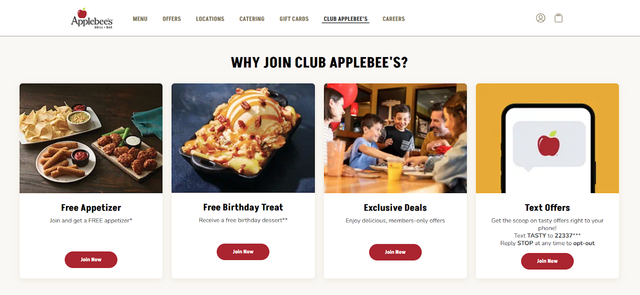
Club Applebee's reached 8.5 million members in Q1 2025. No traditional points. No earn-and-redeem math. Instead: exclusive access, sneak peeks, partnerships, and insider offers.
How it works
Members get early access to new menu items before public launch, members-only campaigns like the Date Night Pass (launched 2024, brought back 2025), and sweepstakes tied to cultural moments like the Super Bowl. These create urgency and FOMO without discounting.
Applebee's exec Vicki Hormann explained: "We will continue to look at ways to provide benefits to Club Applebee's that are outside of that traditional points-based currency rewards system."
How it's operated
The Wyndham Hotels partnership adds a cross-industry angle: hotel guests earn Wyndham points when ordering Applebee's through the app, plus free delivery. Club members get 2,000 bonus Wyndham points for signing up. It's a co-marketing deal that brings in new customers who wouldn't have found the program otherwise.
CEO John Peyton's target is specific: "Grow our share of those guests that visit us three or more times a year." That's a frequency play, not a volume play.
Honest caveat
Exclusivity-based programs are harder to measure than points programs. You can't track "feeling like an insider" as easily as you can track points earned and redeemed. Applebee's is still building the right analytics framework.
What you can steal
If your average customer visits once a month, points may feel too slow to accrue. Try exclusivity instead: early menu access, members-only events, priority reservations on busy nights. These perks cost almost nothing but make customers feel special.
6. The Capital Grille: When Loyalty Means They Know Your Name
Type: Recognition-based
The distinction
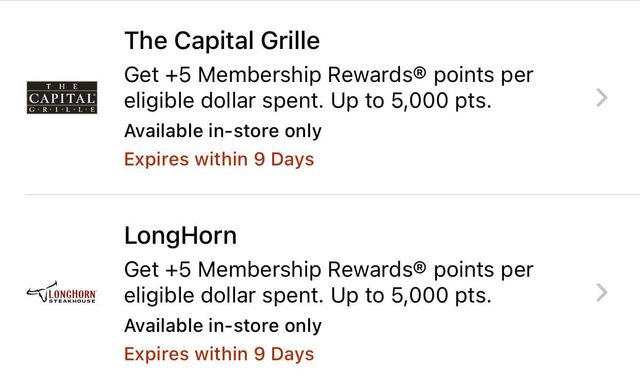
Remembering a regular's name is good service. Building a guest profile that tracks their wine preferences, seating preferences, and dining history across 60+ locations, and making sure the host at any Capital Grille in the country can pull it up? That's a loyalty system. It just doesn't have a points card.
How it works
No points. No tiers. No app. The Capital Grille (owned by Darden) tracks guest preferences both manually and digitally. The result is a guest profile that travels across locations. A regular in Boston gets the same recognition when they walk into the Capital Grille in Chicago.
Preferred tables, personalized wine recommendations, invitations to exclusive wine dinners and events. The "reward" is being known.
How it's operated
Hosts and servers update guest profiles after each visit. Preferences, allergies, celebrations, and wine orders. The system is part CRM, part institutional memory. It works because it's built into the daily routine of the staff, not bolted on as extra work.
Honest caveat
Capital Grille doesn't publish loyalty metrics, and that's partly the point. Recognition-based loyalty isn't measured in points redeemed. It's measured in repeat visits and lifetime spending, which Darden tracks at the portfolio level but doesn't break out publicly.
What you can steal
You don't need Darden's tech. Keep a simple spreadsheet of regular customers' preferences. Train hosts to greet them by name. Reserve their usual table when they call. The key is to make it a system, not rely on individual servers' memory. One server leaves, and the "loyalty program" walks out the door with them. Write it down.
Quick hit: Sweetgreen Rewards and the Feedback Loop
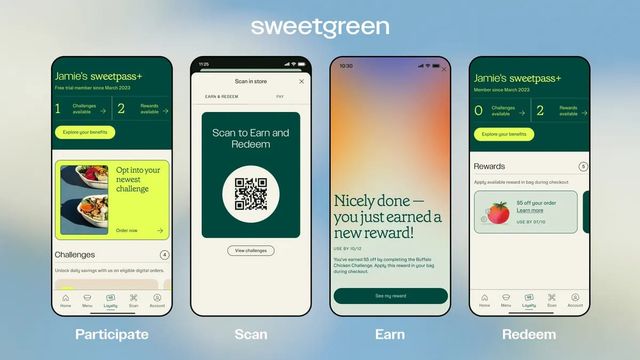
One more worth watching. Sweetgreen uses its loyalty program for two-way communication. Members rate orders and suggest menu changes. That turns a one-directional rewards system into a conversation.
If your restaurant has a strong brand identity and engaged customers, adding a feedback mechanism gives you data and makes customers feel heard. Even a simple "rate your last meal" text message works. It's not a separate program type. It's a feature any program can add.
IV. Common Mistakes That Kill Restaurant Loyalty Programs
1. Picking the wrong program type
Everything else on this list follows from this. A fine-dining restaurant that copies Chipotle's gamification feels gimmicky. A pizza shop running an exclusivity model feels absurd. Go back to the comparison table. Match your type to your restaurant first.
2. Making rewards too hard to earn
If a customer has to spend $200 before they get a free side of fries, they'll never bother. The first reward should feel reachable within two to three visits. If the finish line is too far, people don't start running.
3. Ignoring the sign-up experience
If enrollment takes more than 30 seconds or requires downloading an app, you'll lose most people. Text-to-join or QR code. Keep it under 10 seconds.
4. Not training staff
Give your team one line: "Free chips and salsa every time you come in. Want me to sign you up? Takes 10 seconds." Practice it. Make it natural. But don't push so hard that you tank add-on sales.
5. Setting and forgetting
Review redemption rates quarterly. Nobody redeeming? Thresholds are too high. Everyone redeeming? Margins might be slipping.
6. No expiration policy
Points that never expire become a growing liability on your books. Set a 6-12 month window and communicate it clearly. Expiring points drive visits. That's loss aversion working in your favor.
V. Build Yours
The best restaurant loyalty programs share three things: they match the model to the restaurant type, keep earning simple, and protect margins with smart reward design.
The psychology is consistent across all of them. Reciprocity drives Chili's. Goal-gradient drives Chipotle. Loss aversion drives Cracker Barrel. Different programs, same principles.
One loop ties them all together. The customer is hungry. Choose your restaurant. Earns or redeems a reward. When that loop runs without thinking, you've built real loyalty.
You don't need Chipotle's budget. You need a clear model, smart rewards, and a team that talks about it.
These programs work because they match rewards to how customers actually behave. That same principle applies to e-commerce.
Pick one idea from the list above. Start there.