Annual churn in telecommunications runs between 20% and 50%, according to a 2024 CustomerGauge study. Replacing lost subscribers costs six to seven times more than retaining them. That's why the best carriers invest in telecommunication loyalty programs that actually change customer behavior.
Key Takeaways
- Disney's primary tier benefit is booking access, not discounts — creating switching costs that money can't easily overcome
- Status advances by voyage count, not spend — rewarding frequency over transaction value
- The Pearl tier is intentionally unreachable for most members — its scarcity makes lower tiers feel more prestigious
- Enrollment is automatic — zero friction between first purchase and first reward
- Shopify brands can replicate the access mechanic with early product drop access as a tier perk, at zero margin cost
- Closed-loop redemption only works when your product drives natural repeat purchase — don't copy it blindly
Some do it well. T-Mobile's perks program cut churn in half for active users. O2 saved £8 million in its first year with partner-based rewards. Telstra's three-tier system pushes customers to bundle services under one account.
Below, we break down seven loyalty programs from carriers worldwide: what works, what doesn't, and which tactics fit your scale.
I. Why Telecommunication Loyalty Programs Matter More Than Ever
Most telecom providers spend heavily on acquiring new subscribers. But the real money isn't in new sign-ups. It's in the customers you already have.
Subscribers who stay three years or longer generate 95% of total customer lifetime value in telecom. They spend 7% more than new customers, and retaining them costs 10x less than finding replacements.

Fill-in template to configure earn rules, behavioral triggers, and tiers for your Shopify store.
-d95014.svg?w=640&q=90)
No spam. Unsubscribe any time.
That math should shift how every carrier allocates budget. Yet the industry keeps pouring money into acquisitions while bleeding long-tenured customers out the back door.
| Industry | Annual Churn Range |
|---|---|
| Telecom | 15-25% |
| Retail | 20-37% |
| Banking | ~20% |
| SaaS | 5-10% (monthly) |
The root causes aren't mysterious. 96% of customers who leave cite poor support. Only 5% of providers fully use customer data for personalization. And Mobile Number Portability makes switching almost effortless, so nothing is stopping unhappy subscribers from walking.
The carriers that get this right treat loyalty programs as a core retention tool, not a marketing side project. T-Mobile posted a 0.90% postpaid churn rate in Q2 2025. That same quarter, Verizon, which chose price hikes over loyalty investment, lost 9,000 net postpaid subscribers.
That said, no telecommunication loyalty program can fix broken fundamentals. If your network drops calls or support takes 45 minutes to pick up, reward points won't save the relationship. These programs work on top of solid service. They don't replace it.
1. T-Mobile Tuesdays (USA)
Most loyalty programs ask customers to prove they're loyal. T-Mobile does the opposite.
Program model: Perks-based. No points, no tiers, no spend requirements. Every Tuesday, subscribers claim free stuff through the T-Life app: fuel discounts, food, presale concert tickets, and sweepstakes.
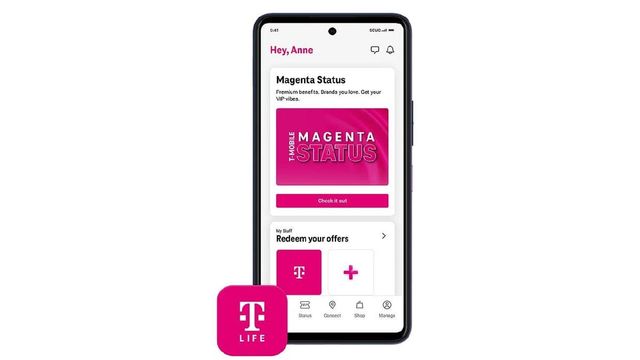
Why it works: The friction is zero. Customers don't calculate point balances or wait months for a payoff. They open the app and get something free. That weekly habit turns the app into a touchpoint competitors can't replicate.
When leaving your network means breaking a routine, the decision to switch becomes harder for reasons unrelated to price.
Key data:
- Churn among active users dropped by half
- NPS runs 14 points above the industry average
- Over one billion redemptions since launch
- ~$900 in perks per customer in 2025
The lesson for your business: You don't need T-Mobile's budget. Even small weekly partnerships with local businesses create a recurring touchpoint. The goal isn't generosity. It's building a habit your subscribers don't want to give up.
2. O2 Priority (UK)
Giving away perks is easy. Giving away the right perks at the right time is what makes O2 different.
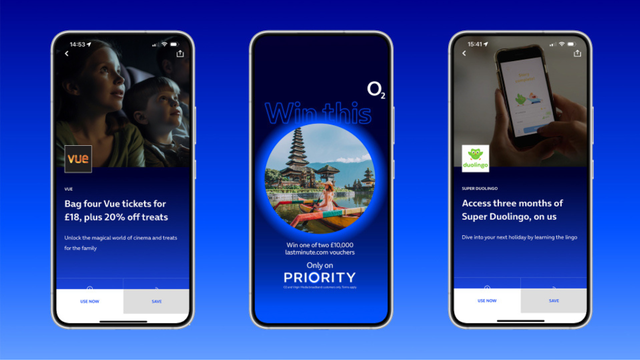
Program model: Perks-based with heavy entertainment focus. No points. Free to join. 48-hour presale access to thousands of gigs and events, monthly rotating rewards from Disney+, Vue Cinemas, and Greggs, plus prize draws.
Why it works: O2 mapped when churn risk spikes in the customer relationship (contract anniversaries, for example) and built targeted rewards around those specific moments. That precision makes the rewards feel personal rather than generic. The partner bartering model also keeps costs down while maintaining high perceived value.
Key data:
- 26 million UK subscribers
- £8 million saved in year one through partner bartering
- Customer Service Index scores 16% higher for active users
- Members saved over £23 million combined in 2024
The lesson for your business: Map your churn triggers first, then build rewards around them. Random reward calendars waste budget. Targeted timing changes decisions at the moments that matter most.
3. Verizon myAccess (USA)
Verizon's loyalty story proves something uncomfortable: a loyalty program amplifies your relationship with customers. It doesn't create one.
Program model: Personalized offers, local passes for exclusive events, presale concert tickets, and anniversary gifts that unlock based on tenure. Survey-driven personalization.
Why it works (and where it doesn't): Verizon moved away from the old "spend $300 = 1 credit" model toward tenure-based personalization. The mechanics are sound. But Verizon raised prices around the same time, and long-tenured customers on community forums feel myAccess is a downgrade from the old system.
The strategic lesson here is clear: loyalty programs sit on top of the customer relationship. If that foundation is cracked by pricing decisions or service failures, no reward structure holds it together.
Key data:
- Verizon lost 9,000 net postpaid subscribers in Q2 2025
- The loss followed controversial price hikes
- Community sentiment on the rebrand has been largely negative
The lesson for your business: Before investing in a loyalty program, make sure the foundation is solid. Pricing, service quality, and trust come first. Loyalty rewards amplify what's already there. They can't manufacture what's missing.
4. Telstra Plus (Australia)
The smartest thing about Telstra Plus is what customers don't have to do. And that effortlessness is what makes passive loyalty so effective.
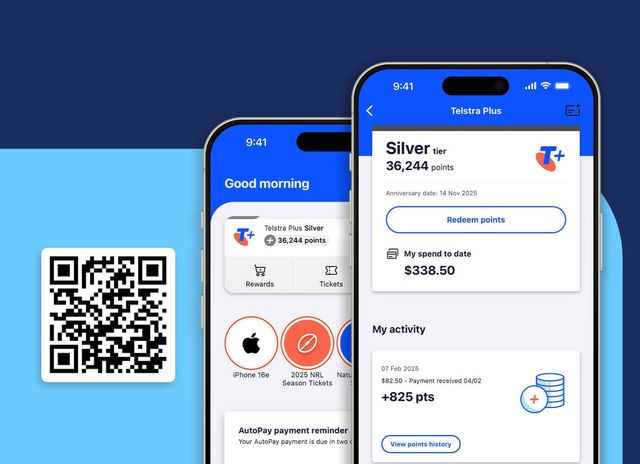
Program model: Points-based + tiered. Three levels (Member, Silver, Gold) based on annual spend. Points earned on monthly bills, devices, and accessories. Redeemable for movie tickets, sports tickets, tech accessories, or bill credits.
Why it works: Telstra connects loyalty directly to billing. There's no separate action. Every dollar spent earns visible value automatically. Over months, customers accumulate a point balance they didn't have to work for. That invisible investment becomes a quiet reason to stay.
The tiered structure adds a strategic second layer: reaching Gold status requires consolidating mobile, internet, and entertainment under Telstra. The program drives bundling without a sales pitch, increasing customer lifetime value while raising the cost of switching.
Key data:
- Three-tier structure tied to annual spend
- Points earned automatically on all Telstra billing
- Rewards include bill credits, event tickets, and tech accessories
The lesson for your business: If you offer multiple product lines, tiers are your best tool for driving bundling. Link points directly to billing, so value accumulates silently. The less effort customers spend earning, the more invested they become without realizing it.
5. AIS Serenade (Thailand)
Most telecommunication loyalty programs reward spending with points. AIS rewards spending with better service. That difference hits a deeper layer of loyalty that points never reach.
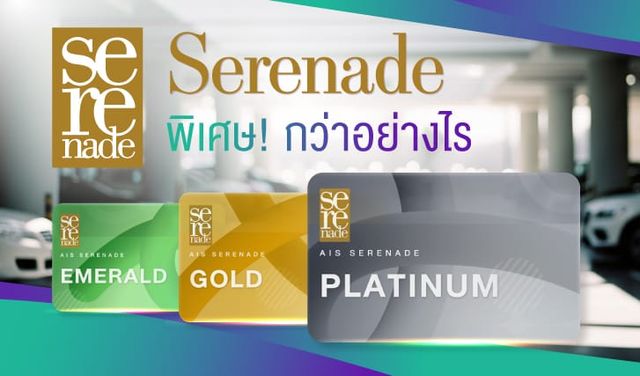
Program model: Four-tier membership based on monthly spend. The differentiator: service quality escalates with each tier. Higher tiers get priority customer support, airport lounge access, dedicated service lines, and exclusive content.
Why it works: In a market where 96% of churn traces back to poor support, AIS solved the root cause instead of working around it. When better service IS the reward, customers don't just feel incentivized. They feel valued. That's the deepest form of loyalty because it's personal.
A point balance is interchangeable. The feeling that your carrier actually takes care of you is not. Competitors can match your perks. They can't easily replicate a service culture that treats loyal customers measurably better.
Key data:
- Four tiers segmented by monthly spend
- Higher tiers receive priority support and dedicated service lines
- Lounge access and exclusive content at top tiers
The lesson for your business: Priority support lines, dedicated account managers, and faster resolution times build stronger loyalty than any point system. This approach scales down well for smaller providers who can't compete on perks budgets. Better service is the most underrated and most durable retention advantage in telecom.
6. Orange Thank You (France/Europe)
When every carrier in a saturated market offers roughly the same service, the one that controls exclusive content controls the switching decision. Orange understood this before most competitors did.
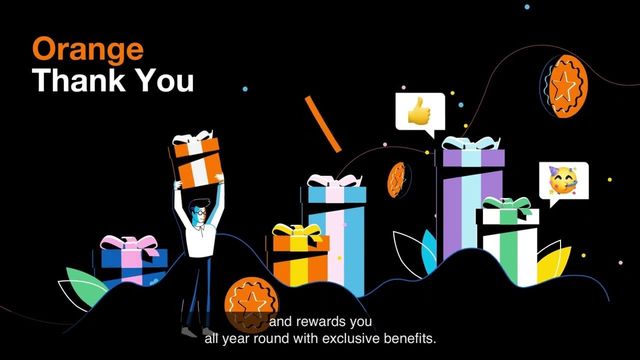
Program model: Content-led loyalty. Subscribers get exclusive access to sports streaming, music, and entertainment content, combined with partner deals across food, travel, and retail.
Why it works: Orange doesn't compete on price or points. It competes on access. That changes the nature of the customer relationship entirely. Your carrier stops being a utility and becomes an entertainment provider. Leaving Orange doesn't mean finding a new phone plan. It means losing access to live sports and content you've built habits around. That's ecosystem loyalty.
The switching cost isn't financial. It's emotional and behavioral. Over time, customers stop comparing carriers and start comparing what they'd lose.
Key data:
- Active across multiple European markets
- Exclusive content partnerships in sports, music, and entertainment
- Partner deals spanning food, travel, and retail
The lesson for your business: Content-as-reward works especially well for telcos because data and streaming are already your product. If you can bundle exclusive content into your plans, the relationship shifts from commodity to platform. That shift is hard for competitors to reverse.
7. Airtel Thanks (India)
In the world's most price-sensitive telecom market, Airtel found a way to make switching feel expensive without touching the price tag.
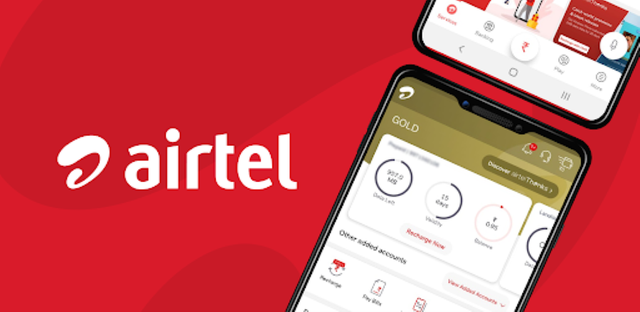
Program model: Tiered membership with premium content integration. Tiers based on plan value. Includes Amazon Prime, Disney+ Hotstar access, cashback on recharges, and priority support.
Why it works: Over one billion MNP requests in India prove that subscribers will switch for even small price differences. Airtel's response is strategic: turn a commodity (mobile service) into a platform by bundling premium content directly into plan tiers.
When your carrier gives you Amazon Prime and Disney+ Hotstar, switching to a cheaper competitor means losing your streaming subscriptions. Customers stop comparing monthly fees and start weighing what they'd give up. The mobile plan becomes secondary to the ecosystem around it. That reframing is what turns price-sensitive subscribers into retained ones.
Key data:
- Over one billion MNP requests in India
- Premium content bundled: Amazon Prime, Disney+ Hotstar
- Cashback on recharges at higher tiers
- Priority support for top-tier members
The lesson for your business: Bundle high-value third-party content into your tiers. When subscribers mentally link your network to their entertainment routine, price alone stops being the deciding factor. This works at any scale if you pick content partners your specific audience cares about.
II. What Makes Telecommunication Loyalty Programs Different
Telecom isn't retail. Customers don't browse. They sign a contract and forget about you until something goes wrong. That changes how loyalty programs need to work.
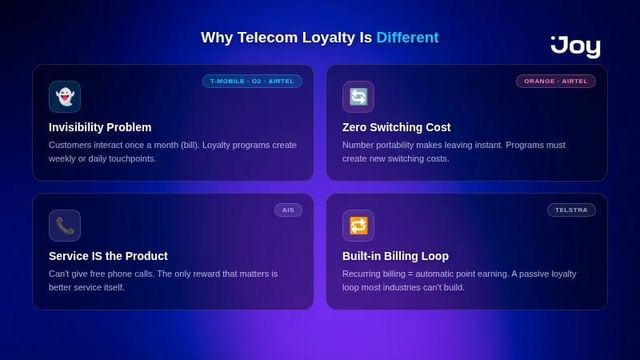
1. The invisibility problem
Most telecom customers interact with their carrier once a month: when the bill arrives. T-Mobile solved this with free weekly perks every Tuesday. O2 times rewards around contract anniversaries and churn-risk moments.
Airtel bundles streaming content that customers open daily. Three different approaches, same goal: give subscribers a reason to think about your brand more than once a month.
2. Switching costs are almost zero
Mobile Number Portability means customers can leave in minutes. Telecom loyalty programs have to create new switching costs that replace the ones regulation removed.
Orange and Airtel do this with content bundling. AIS does it with service tiers. The best programs make leaving feel like losing something, not just changing providers.
3. Service IS the product
A coffee shop can give you a free drink. A telco can't give you a free phone call and expect anyone to care. AIS figured out that the only reward that matters in telecom is better service itself.
Priority support, faster resolution, dedicated lines. When 96% of churn comes from bad support, the most effective "reward" is just doing your core job better for loyal customers.
4. Billing is a built-in loyalty mechanism
Unlike retail, telecom has a recurring billing relationship with every customer. Telstra turns this into automatic point earning. No extra action, no app visit needed. Points accumulate silently on every bill.
Most industries would kill for that kind of passive engagement loop. Few telcos actually use it.
III. How to Build a Telecommunication Loyalty Program That Reduces Churn
The seven programs above share common principles, but copying T-Mobile's playbook won't work if you're running a regional carrier with 500,000 subscribers. Here's how to build a telecommunication loyalty program that fits your actual situation.
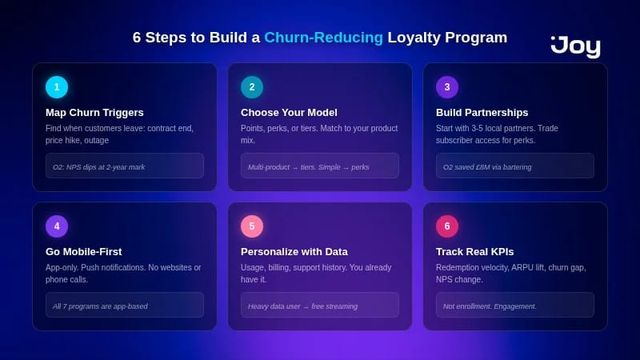
There's no single right model. The choice depends on your product mix, subscriber base, and what you're trying to solve. If you sell mobile, internet, and entertainment, points with tiers drive bundling. If you're a single-product carrier competing on simplicity, perks get results faster.
| Model | Best For | Pros | Cons |
|---|---|---|---|
| Points-based | Multi-product carriers (like Telstra) | Tangible value drives bundling | Slow to deliver value, more complex to manage |
| Perks-based | Simplicity-focused brands (like T-Mobile) | Instant gratification, low friction | Requires ongoing partner deals |
| Tiered | Carriers wanting upsell (like AIS) | Drives higher spend, creates status | Can alienate lower-tier customers if done poorly |
One honest note: building a telecommunication loyalty program in-house is expensive and slow. Most mid-size carriers benefit from third-party loyalty platforms that handle the infrastructure so you can focus on strategy and partner relationships.
IV. KPIs to Track Your Telecommunication Loyalty Program's Success
A loyalty program without measurement is just a cost center. Here are the six metrics that tell you whether your telecommunication loyalty program is actually reducing churn or just adding overhead.
| KPI | What to Track | What "Good" Looks Like | Why It Matters |
|---|---|---|---|
| ARPU | Revenue per user: members vs. non-members | 51% higher spend among members (BCG benchmark) | Shows whether loyalty drives revenue, not just engagement |
| Churn Rate | Member churn vs. overall churn | T-Mobile: active users churn at half the rate | The single most important metric. If this doesn't move, nothing else matters. |
| Redemption Velocity | How fast members use their rewards | Within 30 days of earning | Slow redemption means your rewards aren't valuable enough. Fast redemption means customers are paying attention. |
| CLV | Average tenure of loyalty members vs. non-members | 95% of telecom CLV comes from 3+ year customers (Simon-Kucher) | Tracks whether your program extends relationships, not just transactions. |
| NPS | Score for members vs. non-members | T-Mobile saw a 14-point lift for Tuesday's users | Measures whether loyalty members actually like you more, or just collect freebies. |
| Participation Rate | Active users, not just enrolled members | Above 40% of the enrolled base | High enrollment with low participation means your program looks good on paper but isn't working. |
Most telecom companies don't have clear industry benchmarks yet. That's okay. Start by establishing your own baselines for these six metrics, then aim for incremental improvement each quarter. The carriers in this article didn't build their programs overnight. They iterated.
V. What Most Guides Get Wrong About Telecommunication Loyalty Programs
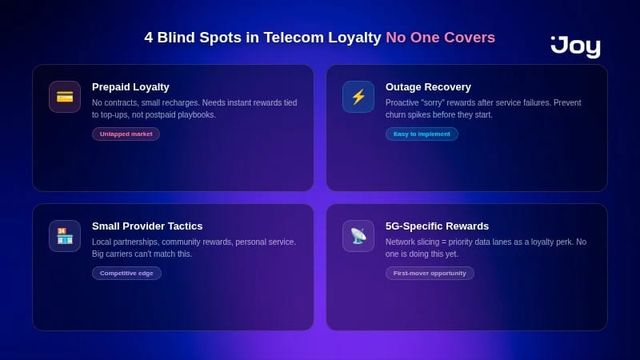
1. Prepaid gets ignored
Almost every guide focuses on postpaid. But prepaid customers don't have contracts, recharge in small amounts, and need instant rewards tied to top-ups. Different behavior requires different mechanics: shorter redemption cycles, cashback on recharge, and immediate value. Most carriers haven't explored this.
2. No one talks about outage recovery
Network failures cause predictable churn spikes. A proactive "sorry" reward (bonus data, bill credits, extra points) can stop the damage before customers start shopping with competitors. Easy to implement. No one writes about it.
3. Small providers get left out
Every guide profiles Verizon and T-Mobile as if their budgets are normal. They're not. Smaller telcos and MVNOs can win with hyper-local partnerships, community rewards, and personalized service that big carriers structurally can't offer.
4. 5G loyalty is wide open
Network slicing could let Gold-tier members get guaranteed bandwidth during peak hours. That's service differentiation by loyalty tier. No competitor is doing this yet.
VI. Start Building Your Telecommunication Loyalty Program
The best programs in this article share one thing: they give customers a reason to stay that goes beyond price. T-Mobile builds weekly habits. O2 intervenes at churn triggers. AIS makes better service the reward. Each approach works because it's personal, immediate, and tied to real customer behavior.
You don't have to build from scratch. Platforms like Joy Loyalty give you the tools to launch tiered rewards, referral programs, and personalized perks without building custom infrastructure. Start with one model, measure the six KPIs above, and iterate.