"TTR came to us with one of the most complex migration scenarios we'd encountered—historical timestamp data from Webcada that needed to integrate seamlessly with tier assessments. We knew that getting this wrong would break trust with their entire community."
— Joy Team
CHALLENGE
When your loyalty program can't keep up with your brand
The Tinsel Rack (TTR) began in 2010 as a LiveJournal blog shop.
Sisters Joyce and Jolene Ng posted outfit photos, took orders through comments, and shipped pieces from their apartment. It was scrappy, personal, and very Singapore.
Fifteen years later, TTR has stores at Jewel Changi Airport and Orchard Gateway. Their audience evolved from millennials to Gen Z. Their brand positioning sharpened: timeless basics, premium comfort, fashion that doesn't take itself too seriously.
But their loyalty program was stuck in 2015.

The WordPress problem
TTR ran loyalty through Webcada on WordPress. It worked - barely. But as they planned to migrate to Shopify, the cracks showed.
Customer point balances lived in one system. Tier status lived in another. Birthday data collected during Shopify account creation didn't sync with the loyalty platform, breaking birthday perk delivery.
Worse: TTR's tier assessment used monthly spending windows with historical timestamps. This wasn't standard "spend X, get Y" logic. The old system tracked when customers spent, not just how much.
A simple platform migration would break everything.
SOLUTION
Building a loyalty club Gen Z actually wants to join
Joy worked with TTR to solve both the migration complexity and the strategic question: what does loyalty look like for a Gen Z fashion brand?
First, they made migration invisible
Joy built custom logic to preserve every piece of TTR's historical data. Assessment logic maintained continuity. Point balances transferred accurately. Tier statuses stayed intact.
Birthday metafields synced properly between Shopify and Joy, fixing the perk delivery failures that had frustrated customers.
No customer noticed the switch. That was the goal.
"We were honestly nervous about the migration. Our customers had accumulated points and tier status over months, and we couldn't afford to lose that data or break their trust. Joy's team handled it flawlessly - nobody even noticed we switched platforms."
- The Tinsel Rack team
Then they built four tiers worth aspiring to
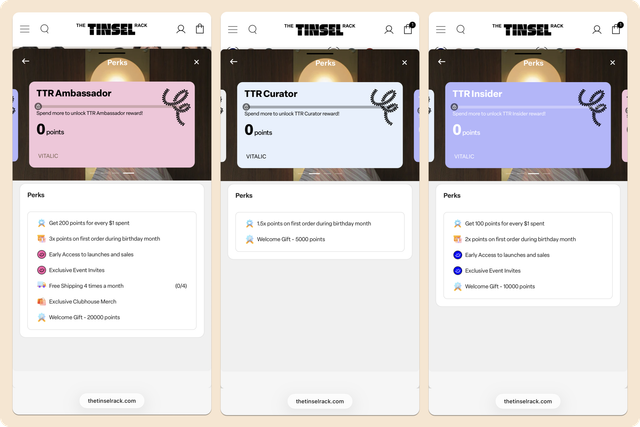
TTR's "Tinsel Club" now has four levels: Basic, Curator, Insider, and Ambassador.
The structure rewards spending, but the perks feel exclusive - not transactional:
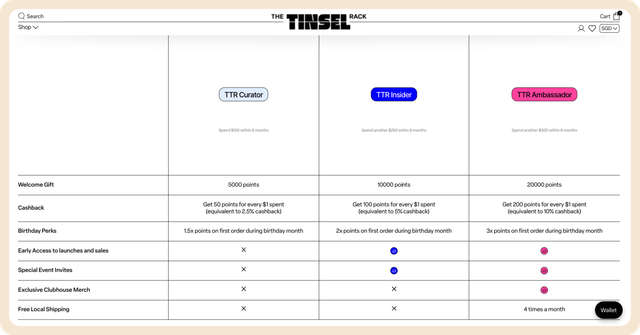
Cashback that accelerates: Basic members earn 50 points per $1 (2.5% back). Ambassadors earn 200 points per $1 (10% back). The gap creates real motivation to climb.
Birthday multipliers that scale: First order during your birthday month earns 1.5x points at Basic, 2x at Curator, 3x at Ambassador. Gen Z customers share these moments on social - free marketing.
Access, not just discounts: Curator and above get early access to launches and sales. Insiders get exclusive Clubhouse merch. Ambassadors get 4 free local shipping orders per month.
The strategic insight: Gen Z doesn't just want savings. They want status.
"Our customers started asking 'how do I reach Ambassador?' within the first week. The tier structure created this aspirational element we never had before—it's not just about discounts, it's about being part of an exclusive community."
— The Tinsel Rack team
They made redemption frictionless
Joy implemented checkout point redemption. Members with 2,000+ points see redemption options at checkout. 2,000 TTR Points = $1.
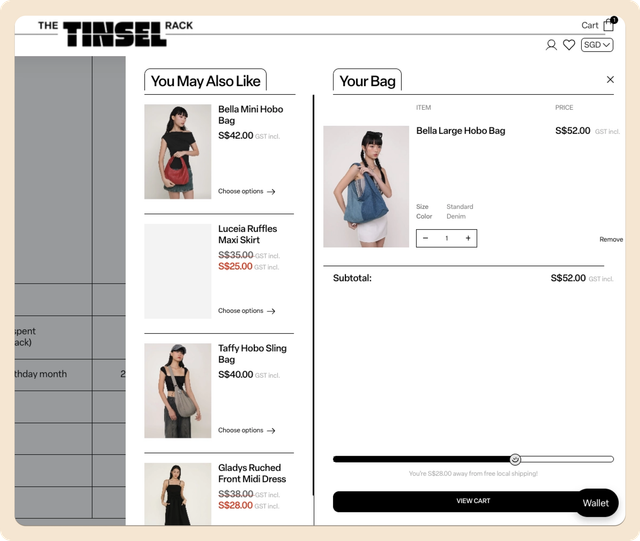
Choose exactly how many points to apply. No hunting through dashboards or copying codes.
They customized every UI
Using Joy's SDK, partnering with Deegix, TTR built custom loyalty pages, widgets, and dashboards matching their Gen Z aesthetic. Dynamic tier icons change as members advance. Email templates pull real-time loyalty data.
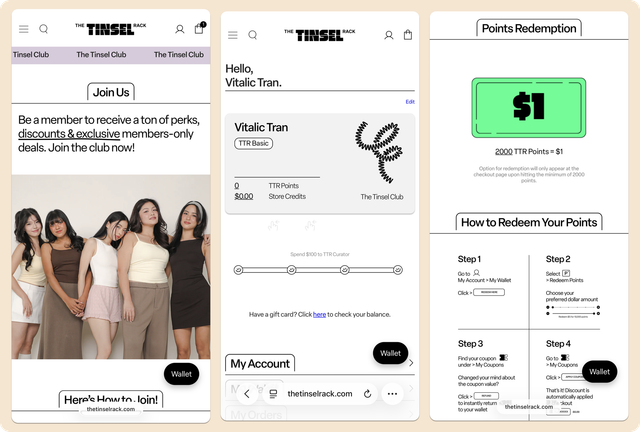
The collaboration between Deegix's frontend expertise and Joy's SDK flexibility created a loyalty experience that feels like a native part of TTR's brand, not a bolted-on app.
"The SDK customization was game-changing. Working with Deegix, we could make the loyalty program look exactly like TTR—same vibe, same aesthetic. Our Gen Z customers expect everything to be cohesive, and Joy's SDK gave us that flexibility."
— The Tinsel Rack team
RESULTS
What happened in 6 months
Six months after launching their Joy-powered loyalty program, TTR's numbers told a clear story: sophisticated tier structures, combined with seamless migration, create an exceptional ROI.
- 409% ROI. TTR spent $53.9K in discount costs and $1,997.50 on Joy. They generated $285K in return.
- $285k in loyalty-attributed sales. Not engagement metrics — actual revenue.
- 56% redemption rate. Members actively use their points, not just earning them.
- 107.8M points issued. Deep engagement across all four tiers.
The 94% enrollment rate is particularly striking: almost every TTR customer chooses to join the loyalty program. Combined with the 56% redemption rate, this shows members aren't just signing up—they're actively participating and using their rewards.
Why it worked
The migration preserved trust. Customers woke up on Shopify with everything intact.
The tiers matched Gen Z psychology. Status and access matter more than discounts. Ambassador membership became something to pursue and protect.
And the SDK customization made loyalty feel native — not bolted on.
"Joy's team handled it flawlessly — nobody even noticed we switched platforms."
— The Tinsel Rack team
The Bottom Line
The Tinsel Rack proves complex migrations don't require sacrificing customer experience.
From blogshop to omnichannel brand, TTR kept what made them special: the feeling that you're part of something. Joy helped them scale that feeling through tiers, perks, and a seamless technical foundation.
409% ROI. And a loyalty program their Gen Z customers actually want to talk about.
Ready to transform your loyalty program with sophisticated tiers and seamless migration? The Tinsel Rack's success shows what's possible when technical capability meets strategic program design.