
How Apple Applies Customer Loyalty: 4 Principles Behind 89% Retention
Apple has 89% customer retention and no points program, no VIP tiers, no rewards. Loyalty comes from four deliberate principles applied across every touchpoint. Here's how each one works, and what results it drives.

Summarize this post with AI
Apple has 89% customer retention. No points program. No VIP tiers. No loyalty rewards. Nine in ten iPhone owners buy their next phone from Apple, not because they lack alternatives, but because Apple has built structural reasons that make staying the default.
Most brands study Apple's customer loyalty strategy and walk away thinking it's unreplicable. A product of hardware dominance, scale, and billions in R&D. That framing misses the point. Apple's retention comes from four deliberate principles, applied consistently across every customer touchpoint, that together make switching feel like a loss.
So what are those principles, and how do they actually work?
Apple's Loyalty Numbers: The Benchmark
These numbers explain why Apple is the most studied loyalty case in business.
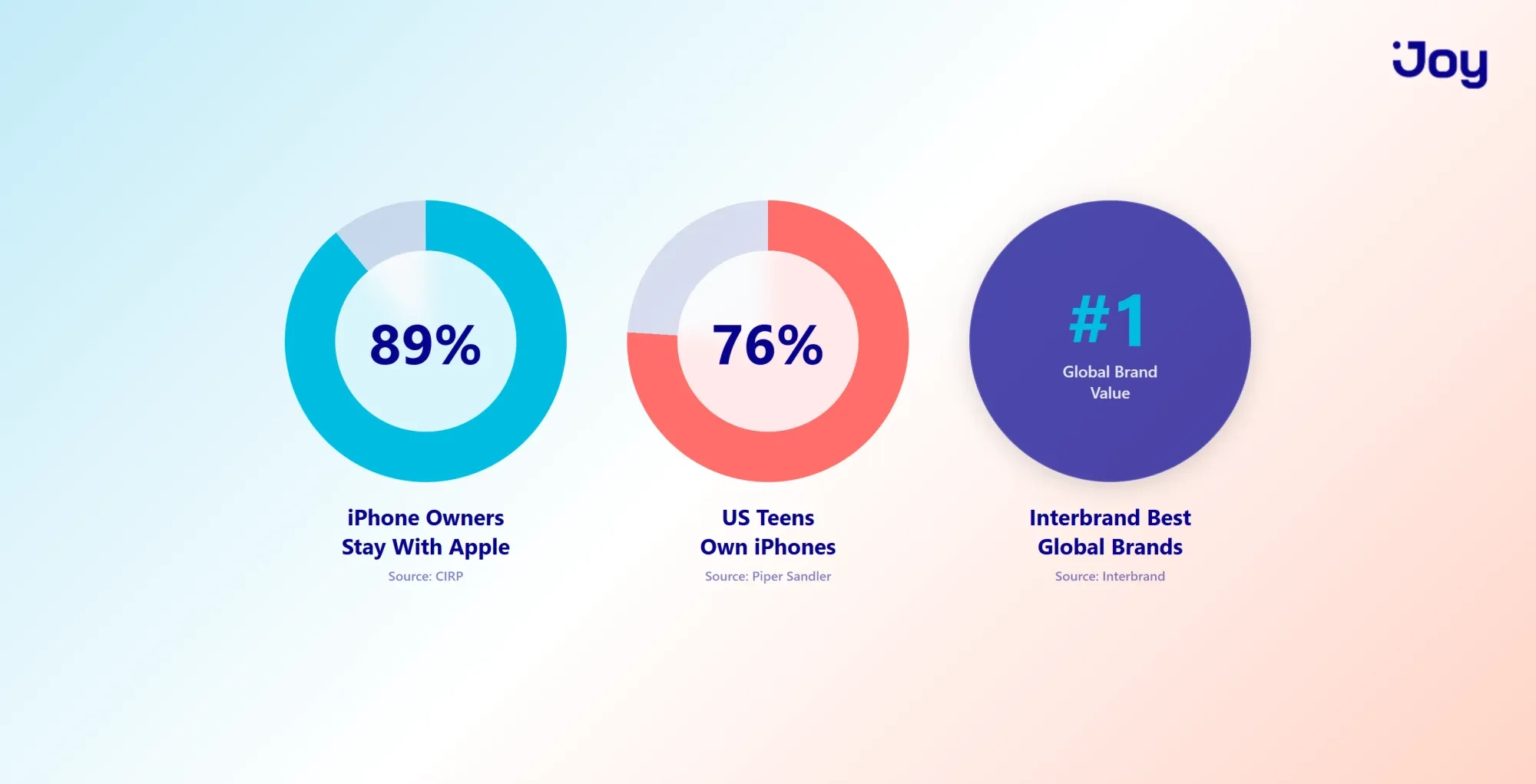
Consumer Intelligence Research Partners (CIRP) puts the figure at 89%: the share of iPhone owners worldwide who plan to stay with Apple for their next phone. That figure rises to 92% when users stay with the same carrier.
And it doesn't stop with existing customers. Roughly 76% of US teenagers own iPhones, per Piper Sandler's "Taking Stock With Teens" survey. Apple captures the next generation before competitors even get a foothold.
What makes these numbers structurally significant is that they're behavioral, not attitudinal. These are customers making a real purchase decision, fully aware of alternatives, and choosing Apple again. Not brand affinity. Behavioral loyalty.
So what specifically produces this outcome? Apple doesn't discount to retain. The loyalty is engineered. Four principles explain how.
Principle 1: Ecosystem Integration Makes Switching Painful
If 89% retention is the outcome, the ecosystem is the foundation it sits on.
How Apple Does It
Apple's ecosystem is an interconnected web of hardware, software, and services where each piece works better together than alone. iPhone integrates with Apple Watch, AirPods, MacBook, iPad, and Apple TV through iCloud sync, Handoff, AirDrop, Continuity Camera, and Universal Clipboard. Every connection adds value. And everyone adds a reason to stay.
Services deepen the lock-in. iCloud Photos stores years of memories that can't be easily migrated. Apple Health accumulates years of health data. Apple Pay stores payment methods and transit cards. iMessage is tied to an Apple ID, so switching means losing conversations and contacts built over the years.
Every new Apple product a customer adds makes every existing Apple product more valuable (and increases the cost of leaving). Apple ecosystem loyalty compounds over time.
Apple doesn't block switching. It makes switching feel like a loss, not just a change.
What It Achieves
Apple's active installed base surpassed 2.2 billion devices as of 2024, an all-time high reflecting the ecosystem's deep expansion across device categories (Apple Q4 FY2024 Earnings Press Release, October 2024).
The Services segment, which monetizes the ecosystem directly, hit $96.2 billion in revenue in FY2024, up 13% year-over-year (Apple Q4 FY2024 Earnings Press Release, October 2024). That's the financial proof: ecosystem integration converts hardware customers into recurring subscribers.
A customer isn't worth one iPhone. They're worth years of iCloud subscriptions, app purchases, and Apple TV+ renewals. Ecosystem integration dramatically increases customer lifetime value beyond the initial hardware purchase.
Principle 2: Identity Attachment Turns Loyalty Into Self-Concept
Ecosystem integration explains why switching is painful. But it doesn't fully explain why Apple customers actively want to stay. Identity attachment does.
The Marketing That Builds Identity
Apple's marketing describes people, not products. "Think Different" (1997) was a statement about who the customer is: creative, independent, unconventional. Every campaign since has reinforced this identity framing, from "Shot on iPhone" to "Behind the Mac" to Apple Watch health campaigns. The product is secondary. The customer's self-image is primary.
This identity framing gets reinforced at every touchpoint. Product naming carries cultural weight: "Mac," "iPhone," "iPad." Owning an iPhone isn't just owning a phone. It's owning an iPhone, a culturally loaded object with its own identity signal. The unboxing ritual is designed as an experience in itself: tactile, precise, anticipatory. And the Apple logo on the back of a MacBook? It's visible to others. A public statement, not a hidden feature.
Apple customers don't merely use Apple products. They identify as Apple users. "I'm a Mac" rather than "I own a Mac." Switching brands feels like abandoning part of who you are.
Why This Creates Price-Resistant Loyalty
The evidence is clear in generational data. Roughly 76% of US teenagers own iPhones, according to Piper Sandler's Taking Stock With Teens survey, and iPhone preference among teens has held above 75% for multiple consecutive years. Apple's brand identity is culturally embedded in the cohort that will be spending for the next 50 years.
Apple has also held the #1 position in Interbrand's Best Global Brands ranking for over a decade, reflecting brand equity that extends far beyond product functionality (Interbrand Best Global Brands).
Identity-based loyalty is price-resistant loyalty. Apple consistently charges a significant premium over Android alternatives, and retention still sits at 89%. Customers aren't staying for the deal. They're staying because leaving would mean becoming someone else.
Principle 3: Community and Support Culture Creates Belonging Beyond the Product
Identity explains why customers feel connected to Apple. But connection alone is fragile without reinforcement. Community and support culture provide that reinforcement.
Apple Stores as Community Spaces
The layout is open. The language is non-transactional ("Specialist" not "salesperson," "Genius Bar" not "tech support"). Steve Jobs articulated the design intention at launch: create a place where Apple customers gather, not just buy.
The Genius Bar removes a common loyalty defection trigger: technical frustration. When a customer's device breaks, the repair experience often determines whether they stay with the brand. Apple designed this interaction to be fast, human, and free of blame. That's loyalty reinforcement at the exact moment it's most at risk.
The Developer and Creator Ecosystem
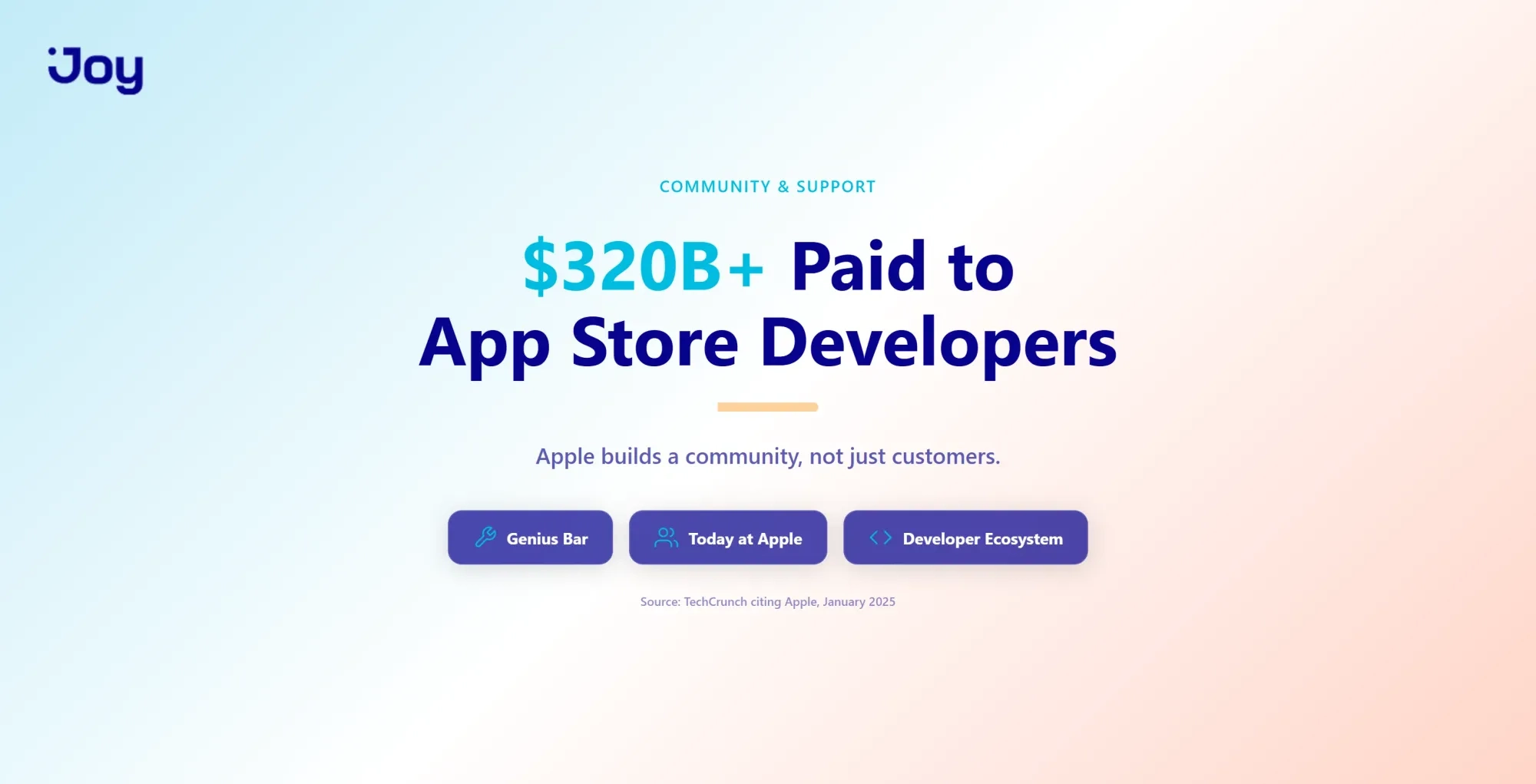
The community extends into professional ecosystems as well. Apple's App Store, Final Cut Pro, Xcode, and Swift developer community create a professional identity layer. Developers who build their workflows around Apple tools face enormous switching costs and act as advocates within their industries.
Apple also runs Today at Apple, free in-store sessions on photography, music, coding, and design. These aren't sales pitches. They're community experiences that deepen the customer's relationship with the brand over time.
The Numbers Behind the Community
Developers have earned more than $550 billion from Apple's App Store since 2008, reflecting the vast scale of its developer ecosystem (Apple Newsroom, January 2026).
Apple Stores consistently rank among the highest revenue-per-square-foot retailers globally. Not from hard-selling, but from brand experiences that convert browsers into buyers and buyers into advocates (Apple Annual Report).
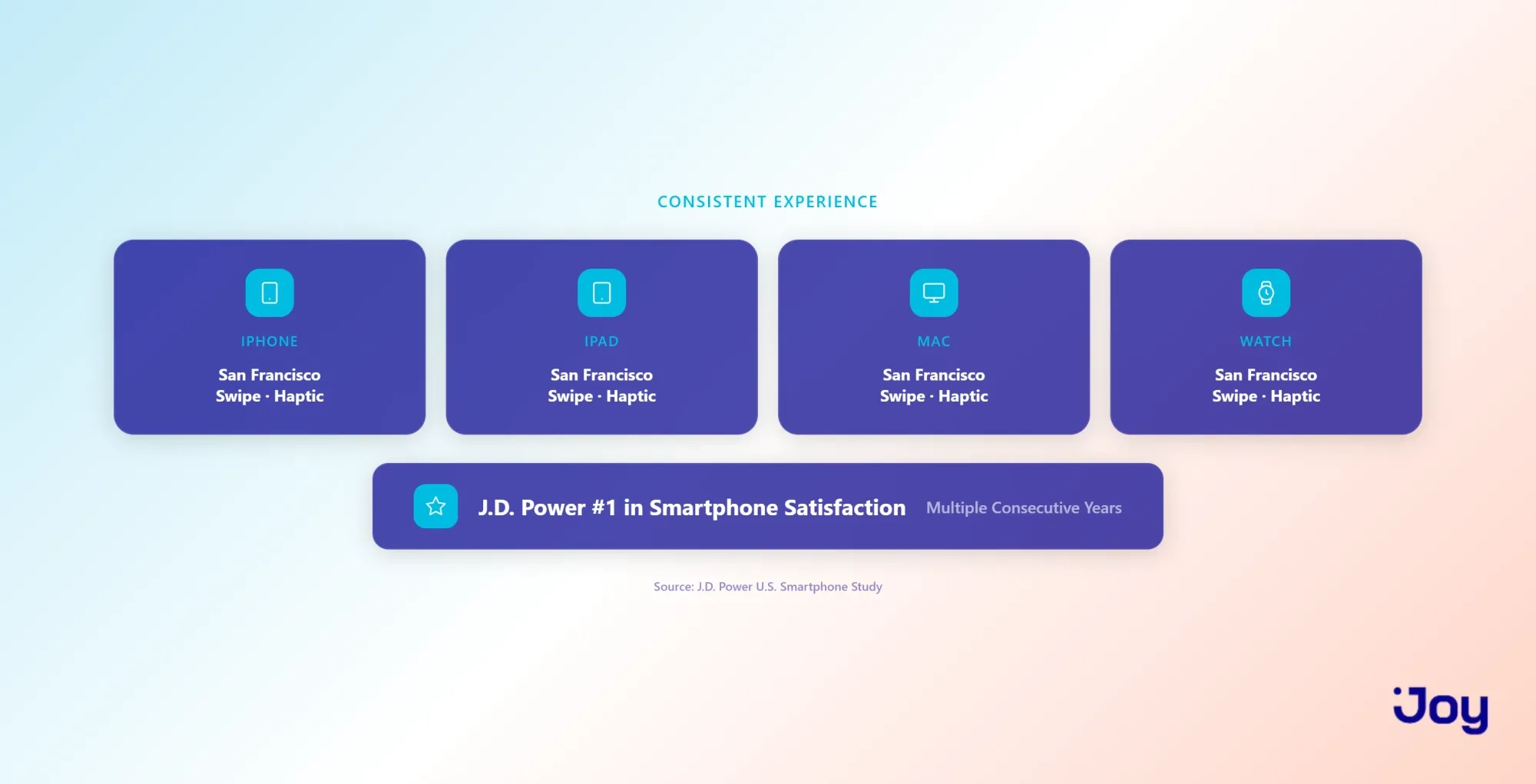
The Genius Bar model directly reduces a key churn trigger: post-purchase technical frustration. J.D. Power's U.S. Smartphone Satisfaction Study has ranked Apple #1 in smartphone satisfaction for multiple consecutive years (J.D. Power).
Principle 4: Consistent Experience Makes Every Touchpoint Deliberate
Belonging weakens fast if the experience is inconsistent, if product quality fluctuates, or the service tone shifts from one interaction to the next. Apple's fourth principle prevents that.
Design Language Across Every Product
Apple's design language is consistent across every product category. The same typography (San Francisco), the same interaction patterns (swipe gestures, haptic feedback), the same material philosophy (aluminum, glass, precise tolerances). A customer who picks up an iPad for the first time already knows how to use it because they use an iPhone. That familiarity is itself a switching cost: learning a new system takes real time and effort.
Software consistency reinforces this. iOS, iPadOS, macOS, watchOS, and tvOS share design patterns, settings structures, and interaction metaphors. Apple updates all of them together. The system feels unified because it is, with each piece designed with the others in mind.
Communication and Full-Stack Control
Customer communication follows the same principle. Apple's support documentation, retail scripts, and marketing copy all carry the same voice: clear, technical when needed, never condescending. You'll never experience a jarring contrast between an Apple ad and an Apple Store visit.
What makes this level of consistency possible is structural: Apple controls the full stack. Hardware, operating system, apps, retail, customer support. That gives Apple the ability to enforce consistency that competitors relying on third-party partners simply can't match.
How Consistency Sustains Retention Over Time
Consistency reduces cognitive switching cost. When every interaction with the brand reinforces the same experience, customers develop behavioral habits, not just preferences. And habits are harder to break than preferences.
The 89% retention rate persists across multiple phone generations, including years when competitors release objectively competitive hardware. It's the consistency of the experience, not just the quality of the latest product, that drives retention over time.
J.D. Power has ranked Apple #1 in U.S. smartphone satisfaction for multiple consecutive years (J.D. Power, U.S. Smartphone Satisfaction Study). Consistent experience at every touchpoint is what makes that ranking repeatable.
Why These 4 Principles Work Together, Not Separately
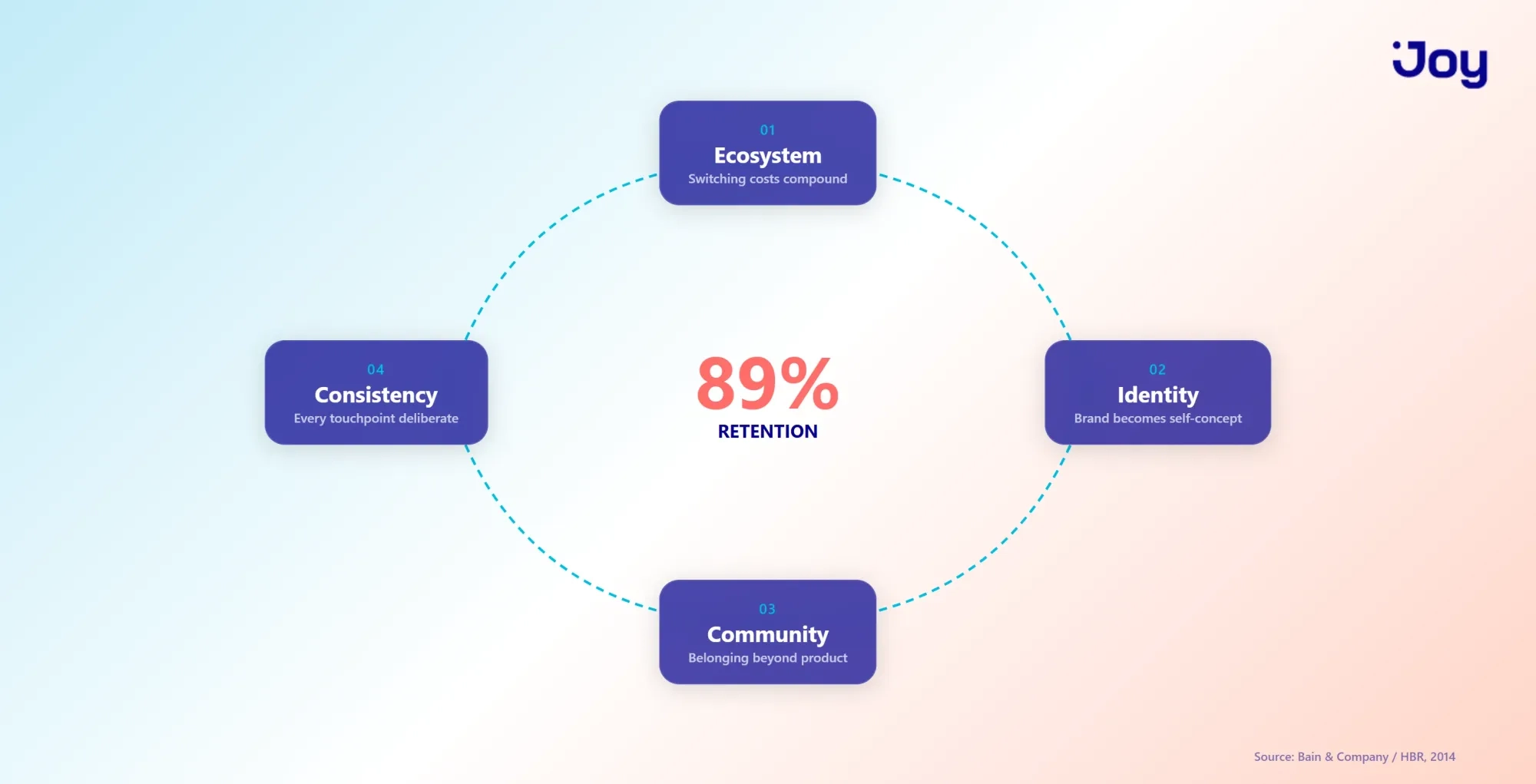
Each of these four principles is powerful on its own. But the reason Apple achieves 89% retention, and sustains it year after year, is that they're mutually reinforcing. Each one makes the others stronger.
Ecosystem integration makes identity harder to abandon, because leaving means losing the tools that define your workflow. Identity makes a community feel authentic, because Apple users share values, so belonging isn't forced. Community, in turn, makes a consistent experience expected because invested customers hold the brand to a high standard. And consistent experience validates identity, because the product delivers on what the brand promises. The loop closes. Loyalty is maintained.
The underlying pattern across all four: Apple gives customers reasons to stay that go beyond the product itself. Switching means losing integration, abandoning an identity, leaving a community, and relearning a system.
What does this mean financially? Bain & Company (Frederick Reichheld, HBR, 2014) found that a 5% increase in customer retention can increase profits by 25% to 95%. Apple's retention rate isn't a vanity metric. It's a financial architecture. The 89% is what compounding customer loyalty and retention looks like at scale.
The Hidden Costs of Apple Loyalty (And What Brands Should Learn)
When we talk about loyalty, it sounds positive. Higher retention. Better margins. More repeat purchases.
But loyalty also creates hidden costs, not for the brand, but for the customer.
Over time, customers invest money, data, habits, and identity into a brand. The deeper that investment goes, the harder it becomes to switch. Apple Inc. understands this better than almost anyone.
If you want to build real loyalty in e-commerce, you need to understand what customers are giving up when they choose to stay.
Premium Pricing and the Willingness to Pay More
Apple products are rarely the cheapest option in their category. Yet millions of customers upgrade year after year without waiting for heavy discounts.
Why are they willing to pay more?
Because they trust what they’re buying.
Over time, Apple has built a track record of product quality, consistent updates, strong resale value, and seamless integration across devices. That track record reduces perceived risk. Customers feel confident the product will work, last, and fit into their daily lives.
When trust is high, price sensitivity drops.
For e-commerce brands, you cannot simply raise prices and call it “brand positioning”. Loyal customers accept higher prices when:
- The experience improves over time
- The product consistently delivers
- Support is responsive and reliable
- The brand feels stable and trustworthy
If customers feel like you are charging more without adding value, resentment builds fast. Loyalty collapses when people feel exploited.
The privilege to charge more comes after you have proven you are worth it.
Switching Costs, Data, and Habit Formation
Loyalty often grows quietly through small actions. When you use an iPhone, you buy specific apps, store thousands of photos in iCloud, and connect your Apple Watch. Eventually, your "muscle memory" adapts to how the phone works.
If you try to switch to a different brand, it no longer feels like a simple purchase; it feels like a difficult "migration." You would have to move your data and relearn how to use a phone. In e-commerce, you can create this same feeling, without "trapping" the customer, by using:
- Saved Profiles: Make it easy for them to store preferences.
- Personalized Recommendations: Show them you know what they like.
- Accumulated Rewards: Give them a reason to feel that leaving means losing progress.
Every interaction that personalizes the experience adds light friction against leaving.
If your product becomes part of someone’s weekly routine, churn drops naturally because habit replaces decision-making.
Value Density: Giving More Than You Take
Here’s where many brands misread Apple’s strategy.
They see high prices and assume the secret is premium positioning.
But Apple does not win because it charges more. It wins because it delivers high value density.
Value density is the amount of perceived value packed into each interaction, from packaging and product design to customer support, ecosystem benefits, and emotional experience.
If you want to justify a loyalty premium without creating resentment:
- Improve experience before increasing price.
- Add visible benefits for repeat customers.
- Communicate clearly what makes your product different.
- Reward tenure instead of punishing it.
If a customer feels they are getting more value than they are paying for, they will stay. Loyalty should be an exchange of value, not just a way to extract money.
How to Apply the Apple Model to Your Business
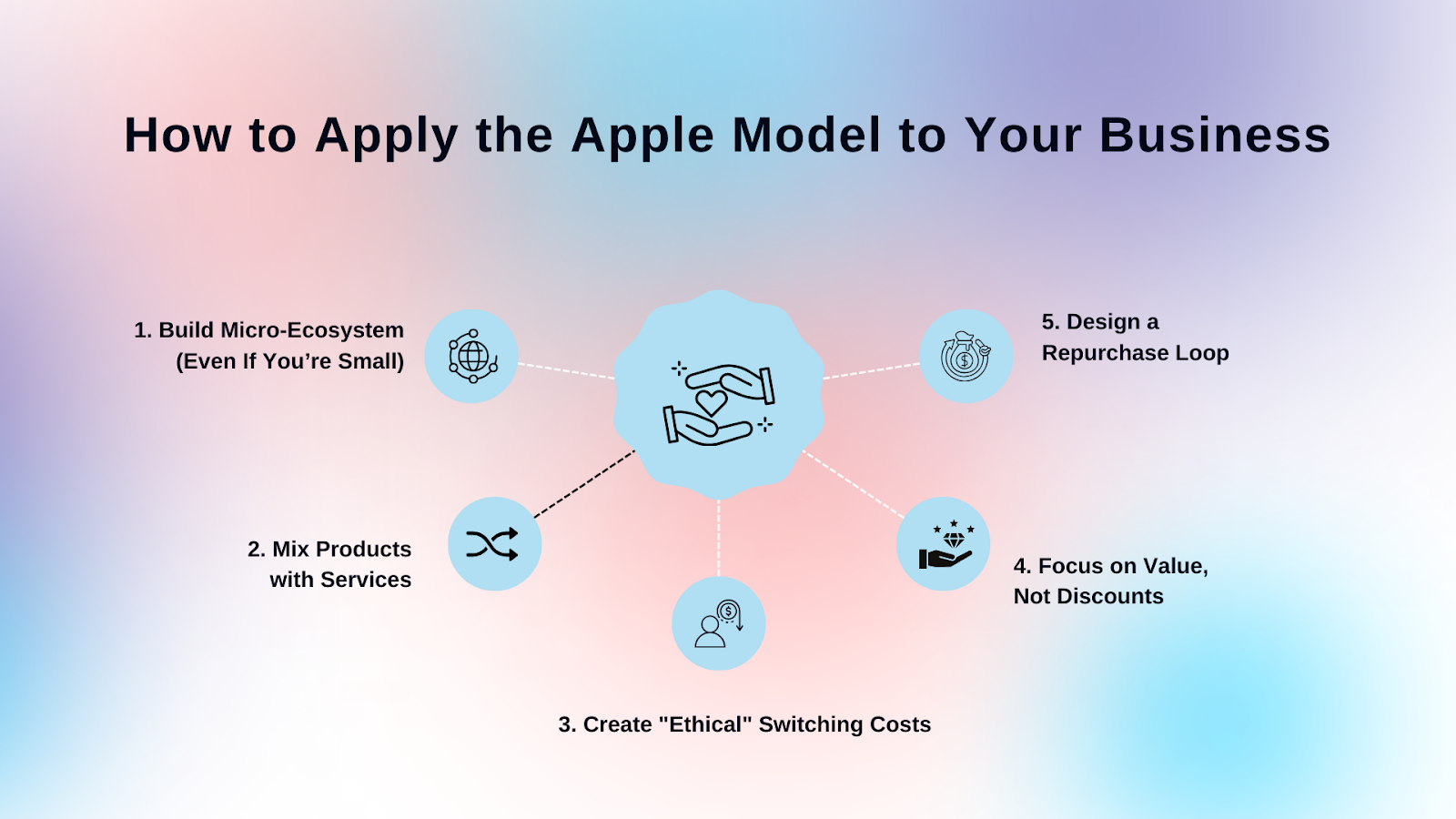
You don’t need a billion-dollar budget to use these strategies. You can build a "loyalty architecture" by following these five steps:
Build a Micro-Ecosystem (Even If You’re Small)
Even if you only sell a few products, make sure they work better together.
If you sell coffee, sell the filters and the mugs that fit the machine perfectly.
When products are designed as a system, customers are more likely to buy the "whole set" from you than to search elsewhere.
Mix Products with Services
One-time sales are unpredictable, but services create a lasting connection.
Consider adding a subscription for items that run out (like skincare) or offering a "members-only" group where customers can get expert advice.
This shifts the relationship from a simple transaction to an ongoing partnership.
Create "Ethical" Switching Costs
Instead of making it hard to leave, make it beneficial to stay. You can do this by using:
- Tiered Rewards: The longer they stay, the better the perks become.
- Saved History: Make it easy for them to re-order based on their past preferences.
- Status: Give long-term buyers early access to new releases.
Focus on Value, Not Discounts
Most stores try to buy loyalty with coupons, but that only teaches customers to wait for a sale. Instead, focus on the Value Loop:
- Attract them with a great promise.
- Onboard them with a smooth first delivery.
- Habitualize them by making your product part of their routine.
- Advocate: Turn them into fans who tell their friends about you.
Design a Repurchase Loop
Don’t wait for customers to remember you; give them a reason to come back.
Whether it’s a seasonal refresh, an "upgrade" discount for old models, or a simple reminder when it's time to refill, creating a predictable cycle ensures your revenue stays steady.
The Bottom Line: Apple’s success isn't magic; it is a carefully designed system. When you stop focusing on one-off sales and start building a structured environment of value, your brand will grow naturally without relying on expensive ads.
Conclusion
Apple's 89% retention is the documented outcome of four principles: ecosystem switching cost, identity attachment, community culture, and consistent experience. These four have operated together for decades, reinforcing each other.
Loyalty at this level isn't purchased with discounts, and product quality alone doesn't guarantee it. It emerges from deliberate structural choices about how customers interact with a brand, from the first purchase to the tenth.
Understanding what produces this kind of retention is the first step. The principles behind it are clear, and they apply to categories far beyond consumer electronics.
Curious what structural loyalty looks like for ecommerce brands? Explore how Joy approaches retention.
Frequently Asked Questions
How does Apple apply customer loyalty strategies?
Four structural principles, none of which rely on discounts or a formal loyalty program. Ecosystem integration makes switching costly through interconnected products and services. Identity attachment positions Apple ownership as a statement of personal values. Community culture creates belonging through Apple Stores, Genius Bar, and developer communities. And consistent experience delivers the same design language and quality across every product and touchpoint.
Why is Apple's customer loyalty so high?
The 89% retention rate reflects four forces working together: high switching costs (an iPhone owner who also uses iCloud, Apple Watch, and AirPods has enormous functional reasons to stay), strong brand identity (Apple customers identify with the brand as a statement of values), community belonging (Apple Stores and developer culture create investment beyond the product), and consistent experience (every Apple interaction reinforces the same quality standard). No single factor explains it. All four compounds.
Does Apple have a customer loyalty program?
No. No points, no tiers, no referral incentives. Apple's loyalty is structural, not programmatic. The ecosystem itself is the loyalty mechanism: customers stay because leaving means losing integration, identity, and invested time, not because they're earning rewards.
What is Apple's customer retention rate?
89%, according to Consumer Intelligence Research Partners (CIRP), rising to 92% for customers who stay with the same carrier. These figures reflect actual purchase decisions: customers who, with full knowledge of Android alternatives, chose iPhone again.
What can brands learn from Apple's customer loyalty model?
Loyalty is structural, not promotional. Apple's retention doesn't come from better discounts. It comes from giving customers reasons to stay that go beyond the product: switching costs embedded in integrations, identity attached to the brand, community belonging through culture, and consistent experience at every touchpoint.
How does Apple use its ecosystem to build loyalty?
Through compounding switching costs. Every additional Apple product a customer adopts, whether Watch, AirPods, iPad, or Mac, makes every other Apple product more valuable and makes leaving more painful. iCloud Photos, Apple Health data, and iMessage conversations accumulate over the years and are difficult to migrate. The ecosystem is designed so that loyalty becomes the path of least resistance.

Written by
Thomas Nguyen is the CEO & Co-founder of Joy, a loyalty solution for Shopify and eCommerce brands. With years of experience building high-performance Shopify apps, Thomas aims to help merchants grow through customizable and retention-focused tools.
Related reading
 Loyalty Strategy
Brand and Customer Loyalty: The Difference That Determines Whether You Win or Race to the Bottom
Customer loyalty keeps people buying until a better offer arrives. Brand loyalty keeps them buying even when better offers already exist. Most merchants build only the cheaper, more fragile ones - here's the upgrade path.
 Thomas Nguyen
 Loyalty Strategy
Customer Loyalty Meaning: The Framework Most Brands Miss
89% of executives think customer loyalty is up. Only 39% of consumers agree — a 50-point perception gap (PwC, 2025). The fix starts with knowing what customer loyalty actually means. This guide breaks down the dual nature, 6 types, and a 2x2 matrix to diagnose your brand.
Thomas Nguyen Loyalty Strategy
Enterprise Plus Loyalty Program: Case Study for Ecommerce Strategists 2026
Most loyalty programs are built to feel generous. Enterprise Plus was built to make leaving expensive. This case study breaks down the 3 structural levers — milestone tiers, status lock-in, and concrete rewards — that added 2M members without ad spend, and which ones translate to Shopify.
Thomas Nguyen Loyalty Strategy
The Impact of Social Media Marketing on Brand Loyalty: 7 Key Insights
Likes don't equal loyalty. This guide breaks down how social media marketing actually builds brand loyalty — through two-way communication, user-generated proof, omnichannel touchpoints, influencer collaboration, and measurable ROI. 7 key insights for Shopify merchants in 2026.
Thomas Nguyen Loyalty Strategy
Three Stages of Brand Loyalty: Mastering the 2026 ROI Strategies
From "knowing" your brand to "refusing" any other. The three stages of brand loyalty — Recognition, Preference, Insistence — map how customers actually move from awareness to advocacy. This guide breaks down each stage and the tactics to climb the ladder when acquisition costs are 4× higher.
Thomas Nguyen Loyalty Strategy
Dimensions of Customer Loyalty: Why Discounts Alone Never Create Real Loyalty
Most loyalty programs run the same points-for-purchase mechanic—and customers bounce the moment a competitor offers more. Real loyalty has four dimensions, and brands that activate all four see 2–3× better retention. Here's what they are, and how to spot which one your program is missing.
Thomas Nguyen