Customer Loyalty Examples: What Makes Customers Stay (and What Makes Them Leave)
Most brands copy loyalty tactics without understanding the driver behind them. Here are 16 customer loyalty examples sorted by the 5 patterns that make people stay — product obsession, shared identity, values alignment, memorable experience, smart personalization — each with a takeaway to apply.
Summarize this post with AI
Pull up almost any loyalty program, and you'll see the same setup: points, tiers, and an app. But these features don't create loyalty. They capture loyalty that already exists.
The strongest brands first build something customers don't want to leave behind: a great product, a strong identity, shared values, a memorable experience, or personalized service. The loyalty program simply reinforces that connection.
This article breaks down 16 customer loyalty examples across five patterns: product obsession, shared identity, values alignment, memorable experiences, and smart personalization. Let's dive in!
What Customer Loyalty Actually Looks Like
Customer loyalty isn't a program feature. It's a set of behaviors you can observe, and once you know what to look for, you'll spot them everywhere.
Loyal customers turn down a competitor's discount without hesitation. They recommend your brand to friends not because there's a referral bonus, but because they genuinely believe in what you sell. They'll defend you on social media when someone complains. They buy at full price instead of waiting for a sale. And they post about your products because they want to, not because they'll earn points for it.
These behaviors don't come from loyalty programs. They come from something the brand did right.
One stat frames the opportunity well: in Bond Brand Loyalty's 2026 Loyalty Report, 85% of members say loyalty programs make them more likely to continue doing business with certain companies. But programs alone don't create the kind of customer loyalty examples we're about to dig into. They capture loyalty that already exists.
We studied 16 brands whose customers show all of the behaviors above. Five distinct patterns emerged behind why those customers stay. Each pattern runs on a different engine, and each one includes practical takeaways you can apply to your own brand.
For a complete breakdown of the different types of customer loyalty, see our guide on types of customer loyalty.
5 Patterns Behind the Most Loyal Customer Bases
Across 16 brands and five industries, we identified five loyalty patterns:
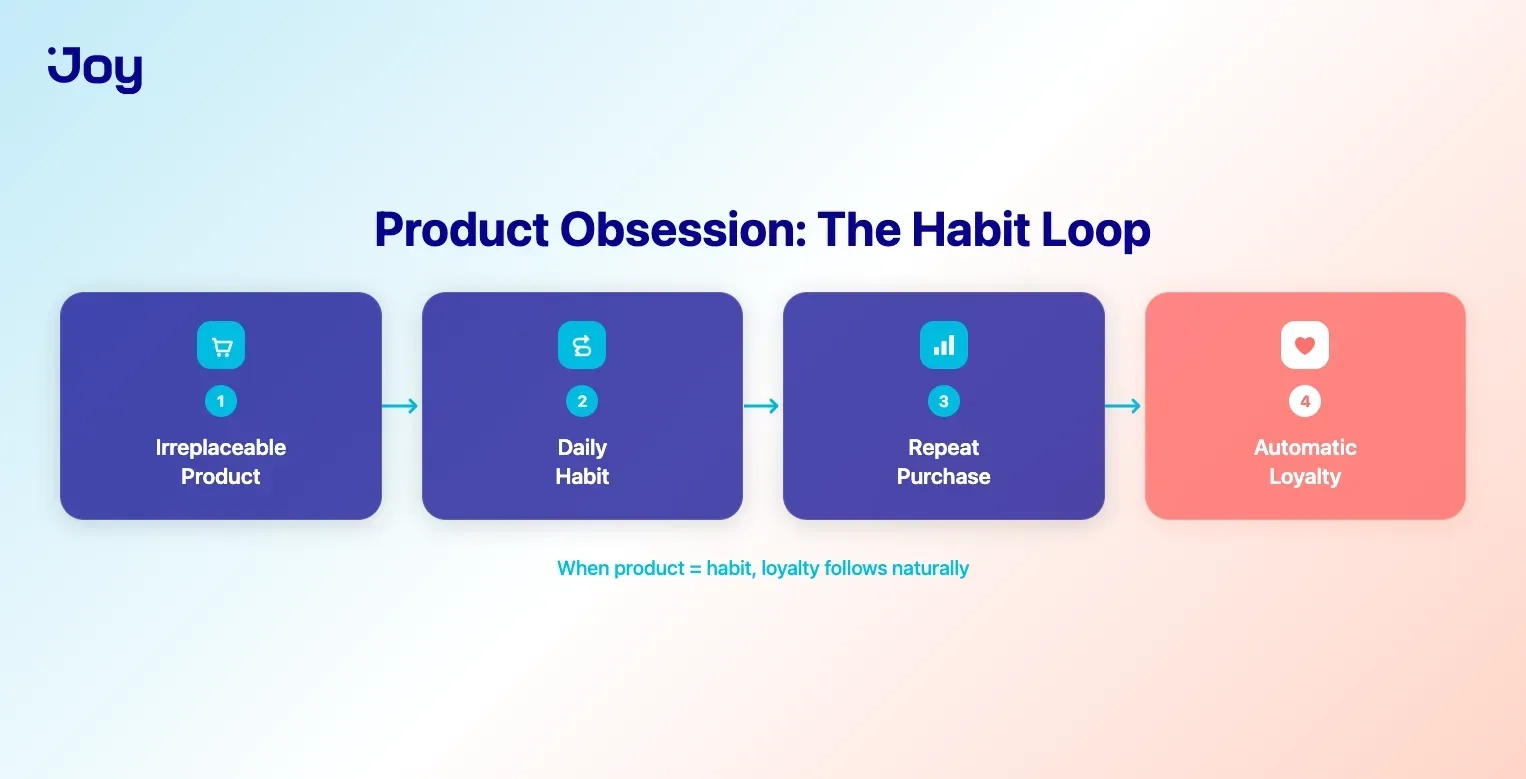
- Product Obsession: "I can't find this anywhere else." Customers return because the product is irreplaceable and has become part of their daily routine.
- Shared Identity: "This brand IS me." The brand's personality becomes how customers define themselves to the world.
- Values Alignment: "We fight for the same cause." Mission-driven brands create emotional investment that no discount can match.
- Memorable Experience: "They made me feel special." Surprise gestures and exclusive experiences outlast any coupon code.
- Smart Personalization: "They actually understand me." Data-powered relevance builds trust, convenience, and a sense of being known.
Most brands with unbreakable customer loyalty don't rely on just one pattern. They stack two or three together. Below, we break down how 16 brands put these patterns into practice and what you can steal for your own store.
Product Obsession: Customers Who Can't Switch
Some brands earn loyalty not through points or perks, but through products so good that switching feels like a downgrade. When a product becomes part of someone's daily routine, loyalty is almost automatic.
Starbucks: "The Daily Ritual"
You've probably heard about Starbucks Rewards. On its Q3 FY2026 earnings call in July 2026, Starbucks put the program at 35.8 million 90-day active US members for the quarter ended 28 June 2026. That number gets the attention, along with the Stars system and the mobile app. But the real reason Starbucks customers stay loyal goes deeper than program mechanics.
It starts with the drink. Every regular Starbucks customer has "my order." An iced oat milk latte with an extra shot. A caramel macchiato with light ice. A venti cold brew with vanilla sweet cream. These aren't just drinks. They're personalized rituals, and Starbucks has made it effortless to repeat them through mobile ordering: tap, walk in, grab, leave.
Starbucks told investors at its Investor Day on 29 January 2026 that Rewards drove nearly 60% of US company-operated revenue in fiscal year 2025. That's enormous. But notice the sequence: loyalty starts with the product habit. The program just captures it.
What you can steal: Find ways to turn your product into a daily or weekly ritual. Subscription models, auto-replenishment, and personalized configurations all build habits around your brand, not just your discount code.
Nuun: "The Subscription Hook"
Nuun sells hydration tablets, a consumable product that athletes use daily. Their approach to loyalty is built around that natural consumption cycle.
Rather than heavily rewarding the first purchase, Nuun offers a 200-point bonus after five subscription renewals. The program rewards the habit, not the acquisition. When the product is something people use up and reorder, the loyalty loop practically runs itself. The program just keeps the cycle spinning.
What you can steal: If your product is consumable, build your rewards around subscription renewals and replenishment rather than one-time discount codes that attract deal-seekers.
Moroccanoil: "The Cult Product"
Moroccanoil has built a cult following on product quality alone. The signature scent, the visible results, the unmistakable turquoise packaging. Customers repeat-buy without needing heavy incentives.
The brand does have a loyalty program, but it isn't the reason customers stay. The product is. When something becomes irreplaceable in a customer's routine, the program is a cherry on top rather than the main course.
What you can steal: Invest in product differentiation before investing in program complexity. A great product with a simple program outperforms a mediocre product with an elaborate one. Every time.
When a product becomes a habit, loyalty follows naturally. The program only needs to reinforce the cycle, not create it from scratch. But product-driven loyalty still needs the right infrastructure: subscription management, replenishment reminders, and personalized rewards that align with how customers actually buy.
Shared Identity: Customers Who Belong
For some brands, loyalty doesn't come from what they sell. It comes from what they represent. When brand identity becomes customer identity, churn drops to near zero.
Nike: "The Identity Badge"
Nike membership features and the 3x spending lift from members get a lot of attention. But the deeper question is: why do members spend that much more?
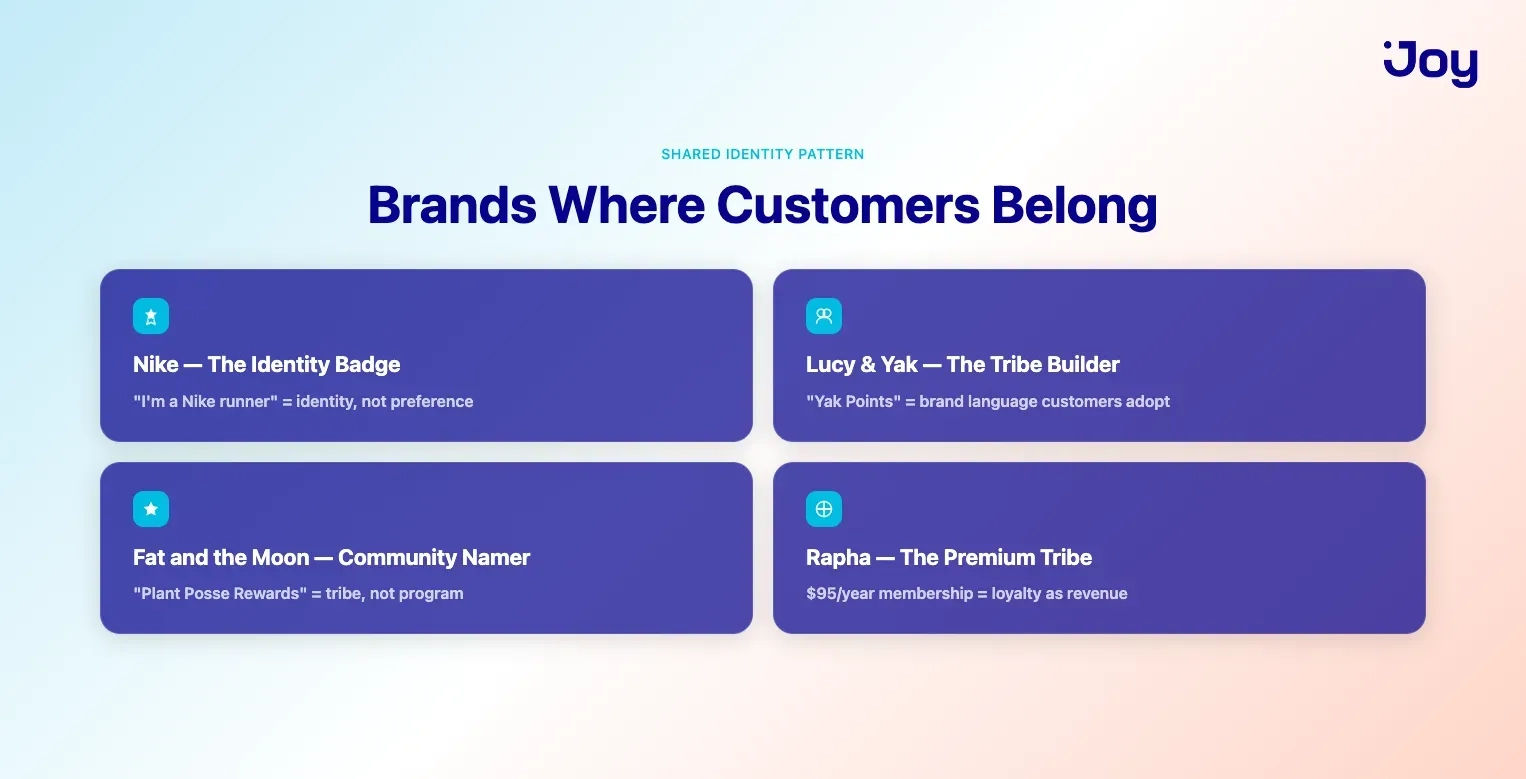
Because wearing Nike isn't just a product choice. It's an identity statement. "I'm a Nike runner" means something. Run Club and Training Club aren't just apps; they're communities where people train together, share achievements, and compete with friends. The gear becomes part of who they are.
Members don't spend 3x more because of rewards points. They spend more because Nike has become inseparable from their self-image. And that's an example of customer loyalty that no discount can replicate.
What you can steal: Create brand language and community rituals that customers adopt as their own identity. The goal: customers saying "I'm a [your brand] person" and meaning it.
Lucy & Yak: "The Tribe Builder"
Lucy & Yak, a sustainable fashion brand, named their loyalty currency "Yak Points." Small detail. But customers use that language naturally, and that's the signal of genuine identity alignment.
The community is built around sustainable fashion and a colorful, playful aesthetic that attracts a distinct tribe. Customers post user-generated content not for points. They do it because they want to be seen as Lucy & Yak people. The brand language has become personal language.
What you can steal: Name your program, tiers, and currency with brand-specific language. "Yak Points" sticks. "Gold Tier" doesn't.
Fat and the Moon: "The Community Namer"
Fat and the Moon went even further with naming. Their program is called "Plant Posse Rewards," and that's not just a program name. It's a tribe name. The community is built around natural skincare values and a handmade ethos that customers genuinely share.
People join the Plant Posse for identity alignment, not discount math. When a program name becomes a community identity, you've built something competitors can't copy.
Rapha Cycling Club: "The Premium Tribe"
Identity loyalty at its most powerful: Rapha charges $95 per year for cycling club membership, and customers gladly pay.
Why? Because the barrier filters for true believers. With 22 physical clubhouses worldwide, the community has a real-world presence that digital-only brands can't match. The value split runs roughly 50% product benefits and 50% community: group rides, exclusive events, members-only content. When identity loyalty runs this strongly, customers pay for membership. Loyalty becomes a revenue source, not a cost center.
What you can steal: If your community is passionate enough, consider a paid membership tier. It filters for your highest-value customers and turns loyalty into revenue.
When customers belong to a brand, they don't just buy. They defend, recruit, and evangelize. Identity-driven loyalty starts with how you name and design your program. Custom tier names, branded rewards language, and community-driven perks turn a generic program into a tribe.
Values Alignment: Customers Who Believe
Identity is about who you are. Values are about what you stand for. And for some brands, customers stay loyal because they share a common cause. These customer loyalty examples show that mission-driven brands create emotional investment that goes far beyond discounts.
Patagonia: "The Anti-Program"
Patagonia doesn't have a formal loyalty program. None. Zero. And yet the brand has some of the most devoted customers on the planet.
Their loyalty comes entirely from values: environmental activism, repair culture, and the famous "Don't Buy This Jacket" campaign. Buying Patagonia feels like voting for environmental action. The Worn Wear program, where customers can trade in and repair gear, bakes those values directly into the product experience.
An important caveat: Patagonia is the exception, not the rule. Most brands need a program to capture and amplify organic loyalty. But what Patagonia proves is that when values run deep enough, customers will stay without any program incentive at all.
What you can steal: Values must be visible in the product experience, not just in the marketing copy. If you claim sustainability, show the supply chain. If you claim community, build the community.
TOMS: "The Impact Tracker"
TOMS retired its One-for-One model in 2019. Today the giving runs through grants and nonprofit partners: Save the Children, Didi Hirsch Mental Health Services, GirlForward. The promise on its impact page is one line long: your purchase supports children's education, health and well-being. But what makes this work isn't the giving itself. It's the visibility.
Customers can see exactly where their loyalty is going. That transparency creates trust, and trust creates emotional investment. When customers can see the impact of their purchases, they're no longer just buying shoes. They're funding a cause.
What you can steal: Make social impact measurable and visible for customers. A donation counter, an impact dashboard, and a yearly impact report. Anything that shows customers they are valued makes a real difference.
Girlfriend Collective: "The Action Rewarder"
Girlfriend Collective awards points for environmental and charitable actions, not just purchases. Earning loyalty here means living your values: recycling, volunteering, and making sustainable choices.
This creates a powerful side effect. By rewarding value-aligned actions rather than price cuts, the brand attracts customers who are less price-sensitive. They're buying into a mission, not hunting for a deal. And that makes them far more valuable in the long term.
What you can steal: Add non-purchase earning actions aligned with your brand values. Recycle an old product, attend a workshop, share an impact story. All of these can earn points while reinforcing what your brand stands for.
Values-driven customers are less price-sensitive and carry a higher lifetime value. When loyalty is tied to a shared cause, competitors can't buy your customers away with a bigger discount. But values-based loyalty requires flexibility at the earning level: you need the ability to define what actions earn points beyond just purchases, and to design rewards that reflect your brand's mission.
Memorable Experience: Customers Who Feel Special
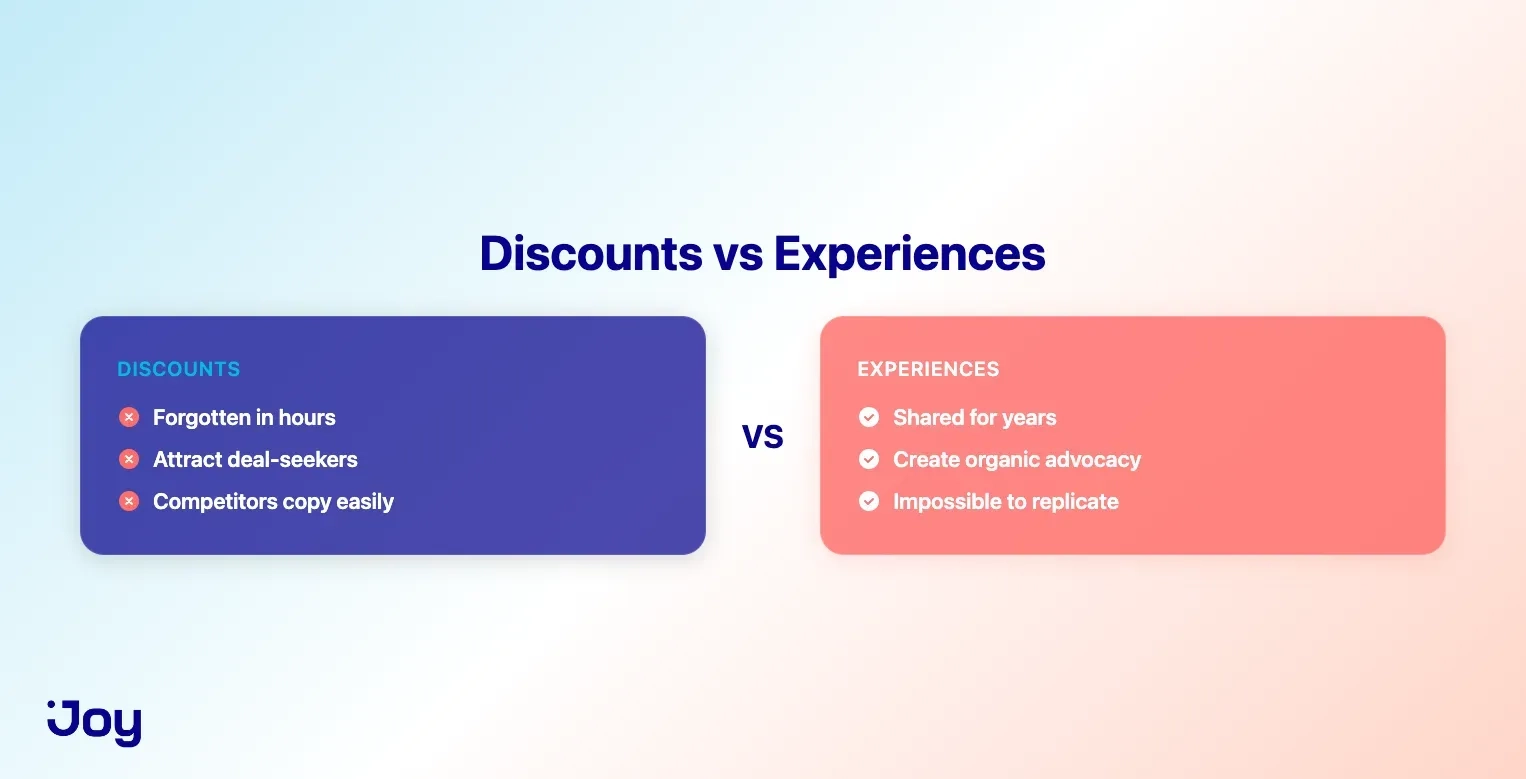
Discounts get forgotten within hours. Experiences get shared for years. The brands in this section built loyalty through moments that make customers feel something.
Chewy: "The Emotional Connector"
Chewy doesn't just sell pet food. They send handwritten condolence cards when a customer's pet passes away. They mail hand-painted pet portraits as surprises. These aren't program mechanics. This is a loyalty culture baked into the company.
What happens next? Customers post those condolence cards on social media. They go viral. Not because Chewy asked them to, but because the gesture was so genuinely caring that people felt compelled to share it. That's earned media at its most powerful, and an example of customer loyalty built on emotion, not algorithms.
What you can steal: Identify emotional moments in the customer journey: milestones, losses, celebrations. One genuine gesture beats 100 automated emails. You don't need a massive budget. You need attention to the moments that matter.
Sephora: "The Beauty Playground"
Sephora's Beauty Insider program gets attention for its tiers (Insider, VIB, Rouge) and its birthday gifts. But the reason customers are loyal has less to do with tier status and more to do with what happens in-store and in the community.
Walking into a Sephora is an experience: try products freely, get makeovers, attend beauty classes. The online Beauty Insider community extends that with reviews, discussions, and tutorials. And tier rewards include experiences, not just discounts. Exclusive events, early access, meet-and-greets.
When rewards create memories, those memories create loyalty. That's what makes Sephora one of the strongest examples of customer loyalty in retail.
What you can steal: Add experiential rewards alongside discounts. Exclusive access, workshops, behind-the-scenes content, and early product launches all create memories that percentage-off coupons never will.
REI: "The Adventure Partner"
REI's Co-op membership costs $30 for life and includes an annual dividend of up to 10% on purchases. Solid financial benefits. But they're not why members stay.
The real loyalty driver is offline experiences. Adventure classes in 22+ cities. Local chapters that organize group hikes, kayaking trips, and camping weekends. REI isn't just a retailer. It's an adventure partner. The community chapters create real-world friendships, and those relationships are loyalty bonds that no competitor can replicate online.
What you can steal: If your product ties to a lifestyle or hobby, consider offline community events. They don't need to be massive. Local meetups, small workshops, or classes can create the social bonds that keep customers coming back.
Memorable experiences create stories customers tell on their own. Stories drive organic advocacy. But experiential loyalty requires a tier structure flexible enough to reward customers with access, events, and exclusive content, not just percentage-off coupons.
Smart Personalization: Customers Who Feel Understood
The final pattern is about relevance. When customers feel that a brand truly understands them (their preferences, their needs, their tastes), loyalty deepens in ways that generic programs can't match.
But there's a fine line between personalization that feels helpful and tracking that feels invasive. The brands that get this right share one trait: they collect data through voluntary sharing, not surveillance.
Jane Iredale: "The Quiz Master"
Jane Iredale uses skin quizzes at loyalty enrollment to collect zero-party data, information customers share willingly. Based on skin type, concerns, and goals, the brand delivers personalized product recommendations.
Customers trust the brand because "they know my skin." Not through creepy third-party tracking, but through a quiz the customer chose to take. When data collection feels like a service rather than surveillance, customers open up and stay.
What you can steal: Add a quiz or profile-building step at loyalty enrollment. Use that data for personalized recommendations, not just retargeting ads.
The Honest Kitchen: "The Story Collector"
The Honest Kitchen awards points for sharing pet stories, not just purchases. Customers create pet profiles that feed personalized content and product recommendations. The data collection feels like community participation, not data harvesting.
The community is built around a shared love for pets, and the emotional bond keeps customers engaged far beyond what a standard points program could achieve. So what does customer loyalty actually look like in practice? It's trust earned through genuine community, not extracted through tracking pixels. And that trust translates directly into repeat purchases.
What you can steal: Turn data collection into a community activity. Encourage customers to share stories, fill out profiles, and answer surveys, then reward them with points for participating.
Tarte Perks: "The Feedback Loop"
Tarte rewards customers with points for reviews, social follows, and social shares. On the surface, that's UGC incentivization. But the real value is in the loop it creates.
Customer reviews and UGC generate data that informs product development. Better products lead to more loyalty, which generates more reviews. It's a virtuous cycle: customer input leads to visible product changes, which makes customers feel heard, which encourages even more input.
What you can steal: Reward reviews and UGC generously. Then close the feedback loop by showing customers how their input shaped actual decisions. That's when loyalty shifts from transactional to emotional. Collecting those reviews takes a reviews app, and Judge.me vs Okendo vs Yotpo compares three of the main options.
Zero-party data beats tracking data every time. Customers stay when they feel understood, not watched. Personalization-driven loyalty requires data infrastructure: quizzes, profiles, UGC collection, and the ability to segment rewards based on customer attributes. That's a platform-level decision, not a tactical one.
The Loyalty Stack: Why the Strongest Brands Combine Multiple Patterns
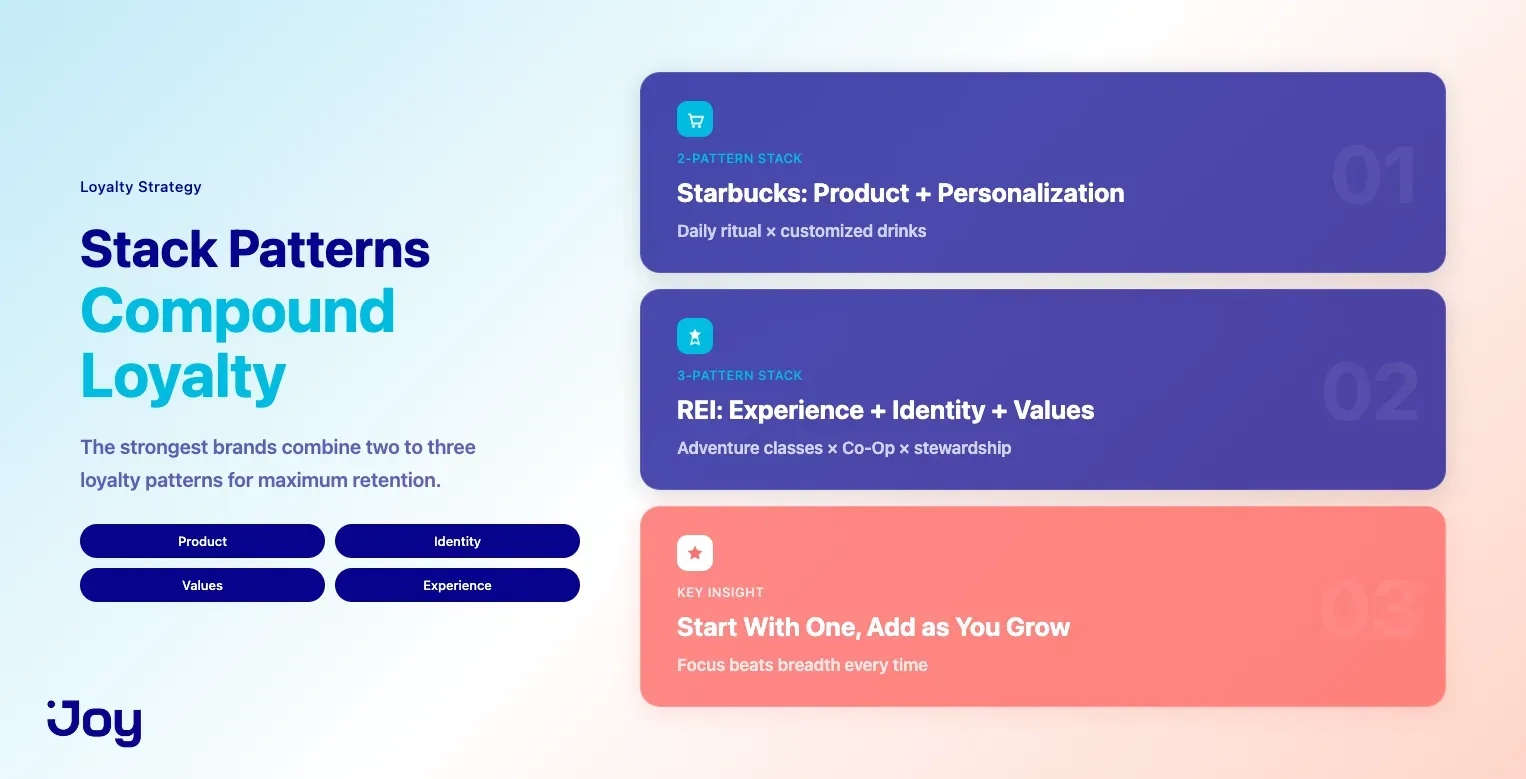
The strongest brands don't rely on just one pattern. They stack two or three together for a compounding effect.
Consider these real examples:
- Fat and the Moon = Identity (Plant Posse) + Values (carbon-neutral shipping). A two-pattern stack.
- REI = Experience (adventure classes) + Identity (Co-op membership) + Values (environmental stewardship). A three-pattern stack.
- Sephora = Experience (beauty playground) + Personalization (Beauty Insider data) + Identity (tier status). A three-pattern stack.
- Starbucks = Product (daily ritual) + Personalization (customized drinks). A two-pattern stack.
A quick diagnostic to find your starting point:
- Is your product easily replaceable? Don't lead with Product Obsession. Lead with Identity or Values instead.
- Your brand has a strong social mission? Lead with Values Alignment.
- You sell consumables or replenishable products? Lead with Product Obsession + Personalization.
- You have a passionate niche community? Lead with Shared Identity.
- Your product ties to a lifestyle or hobby? Lead with Memorable Experience.
The key insight from these customer loyalty examples: start with one primary pattern that fits your brand DNA. Add one supporting pattern as you grow. Don't try to stack all five. Focus beats breadth every time.
Stacking patterns requires a loyalty platform that can handle multiple mechanics at once: points for purchases, rewards for community actions, tiered benefits for status, and personalized offers based on customer profiles. That's worth considering when you evaluate your options. Yotpo vs LoyaltyLion shows the two ends of that choice: loyalty folded into a broader suite, or a platform that does nothing else.
Turning Customer Loyalty into a Program (Without Killing What Works)
Many brands build a loyalty program before understanding what drives their organic loyalty. The result? A generic points system that doesn't match their brand's DNA. And customers can feel it.
A program should amplify existing loyalty patterns, not try to create loyalty from scratch. The brands in this article didn't start with a program. They started with a reason customers wanted to come back.
Once you've identified your primary pattern, translate it into a program:
| Your Primary Pattern | Program Approach | What to Customize |
|---|---|---|
| Product Obsession | Subscription rewards, replenishment reminders, personalized bundles | Earning rate per product, auto-renewal bonuses, product-specific rewards |
| Shared Identity | Branded program language, community perks, tribe-exclusive access | Program name, tier names, community rewards, UGC earning |
| Values Alignment | Action-based earning, cause-linked rewards, impact tracking | Non-purchase earning actions, donation integration, impact visibility |
| Memorable Experience | Experiential tier rewards, exclusive access, surprise gestures | Tier benefits (experiences, not just discounts), event access, VIP perks |
| Smart Personalization | Quiz-driven enrollment, segmented offers, feedback rewards | Data collection points, personalized reward catalog, review incentives |
The brands in this article didn't start with a template. They started with a reason customers wanted to come back, then built a program around that reason. Your program should start there, too.
If you're exploring platforms that give you this level of customization (earning rules, tier structure, reward catalog, and community actions) see what Joy offers for Shopify brands.
What Makes Customers Leave
Every pattern above has a mirror image. The same mechanics that build loyalty destroy it the moment a brand changes the deal after customers have already committed. None of the following is hypothetical. Each one happened to a company whose program people genuinely loved.
Starbucks: Repricing rewards people had already earned
On 13 February 2023, Starbucks raised the Star price of its most-redeemed rewards. A brewed coffee went from 50 Stars to 100. A handcrafted drink went from 150 to 200. The product did not change. Only the price of the reward did, and members who had been saving toward a specific redemption watched it move out of reach overnight.
The lesson isn't "never change your economics." It's that a point balance is a promise the customer has already paid for. Reprice it retroactively and it reads as a broken promise, not a business decision.
What to avoid: changing earn or burn rates on balances customers already hold. If the economics have to move, grandfather existing balances, announce months ahead, and say why.
Dunkin': Removing the mechanic people joined for
Dunkin' replaced DD Perks with Dunkin' Rewards in October 2022. Under the old program, $40 of spend earned a free beverage of your choice. Under the new one, a free coffee cost $50 of spend, a crafted drink $70, and a premium latte $90. Points per dollar doubled, which sounds generous. The reward customers actually wanted got more expensive.
Customers don't read a program as a spreadsheet. They read it as one habit: spend about forty dollars, get any drink you like. Take the habit away and the arithmetic won't save you.
What to avoid: optimizing the average while breaking the single mechanic your members describe when they explain the program to a friend.
Delta: Moving the goalposts mid-year
In September 2023, Delta rewrote SkyMiles so elite status depended almost entirely on spend, much of it through co-branded credit cards. Members who had already booked a year of travel against the old rules found the rules had changed underneath them. Rival airlines ran status-match campaigns aimed straight at the defectors. Within weeks, CEO Ed Bastian conceded the airline had gone “too far”, and by late October Delta had scaled the changes back.
The damage wasn't the new thresholds. It was that a year of customer effort got revalued without consent.
What to avoid: changing qualification rules inside a period customers are already competing in. Change them for the next cycle, and tell people before that cycle starts.
Marriott: Losing the data customers handed over
Loyalty programs run on data customers give you voluntarily. In November 2018, Marriott determined that an intrusion into Starwood's reservation systems had exposed at least 339 million guest records. The attack had begun in 2014, two years before Marriott acquired Starwood, and went undetected until 2018. The UK's Information Commissioner's Office fined Marriott £18.4 million.
Every quiz answer, birthday and phone number in a loyalty database is a deposit of trust. A breach withdraws all of it at once, and no points balance compensates for that.
What to avoid: collecting more personal data than your program actually uses. The safest field is the one you never asked for.
Southwest: Charging for the thing that defined the brand
"Bags Fly Free" ran at Southwest for decades and was the single benefit customers named when they explained why they flew Southwest. In March 2025 the airline announced it was ending the policy, and free checked bags stopped on 28 May 2025. Elite members and co-branded cardholders kept an allowance, so on paper the loyalty program became more valuable relative to the base fare. The brand promise still broke.
What to avoid: monetizing the benefit your brand is known for. If you need the revenue, add a paid tier on top rather than moving the free benefit behind it.
One thread runs through all five: loyalty dies when the terms change after the customer has already invested. Customers forgive higher prices. They don't forgive retroactive ones.
Frequently Asked Questions
What is customer loyalty?
Customers repeatedly choose your brand over competitors, not because of price, but because of trust, habit, identity, or emotional connection. It's both a behavior and a feeling, not just a transaction count.
What's the difference between customer loyalty and a loyalty program?
Customer loyalty is the outcome: customers keep coming back. A loyalty program is a tool to capture and amplify that loyalty. You can have loyal customers without a program (like Patagonia), and you can have a program without loyal customers (if the program doesn't match what actually drives their loyalty).
What are the main types of customer loyalty?
Five primary types emerge from the patterns in this article: product obsession (they can't find it elsewhere), shared identity (the brand represents who they are), values alignment (they believe in the mission), memorable experience (they feel special), and smart personalization (they feel understood). For a deeper breakdown, see our guide to types of customer loyalty.
How do you measure customer loyalty?
Track repeat purchase rate, customer lifetime value (CLV), Net Promoter Score (NPS), referral rate, churn rate, and the ratio of full-price purchases to discounted purchases. A high full-price ratio signals strong loyalty. Customers are buying because they want to, not because there's a sale. We break down each metric in our guide on how to measure customer loyalty.
Can small businesses build strong customer loyalty?
Absolutely. And small businesses often have a natural advantage. They can build personal relationships, create an authentic brand identity, and respond faster to customer feedback. Several examples in this article (Lucy & Yak, Fat and the Moon, Nuun) are DTC brands, not enterprise corporations.
What drives customer loyalty more: discounts or experience?
Experience and emotional connection, consistently. Discounts attract price-sensitive customers who leave the moment a competitor offers something cheaper. Experiences create memories and stories that customers share willingly.
How long does it take to build customer loyalty?
A first repeat purchase typically happens within 30 to 90 days. Building deep emotional loyalty (at the identity and values level) takes six to 12 months of consistent experience. Programs can accelerate that timeline by incentivizing the behaviors that naturally build loyalty.
What's the relationship between customer loyalty and CLV?
Direct. Loyal customers buy more frequently, spend more per order, cost less to serve (fewer support tickets, less price sensitivity), and refer new customers. Bain & Company research found that even a 5% increase in retention can increase profits by 25% to 95%.
Do you need a loyalty program to have loyal customers?
No. Patagonia proves that. But for most brands, a well-designed program accelerates loyalty by making the value exchange explicit, rewarding desired behaviors, and creating structure around the customer relationship. The key: the program must match the loyalty patterns that already exist.
How do you know if your customers are truly loyal vs. just habitual?
A simple test: if a competitor offered the same product at 10% less, would your customers switch? Habitual customers switch. Truly loyal customers stay because switching would mean losing identity, community, or values alignment, not just a product. That distinction is what separates the customer loyalty examples above from ordinary repeat purchasing.
What kills customer loyalty fastest?
Changing the deal after customers have already committed. The section on what makes customers leave above walks through the five most common ways brands do it.
How do referrals relate to customer loyalty?
Referrals are the highest expression of loyalty. When customers refer someone, they're putting their personal reputation on the line. A high referral rate signals strong loyalty. A low referral rate with high repeat purchases? That signals habitual buying, not true loyalty. Our guide to loyalty and referral programs covers how the two feed each other.

Written by
Thomas Nguyen is the CEO & Co-founder of Joy, a loyalty solution for Shopify and eCommerce brands. With years of experience building high-performance Shopify apps, Thomas aims to help merchants grow through customizable and retention-focused tools.
Related reading
 Examples & Inspiration
Brand Loyalty and Consumer Behavior: Strategic Case Study & Ecommerce Breakdown (2026)
Brand loyalty and consumer behavior are engineered, not accidental. See how Nike, Sephora, and others reshape buying habits - and how ecommerce brands can copy it.
 Thomas Nguyen
 Examples & Inspiration
17+ Best Refer-a-Friend Program Examples to Grow Sales in 2026
What a refer-a-friend program is, how it works, examples across beauty, fashion, pet, and more, plus tips to build one that gets shared.
Thomas Nguyen Examples & Inspiration
7 Personalized Loyalty Program Examples (With Tactics You Can Use Today)
Here are 7 personalized loyalty programs worth studying, with practical tactics you can apply to your store today.
Thomas Nguyen Examples & Inspiration
Referral Programs for Small Businesses: 12 Ideas & Examples (2026)
Twelve referral program ideas for small businesses, real examples broken down by how they actually work, a five-step setup with copy-paste scripts, and a simple way to measure ROI.
Thomas Nguyen Examples & Inspiration
IKEA Loyalty Program: How 170M Members Drive 50% of Revenue
IKEA Family has 170M members driving 50% of revenue — with zero tiers and a flat structure. After 73 years, the 2025 points refresh adds a new layer. This breakdown covers how it works, the emotional-loyalty playbook, hub-and-spoke architecture, and what Shopify brands can steal.
Thomas Nguyen Examples & Inspiration
Coca-Cola Brand Loyalty: 5 Strategies E-commerce Brands Can Use to Boost Retention
Coca-Cola brand loyalty is built on emotion, consistency, and ubiquity - not discounts. See the 5 strategies behind it and how to apply them to ecommerce retention.
Thomas Nguyen