
Pub Loyalty Scheme: How to Build One That Drives Repeat Visits
A pub loyalty scheme turns walk-in traffic into repeat revenue. Here's how to pick the right model—stamps, points, or tiers—stay compliant with UK alcohol and GDPR rules, and launch in 4 weeks.
Summarize this post with AI
The average UK pub competes with half a dozen venues within a 10-minute walk. In a market this saturated, the pubs that survive aren't the ones pouring the best pints. They're the ones customers return to by habit. And a pub loyalty scheme deliberately builds that habit.
Most operators face the same problem: physical stamp cards still dominate. They give you zero customer data, disappear into coat pockets, and offer no insight into visit frequency or spend patterns. You're rewarding loyalty you can't measure.
But the shift is already underway. Digital loyalty, from mobile wallet stamp cards to spend-based points and tiered memberships, delivers the data and automation that retail brands have used for years. Pubs that adopt it gain a decisive edge.
In this guide, we'll compare the three core mechanics (stamps vs. points vs. tiers), walk through real pub examples, cover the legal pitfalls that competitors ignore, including alcohol reward regulations and GDPR, and show you how to launch a scheme that protects margins while feeling generous to every regular who walks through your door.
A well-designed pub loyalty scheme isn't a cost. It's the lowest-cost customer acquisition channel a pub can build, turning existing foot traffic into predictable repeat revenue.
What Is a Pub Loyalty Scheme? The 3 Models Every Operator Should Know
Before you print a single stamp card or configure a points engine, you need to pick the right loyalty mechanic for your venue. Three models dominate the pub and hospitality space, and each offers a distinct tradeoff between simplicity and intelligence.
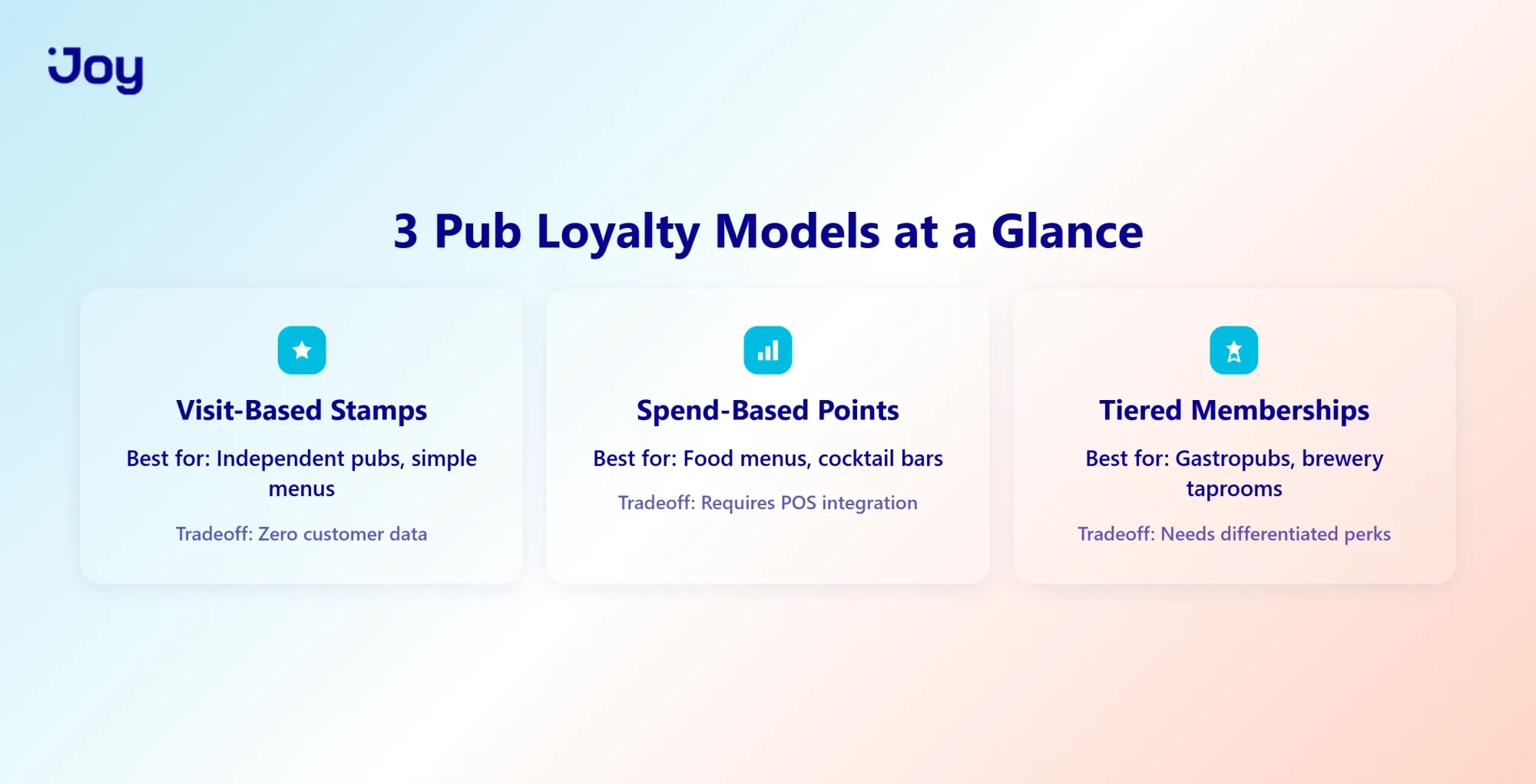
Visit-Based Stamps: The Simplest Entry Point
A stamp-based pub loyalty scheme works exactly how it sounds. The customer gets one stamp per visit (or per qualifying purchase), and after a set number of stamps, they earn a reward, such as a free drink, a food item, or a discount.
Digital versions use Apple Wallet or Google Wallet. The customer scans a QR code at the bar, the stamp registers automatically, and the card lives on their phone. No app download. No account creation. No friction.
Best for: Independent pubs with simple menus, high walk-in traffic, and operators who want zero complexity.
Speed is the advantage here. Customers join in seconds. But the limitation is intelligence. Stamp cards tell you someone visited. They don't tell you what they ordered, how much they spent, or when they stopped coming. You know they showed up. That's it.
Spend-Based Points: Data-Rich and Margin-Friendly
Points programs tie rewards to spending. Say, 1 point per pound spent, with defined redemption thresholds like 100 points for a £5 reward. Every transaction is tracked through POS integration or digital ordering, so the customer is identified by phone number, app, or card tap.
Best for: Pubs with food menus, cocktail bars, or venues where average spend varies significantly between customers.
The advantage is data. You see basket size, visit frequency, peak hours, and your top-spending regulars. Because rewards scale proportionally, high spenders earn more, but they also spend more, which protects your margins. The tradeoff? Points programs require POS integration or a digital ordering system. More setup than stamps.
Points programs turn every transaction into a data point. You stop guessing who your best customers are and start knowing.
Tiered Memberships: For Pubs With a Premium Play
Tiered programs create levels such as Regular, Local, and VIP based on visit count or total spend. As customers move up, higher tiers unlock better perks: priority seating, private events, first access to new cask releases, and tasting menus.
Best for: Gastropubs, brewery taprooms, or venue groups with genuinely differentiated premium experiences.
The advantage is aspiration. Customers see the next tier and visit more often to reach it. VIP status drives word-of-mouth as members tell friends about their perks. But tiers only work when each level unlocks something meaningfully different. If every tier just gets "10% off," the structure is cosmetic. Nothing more.
Joy supports all three models, including stamps (via custom actions), points (per-pound earning rules), and tiers (unlimited levels with automatic progression). So you can start with stamps and upgrade to points or tiers as you scale, all without switching platforms.
Pub Loyalty Scheme: Paper vs. Digital and Why Stamp Cards Are Holding You Back
If your pub still runs a paper stamp card, you're operating with a 1990s tool in a 2026 market. Here's what that costs you, and what the digital alternative delivers instead.
The Paper Stamp Card Problem: Lost Cards, Zero Data, Easy Fraud
Physical stamp cards fail in three predictable ways.
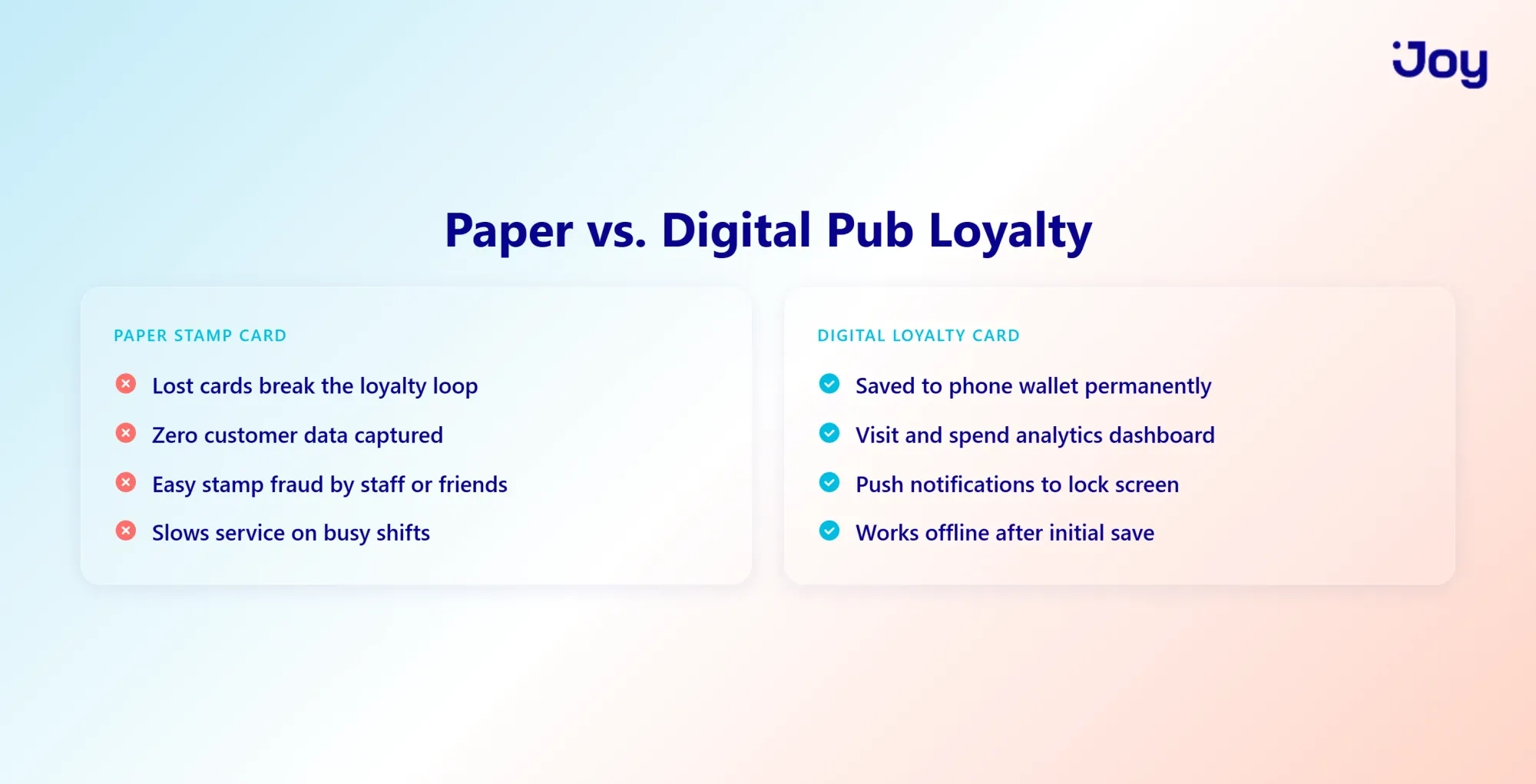
Lost progress. Customers lose cards constantly. Every lost card breaks the loyalty loop. Someone who was seven stamps toward a free pint now has to start over. Most don't bother.
Zero data. Paper cards capture nothing. You can't see visit frequency, peak times, average spend, or which customers churned last month. You're running a rewards program with no feedback loop, rewarding behavior you can't measure or replicate.
Easy fraud. Friends stamp each other's cards. Staff give stamps without purchases. Customers claim they "forgot" their card and collect double stamps on their next visit. No audit trail. No accountability.
Operational drag. During a packed Friday service, asking bar staff to find, stamp, and return a physical card slows every transaction. Even in basement bars or beer gardens with poor Wi-Fi (where some digital solutions struggle), paper cards still don't solve the data problem.
Digital Pub Loyalty Scheme: Mobile Wallet, No App Download
The fix isn't an app. It's a mobile wallet card.
The customer scans a QR code at the bar, and a digital loyalty card is saved directly to Apple Wallet or Google Wallet. No app download, no account creation, no friction. Sign-up takes 15 seconds.
From there, each visit or qualifying purchase triggers a digital stamp via QR scan or NFC tap. The customer sees their stamp progress on their phone's lock screen. The pub owner sees a dashboard with visit dates, redemption history, and customer analytics.
Offline capability matters too. Mobile wallet cards function without Wi-Fi after the initial save. Critical for venues with spotty connectivity.
Push notifications close the loop. Messages like "You're 2 stamps away from a free pint" go directly to the customer's lock screen. No email open rate dependency. No app notification permission required.
For pubs that also sell online (merchandise, gift cards, or event tickets on Shopify), Joy connects in-store loyalty activity with online purchase data. The result: one unified customer profile across both channels.
How to Design a Pub Loyalty Scheme That Protects Margins
Every pub owner asks the same question before launching a loyalty scheme: "Won't this eat my margins?" And the answer depends entirely on how you design your rewards. Done right, a pub loyalty scheme costs less than most marketing channels and delivers more predictable returns.
Reward Types That Work for Pubs: Beyond Free Pints
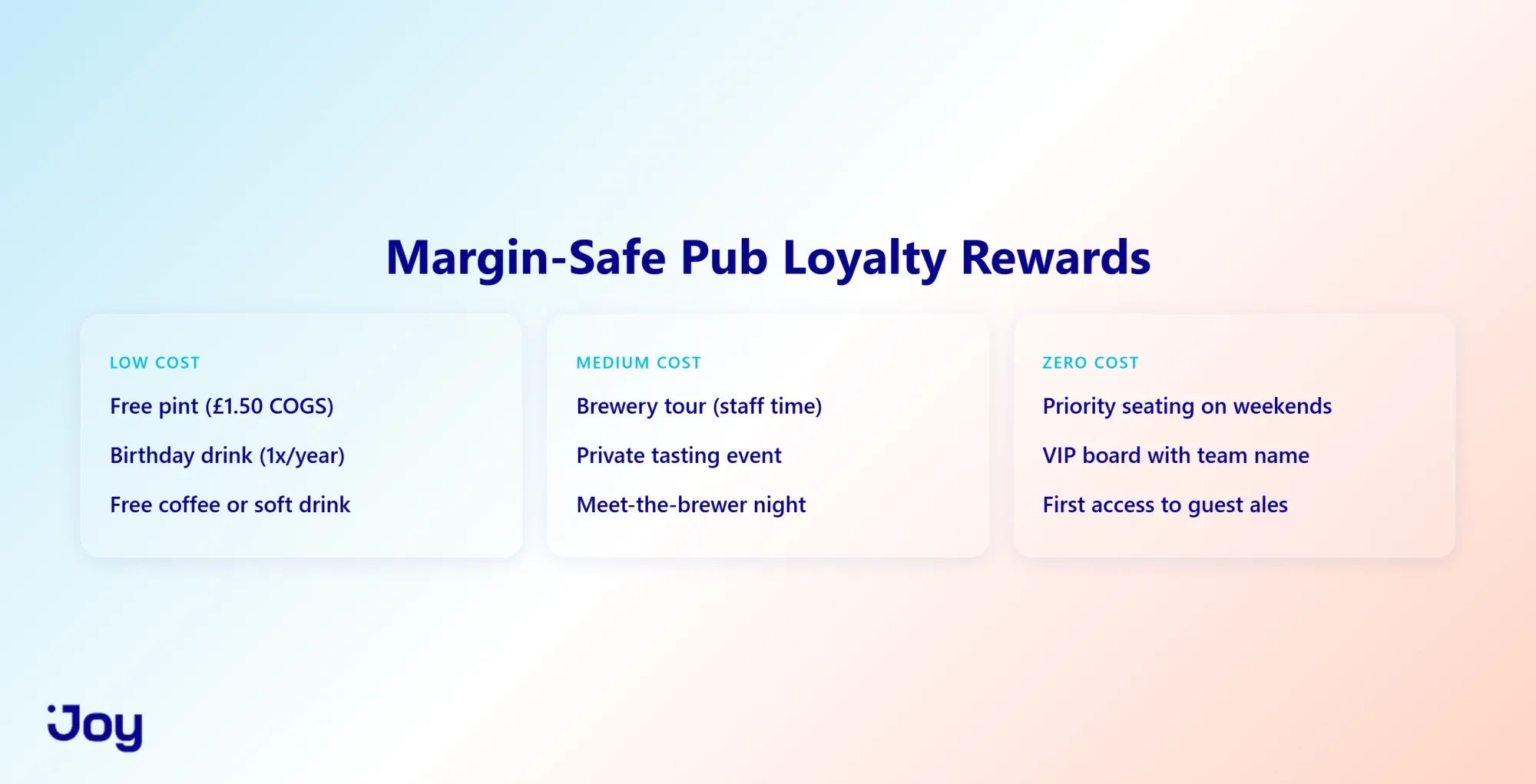
Free drinks are the default reward, and they're not a bad one. A free pint costs the pub roughly £1.50 to £2.50 in COGS but feels like a £5 to £6 reward to the customer. That perceived-value-to-actual-cost ratio is strong.
But the best margin play goes beyond points. Consider rewards that cost you almost nothing:
- Priority seating on busy Friday and Saturday nights. Costs nothing, feels exclusive.
- First access to new cask ales or guest beers. Costs nothing, creates anticipation.
- Pub quiz VIP board with team name displayed permanently. Costs nothing, drives pride.
- Birthday pint once per year. Predictable cost, high emotional impact.
- Experience rewards like brewery tour tickets, meet-the-brewer nights, and private tasting events. These create memorable moments that fuel word-of-mouth, and they cost staff time rather than product.
Even better, let members choose. Offer a tiered reward menu with low-cost options (free coffee, soft drink) alongside aspirational ones (private event invite, brewery tour). Choice increases perceived value without increasing your cost.
Earn/Burn Ratio: How to Set Points Without Bleeding Profit
The earn/burn ratio determines your actual loyalty cost. If customers earn 1 point per £1 spent and 100 points equals a £5 reward, that's a 5% reward rate.
Rule of thumb: keep your effective reward rate between 3% and 7% of customer spend. Below 3%, customers don't feel rewarded. Above 7%, you're eroding margins.
Expiry mechanics cap your exposure, too. Points that never expire create a growing liability on your books. Set a 6- to 12-month rolling expiry, with a reminder notification 30 days before points lapse. This creates urgency to visit now or lose progress, and it keeps your costs predictable.
Breakage works in your favor. Not every customer redeems. Industry-standard breakage (unredeemed points) runs between 20% and 30%. Factor this into your model. A 5% stated reward rate with natural breakage means your actual cost is closer to 3.5%-4% of revenue. That's less than most marketing spend.
Fraud Prevention: Stopping Stamp Abuse and Point Gaming
Digital systems also create accountability that paper never could.
Common pub fraud: friends stamping each other's cards, staff stamping without purchase, customers splitting a single order into multiple small transactions to earn extra points.
The digital prevention toolkit:
- Unique QR codes per transaction
- Staff PIN verification for each stamp
- Time-gating with one stamp per visit and a minimum 2-hour gap
- Minimum spend threshold per point-earning transaction
- Staff audit trail where every validated stamp logs which team member approved it
Digital loyalty systems don't just prevent fraud. They create accountability for both customers and staff that paper cards never could.
Joy's earning rules engine lets merchants set custom point-per-pound ratios, minimum spend thresholds, and expiry windows, all configurable without code and adjustable in real time as you learn what works.
Pub Loyalty Scheme Legal Pitfalls: Alcohol Regulations and GDPR
This is the section no one else covers. Two legal gaps can derail a pub loyalty scheme before it gains traction: alcohol reward regulations and data compliance. Ignore them, and you risk your license or a regulatory fine.
Alcohol Reward Regulations: Can You Give Away Free Drinks?
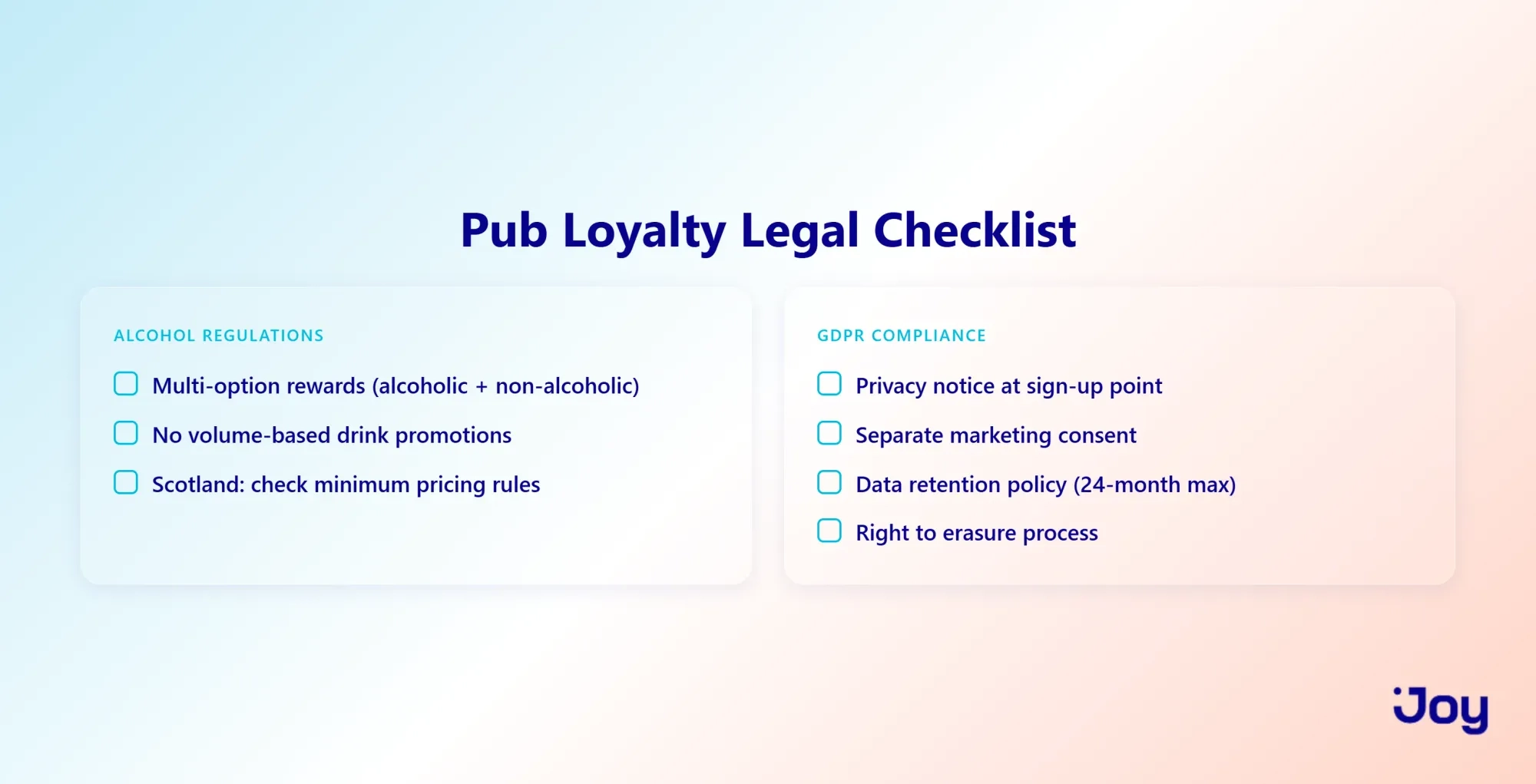
The UK Licensing Act 2003 prohibits irresponsible drink promotions. The Mandatory Licensing Conditions (2014) specifically ban promotions that encourage excessive consumption.
And this is where it gets tricky. A "buy 9 pints, get 1 free" stamp card could be interpreted as encouraging volume drinking. The risk increases when the reward is exclusively an alcoholic drink with no alternative option.
The safer approach: offer choice. "Redeem for a free pint OR a free soft drink OR a £5 food voucher." This demonstrates responsible promotion and protects your license.
Multi-option rewards also broaden your audience. Designated drivers, non-drinkers, and lunch-only visitors all find value in a scheme that doesn't assume everyone is there for alcohol.
Scotland applies stricter scrutiny. Under the Alcohol (Minimum Pricing) (Scotland) Act 2012, free alcohol promotions face additional regulatory oversight. If you operate in Scotland, review your reward structure with your licensing solicitor before launch.
Offering exclusively alcoholic rewards in a pub loyalty scheme is a licensing risk. Always include non-alcoholic or food alternatives.
GDPR Compliance: What Pub Operators Must Do When Collecting Customer Data
Any digital loyalty scheme collects personal data, including names, email addresses, phone numbers, visit history, and spending patterns. Under UK GDPR, this requires explicit consent and clear data governance.
What you must have in place:
- A clear privacy policy covering what data you collect, why, how long you retain it, and who accesses it
- Consent at sign-up through an opt-in checkbox (not pre-ticked)
- Right to erasure so customers can request deletion of their data at any time
The gap most pubs miss? Using loyalty data for marketing (emails, SMS promotions) requires separate marketing consent. Signing up for the loyalty scheme does NOT automatically opt customers into marketing communications. These are two distinct GDPR permissions. And getting this wrong is one of the fastest ways to draw a complaint.
On data retention: don't store customer data indefinitely. Set a retention period where 24 months of inactivity triggers automatic deletion. This caps your compliance risk and keeps your database clean.
The practical step? Add a one-paragraph privacy notice at your QR code sign-up point. One paragraph. That's the entire implementation.
Joy is built for GDPR-compliant markets. Consent management, data export, and customer deletion are all built into the platform, so merchants don't need to engineer compliance workflows manually.
Real Pub Loyalty Scheme Examples: What Works in Practice
Theory is useful, but seeing it applied is better. Here are three pub loyalty scheme approaches at different scales: a single independent pub, a multi-site brewery group, and a modern gastropub with an online store.
The Independent Pub: Simple Stamp Card Done Right
The setup: A single-location pub running a digital stamp card via mobile wallet. Ten stamps earn a free drink or £5 food credit, with a multi-option reward for licensing compliance.
What drives sign-ups: QR codes on every table and one at the bar. Staff trained with a single script: "Scan the QR to join our loyalty. You're halfway to a free round." No app download, 15-second sign-up.
The result: For the first time, regulars self-identify through the scheme. The pub owner sees visit frequency data, revealing that the top 20% of members visit three times per week. That insight alone changes how the pub allocates staff and stock on peak days.
The lesson: Start simple. A stamp card with one clear reward and zero-friction sign-up outperforms a complicated points system that nobody understands. Every time.
The Brewery Taproom: Points + Exclusive Access
The setup: A craft brewery with three taproom locations running a points-based program. One point per £1 spent. 100 points get £5 off. 250 points unlock a brewery tour invite. And 500 points earns "Founder's Club" membership, which includes an annual tasting event plus name on the taproom wall.
What drives engagement: Points sync across all three locations, so a customer who visits Taproom A earns points redeemable at Taproom B. This multi-site syncing eliminates the "this card only works here" frustration that kills repeat visits at second- and third-location stores.
The aspiration layer: The "Founder's Club" at 500 points creates a visible goal. Members see other names on the wall and want to join. Social proof is built into the venue itself.
The lesson: Multi-site pubs and brewery groups need loyalty data that syncs across locations. Customers don't think in terms of "which branch." They think in terms of "my local."
The Modern Gastropub: Tiered Membership with Online Integration
The setup: A gastropub that sells branded merchandise, gift cards, and event tickets through a Shopify store alongside its dine-in operation. Three tiers: Regular (free to join), then Local (10+ visits), then VIP (25+ visits or £500+ annual spend).
What drives retention: VIP members get priority booking on Friday and Saturday nights, first access to seasonal tasting menus, and 10% off the online merch store. Because the online store is connected, loyalty extends beyond the physical venue. A VIP who buys merchandise online is still deepening their relationship with the brand.
The data advantage: The pub sees which VIP members also purchase online, enabling cross-channel campaigns like "Your VIP status gives you early access to our new merch drop." In-venue loyalty and ecommerce data feed the same customer profile.
The lesson: For pubs with an online presence, connecting in-venue loyalty data to ecommerce data creates a complete customer picture that neither channel delivers on its own.
This gastropub example is where Joy shines. By connecting Shopify online store data (merchandise purchases, gift cards, event tickets) with in-venue loyalty activity into a single unified customer profile, Joy powers cross-channel campaigns and repeat revenue.
How to Launch Your Pub Loyalty Scheme: A 4-Week Rollout Plan
You've chosen your model, designed your rewards, and checked the legal boxes. Now it's time to execute. This 4-week rollout turns your pub loyalty scheme from a plan into a running program.
Week 1 to 2: Choose Your Model and Set Up
Pick your mechanic first. Use the three-model framework from Section 1. Most independent pubs should start with digital stamps. Multi-site venues or gastropubs with online stores should consider points or tiers.
Then work through the setup checklist:
- Choose a loyalty platform
- Configure earning rules, either stamps per visit or points per £1 spent
- Set reward(s) with multi-option choice for licensing compliance (see Section 4)
- Design the QR code sign-up flow
- Write a one-paragraph privacy notice for GDPR compliance
Train every staff member. Each person behind the bar should be able to explain the scheme in one sentence and prompt customers to join. Example script: "We've just launched our loyalty. Scan the QR on your table, and your 10th visit earns you a free drink or food credit."
Test internally first. Run the scheme with staff for 3 to 5 days before the public launch. Identify friction points like slow QR loading, confusing reward language, or unclear sign-up flow, and fix them before customers see them.
A pub loyalty scheme should take days, not weeks, to set up. If your platform requires more than a week of configuration, it's too complex for hospitality.
Week 3 to 4: Launch, Promote, and Optimize
Launch day: go visible everywhere.
- QR codes on every table, bar top, and receipt
- A-frame sign at the entrance
- Social media announcement: "Join today and get your first stamp free."
Staff stamp-and-point is your number one promotion channel. Every transaction is a prompt opportunity. Incentivize the team by offering a prize for the staff member who signs up the most members that month. Staff enthusiasm directly determines sign-up velocity.
By week 3, measure and fix. Review sign-up rate, stamp-and-point activity, and customer feedback. The most common issue? QR codes that are too small or poorly placed. The fix is simple: print larger and position it at eye level at the bar.
In week 4, optimize your behavior rewards. Look at your redemption rate. If nobody's redeeming, the reward feels too far away, so lower the threshold. If everyone redeems immediately, the threshold is too low, so raise it or introduce a second, higher-tier reward.
The first month isn't about perfection. It's about learning. Launch fast, measure everything, and adjust based on real customer behavior rather than assumptions.
Joy's dashboard delivers real-time analytics on sign-ups, point activity, and redemption rates. Pub operators can make week 3 to 4 adjustments from their phone without waiting for monthly reports.
Your Pub Loyalty Scheme Starts With One Decision
Stamps for simplicity. Points for data. Tiers for aspiration. Most pubs should start with digital stamps and upgrade as they learn what their customers respond to.
Build on a legal foundation from day one. Multi-option rewards (alcoholic and non-alcoholic) for licensing compliance. A privacy notice and explicit consent for GDPR. These aren't optional extras. They're table stakes.
The real ROI of a pub loyalty scheme isn't free pints redeemed. It's intelligence. You gain data on who your customers are, when they visit, what they spend, and, critically, when they stop coming. That insight is worth more than any single reward.
For pubs with a Shopify store selling merchandise, gift cards, or event tickets, Joy connects your in-venue loyalty data with your online sales. One customer profile. One loyalty engine. One place to see everything.
The best time to launch a pub loyalty scheme was five years ago. The second-best time is this week.

Written by
Thomas Nguyen is the CEO & Co-founder of Joy, a loyalty solution for Shopify and eCommerce brands. With years of experience building high-performance Shopify apps, Thomas aims to help merchants grow through customizable and retention-focused tools.
Related reading
 Loyalty Strategy
Loyalty Fraud Prevention: Protect Your Program, Keep the Experience
One of the key experiences that makes your loyalty program valuable is the attack surface that fraudsters exploit. Here's how to defend the program without losing the customers you built it for.
 Thomas Nguyen
 Loyalty Strategy
The Loyalty Program Business Model: How to Structure Your Store Around Keeping Customers
Most stores bolt on a rewards program and hope for the best. A loyalty program business model builds growth around keeping customers. Here's how to do it.
Thomas Nguyen Loyalty Strategy
How to Retain Customer Loyalty: 7 Proven Strategies
Acquiring a customer costs 5 to 25x more than keeping one — yet most brands keep pouring budget into acquisition. Here are seven proven strategies to retain customer loyalty, each with action steps and real metrics, plus a Day 0 to 60 playbook you can run immediately.
Thomas Nguyen Loyalty Strategy
Building Customer Loyalty: The Framework That Actually Works
Stable revenue can mask something uncomfortable: customers returning out of habit, not preference. When they find a better option, they leave without warning — and you pay full CAC to replace them. Here's how to build the loyalty they actually feel, not the one you assume.
Thomas Nguyen Loyalty Strategy
Customer Loyalty Platforms: How to Choose the Right One
Customer loyalty platforms generate 15% to 25% revenue lift for top performers — and the wrong one quietly drains budget for months. Most brands pick based on feature lists and demo calls. This guide gives you 8 evaluation criteria and a scoring framework to choose objectively.
Thomas Nguyen Loyalty Strategy
Channel Loyalty Platform: The Complete Guide to Building Partner Programs That Drive Revenue
Most B2B brands lose channel partners not to better products — but to better incentives. A channel loyalty platform is the system that makes your brand the easy choice for distributors, dealers, and resellers. Inside: 5 incentive models, implementation, and ROI.
Thomas Nguyen