10 Best Rental Car Rewards Programs for Business Owners (2026 Guide)
Your sales team rented 47 cars last quarter. How many of those earned a free rental day? Most business owners don't track this and it's costing them.

Summarize this post with AI
Your sales team rented 47 cars last quarter. How many of those earned a free rental day?
Most business owners don't track this. Understandable. Car rentals feel like a fixed cost, something you pay and move on. But here's what makes it worth a second look: every major rental company runs a free rewards program, and at $60–$80 a day, even three or four free days add up to $500+ back in your pocket.
The catch is that these programs work very differently from each other. Some give you points toward free days. Others skip the points entirely and just knock 10–15% off every rental. A few let your team walk past the counter and straight to the car. Which one makes sense depends on how often you rent, where your team flies, and what you actually care about saving: time or money.
We signed up for all eight major programs, compared their business tiers, and calculated the actual dollar value at three rental volumes. Here's what we found.
Key Takeaways
- Hertz Gold Plus + Business Rewards is the strongest combo for 15+ rentals/year, but only off-peak. Peak pricing cuts your value by 60%.
- Enterprise Plus has the lowest free-day threshold (400 points) and 9,500+ locations including neighborhood branches.
- Under 10 rentals/year? Skip points entirely. Thrifty's 15% flat discount or Alamo's instant savings beat uncertain point math every time.
- One credit card hack: The Amex Platinum unlocks top-tier status at Hertz, National, and Avis simultaneously, no rentals required.
- Stack three layers: Primary rental program + credit card status + AutoSlash price tracking. That's how businesses save 30%+ on car rentals.
Quick Comparison Table
Before we get into the details, here's every program side-by-side. All of them are free to join.
| Program | How You Earn | Free Day Starts At | Best For |
|---|---|---|---|
| Hertz Gold Plus Rewards | 1 point per $1 | 950 points (off-peak) | Frequent renters with global travel |
| Enterprise Plus | 1 point per $1 | 400 points | Mixed airport and neighborhood rentals |
| National Emerald Club | 1 credit per rental | 1 free day per 7 credits | Teams that want to choose their own car |
| Avis Preferred | 1 point per $1 | 700 points (cars under $50/day) | Solo business travelers who want speed |
| SIXT ONE | Varies by tier | Varies | Companies renting in the US and Europe |
| Budget Fastbreak | Promo-based | $25 Budget Bucks per 2 rentals | Cost-conscious businesses |
| Dollar Express Rewards | 1 point per $1 | 500 points (weekend) | Supplementary budget option |
| Thrifty Blue Chip | No points | 15% off base rate | Budget-first businesses |
| Fox Rewards | 4 points per $1 | $20 FoxBucks per $400 spent | Budget renters at Fox airports |
| Alamo Insiders | No points | Flat 5% off base rate | Occasional renters who want instant savings |
A few things jump out. Enterprise has the lowest threshold for a free day at 400 points. Hertz earns at the same rate but needs more than double that to redeem. And Alamo skips the points game altogether, giving you a straight discount on every rental.
The table tells you what each program offers. The next sections help you figure out which one actually fits your business.
How We Evaluated These Programs
Most rental car rewards guides are written for vacationers. A solo traveler picking the cheapest compact for a weekend trip has very different priorities than a business running 20+ rentals a year across multiple employees.
So we evaluated each program on five things that matter specifically to businesses:
- Earning rate and redemption value per dollar spent
- Team-friendly features (pooled earnings, company accounts)
- Airport experience (counter skip, car selection, upgrade priority)
- Network coverage (airport + neighborhood locations)
- Credit card partnerships that grant automatic elite status
We didn't rank these programs by the flashiest perks. We ranked them by how much a real business saves over 12 months.
Best Rental Car Rewards Programs Ranked
1. Hertz Gold Plus Rewards: Best for Frequent Business Renters
Hertz Gold Plus Rewards ranked #1 in Newsweek's 2025 rental car loyalty list. The ranking is generous. Whether Hertz is actually #1 for your business depends on when your team travels.
Program basics:
- Earn 1 point per $1 spent on eligible rentals
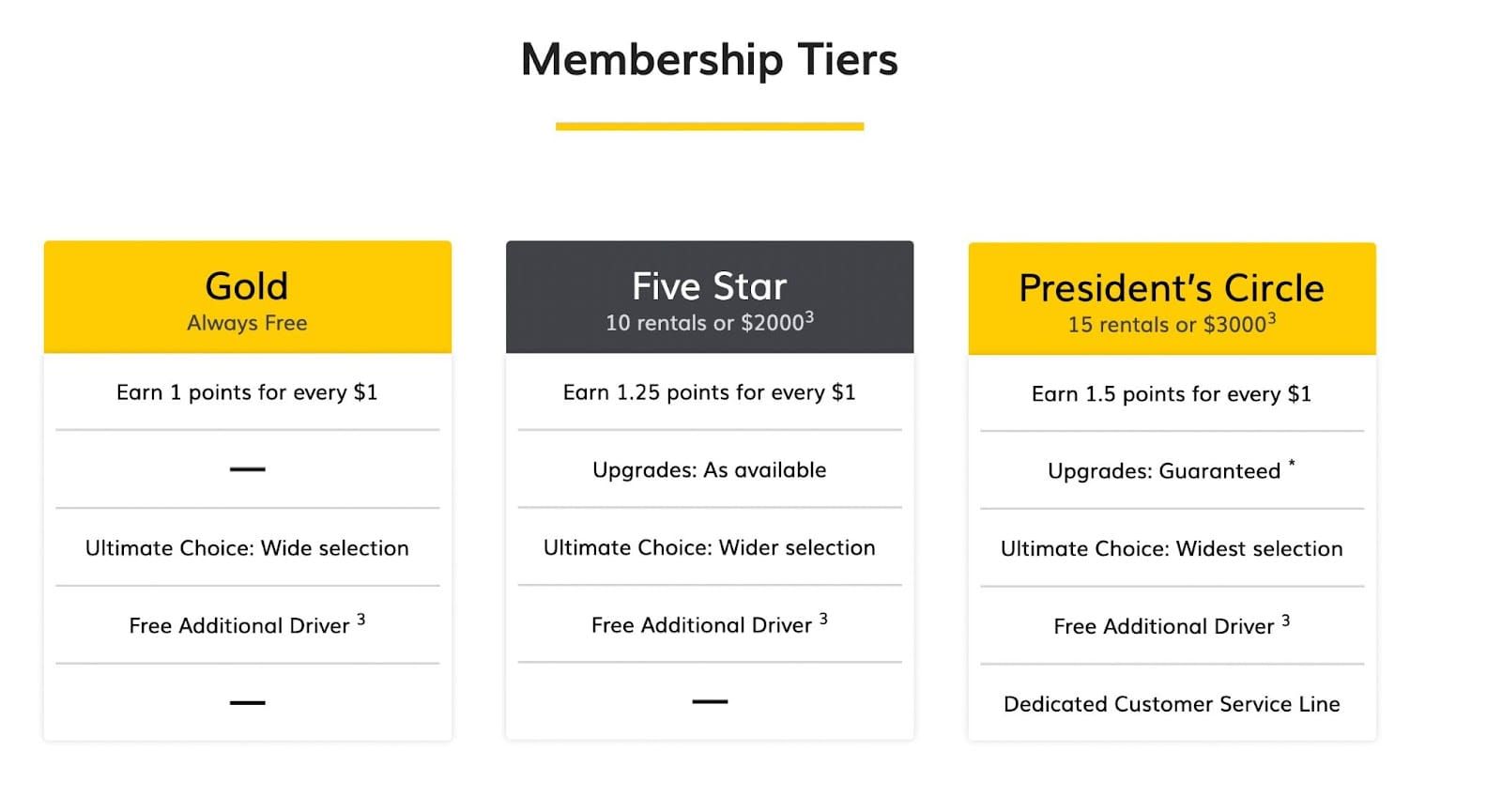
- Free day starts at 950 points (off-peak) or 1,900 points (peak)
- Tier progression: Gold → Five Star → President's Circle
- Five Star unlocks at 3 rentals or $1,000/year
The math that matters: Your team spends $5,000/year on Hertz. Off-peak, that's five free days (~$350 back). Peak? Two free days ($140). Same spend, 60% less value. Quick test: if more than half your rentals fall between June and August, Hertz's point economy is working against you.
What Hertz gets right: Five Star unlocks at just 3 rentals or $1,000/year. Most small teams hit that. Once there, guaranteed car class means your employees no longer get stuck with whatever's left on the lot. That's an operational win, not just a perk. Your team stops wasting time at the counter negotiating for the car class they already booked.
The program nobody talks about: Hertz runs a separate Business Rewards for SMBs. We checked 12 competing guides. One mentioned it. Gold Plus tracks individual employees. Business Rewards tracks your company's total spend.
Here's the thing: three employees renting five times each? Gold Plus sees three light users. Business Rewards sees a 15-rental account and starts offering real discounts. Run both.
Pick Hertz if you rent 15+ times/year, mostly off-peak, through one provider. Skip it if your busy season is Hertz's peak season, or your team splits across multiple companies.
2. Enterprise Plus: Best for Businesses with Mixed Rental Needs
Enterprise has something no other major rental company offers: 5,500+ neighborhood branches in addition to its airport locations. That's 9,500+ locations total. For businesses that need cars for local project work, client visits, or replacement vehicles, this changes the equation entirely. You're not locked into airport pickup.
Program basics:
- Earn 1 point per $1 spent
- Free day starts at 400 points (lowest threshold of any major program)
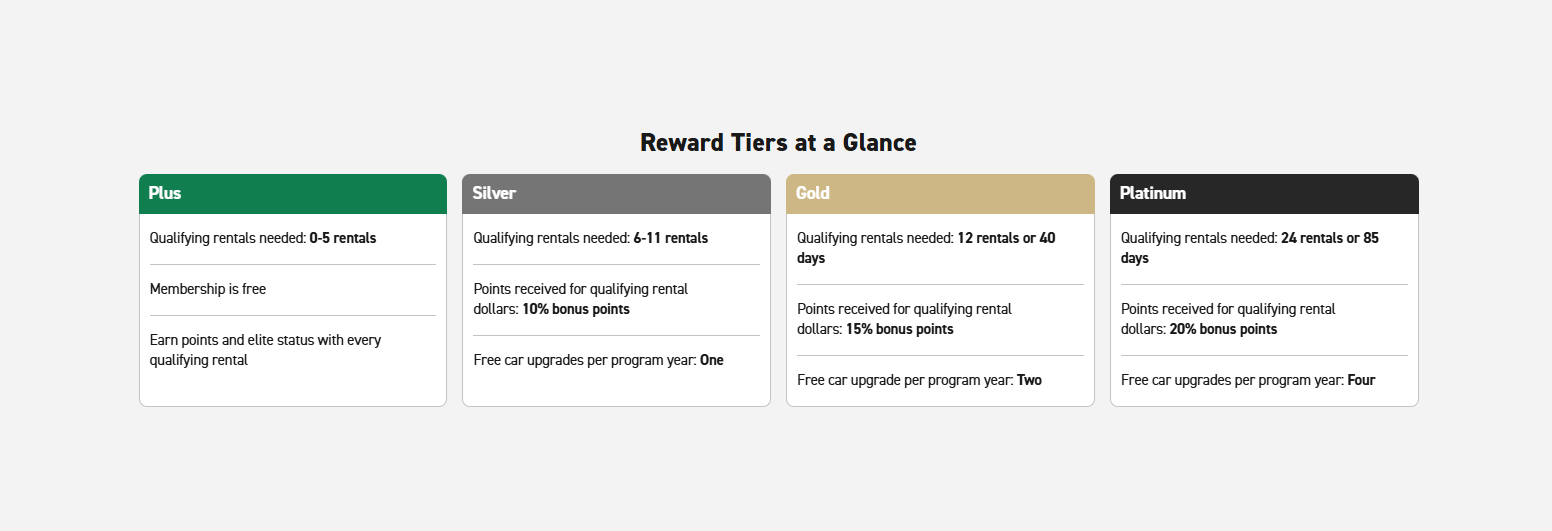
- Tier progression: Plus → Silver → Gold → Platinum
- Silver unlocks at 6 rentals
Why the 400-point threshold is deceptive: It sounds like the clear winner on paper. And for basic rentals, it often is. But Enterprise uses variable pricing on redemptions. A "free day" on a compact might cost 400 points. An SUV at a busy airport? Could be much more.
Taxes and fees are never covered either. Your "free" day still comes with a $15–$30 bill.
The real advantage is strategic: Enterprise matches status from 40+ other loyalty programs. Already have Hertz Five Star? Enterprise will match it. This makes Enterprise the lowest-risk program to start with. You can earn here, build status elsewhere, then bring that status back. No other rental company offers this kind of flexibility.
Pick Enterprise if your team rents from both airports and local branches, or you want the easiest path to free days. Skip it if you need a premium vehicle selection at airports. Enterprise's fleet skews practical rather than premium.
3. National Emerald Club: Best for Teams That Want Car Choice
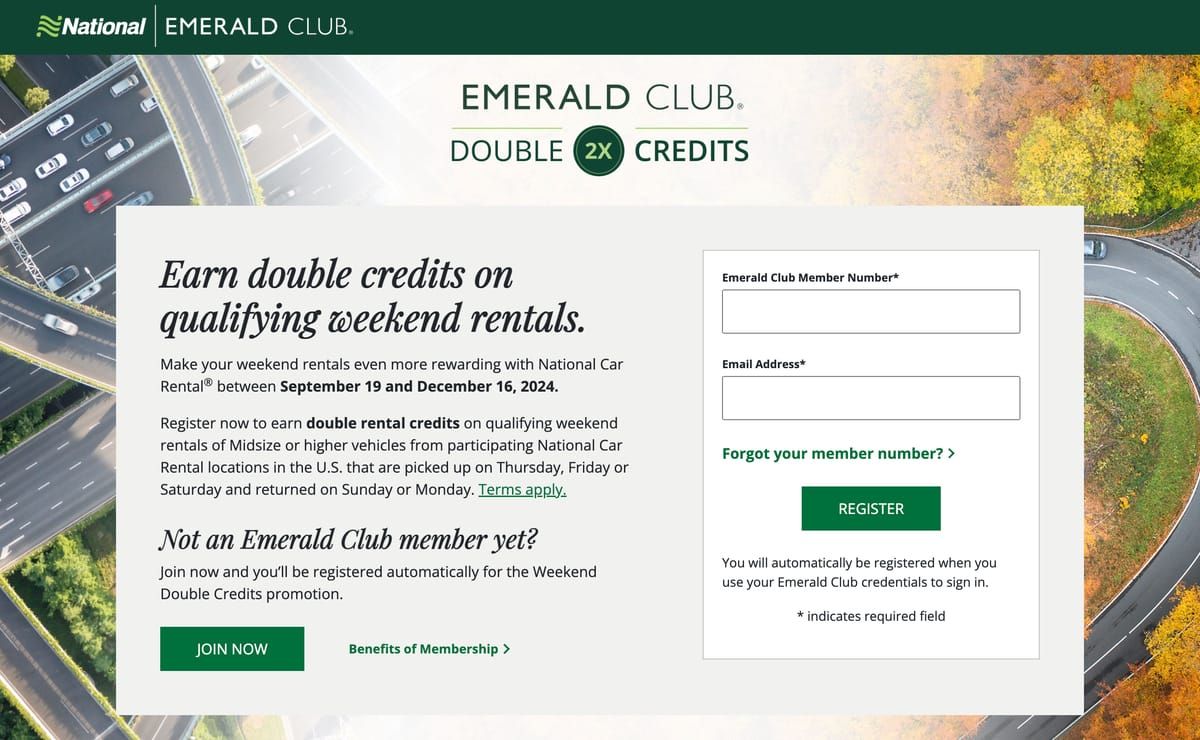
Every other rental program assigns you a car. National lets you pick one. Walk into the Emerald Aisle, book a midsize rate, and choose any midsize-or-above vehicle on the lot. For businesses with employees who need different cars (compact for city driving, SUV for site visits), this eliminates the need for upgrade negotiations entirely.
Program basics:
- Earning: 1 credit per qualifying rental
- Free day: 7 credits (US)
- Key perk: Emerald Aisle car choice at participating airports
- Satisfaction: Topped J.D. Power rental car surveys
The credit system is simpler but less flexible. You earn one credit per rental regardless of how much you spend. A $40 weekend rental and a $200 week-long booking earn the same credit. That rewards frequency over spend. If your team does lots of short rentals, National's math actually beats point-based programs.
The insider move: National and Enterprise are sister companies. Sign up for both. At participating locations, you can cross-credit between programs. Rent through Enterprise when you need a neighborhood branch. Rent through National when you want the Emerald Aisle at the airport. Credits count toward both. Very few business owners know this, and it's one of the most valuable stacking strategies in the rental car space.
Pick National if your employees have varied vehicle needs and you rent frequently at major airports. Skip it if you mostly rent at smaller regional airports. Emerald Aisle availability thins out fast outside major hubs.
4. Avis Preferred: Best for Solo Business Travelers
Avis built its loyalty program around one thing: getting you into a car fast. Skip the counter, walk to your assigned car, and drive away. For a founder or solo consultant who rents 10–15 times a year, that speed is the entire value proposition.
Program basics:
- Earning: 1 point per $1 (2x on accessories)
- Free day: 700 points (cars under $50/day)
- Tiers: Preferred (free) → Preferred Plus → President's Club
- Expiration: None while active
The credit card shortcut is the real story
Amex Platinum and Capital One Venture X grant automatic elevated Avis status. If you already carry one of these cards, you skip the earning grind entirely and start with priority service and upgrade eligibility. For solo travelers who don't earn enough to qualify for status naturally, this is the most efficient path.

Where Avis falls short for the team
The program tracks individual renters only. No company-level pooling, no shared earnings, no Business Rewards equivalent like Hertz offers. If you have five employees renting through Avis, you have five separate accounts earning slowly. Enterprise or Hertz handles this better.
Pick Avis if you're a solo traveler or a small team where one person does most of the renting, especially if you already hold an Amex Platinum. Skip it if you have multiple employees renting regularly. The program simply doesn't scale.
5. SIXT ONE: Best for US + European Business Travel
SIXT is the odd one out on this list. Smaller US footprint, but dominant in Europe. If your business operates on both sides of the Atlantic, this is the only rental loyalty program that provides consistent coverage on both.
Program basics:
- Earning: Two point types (status points + rental points)
- Tiers: Calendar-year status, maintained through the end of the following year
- Status matching: Available from competing rental programs
- Recognition: #1 Rental Car Company, 2025 USA TODAY 10Best
The dual-point system is confusing but intentional. Status points determine your tier. Rental points are what you redeem. The split means you can maintain elite status while spending rental points freely, without demoting yourself. Most programs force you to choose between earning status and spending rewards. SIXT doesn't.

The catch for businesses: SIXT ONE is for US residents only. And rental points earned on business rentals can't be redeemed personally. This creates an awkward split. Your employee earns status on a business trip but can't use the reward points. For companies where employees also do their own personal renting, this works. For pure business accounts, it limits the value.
Pick SIXT if your team regularly rents in both the US and Europe. No other program covers both markets as well as this one does. Skip it if your travel is US-only. Hertz and Enterprise have better domestic networks and simpler programs.
Budget-Friendly Options: When Low Rates Beat Loyalty Perks
Look, not every business needs a points program. If your team rents sporadically or your travel budget is tight, a flat discount you can use immediately is worth more than points you might never redeem.
Thrifty Blue Chip: The simplest value proposition on this list. No points, no tiers, just a flat 15% discount on base rates every time. For businesses with under 10 rentals a year, this guaranteed savings beats the uncertain value of point accumulation. The catch: Thrifty's fleet and locations are smaller than the big three.
Alamo Insiders: Similar idea, smaller discount (a flat 5% off base rates). The real perk is self-service kiosks at most airports, so your team can skip the counter without elite status. Good for occasional renters who value speed over savings.
Budget Fastbreak: Promo-based rather than points-based. You earn $25 in Budget Bucks after every two rentals. The counter-skip is solid at major airports. Budget shares a parent company with Avis, but the programs don't cross-credit.
Dollar Express Rewards: Points-based (1 point per $1), with free days starting at 500 points for weekend rentals. Functional but thin. Dollar is best treated as a supplementary option when its rates undercut the competition on a specific trip, not as your primary program.
Fox Rewards: The newcomer worth watching. Points-based system at a smaller network of airport locations. Fox often has the lowest base rates in the market, and the rewards program stacks on top. Limited footprint means it won't work as your only provider, but it's a strong secondary option for price-sensitive routes.
The bottom line on budget programs: If your annual rental spend is under $2,000, skip points entirely. Thrifty's 15% or Alamo's instant discount will save you more with zero effort.
Which Program Fits Your Business? (By Rental Volume)
The right program depends on your rental volume. Not your preferences, not your favorite brand. Just volume. Here's the math for three common business profiles.
1. Under 10 rentals/year (solo founder, small team):
Skip points entirely. At 8 rentals averaging $65/day for 3 days, you're spending $1,560/year. Enterprise gives you ~1,560 points, which buys roughly 3 free days ($195). Sounds okay until you factor in variable redemption costs, taxes on "free" days, and the risk of expiration. Alamo's 5% instant discount saves $78 with zero effort and zero risk. Thrifty's 15% saves $234.
The guaranteed discount beats the uncertainty of low-volume points. Every time.
2. 10–30 rentals /year (growing team):
Now points start working. At 20 rentals, $70/day average, 3 days each = $4,200/year. Enterprise turns that into ~10 free days ($700 value). Hertz? Roughly 4 off-peak ($280) or 2 at peak ($140). Enterprise wins the math at this volume by a wide margin.
Pair either with a business travel credit card. Amex Platinum automatically grants elite status at Hertz, National, and Avis. That's free upgrades and priority service without renting your way up. The card's annual fee often pays for itself through rental perks alone.
These rental car tiers work on the same principle as any tiered loyalty program: reward your best customers more, and they consolidate spending with you.
3. 30+ rentals/year (frequent renters):
The game changes here. Free days still matter, but the bigger value is time. At 40 rentals, skipping the counter saves 15–30 minutes each time. That's 10–20 hours a year your team gets back. Free upgrades to SUVs or premium cars avoid $20–$40/day in upgrade fees.
At this volume, pick the program with the best airport experience on your team's actual routes, not the one with the best point value. Use status matching to start at the elite tier on day one. Use AutoSlash to track price drops on every reservation (~30% average savings).
How to Stack Rewards for Maximum Savings
Here's where most people leave money on the table: they pick a rental program and stop there. The ones who save the most treat it as a system: rental program + credit card + price tracking, all working together.
1. Credit card shortcuts worth knowing:
The Amex Platinum alone unlocks Hertz President's Circle, National Executive, and Avis Preferred status. One card, three programs, top-tier treatment at all of them. Chase Sapphire Reserve and Capital One Venture X offer similar cross-program benefits. If you're already carrying one of these cards for other business travel, you've got elite rental status, and you might not even know it.
| Card | Rental Status Unlocked | Best For |
|---|---|---|
| Amex Platinum | Hertz President's Circle, National Executive, Avis Preferred Plus | Business owners who rent across multiple providers |
| Chase Sapphire Reserve | National Executive, Avis Preferred, Hertz upgrade eligibility | Teams already in the Chase travel ecosystem |
| Capital One Venture X | Hertz President's Circle, Avis Preferred Plus | Solo travelers who want top-tier with one card |
2. Status matching between programs:
Already earned Gold at Enterprise? Most competitors will match it. Enterprise is the most generous here, accepting status from 40+ travel programs. SIXT matches from other rental companies. This means you can earn status where it's easiest and carry it everywhere.
3. Price tracking (the step everyone skips):
AutoSlash monitors your reservation after you book and alerts you when the price drops. Their users save roughly 30% on average. It takes 2 minutes to set up and runs in the background. There's no reason not to use it.
The smartest approach: pick one primary rental program, activate your credit card status benefits, set up AutoSlash, and let all three compound.
What These Programs Don't Tell You
Rental car loyalty programs sell you on free days. They don't mention the asterisks. We will.
1. "Free" days aren't free
Every program excludes taxes, surcharges, and optional extras from free day redemptions. Expect $15–$30 in fees on every "free" day you redeem. On a $65/day rental, that means your free day is really a $20 day. Still a deal, but not the deal you were promised.
2. Peak pricing silently doubles your cost
Hertz charges 950 points for a free day off-peak, 1,900 during peak. If you don't check, you'll burn through points twice as fast during your busiest travel months. Enterprise uses variable redemption pricing that shifts by car type and location. Always check the point cost before you book.
3. Point expiration erases quiet accounts
Hertz points expire after 12 months of inactivity. If your team rotates between providers quarter to quarter, accumulated points can disappear without a single notification. Enterprise is more forgiving (3 years), but it's still a trap for businesses with seasonal rental patterns.
4. Corporate codes can block point earning
This is the one nobody talks about. Corporate negotiated rates often give the best pricing, but some programs reduce or eliminate point earning on corporate bookings. You get the discount but lose the loyalty credits. Check the fine print on your corporate agreement before assuming you're earning on every rental.
The Bottom Line
For frequent renters with global travel, Hertz Gold Plus combined with Business Rewards is the strongest setup. For mixed airport and local rentals, Enterprise Plus has the lowest free-day threshold and the widest coverage. For car choice at airports, National's Emerald Aisle stands alone. And for low-volume renters, skip points entirely and take Alamo's or Thrifty's guaranteed discount.
Pick one program. Enroll your team. Track the savings over 90 days.
Notice what the best rental programs share: they reward consistency, make progress visible, and use tiers to keep frequent customers from shopping around. The same mechanics work in reverse. If your own customers show that kind of repeat behavior, a well-designed loyalty program can turn it into measurable value. Here are real examples from businesses doing exactly that.
FAQs

Written by
Thomas Nguyen is the CEO & Co-founder of Joy, a loyalty solution for Shopify and eCommerce brands. With years of experience building high-performance Shopify apps, Thomas aims to help merchants grow through customizable and retention-focused tools.
Related reading
 Industry Spotlight
Rent Rewards Programs: The Best Loyalty Programs for the Rental Industry
Rent rewards programs can cut turnover and boost NOI, but not every program fits every property.
 Thomas Nguyen
 Industry Spotlight
CPG Loyalty Programs: How Top 8 Brands Drive Customer Retention
Discover how top CPG brands like Coca-Cola, Pampers, and Vinamilk use innovative loyalty programs to build direct customer relationships, drive repeat purchases, and stay ahead in today’s competitive FMCG market.
Thomas Nguyen- Industry Spotlight
Hotel Loyalty Programs: Best Programs Compared (2026)
Compare the best hotel loyalty programs and what makes each one work. Real data from Marriott, Hilton, IHG, and Hyatt plus strategies for your business.
Thomas Nguyen  Industry Spotlight
Best Gas Rewards Programs in 2026: What Every Fuel Business Can Learn From the Top Performers
Your customers probably already belong to at least one gas rewards program. Shell, BP, Exxon, Circle K. They've all built loyalty programs that change how
Thomas Nguyen Industry Spotlight
Best Airline Loyalty Program: How Top Programs Drive Revenue, Retention, and Growth
Strip out loyalty revenue, and not a single major US airline turned a profit from flying alone in 2024. The flights are the loss leader. The loyalty program is the profit center.
Thomas Nguyen Industry Spotlight
Best Telecommunication Loyalty Programs: 7 Real Examples and What Makes Them Work
Telecom churn rates run between 20% and 50% annually. The carriers fighting back use loyalty programs that go beyond generic point systems.
Thomas Nguyen
