
Channel Loyalty Platform: The Complete Guide to Building Partner Programs That Drive Revenue
Most B2B brands lose channel partners not to better products — but to better incentives. A channel loyalty platform is the system that makes your brand the easy choice for distributors, dealers, and resellers. Inside: 5 incentive models, implementation, and ROI.
Summarize this post with AI
Most ecommerce founders think loyalty programs are for shoppers. The bigger lever often sits somewhere else entirely — inside the network of partners selling your products on your behalf.
For brands operating through resellers, distributors, affiliates, or wholesale buyers, the partner channel can drive more revenue than direct customers ever will. But channel loyalty rarely gets a system. It gets spreadsheets, end-of-quarter rebates, and hope. A channel loyalty platform is what closes that gap.
Why Channel Partners Prioritize Your Competitors
Your channel partners sell five to ten competing product lines. The vendor they push hardest isn't the one with the best product. It's the one with the best incentive structure. A channel loyalty platform is how you become that vendor.
And most brands still manage partner incentives through spreadsheets, delayed rebate checks, and email chains. The result: low partner engagement, zero visibility into performance, and partners quietly prioritizing competitors who make it easier to earn rewards.
What makes this worse? Existing guides either define channel loyalty in abstract B2B terms (using only Intel, Cisco, and Microsoft examples) or they sell a specific platform without bridging the concept to ecommerce. Nobody connects channel loyalty to the reality of affiliates, wholesale partners, and influencer networks, where these same principles apply to ambitious brands on Shopify, WooCommerce, and beyond.
This guide covers what a channel loyalty platform actually does, the incentive structures that drive partner behavior, the technology features that matter, how to build a program step by step, why programs fail, and how to measure real ROI.
The brands that win partner mindshare aren't the ones with the best product. They're the ones with the best channel loyalty platform.
To understand why, we first need to define what a channel loyalty platform is and how it differs from the consumer loyalty programs most merchants already know.
What Is a Channel Loyalty Platform and How It Differs from Consumer Loyalty
Channel Loyalty Platform Defined: What It Is and Who It Serves
A channel loyalty platform is software that manages incentive programs for your distribution partners (resellers, distributors, dealers, affiliates, and wholesale buyers) rather than end consumers. The purpose is straightforward: reward partners for selling, promoting, and prioritizing YOUR products over competitors.
Who uses it? Manufacturers, brands with indirect sales channels, and ecommerce brands with wholesale or affiliate networks. The distinction from a CRM matters here. A CRM tracks relationships. A channel loyalty platform automates incentives, tracks performance, and manages reward fulfillment. Different job entirely.
The scale of this market reflects how fast it's growing. Grand View Research's 2025 Loyalty Management Market Report projects the global loyalty management market to grow from $13.59 billion in 2025 to $31.11 billion by 2033 at a 10.7% CAGR.
A channel loyalty platform turns your partner network from a passive distribution layer into an active, motivated sales force. That's the shift.
Channel Loyalty Platform vs. Consumer Loyalty: The Core Differences
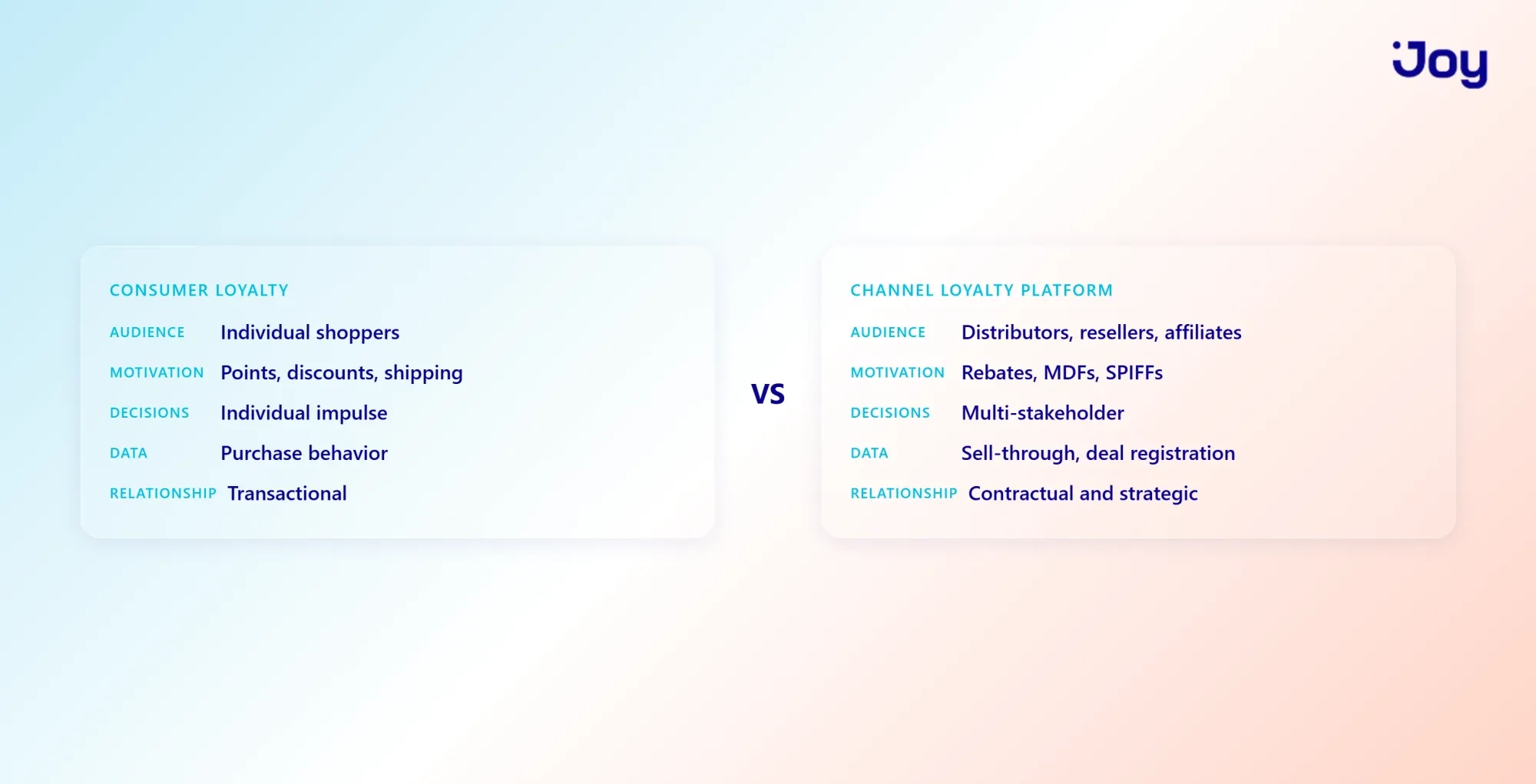
The distinction between these two systems goes deeper than audience. They require fundamentally different platform architectures because the motivations, data, and relationship dynamics don't overlap the way you'd expect.
| Dimension | Consumer Loyalty | Channel Loyalty Platform |
|---|---|---|
| Audience | Individual shoppers | Distributors, resellers, affiliates |
| Motivation | Points, discounts, free shipping | Rebates, MDFs, SPIFFs, margin protection |
| Decision type | Individual impulse | Multi-stakeholder (company + rep) |
| Data tracked | Purchase behavior | Sell-through, deal registration, training completion |
| Relationship | Transactional | Contractual and strategic |
The stakes underscore this difference. A single channel partner may represent thousands of end-customer transactions. Losing one partner doesn't mean losing one customer. It means losing an entire revenue stream.
The Ecommerce Bridge: Why Channel Loyalty Platform Concepts Apply to Your Brand
What most guides miss entirely. Shopify and ecommerce brands already HAVE channel partners. They just don't call them that.
The equivalents map directly. Affiliates function as resellers. Influencers serve as brand ambassadors. Wholesale buyers operate as distributors. Referral partners act as deal registrants. McKinsey's B2B Pulse Survey (2024) found that B2B decision-makers now use 10.2 channels in their buying journey, up from five in 2016. Ecommerce follows the same trajectory.
An ambitious brand doing $50K to $500K per month likely has 20 to 200 people actively driving revenue through non-direct channels. Most have no structured incentive system for them. None.
If anyone other than the end customer drives revenue for your store, you have a channel. And that channel needs a loyalty platform.
So what incentive structures actually drive partner behavior inside a channel loyalty platform?
Core Incentive Structures in a Channel Loyalty Platform: What Drives Partner Behavior
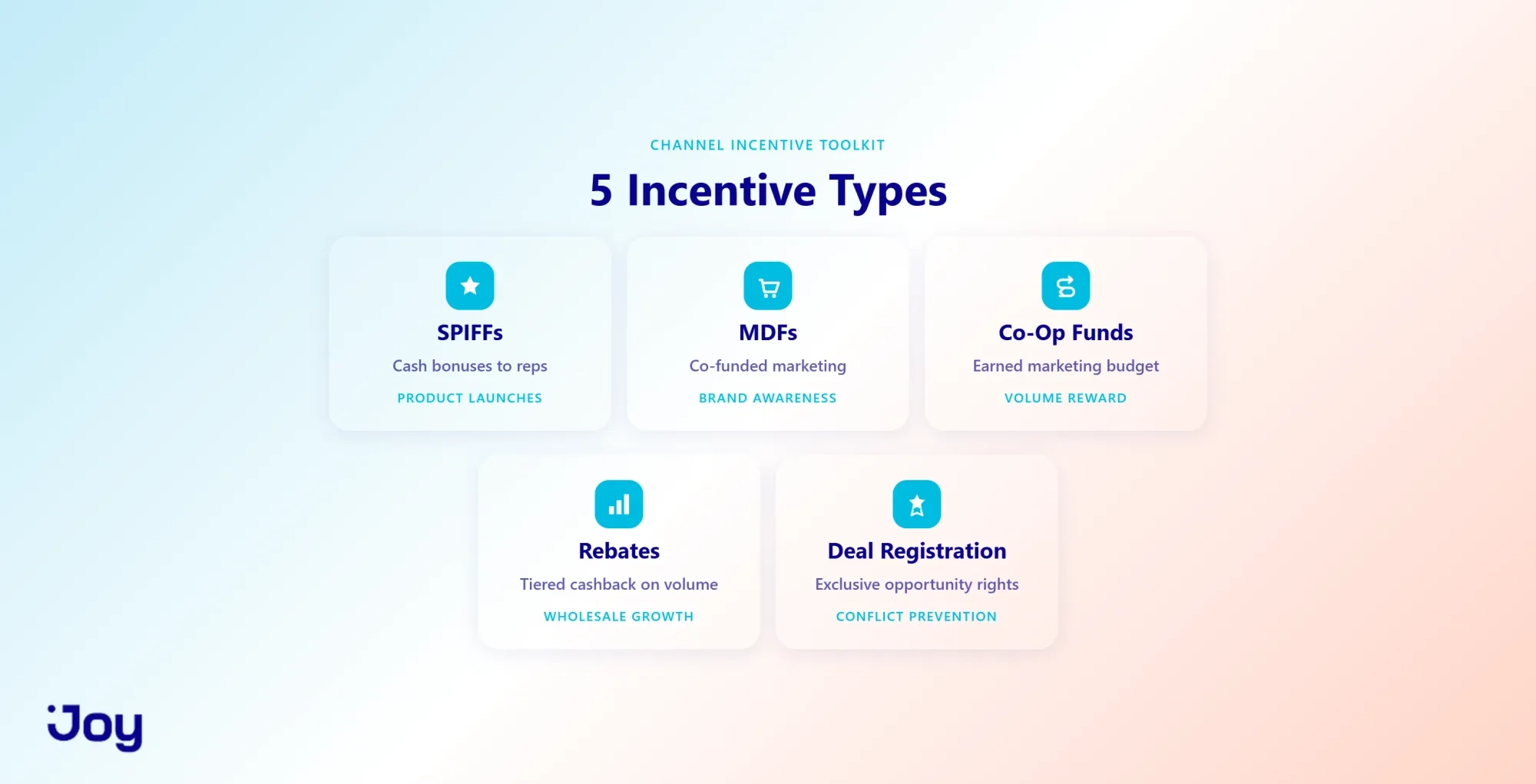
The incentive toolkit is what separates a functional channel loyalty platform from a generic reward system. Five primary incentive types exist, each designed for a different strategic purpose. Knowing when to deploy each one determines whether your partners actively sell for you or passively list your products.
SPIFFs: Short-Term Incentives That Drive Immediate Engagement
SPIFF stands for Sales Performance Incentive Fund. It's a short-term cash or reward bonus paid directly to individual sales reps, not the partner company, for selling specific products.
When to use them: product launches, clearing inventory, pushing high-margin SKUs, or competitive displacement. In practice, a SPIFF looks like this: "Sell ten units of Product X this month and earn $50 bonus per unit," paid within 48 hours through the channel loyalty platform. Cisco, for example, uses SPIFFs to incentivize partner engineers to recommend specific networking solutions during design phases.
For ecommerce brands, the equivalent is affiliate bonus payouts for promoting a specific product collection during a launch window.
SPIFFs are the fastest lever in a channel loyalty platform. They change partner behavior within days, not quarters. But they don't build long-term commitment. That requires a different set of incentive tools.
MDFs, Co-Op Funds, and Rebates: Long-Term Channel Loyalty Platform Incentives
Where SPIFFs create urgency, these three incentive types build sustained partner investment over time.
Market Development Funds (MDFs) are front-end, proposal-based funding for partner marketing activities. The partner submits a plan, the brand approves it, and a co-funded campaign runs. Think: "We'll fund 50% of your Google Ads campaign promoting our products." An industry survey by Gotoclient found that 83% of brand marketers believe MDF programs have meaningful impact on partner engagement.
Co-Op Funds work differently. They're back-end incentives where partners earn a percentage of their sales as a marketing budget. The key distinction: Co-Op funds are earned retroactively based on sales volume, while MDFs are approved proactively based on proposals.
Volume Rebates are the most straightforward incentive type. Tiered discounts or cashback based on total purchase volume over a period. "Purchase $100K in Q1 and earn a 3% rebate. Reach $250K and earn 5%."
In ecommerce terms, MDFs translate to co-branded influencer campaigns. Co-Op funds map to affiliate tier bonuses based on quarterly performance. Rebates correspond to wholesale volume discounts.
Together, these three incentives cover every timeframe. MDFs build partner capability. Rebates reward volume. Co-Op funds bridge both. A complete channel loyalty platform supports all three.
Tiered Programs and Deal Registration: Building Partner Hierarchy
The final two incentive structures create the long-term architecture that holds everything together.
Tiered partner programs assign partners status levels (Bronze, Silver, Gold, Platinum) based on performance metrics: sales volume, certifications, and customer satisfaction scores. Higher tiers unlock better margins, priority support, exclusive product access, and co-marketing budgets. Intel's Technology Provider program, Microsoft's Partner Network, and HP's Partner First program all follow this model.
Deal registration solves a different problem entirely. When a partner claims a sales opportunity, they receive exclusive or preferential rights to work it and earn bonus margin for protecting the deal. This prevents channel conflict where multiple partners compete for the same customer.
For ecommerce brands, tiered loyalty programs translate directly to affiliate tiers with increasing commission rates. Deal registration maps to influencer exclusivity agreements for specific campaigns.
Tiers create aspiration and long-term commitment. Deal registration prevents channel conflict. Together, they shift a channel loyalty platform from a reward system into a strategic partnership framework.
But can the technology actually deliver on these incentive models?
Channel Loyalty Platform Technology: Features That Separate Functional from Dominant
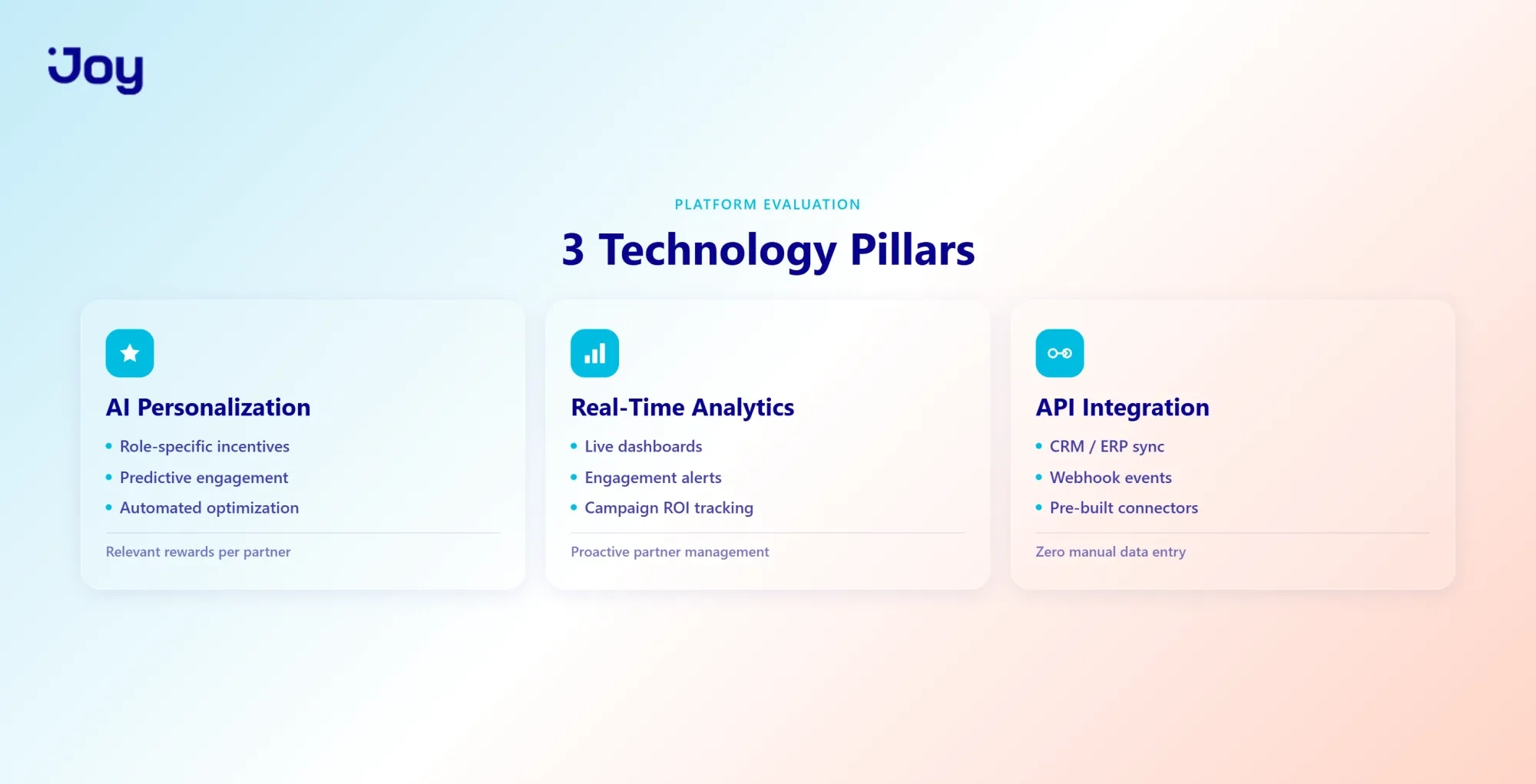
An incentive strategy is only as strong as the technology executing it. The most elegant tier structure or SPIFF program collapses if the platform can't personalize offers, surface real-time data, or connect with your existing tech stack. Three technology pillars separate a functional channel loyalty platform from one that actually drives results.
AI-Driven Personalization in a Channel Loyalty Platform
The shift from static to intelligent incentive management is already underway. An industry survey of program owners found that 37.1% now use AI to manage their loyalty programs, and adoption is accelerating.
What does AI enable inside a channel loyalty platform? The move from "same SPIFF for everyone" to role-specific incentive delivery. Partner A receives electronics-focused incentives because their customers buy tech. Partner B gets seasonal bonuses because their sales spike in Q4. The platform analyzes behavior patterns and adjusts recommendations automatically.
In practice, this means predictive partner engagement scoring, automated reward optimization, and personalized communication sequences that adapt based on partner activity. Partners engage more frequently and sell harder because the rewards feel relevant, not generic. That's a measurable difference.
For ecommerce brands, the equivalent is AI-powered affiliate recommendations, showing each affiliate the products their audience is most likely to convert on. As covered in this guide to data-driven loyalty programs, personalization turns generic programs into growth engines.
Real-Time Analytics and Partner Dashboards
Most brands can't see real-time partner performance. They rely on quarterly reports, spreadsheet rollups, and partner self-reporting. Dangerous blind spot.
A modern channel loyalty platform dashboard surfaces sell-through data by partner, region, and product. It shows reward redemption rates, tier progression velocity, campaign ROI, and partner engagement scores, all in real time. According to McKinsey's B2B Pulse Survey (2024), 54% of B2B decision-makers would switch suppliers due to poor omnichannel experience. Delayed data creates that exact friction.
The feature requirements are specific: customizable KPI dashboards, automated alerts for engagement drops, and exportable reports for executive review. You want to shift from reactive management ("why did Partner X leave?") to proactive intervention ("Partner X's engagement dropped 30% this month, trigger a retention campaign"). For a deeper look at analytics frameworks, this resource on customer loyalty analytics covers the core measurement principles.
API-First Architecture and Integration
A channel loyalty platform must connect to your CRM, ERP, ecommerce platform, POS system, and marketing automation tools. Without these integrations, you're creating data silos instead of eliminating them.
What to evaluate: REST or GraphQL APIs, webhook support, pre-built connectors, and SDKs for custom development. The integration patterns that matter most include CRM sync (partner data flowing both directions), ERP sync (purchase and invoice data triggering reward calculations automatically), and POS integration (in-store partner transactions captured without manual entry).
McKinsey's finding that B2B customers now use 10.2 channels reinforces this. Your channel loyalty platform must be present across all of them. Any platform that requires manual CSV uploads for partner data? Not a modern solution.
A channel loyalty platform that can't integrate with your existing tech stack creates more operational friction than it removes.
Now the practical question: how do you actually build one from the ground up?
How to Build a Channel Loyalty Platform Program: Step-by-Step Implementation
Knowing the incentive models and evaluating the technology are critical foundations. But the most common question is practical: how do you actually build and launch a channel loyalty platform program? This five-step framework takes you from goal-setting to optimization, with ecommerce-specific guidance at every stage.
Step 1: Define Your Channel Loyalty Platform Goals (Breadth vs. Depth)
The foundational decision comes first. Are you expanding your partner network (breadth) or deepening engagement with existing partners (depth)?
Breadth goals focus on recruitment: sign new affiliates, onboard new wholesale accounts, expand into new regions. The channel loyalty platform features you'll need include frictionless signup flows, low-barrier entry tiers, and attractive onboarding incentives.
Depth goals focus on performance: increase sell-through from your top 20% of partners, improve training completion rates, or increase deal registration volume. The features required here are tiered progression, performance multipliers, and advanced analytics.
The framework is straightforward. Start with ONE goal, prove ROI, then expand. Set SMART KPIs from day one: partner retention rate, average partner revenue, program enrollment rate, and reward redemption rate.
For ecommerce, breadth means "recruit 50 new affiliates in Q2." Depth means "increase top-tier affiliate average revenue by 25%."
The number one reason channel loyalty platform programs fail? Trying to do everything at once. Choose breadth or depth first.
Step 2: Design Your Incentive Structure and Partner Tiers
With your goal defined, map your incentives to match. Breadth programs need simple, accessible rewards like points and SPIFFs. Depth programs need escalating value through tiers, MDFs, and exclusive access.
One principle is non-negotiable: design incentives that appeal to BOTH the partner company (rebates, MDFs, co-marketing) AND individual reps (SPIFFs, gift cards, recognition). Miss either stakeholder and engagement drops.
For tier design, keep it to three or four tiers maximum. Bronze, Silver, Gold, and Platinum is the standard for a reason. The criteria for advancement must be crystal clear, and the reward gaps between tiers must be meaningful enough to motivate progression.
Your reward mix should balance financial incentives (cash, rebates, margin improvement) with non-financial ones (training, certification, exclusive product access, priority support). For inspiration on structuring these tiers effectively, this guide to loyalty program strategies covers the design principles in detail.
If a partner can't explain how to reach the next tier in one sentence, the program is too complex.
Step 3: Select Your Channel Loyalty Platform Technology
The build-versus-buy decision is critical. Building custom takes six to twelve months of development, requires a dedicated engineering team, and demands ongoing maintenance. Buying a SaaS solution means launching in days or weeks, with the vendor handling updates and lower total cost of ownership for most brands.
Your evaluation checklist: Does the platform support your incentive model (points, tiers, SPIFFs)? Does it integrate with your CRM, ERP, and ecommerce stack? Does it offer real-time dashboards? Can it scale as your partner network grows?
For ecommerce brands specifically, prioritize native integration with your commerce platform, affiliate management features, and multi-program support. Running customer loyalty and partner loyalty from a single platform reduces complexity significantly. Joy, for example, offers Shopify-native integration with flexible reward rules for points, tiers, and referral programs that can be configured for both customer-facing and partner-level incentive structures, all from one dashboard.
Red flags during evaluation: no API, manual reward fulfillment, and no mobile access for partners. For a broader comparison of available tools, this overview of loyalty program software covers the space.
Steps 4 and 5: Launch, Communicate, and Iterate
Step 4: Launch with a communication plan. Don't just activate the program and hope partners notice. You need a dedicated launch email, a partner training webinar, a quick-start guide, and visible dashboard access from day one.
Research consistently shows that loyal partners, like loyal customers, are five times more likely to repurchase and four times more likely to refer. But only if they KNOW the program exists and understand how it works.
Step 5: Monitor KPIs and iterate. Track weekly: enrollment rate, engagement rate, redemption rate, and tier progression velocity. Track monthly: partner revenue change, program ROI, and partner satisfaction scores.
The feedback loop is essential. Survey partners quarterly with direct questions: "What's working? What reward would make you sell harder?" Then adjust. Programs not updated within the first 90 days lose significant initial engagement, sometimes as much as 40%.
Launching the channel loyalty platform is 30% of the work. The other 70% is iterating based on partner feedback and performance data.
Even with solid implementation, programs still fail. Understanding why is what separates programs that survive from those that collapse within a year.
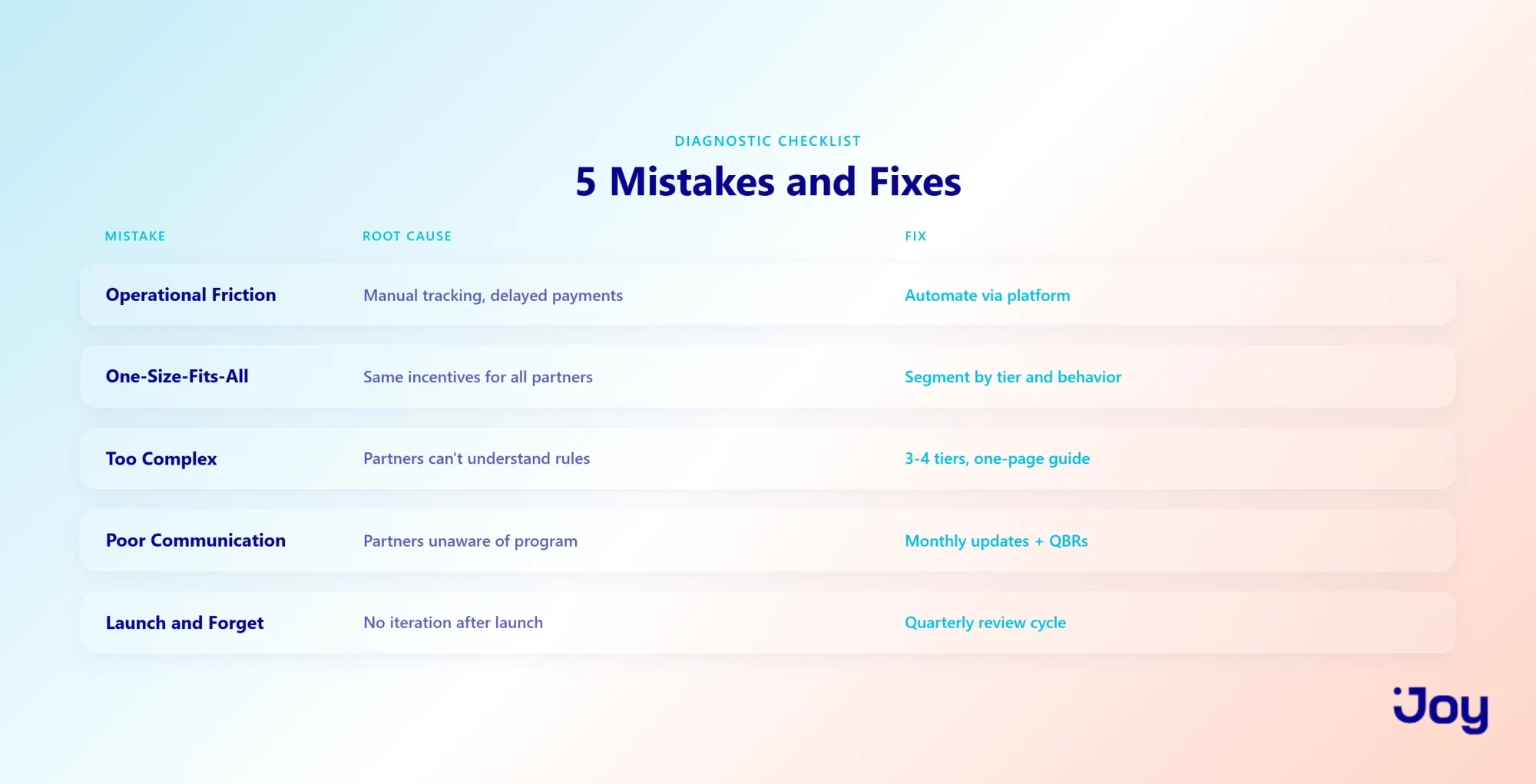
Why Channel Loyalty Platform Programs Fail: 5 Mistakes and How to Prevent Them
Only three of the top eight SERP competitors cover failure points in depth. That makes this one of the highest-value sections for anyone evaluating or running a channel loyalty platform. Each mistake below includes the symptom, the root cause, and the prevention strategy.
Mistake 1: Operational Friction That Erodes Partner Trust
The symptom: Partners sign up for the program but stop engaging after 60 to 90 days.
The root cause: Manual processes. Reward calculations done in spreadsheets. Payments delayed by weeks. Partner inquiries answered by email with no self-service portal.
The prevention: Automate reward calculation and fulfillment through the channel loyalty platform. Partners should see earned rewards in real time, redeem instantly, and track their own performance through a dedicated dashboard. Research from Genefied highlights "direct incentivisation" as critical: partners who wait 30 or more days for reward payment disengage permanently.
For ecommerce brands, the parallel is clear. Affiliates who don't see their commissions in real time will switch to competitors with better tracking dashboards.
If your partners have to ask "where's my reward?" even once, your channel loyalty platform has already failed them.
Mistake 2: One-Size-Fits-All Incentives That Ignore Partner Segments
The symptom: Top partners feel under-rewarded. Bottom partners feel overwhelmed by unrealistic targets.
The root cause: Same SPIFF, same tier threshold, same reward for every partner regardless of size, region, product focus, or relationship maturity.
The prevention: Segment partners by performance tier, product specialization, geographic focus, and relationship stage. Use the channel loyalty platform's segmentation engine to deliver different incentive tracks to different partner cohorts. Forrester's research (2024) found that customer-obsessed companies grow revenue 41% faster. The same principle applies to partner obsession: understanding and serving different partner segments drives disproportionate results.
A micro-influencer with 5,000 followers needs different incentives than a media publisher with 500,000 monthly readers. Not even close.
The fastest way to kill a channel loyalty platform program? Treating a $10K-per-month partner the same as a $500K-per-month partner.
Mistakes 3 Through 5: Complexity, Poor Communication, and "Launch and Forget"
Mistake 3: Program too complex. If partners need a training manual to understand how to earn rewards, enrollment will be low. The fix: three to four tiers maximum, clear earning rules, and a one-page partner quick-start guide.
Mistake 4: Poor communication. Partners don't know the program exists, don't understand changes, and don't feel connected to the brand. The fix: a monthly partner newsletter, a dedicated communication channel, and quarterly business reviews highlighting top performers.
Mistake 5: No iteration. The program launches and never evolves. Partner needs change, the competitive space shifts, and reward values become stale. The fix: conduct a quarterly program review using your channel loyalty platform analytics. Track which incentives drive behavior changes and which get ignored.
A connecting insight ties these together. A Harvard Business Review study of 46,000 shoppers found that omnichannel customers logged 23% more repeat shopping trips and spent more per occasion than single-channel customers. The same applies to partners engaged across multiple program touchpoints: newsletter, dashboard, events, and direct communication.
The difference between a failed and successful channel loyalty platform isn't the software. It's the operational discipline to keep it simple, communicate consistently, and evolve based on data.
These failure points naturally raise the final question: how do you prove the program is actually working?
Channel Loyalty Platform ROI: How to Measure What Matters
Every competitor on the SERP says a channel loyalty platform "increases ROI." None of them show you how to calculate it. This section provides the actual formulas, KPIs, and benchmarks so you can build a business case for investment and track performance after launch.
5 KPIs Every Channel Loyalty Platform Must Track
Partner Retention Rate: ((Partners at end of period minus new partners) divided by partners at start) multiplied by 100. The industry benchmark for healthy B2B partner programs ranges from 70% to 85% annually.
Partner Lifetime Value (PLTV): Average annual partner revenue multiplied by average partner tenure in years. This is the channel equivalent of customer lifetime value, and it's the single most important number for understanding program health.
Program Enrollment Rate: Partners enrolled divided by total eligible partners, multiplied by 100. Target 60% or higher within the first six months.
Reward Redemption Rate: Rewards redeemed divided by rewards earned, multiplied by 100. If redemption falls below 30%, your rewards aren't compelling or the program is too confusing. For more on optimizing this metric, see this guide on redemption rates.
Tier Progression Velocity: The average time for partners to move from the entry tier to the next level. Faster progression means the program is successfully motivating behavior change.
If your channel loyalty platform can't produce these five numbers on demand, you're running a reward program, not a business strategy.
Calculating Channel Loyalty Platform ROI: The Actual Formula
The formula is straightforward:
Channel Loyalty ROI = ((Revenue from loyalty partners minus revenue without program) minus program cost) divided by program cost, multiplied by 100
Program cost includes platform subscription, reward fulfillment, partner communication resources, and program management time. For revenue attribution, compare revenue from enrolled partners versus non-enrolled partners over the same period. Or compare partner revenue before versus after program enrollment.
The benchmark that frames this calculation comes from Bain and Company. Frederick Reichheld's foundational research found that a 5% increase in retention leads to a 25% to 95% increase in profits. Applied to channel partners, retaining your top 20% of partners protects roughly 80% of your indirect revenue.
When building your business case, don't just present what the program earns. Present the cost of NOT having a program: partner churn, lost mindshare, and competitors winning your partners with better incentive structures.
From Transactional to Strategic: How a Channel Loyalty Platform Shifts Relationships
The ultimate measure of a channel loyalty platform's success isn't a KPI on a dashboard. It's the qualitative shift in how partners relate to your brand.
Transactional partners say, "I sell your product because the margin is okay." Strategic partners say, "I prioritize your brand because the relationship makes my business better." In data terms, transactional partners show flat or declining revenue year over year. Strategic partners show increasing revenue, cross-selling activity, referrals, and co-marketing participation.
This shift from transactional to emotional loyalty is what separates programs that survive from programs that thrive. Forrester's CX Index (2024) found that customer-obsessed companies retain customers 51% better than their peers. The same principle applies to partner-obsessed channel strategies.
The ROI of a channel loyalty platform isn't just what it earns. It's what it prevents you from losing.
Your Channel Partners Are Already Choosing: Make Sure They Choose You
This guide has moved through a deliberate progression: defining what a channel loyalty platform is, mapping the incentive structures that drive partner behavior, evaluating the technology that makes it work, building a program step by step, understanding why programs fail, and measuring ROI with actual formulas.
The core insight runs through every section. A channel loyalty platform isn't just software. It's a strategic system for turning passive distribution into active, motivated partner advocacy.
For ecommerce brands specifically, the opportunity is largely untapped. Most Shopify merchants don't realize they already have channel partners: affiliates, wholesale buyers, influencers, and referral networks. The brands that structure and incentivize these relationships will command their categories. The ones that don't will keep wondering why their partners push a competitor's products harder.
For ambitious brands ready to build both customer loyalty and partner loyalty from a single platform, Joy Loyalty provides the flexibility, automation, and analytics to do it without enterprise-level complexity. Or, if you'd prefer a guided walkthrough for your specific partner structure, book a demo and see what's possible.
Stop hoping your partners will prioritize your products. Give them a reason.

Written by
Thomas Nguyen is the CEO & Co-founder of Joy, a loyalty solution for Shopify and eCommerce brands. With years of experience building high-performance Shopify apps, Thomas aims to help merchants grow through customizable and retention-focused tools.
Related reading
 Loyalty Strategy
Building Customer Loyalty: The Framework That Actually Works
Stable revenue can mask something uncomfortable: customers returning out of habit, not preference. When they find a better option, they leave without warning — and you pay full CAC to replace them. Here's how to build the loyalty they actually feel, not the one you assume.
 Thomas Nguyen
 Loyalty Strategy
Omnichannel Loyalty Programs: Best Programs by Industry (2026)
Your loyalty program might work on your website. But does it work in-store? On mobile? Across every channel your customers use?
Thomas Nguyen Loyalty Strategy
Pub Loyalty Scheme: How to Build One That Drives Repeat Visits
A pub loyalty scheme turns walk-in traffic into repeat revenue. Here's how to pick the right model—stamps, points, or tiers—stay compliant with UK alcohol and GDPR rules, and launch in 4 weeks.
Thomas Nguyen Loyalty Strategy
BFCM Loyalty Strategies: Eight Mechanics That Are Not a Discount
Eight loyalty mechanics for the BFCM weekend, with the cheapest instrument named for each and the costly one priced.
Thomas Nguyen Loyalty Strategy
SaaS Referral Programs: How to Build One That Actually Converts
Most SaaS referral programs spike at launch, then fade. The fix isn't a better announcement. It's treating referral as an operation, not a campaign. Here's how to build one that keeps producing.
Thomas Nguyen Loyalty Strategy
Customer Loyalty Management: Your Guide to Maximizing Repeat Revenue
Customer loyalty management is the system that turns one-time buyers into repeat revenue. This guide covers segmentation, reward design, omnichannel sync, and how to measure ROI — with frameworks you can put to work this quarter.
Thomas Nguyen