Open Source Loyalty Platform: The Honest Guide (2026)
Open source loyalty platform sounds like the dream — full code access, zero licensing, total control. The reality is messier. This honest guide covers what's actually available in 2026, real total cost vs SaaS, security/compliance shifts, and a build-buy-compose framework.

Summarize this post with AI
"Open source loyalty platform" sounds like the dream. Full code access, zero licensing fees, total control over every feature. But when you actually search for one, what you find doesn't match what the SERP promises.
The most-cited open-source loyalty platform? Its GitHub repo is essentially abandoned. Other "open-source" options need paid backends to function. And the category itself is far thinner than any comparison article will admit.
This article gives you the honest picture. We'll walk through what open-source loyalty platforms actually exist in 2026, what they really cost to run, and when they make sense over SaaS or headless alternatives. By the end, you'll have a decision framework for whether to build, buy, or compose.
An open source loyalty platform gives you maximum control, but only if you have the engineering team, budget, and patience to maintain it. For most ecommerce brands, the smarter path is a flexible SaaS platform that solves the same problems without the overhead.
What Is an Open Source Loyalty Platform? Key Concepts Defined
Before evaluating specific platforms, it's worth nailing down the technical concepts that the SERP throws around but rarely explains. These distinctions shape everything from implementation timelines to long-term costs.
Open Source Loyalty Platform Defined: What "Open Source" Actually Means Here
An open source loyalty platform is software whose source code is publicly available. You can download it, modify it, and self-host it without licensing fees.
But "open source" doesn't mean "free." The code is free. The infrastructure, maintenance, security patches, and developer time? Not free.
Licensing types matter too. MIT licenses let you do almost anything with the code. GPL requires you to share modifications. AGPL triggers sharing obligations even for network use. And commercial open-core models offer a free core with paid enterprise features layered on top.
So why do ecommerce brands search for this? Usually frustration with rigid SaaS platforms, a desire for full customization, or fear of vendor lock-in. Those are valid concerns. But the question is whether open source actually solves them, or simply trades one set of constraints for another.
API-First, Headless, and Composable: The Architecture Behind Open Source Loyalty Platforms
These three terms show up constantly in loyalty platform discussions, often used interchangeably. They're not the same thing.
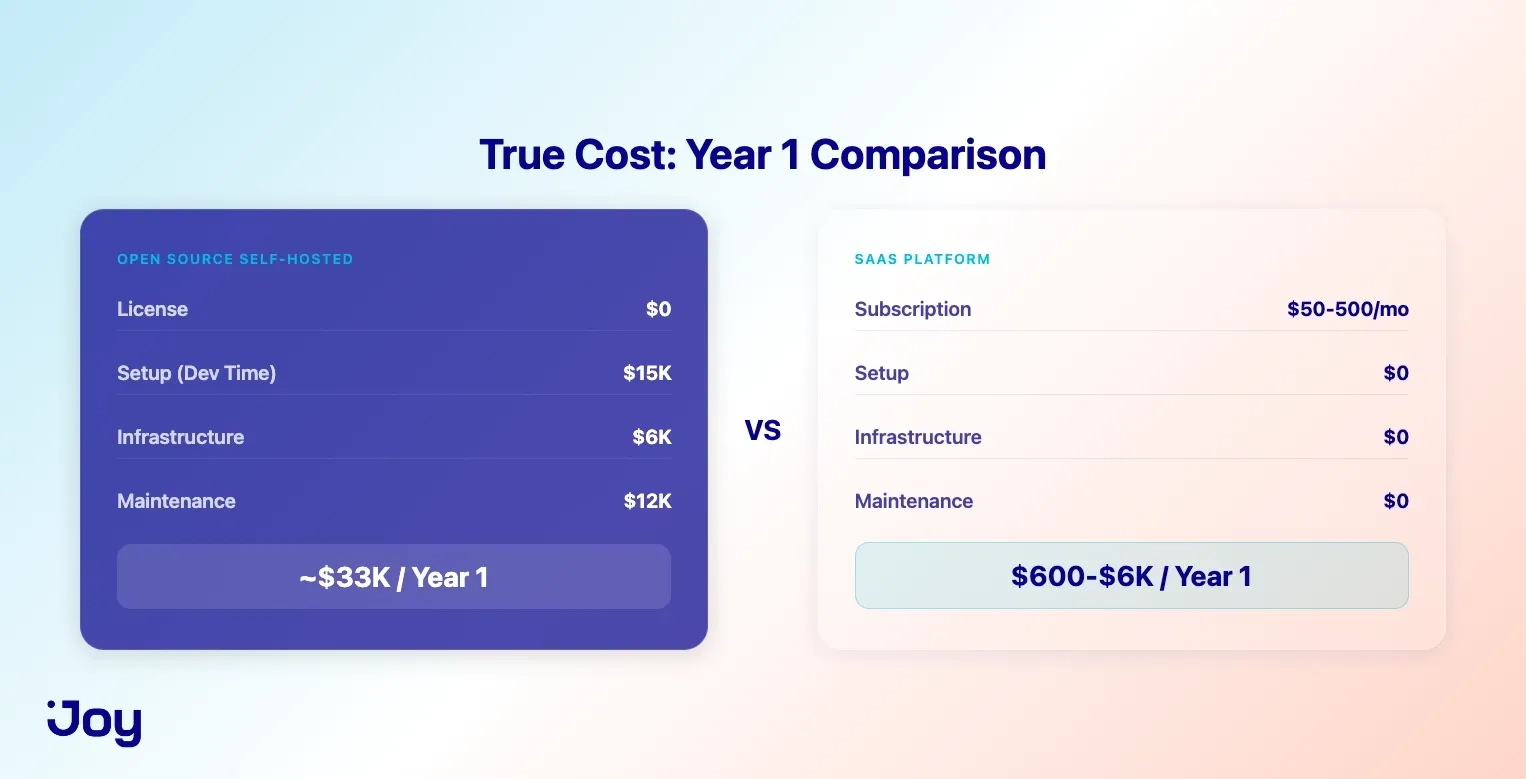
API-first architecture means the loyalty engine exposes all functionality through REST or GraphQL APIs. There's no built-in UI. Your developers build the entire customer-facing experience. Earning points, redeeming rewards, checking tier status -- it all happens through API calls.
Headless loyalty takes this a step further. The backend (rules, points, tiers) is completely decoupled from the frontend (how customers see and interact with rewards). You control 100% of the UI/UX.
Composable architecture, sometimes called MACH, is the mix-and-match approach. You combine best-of-breed tools: a CDP like Segment, a customer engagement platform like Braze, and a loyalty engine like Voucherify or Open Loyalty. Each component is independently deployable and replaceable.
The flexibility is real. But so is the cost: every API endpoint is a dependency your team must maintain. How many of those dependencies can your engineering team realistically support?
Self-Hosted vs. Cloud-Hosted: Who Manages What
Self-hosted means you run the software on your own servers, whether that's AWS, GCP, or on-premise hardware. You get full control over data, uptime, and security. You also get full responsibility for all of it.
Cloud-hosted (managed) means the vendor runs the infrastructure. You access the platform through a dashboard or API. Updates, security patches, and scaling are the vendor's problem.
Hybrid models sit between the two. Open-core platforms have historically offered a free self-hosted version alongside a paid cloud-managed version with enterprise features. Open Loyalty followed this exact model before pivoting to commercial-only.
And the real-world pattern tells you something: most brands start self-hosted for control, then migrate to cloud-hosted when maintenance overhead starts eating into their roadmap. SaaS-native platforms sit on the cloud-hosted end. Merchants customize rewards, tiers, and referral programs without managing infrastructure or worrying about server uptime.
The Open Source Loyalty Platform Landscape in 2026: What's Actually Available
This is the section every other article gets wrong. Nearly every comparison piece treats "open-source loyalty platform" as a thriving category with plenty of options. The honest reality? The space is sparse, most projects are abandoned or have pivoted to commercial, and the truly open-source options come with significant caveats.
Open Loyalty: The Most-Cited Name, but Read the Fine Print
Open Loyalty is the first name that appears when you search "open source loyalty platform." Nearly every comparison article cites it. And on the surface, the story sounds great: a full-featured loyalty engine with open-source code.
Now look closer. We pulled up the sbodak/open-loyalty repo on March 27, 2026. What we found.
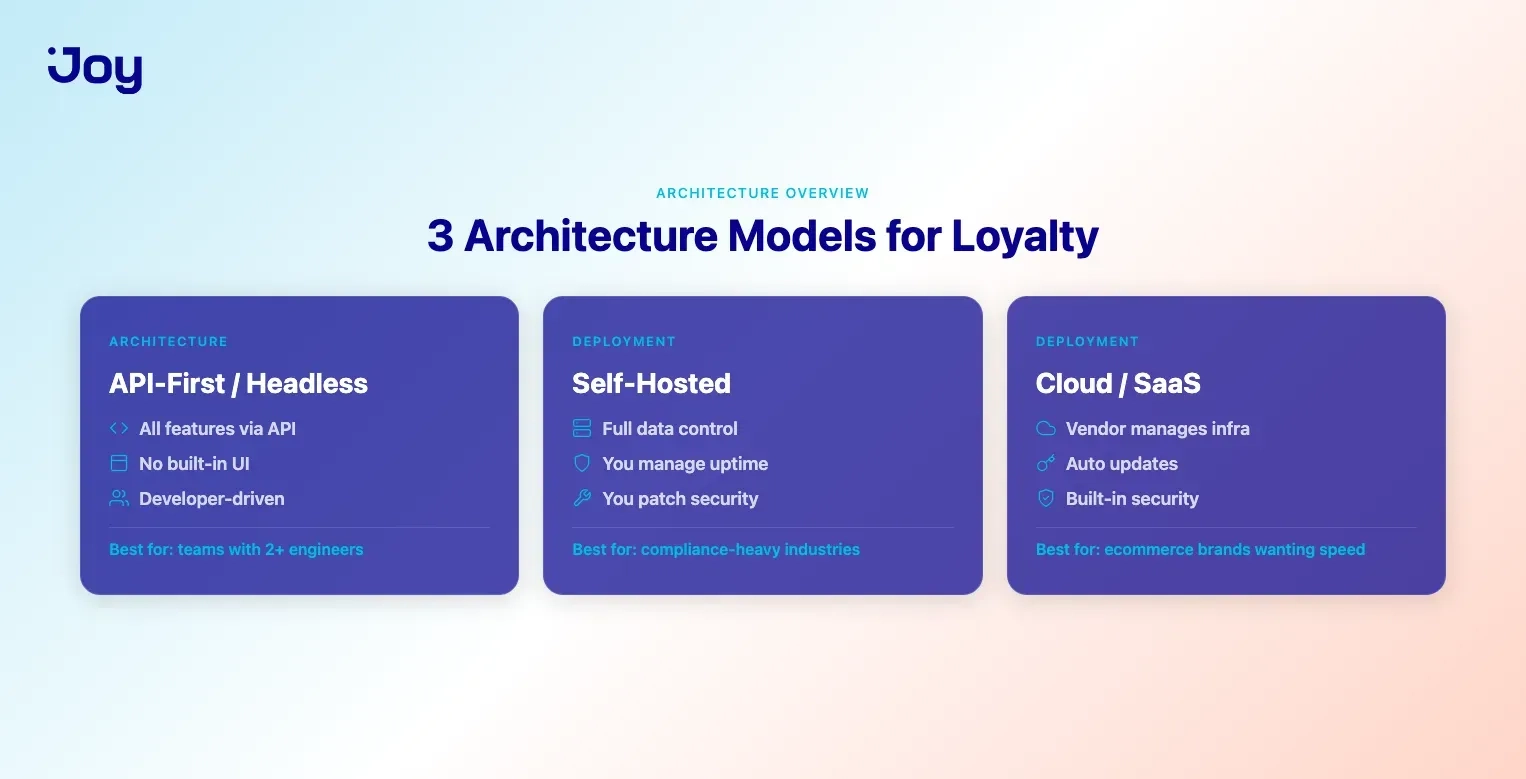
The original open-source repo is a PHP/Symfony stack with just 24 GitHub stars and roughly 260 forks. The last meaningful activity dates back to around 2021. The official GitHub organization now contains only five repos, all blockchain-related experiments built on HyperLedger Fabric, with the most recent update from October 2025.
Meanwhile, the company behind it (part of OEX SA, with EUR 199 million in revenue in 2024) has fully pivoted to a commercial cloud platform. The open-source code technically still exists, but nobody's maintaining it. No security patches. No updates. No community support.
In practice: if you deploy the open-source version today, you're running abandoned software with known security exposure. Open Loyalty now markets itself as a "headless loyalty platform," and it's entirely commercial.
Voucherify Loyalty Accelerator: Open Source with a Catch
Voucherify offers what it calls an open-source "Composable Loyalty Accelerator": a Next.js frontend app paired with a POS simulator. It integrates with Segment for customer data and Braze for engagement. The composable, MACH-certified architecture is well-designed.
The catch, though. The frontend is open-source, but it requires Voucherify's paid API backend to function. You can't run it independently. Strip away the marketing language, and what you have is a development accelerator for existing Voucherify customers. Not a standalone open-source loyalty platform.
The GitHub repo is actively maintained with good documentation and real production templates. If you're already paying for Voucherify, the accelerator is genuinely useful. But if you came looking for a free loyalty solution, this isn't it.
Smaller GitHub Projects: The Long Tail of Abandoned Code
Beyond Open Loyalty and Voucherify, GitHub has dozens of loyalty-related repos. Most have fewer than 200 stars and no recent activity.
You'll find loyalty management systems in Python, Node.js, and Java, all at proof-of-concept quality rather than production-ready. A merchant retention platform built with Next.js, FastAPI, and Firestore represents one of the newer entries. An open-source referral platform with roughly 152 stars (TypeScript/Next.js/Drizzle) is another. Both are still early-stage.
The pattern is consistent: developers build loyalty proof-of-concepts for portfolios or hackathons, and few survive past the initial commit. No production-grade, actively-maintained, fully open-source loyalty platform exists in 2026. None.
Why the Open Source Loyalty Platform Category Is So Thin
This isn't an accident. Loyalty platforms are inherently complex: points engines, tier management, referral tracking, fraud detection, multi-channel sync, analytics dashboards, and deep ecommerce integrations all need to work together.
Building and maintaining all of that as open-source requires a large, committed contributor community. Think WordPress, Supabase, or Linux. Loyalty software simply doesn't have that critical mass.
And commercial incentives pull in the opposite direction. Companies that build working loyalty engines monetize them as SaaS, not as open-source giveaways. The economics don't support community-maintained loyalty infrastructure, which means this category will likely stay thin for years to come.
The True Cost of an Open Source Loyalty Platform: TCO Framework
Knowing the space is one thing. Knowing the costs is what actually changes decisions. Every SERP result focuses on the "$0 license fee" headline. None of them walk through what happens after you download the code.
The Hidden Costs Behind "Free" Open Source Software
The license is free. Everything else is not.
Infrastructure comes first: servers, databases, CDN, monitoring tools. Depending on your scale, expect $200 to $2,000 per month just to keep the lights on.
Developer time adds up fast. Setup, customization, and integration with Shopify, your CRM, POS, and email provider requires at minimum two to four weeks of senior developer time. That's $5,000 to $20,000 or more before a single customer earns a point.
Ongoing maintenance is where costs really compound. Security patches, bug fixes, dependency updates, and performance monitoring don't stop after launch. Gartner estimates that the annual cost to own and manage software can reach four times the initial purchase cost. For "free" open-source software, that math starts at zero and still adds up fast.
Then there's opportunity cost, and this might be the biggest expense of all. Forrester research shows that 80% of IT spending goes to maintenance, leaving only 20% for new projects. Your dev team maintains loyalty infrastructure instead of building features that grow revenue. Every sprint spent patching your loyalty engine is a sprint not spent on conversion optimization or product development.
The total? What starts as "$0/month" often becomes $2,000 to $10,000 per month in loaded costs.
Open Source Loyalty Platform vs. SaaS: A Cost Comparison Framework
To make this concrete, here's a side-by-side framework for a mid-size ecommerce brand doing $200K per month in revenue:
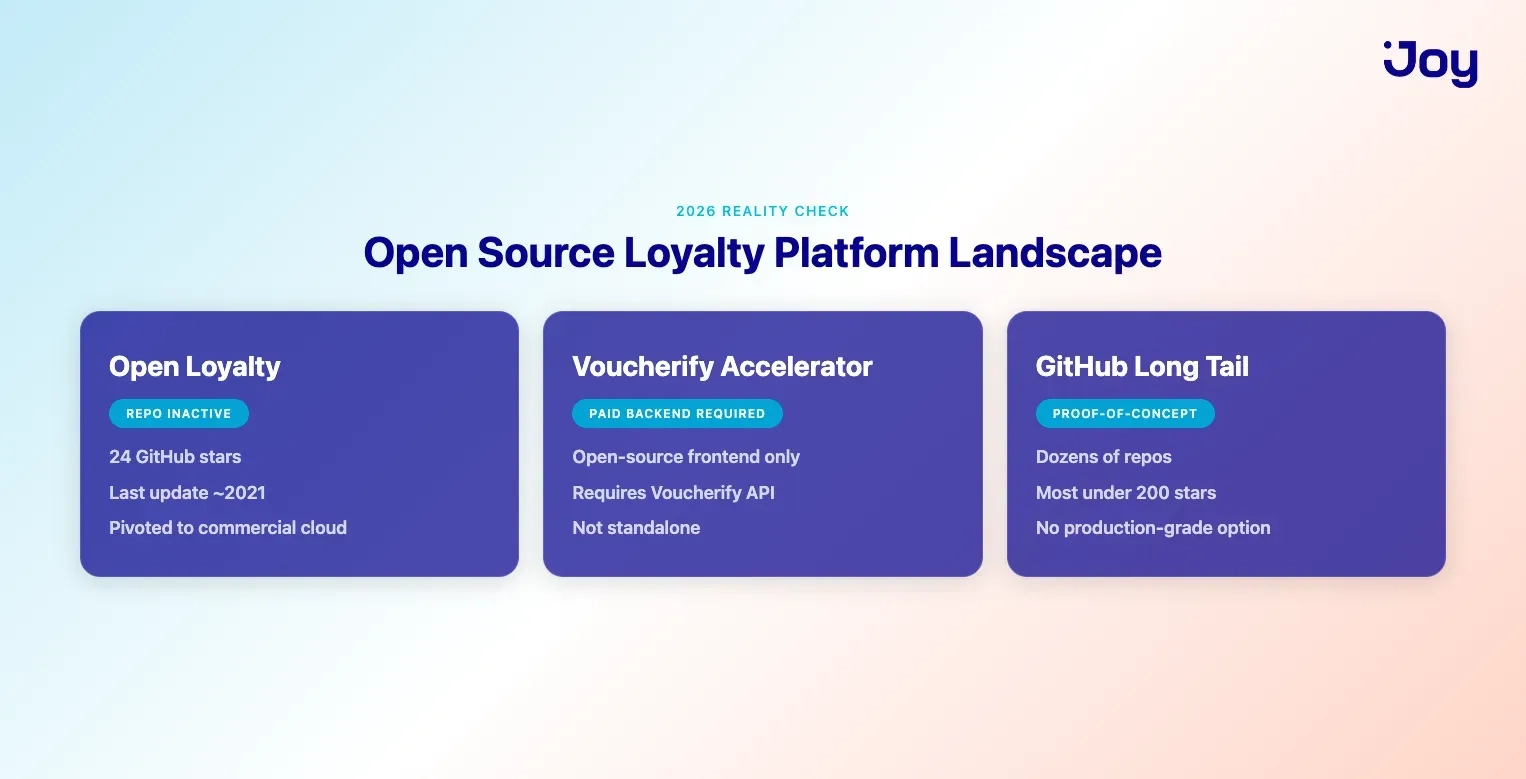
Open-source self-hosted (Year one):
- $0 license
- ~$15K setup (developer time)
- ~$6K infrastructure
- ~$12K maintenance
- Total: ~$33K
Open-source self-hosted (Year two and beyond):
- ~$18K/year (infrastructure + maintenance + dev time for updates)
SaaS loyalty platform (Year one):
- $50 to $500/month subscription
- $0 setup (install the app)
- $0 infrastructure
- $0 maintenance
- Total: $600 to $6,000
SaaS loyalty platform (Year two and beyond):
- Same subscription, scales with usage
The inflection point is clear: open-source only becomes cheaper than enterprise SaaS ($5K+/month) when you have a full-time developer maintaining it AND your scale justifies the control. For most Shopify brands, SaaS-native platforms cost a fraction of self-hosting with far faster time-to-value.
True TCO = License + Setup + Infrastructure + Maintenance + Opportunity Cost
When Open Source Loyalty DOES Make Financial Sense
Open source isn't always the wrong choice. It makes sense when:
- You have three or more dedicated engineers who can maintain loyalty infrastructure full-time
- Your loyalty program requires highly custom mechanics that no SaaS platform supports, like blockchain-based rewards, cross-brand coalition programs, or proprietary algorithms
- You operate in a regulated industry where on-premise hosting is legally required, such as healthcare, government, or defense
- Your scale is massive enough (10 million+ members) that SaaS per-member pricing exceeds self-hosting costs
For most ecommerce brands doing $50K to $500K per month in revenue, none of these criteria apply.
Joy's transparent pricing ($0 to $499/month for Shopify brands) eliminates the hidden costs of self-hosting. No infrastructure to manage, no security patches to apply, no dev hours spent on maintenance instead of growth.
Security, Compliance, and Community: What Shifts to Your Team
Cost is only half the picture. The other half is responsibility. When you self-host open-source software, every obligation the SaaS vendor would have handled lands on your team. That includes obligations you might not even know exist yet.
Security and Compliance: Your Responsibility Now
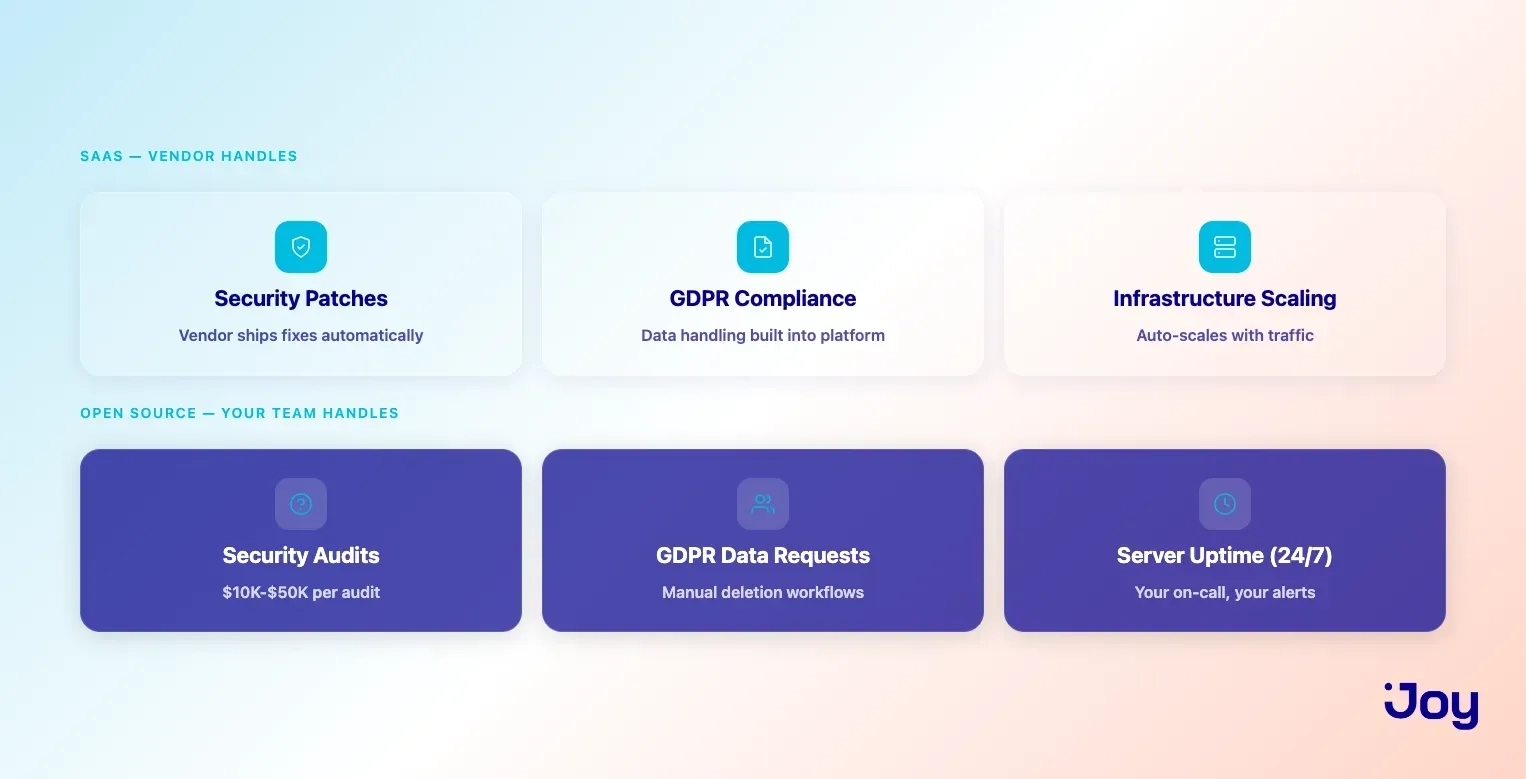
With a SaaS provider, the vendor handles SOC2 compliance, GDPR data handling, PCI DSS for payment-adjacent data, security patches, penetration testing, and incident response. You benefit from their investment without managing any of it.
With self-hosted open source, all of that becomes yours.
You need to audit all code for vulnerabilities before deployment. You need to implement and maintain GDPR compliance, including data subject requests, right to deletion, and consent management. You need to run your own security audits (or hire a firm at $10K to $50K+ per audit). And you need to respond to zero-day vulnerabilities in your stack, whether that's PHP, Symfony, Node.js, or any other dependency.
For loyalty platforms specifically, the stakes are high. You're handling PII: names, emails, purchase history, point balances. A data breach isn't just a technical incident. It's a legal and reputational event.
SaaS-native platforms run on the ecommerce platform's infrastructure. Security patches, compliance, and incident response are the vendor's responsibility, not yours.
Developer Community and Long-Term Viability of Open Source Loyalty Platforms
What does a healthy open-source project look like? Thousands of stars, hundreds of contributors, weekly commits, an active issue tracker, and responsive maintainers. Supabase has 99,000+ stars and 1,742 contributors. That's a thriving ecosystem.
Now compare that to Open Loyalty's original repo: 24 stars, roughly nine commits, and effectively abandoned.
Why does this matter? Because no community means no one is catching security bugs, no one is reviewing pull requests, and no one is building integrations for the platforms you use. SaaS vendors, by contrast, have paid engineering teams shipping updates weekly, fixing bugs within days, and maintaining integrations with every platform update.
There's also a risk signal worth watching: when the maintainer pivots to commercial (as Open Loyalty did), your self-hosted version stops receiving updates immediately. You're maintaining a fork alone. That's not open source. That's unmaintained software with a GitHub URL.
Migration Paths: Getting In and Getting Out
Migrating TO open-source is a heavy lift. Export customer data from your current platform, map it to the open-source schema, import, rebuild integrations, test, and launch. Timeline: four to 12 weeks minimum with dedicated dev resources.
Migrating FROM open-source back to SaaS is more common than you'd expect. Export customer and points data, import into SaaS (most support CSV or API import), re-map reward rules, and launch. With Shopify-native platforms, you're looking at one to five days.
And here's the paradox nobody talks about: brands choose open-source specifically to avoid vendor lock-in, but custom code creates its own form of lock-in. The more you customize, the harder it becomes to switch. What actually matters more than code access is data portability. Make sure any platform, whether open-source or SaaS, lets you export your customer and transaction data.
The best SaaS platforms let you export all customer and transaction data, avoiding both vendor lock-in and the code lock-in that comes with heavy customization.
Open Source Loyalty Platform Decision Framework: Should You Build, Buy, or Compose?
Costs quantified, risks mapped. How do you actually decide? It comes down to three honest questions about your team, your requirements, and your timeline. Each fits a different type of team, and being honest about which one matches yours will save months of wasted effort.
Three Paths for Your Loyalty Platform: Match Your Team to the Right Model
Path 1: Build (Open Source Self-Hosted)
Choose this when you have three or more dedicated engineers, need loyalty mechanics that no SaaS platform supports, operate in a regulated industry requiring on-premise hosting, or manage 10 million+ members at scale. The reality: you're building a product, not installing a tool. Expect three to six months to reach production. Your best available option is to fork Open Loyalty's old code or build from scratch with a modern stack.
Path 2: Buy (SaaS-Native)
Choose this when you're running a Shopify store doing $50K to $500K per month, want powerful loyalty without dev overhead, and need to launch in days rather than months. This is the fastest path to measurable loyalty ROI, and 80%+ of ecommerce brands belong here. Strong options include Joy Loyalty (most flexible for Shopify), Smile.io, Yotpo, and LoyaltyLion.
Path 3: Compose (Headless/API-First)
Choose this when you have a custom tech stack, in-house engineering, and want composable architecture combining a CDP, a CEP, and a loyalty engine. More control than SaaS, less maintenance than full self-hosting. Strong options include Voucherify (MACH-certified), Talon.One, and Open Loyalty Cloud (commercial).
Most ecommerce brands searching for "open source loyalty platform" actually need Path 2. The flexibility they're looking for doesn't require maintaining their own code.
A Quick Decision Checklist Before You Choose
Answer these five questions honestly:
- Do you have two or more engineers who can dedicate time to loyalty infrastructure? If no, choose SaaS.
- Does your loyalty program require mechanics no SaaS platform supports? If no, choose SaaS.
- Are you in a regulated industry requiring on-premise hosting? If no, choose SaaS or headless.
- Is your member base large enough (10 million+) that per-member SaaS pricing is prohibitive? If no, choose SaaS.
- Are you willing to accept three to six months to production instead of three to six days? If no, choose SaaS.
If you answered "No" to all five, an open source loyalty platform will cost you more in time and money than it saves. If you answered "Yes" to two or more, open-source or headless is worth evaluating further.
For the majority of Shopify brands, Joy delivers all the reward mechanics (points, tiers, referrals, VIP) in one platform, with clear loyalty ROI tracking built in, launching in minutes instead of months, and zero infrastructure to maintain.
Conclusion
The open source loyalty platform space in 2026 is thinner than the SERP suggests. Most options are abandoned, commercial, or dependent on paid backends. The true cost of "free" open-source loyalty -- when you add infrastructure, developer time, security, and maintenance -- exceeds SaaS for the vast majority of ecommerce brands.
Open source makes sense for large enterprises with dedicated engineering teams and genuinely unique requirements. For ambitious Shopify brands looking for flexibility and control, it's almost certainly not the right path.
The real question isn't "open source vs. SaaS?" It's "what gives me the most flexibility with the least overhead?"
Joy Loyalty delivers the customization, control, and reward flexibility that drives brands to search for open-source -- without the maintenance burden. Start free on Shopify today.
Choose your loyalty platform by what it generates -- repeat purchases, stronger relationships, measurable revenue -- not by whether you can read its source code.
FAQ
Is Open Loyalty really open source?
Technically, the code is still on GitHub. But the company has fully pivoted to a commercial cloud platform. The open-source repo (24 GitHub stars, last meaningful activity around 2021) is unmaintained. You can fork it, but you'd be running abandoned software with no security patches or community support.
What is the best free loyalty program software?
No production-grade, fully free loyalty platform exists in 2026. The closest options are Open Loyalty's abandoned repo and Voucherify's open-source frontend (which requires their paid API). For Shopify brands, SaaS platforms like Joy Loyalty offer free tiers that cover core loyalty features without the burden of self-hosting.
How much does it cost to self-host a loyalty platform?
$33K+ in year one (setup + infrastructure + maintenance) and $18K+/year ongoing. That includes developer time, server costs, security audits, and dependency management. Most Shopify brands find SaaS subscriptions ($50 to $500/month) significantly cheaper overall.
Can you build a loyalty program from scratch?
Yes, but expect three to six months to production with two or more dedicated engineers. You'll need to build a points engine, tier management, referral tracking, fraud detection, analytics, and ecommerce integrations. Most teams underestimate the ongoing maintenance cost once the initial build ships.
What is a headless loyalty platform?
A headless loyalty platform separates the backend logic (points, rules, tiers) from the frontend display. You control the customer-facing UI while the platform handles business logic via API. Examples include Open Loyalty Cloud (commercial), Voucherify, and Talon.One.
Is open-source software more secure than SaaS?
Not inherently. Open-source security depends on active community review and timely patches. For loyalty platforms, where the developer community is nearly nonexistent, self-hosted open source may actually be less secure than SaaS vendors with dedicated security teams, SOC2 compliance, and regular penetration testing.
What is the difference between open-source and API-first loyalty?
They're independent concepts. Open-source means the source code is publicly available and modifiable. API-first means the platform exposes functionality through APIs. A platform can be API-first without being open-source (most are), and open-source without being API-first.
When should an ecommerce brand choose open-source loyalty over SaaS?
When you have three or more dedicated engineers, need highly custom mechanics no SaaS supports, operate in a regulated industry requiring on-premise hosting, or have 10 million+ members where per-member SaaS pricing becomes prohibitive. For most Shopify brands, SaaS is the better choice.
What happened to Open Loyalty's open-source project?
Open Loyalty (part of OEX SA, EUR 199M revenue in 2024) pivoted from open-source to a commercial cloud platform. The original PHP/Symfony repo is essentially frozen. Their GitHub org now contains blockchain experiments. The company markets itself as a "headless loyalty platform," fully commercial, no longer open-source.
What is composable loyalty architecture?
Composable (MACH) loyalty uses mix-and-match components: a CDP like Segment, a customer engagement platform like Braze, and a loyalty engine like Voucherify. Each component is independently deployable and replaceable. It offers more flexibility than monolithic SaaS but requires integration expertise and ongoing maintenance.

Written by
Thomas Nguyen is the CEO & Co-founder of Joy, a loyalty solution for Shopify and eCommerce brands. With years of experience building high-performance Shopify apps, Thomas aims to help merchants grow through customizable and retention-focused tools.
Related reading
 Loyalty Strategy
When a Referral Program Beats a Points Program
Use product cadence, advocacy, margin, and fraud risk to decide when referrals should lead your retention strategy instead of points.
 Thomas Nguyen
 Loyalty Strategy
What Is a Loyalty Discount? (And How to Use It Without Killing Your Margins)
Most merchants avoid discounts because they fear training customers to only buy on sale. Loyalty discounts work differently: they reward earned behavior, not price hunting. Inside: what they actually are, six types that work for ecommerce, and the margin math that proves the ROI.
Thomas Nguyen Loyalty Strategy
BFCM Retention: Only 13% of New Buyers Place a Second Order
Only 13% of the new customers a store wins over BFCM come back for a second order. That is Tresl's BFCM 2022 measurement, inverted.
Thomas Nguyen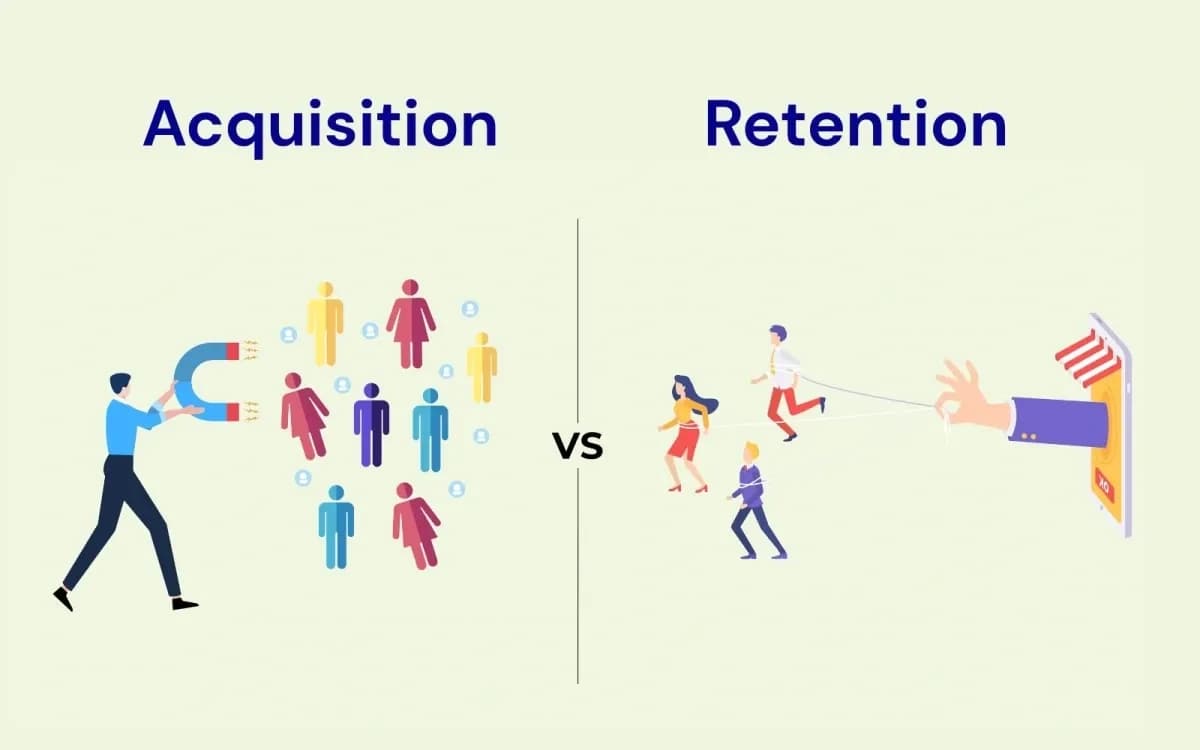 Loyalty Strategy
Customer Acquisition vs Retention: Where to Put Your Next Dollar
Customer acquisition and retention aren't a contest. Here's what each really costs, when to prioritize which, and a simple LTV:CAC way to decide your split.
Thomas Nguyen Loyalty Strategy
How Much Does a Loyalty Program Cost? A Detailed Breakdown
Loyalty programs cost $2,500–$4,500 in month one and $7,720–$15,320 in year one. Full 2026 breakdown of software, rewards, setup and hidden costs.
Thomas Nguyen Loyalty Strategy
The Loyalty Program Business Model: How to Structure Your Store Around Keeping Customers
Most stores bolt on a rewards program and hope for the best. A loyalty program business model builds growth around keeping customers. Here's how to do it.
Thomas Nguyen