
Loyalty Platform Providers: How to Choose the Right One for Your Brand
The loyalty management market hits $51.65B by 2034 — and platform choice is where most brands waste it. This guide compares loyalty platform providers across 4 categories, lays out 7 evaluation criteria, and explains how Gartner and Forrester rate vendors.

Summarize this post with AI
The loyalty management market is projected to reach USD 51.65 billion by 2034, according to Fortune Business Insights. That's a lot of money chasing a lot of platforms. Yet most brands still pick the wrong one.
Why? Because there are hundreds of loyalty platform providers, and no honest guide sorts them by who they actually serve.
Enterprise vendors dominate every "best of" list. If you're running a Shopify store doing $100K a month, you've probably scrolled past Epsilon, Oracle CrowdTwist, and Comarch recommendations you'll never use -- and still couldn't find the right fit.
This guide fixes that. We'll walk through seven evaluation criteria, name specific providers in each category, share honest pricing ranges, lay out realistic implementation timelines, and give you a decision framework that actually works.
What Are Loyalty Platform Providers? And Why the Category Is More Complex Than It Looks
Before comparing vendors, you need to understand what you're actually buying -- and why the "best" list depends entirely on your business type.
Loyalty Platform Providers Defined: What You're Actually Buying
A loyalty platform provider delivers software that manages customer rewards, points, tiers, referrals, and engagement programs – all integrated with your existing tech stack (ecommerce platform, CRM, POS, email/SMS).
There's an important distinction here. A "loyalty platform provider" gives you the tools to build and own your loyalty strategy. A "loyalty managed service" rents you theirs. With a platform, you own the setup and data. With a managed service, the vendor runs it for you -- higher cost, less control.
The category spans a wide range. Free Shopify apps that launch in minutes on one end. $50K+/year enterprise suites with six-month implementations on the other. Picking the wrong tier either wastes budget or limits growth, so understanding where you fall matters before you start comparing features.
How the Loyalty Platform Providers Market Has Fragmented
The market used to be dominated by monolithic enterprise suites -- Oracle, Comarch, Epsilon -- all-in-one platforms with 12+ month implementations and price tags to match.
Then, headless, API-first entrants shook things up. Voucherify, Open Loyalty, and Talon. One brought modular, developer-focused, composable approaches built on MACH architecture. At the same time, ecommerce-native platforms emerged – Joy, Smile.io, Yotpo, and LoyaltyLion – built specifically for Shopify, launching in minutes instead of months.
The result? Four distinct categories that serve fundamentally different buyers.
And the market data backs this up. According to Mordor Intelligence, the loyalty management market is expected to reach USD 15.19 billion in 2025 and is growing at 14.60% CAGR. More telling: SMEs are the fastest-growing segment at 17.26% CAGR, and cloud deployment is growing at 16.44% CAGR. The shift is toward accessible, agile platforms – not enterprise monoliths.
Seven Features to Evaluate Before Choosing a Loyalty Platform Provider
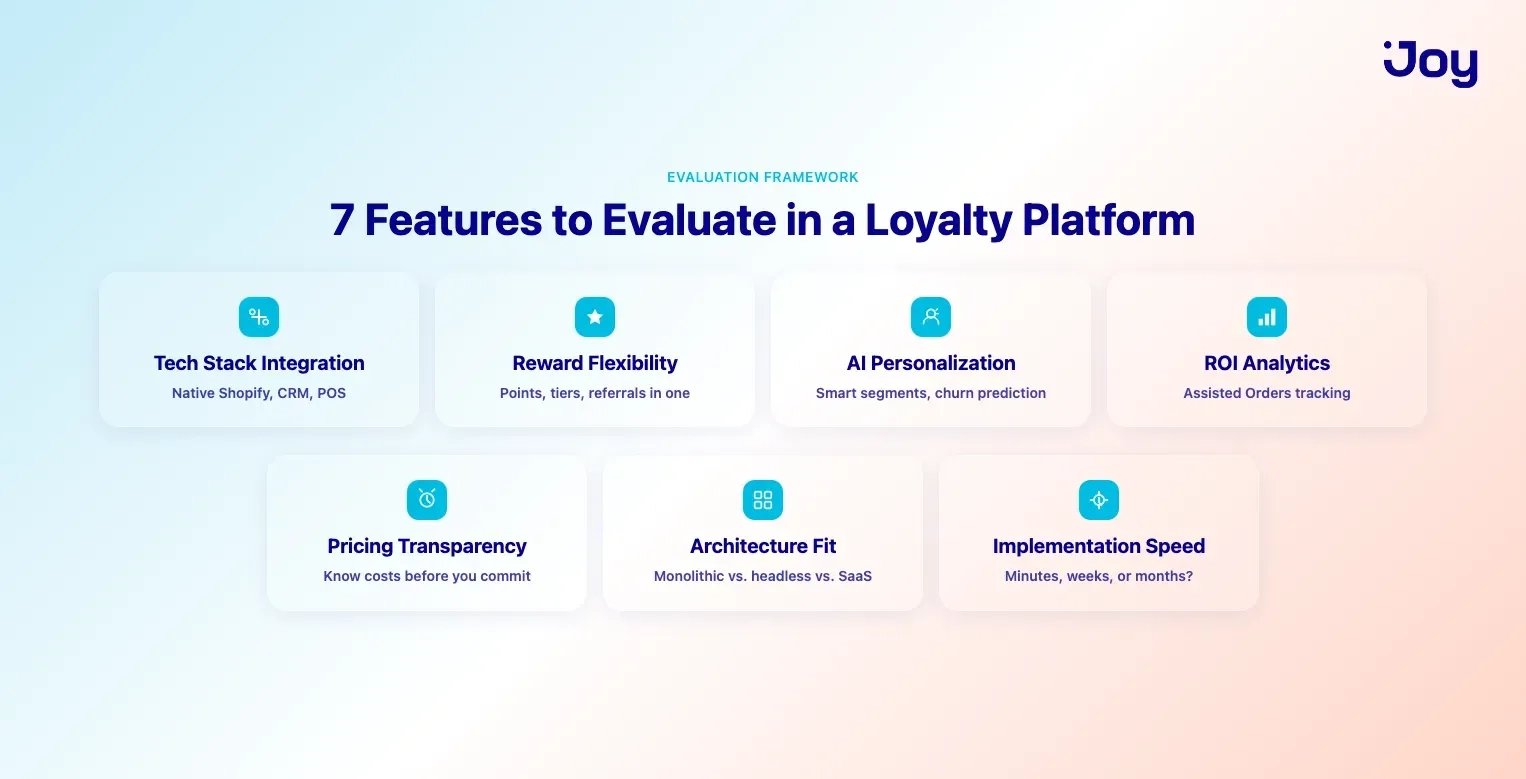
With the market mapped, the next step is knowing what to evaluate. These seven criteria separate platforms that deliver from those that drain the budget. Each one is ordered by importance for ecommerce brands, not enterprises.
1. Integration With Your Ecommerce Tech Stack
This is the single most important criterion. Does the platform plug into Shopify (or your platform), your email/SMS tool, your CRM, your POS?
If your loyalty platform doesn't natively connect to your ecommerce stack, you'll spend more on integration than on the platform itself. Look for native Shopify integration, pre-built connectors for Klaviyo, Mailchimp, or Omnisend, and POS sync. What you want: data flows automatically, giving you a unified customer view that makes your rewards smarter over time.
Red flag: "custom API integration required" usually means months of dev work plus ongoing maintenance.
2. Reward Flexibility: Points, Tiers, Referrals, and Beyond
Can the platform run points, tiers, referrals, VIP, and gamification simultaneously -- or are these separate add-ons you pay for individually?
A platform that locks you into one reward type today will cost you a migration tomorrow. Your program will evolve. What starts as a simple points system often grows into tiers, then referrals, then gamification. You need a platform that grows with you without charging per module or forcing a rebuild.
Red flag: platforms that limit reward types by pricing tier or charge separately for each mechanic.
3. AI-Powered Personalization and Segmentation
AI is now table stakes. The Forrester Wave Q4 2025 confirmed it: "AI-driven capabilities anchored by human oversight" are mandatory across leading platforms.
What does that look like in practice? Automated segmentation that groups customers by behavior, churn prediction that flags at-risk members before they leave, and personalized reward recommendations that match individual preferences. Enterprise platforms have deep machine learning models. Shopify-native platforms increasingly offer smart segmentation and automated campaigns that cover 80% of what most brands need.
And here's something worth paying attention to: zero-party data collection -- quizzes, preference centers, review prompts -- feeds AI personalization. Platforms that capture and activate this data natively have a real edge.
4. Analytics, ROI Tracking, and Reporting
Can you measure what your loyalty program actually generates? Look for dashboards for CLV tracking, repeat purchase rate, referral attribution, and redemption rate.
The metric that matters most: Assisted Orders -- orders placed through loyalty-generated discount codes or referral links. This directly connects your loyalty program to revenue, not just engagement.
Red flag: platforms that show vanity metrics like enrolled members but can't show revenue impact.
5. Scalability and Pricing Transparency
Honest pricing ranges by category:
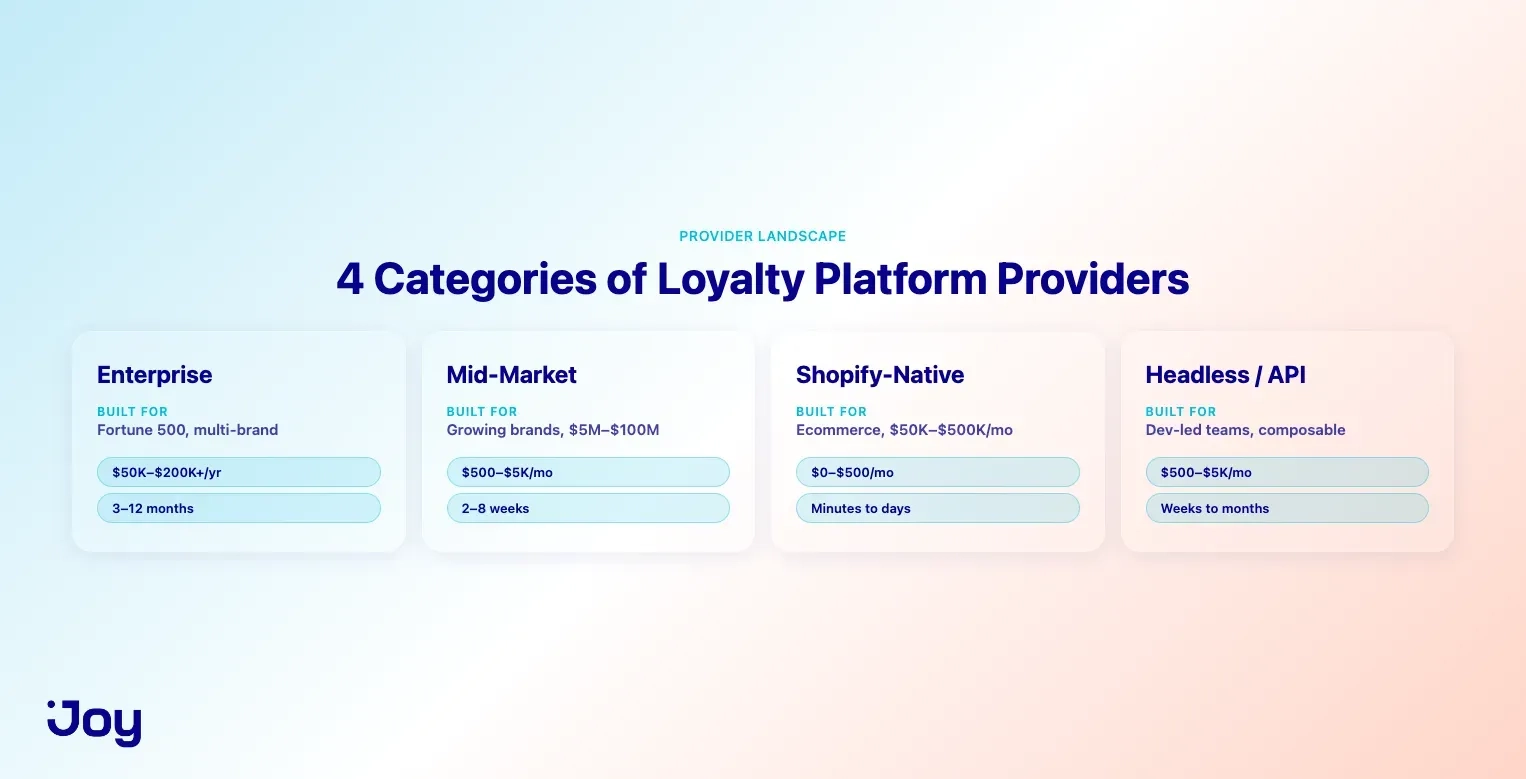
- Enterprise: $50K--$200K+/year (often hidden behind "contact sales")
- Mid-market: $500--$5,000/month
- Shopify-native: $0--$500/month (many offer generous free tiers)
- Headless/API-first: $500--$5,000/month (typically usage-based)
The most expensive platform isn't the most powerful – it's the one built for a different business than yours. Evaluate whether pricing is per order, per member, or flat rate, and always calculate the total cost of ownership, including integration, training, and reward fulfillment.
Red flag: vendors who won't publish pricing. That usually means enterprise-only or heavy upselling.
6. Architecture: Monolithic vs. Headless vs. SaaS-Native
Three architecture types, each serving different buyers:
- Monolithic: All-in-one enterprise suite. Powerful but rigid, expensive, and slow to implement. Built for Fortune 500 companies with dedicated IT teams.
- Headless/API-first (MACH): Modular, developer-driven, composable. Built for tech-forward brands with engineering resources who want maximum flexibility.
- SaaS-native: Purpose-built for specific platforms like Shopify. Fastest to launch, lowest total cost of ownership. Built for ecommerce brands that want power without complexity.
This distinction matters when reading analyst reports, too. Gartner Peer Insights and the Forrester Wave primarily evaluate enterprise and monolithic vendors – a point we'll come back to in Section 4.
7. Support, Onboarding, and Implementation Timeline
Realistic timelines vary dramatically by category:
- Enterprise: 3--12 months (dedicated implementation team required)
- Mid-market: 2--8 weeks
- Shopify-native: Minutes to days (install app, configure, launch)
Beyond speed, evaluate the quality of support. Is there a dedicated customer success manager? Good documentation? Responsive support channels? A platform that gets you live faster also starts generating ROI faster. That's not a small difference.
Red flag: "implementation partner required" is code for hidden cost and timeline bloat.
Loyalty Platform Providers by Category: Enterprise, Mid-Market, Shopify-Native, and Headless
Now you know what to evaluate. Next question: which providers score highest on these criteria? That depends entirely on your category. Each of the four provider tiers below includes named providers, strengths, weaknesses, pricing context, and who they're actually built for. Find your category first -- then compare within it.
Enterprise Loyalty Platform Providers: Built for Fortune 500 Scale
Who these are for: Large retailers, airlines, hotel chains, and multi-brand conglomerates with $1B+ revenue and dedicated loyalty teams.
Named providers:
- Epsilon – Forrester Wave Q4 2025 Leader. Data-driven personalization at massive scale, owned by Publicis.
- Kobie – Forrester Wave Q4 2025 Leader and Customer Favorite, with the highest scores in 21 of 27 criteria. Combines strategic consulting with platform delivery.
- Capillary Technologies -- Highest Forrester scores in current offering and strategy categories. Strong proprietary AI (including Gen AI). Particularly popular in Asia-Pacific markets.
- Oracle CrowdTwist -- Part of Oracle's CX suite. Deep CRM/ERP integration with heavy customization options.
- Comarch -- Forrester Strong Performer. European heritage with particular strength in telco and retail verticals.
- SessionM (Mastercard) -- 360-degree customer view built on transaction-level data. Enterprise pricing (industry estimates suggest ~$20K/month for one million profiles).
For context, Gartner Peer Insights rates these vendors through verified user reviews. The Forrester Wave Q4 2025 evaluated 11 providers across 27 criteria -- Kobie and Epsilon emerged as Leaders.
Strengths: Massive scale, deep customization, multi-brand and multi-region support. The average US consumer belongs to roughly 16.7 loyalty programs (Fortune Business Insights) -- enterprise platforms manage programs with millions of members across all of them.
Weaknesses for ecommerce brands: 3--12-month implementation, $50K--$200K+/year cost, requires dedicated IT teams. For most Shopify stores, this is paying for a capability you'll never touch.
Mid-Market Loyalty Platform Providers: Flexibility Without Enterprise Overhead
Who these are for: Growing brands ($5M--$100M revenue) that have outgrown basic tools but don't need Fortune 500 infrastructure.
Named providers:
- Antavo -- AI Loyalty Cloud with strong gamification and experiential rewards. Recognized in Gartner Peer Insights.
- Annex Cloud -- Multi-product suite covering loyalty, referrals, and UGC. Scales well for mid-market needs.
- Zinrelo -- Data-driven approach with strong analytics. Good for brands wanting deep customer insights without enterprise complexity.
- Talon.One -- Rule-based promotions engine with API-driven architecture. Straddles mid-market and headless categories.
Pricing: $500--$5,000/month depending on features and member count.
Implementation: Two to eight weeks, typically.
Strengths: More flexible than enterprise, lower total cost, better support ratios. These platforms hit the sweet spot for brands that need more than app-level tools but can't justify -- or don't need -- enterprise infrastructure.
Weaknesses: Some lack native Shopify depth. Others require dev resources for full setup.
Shopify-Native Loyalty Platform Providers: Built for Ecommerce Speed
Who these are for: Shopify brands ($50K--$500K/month revenue) who want powerful loyalty mechanics without leaving the Shopify ecosystem.
Named providers:
- Joy Loyalty – The most flexible Shopify-native platform — bringing points, tiers, referrals, VIP, and gamification together in one system, and tying it all back to Assisted Orders so you can see loyalty-driven revenue clearly.
- Smile.io -- Popular and established. Clean UI with strength in points and referrals. Customization is more limited on lower tiers.
- LoyaltyLion -- Good analytics and segmentation. Integrates with Shopify and BigCommerce. Mid-to-high pricing.
- Yotpo Loyalty -- Part of Yotpo's review/SMS/loyalty suite. Benefits from ecosystem integration, though pricing can escalate with the full suite.
- Rivo -- Shopify-specific with a growing feature set and strong community engagement.
- BON Loyalty -- Budget-friendly with solid points and referrals. Good for brands just getting started.
So what makes Shopify-native different from the other categories? Install from the Shopify App Store, configure, and launch – minutes, not months. Native Shopify checkout integration means no custom dev. Customer data flows automatically from Shopify. And pricing is built for ecommerce scale: $0--$500/month.
Headless and API-First Loyalty Platform Providers: For Developer-Led Teams
Who these are for: Tech-forward brands with in-house engineering teams who want to build custom loyalty experiences on top of modular APIs.
Named providers:
- Open Loyalty -- Headless loyalty platform with flexible building blocks via APIs/SDKs. Featured in Gartner Market Guide.
- Voucherify -- First MACH-certified loyalty engine. Combines promotions and loyalty in one developer-focused platform.
- White Label Loyalty -- Event-based architecture with strong multi-channel support and customizable UX.
- Talon.One -- Also appears in mid-market. Rule-based engine with particular strength for brands running complex promotion logic.
MACH architecture, briefly: Microservices, API-first, Cloud-native, Headless. Each component is independently deployable and replaceable -- maximum flexibility for teams that can build with it.
Pricing: $500--$5,000/month, typically usage-based.
Implementation: Varies widely depending on the engineering team's capability.
Strengths: Maximum customization, composable, future-proof architecture.
Weaknesses: Requires engineering resources. Not plug-and-play. And the hidden cost – developer time – is one of the most underestimated costs for ecommerce brands.
How Gartner, Forrester, and Industry Analysts Evaluate Loyalty Platform Providers
If you've searched for "loyalty platform providers Gartner," you've probably landed on analyst reports that evaluate enterprise vendors. These reports are valuable -- but they weren't written for you if you're running a Shopify store. Here's how to use them wisely.
Loyalty Platform Providers Gartner Peer Insights: What It Measures and What It Misses
Gartner Peer Insights aggregates verified user reviews from enterprise IT buyers. It's strong for understanding real-world satisfaction at scale. The Gartner Market Guide for Loyalty Program Vendors identifies representative vendors and defines mandatory capabilities.
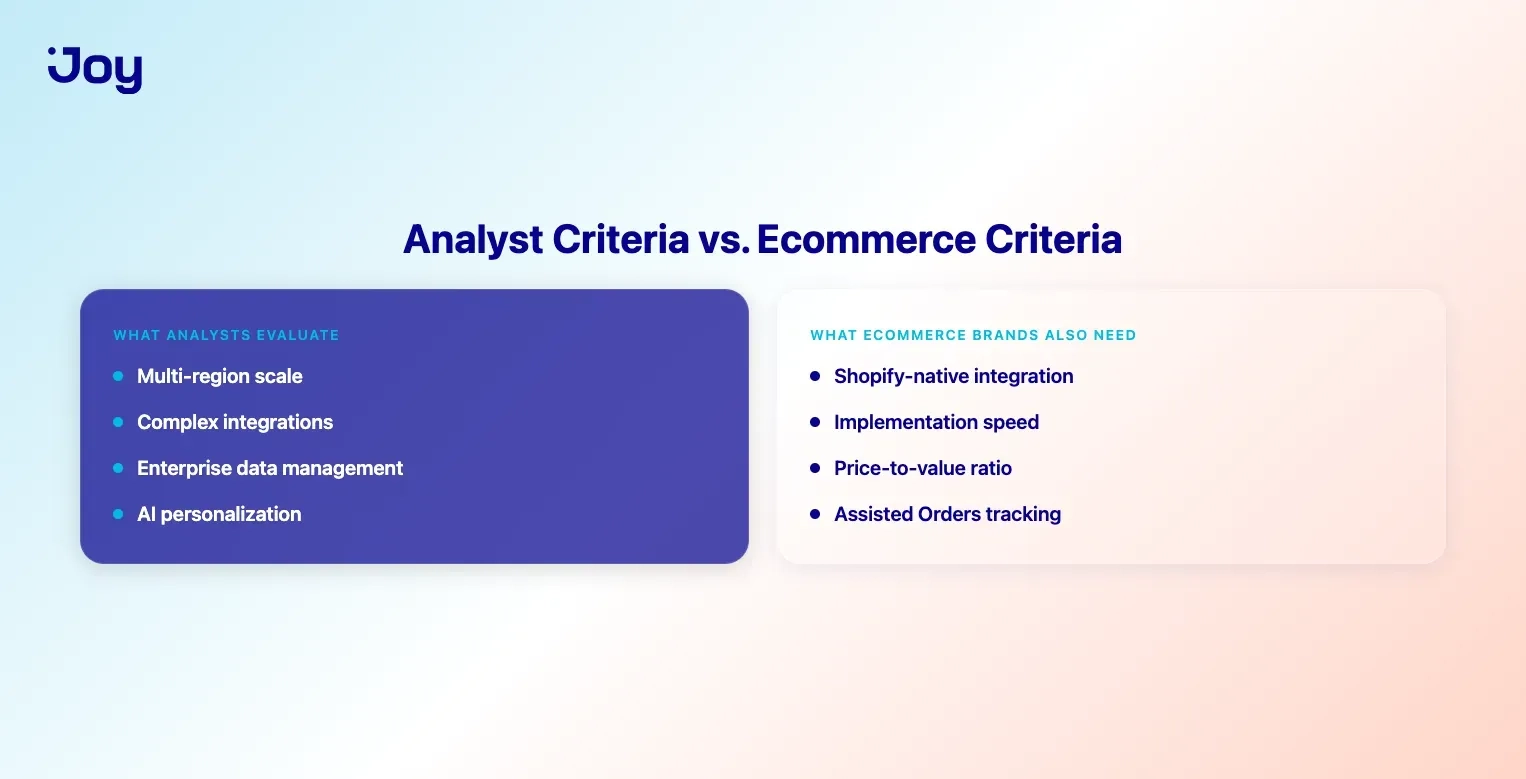
But there's a limitation worth understanding. Gartner evaluates enterprise features: multi-region deployments, complex integrations, and large-scale data management. Shopify-native platforms aren't typically included – not because they're weak, but because they serve a fundamentally different market.
How to use it: reference Gartner for understanding what enterprise-grade features look like, then ask yourself honestly -- do you actually need this?
Being absent from Gartner doesn't mean a platform is inferior. It means it was built for a different buyer.
The Forrester Wave: How 11 Vendors Scored Across 27 Criteria
The Forrester Wave Q4 2025 is the most rigorous independent assessment available, evaluating 11 loyalty platform vendors across 27 criteria.
Five core use cases emerged: program development and management, promotions and offer management, customer experience optimization, business intelligence, and loyal customer intelligence. Leaders included Kobie (Customer Favorite, highest scores in 21 of 27 criteria) and Epsilon. Strong Performers included Comarch and Capillary, with Capillary scoring highest in both current offering and strategy categories.
The key trend across all evaluated vendors: AI-driven capabilities are now mandatory, "anchored by human oversight and clear guardrails."
For ecommerce brands, these evaluations confirm what enterprise loyalty looks like. Use them to understand the ceiling, not to set your floor.
What These Evaluations Mean for Your Decision
Analyst reports are genuinely useful for understanding the market and identifying mandatory features. But they don't evaluate Shopify-native integration, ecommerce-specific ROI, implementation speed for small and medium businesses, or price-to-value for sub-enterprise budgets.
So here's the practical approach: combine analyst insights (what features matter) with category fit (which tier matches your business) and hands-on testing (free trial or demo).
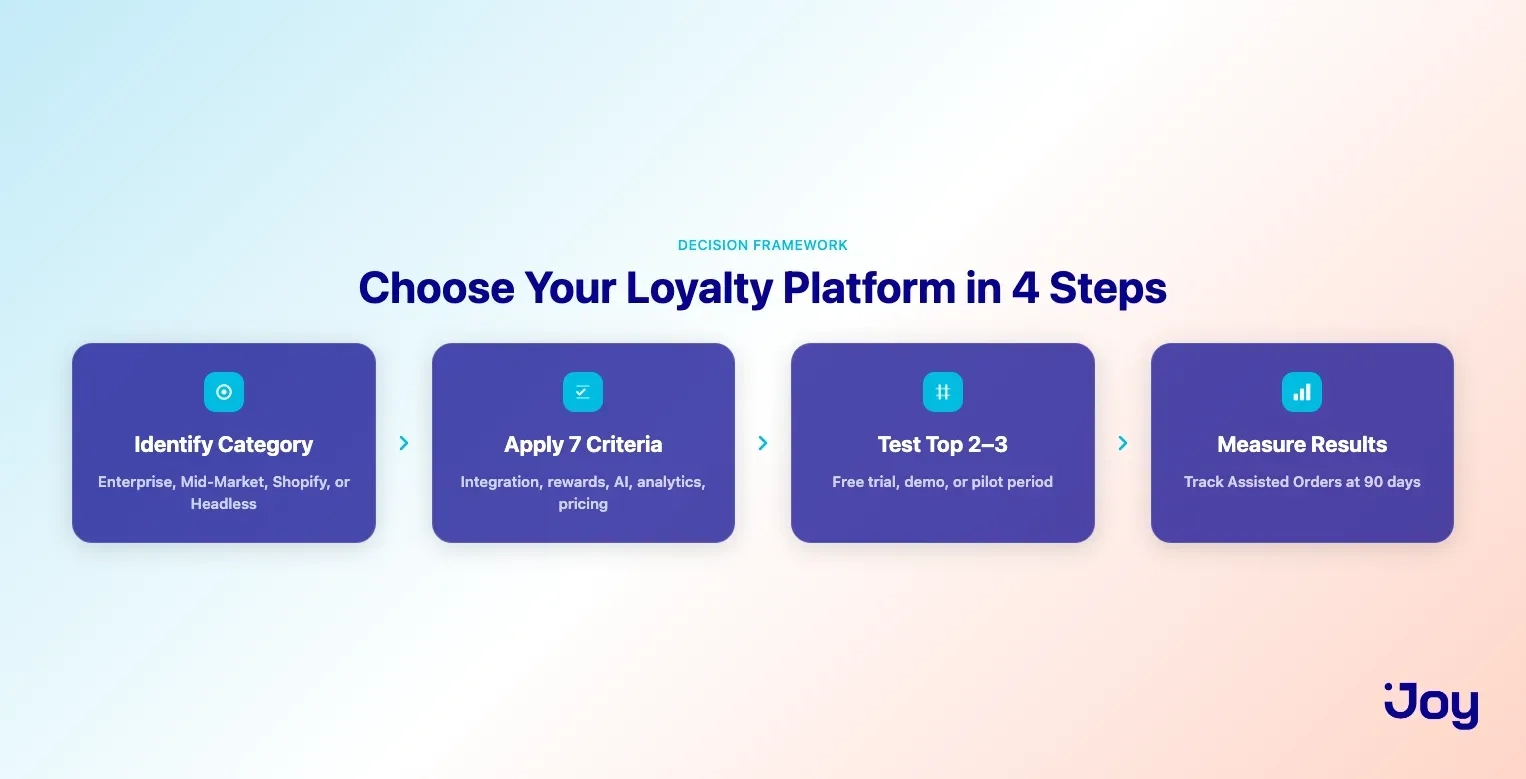
Use the seven criteria from Section 2. Filter by your category from Section 3. Then test your top two or three options.
Shopify-native platforms increasingly deliver the same core capabilities analysts flag as mandatory -- smart segmentation, multi-channel rewards, analytics -- at a fraction of the enterprise cost and timeline. The gap is narrowing fast.
How to Choose the Right Loyalty Platform Provider for Your Brand
Analyst reports tell you what features matter. Your business context tells you which providers to actually test. Here's how to combine both into a decision framework that moves you from research to action.
Match Your Business to the Right Provider Category
Start by eliminating categories that aren't built for you. A quick decision tree:
- Revenue > $100M + dedicated loyalty team + multi-brand operations → Enterprise
- Revenue $5M--$100M + some dev resources + outgrowing basic tools → Mid-Market
- Shopify store + $50K--$500K/month + want powerful loyalty without dev overhead → Shopify-Native
- Custom tech stack + in-house engineering + composable architecture priority → Headless/API-First
This single step eliminates roughly 75% of options immediately. The most common mistake? Shopify brands are evaluating enterprise platforms because they "want the best." But the best is the one built for your business. Not the most expensive one on the Forrester Wave.
Migration and Switching: It's Easier Than You Think
If you're stuck on a legacy or basic platform, switching is a real concern -- but simpler than most vendors want you to believe.
For Shopify-native platforms, migration looks like this: install the new app, import customer data, configure rewards, and launch. Most platforms can even run in parallel with your old one during the transition. For enterprise migration, plan three to six months and involve IT and CRM teams.
Don't let switching cost lock you into a platform that no longer fits. The longer you wait, the higher that cost grows. Act when you recognize the misfit, not six months later.
Measure What Matters: Assisted Orders, Not Just Enrolled Members
Once you've chosen and launched, one metric proves platform value above all others: Assisted Orders -- orders placed through loyalty-generated discount codes or referral links.
Secondary metrics worth tracking: repeat purchase rate, CLV by loyalty tier, redemption rate, and referral conversion rate. Set a 90-day benchmark and compare your loyalty-attributed revenue before and after switching.
Don't measure success by how many members enrolled. Measure it by how much revenue the platform directly generates. That's the number that justifies your investment and earns budget renewals.
A 5% increase in retention drives a 25--95% boost in profit (Bain & Company). The right platform makes that lift real and measurable.
Joy tracks Assisted Orders natively -- every order attributed to a loyalty discount code or referral link is measured automatically, giving merchants a clear ROI number from day one.
Not ready to decide yet? Compare the top Shopify loyalty apps with a detailed breakdown of features, pricing, and integration depth.
Choosing a Loyalty Platform Provider That Actually Fits
The loyalty platform market has fragmented into four distinct categories -- enterprise, mid-market, Shopify-native, and headless. The right choice depends on your business scale, tech stack, and growth trajectory. Not on which vendor has the biggest marketing budget.
For Shopify brands, the Shopify-native category offers the fastest path to measurable loyalty ROI. You get the same core mechanics -- points, tiers, referrals, gamification -- without the enterprise timeline or budget.
Joy Loyalty delivers all five reward types on a single Shopify-native platform, with Assisted Orders tracking built in from day one. No module upselling. No six-month implementation. Start free and measure results in 90 days.
The best loyalty platform provider isn't the most powerful one on paper. It's the one your customers actually engage with -- and that starts with choosing one you can launch and iterate on, not one that takes six months to implement.
Frequently Asked Questions
What is a loyalty platform provider?
Software that manages customer rewards programs -- points, tiers, referrals, VIP, and gamification -- integrated with your ecommerce platform, CRM, and marketing tools. Unlike managed services that run your program for you, a platform gives you full ownership and control over your loyalty strategy and customer data.
How much do loyalty platforms cost?
It depends on the category. Enterprise platforms run $50K--$200K+/year. Mid-market ranges from $500 to $5,000/month. Shopify-native typically costs $0--$500/month, with many offering free tiers. Headless/API-first runs $500--$5,000/month based on usage. The key is matching your spend to your actual business tier – not overpaying for features built for a different scale.
What's the difference between enterprise and Shopify-native loyalty platforms?
Enterprise platforms like Epsilon, Comarch, and Oracle are built for Fortune 500 brands with dedicated IT teams and three to twelve-month implementations. Shopify-native platforms like Joy, Smile.io, and LoyaltyLion install from the Shopify App Store and launch in minutes. Both offer the same core mechanics – points, tiers, referrals – but at dramatically different cost and timeline scales.
How long does it take to implement a loyalty platform?
Enterprise: three to twelve months. Mid-market: two to eight weeks. Shopify-native: minutes to days. If a vendor says "implementation partner required," factor in hidden cost and timeline -- that phrase almost always signals enterprise-level complexity.
Do I need a loyalty platform if I'm on Shopify?
Yes, if you want to drive repeat purchases and increase customer lifetime value. Shopify has basic discount and gift card features, but no native loyalty program. A dedicated loyalty platform adds points, tiers, referrals, gamification, and the analytics you need to prove ROI. The real question isn't whether to have a loyalty program -- it's which platform matches your growth stage.
How do I measure if my loyalty platform is working?
Track loyalty-attributed revenue -- orders placed through loyalty-generated discount codes or referral links. This directly measures what your program generates, not just engagement. Secondary metrics: repeat purchase rate, CLV by tier, and redemption rate. Set a 90-day benchmark to evaluate ROI. If your platform can't show you exactly how many orders it generated, it's time to switch.

Written by
Thomas Nguyen is the CEO & Co-founder of Joy, a loyalty solution for Shopify and eCommerce brands. With years of experience building high-performance Shopify apps, Thomas aims to help merchants grow through customizable and retention-focused tools.
Related reading
 Loyalty Strategy
Omnichannel Loyalty Programs: Best Programs by Industry (2026)
Your loyalty program might work on your website. But does it work in-store? On mobile? Across every channel your customers use?
 Thomas Nguyen
 Loyalty Strategy
Pub Loyalty Scheme: How to Build One That Drives Repeat Visits
A pub loyalty scheme turns walk-in traffic into repeat revenue. Here's how to pick the right model—stamps, points, or tiers—stay compliant with UK alcohol and GDPR rules, and launch in 4 weeks.
Thomas Nguyen Loyalty Strategy
The Loyalty Program Business Model: How to Structure Your Store Around Keeping Customers
Most stores bolt on a rewards program and hope for the best. A loyalty program business model builds growth around keeping customers. Here's how to do it.
Thomas Nguyen Loyalty Strategy
Building Customer Loyalty: The Framework That Actually Works
Stable revenue can mask something uncomfortable: customers returning out of habit, not preference. When they find a better option, they leave without warning — and you pay full CAC to replace them. Here's how to build the loyalty they actually feel, not the one you assume.
Thomas Nguyen Loyalty Strategy
Channel Loyalty Platform: The Complete Guide to Building Partner Programs That Drive Revenue
Most B2B brands lose channel partners not to better products — but to better incentives. A channel loyalty platform is the system that makes your brand the easy choice for distributors, dealers, and resellers. Inside: 5 incentive models, implementation, and ROI.
Thomas Nguyen Loyalty Strategy
Value-Based Loyalty Programs: 9 Strategies That Turn Shoppers Into Brand Advocates
Here are nine strategies to build one that drives real retention.
Thomas Nguyen