
Customer Engagement and Loyalty: Strategies and How to Measure Them
Customer engagement and loyalty aren’t the same thing. Here’s how they differ, seven strategies that build both, and the metrics that tell you it’s working.
-f9ebcc.webp&w=3840&q=95)
Summarize this post with AI
Plenty of brands launch a points program, watch a few people sign up, and then wonder why nobody comes back. The program is live. The rewards are set. And still, most members earn points once and disappear.
The gap usually isn't the rewards. It's engagement. A loyalty program gives customers a reason to come back, but engagement is the steady stream of interactions that actually brings them back. One is the result you want. The other is the work that gets you there. Treating them as the same thing is why so many programs stall.
This guide is for ecommerce and DTC brands trying to turn one-time buyers into repeat customers. We'll cover how customer engagement and loyalty differ, why the distinction matters for what you build, seven strategies that strengthen both, and the specific metrics that tell you whether any of it is working.
Customer Engagement vs Customer Loyalty: What's the Difference?
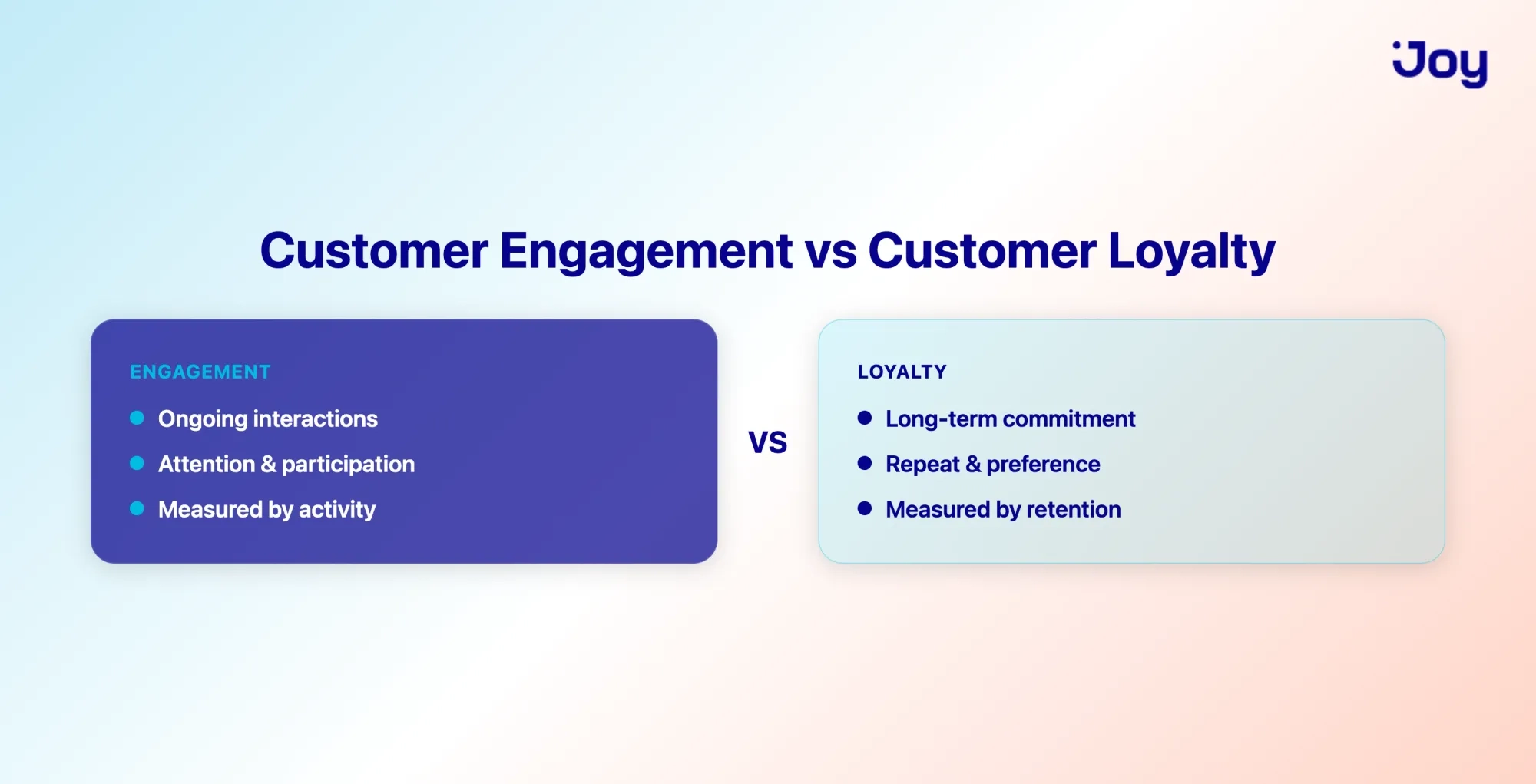
Customer engagement is the sum of interactions a customer has with your brand over time, across every channel: opening an email, browsing the app, redeeming a reward, replying to a review request, tagging you on social. It's about attention and participation.
Customer loyalty is the long-term commitment that comes after those interactions add up. A loyal customer chooses you again when a cheaper option exists, refers a friend without being asked, and forgives the occasional slip. It's about preference and repeat behavior.
The simplest way to hold the two apart:
| Engagement | Loyalty | |
|---|---|---|
| What it is | Ongoing interactions with your brand | Long-term commitment to buy again |
| Time frame | Happens continuously | Builds over months |
| You measure it by | Participation, opens, redemptions | Repeat purchase rate, retention, CLV |
| Example | A customer joins your program and checks their points | That customer buys from you four times a year |
| What it answers | "Are they paying attention?" | "Will they stay?" |
How Engagement Drives Loyalty
Engagement comes first. Loyalty is the effect, not the cause.
Think of it as a chain. A relevant email gets opened. The offer inside gets used. The reward feels worth it, so the next email gets opened too. Each small interaction lowers the friction of the next one, and after enough of them, choosing your brand stops being a decision and becomes a habit. That habit is loyalty.
Which is why you can't shortcut to loyalty with a generous reward alone. If customers never engage, they never build the habit, and the program just hands out discounts to people who would've bought anyway. Engagement is what compounds the reward.
Why Customer Engagement and Loyalty Matter
If engagement is what makes loyalty compound, the next question is whether it's worth the effort. The economists say yes. Keeping a customer is where the margin is, and brands are shifting budget to match. In Antavo's Global Customer Loyalty Report, 67% of companies said they planned to increase investment in retention, while only 31.2% planned to increase investment in acquisition. The thinking is straightforward: an engaged, loyal customer costs nothing to reach again and tends to spend more each time.
Run well, a program pays for itself several times over. Antavo's Global Customer Loyalty Report 2025 found that 83% of loyalty program owners measuring ROI reported a positive return, with the average program generating 5.2 times more revenue than it cost to run.
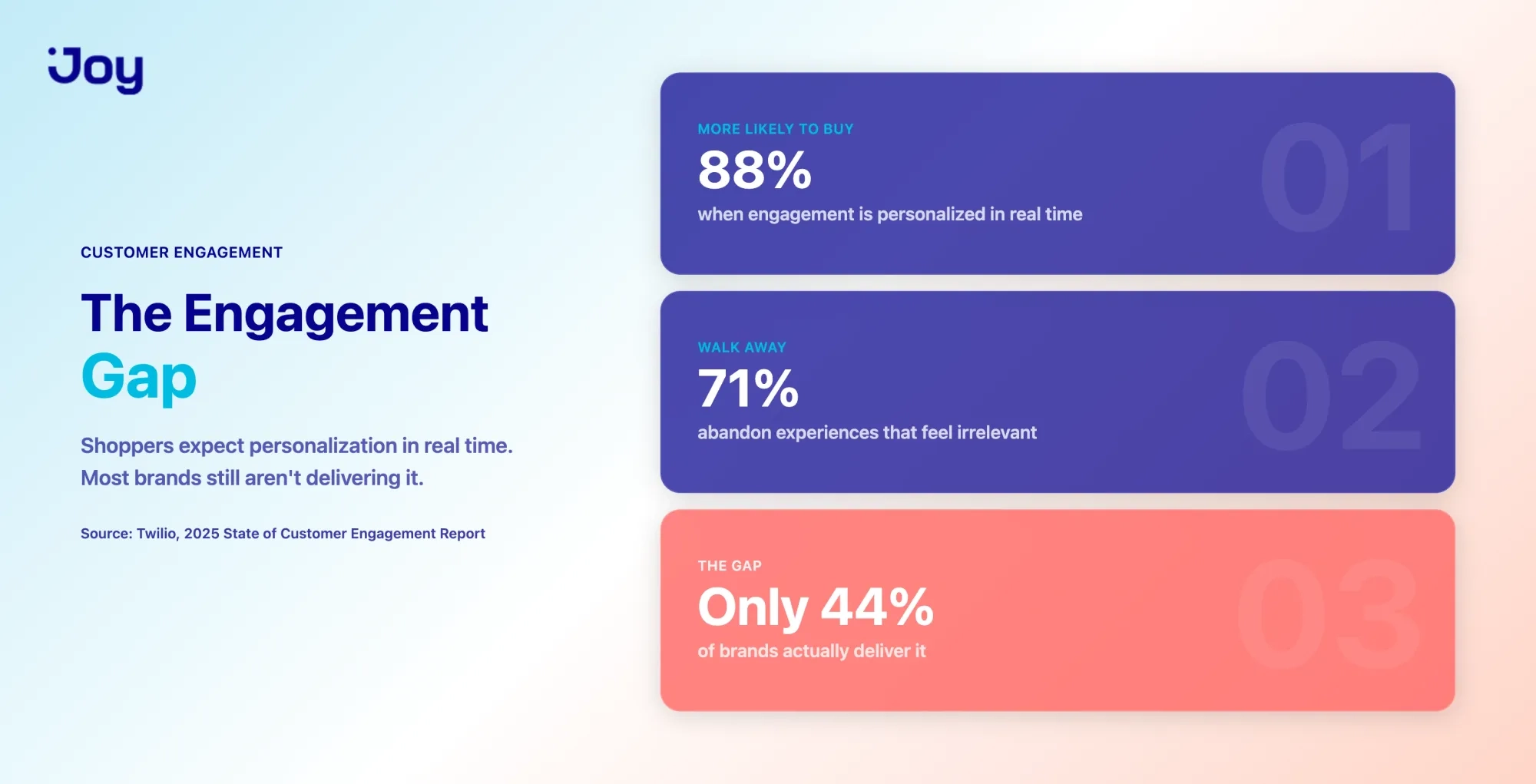
Engagement is also what customers now expect before they'll commit. According to Twilio's 2025 State of Customer Engagement Report, surveying more than 7,600 consumers across 18 countries, 88% of consumers said they're more likely to buy when a brand personalizes engagement in real time, yet only 44% of brands believe they're delivering at that level. The same report found 71% of consumers abandon experiences that feel irrelevant.
That's the real opportunity. Most brands know engagement matters. Far fewer are actually closing the gap between what customers expect and what they get, and that gap is where loyalty is won or lost.
7 Strategies to Build Customer Engagement and Loyalty
None of these works alone. Loyalty comes from stacking small, consistent interactions - so read these as a system, not a checklist.
1. Personalize Based on Real Behavior
Generic blasts are what customers tune out. Personalization works when it's tied to what someone actually did: products viewed, past orders, points balance, tier status.
In Twilio's 2025 report, 56% of brands said they use AI to tailor experiences, and 75% of those reported higher customer spend as a result. You don't need AI to start, though. Segmenting customers by purchase history and sending each group a relevant offer is personalization, too. On Shopify, customer tags and metafields give you enough to segment on from day one.
Try this: start with three segments - first-time buyers, repeat buyers, and lapsed customers with no orders in 90 days. Tag each one in Shopify, then send a different message to each: a welcome offer for the first group, an early-access perk for the second, a "we saved your spot" nudge for the third. Three segments you act on beat twenty you never use.
2. Meet Customers Where They Already Are
Engagement falls apart when channels don't talk to each other. A customer who earns points in your store shouldn't have to dig through email to find their balance.
Antavo's 2025 report found that 59% of consumers prefer to interact with loyalty programs through a mobile app, but the broader point is consistency: email, your storefront, customer accounts, and SMS should all reflect the same up-to-date status. The goal isn't to be on every channel. It's to make the experience continuous across the devices your customers use.
Try this: pick the two places your customers already look and put their points balance in both - a widget on your storefront and a line in your post-purchase email. Add a "you have X points" reminder to the order confirmation email, since it's an email almost everyone opens. If you sell in person too, connect your POS so points earn at the counter and online, without the customer having to think about it.
3. Reward More Than Just Purchases
Points-per-dollar is the easiest program to explain, and it's a fine place to start. But if buying is the only way to earn, customers only engage when they're already spending.
The fix is to reward the behaviors that build a relationship: writing a review, referring a friend, following on social, creating an account, and celebrating a birthday. These give customers a reason to interact between purchases, which is exactly the window where engagement usually goes quiet. A flexible rule engine lets you set earning rules for each of these without touching code.
4. Use Tiers to Give Customers Something to Work Toward
A flat program treats a first-time buyer and a tenth-time buyer the same, which wastes your best customers. Tiers fix that by giving people a visible next step.
The mechanic is simple: higher tiers unlock as customers spend more, and each tier carries better perks. A customer 50 points from the next level has a concrete reason to come back. Some brands lean into experiential perks at the top, like early access or free shipping, rather than just bigger discounts. It rewards your most engaged customers without eroding margin on everyone else.
5. Turn Loyal Customers Into Referrers
Your most engaged customers are your most credible marketers. A referral program gives them a structured way to bring in people who look a lot like them, and it rewards both parties.
This works because the trust is already there. A recommendation from a friend skips the skepticism a paid ad has to fight through. Tying referral rewards to the same points system keeps everything in one place, so a referral feels like a natural part of the program rather than a separate thing to manage.
6. Communicate With Intention, Not Just Frequency
More emails do not mean more engagement. Relevant, well-timed messages are. A "you're 100 points from a reward" nudge lands because it's useful. A seventh promo email in a week results in an unsubscribe.
Tie communication to where the customer is: a welcome when they join, a reminder when points are about to expire, a heads-up when they're close to a new tier. Each one has a reason to exist. This is also where Shopify Flow earns its keep, letting you trigger messages based on real events, like hitting a spend threshold or earning a reward.
Try this: set up three lifecycle messages before you send a single promo blast.
- One: a welcome that explains how the program works in two lines and gives them a first task to earn points.
- Two: a points-expiry reminder a couple of weeks before the balance lapses.
- Three: a "you're 100 points away" nudge when someone's close to a reward or tier.
Trigger all three in Shopify Flow off real events - account created, points threshold reached - so they land at the right moment instead of on a schedule.
7. Close the Loop on Feedback
Asking for feedback is engagement. Acting on it is what builds loyalty. When a customer suggests something and later sees it happen, they stop being a buyer and start being invested.
You don't need a formal research program. Reward customers with points for completing a short survey or leaving a review, then actually read the responses for patterns. The reward gets you the engagement. The follow-through gets you the loyalty.
Try this: after a customer's second or third order, send a one-question survey - "What almost stopped you from buying?" - because it tells you more than a five-star rating ever will. Reward a few points for answering, so people actually do. Tag the responses by theme as they come in, and when you ship a change someone asked for, tell the customers who raised it. That last step is the one most brands skip, and it's the one that turns a respondent into a regular.
How to Measure Customer Engagement and Loyalty
Most "how to build loyalty" advice skips the part where you check if it's working. That's a mistake, because engagement and loyalty are measured differently, and confusing the two leads to the wrong conclusions.
Split your metrics into two groups. Engagement metrics tell you whether customers are participating right now. Loyalty metrics tell you whether that participation is turning into commitment.
| Engagement metrics | What it tells you |
|---|---|
| Active member rate | Share of members who earned or redeemed recently. A program full of dormant accounts isn't engaging anyone. |
| Redemption rate | How many earned points actually get used. Low redemption usually means rewards feel out of reach or irrelevant. |
| Participation rate | How many customers take non-purchase actions like reviews or referrals. |
| Email and app interaction | Opens, clicks, and logins on program-related messages. |
| Loyalty metrics | What it tells you |
|---|---|
| Repeat purchase rate | Share of customers who buy more than once. The clearest signal loyalty is forming. |
| Customer retention rate | The percentage of customers you keep over a given period. |
| Customer lifetime value (CLV) | Total revenue from a customer across the relationship. Rising CLV among members is the outcome the program exists for. |
| Churn rate | How many customers stop buying. Watch it alongside retention. |
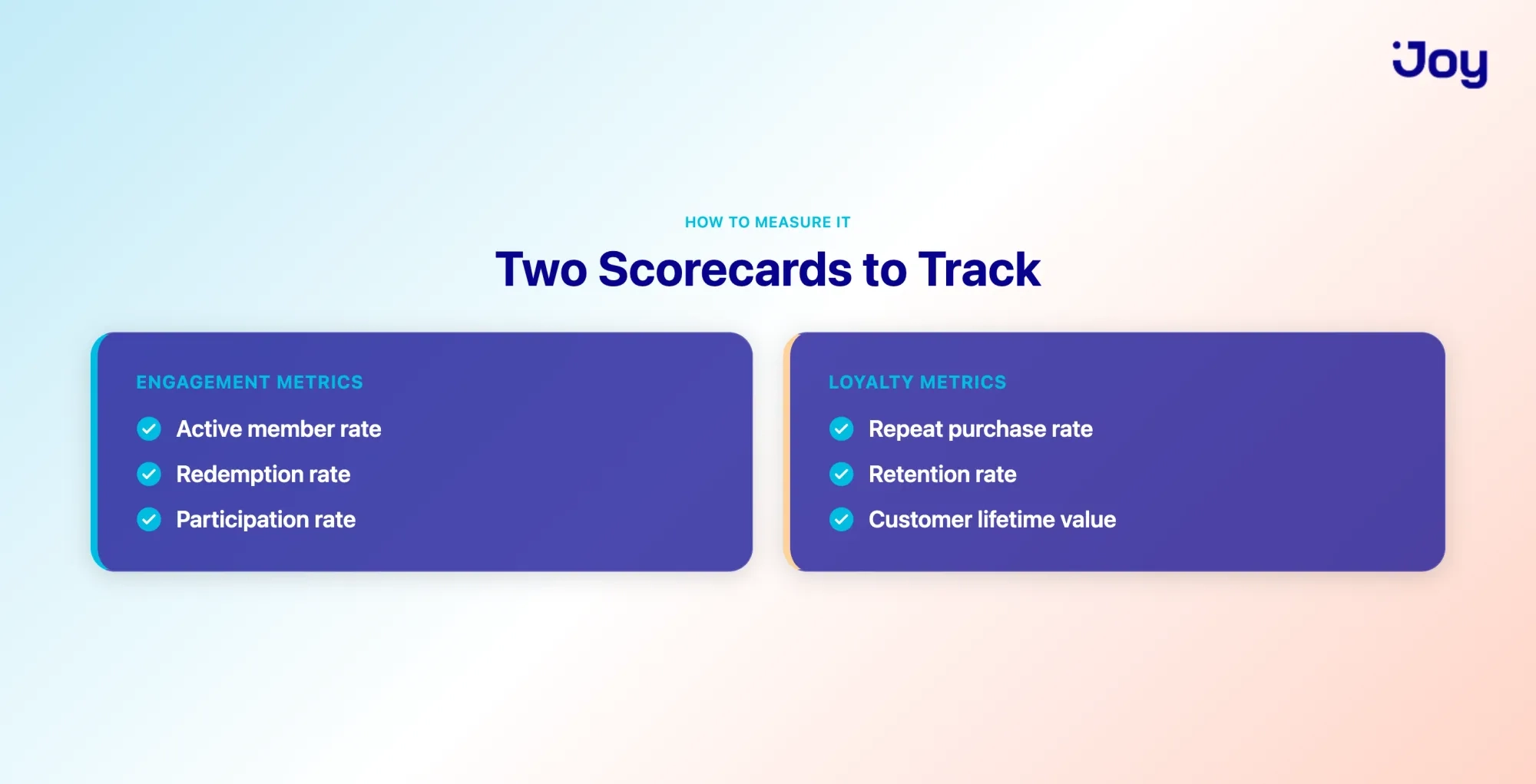
The pattern to watch for: strong engagement metrics but weak loyalty metrics means people are interacting without committing, often a sign that your rewards don't match what customers value. Weak engagement but okay loyalty usually means you're coasting on a few habitual buyers and have little protecting you if a competitor shows up.
One detail worth flagging here: personalization tends to widen the gap between members and the rest of the community. Antavo's 2024 report found that members who redeemed personalized rewards spent 4.3 times more a year on average than those who redeemed non-personalized rewards. If you're segmenting, measure those segments separately, or you'll average away the very effect you're trying to grow.
Building Engagement and Loyalty for Your Ecommerce Store
For a Shopify store, the strategies above come together in one place: the program is where engagement and loyalty meet. Points give customers a reason to come back, tiers give them something to climb, referrals turn them into a channel, and the interactions in between are what keep the whole thing warm.
A loyalty app like Joy keeps these mechanics in one place - earning and redemption rules, tiers, referrals, and the analytics to track the metrics above - all native to Shopify, so it works with your tags, customer accounts, and Flow. The software isn't the point, though. It's that engagement and loyalty are easier to sustain when the moving parts live together instead of scattered across disconnected tools.
To be clear, a loyalty program isn't the right first move for everyone. If you're very early, with a thin catalog or an average order value too low to fund rewards, your energy is better spent on the product and the first purchase. Loyalty pays off once you have customers worth bringing back.
Start simple. A points-per-dollar program with one or two non-purchase-earning rules is enough to start generating engagement you can measure. Add tiers and referrals once you see what your customers respond to. The brands that win here aren't the ones with the most features turned on. They're the ones who keep showing up in relevant, useful ways until coming back becomes a habit.
If you want to see what this looks like in practice, explore how a Shopify-native loyalty program brings points, tiers, and referrals into one place — then start with the one or two strategies above that fit your store today.
Frequently Asked Questions
What is the difference between customer engagement and customer loyalty?
Customer engagement is the ongoing set of interactions a customer has with your brand, like opening emails, redeeming rewards, or leaving reviews. Customer loyalty is the long-term commitment to keep buying from you that builds over time from those interactions. Engagement is the activity; loyalty is the outcome.
What comes first, engagement or loyalty?
Engagement comes first. Loyalty is the effect of consistent, positive engagement over time. Customers interact with your brand; those interactions build trust and habit, and that habit becomes loyalty. You can't manufacture loyalty without engagement first.
How do you measure customer engagement and loyalty?
Measure them with separate metrics. For engagement, track active member rate, redemption rate, and participation in non-purchase actions. For loyalty, track repeat purchase rate, retention rate, customer lifetime value, and churn. Looking at both together shows whether interaction is actually turning into commitment.
Can you have customer loyalty without engagement?
Rarely, and not for long. A customer might keep buying out of habit or convenience for a while, but without ongoing engagement, there's nothing protecting that relationship when a competitor offers something better. Engagement is what keeps loyalty from quietly eroding.
Why is customer engagement important for brand loyalty?
Because loyalty is built from repeated, positive interactions, not from a single purchase or reward. Each relevant, well-timed interaction lowers the friction of the next one until choosing your brand becomes automatic. Without engagement, a loyalty program just hands out discounts to customers who would've bought anyway.

Written by
Thomas Nguyen is the CEO & Co-founder of Joy, a loyalty solution for Shopify and eCommerce brands. With years of experience building high-performance Shopify apps, Thomas aims to help merchants grow through customizable and retention-focused tools.
Related reading
 Loyalty Strategy
Customer Acquisition vs Retention: Where to Put Your Next Dollar
Customer acquisition and retention aren't a contest. Here's what each really costs, when to prioritize which, and a simple LTV:CAC way to decide your split.
 Thomas Nguyen
 Loyalty Strategy
6 Key Factors That Affect Customer Loyalty
Loyalty isn't luck or a good Black Friday sale — it's built on six specific, measurable factors. This guide breaks down each one: why it matters, how to measure it, and how to put it into action, with examples from brands that got it right.
Thomas Nguyen Loyalty Strategy
Customer Retention Cost: Formula & Strategies to Optimize It
Customer retention is often cheaper than acquisition, but are you managing your costs effectively? Learn how to calculate retention costs and optimize your strategy without overspending.
Thomas Nguyen Loyalty Strategy
Customer Retention Goals: 5 Targets to Set (and How to Hit Them)
A goal-first guide to customer retention: the five targets worth setting, how to make each one SMART, and the strategy that hits it.
Thomas Nguyen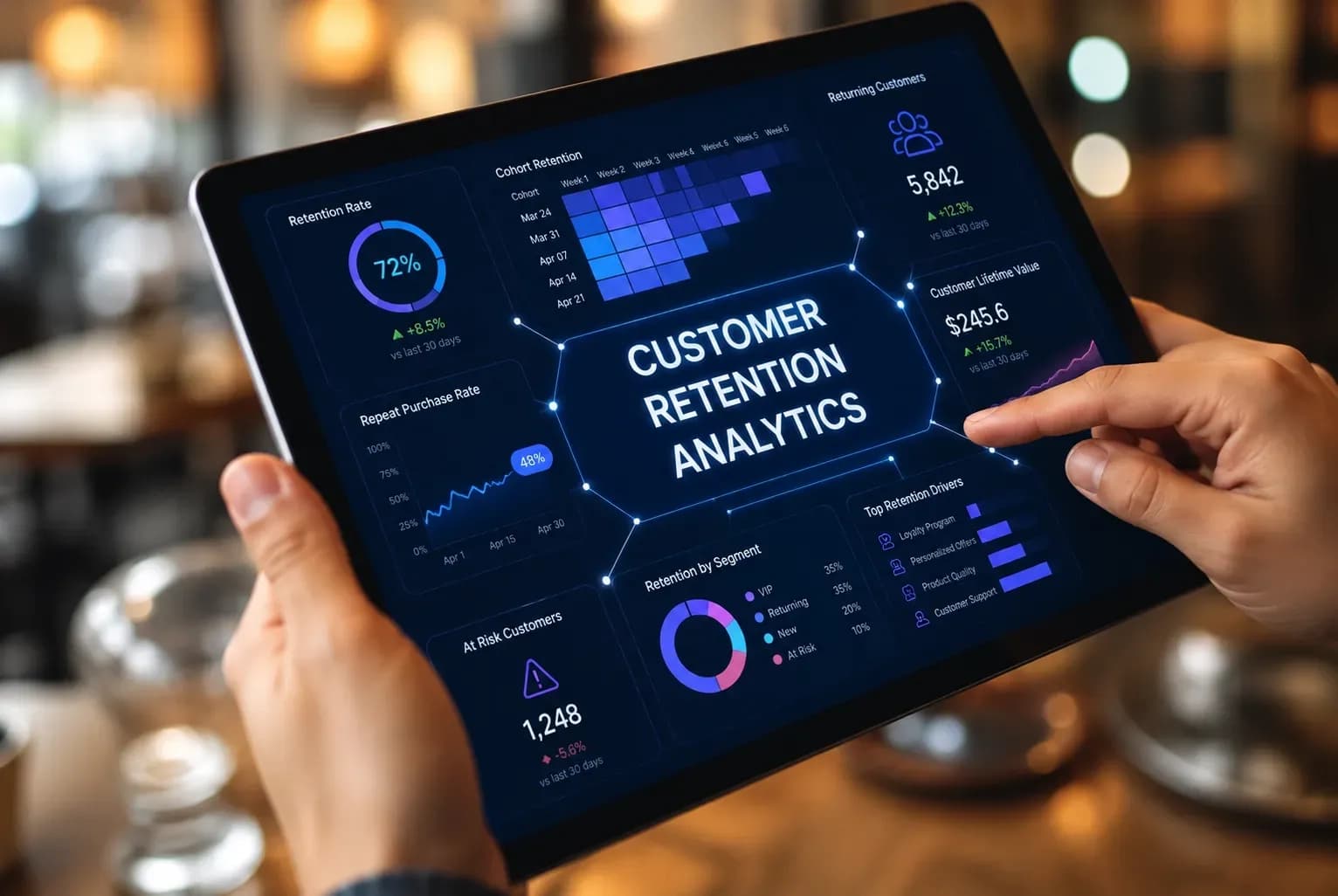 Loyalty Strategy
Customer Retention Analytics: Turn Your Data Into Retention Action
Most retention guides stop at the numbers. This one shows how to read your retention data and turn each metric into a concrete loyalty play for your Shopify store.
Thomas Nguyen Loyalty Strategy
Customer Loyalty Index: The Metric That Predicts Customer Churn
Most brands measure loyalty with a single number and miss most of the picture. The Customer Loyalty Index combines three survey questions into one composite score: an early churn warning, a revenue forecast, and a segmentation tool. Here's the formula, benchmarks, and how to act on it.
Thomas Nguyen