
Customer Retention Goals: 5 Targets to Set (and How to Hit Them)
A goal-first guide to customer retention: the five targets worth setting, how to make each one SMART, and the strategy that hits it.

Summarize this post with AI
Most retention work starts in the wrong place. A store owner reads about win-back emails, loyalty points, or churn alerts, then rushes to set them up. The tactics are fine, but without a target to aim at, you have motion without direction. You cannot tell whether any of it is working.
That is the gap this guide fills. Before you pick a single tactic, you need clear customer retention goals: the specific outcomes you want to achieve and the numbers that prove you achieved them. Below are the five retention goals worth setting for an ecommerce store, how to turn each one into a measurable target, and the lever that gets you there.
Key takeaways
- A customer retention goal is a measurable target for keeping and growing the value of existing customers, not a tactic.
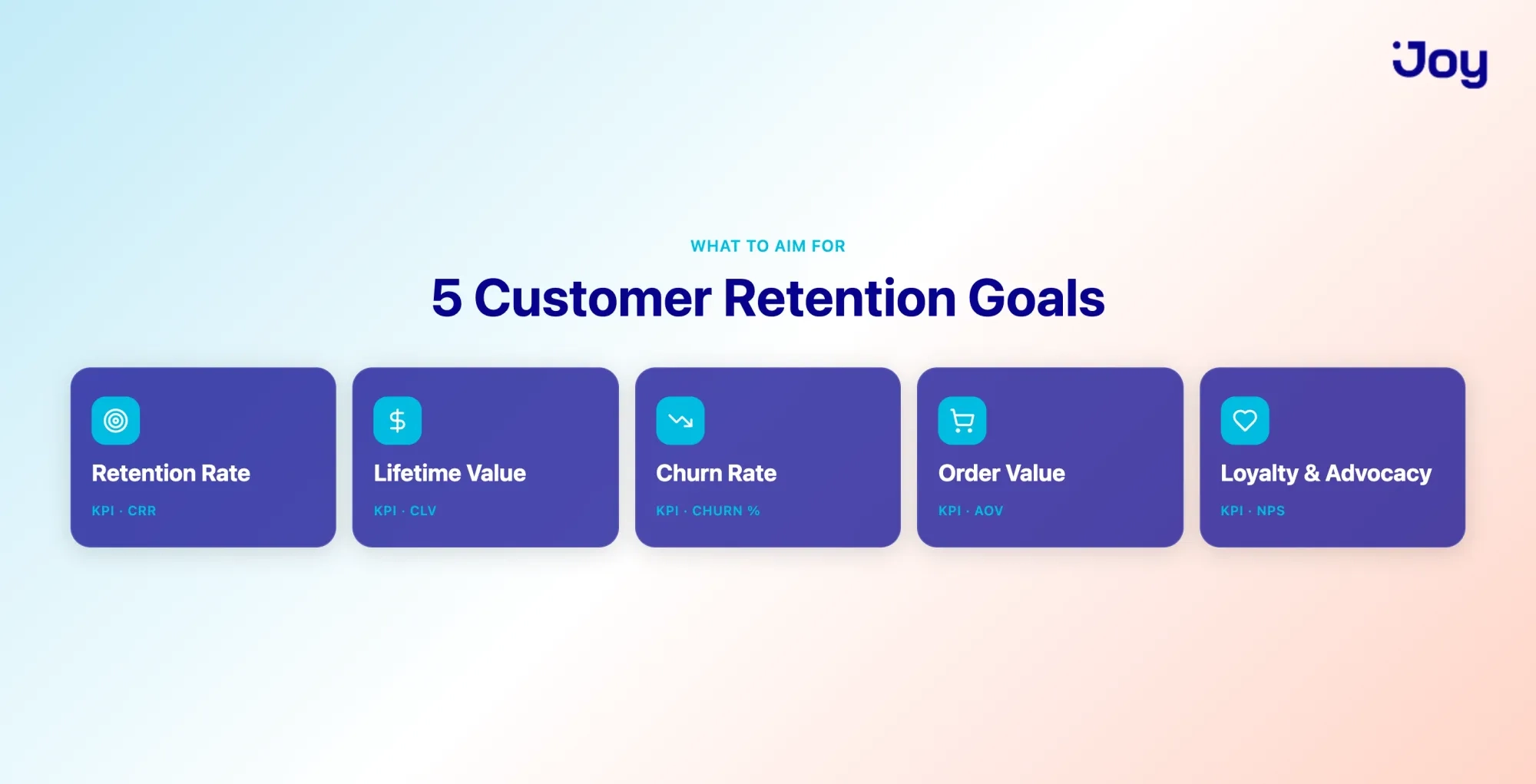
- The five goals worth setting are retention rate, customer lifetime value, churn rate, average order value, and loyalty and advocacy.
- Each goal pairs with one KPI, so you always know whether you are on track.
- A goal only works when you set it as a SMART target against your own baseline, assign an owner, and establish a review cadence.
- A loyalty program is one of the few levers that touch three of these five goals at once, making it a practical starting point.
What customer retention goals are, and why set them before strategies
A customer retention goal is a measurable target for how well you keep existing customers and grow their value over time. It is easy to confuse three things that sit close together, so it helps to separate them early.
The goal is what you aim for, such as a higher repeat purchase rate.
The strategy is how you get there, such as a loyalty program.
The metric, or KPI, is how you measure progress, such as the repeat purchase rate itself.
If you want a refresher on the underlying concept, the definition of customer retention covers it in plain terms.
Setting the goal first matters because it keeps your effort honest. When you start with a target, every tactic has to earn its place by moving that number. When you start with tactics, you tend to collect activity that feels productive but never proves its worth.
The 5 customer retention goals worth setting
These five goals cover the full picture of retention, from how many customers come back to how much they are worth and how loudly they recommend you.
Increase your customer retention rate
Your customer retention rate is the share of customers who keep buying over a set period, and it sits at the center of everything else. When this number rises, most of your other retention goals move with it.
The KPI here is the retention rate, or the closely related repeat-purchase rate, for stores without subscriptions. A realistic target might read like this: lift repeat purchase rate from 22% to 28% by the end of Q3. The main lever is a stronger post-purchase experience plus a reason to come back, which the guide on ecommerce customer retention breaks down in detail.
Grow customer lifetime value
While retention rate counts how many customers return, customer lifetime value measures how much each one is worth over the entire relationship. That makes it the quality goal rather than the volume goal. The KPI is CLV, and a target could be a 15% increase in average CLV over six months.
You raise it by increasing purchase frequency, order value, and customer retention time, all at the same time. For the methods and formulas used to track it, see customer retention analytics.
Reduce your churn rate
Churn is the mirror image of retention, the share of customers who slip away over a period. Setting a ceiling on it is one of the clearest goals you can own, because reducing churn is almost always cheaper than replacing those customers with new ones, a trade-off explored in customer acquisition vs retention.
The KPI is the churn rate, and a target might be cutting monthly churn from 6% to 4%. The lever is catching at-risk customers early and bringing them back, which is exactly what a retention curve helps you diagnose before the drop becomes permanent.
Increase average order value
Retention is not only about how often customers return. It is also about how much they spend each time. That makes average order value a value goal that compounds nicely with the others, since a loyal customer is usually more open to spending more.
The KPI is AOV, and a target could be a 10% lift in AOV among repeat customers. Tiered rewards and point thresholds are a natural lever here because they give customers a clear reason to add one more item before checkout.
Build loyalty and advocacy
The final goal goes beyond the next purchase to how customers feel and what they tell others. Loyal customers refer friends, turning retention into a quieter, cheaper acquisition channel.
The KPI can be a referral rate, a Net Promoter Score, or a redemption rate, depending on what you can measure. A target might be reaching an 8% referral rate among active customers, tracked alongside assisted-order revenue so you can see the actual sales it drives.
How to turn a goal into a SMART target
Naming a goal is the easy part. Turning it into a target you can actually manage takes five steps, and skipping any of them is where most retention plans quietly fall apart.
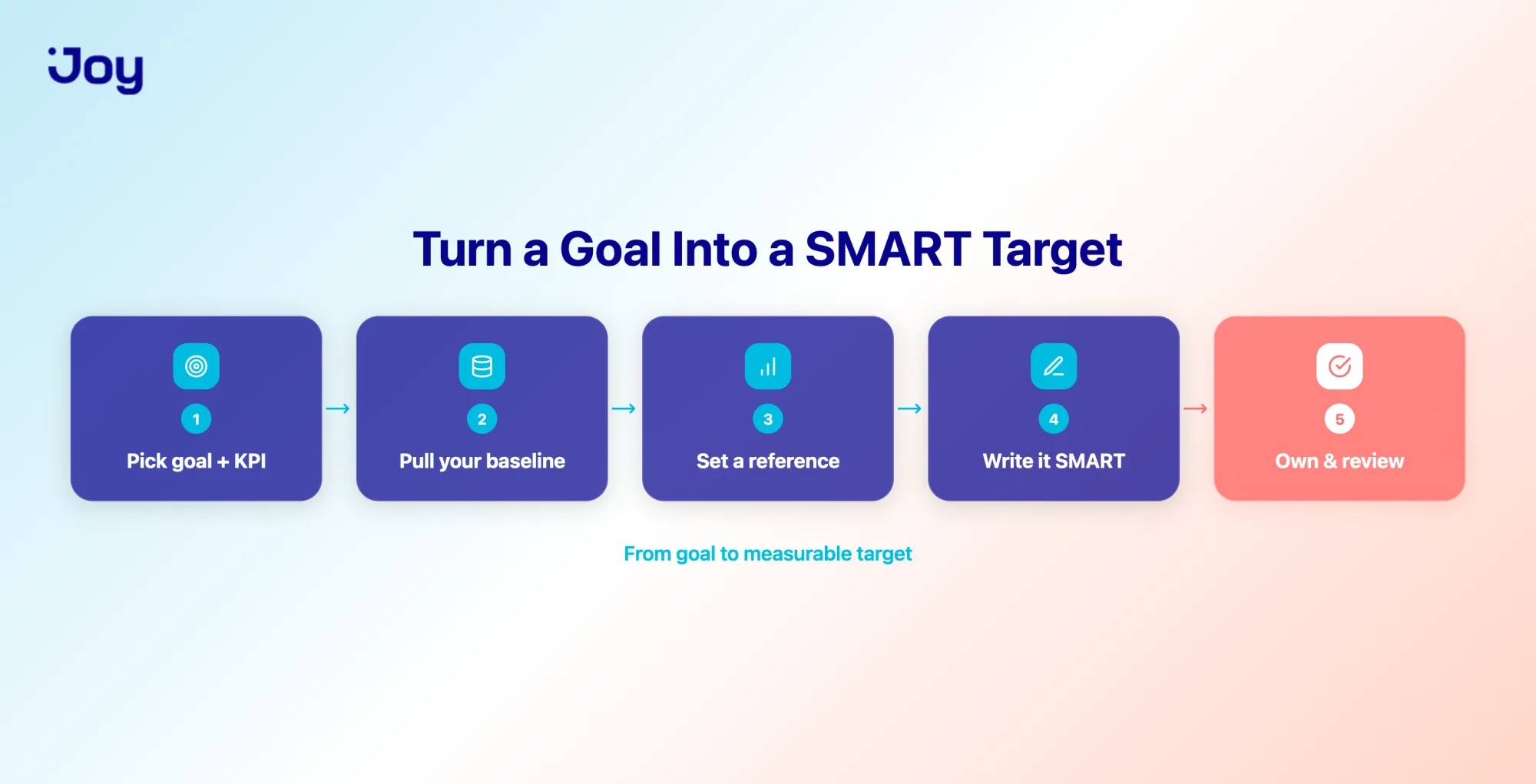
1. Choose the goal and its KPI. Pick one of the five goals above so you know exactly what you are moving and how you will measure it.
2. Pull your own baseline. You cannot set a sensible target without knowing where you stand today. Your store's analytics will show your current retention rate, repeat purchase rate, and CLV.
3. Set a reference point. Look at your own trend first, then glance at industry figures for context using customer retention benchmarks, rather than copying a number that was never meant for your category.
4. Write it as a SMART target. That means specific, measurable, attainable, relevant, and time-bound. "Improve retention" is a wish. "Increase repeat purchase rate from 22% to 28% before the end of Q3" is a target you can act on.
5. Give it an owner and a review cadence. A goal with no one responsible and no monthly check-in tends to live on a slide and nowhere else. Because targets drift without attention, this final step keeps the goal alive throughout the quarter.
Map each goal to the strategy that achieves it
A target tells you where to go, but you still need the lever that gets you there. The table below connects each goal to its primary strategy and points to where you can go deeper, so this section stays a map rather than a repeat of work covered elsewhere.
| Goal | Primary lever | Go deeper |
|---|---|---|
| Retention rate up | Onboarding plus a loyalty program | Ecommerce customer retention |
| CLV up | Tiers, cross-sell, longer active life | Customer retention analytics |
| Churn down | Early at-risk detection and win-back | Customer retention automation |
| AOV up | VIP tiers and points thresholds | Shopify customer retention |
| Loyalty and advocacy up | Points and referrals | Loyalty program retention rate |
One pattern stands out when you lay it out this way. A loyalty program is a rare lever that touches three goals at once: retention rate, average order value, and loyalty itself. That is why many smaller teams start there. It moves several targets with a single, manageable setup instead of running five separate programs.
If you want to see what this looks like in practice, the collection of customer retention examples shows how real stores integrate these levers.
Common mistakes when setting retention goals
Even a sound goal can fail in the way it is set. These are the traps to watch for before you fall into them:
- Chasing a vanity goal. Pushing the retention rate higher while ignoring whether those customers are actually profitable.
- Copying an industry benchmark. Measure against your own past instead, since an outside number may not fit your category at all.
- Setting a goal with no lever. Every target needs a matching strategy from the section above; otherwise, it remains a wish.
- Skipping the owner and cadence. A goal with no one responsible and no monthly check-in rarely survives a busy quarter.
- Chasing all five at once. Two or three focused targets outperform a scattered list because attention is the scarce resource, not ambition.
One caveat on timing: if your store is still very early, under roughly $20K a month with a repeat purchase rate that has not settled, the full five-goal plan is premature. At that stage, set a single goal around earning the second order and grow into the rest once your baseline is stable.
Turning goals into returning customers
Strong retention is less about collecting tactics and more about aiming them. When you start with clear customer retention goals, turn each into a SMART target, and attach the lever that moves it, the work finally has a scoreboard. A goal without a lever is a wish, and a lever without a goal is just busywork, but together they compound.
If you are not sure where you stand yet, start by checking your numbers against ecommerce retention benchmarks so your first target is grounded in reality.
A loyalty program is one of the most efficient places to begin, since it moves three of the five goals at once. If that fits where your store is right now, you can try Joy Loyalty for free and start with repeat purchases, CLV, and advocacy from one setup.
Frequently asked questions
What is a good customer retention goal?
A good goal is specific to your store. Set it as a SMART target that improves on your own baseline rather than matching an industry average, since what counts as strong varies widely by category and purchase frequency.
What are examples of customer retention goals?
Common examples include increasing your repeat purchase rate, growing customer lifetime value, reducing churn, lifting average order value, and raising your referral rate or NPS.
How do you measure retention goals?
Pair each goal with a single KPI. Retention rate, CLV, churn rate, AOV, and NPS or referral rate each map to one of the five goals, and you track them on a regular cadence.
What is the difference between a retention goal and a KPI?
The goal is the desired outcome, such as lower churn. A KPI is a metric that measures progress toward a goal, such as the monthly churn rate. One goal usually has one primary KPI.
How many retention goals should I set?
Two or three at a time is usually enough. Focusing on a small set lets you give each one a real lever and a review cadence, which beats spreading effort thin across five.

Written by
Thomas Nguyen is the CEO & Co-founder of Joy, a loyalty solution for Shopify and eCommerce brands. With years of experience building high-performance Shopify apps, Thomas aims to help merchants grow through customizable and retention-focused tools.
Related reading
 Loyalty Strategy
Advantages of Customer Loyalty: 7 Data-Backed Benefits for Ecommerce Growth
Customer loyalty isn't a feeling — it's a financial asset that compounds. A 5% retention bump drives 25–95% more profit; emotionally connected customers deliver 306% higher LTV. This guide covers all 7 data-backed advantages and the 3 mistakes that kill programs before the compounding kicks in.
 Thomas Nguyen
 Loyalty Strategy
Customer retention benchmarks for ecommerce: What's a good rate?
A clear-eyed look at ecommerce retention benchmarks: the one number worth trusting, why most by-industry tables mislead, and how to benchmark against yourself.
Thomas Nguyen Loyalty Strategy
Customer Retention Analytics: Turn Your Data Into Retention Action
Most retention guides stop at the numbers. This one shows how to read your retention data and turn each metric into a concrete loyalty play for your Shopify store.
Thomas Nguyen Loyalty Strategy
6 Key Factors That Affect Customer Loyalty
Loyalty isn't luck or a good Black Friday sale — it's built on six specific, measurable factors. This guide breaks down each one: why it matters, how to measure it, and how to put it into action, with examples from brands that got it right.
Thomas Nguyen Loyalty Strategy
Customer Loyalty Index: The Metric That Predicts Customer Churn
Most brands measure loyalty with a single number and miss most of the picture. The Customer Loyalty Index combines three survey questions into one composite score: an early churn warning, a revenue forecast, and a segmentation tool. Here's the formula, benchmarks, and how to act on it.
Thomas Nguyen Loyalty Strategy
Customer Retention Cost: Formula & Strategies to Optimize It
Customer retention is often cheaper than acquisition, but are you managing your costs effectively? Learn how to calculate retention costs and optimize your strategy without overspending.
Thomas Nguyen