
Customer Retention Analytics: Turn Your Data Into Retention Action
Most retention guides stop at the numbers. This one shows how to read your retention data and turn each metric into a concrete loyalty play for your Shopify store.
Summarize this post with AI
Most retention reports tell you what happened. Far fewer help you decide what to do next. That gap is where customer retention analytics earns its keep.
Customer retention analytics is the practice of collecting and reading customer behavior data so you can understand why people stay, why they leave, and what action changes the outcome. Done well, it turns a vague worry like "I think repeat orders are slipping" into something you can act on: which customers are at risk, why, and which reward or message brings them back.
This guide covers the metrics worth tracking, the methods that surface real patterns (cohort and RFM analysis), and the part most articles skip: how to convert each insight into a loyalty play you can run this week. If you want the broader business case first, our piece on customer acquisition vs retention is a good companion read.
What is customer retention analytics?
Customer retention analytics is the analysis of behavioral, transactional, and feedback data to measure and improve how many customers keep buying from you over time.
It pulls from sources you already have: order history, email and SMS engagement, support tickets, and product usage. The goal is a clearer view of customer health, so you can spot trends early instead of reacting after revenue dips.
It helps to separate two terms people often blur:
- Customer retention analytics looks at your whole customer base. Are people coming back? Who's drifting away? What's the pattern across the entire store?
- Loyalty program analytics zooms into one channel: how your points, tiers, or rewards are performing. We cover that in depth in our guide to customer loyalty analytics.
You need both. Retention analytics tells you where the leak is. Loyalty analytics tells you whether your program is one of the tools plugging it.
Why retention analytics matters
Retention analytics matters because retention itself is where steady profit lives, and you can't improve what you can't see clearly.
The case for paying attention to existing customers is strong. Forrester's 2024 US Customer Experience Index found that customer-obsessed organizations reported 51% better customer retention, along with 41% faster revenue growth, than companies that weren't. The link between understanding customers and keeping them isn't a hunch... it shows up in the numbers.
Analytics is what makes that focus real rather than aspirational. Without it, retention work runs on gut feeling: you guess which customers matter, guess why they leave, and guess whether your fix worked. With it, you can:
- Catch early signs of churn while there's still time to act
- See which customer segments drive most of your repeat revenue
- Measure whether a reward, email, or onboarding change actually moved retention
- Decide where to spend, since holding onto a customer usually costs less than winning a new one (our customer retention cost breakdown digs into the math)
One honest caveat before we go further. You'll see a famous stat everywhere claiming a 5% lift in retention raises profits by 25% to 95%. It traces back to a 1990 Harvard Business Review paper by Reichheld and Sasser, *Zero Defections: Quality Comes to Services*, and the original finding was far narrower, drawn largely from one bank's branch system. It's a fine illustration of direction, not a promise for your store. Treat it as a story, not a forecast.
The retention metrics that actually matter
Strong retention analytics rests on a handful of metrics, each answering a specific business question. Track these five and you'll have a clear picture of customer health.
Customer Retention Rate (CRR)
CRR answers: what share of customers did we keep over a period?
The formula:
CRR = [(Customers at end − New customers gained) ÷ Customers at start] × 100
Say you start a quarter with 1,000 customers, gain 200, and end with 1,050. Your retained customers are 850, so your CRR is 85%. Track it monthly or quarterly and watch the trend, not just the single number.
Churn Rate
Churn is the mirror of retention: what share of customers did we lose? If your CRR is 85%, your customer churn is 15%.
For subscription or membership models, also watch revenue churn, the percentage of recurring revenue lost in a period. It's possible to lose small customers (low customer churn impact) while keeping revenue steady, or to lose one big account that quietly wrecks the month. Revenue churn catches what customer churn alone can hide.
Customer Lifetime Value (CLV)
CLV answers: how much is a customer worth over the whole relationship?
A simple version:
CLV = Average order value × Purchase frequency × Customer lifespan
CLV is the metric that justifies retention spending. When you know a repeat customer is worth $400 over two years, a $20 win-back reward stops looking like a cost and starts looking like an investment.
Repeat Purchase Rate
Repeat purchase rate answers: what share of customers bought more than once? For ecommerce, this is often the most telling early signal, because the jump from one order to two is where loyalty begins.
It's also where small changes compound. According to Klaviyo's 2024 benchmark data, post-purchase emails tend to drive a 10–15% repeat purchase rate, which is a meaningful nudge for a flow you set up once and leave running.
NPS and CSAT
Numbers tell you what customers do. Net Promoter Score (NPS) and Customer Satisfaction Score (CSAT) help explain why.
- NPS asks how likely someone is to recommend you, on a scale of 0 to 10
- CSAT asks how satisfied they were, usually right after a purchase or support interaction
Neither predicts behavior perfectly, but a falling NPS among your best customers is an early warning worth heeding before it shows up in churn.
Retention benchmarks: what "good" looks like
A common question once you have your numbers: is this any good? Benchmarks help, but read them carefully, because "good" depends heavily on what you sell.
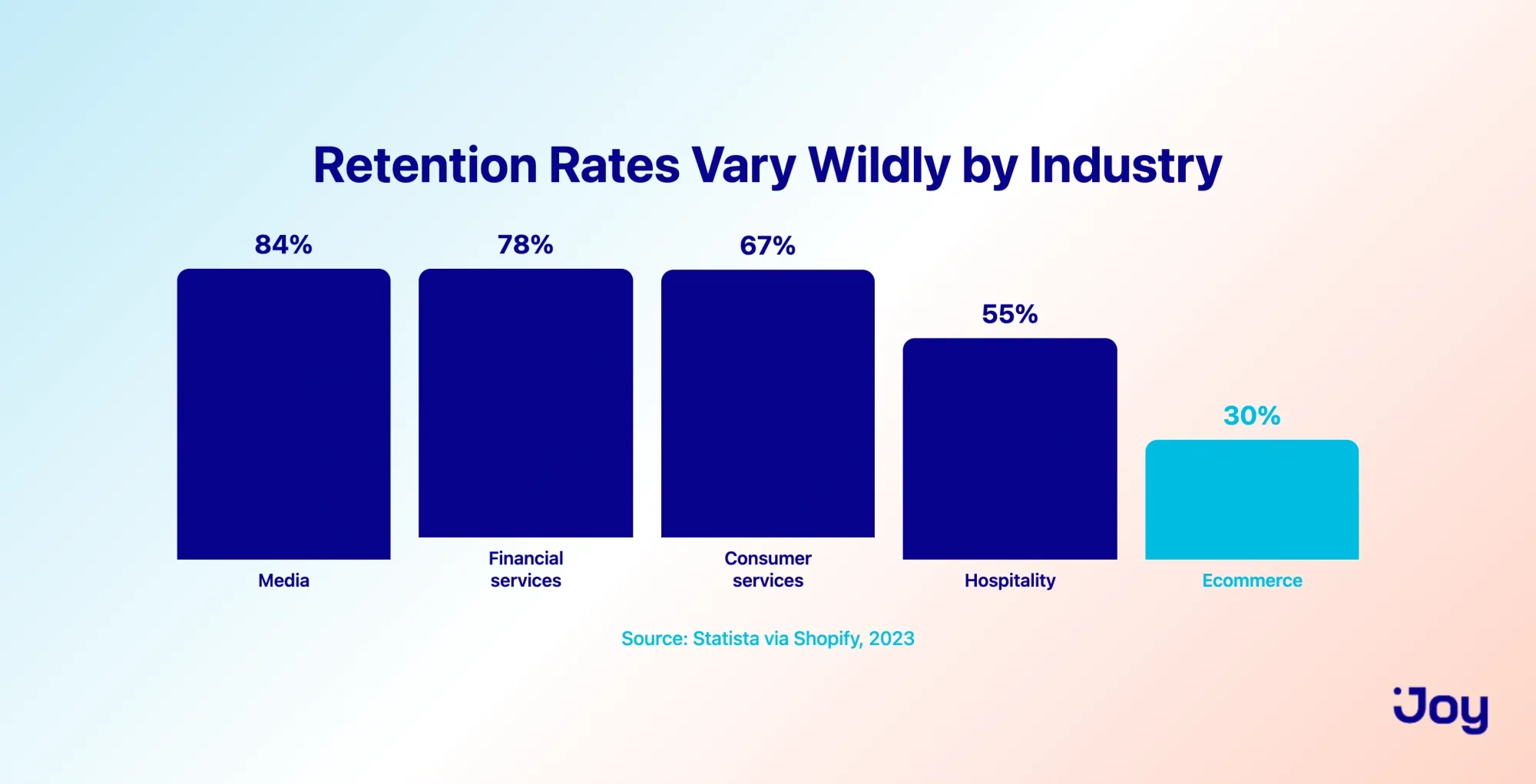
According to retention rates compiled by Statista (via Shopify), average customer retention varies widely by industry:
| Industry | Average retention rate |
|---|---|
| Media | 84% |
| Professional services | 84% |
| Automotive & transportation | 83% |
| Financial services | 78% |
| Consumer services | 67% |
| Hospitality | 55% |
| Ecommerce | 30% |
That ecommerce figure of 30% comes from Decile's 2023 Ecommerce Benchmarking Guide, so treat it as a rough reference point rather than this year's exact reading. Retail and ecommerce sit lower than service industries for a simple reason: switching stores is easy, and many purchases are one-off by nature.
External averages are a starting point, not a verdict. The more useful move: build your own benchmark. Industry numbers lump together businesses nothing like yours. A pet supplies store with monthly reorders and a furniture store selling once every few years can't share a target.
To set a benchmark that means something:
- Measure your retention rate for the last four quarters
- Use your own trailing average as the baseline
- Segment by product category and customer cohort, since a blended number hides more than it shows
- Compare each new quarter against your trend, then against industry context
Your previous quarter is a fairer rival than a stranger's spreadsheet.
Knowing where you stand is only the "what." The more valuable question is "why," and that's where the four modes of analytics come in.
Four types of retention analytics (and the question each answers)
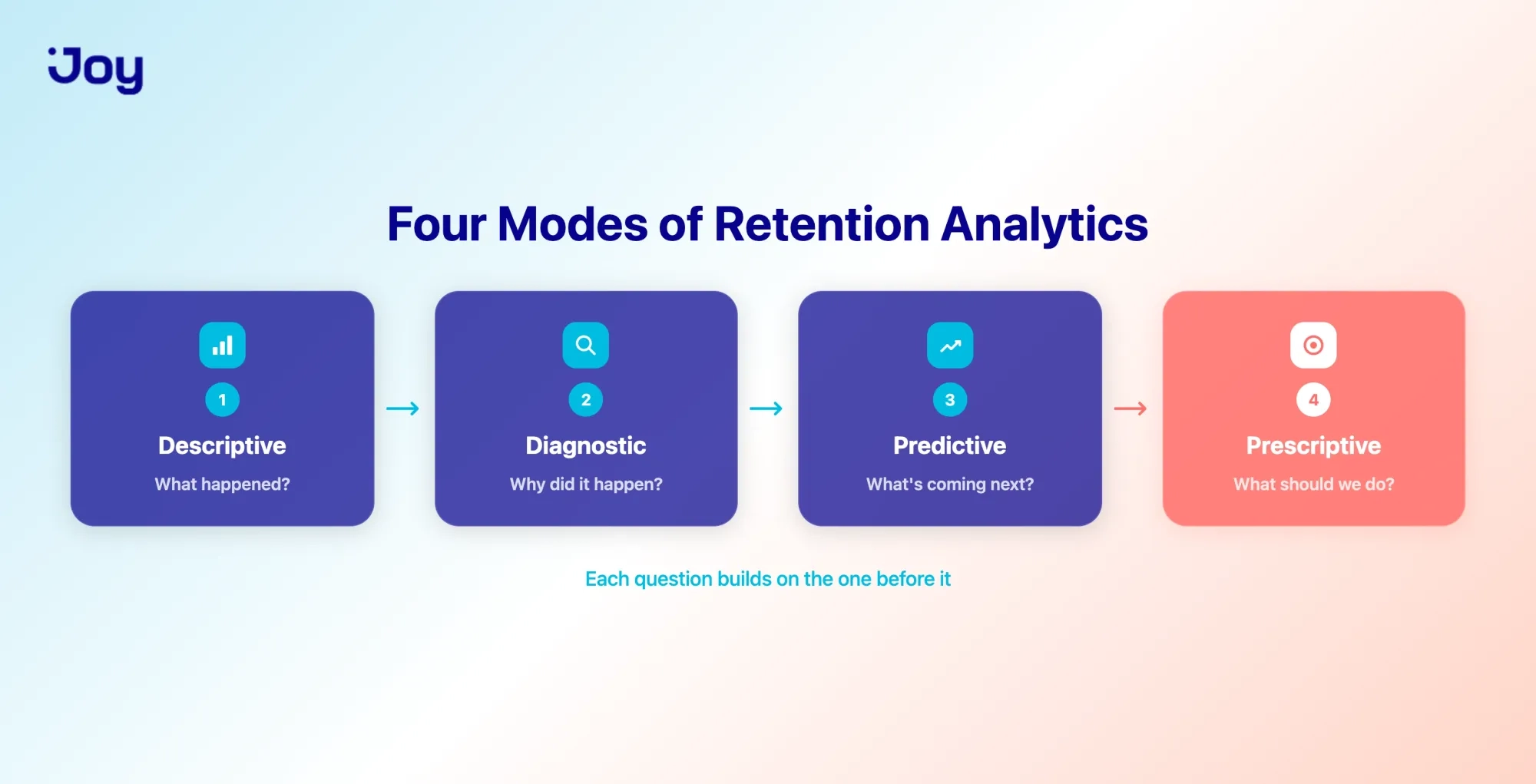
Analytics work falls into four modes. You don't need fancy tools to use them, just the discipline to ask the next question after "what happened."
Descriptive analytics — what happened? This is your dashboard view: retention rate is 32%, repeat purchase rate dipped 3 points last month. It's the starting line, not the finish.
Diagnostic analytics — why did it happen? Here you dig for cause. Did churn rise after a shipping delay? Did a discount campaign pull in one-time bargain hunters who never came back? This is where most stores stop too early.
Predictive analytics — what's likely next? You don't need a data scientist to predict churn. Simple, observable signals work well for most stores:
- Order frequency slowing down (someone who bought monthly hasn't ordered in 90 days)
- Email engagement dropping to zero across several sends
- A drop in average order value over recent purchases
- A support ticket that ended unresolved or unhappy
Flag customers showing two or more of these, and you've built a workable at-risk list by hand.
Prescriptive analytics — what should we do? This is the payoff: turning the at-risk list into action. Which is exactly where the next section goes.
Cohort and RFM analysis, explained
Two methods do most of the heavy lifting in retention analytics. Both turn a flat customer list into something you can act on.
Cohort analysis
Cohort analysis groups customers by when they first bought, then tracks how each group behaves over the following months. Instead of one blurry average, you see whether customers who joined in March are sticking around longer than those who joined in June.
It's the clearest way to answer "is retention getting better or worse over time?" If your newer cohorts drop off faster, something in the recent customer experience changed. In one store we looked at, the cohorts from a big holiday sale churned far faster than organic cohorts... the discount had pulled in one-time deal seekers, and the blended retention number had hidden it completely. We walk through reading these patterns in our guide to the retention curve.
RFM segmentation
RFM scores every customer on three things:
- Recency — how recently they bought
- Frequency — how often they buy
- Monetary — how much they spend
Score each from 1 to 5 and you get practical segments instead of one undifferentiated crowd. A few that matter most:
| Segment | What it looks like | What it signals |
|---|---|---|
| Champions | Bought recently, often, and big | Your core. Protect them. |
| Loyal customers | Buy regularly, solid spend | Steady revenue, room to grow |
| At-risk | Used to buy often, gone quiet | Slipping away, still reachable |
| Hibernating | Low recency, low frequency | Need a real reason to return |
| New customers | One recent purchase | The make-or-break moment |
RFM is powerful because it tells you not just who a customer is, but what to do about them. That's the bridge to action.
From insight to action: turn analytics into a loyalty play
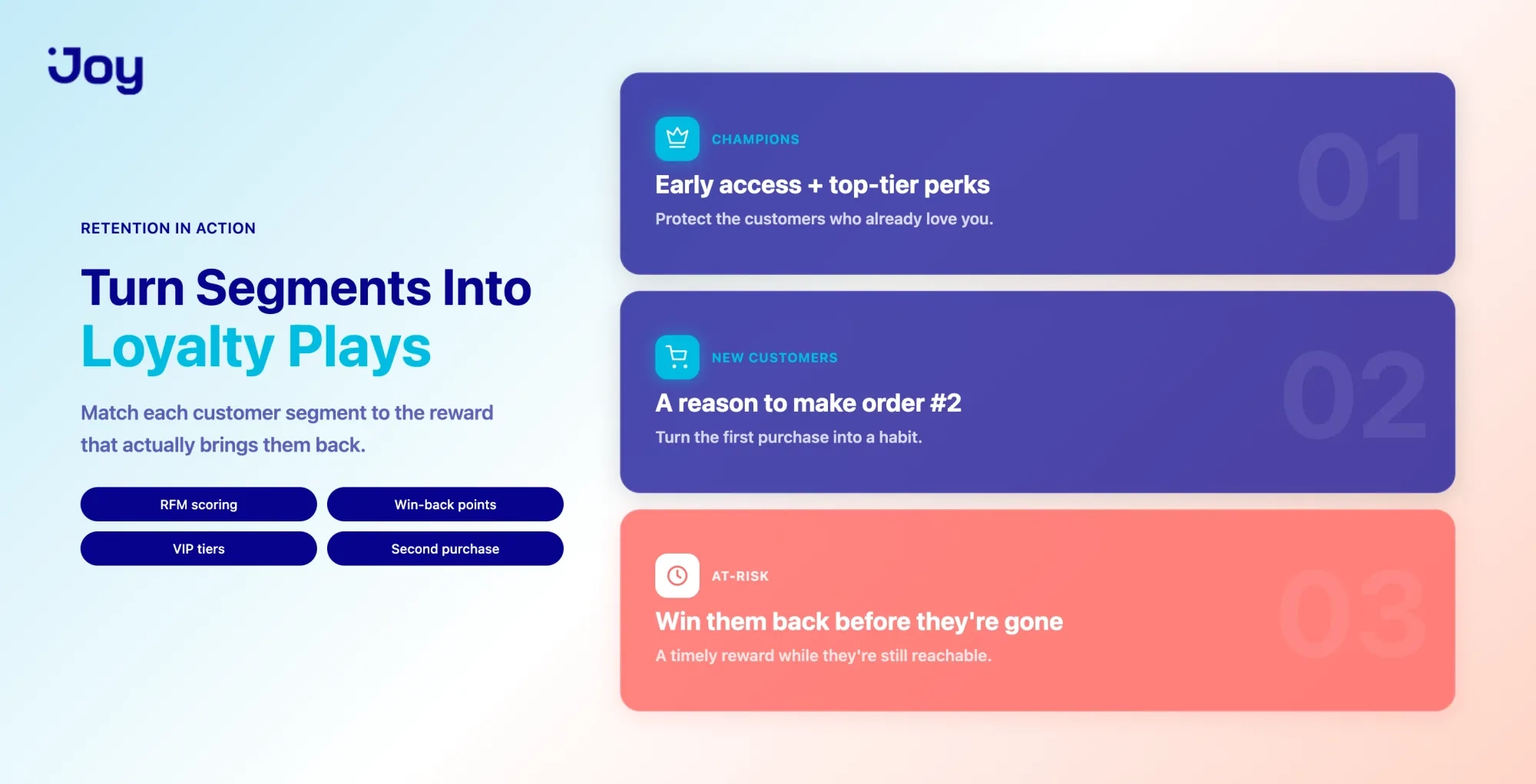
This is the step most retention guides leave out. Knowing a customer is "at-risk" changes nothing until you do something with it. A loyalty program is one of the most direct ways to act on what your analytics surface, because it lets you respond to each segment differently.
Here's how the RFM segments above map to concrete plays:
| Segment | Retention play |
|---|---|
| Champions | Early access to new products, a top tier with real perks, personal thank-yous |
| Loyal customers | A clear next tier to reach for, bonus points on their favorite category |
| At-risk | A timely win-back offer or bonus points, before they fully drift |
| Hibernating | A stronger, time-limited reason to return, paired with a "we've missed you" message |
| New customers | A second-purchase incentive while the first order is still fresh |
This is where a loyalty program earns its place: instead of blasting everyone the same offer, a flexible rule engine (Joy's, for instance) lets you target rewards by segment. You might set bonus points to trigger for customers who haven't ordered in 60 days, or reserve a VIP tier for your Champions. The point isn't more rewards... it's the right reward reaching the right customer at the right moment.
There's a feedback loop worth noting, too. Your loyalty program also generates retention data: who redeems, who climbs tiers, who refers friends. That data flows back into your analytics and sharpens the next round of decisions. Retention analytics and your loyalty program aren't separate projects; they feed each other.
If you want to see what this looks like in practice, it's worth exploring how a flexible loyalty program turns these segments into automatic, targeted rewards rather than manual one-off campaigns.
How to set up retention analytics for your store (a Shopify example)
You don't need a data warehouse or a dedicated analyst to start. Most ecommerce stores can build a working retention view from tools they already have. Here's how it comes together on Shopify, though the same logic applies on any platform.
Start with your store platform's own reports. On Shopify, the Customers section and built-in reports show repeat customer rate, customer cohorts, and first-versus-returning order splits. For many stores, that alone covers descriptive and basic cohort analysis.
Layer in your email and SMS platform. Tools like Klaviyo or Shopify Email show engagement and post-purchase flow performance, which feed your churn signals and repeat purchase tracking.
Use your loyalty app's analytics. A loyalty platform's dashboard surfaces program-level signals such as redemption rate and how many repeat orders come from program members. That connects "members" to "revenue" without a spreadsheet export.
To keep it manageable, here's a simple cadence to review:
- Weekly: new versus returning customers, at-risk list movement
- Monthly: repeat purchase rate, churn rate, loyalty program redemptions
- Quarterly: retention rate by cohort, CLV trend, RFM segment shifts
Pick the metrics you'll actually act on. A short list you review every week beats a sprawling dashboard you open twice a year. For a deeper, Shopify-specific playbook, our guide to Shopify customer retention goes further on tactics.
Best practices and common mistakes
A few habits separate retention analytics that drives decisions from analytics that just fills dashboards.
Do these:
- Segment before you conclude. A blended retention number can stay flat while your best customers quietly leave and bargain hunters mask the loss.
- Tie every metric to an action. If a number won't change what you do, it's a vanity metric.
- Pair numbers with feedback. CSAT and open-ended survey replies explain the why behind the churn.
Avoid these:
- Chasing every metric at once. Start with retention rate, repeat purchase rate, and an at-risk list.
- Trusting borrowed benchmarks too literally. Your own trend is the more honest comparison.
- Treating a campaign as proof. If retention rose, confirm it held for the next cohort before calling it a win.
Turning numbers into returning customers
Customer retention analytics isn't really about dashboards. It's about noticing, early enough to matter, which customers are drifting and giving them a reason to stay.
Start small. Track your retention rate, build an at-risk list from a few honest signals, and map each segment to one concrete play. Let your loyalty program act on what the data tells you, then watch the next cohort to see if it worked.
The stores that retain best aren't the ones with the most data. They're the ones that act on it.
Frequently asked questions
What is a good customer retention rate?
It depends entirely on your industry and model. Service businesses often sit at 75–85%, while ecommerce averages closer to 30% because repeat buying is harder to earn. The more useful target is beating your own trailing average, quarter over quarter.
Which retention metric matters most?
For most ecommerce stores, repeat purchase rate is the clearest early signal, since the move from one order to two is where loyalty starts. Pair it with CLV to understand how much that loyalty is worth.
How often should I review retention analytics?
Check a small set of signals weekly (new versus returning customers, at-risk movement), review core metrics monthly, and do deeper cohort and RFM analysis quarterly. Consistency matters more than frequency.
What's the difference between retention analytics and loyalty analytics?
Retention analytics measures your whole customer base: who comes back and who leaves. Loyalty analytics measures one channel: how your points, tiers, and rewards perform. Retention analytics finds the leak; loyalty analytics shows whether your program helps seal it.

Written by
Thomas Nguyen is the CEO & Co-founder of Joy, a loyalty solution for Shopify and eCommerce brands. With years of experience building high-performance Shopify apps, Thomas aims to help merchants grow through customizable and retention-focused tools.
Related reading
 Loyalty Strategy
6 Key Factors That Affect Customer Loyalty
Loyalty isn't luck or a good Black Friday sale — it's built on six specific, measurable factors. This guide breaks down each one: why it matters, how to measure it, and how to put it into action, with examples from brands that got it right.
 Thomas Nguyen
 Loyalty Strategy
Customer Acquisition vs Retention: Where to Put Your Next Dollar
Customer acquisition and retention aren't a contest. Here's what each really costs, when to prioritize which, and a simple LTV:CAC way to decide your split.
Thomas Nguyen Loyalty Strategy
Customer Retention Goals: 5 Targets to Set (and How to Hit Them)
A goal-first guide to customer retention: the five targets worth setting, how to make each one SMART, and the strategy that hits it.
Thomas Nguyen Loyalty Strategy
Customer Retention Cost: Formula & Strategies to Optimize It
Customer retention is often cheaper than acquisition, but are you managing your costs effectively? Learn how to calculate retention costs and optimize your strategy without overspending.
Thomas Nguyen-f9ebcc.webp&w=3840&q=75) Loyalty Strategy
Loyalty StrategyCustomer Engagement and Loyalty: Strategies and How to Measure Them
Customer engagement and loyalty aren’t the same thing. Here’s how they differ, seven strategies that build both, and the metrics that tell you it’s working.
Thomas Nguyen Loyalty Strategy
How to set up customer retention automation (without a big team)
A step-by-step guide to automating customer retention across the customer lifecycle, from onboarding to win-back.
Thomas Nguyen