
6 Key Factors That Affect Customer Loyalty
Loyalty isn't luck or a good Black Friday sale — it's built on six specific, measurable factors. This guide breaks down each one: why it matters, how to measure it, and how to put it into action, with examples from brands that got it right.

Summarize this post with AI
Nearly half of all customers would walk away from a brand that conflicts with their values. Not slowly drift away. Actively boycott it.
That tells you something critical about what customer loyalty actually is. It isn't random. It doesn't happen because your product is "good enough" or because you ran a Black Friday sale last year. Loyalty gets built on specific, measurable factors. And when you understand what those factors are, you can do something about them.
Yet most businesses pour their budget into acquiring new customers while ignoring what keeps existing ones coming back. The math doesn't support that approach. Retaining a customer costs five to seven times less than acquiring a new one. And loyal customers? They spend 67% more than first-time buyers.
So what actually drives loyalty? Six core factors. This article breaks down each one: why it matters, how to measure it, and how to put it into action with real examples from brands that got it right.
What Is Customer Loyalty and Why Does It Matter?
Customer loyalty is the ongoing positive relationship between a customer and a brand, reflected in repeat purchases, higher spending, and a willingness to recommend. What separates loyalty from simple satisfaction: loyalty is active.
A satisfied customer isn't unhappy. They got what they expected, and they might come back. But a loyal customer actively chooses your brand over alternatives. They recommend you to friends. They defend you when someone complains online. And they keep buying even when a competitor offers a lower price.
Why does that distinction matter? Bain & Company research found that a 5% increase in customer retention can boost profits by 25% to 95%. Loyal customers create a flywheel effect: they buy more, cost less to serve, and bring in new customers through word-of-mouth. Understanding the factors of customer loyalty is the first step toward building that flywheel.
The 6 Core Factors That Drive Customer Loyalty
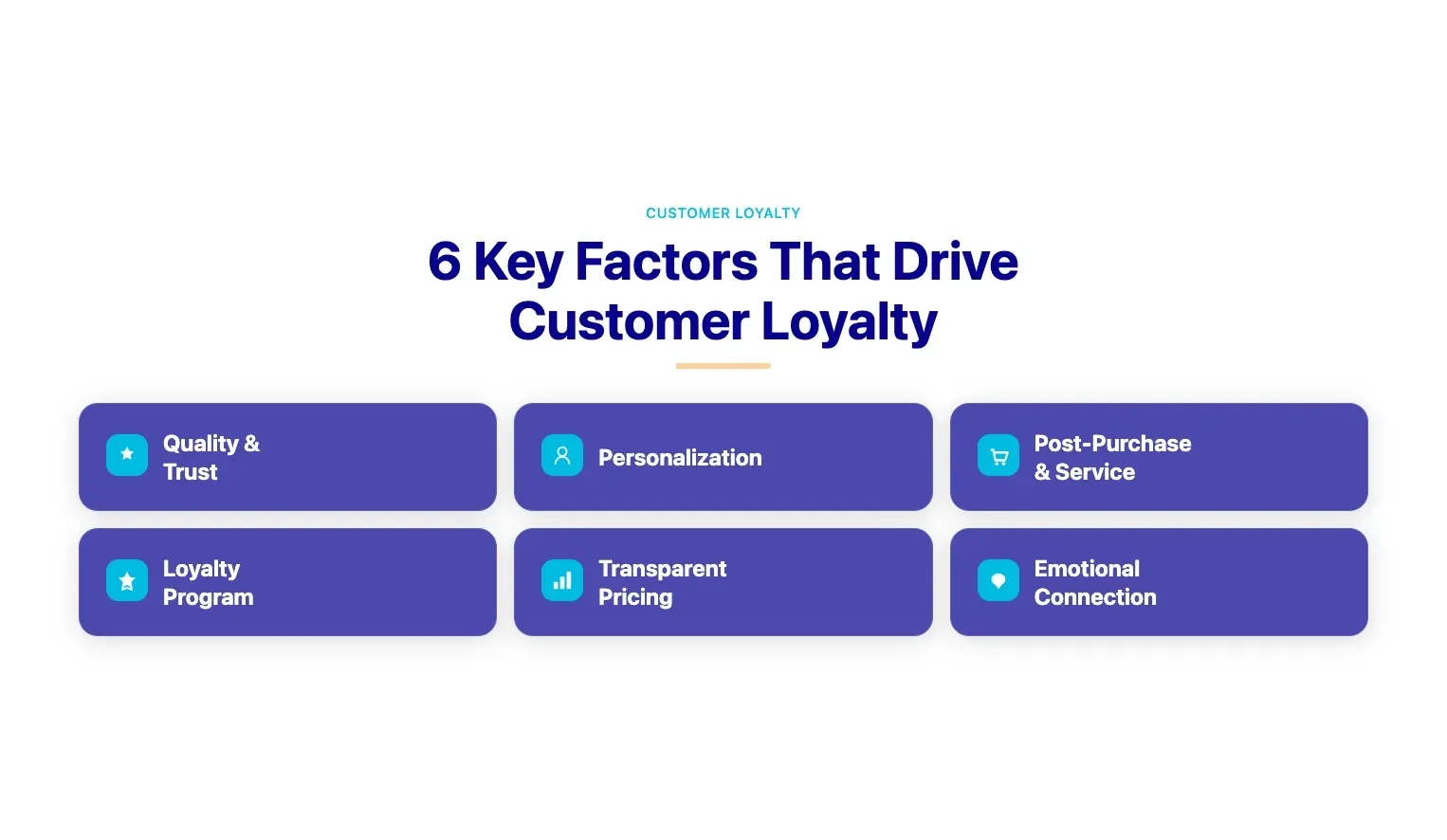
Each of these customer loyalty factors plays a distinct role. Some build the foundation. Others amplify what's already working. Together, they form a system, and the brands that master all six are the ones customers keep choosing.
Factor 1: Product Quality and Brand Trust
Everything starts here. If your product doesn't deliver on its promise, nothing else matters. No amount of personalization, rewards, or clever marketing can compensate for a product that disappoints.
The mechanism is straightforward. High-quality products create confidence. That confidence turns into trust. And trust is what makes customers recommend you to their friends without hesitation.
One clear indicator? Return rate. When it stays below 5%, customers generally trust your brand enough to refer others. Push above 10%, and you've got a trust problem that will undermine every other loyalty effort you make.
Allbirds is a strong example. The company built its early growth almost entirely on product quality and word-of-mouth. A low return rate paired with consistently high NPS scores created organic referrals that scaled without heavy paid advertising. No gimmicks, no flashy campaigns. Just a product people trusted enough to tell their friends about.
How to act on it: Audit your return rate and NPS scores first. If quality issues exist, fix them before investing in programs or campaigns. A rapid refund-or-replace policy on defective items also signals that you stand behind what you sell.
Factor 2: Personalization
Generic experiences are forgettable. Personalized ones create loyalty, because when a customer feels understood, they come back faster.
Personalized customer segments see 40% to 50% repeat purchase rates compared to just 15% to 25% for generic segments. That's not a marginal difference. It's the gap between a one-time buyer and a returning customer.
Here's how it works: you collect preferences (through surveys, purchase history, or browsing behavior), then deliver offers and recommendations that actually match what the customer wants. When they get something relevant instead of something random, they feel valued. They repeat faster.
Sephora's Beauty Insider program nails this. By using purchase history and stated preferences to personalize product recommendations, Sephora created a system where loyalty members now drive 80% of total sales. Eighty percent. From a single personalized program.
How to act on it: Start with one post-purchase preference question. Something as simple as "What matters most to you: price, new arrivals, or specific product categories?" gives you enough to create meaningful segments. Build from there.
Factor 3: Post-Purchase Experience and Customer Service
What happens after checkout determines whether a customer comes back and how quickly. This factor has two sides: proactive engagement and responsive support. Both matter.
On the proactive side, customers who receive post-purchase attention (a thank-you message, shipping updates, a next-purchase incentive) tend to repeat within 30 days. Customers who hear nothing? They often don't return for 90 days or more. That's a three-month gap created by silence alone.
On the support side, the stakes are just as high. 97% of consumers say customer service is a key factor in their loyalty to a brand. And one bad service experience can erase months of loyalty-building in a single interaction.
Zappos understood this better than most. Their 365-day return policy and empowered support team (agents who could resolve problems on the spot without escalation) created customers who didn't just stay. They actively evangelized the brand to everyone they knew.
How to act on it: Set up a three-email post-purchase sequence: order confirmation, shipping update, and a next-purchase incentive. For support, establish a response SLA under 24 hours and give your team the authority to resolve issues without jumping through hoops. When something does go wrong, fix it visibly and offer a goodwill gesture. The recovery matters more than the mistake.
Factor 4: Loyalty Program Design
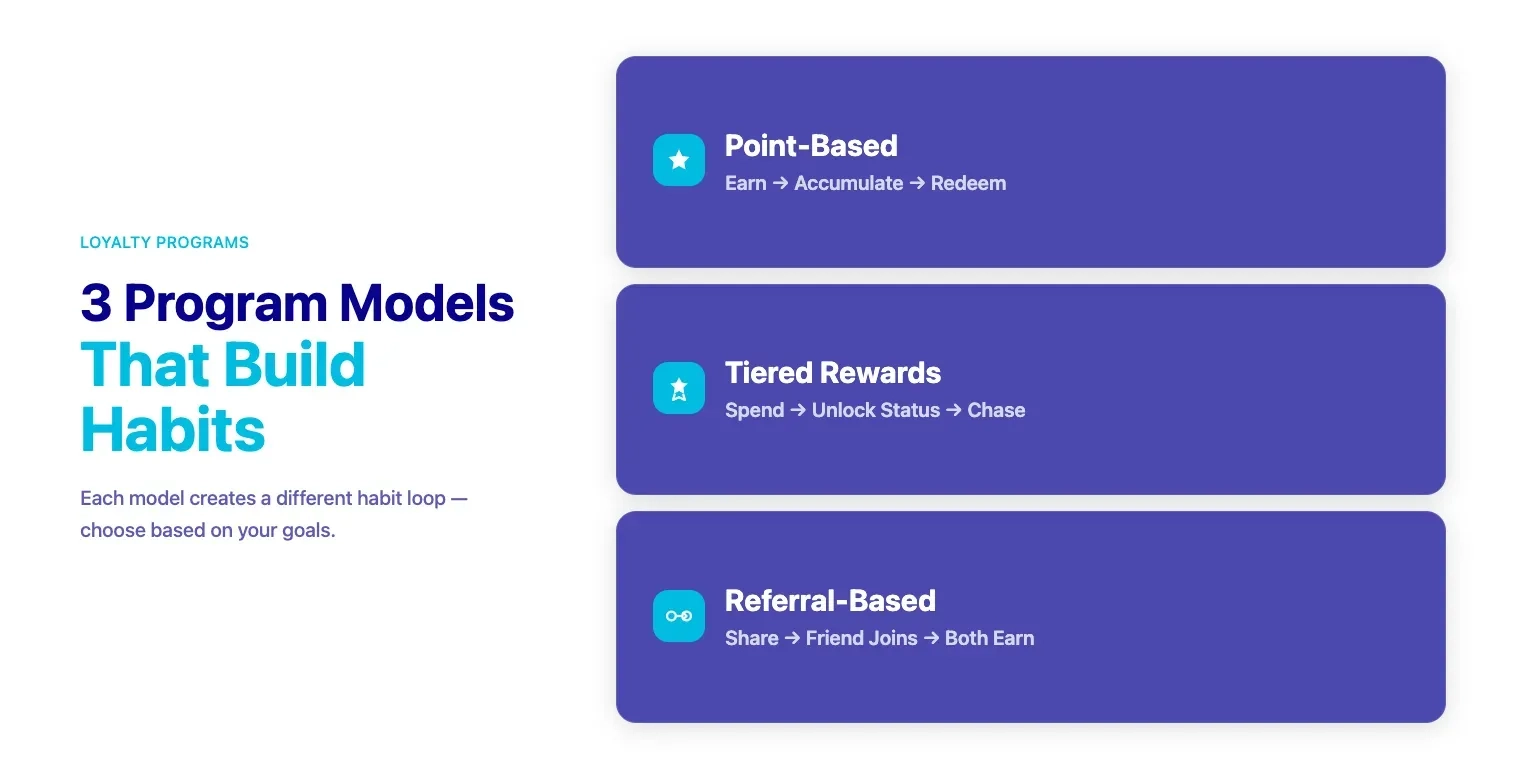
A well-designed loyalty program doesn't just reward purchases. It creates habit loops: earn, return, refer. Those loops turn customers into repeat buyers and brand advocates.
The numbers back this up: program members typically refer at significantly higher rates and spend 30% to 50% more per year. A good program gives customers a reason to come back (points to redeem), something to chase (tiers and status), and a way to share (referral perks for both parties).
Starbucks Rewards illustrates this at scale. Their tiered system (Green to Gold) creates status motivation that goes beyond discounts. Loyalty members now drive 57% of U.S. sales. Not 57% of loyalty transactions. 57% of all U.S. revenue. That's the core growth engine.
How to act on it: Start with four elements: post-purchase enrollment, points for purchases and referrals, tiers that create something to aspire to, and a referral incentive where both the referrer and the friend benefit. Keep the mechanics simple. If a customer can't explain your program in one sentence, it's too complicated.
Factor 5: Transparent Pricing and Value Perception
Customers who clearly see the value they're getting become confident advocates. Hidden costs, on the other hand, destroy trust faster than almost anything else.
This factor works through confidence. When a customer can see "You've saved $47 with us" or understands exactly how their points convert to discounts, they feel good about the relationship. That confidence translates directly into referrals. They'll recommend your brand because they trust the value story, not just because they like the product.
Costco built an entire business model around this principle. Their transparent membership structure (customers know exactly what they pay and exactly what they save) produces a 93% membership renewal rate in the U.S. and Canada. That kind of retention doesn't happen by accident. It happens because the value is visible and honest.
How to act on it: Make savings visible wherever possible. If you run a loyalty program with discounts, show the points-to-discount conversion clearly (100 points = $10 off). No hidden math, no fine print surprises. Pricing transparency isn't just ethical. It's a loyalty multiplier.
Factor 6: Emotional Connection and Brand Values
Emotional connection is what makes loyalty stick. It's the difference between a customer who stays because you're convenient and one who stays because they believe in your brand.
And the impact is measurable. A Motista study found that emotionally connected customers have a 306% higher lifetime value. They recommend more, forgive mistakes more, and stay longer, even when competitors offer lower prices. That's because emotional loyalty is rooted in identity, not just transactions.
Three elements drive emotional connection:
- Shared values. Customers increasingly choose brands that reflect their own beliefs. Nearly half of consumers (the same stat that opened this article) would boycott a brand that conflicts with their values. That makes shared values one of the most concrete loyalty drivers, not just a marketing talking point.
- Community belonging. Brands that create genuine community (exclusive groups, events, forums) see two to three times higher retention than those that treat customers as isolated transactions.
- Feeling valued. Small gestures: a birthday message, recognition for long-term membership, a handwritten note. These signals that you see the customer as a person, not a transaction number.
Patagonia's "Don't Buy This Jacket" campaign is perhaps the most famous example. By urging customers not to buy unless they truly needed the product, Patagonia strengthened loyalty through values alignment. Customers bought more, not less, because they trusted the brand's authenticity.
How to act on it: Communicate your values consistently in every touchpoint, not just on your About page. Build community around shared identity, not just discounts. And worth noting: emotional connection takes longer to build than the other five factors. It's a compound investment. The returns show up over quarters, not weeks. But the brands that invest in it early see the biggest returns on customer loyalty over time.
How to Measure These 6 Factors
You don't need enterprise software to track these. One metric per factor gives you a clear picture of where you stand and where to focus next.
The 6-Factor Loyalty Scorecard
| Factor | Key Metric | Healthy Benchmark | If Below Benchmark |
|---|---|---|---|
| Product Quality | Return rate | Below 5% | QA and fulfillment audit |
| Personalization | Repeat rate (personalized segment) | 40–50% | Add preference survey |
| Post-Purchase & Service | Time to first repeat + support response | Under 30 days / under 24 hrs | Automate post-purchase sequence + set support SLA |
| Loyalty Program | Redemption rate | 40–60% | Simplify earning and redemption |
| Transparent Pricing | Cart abandonment rate | Below 5% | Make savings visible |
| Emotional Connection | NPS / referral conversion | NPS above 50 | Amplify values in messaging |
How to use it: Identify the factor with the weakest metric. That's your priority. Fix the bottleneck before investing in the next factor. Spreading effort across all six at once dilutes impact.
For a deeper look at each metric, including formulas and benchmarks by industry, check out this guide on customer loyalty measurement.
Tools you can use today:
- Free: Google Analytics (track referral sources via UTM) plus your ecommerce platform's built-in reports (repeat purchase rate, return rate, cart abandonment)
- Paid: A loyalty platform can consolidate all six metrics in one dashboard, which saves time once you've scaled past manual tracking
How the 6 Factors Work Together
These factors don't operate in isolation. Each one reinforces the next. And when they're all working, they create a flywheel that accelerates growth on its own.
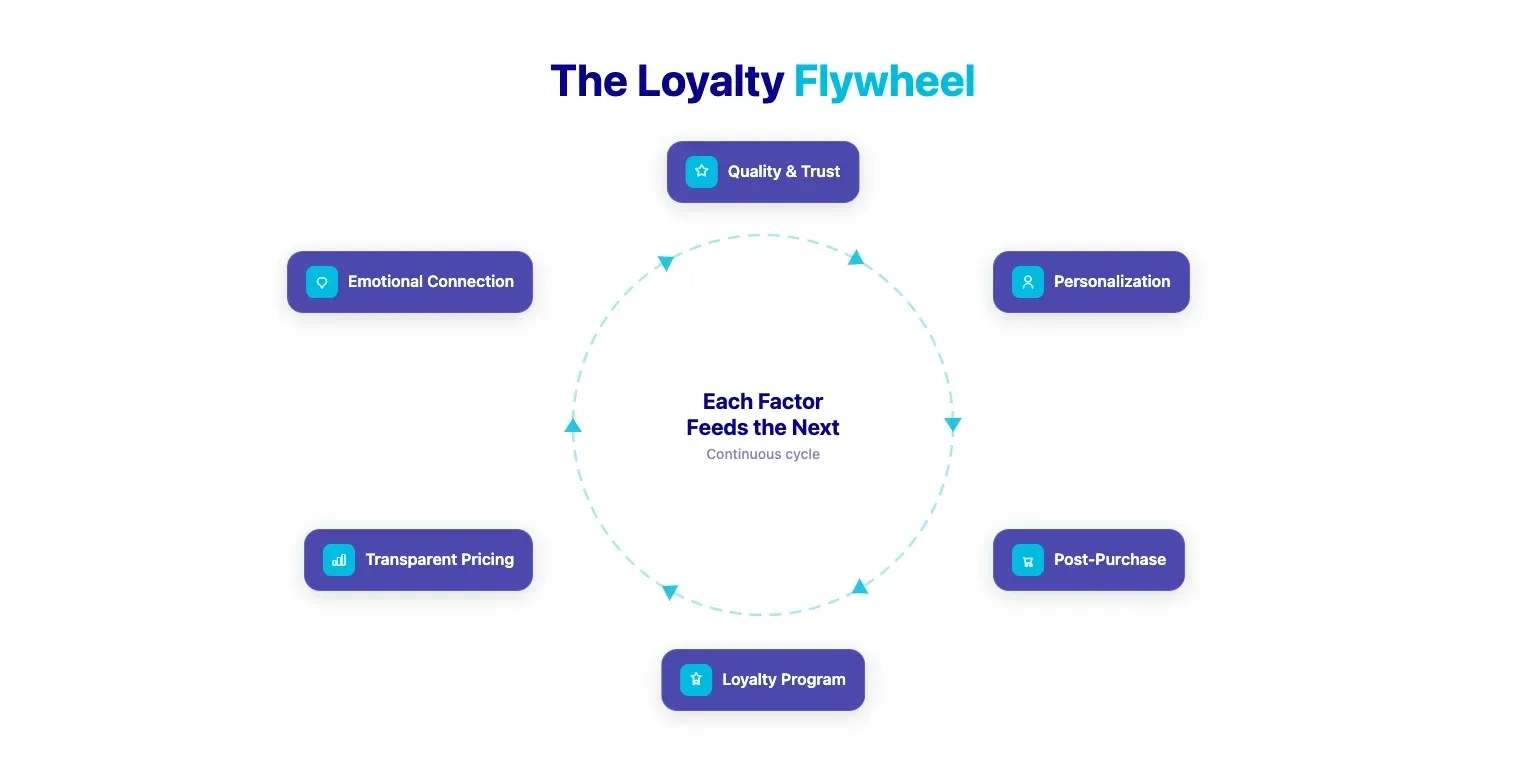
Here's the cycle: product quality builds trust. Trust makes customers open to personalization. Personalization drives faster repeat purchases. Repeats give your loyalty program enough active members to generate referrals. Transparent pricing makes those referrals confident and high-quality. And emotional connection turns one-time referrers into long-term advocates who bring in values-aligned customers, customers who are more likely to stay, creating a virtuous loyalty loop.
Where to Start
The sequence matters as much as the factors themselves.
- Month one: Measure all six factors using the scorecard above. Identify your weakest metric. That's your constraint, and it's where you'll get the fastest return on effort.
- Months two through three: Fix the quick wins. Quality QA, post-purchase automation, and a support SLA are operational improvements that don't require new tools. They're also the trust foundation that everything else builds on.
- Months four through six: Scale up. Launch or improve your loyalty program, add personalization based on the data you've collected, and start building a community.
Why this order? Because fixing quality and post-purchase experience first creates the trust foundation. Without it, loyalty programs and personalization efforts fall flat. Customers won't engage with a program from a brand they don't trust yet.
If you're currently seeing low customer loyalty across multiple factors, start with the one closest to the "healthy" benchmark. Small wins build momentum. And momentum is what turns a struggling retention strategy into a working flywheel.
Curious what this looks like in practice? See how a loyalty platform connects all six factors →
To sum up
Customer loyalty isn't built on one factor. It's built on orchestrating all six. Product quality and trust create the foundation. Personalization makes every interaction relevant. Post-purchase experience and responsive service turn buyers into engaged customers. A well-designed loyalty program creates habit loops and referral channels. Transparent pricing builds confidence. An emotional connection turns customers into advocates.
Your move: pick the weakest factor, fix it first, and watch how it lifts the others. That's the flywheel in action, and it's how the brands you admire turned one-time buyers into their most reliable growth engine.
FAQ: Customer Loyalty Factors
What is the most important factor in customer loyalty?
It depends on your business. For most ecommerce brands, product quality and customer service form the foundation. Without trust in your product and responsive support, no loyalty program or personalization effort can compensate. The best approach: measure all six factors and fix your weakest one first.
How do you measure customer loyalty?
Three core metrics: repeat purchase rate (are they coming back?), Net Promoter Score (would they recommend you?), and customer lifetime value (how much do they spend over time?). Use the 6-Factor Scorecard in this article to identify which specific driver needs attention.
What causes customers to lose loyalty?
The top loyalty killers: declining product quality, poor customer service (slow response, unresolved issues), price increases without added value, data breaches or privacy violations, and brand actions that conflict with customer values. Most loyalty loss is gradual. Customers disengage well before they leave.
Do I need all six factors, or can I focus on one or two?
All six matter for sustainable loyalty, but you don't activate them all at once. Start with your constraint. Measure all six, find the weakest, fix that first. Then layer in the others. They reinforce each other, so skipping one creates a gap competitors can exploit.
How long does it take to build customer loyalty?
Quick wins (product quality fixes, post-purchase automation, support SLA) show results in four to six weeks. Loyalty program and personalization effects appear in two to three months. A fully integrated loyalty system typically shows strong ROI within six months.
What's the difference between customer loyalty and customer satisfaction?
Satisfaction means customers aren't unhappy. They got what they expected. Loyalty means they actively choose you over alternatives and recommend you. A satisfied customer still switches for a better price. A loyal customer doesn't. Satisfaction is the minimum. Loyalty is the goal.
How does customer service affect loyalty?
Massively. 97% of consumers say service is a key factor in their loyalty to a brand. Fast response times (under 24 hours), first-contact resolution, and empowered support teams that can fix problems without escalation are the biggest drivers. One bad service experience can erase months of loyalty-building.
Can a loyalty program alone build customer loyalty?
No. A loyalty program is one of six factors. Without product quality, good service, and genuine emotional connection, a points program becomes just another discount, easily replicated by competitors. The most effective programs combine rewards with personalization, community, and values alignment.
How do emotional connections affect customer loyalty?
306% higher lifetime value. That's what emotionally connected customers deliver. They forgive mistakes, pay premium prices, and recommend actively. Build emotional connection through shared values, community belonging, and consistent brand voice, not just transactions.
What role does pricing play in customer loyalty?
Fair, transparent pricing builds trust. It's not about being the cheapest. It's about perceived value. Customers who clearly see what they save (through loyalty rewards, visible discounts) become more confident advocates. Hidden costs and surprise fees destroy loyalty faster than any competitor can.

Written by
Thomas Nguyen is the CEO & Co-founder of Joy, a loyalty solution for Shopify and eCommerce brands. With years of experience building high-performance Shopify apps, Thomas aims to help merchants grow through customizable and retention-focused tools.
Related reading
 Loyalty Strategy
Customer Loyalty Index: The Metric That Predicts Customer Churn
Most brands measure loyalty with a single number and miss most of the picture. The Customer Loyalty Index combines three survey questions into one composite score: an early churn warning, a revenue forecast, and a segmentation tool. Here's the formula, benchmarks, and how to act on it.
 Thomas Nguyen
 Loyalty Strategy
Customer Retention Goals: 5 Targets to Set (and How to Hit Them)
A goal-first guide to customer retention: the five targets worth setting, how to make each one SMART, and the strategy that hits it.
Thomas Nguyen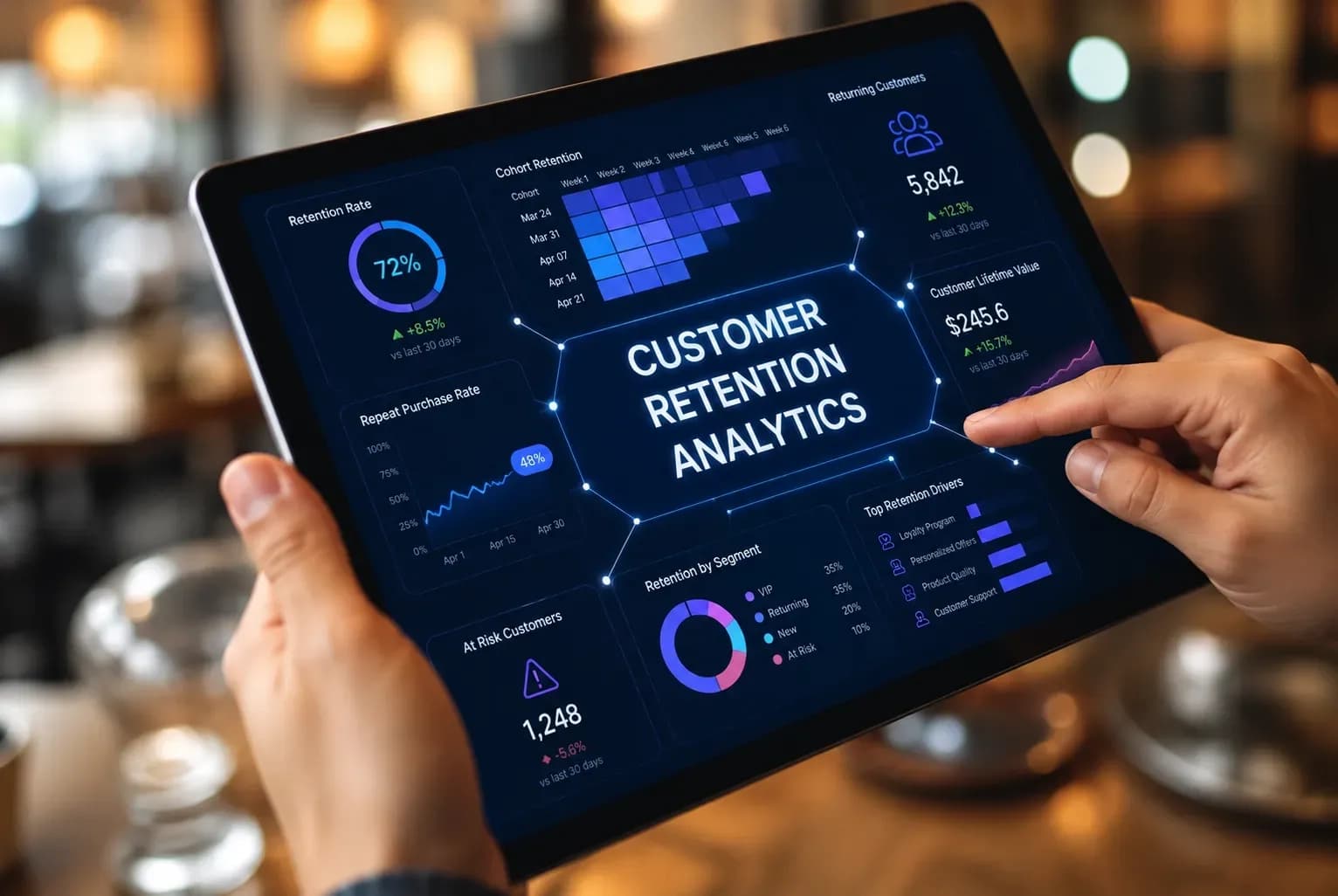 Loyalty Strategy
Customer Retention Analytics: Turn Your Data Into Retention Action
Most retention guides stop at the numbers. This one shows how to read your retention data and turn each metric into a concrete loyalty play for your Shopify store.
Thomas Nguyen Loyalty Strategy
Loyalty Customer Service: How Service Quality Drives Revenue
80% of customers say experience matters as much as products (Salesforce). Loyalty customer service isn't a cost center — it's a revenue lever. This guide covers Harvard's Service-Profit Chain, the service-to-revenue mechanism, and a 5-step recovery system any ecommerce brand can run.
Thomas Nguyen Loyalty Strategy
Advantages of Customer Loyalty: 7 Data-Backed Benefits for Ecommerce Growth
Customer loyalty isn't a feeling — it's a financial asset that compounds. A 5% retention bump drives 25–95% more profit; emotionally connected customers deliver 306% higher LTV. This guide covers all 7 data-backed advantages and the 3 mistakes that kill programs before the compounding kicks in.
Thomas Nguyen Loyalty Strategy
Customer retention benchmarks for ecommerce: What's a good rate?
A clear-eyed look at ecommerce retention benchmarks: the one number worth trusting, why most by-industry tables mislead, and how to benchmark against yourself.
Thomas Nguyen