What Is a Loyalty Discount? (And How to Use It Without Killing Your Margins)
Most merchants avoid discounts because they fear training customers to only buy on sale. Loyalty discounts work differently: they reward earned behavior, not price hunting. Inside: what they actually are, six types that work for ecommerce, and the margin math that proves the ROI.
Summarize this post with AI
"If I give discounts, I'll train customers to only buy on deals."
That fear keeps many merchants from offering discounts at all. And it's not unfounded. Blanket promotional discounts do condition customers to wait for the next sale.
But a loyalty discount runs on a completely different mechanism. Instead of handing out price cuts to trigger a purchase, it rewards customers who've already demonstrated commitment through their buying behavior.
Why does that matter? According to Bain & Company, loyal customers spend 67% more per transaction than new ones. They don't need a discount to buy. They need a reason to keep choosing you over everyone else.
This guide breaks down what loyalty discounts are, which 6 types work for ecommerce, how the margin math works, and the warning signs that your discount structure is quietly eroding profits.
What Is a Loyalty Discount?
A loyalty discount is a price reduction or reward that customers earn through repeated purchases or participation in a loyalty program. Unlike a site-wide sale or a cart abandonment coupon, it's not available to everyone who visits your store.
That changes the psychology entirely. When customers earn a discount, they feel ownership over it. The reward becomes something they've worked toward, not something handed out to drive a quick transaction. Promotional discounts create expectation instead. Customers learn to wait because they know another sale is always around the corner.
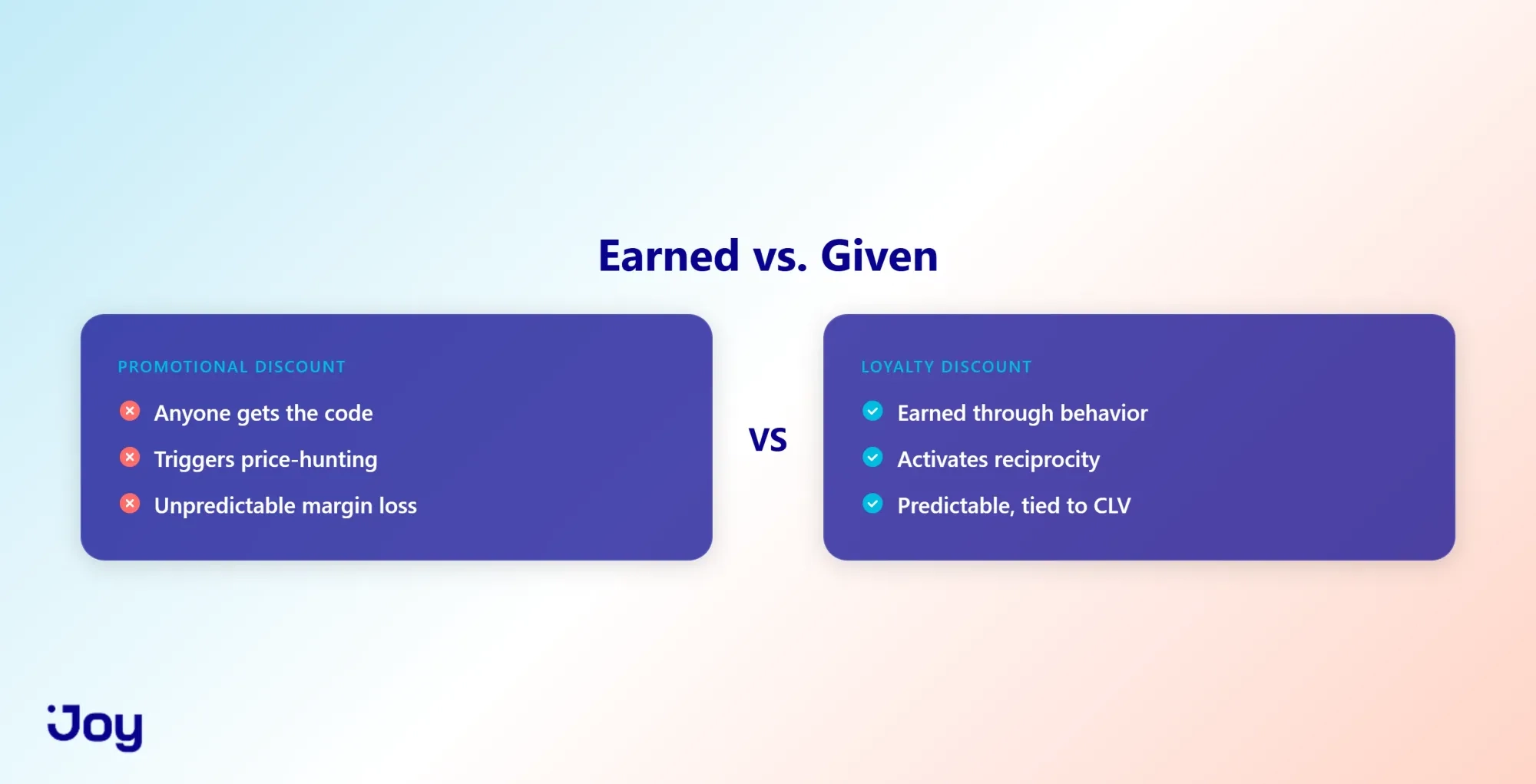
How Loyalty Discounts Work (Earned vs. Given)
Two fundamentally different paths.
With a promotional discount, the brand proactively gives up margin. It pushes a percentage off or a dollar amount to anyone with a code, hoping to trigger a purchase. The customer didn't do anything to earn it. The brand simply decided to sell for less.
With a loyalty discount, the sequence reverses. The customer acts first (purchases, referrals, engagement) and the brand rewards that behavior afterward. Psychologists call this reciprocity: the customer feels invested in the relationship and is more likely to return.
And the trap that promotional discounts create? It's predictable. A discount available to everyone builds a customer base that only activates during promotions. That's not a loyal customer base. Price-motivated customers will abandon a brand the moment a competitor offers a better deal, which traps you in a race to the bottom.
The financial case is just as clear. Acquiring a new customer costs 5 to 7 times as much as retaining an existing one, according to research from Bain & Company and Invesp. Even a generous loyalty discount looks like a bargain compared to the cost of acquiring that same customer through paid ads.
6 Types of Loyalty Discounts That Work for Ecommerce
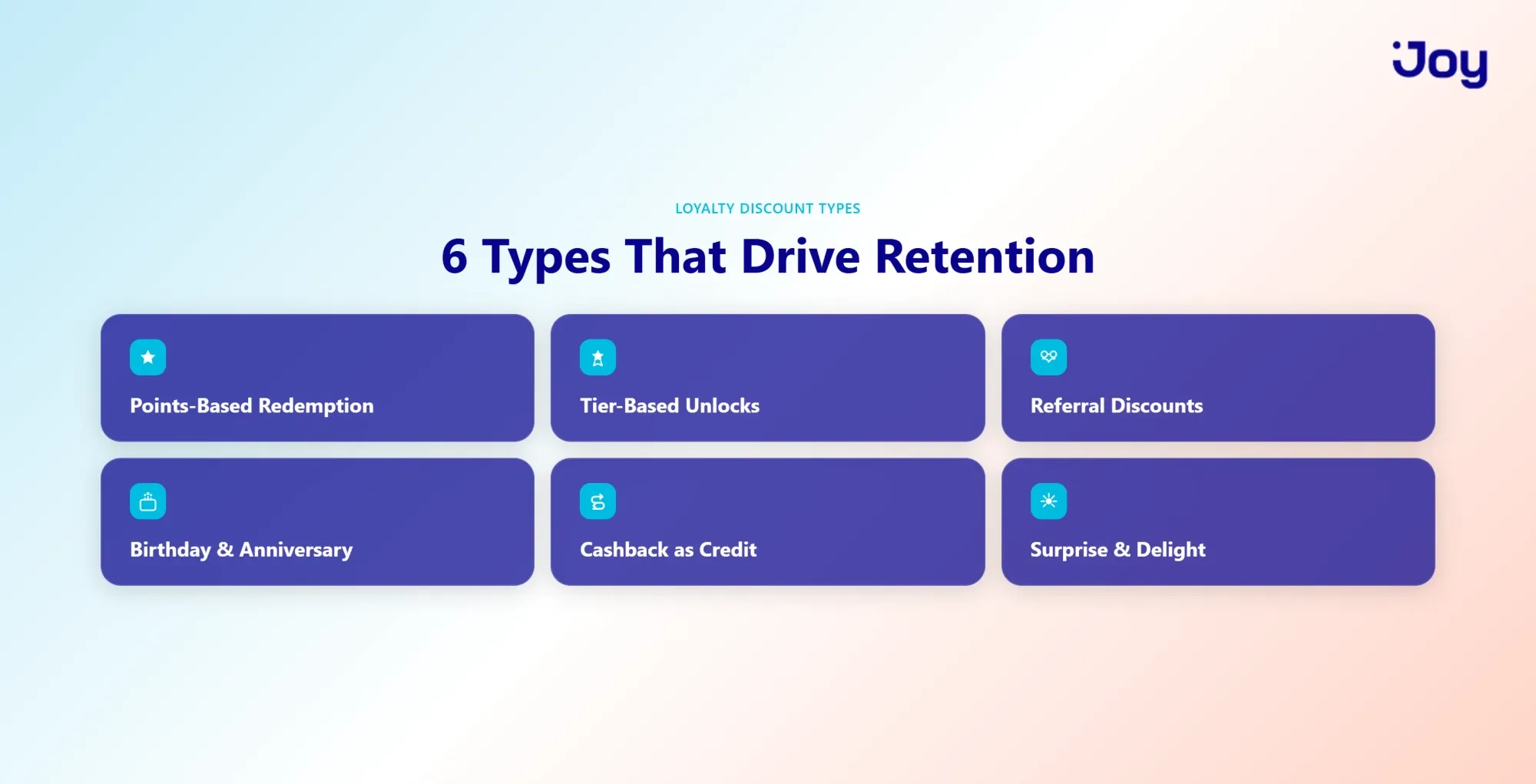
Discounts are one lever, not the whole strategy. The strongest loyalty programs combine discount mechanics with experiential value, such as recognition, exclusive access, and personalization. Still, when you do use discounts, different types reinforce different behaviors. Here are six that work for ecommerce, mapped to what each one drives.
Points-Based Redemption Discounts
Customers earn points with every purchase and redeem them for discount codes or free products. The strength here is the visible balance. When a customer sees they're 50 points away from a reward, that proximity creates a pull to come back and close the gap.
Starbucks Rewards operates this way. Members earn stars per purchase and redeem them for specific items, not blanket percentage discounts. That keeps average order value intact while still rewarding frequency. We break down the full points-program mechanics in our loyalty points programs guide.
Tier-Based Unlock Discounts
In tier-based programs, better discounts unlock as customers hit higher spending thresholds. Entry-level members get recognition and small perks, but the meaningful discounts? Reserved for top-tier customers who've demonstrated significant commitment.
Sephora's Beauty Insider program is a good example. Real discount access is available only at the Rouge tier, which protects margins across the broader membership base while rewarding customers who generate the most revenue. For more on how brands structure tiers, explore these tiered loyalty program examples.
Referral Discounts
Referral discounts reward both the referrer and the new customer with a discount code. The economics are straightforward: two discount codes cost less than the $20 to $50 you'd spend acquiring that same customer through paid ads.
What makes this particularly effective is that it turns existing customers into an acquisition channel. The referral carries built-in trust that no ad can replicate. Not even close.
Birthday and Anniversary Discounts
Time-based, personal discounts triggered by a customer's birthday or their membership anniversary. They consistently generate high redemption rates because they feel like genuine recognition, not a transactional offer.
What sets them apart is the emotional connection. Customers don't associate birthday discounts with deal-hunting behavior. They associate them with being valued. And that distinction drives goodwill that a standard percentage-off code simply can't.
Cashback as a Discount
Cashback programs return a percentage of each purchase as store credit. The margin dynamics differ from a straight discount because the money never actually leaves the ecosystem. Customers return to "spend" their balance, which creates another purchase cycle.
This works especially well for brands with broad product catalogs where customers have reason to browse and discover new items on return visits. For more on structuring cashback rewards, see our cashback loyalty programs guide.
Surprise and Delight (Flash Rewards)
Unannounced discounts delivered to VIP members at random intervals. Because the rewards can't be predicted, they can't be gamed. Customers don't wait for them or plan purchases around them.
That unpredictability is exactly the point. Surprise rewards generate emotional loyalty rather than calculated behavior. The customer remembers how the brand made them feel, not just the discount amount.
Why Loyalty Discounts Work: The Margin Math
The six types above all share a common question merchants ask before implementing any of them: "Am I just giving away margin on customers who would have paid full price anyway?"
The Objection: "They Would Have Paid Full Price"
Understandable concern. But it frames the problem wrong. The real question isn't whether a customer would have bought today at full price. It's whether they'd come back next month without an incentive.
When you reframe it that way, the comparison shifts entirely. You're no longer measuring the loyalty discount against full-price revenue. You're measuring it against the cost of acquiring that repeat visit through paid channels.
The Math That Flips It
Here's how the numbers play out. At a 2% reward rate, a $100 order earns $2 in rewards for the customer. If that $2 brings them back for a second purchase, the effective acquisition cost for order number two is just $2.
Compare that to typical paid customer acquisition costs: $20 to $50, depending on the industry and channel. A loyalty discount is 10 to 25 times cheaper than acquiring the same repeat visit through advertising.
The research confirms it at scale. According to the Bond Brand Loyalty Report (2024), loyalty program members generate 12-18% more revenue per household per year than non-members. And Frederick Reichheld's foundational research for Bain & Company, published in The Loyalty Effect, found that a 5% increase in customer retention rates drives 25-95% profit growth, depending on the industry.
For merchants who want to test their own numbers, the formula is simple:
> Breakeven repeat rate = reward cost per order / incremental gross margin from repeat purchase
At 2% reward value with 40% gross margin, the discount pays for itself with just one additional purchase per year. In most ecommerce categories, that threshold is well within reach. For a detailed framework on tracking loyalty ROI, see our guide on calculating loyalty program ROI.
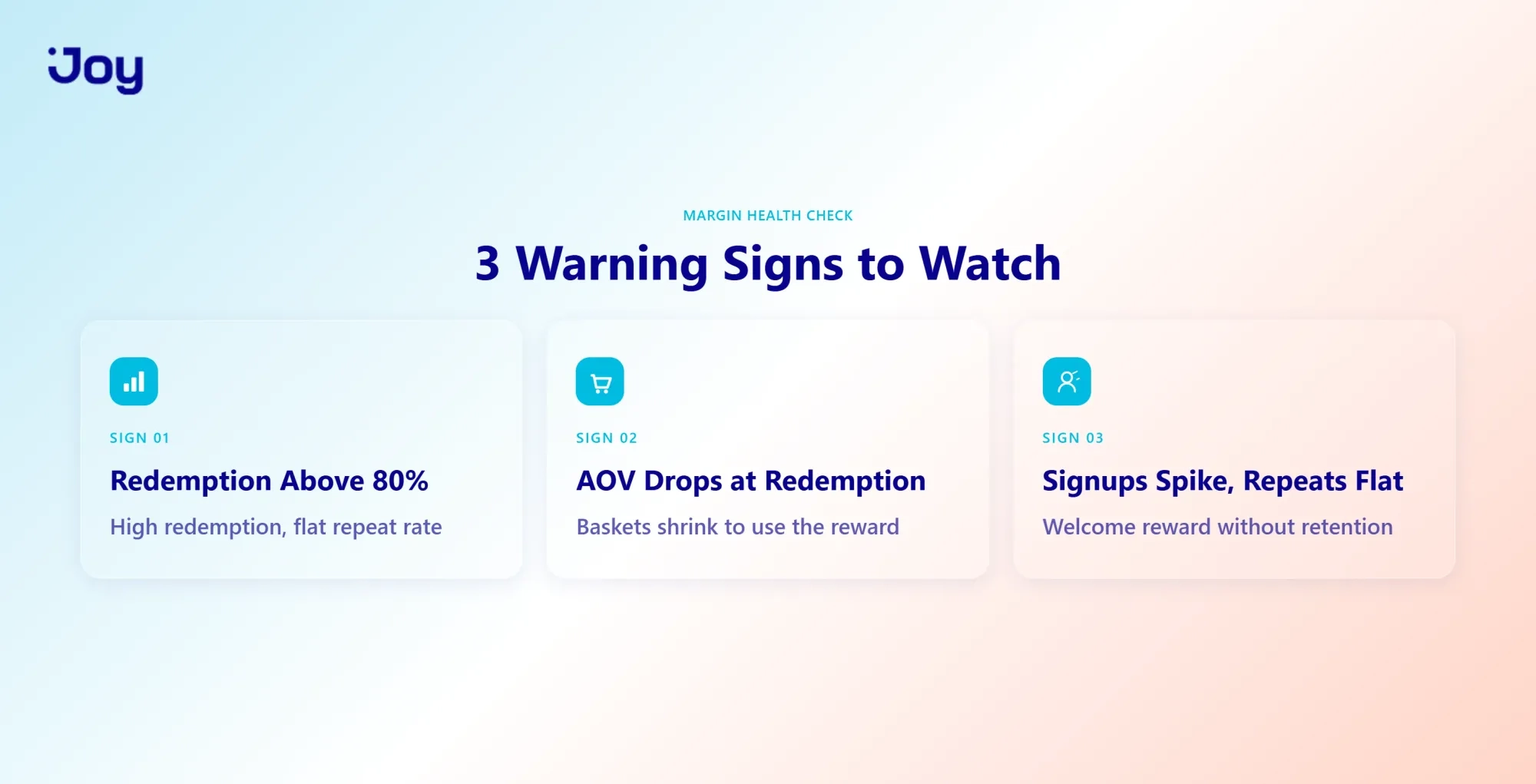
3 Warning Signs Your Loyalty Discount Is Eroding Margins
The math above holds on one condition: the discount is actually changing customer behavior. When it isn't, the warning signs are specific and measurable.
Redemption Rate Above 80%
When nearly every member redeems every earned discount immediately, something's off. A high redemption rate isn't always a success metric. If redemptions sit above 80% but the repeat purchase rate isn't climbing alongside them, the discount is subsidizing purchases that would've happened anyway.
The diagnostic question: are customers redeeming because the discount changed their behavior, or because they timed a purchase they were already planning? When redemption rates are high and repeat rates stay flat, you're reducing margins without generating incremental revenue.
AOV Drops at Redemption
Pay attention to what happens to the average order value when customers redeem. If they're shrinking their baskets, buying only the minimum necessary to apply the reward, the loyalty discount is encouraging smaller orders rather than deeper engagement.
When AOV drops below the discount amount, net revenue per order decreases. The reward ends up costing more than its face value suggests. That's a leak.
New Member Spike, Repeat Purchase Rate Flat
A surge in new signups (especially after introducing a welcome reward) appears to be a success on the surface. But if the repeat purchase rate doesn't move along with it, the discount applies only to one-time transactions. Not relationships.
This pattern often means customers claim the signup incentive and never return. The widening gap between the signup rate and the second-purchase rate reveals that the welcome reward isn't building habits. It's functioning as an acquisition cost disguised as a loyalty investment.
How to Recognize the Right Loyalty Discount Value
Many of those warning signs trace back to a single root variable: the discount value itself. Most merchants set that value by guessing or copying competitors' prices, with no model or margin analysis to back it up. The result? Either rewards so small that nobody bothers to redeem them, or giveaways so generous they quietly bleed profit.
The 1 to 5% Benchmark and Why It Matters
Industry benchmarks place effective loyalty discount values between 1 and 5% of customer spend. Outside that range, problems surface fast.
Below 1%, the reward becomes psychologically invisible. Customers don't perceive enough value to change their behavior, and redemption rates collapse. For context, healthy redemption falls in the 50 to 70% range according to Bond Brand Loyalty and LoyaltyOne benchmarks. If your program sits well below that, the reward likely isn't registering.
Above 5%, the margin risk escalates. That level of reward is only sustainable for brands with very high customer lifetime value (luxury or subscription businesses where long-term revenue per customer justifies a higher upfront cost).
The sweet spot depends on your business model:
- High-frequency, low-AOV (coffee, beauty consumables): 3 to 5% range
- Low-frequency, high-AOV (furniture, electronics): 1 to 2% range, supplemented with experiential rewards
- Subscription models: cashback or store credit tends to outperform percentage discounts
Why One Discount Value Doesn't Fit All Customers
Beyond choosing the right percentage, there's a segmentation dimension that most flat-rate programs miss entirely. Different purchase behaviors signal different needs. Treating a VIP and a first-time buyer identically wastes margin on one while under-investing in the other.
Segmenting by purchase behavior (often using recency, frequency, and monetary value, or RFM analysis) reveals three distinct groups:
High-value repeat customers have already demonstrated loyalty. For this group, premium tier access and exclusive recognition matter more than deeper discounts. They've earned it, and the churn risk is real if they feel undervalued.
At-risk customers (those who purchased two or three times and then went silent) need a targeted re-engagement incentive. A higher-value, time-limited reward can break the silence in a way that a standard ongoing discount can't.
New customers benefit most from a reward tied to their second purchase, not their first. Rewarding the initial transaction often just subsidizes a one-time visit, as warning sign number three makes clear.
The pattern across all three groups: match the discount value to the behavior you want to reinforce. Not to a flat rate applied uniformly.
One caveat worth noting: for brands still establishing product-market fit or operating at a level of consistent repeat purchase volume, the infrastructure costs of a structured loyalty discount program may not yet justify themselves. The math works when there's enough transaction volume to make the retention economics real.
Loyalty Discounts vs. Promotional Discounts
With a clearer picture of how loyalty discounts work, what they cost, and where they break, the final distinction worth drawing is how they compare to the promotional discounts most merchants already run.
| Who gets it | Earned by program members | Anyone with the code |
|---|---|---|
| Triggers | Past customer behavior | Brand's decision |
| Customer psychology | Reciprocity, status | Price-hunting |
| Margin impact | Predictable, tied to CLV | Broad, unpredictable |
| Risk | Discount dependency if misdesigned | Trains customers to wait for sales |
| Data collected | Zero-party behavioral data | None |
Neither approach is universally wrong. Promotional discounts serve a purpose for clearing inventory, driving seasonal traffic, or acquiring first-time customers. The distinction is whether the discount reinforces a relationship or simply triggers a transaction. For a broader look at how these mechanics fit into different retention strategies, see our overview of loyalty program types.
What Separates a Loyalty Discount From a Margin Leak
A loyalty discount isn't a margin risk. It's a retention investment that costs 10 to 25 times less than paid acquisition when the right structure is in place.
The difference between a loyalty discount and a promotional discount comes down to one principle: earned versus given. The math works when redemption drives repeat behavior that wouldn't have happened otherwise. And it breaks when discounts subsidize purchases that were already inevitable, when baskets shrink at redemption, or when welcome rewards attract signups without generating second purchases.
That 67% spending gap between loyal and new customers, documented by Bain & Company, means the discount is funded by the very behavior it creates. The question isn't whether loyalty discounts work. It's whether yours is designed to change behavior or simply reduce price.
If you're evaluating whether a loyalty discount structure could work for your store, exploring how different loyalty program models handle discounting and retention is a practical next step.

Written by
Thomas Nguyen is the CEO & Co-founder of Joy, a loyalty solution for Shopify and eCommerce brands. With years of experience building high-performance Shopify apps, Thomas aims to help merchants grow through customizable and retention-focused tools.
Related reading
 Loyalty Strategy
A Deep Dive Into Paid Loyalty Programs: Why Is It Gaining Popularity?
Paid loyalty program is a type of loyalty program where customers pay a recurring fee in exchange for exclusive perks and benefits. Let’s see how it works and real life examples.
 Thomas Nguyen
 Loyalty Strategy
Customer Acquisition vs Retention: Where to Put Your Next Dollar
Customer acquisition and retention aren't a contest. Here's what each really costs, when to prioritize which, and a simple LTV:CAC way to decide your split.
Thomas Nguyen Loyalty Strategy
Customer Retention Cost: Formula & Strategies to Optimize It
Customer retention is often cheaper than acquisition, but are you managing your costs effectively? Learn how to calculate retention costs and optimize your strategy without overspending.
Thomas Nguyen Loyalty Strategy
Loyalty Fraud Prevention: Protect Your Program, Keep the Experience
One of the key experiences that makes your loyalty program valuable is the attack surface that fraudsters exploit. Here's how to defend the program without losing the customers you built it for.
Thomas Nguyen Loyalty Strategy
Open Source Loyalty Platform: The Honest Guide (2026)
Open source loyalty platform sounds like the dream — full code access, zero licensing, total control. The reality is messier. This honest guide covers what's actually available in 2026, real total cost vs SaaS, security/compliance shifts, and a build-buy-compose framework.
Thomas Nguyen Loyalty Strategy
Earn-and-Burn Loyalty Programs: All You Need To Know
Discover how earn-and-burn loyalty programs work, why they drive customer engagement, and how to design one that boosts revenue and retention.
Thomas Nguyen