
How to Measure Customer Loyalty: 8 Metrics That Matter
Nearly half of businesses don't track their retention rate. This guide breaks down 8 customer loyalty metrics — with formulas, ecommerce benchmarks, and how to pick the 3 that actually matter for your store.

Summarize this post with AI
44% of businesses don't know their churn or retention rate. Nearly half. That means almost one in two companies is flying blind on the single most important question in their business: are customers actually staying?
You probably have some data. Order history in Shopify. Maybe an NPS survey you ran last quarter. Perhaps a spreadsheet tracking repeat purchases. But having data and knowing what it means are two very different things.
This guide walks you through eight metrics that separate loyalty sentiment from loyalty action. By the end, you'll know exactly which three or four metrics your business needs, along with formulas you can apply today and eCommerce benchmarks to measure against.
Why Customer Loyalty Measurement Fails
Before diving into specific metrics, it's worth understanding why so many businesses get customer loyalty measurement wrong. The problem isn't a lack of data. It's that different types of data never connect.
Data lives in silos. Behavioral data like repeat purchases and browsing patterns sits in Shopify or Google Analytics. Emotional data from NPS surveys and satisfaction scores live in separate survey tools. These two worlds rarely talk to each other. You see what customers do or how they feel, but not both at once.
Too many metrics create paralysis. Google "how to measure customer loyalty" and you'll find lists of 15, 20, even 30 metrics. That's overwhelming. And the real question isn't "what can I track?" It's "What should I track for my specific business?"
Benchmarks get confusing fast. A 30% customer retention rate is solid for eCommerce, but B2B companies average 77% (CustomerGauge). Without the right context, you might think your store is failing when it's actually performing above average.
Survey fatigue kills data quality. Customers stop responding to post-purchase surveys after the third or fourth request. Response rates drop. And the people still answering tend to skew toward extremes: the ones who either love or hate the experience.
Numbers without context don't lead anywhere. You can have an NPS of 45 and still not know why customers feel that way or what to do about it. 86% of B2B brands don't measure the ROI of their customer experience initiatives (CustomerGauge). Data goes in, but action rarely comes out.
The good news? You don't need to track everything. You need the right three to four metrics for your business model.
Financial Metrics for Measuring Customer Loyalty
Financial metrics answer the most fundamental loyalty question: Is customer loyalty translating into revenue? They give you the clearest picture of long-term business health.
How to Measure Customer Lifetime Value (CLV)
Customer Lifetime Value represents the total revenue a customer generates across their entire relationship with your business. It's the metric that tells you which customers are worth investing in and how much you can afford to spend acquiring new ones.
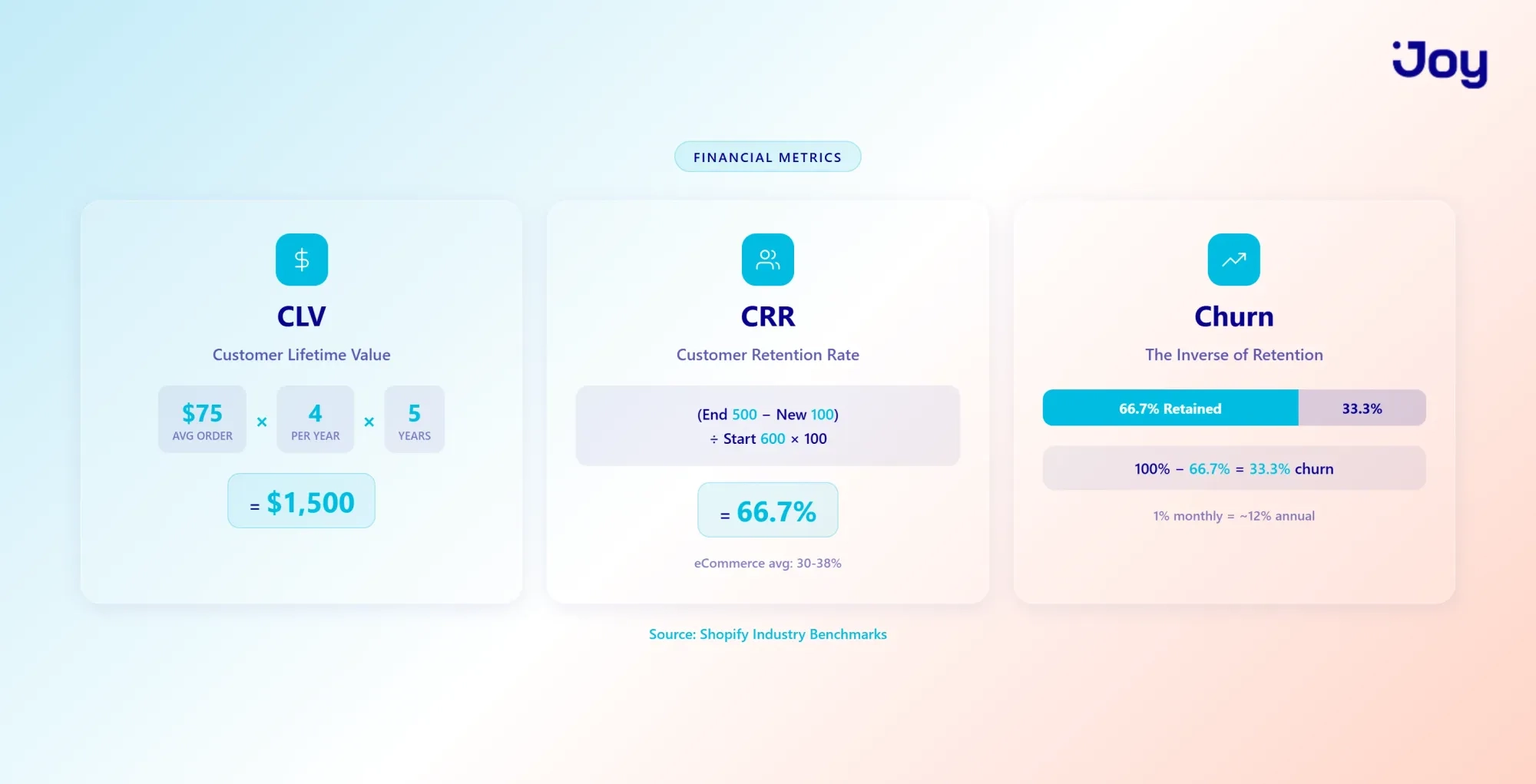
Formula: Average Purchase Value x Purchase Frequency x Customer Lifespan
A quick example. Say your average order is $75, customers buy four times per year, and the typical relationship lasts five years. That gives you a CLV of $1,500.
Why does this matter? Because CLV sets the ceiling for your acquisition budget. Harvard Business Review shows that acquiring a new customer costs five to 25 times more than retaining an existing one. For eCommerce, a healthy CLV should be at least three times your customer acquisition cost. Anything below that ratio, and you're spending more to get customers than they'll ever return.
Measuring Customer Loyalty Through Retention Rate (CRR)
CLV shows the value of keeping customers. Customer Retention Rate reveals whether you're actually keeping them. It's the percentage of customers from the start of a period who are still active at the end.
Formula: (End Customers - New Customers) / Start Customers x 100
Say you started the quarter with 600 customers, gained 100 new ones, and ended with 500 total: (500 - 100) / 600 x 100 = 66.7% retention.
According to Shopify's industry benchmarks, eCommerce retention rates of 20 to 40% are considered good, with 30 to 38% being the industry average. B2B retention runs much higher at around 77%.
One important distinction: don't confuse retention rate with repeat purchase rate. They measure different things, and we'll cover that difference shortly.
Churn Rate: The Inverse of Retention
Churn rate is the flip side of retention. If your retention rate is 66.7%, your churn rate is 33.3%. Same data, different framing.
Formula: 100 - Retention Rate (or: Lost Customers / Start Count x 100)
So why track it separately? Framing matters. Telling your team, "We retained 67% of customers," feels acceptable. Telling them "we lost a third of our customers" creates urgency. Same reality, but one drives action faster.
And the compounding effect is real. Even 1% monthly churn adds up to roughly 12% annual churn. Small leaks become costly retention problems fast, which is why tracking churn monthly catches issues before they spiral.
How to Measure Customer Loyalty Using Sentiment Metrics
Financial metrics tell you the "what." Sentiment metrics tell you the "why." Together, they form a complete picture of customer loyalty. Without sentiment data, you might know that 33% of customers churned last quarter, but you won't know if the cause was pricing, product quality, shipping delays, or something else entirely.
How to Use Net Promoter Score (NPS) to Measure Loyalty
Net Promoter Score remains the most widely used loyalty sentiment metric. One question: "On a scale of 0 to 10, how likely are you to recommend us?"
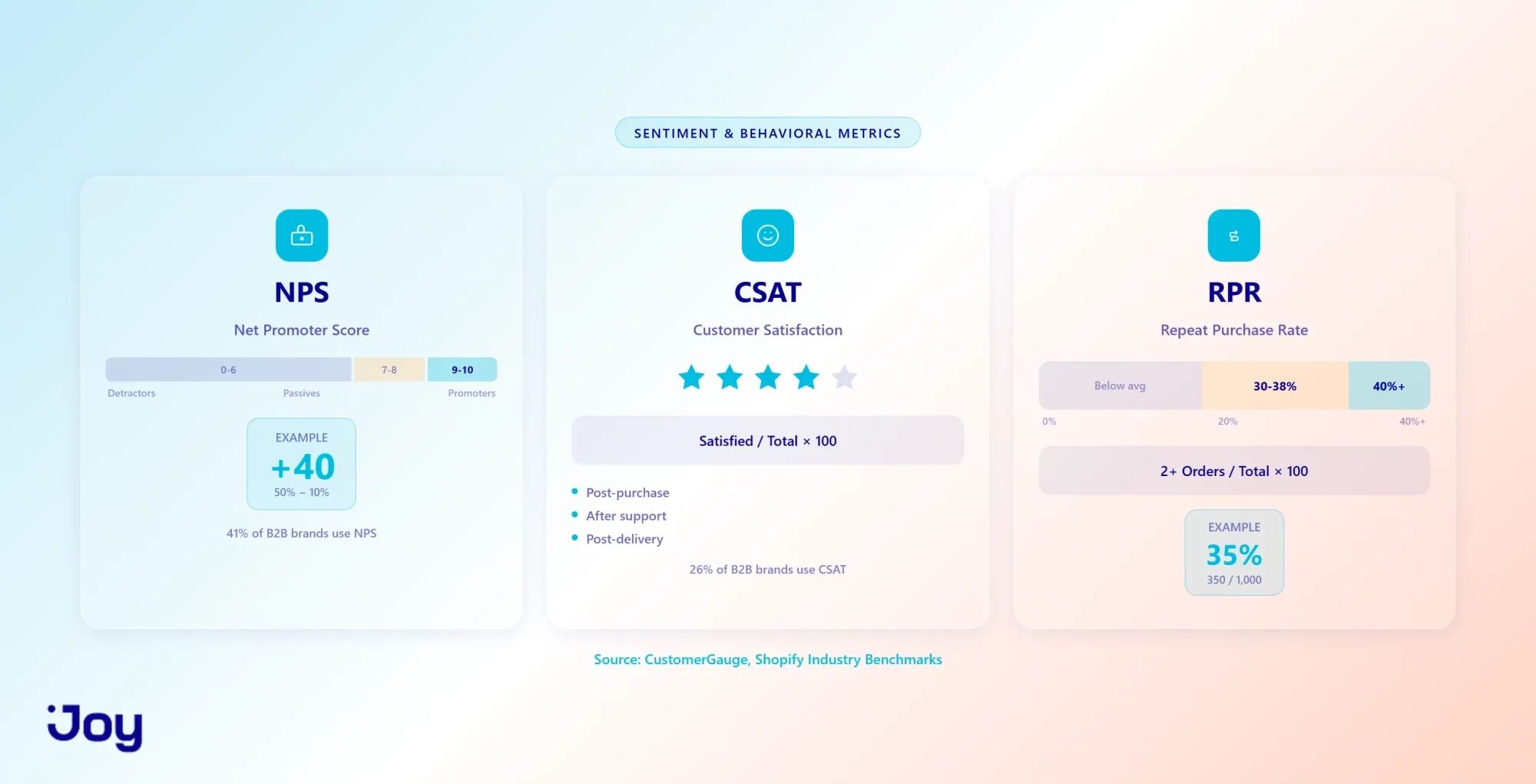
Formula: % Promoters (9-10) - % Detractors (0-6) = NPS
Responses fall into three groups. Promoters (9 and 10) are loyal advocates. Passives (7 and 8) are satisfied but not vocal. Detractors (0 through 6) are at risk and may actively discourage others.
If 50% of respondents are Promoters and 10% are Detractors, your NPS is +40. That's strong.
Adoption is significant: 41% of B2B brands (CustomerGauge) actively use NPS for loyalty measurement. But here's the trap. A high NPS doesn't automatically translate to high repeat purchases. Someone can love your brand and still not buy again because of price, availability, or simply forgetting. That's why NPS works best paired with behavioral metrics like Repeat Purchase Rate.
Measuring Customer Satisfaction: The CSAT Score
NPS measures overall loyalty sentiment. CSAT zooms in on specific interactions. The question is simple: "How satisfied were you with this experience?" on a scale of one to five (or one to 10).
Formula: (Number of Satisfied Responses / Total Responses) x 100
CSAT is fast, focused, and best deployed at specific touchpoints: right after a purchase, following a support interaction, or post-delivery. 26% of B2B brands use CSAT (CustomerGauge), and while its adoption is lower than NPS, it excels at catching experience-level problems that broader metrics miss.
Think of it this way. NPS tells you the overall temperature. CSAT tells you which room is too hot or too cold.
Repeat Purchase Rate (RPR): The Behavioral Counterpart
RPR is where sentiment meets action. And for eCommerce, it's arguably the most valuable metric on this list. It measures the percentage of customers who made two or more purchases.
Formula: Customers with 2+ Orders / Total Customers x 100
If 350 out of 1,000 customers have purchased more than once, your RPR is 35%.
The eCommerce benchmark sits at 20 to 40%, with 30 to 38% considered average. What makes RPR so powerful is its directness. NPS tells you who would recommend your store. RPR tells you who actually came back and bought again. One is a prediction. The other is proof.
This is also where loyalty programs create a measurable edge. Referral rewards and repeat purchase incentives directly influence RPR, making it the clearest metric for tracking whether your retention efforts are actually translating into revenue.
Referral Rate and Word-of-Mouth Tracking
Referral rate measures the percentage of customers who actively refer others, whether through a structured program, organic word-of-mouth, or social sharing.
Why track this? Referrals represent the highest-quality acquisition channel, with lower acquisition costs and higher lifetime value than paid channels. Key signals to watch: referral link clicks, referral-to-conversion rate, and program-driven versus organic referral split.
Measuring Customer Loyalty With the RFM Model and Behavioral Analytics
Individual metrics like NPS and RPR tell you about your customer base as a whole. But not all customers are equal. Treating them as one group means missing your most valuable segments alongside your most at-risk ones. RFM solves this by sorting customers into actionable groups based on actual behavior.
The RFM Model: Measuring Customer Loyalty by Behavior
RFM stands for Recency, Frequency, and Monetary Value. Each customer gets scored on three dimensions:
- Recency: Days since their last purchase. More recent means more engaged.
- Frequency: Number of purchases in a given period. Higher frequency signals stronger loyalty.
- Monetary: Total amount spent. Higher spend indicates greater value.
Score each dimension from one to five, and distinct segments emerge. Customers scoring high across all three are your "Champions." Protecting them should be your top retention priority. Those scoring low across the board? "At-Risk" and in need of immediate attention. High recency with low frequency and monetary value? "New Customers" who need nurturing toward their second and third purchases.
What makes RFM especially useful is that it moves you past broad averages. Instead of saying "our retention rate is 35%," you can say "our Champions segment grew 8% while our At-Risk segment shrank 3%." That's a story you can act on.
For brands using tiered loyalty programs, RFM segments map naturally to VIP tiers. Champions become your top tier with the best rewards. At-Risk customers receive targeted win-back incentives. The framework and the program reinforce each other.
Engagement Signals: The Early Warning System
Beyond purchase behavior, engagement signals act as leading indicators. They reveal loyalty shifts before they show up in your retention rate.
Track these: website visit frequency, email open rates, loyalty program activity (point redemptions, reward browsing), and support ticket patterns. A customer who stops opening emails and hasn't logged in for 60 days is already leaving, even if they technically haven't churned yet.
As CustomerGauge puts it: "Absence of signal is a signal." For eCommerce, pay particular attention to login frequency, wishlist activity, and review submissions. These are engagement proxies that cost nothing to track but reveal a lot about loyalty trajectory.
Behavioral Loyalty vs. Emotional Loyalty: The Customer Loyalty Matrix
All the metrics we've covered fall into two categories. Behavioral loyalty is what customers do: repeat purchases, referral clicks, and point redemptions. Emotional loyalty is how they feel: NPS scores, satisfaction ratings, brand advocacy.
You need both. One without the other creates blind spots.
Behavioral loyalty without emotional loyalty means your customers are transactional. They buy because of price or convenience, and they'll leave the moment a cheaper option appears. Emotional loyalty without behavioral loyalty means customers like you but aren't buying. Something in the purchase path is creating friction.
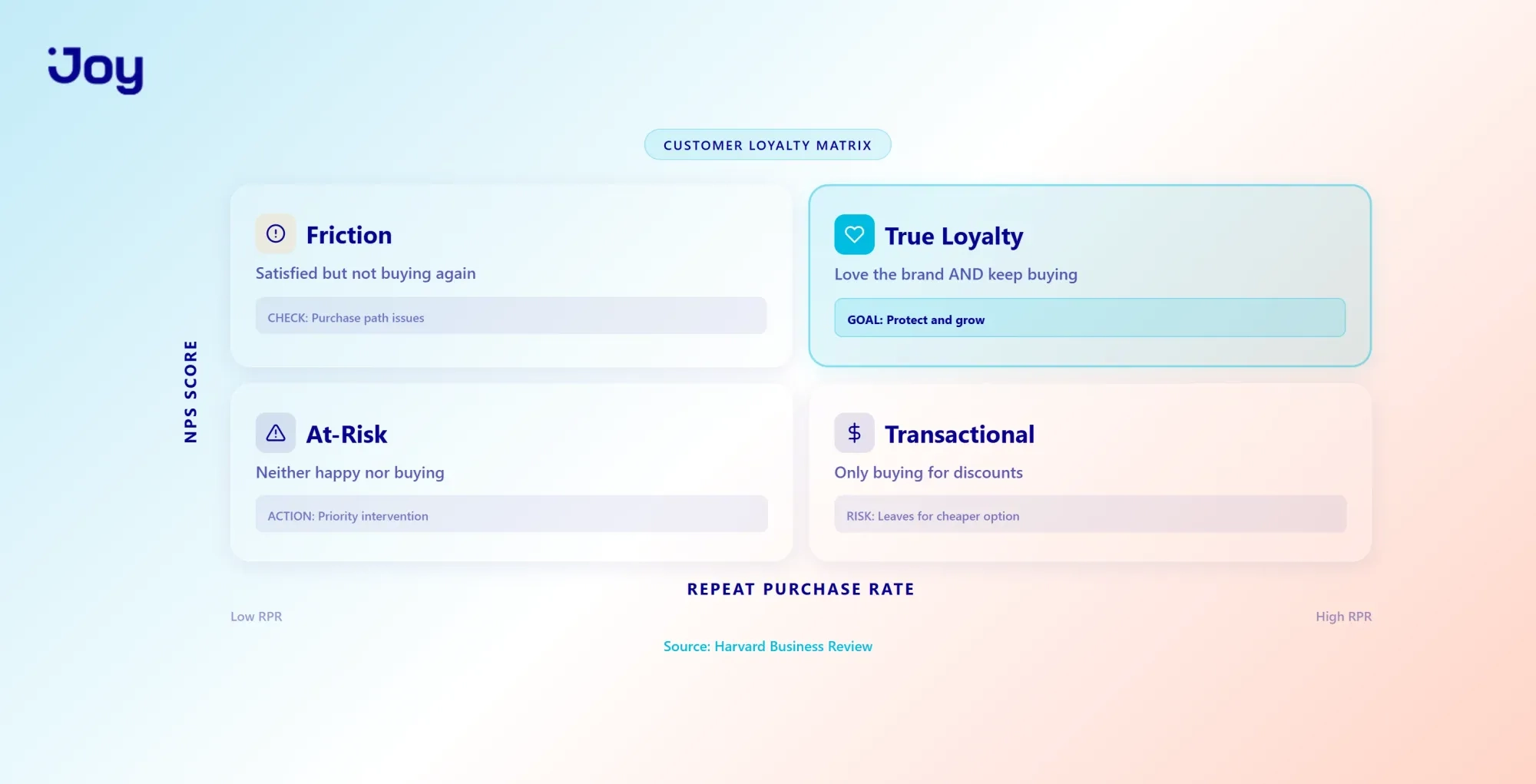
The clearest way to visualize this customer loyalty matrix is a two-by-two grid using NPS and RPR:
- High NPS + High RPR = True Loyalty. Customers love your brand and keep buying.
- High NPS + Low RPR = Friction. They're satisfied but something prevents repeat purchases. Investigate your purchase path.
- Low NPS + High RPR = Transactional. They're only buying for discounts. One competitor price cut and they're gone.
- Low NPS + Low RPR = At-Risk. Neither sentiment nor behavior is working. Priority intervention needed.
Research from Harvard Business Review confirms the financial stakes: satisfied customers spend 140% more than unsatisfied ones. That gap makes measuring both dimensions essential. Not optional.
Qualitative Feedback: The "Why" Behind the Numbers
Surveys and Reviews as Loyalty Measurement
Quantitative metrics like NPS, RPR, and CLV show what's happening across your customer base. Qualitative feedback explains the reasons behind those numbers.
Four practical methods to gather this insight:
- Post-purchase surveys: Keep them short. One to three questions, tied to a specific experience. "How was your delivery?" tells you more than "How do you feel about our brand?"
- Customer reviews: Product reviews reveal quality signals, expectation gaps, and sentiment patterns you won't find in any dashboard.
- Open-ended NPS follow-ups: Adding "Why did you give this score?" to your NPS survey turns a number into a narrative. Those answers uncover the real drivers behind loyalty shifts.
- User-generated content: Customer photos, videos, and social mentions represent unprompted loyalty signals. Nobody posts about a brand they feel neutral about.
One critical warning: survey fatigue is real. Keep surveys short, rotate your questions, and don't survey every transaction. Burning out your customers with feedback requests defeats the purpose.
The most actionable approach? Combine quantitative and qualitative together. "RPR dropped 5% last month" is a fact. "RPR dropped 5%, and reviews mention shipping delays" is an insight you can act on immediately.
For eCommerce brands, product reviews serve double duty. They function as both a loyalty measurement tool and social proof for new customers. Two benefits from one data source.
How Do You Measure Customer Loyalty? Choosing the Right Metrics
Not every metric fits every business. Your measurement strategy should match your business model and the specific loyalty questions you need answered.
Start with your model:
- High-repeat eCommerce (consumables, beauty, grocery, subscriptions): Prioritize RPR, CRR, CLV, and RFM segmentation. Purchase frequency is your key signal.
- Low-repeat eCommerce (luxury goods, furniture, electronics): Prioritize CLV, NPS, and behavioral signals like reviews and referrals. Individual customer value matters more than frequency.
- B2B SaaS: Prioritize NPS, CLV, churn rate, and expansion revenue. Relationship depth outweighs transaction volume.
The three-metric minimum:
Regardless of your model, every business needs at least three metrics working together:
- One revenue metric (CLV) to connect loyalty to financial outcomes
- One behavioral metric (RPR for eCommerce, NPS for B2B) to track actual loyalty actions
- One trend metric (CRR or churn rate) to show whether loyalty is improving or declining over time
Adding a fourth metric, like the Customer Loyalty Index (a composite of NPS, repurchase likelihood, and CSAT), strengthens executive reporting but isn't strictly required for day-to-day decisions.
The most common mistake? Believing that measuring NPS alone counts as measuring customer loyalty. It doesn't. 86% of B2B brands don't measure the ROI of their customer experience efforts. That disconnect between sentiment data and business results is exactly why single-metric approaches fail.
For ambitious eCommerce brands ($50K to $500K per month):
- Essential: RPR, CLV, RFM segmentation
- Strategic: NPS + qualitative feedback + referral tracking
- Dashboard view: RPR + CLV + program-driven orders (referral conversions, discount code redemptions)
This combination gives you behavioral proof, financial context, and directional trend data. Three lenses on the same question: are customers actually loyal, and is that loyalty driving revenue?
From Customer Loyalty Measurement to Action
You now have eight metrics, their formulas, eCommerce benchmarks, and a framework for choosing the right ones. But measuring customer loyalty is only step one. Acting on what the data reveals is step two.
What that looks like in practice: say your RPR is 22%, below the 30% average benchmark. That number alone tells you repeat purchases need attention. Pair it with qualitative feedback showing that customers love your product but often forget to reorder, and you have a clear action: launch a reorder reminder sequence or a referral incentive program to address that gap.
The advantage of behavioral loyalty data is that it doesn't depend on surveys. Signals like referral link clicks, discount code redemptions, and point accumulation velocity are directly derived from customer actions. No survey fatigue, higher data quality, and a more reliable picture of loyalty than sentiment scores alone.
Your next step: pick your three metrics. Measure for 30 days. Then compare against the benchmarks in this guide and identify your biggest gap. That gap is where your first optimization should focus.
To see how loyalty programs turn measurement data into automated behavioral signals, explore our guide to customer loyalty analytics.
FAQ
What is the best metric for measuring customer loyalty?
There's no single best metric. For eCommerce, Repeat Purchase Rate (RPR) is the most actionable because it directly measures buying behavior. Combine it with at least one sentiment metric (NPS or CSAT) and one revenue metric (CLV) for a complete picture.
How often should you measure customer loyalty?
Monthly for behavioral metrics (RPR, CLV, churn). Quarterly for sentiment surveys (NPS, CSAT) to avoid survey fatigue. Review RFM segments quarterly and adjust loyalty strategies in response to segment shifts.
What's a good customer retention rate for eCommerce?
20 to 40% is considered good, with 30 to 38% being the industry average. B2B benchmarks are around 77%. Compare within your specific industry rather than across categories.
What's the difference between NPS and CSAT?
NPS measures overall loyalty likelihood ("Would you recommend us?") on a 0 to 10 scale. CSAT measures satisfaction with a specific interaction ("How satisfied were you?"). NPS is broader and strategic. CSAT is focused and tactical.
How do you measure customer loyalty without surveys?
Track behavioral signals: repeat purchase rate, purchase frequency, referral activity, engagement metrics (login frequency, email opens), and RFM scoring. These measure what customers do rather than what they say.
What is the RFM model in customer loyalty?
RFM segments customers by Recency (days since last purchase), Frequency (number of purchases), and Monetary value (total spend). Each dimension is scored one to five, creating segments like "Champions" (high across all three) or "At-Risk" (low across all three).
How do you calculate customer lifetime value?
CLV = Average Purchase Value x Purchase Frequency x Customer Lifespan. For example: $75 average order x four purchases per year x five years = $1,500 CLV. Your CLV should be at least three times your customer acquisition cost.
What is a Customer Loyalty Index?
A composite score combining NPS, repurchase likelihood, and satisfaction. Formula: (NPS + Repurchase % + CSAT) / 3. It's useful for executive reporting but hides individual metric details.
What's the difference between behavioral and emotional loyalty?
Behavioral loyalty is what customers do (repeat purchases, referrals). Emotional loyalty is how they feel (satisfaction, brand advocacy). Both matter. Behaviorally, without emotional means, customers leave when a cheaper option appears. Emotionally, without behavioral means, they like you but don't buy.
How do loyalty programs help measure customer loyalty?
They generate first-party behavioral data: referral link clicks, discount code redemptions, point accumulation velocity, and tier progression. This data measures loyalty through actions rather than survey responses, avoiding survey fatigue and producing higher-quality signals.

Written by
Thomas Nguyen is the CEO & Co-founder of Joy, a loyalty solution for Shopify and eCommerce brands. With years of experience building high-performance Shopify apps, Thomas aims to help merchants grow through customizable and retention-focused tools.
Related reading
 Loyalty Strategy
Customer Retention Goals: 5 Targets to Set (and How to Hit Them)
A goal-first guide to customer retention: the five targets worth setting, how to make each one SMART, and the strategy that hits it.
 Thomas Nguyen
 Loyalty Strategy
Customer Satisfaction and Brand Loyalty: 2026 Growth Guide
25-35% of satisfied customers still switch silently. This guide explores the gap between customer satisfaction and brand loyalty — and the 4 metrics (NPS, CES, redemption rate, LTV) that turn happy buyers into emotionally connected advocates when acquisition costs are 4× higher.
Thomas Nguyen Loyalty Strategy
Customer Retention Analytics: Turn Your Data Into Retention Action
Most retention guides stop at the numbers. This one shows how to read your retention data and turn each metric into a concrete loyalty play for your Shopify store.
Thomas Nguyen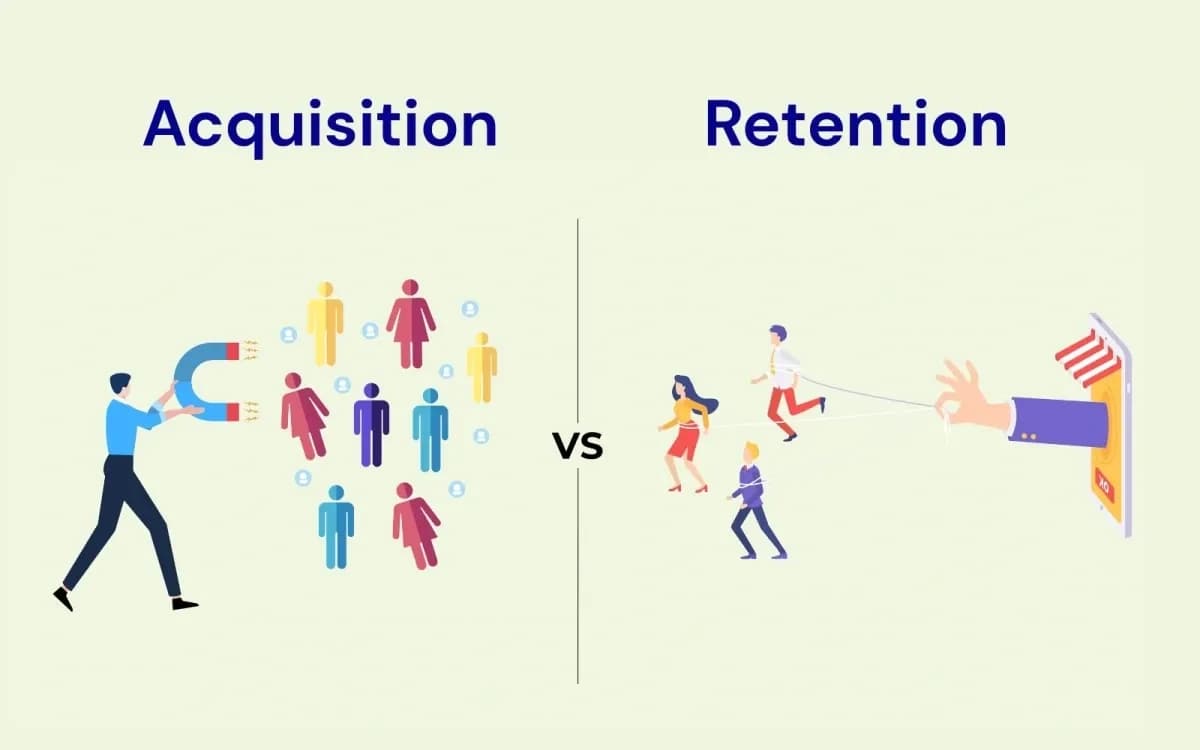 Loyalty Strategy
Customer Acquisition vs Retention: Where to Put Your Next Dollar
Customer acquisition and retention aren't a contest. Here's what each really costs, when to prioritize which, and a simple LTV:CAC way to decide your split.
Thomas Nguyen Loyalty Strategy
Customer Loyalty Management: Your Guide to Maximizing Repeat Revenue
Customer loyalty management is the system that turns one-time buyers into repeat revenue. This guide covers segmentation, reward design, omnichannel sync, and how to measure ROI — with frameworks you can put to work this quarter.
Thomas Nguyen Loyalty Strategy
Customer retention benchmarks for ecommerce: What's a good rate?
A clear-eyed look at ecommerce retention benchmarks: the one number worth trusting, why most by-industry tables mislead, and how to benchmark against yourself.
Thomas Nguyen