Advantages of Customer Loyalty: 7 Data-Backed Benefits for Ecommerce Growth
Customer loyalty isn't a feeling — it's a financial asset that compounds. A 5% retention bump drives 25–95% more profit; emotionally connected customers deliver 306% higher LTV. This guide covers all 7 data-backed advantages and the 3 mistakes that kill programs before the compounding kicks in.

Summarize this post with AI
Customer loyalty isn't a feeling. It's a financial asset that compounds, generates first-party data competitors can't replicate, and builds switching costs that make price comparison irrelevant. Most ecommerce brands treat it as a nice-to-have. The ones who treat it as infrastructure? They're growing revenue roughly twice as fast.
The numbers back this up. A 5% retention increase produces 25–95% more profit. Emotionally connected customers deliver 306% higher lifetime value. Loyalty leaders grow revenue roughly twice as fast as peers who don't invest in retention. These aren't soft metrics. They come from Bain, McKinsey, Harvard Business Review, and Motista research across hundreds of thousands of customers.
This article covers all seven data-backed advantages of customer loyalty, why the math gets worse the longer you wait to act, and the three structural mistakes that cause programs to fail before the compounding kicks in.
What Are the Advantages of Customer Loyalty?
Customer loyalty produces seven measurable business advantages, each backed by independent research:
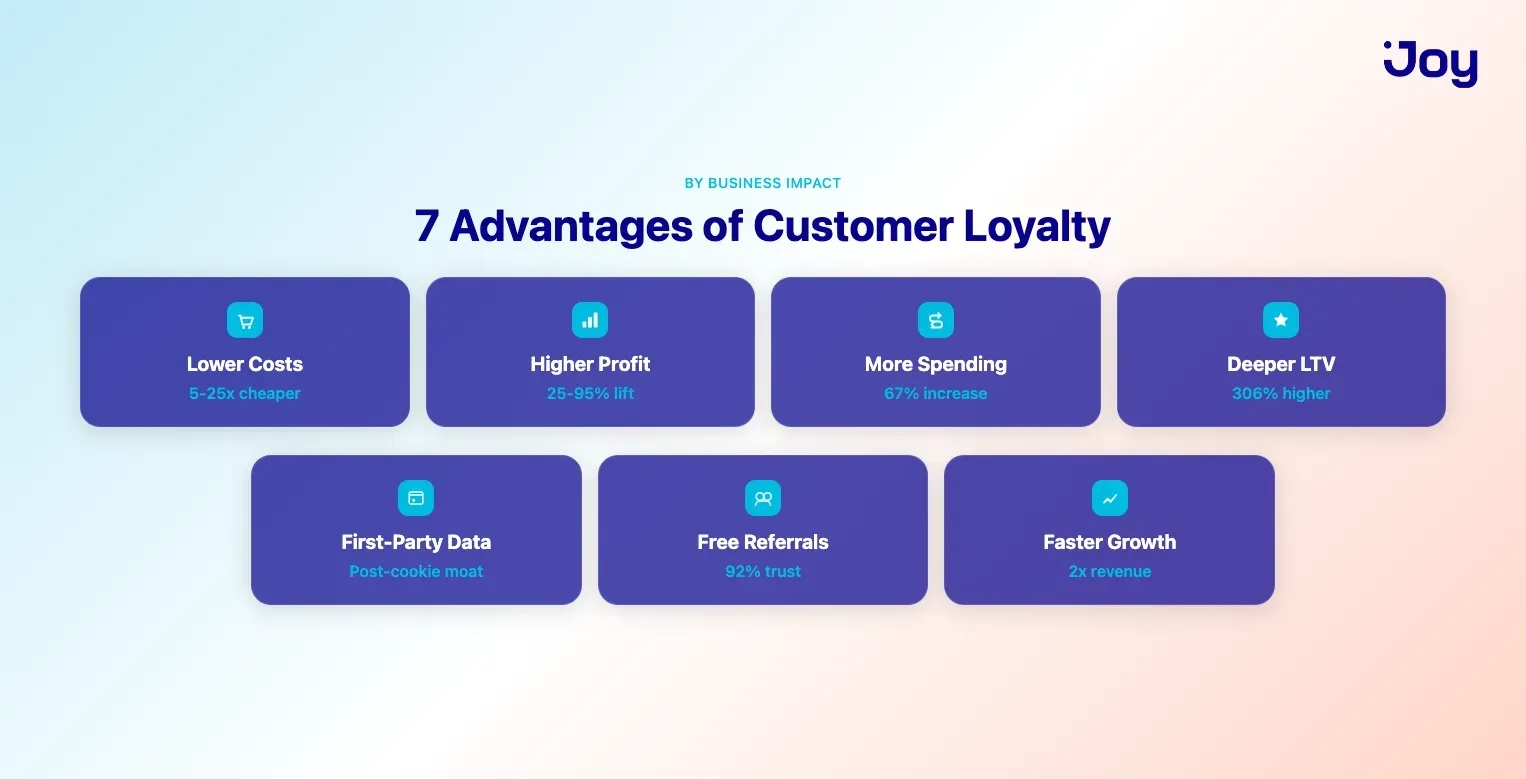
- Lower acquisition costs: retaining a customer costs 5-25x less than acquiring a new one (Bain/HBR)
- Higher profit margins: a 5% retention increase drives 25-95% more profit, depending on industry
- Compounding customer spend: loyal customers spend 67% more than new buyers, and the gap accelerates over time
- Higher lifetime value: emotionally connected customers have 306% higher LTV than merely satisfied ones (Motista)
- First-party data asset: loyalty programs collect consent-based purchase and preference data competitors can't replicate
- Free referral acquisition: loyal customers refer at 71% vs. 45% for satisfied-but-not-loyal customers; referral CAC is $5-$15 vs. $45-$300 paid
- Structural switching costs: loyalty leaders grow revenues roughly 2x faster than industry peers (Bain)
The sections below break down each advantage with data, then cover the three structural mistakes that prevent brands from capturing any of them.
The Revenue Advantages of Customer Loyalty
Revenue is where the loyalty advantage hits hardest. Not by a few percentage points. By multiples.
Advantage 1: Retention Costs 5-25x Less Than Acquisition
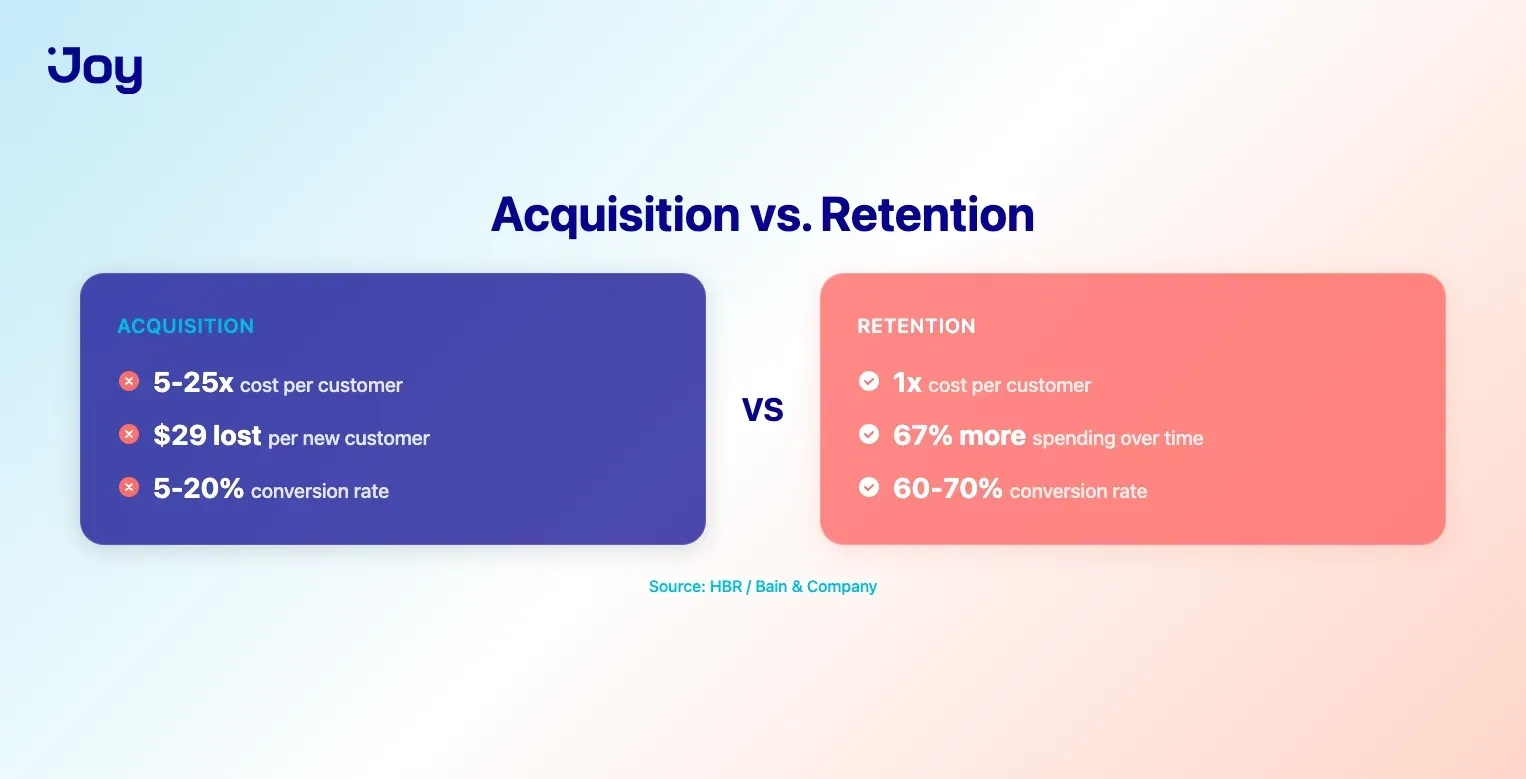
Acquiring a new customer costs five to 25 times more than retaining an existing one. That finding comes from Frederick Reichheld's research at Bain & Company, published in Harvard Business Review, and the ratio has only gotten worse since.
The reason is structural. Acquisition requires ad spend, lead generation, onboarding offers, and first-purchase incentives. Retention requires maintaining a relationship you've already built, at a fraction of the cost.
Shopify merchants feel this more than most. iOS 14.5 privacy changes gutted ad targeting. Cookie deprecation is limiting retargeting. Meta and Google CPMs keep climbing. That $29 average loss per new customer? A 2022 figure. It's higher now.
Every dollar spent acquiring a customer who disappears in 90 days is wasted twice. You paid to get them and lost their future value.
Advantage 2: A 5% Retention Increase Drives 25-95% More Profit
This is where the math turns dramatic. Reichheld and Sasser's research in HBR found that a 5% increase in customer retention produces 25% to 95% more profit, depending on industry.
Why such a wide range? Industry dynamics. Banking saw 85% profit increases. Insurance hit 50%. Auto services reached 30%. Ecommerce sits in the middle-to-high range because of repeat purchase frequency: customers can buy again every week, not just once a year.
Retained customers cost less to serve with each subsequent purchase. They buy more over time. They refer others. And they grow less price-sensitive as trust builds.
Put that into perspective: a store doing $500,000 per year that improves retention by 5% could see $125,000 to $475,000 in additional profit. Not revenue. Profit.
Advantage 3: Loyal Customers Spend 67% More — And It Compounds
The benefits of customer loyalty don't stop at lower costs. Loyal customers actively spend more. According to Manta and BIA/Kelsey research, repeat customers spend 67% more than new ones. Antavo's 2024 Global Loyalty Report adds another layer: members who redeem loyalty rewards spend 3.1 times more annually than non-redeemers.
The compounding is what matters most. Spending doesn't just increase. It accelerates. The gap between months zero through six and months 31 through 36 is where the steepest growth happens. Trust deepens. Price sensitivity drops. Tier incentives push average order values higher.
And that means every customer who churns before month 12 never reaches the spending premium. You're losing the most valuable phase of the relationship before it starts.
Loyalty Programs Even Out Seasonal Revenue Dips
Most brands accept slow seasons as a fixed cost of doing business. It's not inevitable. It's a program design gap.
Double-point events, bonus reward periods, and member-exclusive campaigns give you a lever to pull when organic demand drops. Starbucks runs Happy Hour promotions exclusively for Rewards members during afternoon slow periods: a deliberate move to drive traffic at times when non-loyalty brands have no equivalent mechanism. The same logic applies to ecommerce. A flash-earning event in January costs less than a sitewide discount and builds loyalty data instead of eroding margin.
The result is a revenue floor that purely transactional businesses can't match. Members who've accumulated points have a reason to buy before the quarter ends. Non-members don't.
Customer Loyalty Benefits That Compound Over Time
The revenue case is strong on its own. But the deeper customer loyalty benefits are the ones that compound, building assets your competitors can't easily replicate.
Advantage 4: Emotional Connection Multiplies Lifetime Value by 306%
Satisfaction and loyalty aren't the same thing. A Motista study spanning 100,000 consumers and 100 brands found that emotionally connected customers have a 306% higher lifetime value than merely satisfied ones. They stay 5.1 years compared to 3.4. They recommend at 71% versus 45%.
306% isn't a rounding error. It's a different category of customer entirely.
So what does "emotional connection" actually mean in practice? Not warm feelings. Identity alignment. Customers feel the brand reflects who they are or who they want to be. SAP Emarsys data shows that "true loyalty" driven by emotional and values alignment grew 26% between 2021 and 2024, the fastest-growing segment in their global loyalty benchmark.
Sephora's Beauty Insider program is one of the clearest examples. Its three tiers (Insider, VIP, and Rouge) aren't just reward levels. They're status markers that millions of members wear publicly. Rouge members don't just spend more; they identify as Rouge members. That identity alignment drives the LTV premium.
But the brand only captures this premium when the customer genuinely wins too. Exclusive access, status recognition, personalized offers, savings that feel earned (not manufactured). Loyalty programs that treat members as revenue to extract rather than relationships to build end up with exactly the mercenary loyalty the Capgemini research warns about. The customer-side experience isn't separate from the business outcome. It is the mechanism that produces it.
Loyalty programs build emotional connection through tiered status (identity), surprise rewards (delight), community access (belonging), and personalized offers (recognition). Each element deepens the bond beyond a transaction. Satisfaction keeps customers coming back. Emotional connection keeps them for five years and makes them recruit others.
That's a distinction worth understanding, especially when you consider what drives customer loyalty at its core.
Advantage 5: First-Party Data Turns Buyers Into Targetable Audiences
Third-party ad targeting is broken. iOS 14.5 privacy changes, Google's cookie deprecation, and tightening GDPR enforcement have gutted the retargeting infrastructure most ecommerce brands built their acquisition on. What's left is first-party data (the data customers give you directly), and in 2026, it's the only customer data infrastructure brands fully own.
Loyalty programs are one of the most efficient ways to collect it. Purchase history, reward preferences, tier behavior, referral patterns, engagement frequency. All of this is zero-party or first-party data that customers share willingly because they receive value in return. No tracking pixels required. No third-party brokers. Fully consent-based.
Epsilon research found that 80% of consumers are more likely to purchase from brands offering personalized experiences. The connection is direct: loyalty data makes that personalization possible. Without it, you're guessing. And in a post-cookie environment, guessing gets more expensive every year.
Brands with loyalty-generated first-party data spend less on advertising because they know exactly who to target and when. Competitors can copy your products and match your pricing within weeks. They can't replicate three years of purchase behavior, preference data, and redemption history. That's the moat.
The Importance of Customer Loyalty for Competitive Advantage
Beyond revenue and compounding assets, customer loyalty builds structural advantages: the kind that make it harder for competitors to pull your customers away and easier to grow without increasing ad spend.
Advantage 6: Brand Advocacy Turns Customers Into a Free Acquisition Channel
Nielsen data shows that 92% of consumers trust recommendations from people they know above all other forms of advertising. And emotionally connected customers (the ones from the Motista study) recommend at 71% compared to 45% for merely satisfied customers. That's not a small difference. It's a different acquisition channel entirely.
The economics of referrals are almost unfairly good. Referral acquisition costs typically amount to a reward payout of $5 to $15 in store credit, versus paid CAC of $45 to $300 or more. A three to 20 times savings.
Bain and ROI Rocket's 2024 research found that 63% of U.S. consumers factor loyalty programs into buying decisions. When a loyal customer recommends your brand, that recommendation carries weight precisely because the recommender has real skin in the game.
That's why referrals are one of the few acquisition channels where loyal customers do the work for you. Glossier built much of its early growth this way, turning customers into advocates through community investment before ever spending heavily on paid acquisition. A referral program makes that dynamic intentional and measurable.
Advantage 7: Switching Costs Competitors Can't Replicate
Ecommerce competition is fierce. Product features and pricing are easily matched. But an existing loyalty community with embedded switching costs? Not so much.
According to McKinsey's research on loyalty programs, top-performing programs increase revenue from redeeming customers by 15% to 25% annually. This isn't generic market growth. It's revenue that accrues specifically to brands with active loyalty programs.
Once customers accumulate points, achieve tier status, or build a referral network, they face a real cost to leave. That's structural retention. It doesn't depend on emotional attachment alone (though that helps too).
Bain's data backs this up: loyalty leaders grow revenues roughly two times faster than industry peers. If you don't build switching costs, your customers will switch to competitors who do.
The Cost of Ignoring Customer Loyalty
The seven advantages above describe what you gain. This section covers what you lose. Because inaction isn't neutral. It's actively expensive.
Every Lost Customer Costs More Than You Think
Losing a repeat customer doesn't just cost one sale. It costs the full future value of that relationship, plus the five to 25 times cost to acquire a replacement, plus the months or years it takes for that replacement to reach the same spending level.
Most brands think about churn linearly. The math doesn't work that way. Losing 5% of customers per month doesn't mean losing 60% per year. It means losing 46%, because the math is exponential (1 minus 0.95 to the 12th power equals 0.46). Nearly half your customer base gone in 12 months.
And each churned customer takes their referral potential with them. Fewer loyal customers means fewer referrals, which means higher CAC dependency, thinner margins, less budget for retention, and more churn. It's a spiral, not a line. The longer you wait to address it, the more expensive the fix becomes.
Understanding low customer loyalty patterns early is what separates brands that recover from brands that keep bleeding.
Most Brands Can't Measure What They're Losing
Only 42% of companies can accurately measure customer lifetime value, despite 89% agreeing it's a crucial metric. [Source needed — verify before publishing.]
Why? Predictable reasons: data silos, no unified customer view, manual spreadsheet tracking, and lack of proper attribution. Brands invest heavily in acquisition metrics like ROAS, CPC, and CTR, but have no equivalent measurement infrastructure for customer loyalty value.
If you're in that 58%, you're making retention decisions based on gut feel, not data. And as the numbers above show, the cost of getting those decisions wrong compounds fast. Most brands try to fix retention without reliable measurement in place. That's exactly why programs fail before they deliver results.
Why Customer Loyalty Programs Fail — 3 Mistakes to Avoid
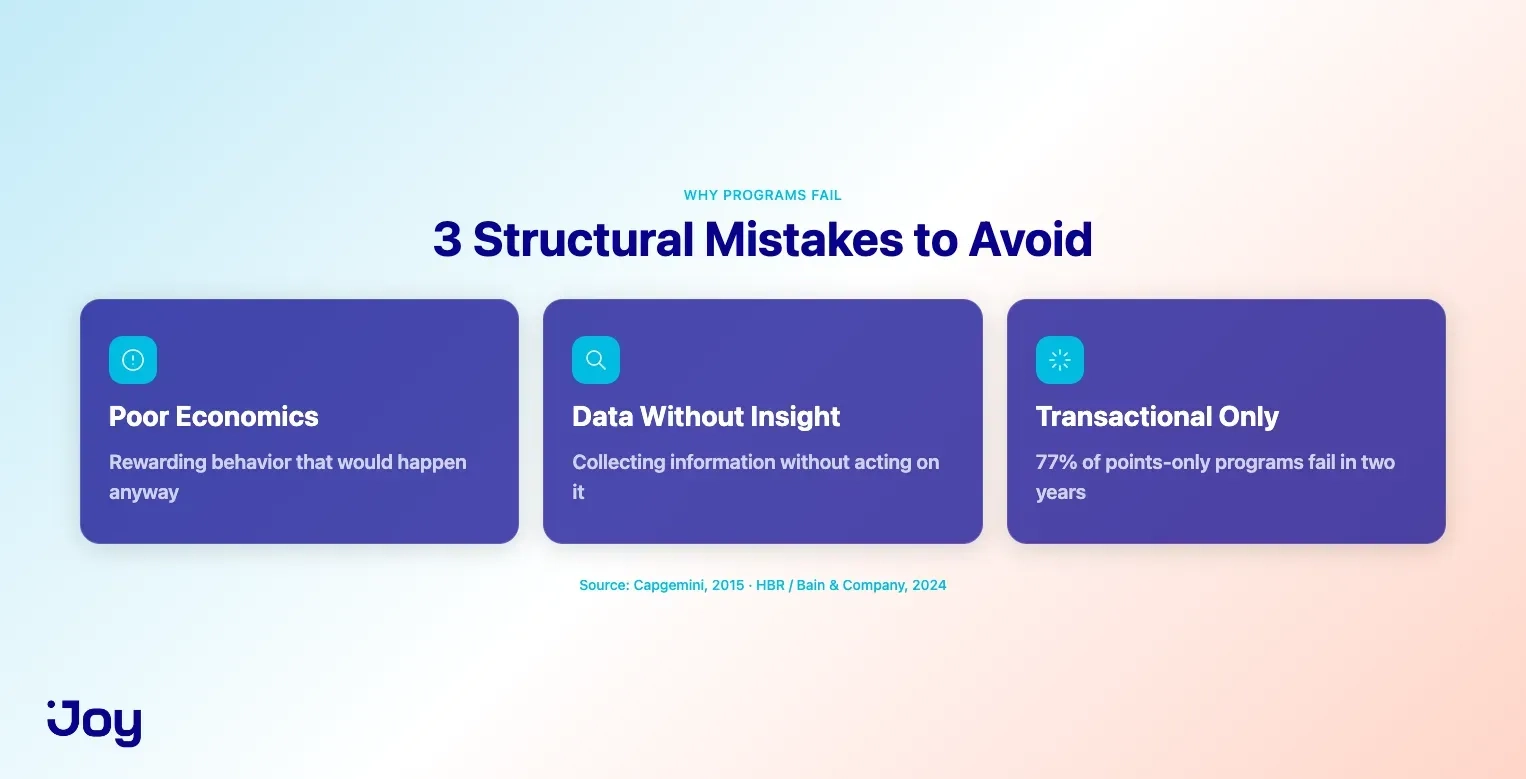
Most brands try to capture these advantages without reliable measurement or a clear structural plan. Bain & Company's research published in Harvard Business Review (2024) identifies three specific reasons programs fail, and all three are avoidable.
Poor Economics — Rewarding Behavior That Would Happen Anyway
The first failure point is poor economics. Programs rack up real operating costs while rewarding behavior that was already occurring.
A concrete example from the Bain research: a North American retailer discovered that 25% of milk bought during promotional weeks would have sold at full price the following week. They weren't changing behavior. They were subsidizing it.
Another cautionary tale: Plenti, American Express's coalition loyalty program, collapsed after three years because partners couldn't agree on point valuations. The economics never worked.
Rewards must incentivize incremental behavior: higher average order values, more frequent visits, referrals. Not discounting existing habits. If your program rewards what customers would do anyway, it's a cost center, not a profit driver.
Inadequate Customer Understanding — The Personalization Gap
The second failure point is a lack of insight into individual customer preferences. One major Asian retailer had misclassified customers entirely. Shoppers labeled "low value" based on spending metrics turned out to be high-value when measured by margin per item. The segmentation was backwards.
In another case, a restaurant chain had millions of program members but only 25% had shared contact information. Millions of profiles, almost no actionable data.
Collecting data isn't enough. You need the right data, properly segmented, with insights you actually act on. This connects directly to the first-party data advantage: loyalty programs generate valuable data, but only if you use it for personalization rather than letting it sit in a database.
Low Engagement — 77% of Transactional Programs Collapse Within Two Years
Capgemini research found that 77% of loyalty programs relying solely on transactional rewards (buy, earn points, redeem) fail within two years. The reason: transactional programs create what researchers call mercenary loyalty. Customers participate for discounts but feel no attachment. The moment a competitor offers a better deal, they leave.
The problem has likely gotten worse since. Bain's 2024 data shows the average U.S. consumer now joins 12 loyalty programs but actively engages with far fewer. Your program is competing for attention against 11 others.
Programs that survive build beyond the transaction. Tier status, exclusive access, community elements, surprise rewards: these create the emotional engagement that prevents loyalty programs from failing.
The Real Advantages of Customer Loyalty Start With Measurement
The advantages of customer loyalty are seven measurable business outcomes: lower acquisition costs, higher profit margins, compounding spending, emotional lifetime value, first-party data, free referral acquisition, and competitive switching costs. Each one is backed by research from Bain, McKinsey, Harvard Business Review, and industry data.
But the cost of inaction is just as measurable. Brands that don't invest in loyalty lose to the churn spiral, rising CAC, and competitors who build switching costs they can't match. And even brands that do invest can fail if they make the three structural mistakes: poor economics, data without insight, or transactional-only design.
The timeline matters too. These advantages don't appear in month one. The compounding the research describes (the 306% LTV premium, the 67% spending increase) takes 12 to 36 months to materialize. For brands under roughly $20K per month in revenue, acquisition usually still outranks retention in ROI. The investment makes most sense when you already have customers worth retaining.
A simple way to check the math: Take your current annual revenue and multiply by a conservative 5% retention improvement. For a $500K/year store, that's $25K in incremental revenue, at the low end of the 25-95% profit range. Most loyalty platforms cost $3K-$20K/year. The ROI case is straightforward once you run it. The reason most brands don't? The 42% measurement gap. They never built the baseline to compare against.
The clearest starting point is a customer loyalty index: a single score that turns these seven metrics into one number your team can act on.
Frequently Asked Questions
What are the main advantages of customer loyalty?
Seven: lower acquisition costs (5-25x cheaper to retain than acquire), higher profit margins (5% retention improvement can drive 25-95% more profit), compounding customer spend (loyal customers spend 67% more), higher lifetime value (emotionally connected customers have 306% higher LTV), a first-party data asset, lower-cost referral acquisition, and structural switching costs that protect revenue against competitors.
What are the 3 R's of customer loyalty?
Reward, Recognize, and Relate. Reward covers tangible incentives for desired behavior (points, discounts, free products). Recognize means acknowledging customer history, status, and preferences. Relate refers to building emotional connection beyond the transaction: community access, shared values, and personalized experiences. Programs that cover all three are much harder to defect from than programs relying on rewards alone.
What are the 4 C's of customer loyalty?
Capture, Cultivate, Convert, and Commit. Capture is the initial data and relationship acquisition at first purchase. Cultivate is the deepening of that relationship through personalization and relevance over time. Convert turns a repeat buyer into an active advocate (someone who refers others). Commit describes structural loyalty: accumulated points, tier status, and switching costs that make leaving genuinely costly. Not every source uses this exact framework, but these four stages map well to the loyalty lifecycle most programs are designed around.
What are the pros and cons of customer loyalty programs?
Pros: Lower effective CAC through repeat purchases and referrals, higher CLV, first-party data collection, competitive switching costs, and revenue stability through loyal base spending.
Cons: Programs take 12-36 months to compound meaningfully, require ongoing investment in rewards and platform costs, and can backfire if poorly designed (rewarding behavior that would happen anyway, or building mercenary loyalty through discounts alone). For brands under roughly $20K/month in revenue, the acquisition stage typically delivers better ROI than retention investment.

Written by
Thomas Nguyen is the CEO & Co-founder of Joy, a loyalty solution for Shopify and eCommerce brands. With years of experience building high-performance Shopify apps, Thomas aims to help merchants grow through customizable and retention-focused tools.
Related reading
 Loyalty Strategy
Customer Satisfaction and Brand Loyalty: 2026 Growth Guide
25-35% of satisfied customers still switch silently. This guide explores the gap between customer satisfaction and brand loyalty — and the 4 metrics (NPS, CES, redemption rate, LTV) that turn happy buyers into emotionally connected advocates when acquisition costs are 4× higher.
 Thomas Nguyen
 Loyalty Strategy
Customer retention benchmarks for ecommerce: What's a good rate?
A clear-eyed look at ecommerce retention benchmarks: the one number worth trusting, why most by-industry tables mislead, and how to benchmark against yourself.
Thomas Nguyen-f9ebcc.webp&w=3840&q=75) Loyalty Strategy
Loyalty StrategyCustomer Engagement and Loyalty: Strategies and How to Measure Them
Customer engagement and loyalty aren’t the same thing. Here’s how they differ, seven strategies that build both, and the metrics that tell you it’s working.
Thomas Nguyen Loyalty Strategy
6 Key Factors That Affect Customer Loyalty
Loyalty isn't luck or a good Black Friday sale — it's built on six specific, measurable factors. This guide breaks down each one: why it matters, how to measure it, and how to put it into action, with examples from brands that got it right.
Thomas Nguyen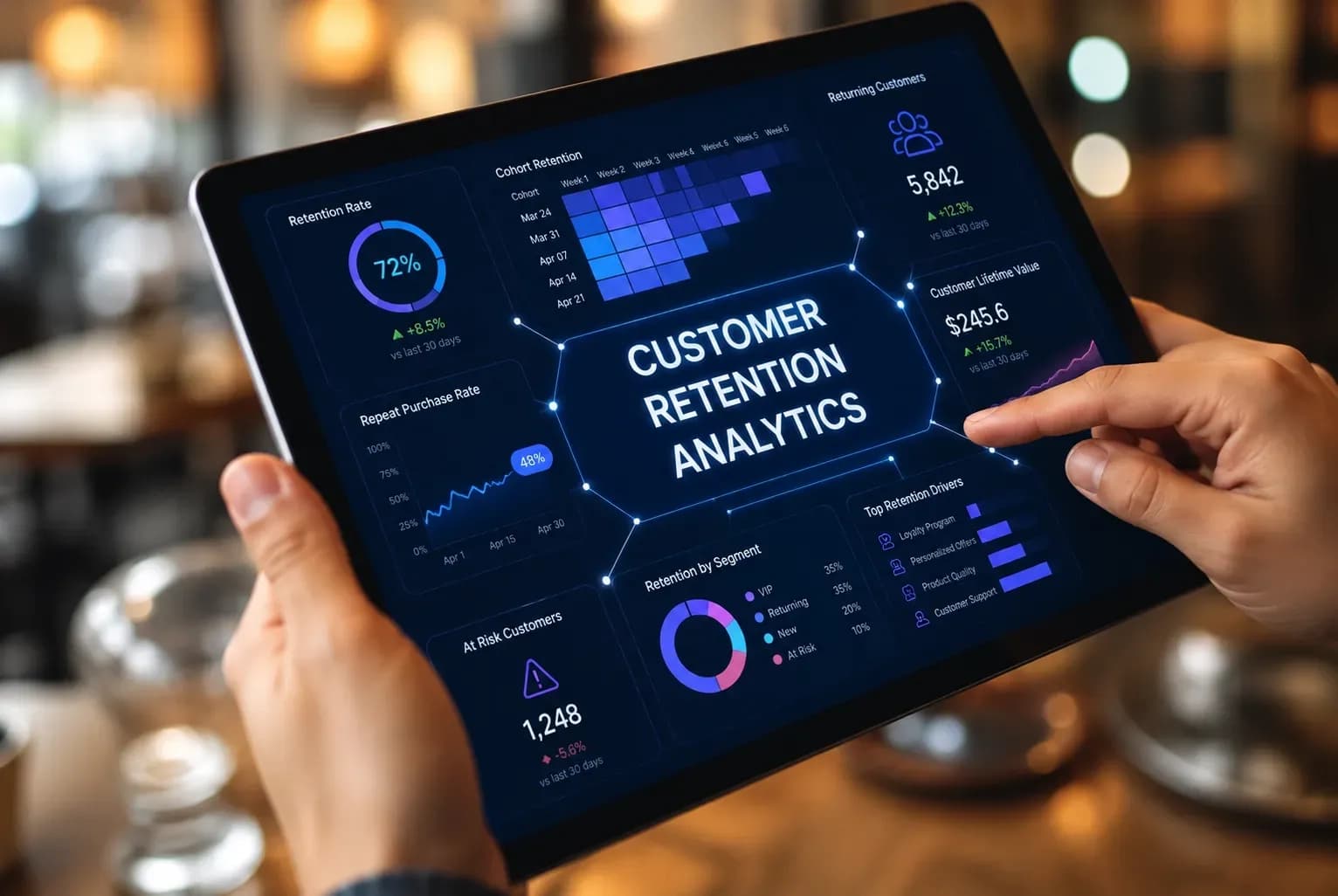 Loyalty Strategy
Customer Retention Analytics: Turn Your Data Into Retention Action
Most retention guides stop at the numbers. This one shows how to read your retention data and turn each metric into a concrete loyalty play for your Shopify store.
Thomas Nguyen Loyalty Strategy
Three Stages of Brand Loyalty: Mastering the 2026 ROI Strategies
From "knowing" your brand to "refusing" any other. The three stages of brand loyalty — Recognition, Preference, Insistence — map how customers actually move from awareness to advocacy. This guide breaks down each stage and the tactics to climb the ladder when acquisition costs are 4× higher.
Thomas Nguyen