
Customer Loyalty Index: The Metric That Predicts Customer Churn
Most brands measure loyalty with a single number and miss most of the picture. The Customer Loyalty Index combines three survey questions into one composite score: an early churn warning, a revenue forecast, and a segmentation tool. Here's the formula, benchmarks, and how to act on it.

Summarize this post with AI
Bain & Company found that a 5% increase in customer retention produces a 25% to 95% increase in profit. One statistic. And it reframes every dollar you spend on acquisition, because the real growth lever sits on the other side of the transaction.
Yet most e-commerce brands still measure loyalty with a single number. They track NPS for advocacy, or CSAT for satisfaction, then wonder why customers quietly disappear. These metrics aren't wrong. But each one captures only a sliver of customer intent. The rest stays invisible.
The Customer Loyalty Index (CLI) changes that. By combining three survey questions into one composite score, CLI measures advocacy, repurchase intent, and cross-buy willingness at the same time. The result is an early warning system for churn, a revenue forecasting tool, and a customer segmentation framework, all packed into a single number.
This guide covers what CLI is, how to calculate it, how to read your score against industry benchmarks, and how to connect CLI data to a loyalty program that actually drives repeat purchases.
Customer Loyalty Metrics: Why One Number Isn't Enough
Before digging into CLI, it's worth understanding why the metrics most brands already track keep falling short. The issue isn't effort or intention. It's structural: each traditional metric was designed to answer one question, and loyalty is a three-question problem.
NPS Is Only Part of Customer Loyalty Metrics
Net Promoter Score asks a straightforward question: "How likely are you to recommend us to a friend?" It's familiar, simple, and widely adopted. That's precisely why so many merchants default to it.
But NPS captures only one dimension of loyalty: advocacy. A customer can happily recommend your store and still never come back to buy again. High NPS scores frequently coexist with low repeat purchase rates, because willingness to recommend and willingness to repurchase are two different psychological commitments. Not even close to the same thing.
When merchants rely on NPS alone, they make investment decisions on incomplete signals. They see a healthy advocacy score and assume the relationship is strong, while repurchase intent and cross-buy interest go entirely unmeasured. That gap costs real revenue. It hides the customers most likely to churn.
Satisfaction Metrics Don't Measure Customer Loyalty Statistics
Customer Satisfaction Score (CSAT) and Customer Effort Score (CES) suffer from a similar blind spot, just in a different direction.
CSAT measures satisfaction with a specific transaction. A customer rates their checkout experience a five out of five, and that score enters the dashboard as a win. CES measures how much effort a single interaction required. Both are reactive. They tell you what already happened, not what will happen next.
Consider a customer who rates their last order a perfect score. They loved the packaging, the speed, the product quality. And yet they never return. Nothing in CSAT or CES data would have predicted that outcome. Satisfaction in the moment doesn't guarantee loyalty over time. A satisfied customer can still churn if a competitor offers something more relevant, more convenient, or simply more visible.
Why Single Customer Loyalty Metrics Fail Businesses
Picture a growing e-commerce brand tracking these numbers: a 45 NPS, a 90% CSAT, and a low-friction CES. On paper, everything looks strong. Customers are satisfied, they'd recommend the store, and their interactions feel easy.
Now look at the sales data. Repeat purchase rate sits at 22%. Churn over the last 90 days is 8%. The metrics missed the real story. Customers were satisfied with individual transactions but had no intention of buying again. Their cross-buy interest was low, their repeat intent was lukewarm, and no single metric captured those signals.
This is where fragmented measurement gets expensive. CLI would have caught the disconnect early, because its third question directly measures cross-buy willingness. A low score there, combined with moderate advocacy, flags these customers as passive before they drift away.
What Is a Customer Loyalty Index? The 3-Question Framework
The Customer Loyalty Index is a composite metric built on three survey questions, each scored on a 1 to 6 scale. Unlike NPS, which isolates one dimension, CLI captures three loyalty signals in parallel and combines them into a single actionable score.
Customer Loyalty Index: How the 3-Question Survey Works
The three questions at the core of CLI are:
Question 1 (Advocacy): "How likely are you to recommend us to a friend or colleague?"
Question 2 (Repeat Intent): "How likely are you to make another purchase from us?"
Question 3 (Cross-Buy Intent): "How likely are you to try other products or categories from us?"
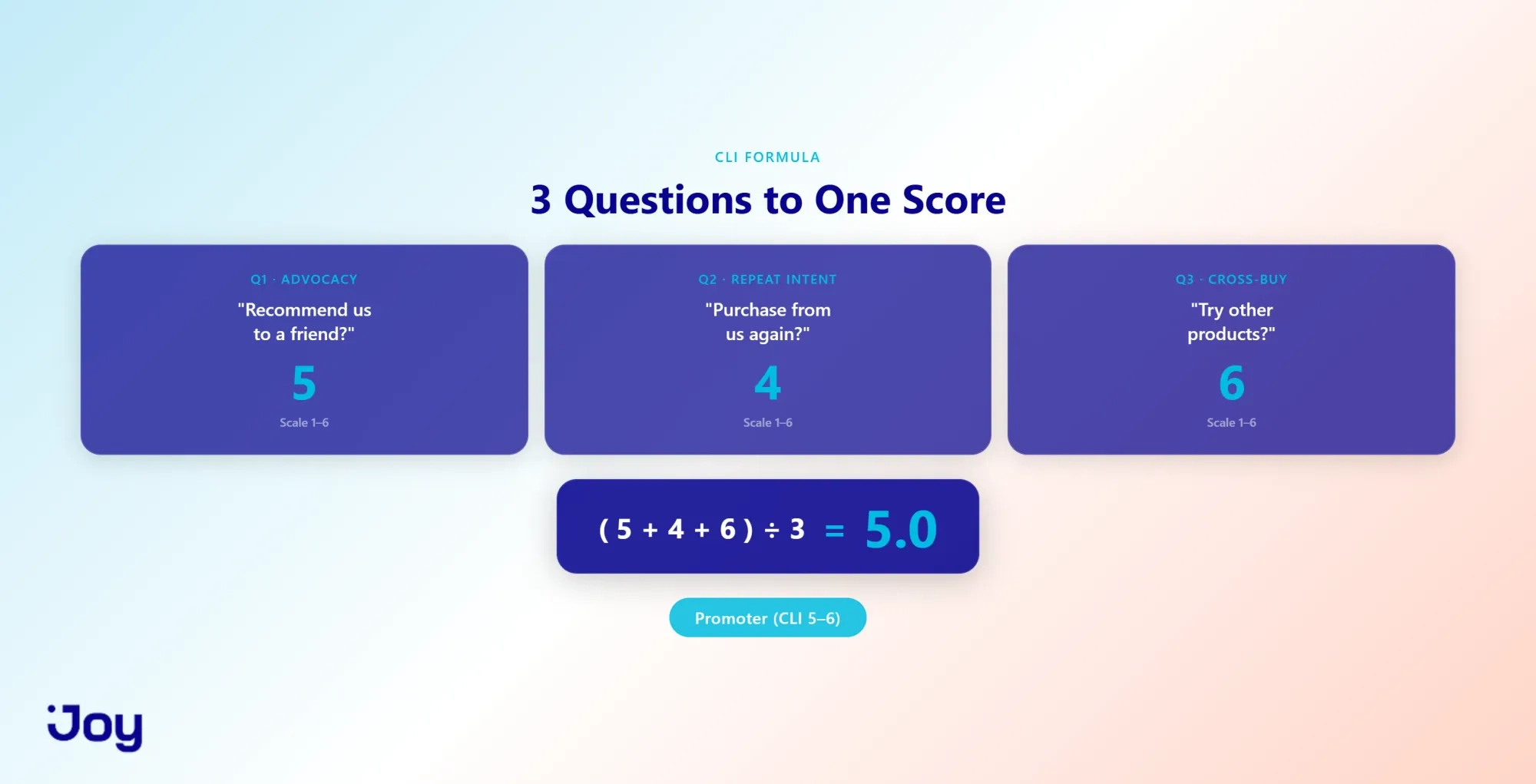
Each response uses a 1 to 6 scale, where 1 means "not at all likely" and 6 means "extremely likely." The formula is simple:
CLI = (Q1 + Q2 + Q3) / 3
If a customer scores 5 on advocacy, 4 on repeat intent, and 6 on cross-buy willingness, their CLI is 5.0. That places them in the Promoter segment.
Why a 1 to 6 scale? There's no neutral midpoint. Every response forces a directional choice, which eliminates fence-sitting and produces cleaner data. And because the entire survey is only three questions, response rates tend to run between 10% and 20%. Well above what longer surveys achieve.
Each question maps directly to a business outcome. Advocacy predicts referral revenue. Repeat intent predicts retention. Cross-buy intent predicts expansion revenue. Together, they give you the full loyalty picture in under 30 seconds of survey time.
Why a Customer Loyalty Index Beats Other Customer Loyalty Metrics
The core advantage of CLI is unification. Instead of maintaining separate dashboards for NPS, CSAT, and CES, you get a single score that captures all three loyalty dimensions at once.
Consider the math. NPS tells you whether a customer would recommend your brand, but says nothing about whether they'll actually come back to buy. CSAT tells you they were satisfied with the last transaction, but can't predict their interest in new product categories. CLI captures all of these in parallel. One survey replaces three. One score tells a more complete story than any of them alone.
Based on CLI scores, customers fall into three segments: Promoters (CLI 5 to 6) who show high intent across all three dimensions, Passives (CLI 3 to 4) who are moderately engaged but at risk, and Detractors (CLI 1 to 2) who show clear signs of disengagement. These segments become the foundation for every retention strategy that follows.
Customer Loyalty Index vs Customer Loyalty Metrics: Comparison
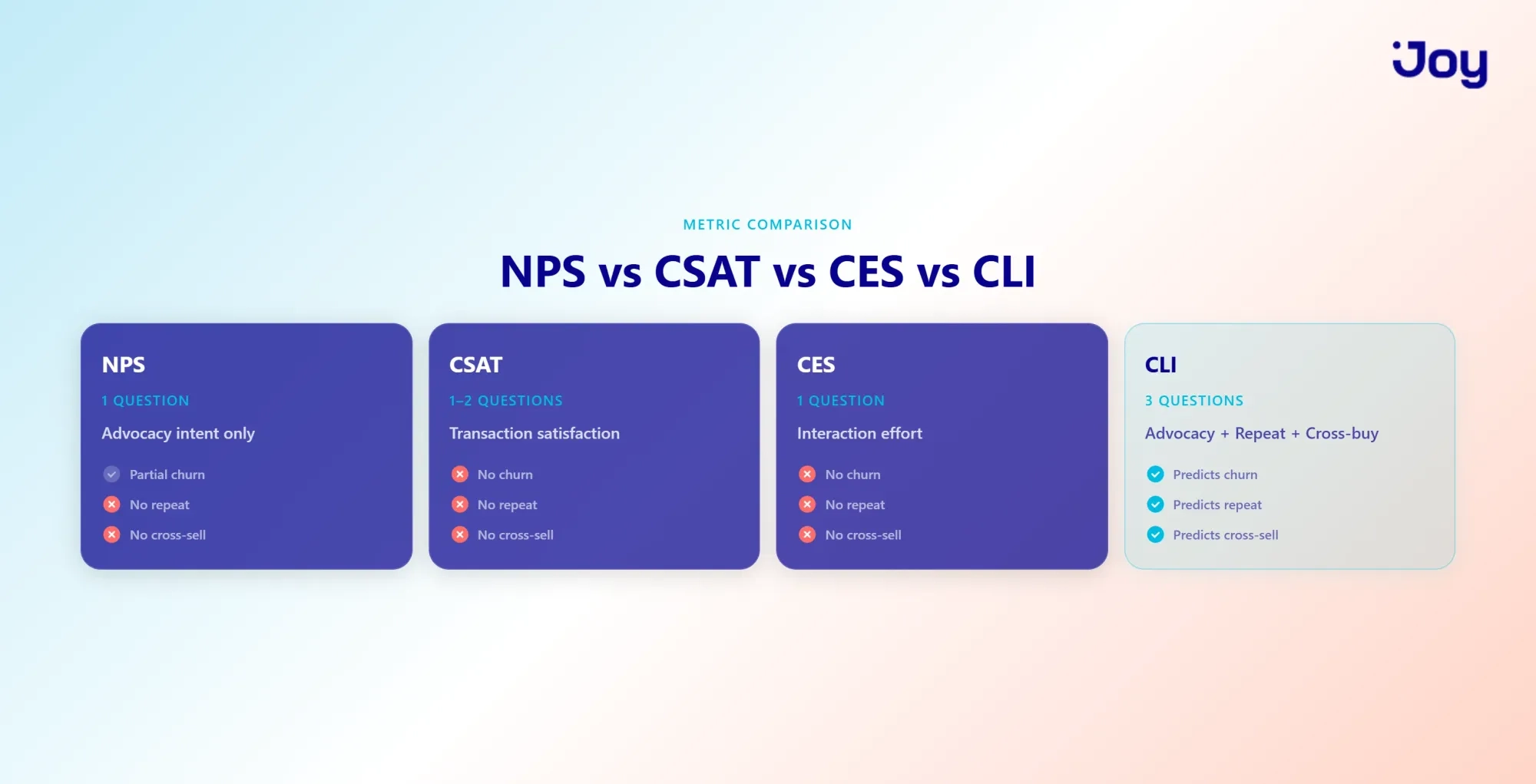
To put CLI in context against the metrics most brands already use, here's how they compare across the dimensions that matter:
| Metric | Questions | What It Measures | Predicts Churn | Predicts Repeat Purchase | Predicts Cross-Sell | Best For |
|---|---|---|---|---|---|---|
| NPS | 1 | Advocacy intent | Partial | No | No | Referral-focused brands |
| CSAT | 1 to 2 | Transaction satisfaction | No | No | No | Service quality tracking |
| CES | 1 | Interaction effort | No | No | No | Friction reduction |
| CLI | 3 | Advocacy + repeat + cross-buy | Yes | Yes | Yes | Holistic loyalty strategy |
NPS, CSAT, and CES aren't useless. Each has a role. But CLI is the only metric that predicts all three revenue-critical outcomes with a single three-question survey. And here's the part most people miss: NPS isn't a replacement for CLI. It's CLI's first question.
Customer Loyalty Index Predicts Churn: The 30 to 60 Day Window
Knowing what CLI measures is one thing. Understanding when it matters most is what makes the metric actionable. And the answer comes down to a narrow window: the 30 to 60 days after a customer's first purchase.
How a Customer Loyalty Index Reveals Churn Signals
Traditional purchase data is backward-looking. You can see that a customer stopped buying, but only after it already happened. By then, they've moved on.
CLI works differently because it captures intent in real time. When a customer who previously scored a 5 on repeat intent drops to a 2, that shift is a churn warning, and it shows up weeks before any change appears in purchase behavior.
Think of it this way: purchase history is a lagging indicator, like reading yesterday's weather report. CLI is a leading indicator, like checking the forecast. Customers with low CLI scores carry roughly four times the churn risk compared to those with high scores. The survey itself becomes an early warning system.
So the question becomes timing. Catch the signal early, and you can still intervene. Miss it, and the customer finds an alternative. Recovery gets exponentially harder from there.
Customer Loyalty Metrics: The Critical 30 to 60 Day Window
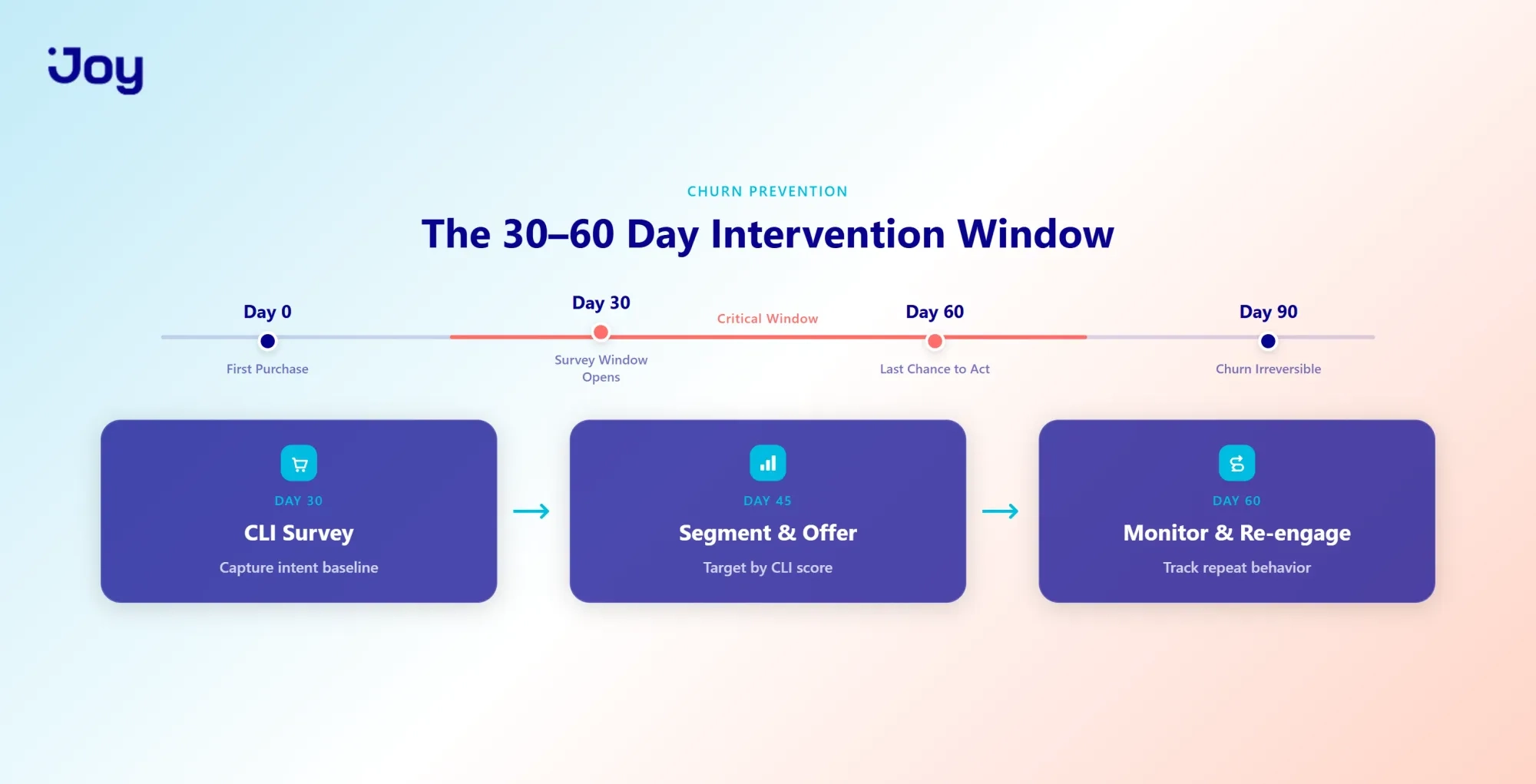
The post-purchase journey has a critical juncture. Between day 30 and day 60, customers face their first real opportunity to make a repeat purchase. If they don't return during this window, the probability of ever repeating drops sharply. By day 90, that probability falls off a cliff.
This is why CLI survey timing matters so much. Running the survey at day 30 to 45 reveals whether a customer is at risk while there's still time to respond. A low repeat intent score at day 35 is a rescue opportunity. The same score at day 120? That's a postmortem.
During this window, retention is also far more cost-effective. Re-engaging an existing customer costs roughly six times less than acquiring a new one. And CLI data shows exactly which customers need attention and what kind of offer is most likely to land. If cross-buy intent is low, push a personalized product recommendation. If repeat intent is dropping, offer a loyalty tier milestone or an exclusive discount.
Missing this window isn't just a missed opportunity. It often means the customer is lost to a competitor permanently.
Customer Loyalty Index Scores and Action Steps
Once you have CLI scores, the segmentation tells you exactly what to do next:
Promoters (CLI 5 to 6) show high repeat and high cross-buy intent. These are your most valuable customers. The action here is expansion: upsell new categories, ask for referrals, and unlock exclusive tier perks. They're already committed. Your job is to reward that commitment.
Passives (CLI 3 to 4) sit in the middle. That's the danger zone. They aren't dissatisfied, but they aren't invested either. The action here is re-engagement: send personalized product recommendations, offer milestone-based incentives, and identify whatever friction is keeping them from moving up.
Detractors (CLI 1 to 2) represent critical churn risk. These customers need immediate intervention within seven days of survey completion. Understand the friction point, offer a high-value incentive like 15% to 20% off, and pair it with a feedback survey to learn what went wrong. Detractors caught in the 30 to 60 day window have a 40% or higher recovery rate compared to those identified later.
The cost difference is striking. A $5 rescue offer can recover $200 to $500 in customer lifetime value. That math alone justifies the entire survey effort.
Customer Loyalty Statistics: What's a Good Index Score?
CLI scores don't exist in a vacuum. A score of 4.0 means something very different for a beauty brand than it does for a luxury retailer. To set meaningful targets, you need benchmarks that reflect your category, your product cycle, and your program maturity.
Customer Loyalty Statistics by Industry
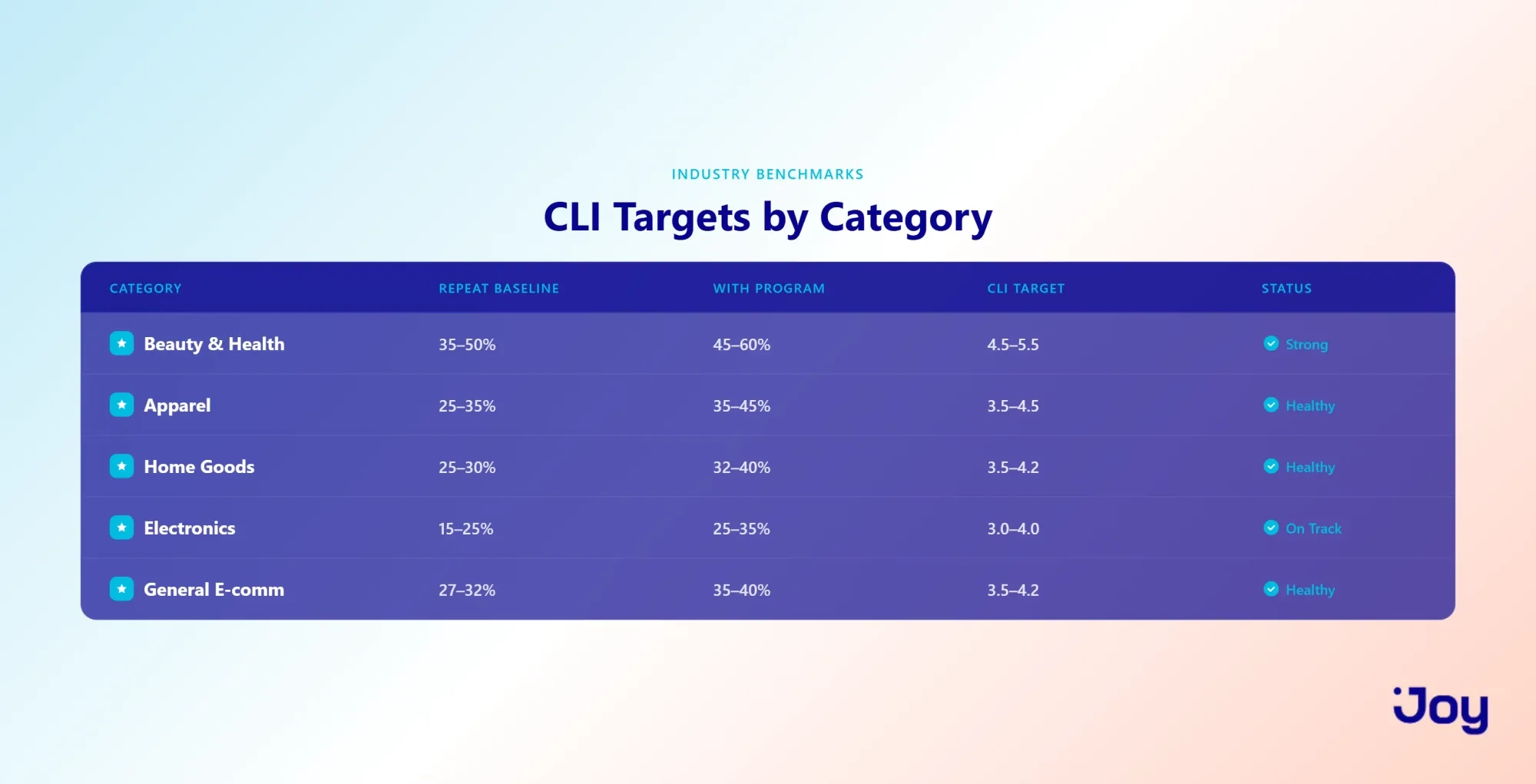
Repeat purchase rates (the behavioral outcome CLI predicts) vary dramatically by category:
General e-commerce runs a 27% to 32% repeat purchase rate as a baseline. For every 100 first-time customers, roughly 27 to 32 return for a second purchase. In CLI terms, that baseline aligns with a median score of 3.5 to 4.0, placing most general e-commerce customers in the Passive segment.
Beauty, supplements, and health categories see 35% to 50% repeat rates. The higher number makes sense: these products are consumable, replacement cycles are short (one to two months), and brand loyalty runs deeper. CLI alignment here is 4.5 to 5.5, solidly in Promoter range. If you're in this category, a CLI below 4.5 signals room for improvement.
Apparel, home goods, and accessories sit in the 25% to 35% range. Discretionary purchases with longer replacement cycles (six to twelve months) naturally produce lower repeat rates. CLI alignment: 3.5 to 4.5, Passive to lower-Promoter. A 30% repeat rate is healthy here. Above 35%? That's strong.
Luxury and specialty products typically show 9.9% to 15% repeat rates. High price points and long consideration cycles drive these numbers down, but that doesn't necessarily mean low CLI scores. A luxury customer with high cross-buy intent may have a strong CLI even if their repeat rate looks modest. For these brands, CLV per customer matters more than repeat volume.
The takeaway: benchmarks vary three to five times by category. Setting a generic target like "40% repeat rate" without accounting for your product cycle leads to frustration and misallocated resources.
Customer Loyalty Metrics Show Loyalty Program Impact
Against those baselines, loyalty programs produce a measurable lift. Brands running a full program with tiers, rewards, and milestone-based perks typically see a 20% to 35% improvement in repeat purchase rates.
In practice, if your baseline repeat rate is 28%, a well-executed loyalty program gets you to 35% to 40%. The lift comes from three reinforcing mechanics: point redemption (customers who redeem loyalty points show a 4.7x higher repeat rate compared to non-redeemers), tier progression (psychological motivation to reach the next level), and exclusive perks (tangible reasons to come back).
That 4.7x difference between redeemers and non-redeemers is one of the most powerful loyalty statistics in e-commerce. It means 50% of point redeemers make another purchase, compared to just 10.7% of customers who never redeem. The program itself becomes the behavior-change lever.
But here's what's critical: you won't see this lift unless you track CLI alongside program participation. The two data sets work together. CLI tells you who is likely to engage. Program analytics tell you who actually did. Without both, you're measuring in the dark.
Customer Loyalty Index Benchmarks by Customer Type
Beyond category, CLI benchmarks also shift based on your program maturity. New brands typically start with an average CLI around 3.0. Brands with two or more years of active program engagement tend to see CLI averages of 4.5 or above.
The absolute score matters less than the trend. If your CLI was 3.2 last quarter and it's 4.1 now, that upward movement is proof your program is working. As a rule of thumb, a healthy program puts 50% or more of customers in the Promoter segment (CLI 5 to 6). If more than 20% of your customers land in the Detractor segment (CLI 1 to 2), that's a churn signal worth investigating immediately.
Customer Loyalty Index and Revenue: The ROI Equation
Understanding your CLI score relative to benchmarks is valuable. But connecting that score to revenue is what makes it a board-level priority. Every point on the CLI scale maps to measurable financial outcomes, from customer lifetime value to profit margin.
Customer Loyalty Statistics: 3 to 5x Revenue from Repeat Customers
Returning customers generate three to five times more lifetime revenue than first-time buyers. That multiplier comes from three compounding factors: repeat customers tend to have higher average order values, they purchase more frequently, and they refer friends (which adds referral revenue on top of direct sales).
Here's a simplified example. A first-time customer with a $50 average order value generates $50 in revenue. A repeat customer with the same AOV but three purchases per year over three years produces $450 in baseline CLV. Add a loyalty program with a 1.5x lift factor, and that CLV reaches $675.
CLI identifies which customers will follow this trajectory. A high score on repeat intent (Question 2) combined with strong cross-buy interest (Question 3) flags a customer as a premium repeater. These are the customers worth investing in with tier perks, early access, and personalized recommendations.
The program cost for points, perks, and tier maintenance typically runs 10% to 15% of incremental revenue. Against a 3x to 5x revenue multiplier, the first-year ROI lands at two to three times the investment. That math holds even under conservative estimates.
Customer Loyalty Metrics Predict Profit Growth
The retention-to-profit relationship follows a non-linear curve that surprises most merchants the first time they see it. A 5% increase in retention (moving from a 30% to a 31.5% repeat rate) produces a 25% to 95% increase in profit.
Why such a wide range? It depends on your margins, your AOV, and your acquisition costs. Low-margin brands see the lower end (25% profit lift). High-margin brands, particularly in beauty, wellness, and specialty categories, see the upper end (95% profit lift). Either way, the compounding effect is significant.
To put a number on it: a $50,000 per month store with 3% average margins that achieves a 5% retention lift gains roughly $7,500 per month in additional profit. Over a year, that's $90,000. All from retaining customers you've already paid to acquire.
CLI makes this possible by making retention precise rather than broad. Instead of sending the same re-engagement campaign to your entire list, you target the customers with the highest repeat intent. Higher targeting accuracy means higher success rates and faster ROI. And when paired with a loyalty program, the achievable retention lift isn't 5%. It's 20% to 35%.
Customer Loyalty Index and Loyalty Program Success
The connection between CLI and loyalty programs becomes clearest when you look at redemption behavior. As covered in the benchmarks section, customers who redeem points show a 4.7x higher repeat rate compared to non-redeemers. That gap is one of the largest behavior-change effects in e-commerce.
The psychology behind it is straightforward. Points create a sense of sunk-cost investment. Once a customer earns points, they feel psychologically committed to the brand. Tier progression adds another layer: the motivation to reach the next level, unlock new perks, and maintain status. These mechanics transform occasional buyers into habitual repeaters.
CLI reveals which customers are most likely to engage with these mechanics. High CLI scores, particularly high cross-buy intent, correlate strongly with program participation. These are commitment-oriented customers who respond well to structured incentives.
How to Use a Customer Loyalty Index: Step-by-Step Guide
CLI is only as valuable as the system you build around it. This section breaks the implementation into four steps: create the survey, segment responses, connect segments to your loyalty program, and build the reporting layer.
Step 1: Create Your Customer Loyalty Index Questions
Start with the three standard CLI questions:
- Advocacy: "How likely are you to recommend us to a friend or colleague?" (1 to 6 scale)
- Repeat Intent: "How likely are you to make another purchase from us?" (1 to 6 scale)
- Cross-Buy Intent: "How likely are you to try other products or categories from us?" (1 to 6 scale)
Scale definition: 1 = Not at all likely, 6 = Extremely likely.
Timing matters. Send the survey 30 to 45 days post-purchase. This places it inside the critical 30 to 60 day churn window, capturing intent at exactly the moment it predicts future behavior most accurately.
Channel selection: Email delivers the highest volume. SMS achieves the highest open rates. In-app prompts produce the highest completion rates. Test all three for your audience, and consider offering a 5% to 10% loyalty reward for survey completion. That alone lifts response rates noticeably.
Survey best practices: Aim for 100 or more responses per segment for statistical significance. Don't survey the same customer more than once per quarter (fatigue kills response quality). And customize Question 3 to your product mix when possible: "How likely are you to try our skincare line?" converts better than a generic "other products" phrasing.
Step 2: Use Your Customer Loyalty Metrics to Segment Customers
Once responses come in, segment customers by their average CLI score:
Promoters (CLI 5 to 6): High repeat intent, high cross-buy willingness. Action: upsell new categories, request referrals, unlock exclusive tier access. Offer: free shipping on next purchase plus loyalty tier promotion.
Passives (CLI 3 to 4): Moderate intent across all three dimensions. Action: re-engage with personalization, identify friction points, offer milestone-based incentives. Offer: personalized product recommendation plus a tier milestone reward.
Detractors (CLI 1 to 2): Low intent across the board. Action: intervene immediately (within seven days), understand churn drivers, offer high-value rescue incentive. Offer: 15% to 20% discount plus a short feedback survey to learn what went wrong.
Each segment requires different messaging, different offer types, and different urgency. Treating them the same defeats the entire purpose of measuring.
Step 3: Link Customer Loyalty Index to Your Loyalty Program
With segments defined, the next step is connecting CLI data to your loyalty program design:
Tier structure: Match tier rewards to segment psychology. Promoters respond to exclusive access and VIP status. Passives respond to milestone-based progression that shows a clear path forward. Detractors respond to easy re-entry with low barriers.
Points-per-dollar: Adjust redemption value by segment. High CLI customers will buy regardless, so standard earning rates work. Detractors need higher redemption value to push the next purchase over the line.
Personalization triggers: Use cross-buy intent from Question 3 to drive product recommendations. If a customer scores a 4 on cross-buy interest, trigger a message like: "Customers like you discovered [new category]. See what's new."
Loyalty platforms like Joy can use segment-based reward rules to match different offers to each CLI group. For example: "If a customer's CLI places them in the Promoter segment AND they reach Gold tier, unlock early access to a new category." The point is to let data drive the decisions rather than guessing.
Step 4: How to Report Customer Loyalty Index Results
CLI without reporting is measurement without action. Build two reporting layers:
Executive scorecard (quarterly): CLI score trend, revenue impact by segment, segment distribution shift. One page. This justifies program investment to stakeholders who care about ROI.
Operational dashboard (weekly or daily): Real-time segment alerts, intervention triggers, survey response rates, repeat purchase rate by CLI segment, and program participation rate (redeemers vs non-redeemers).
The KPIs to track alongside CLI: average CLI score trend, repeat purchase rate by segment, revenue per segment (Promoter CLV vs Passive CLV vs Detractor CLV), and program retention rate.
Track the trend, not just the snapshot. "CLI was 3.2 last quarter, now 4.1" tells a far richer story than any single measurement ever will.
Customer Loyalty Metrics Drive Personalization (+60% Repeat Rate)
Measurement and segmentation create the foundation. Personalization is where CLI data turns into revenue. Customers who receive CLI-driven personalized offers show 60% higher repeat likelihood compared to those who get generic messaging. That number makes personalization the single most effective retention lever available.
Use Customer Loyalty Index Data for Personalization
Disengagement follows a predictable pattern. Customers gradually stop opening emails, then stop visiting the store, then stop purchasing altogether. By the time purchase behavior changes, the customer is already gone. And generic messaging accelerates this decline, because the same offer sent to everyone is the wrong offer for most.
CLI intent data changes the equation by making every offer relevant:
For Promoter segments, personalization means exclusive early access, VIP tier status, and referral bonuses. These customers are already committed. The goal is keeping them engaged and turning their advocacy into measurable referral revenue.
For Passive segments, personalization means product recommendations matched to their interests, milestone-based tier progression showing a clear path forward, and re-engagement messaging that acknowledges their browsing behavior. The goal is moving them from lukewarm to loyal.
For Detractor segments, personalization means a direct "we miss you" message paired with category-specific re-engagement. Not a generic discount, but an offer connected to what they actually bought or browsed. The goal is understanding the friction and offering a reason to reconsider.
The contrast is clear. Generic campaigns achieve roughly 20% click-through rates. Personalized campaigns driven by CLI intent data achieve 32% or higher. Loyalty platforms with data-driven programs can automate these rules so the personalization scales without manual effort.
Customer Loyalty Metrics Guide Product Offers
CLI Question 3 (cross-buy intent) is the most underused data point in loyalty measurement. It reveals which customers are open to exploring new product categories. And more importantly, which ones aren't.
When a customer scores a 6 on cross-buy intent and their purchase history shows beauty products, the action is clear: trigger a category-unlock reward. "Earn points in skincare, unlock 10% off our health category." That offer feels relevant because it matches stated intent with actual behavior.
On the other hand, when cross-buy intent is low (a score of 2), pushing new categories creates friction rather than value. The better play: deepen engagement within their preferred category. "Complete your look: save on matching accessories" resonates because it stays inside the customer's comfort zone.
Loyalty program rules adapt to these signals:
- High cross-buy intent = Category-unlock rewards (earn in one category, unlock discounts in another)
- Low cross-buy intent = Deep-discount within preferred category (reduce friction for repeat purchase)
Intent-driven personalization outperforms purchase-history-only targeting by a meaningful margin. Why? Because intent reveals mindset while history only reveals past behavior.
Track Your Customer Loyalty Index: The Feedback Loop
The real power of CLI appears over time, not in a single survey. The closed-loop process works like this:
- Customer completes CLI survey (establishing an intent baseline)
- System personalizes offers and loyalty tier rules based on that intent
- Customer responds through purchase, engagement, or inaction
- 60 to 90 days later, repeat CLI survey to measure how personalization shifted intent
- Refine again: did intent improve? Did repeat purchases follow? Adjust accordingly
This loop compounds. Each cycle improves personalization accuracy, reduces churn probability, and increases CLV. Most merchants break the loop by surveying once and never following up. That's the difference between a 5% lift and a 20% to 35% lift: continuous improvement through quarterly CLI surveys combined with monthly segment reviews.
Use rolling monthly surveys on different customer cohorts (all customers 30 to 45 days post-purchase each month) to maintain continuous data flow without fatiguing any single customer.
Customer Loyalty Index: Your Competitive Advantage
Measure Customer Loyalty Metrics, Know Your Advantage
Most of your competitors are still guessing. They rely on NPS, CSAT, or no structured measurement at all. They can't see churn signals before customers leave, they can't quantify loyalty program ROI, and they can't personalize with precision.
You will. CLI reveals exact churn risk, revenue opportunity, and personalization strategy for every customer segment. That knowledge compounds over time. When you see a 5% retention lift translate into a 25% to 95% profit increase, you double down on loyalty with confidence. Your competitors stay cautious. You win market share.
The investment is modest. CLI measurement costs $500 to $2,000 per year. A well-executed loyalty program tied to CLI data generates $10,000 to $100,000 per year in incremental revenue. That ROI speaks for itself.
Your 90-Day Customer Loyalty Index Plan
Days 1 to 30: Craft your three CLI survey questions. Segment your existing customer base by purchase behavior as a CLI proxy.
Days 30 to 60: Deploy the CLI survey to recent customers (30 to 45 days post-purchase). Start segmenting responses into Promoters, Passives, and Detractors.
Days 60 to 90: Launch a loyalty program tied to CLI segments. Personalize tier design and offers by segment.
Day 90 and beyond: Measure repeat purchase rate and program participation against your baseline. Iterate. You'll have proof of ROI by month four.
Take the Next Step
CLI gives you the measurement framework. A loyalty program gives you the action framework. Together, they create a closed loop: measure intent, act on segments, track results, and improve.
The brands that win aren't the ones with the biggest budgets. They're the ones that measure, act, and iterate faster than everyone else.
Explore how Joy Loyalty pairs with your loyalty measurement to turn segment data into personalized rewards and tier rules.
FAQ: Customer Loyalty Index
What is the customer loyalty index?
A composite metric built on three survey questions: likelihood to recommend (advocacy), likelihood to repurchase (behavioral intent), and likelihood to try other products (cross-buy intent). Average the three scores on a 1 to 6 scale, and you get a single CLI score that predicts churn, retention, and revenue potential.
How do you calculate a customer loyalty index?
CLI = (Q1 + Q2 + Q3) / 3, where each question is scored on a 1 to 6 scale. Example: a customer scores 5 (recommend), 4 (repurchase), 6 (cross-buy). CLI = 5.0, placing them in the Promoter segment.
What are the 4 C's of customer loyalty?
Consistency (reliable experience), Communication (relevant messaging), Convenience (frictionless interactions), and Community (sense of belonging). CLI captures these indirectly through its three intent questions. Customers who experience all four C's tend to score higher on advocacy, repeat intent, and cross-buy willingness.
What are the KPIs for customer loyalty?
CLI score, repeat purchase rate, customer lifetime value (CLV), Net Promoter Score (NPS), customer retention rate, point redemption rate, and program participation rate. CLI is unique because it predicts future behavior rather than measuring past transactions.
What is a good CLI score?
It depends on your category. Beauty and health brands target CLI 4.5 to 5.5. Apparel and home brands target 3.5 to 4.5. More important than the absolute score: track your CLI trend over time and aim for 50% or more customers in the Promoter segment (CLI 5 to 6).
How often should you survey CLI?
No more than once per quarter per customer. For continuous data, use rolling monthly surveys on different customer cohorts (all customers 30 to 45 days post-purchase each month).

Written by
Thomas Nguyen is the CEO & Co-founder of Joy, a loyalty solution for Shopify and eCommerce brands. With years of experience building high-performance Shopify apps, Thomas aims to help merchants grow through customizable and retention-focused tools.
Related reading
 Loyalty Strategy
Repeat Customer Rate: Formula, Benchmarks, and What Good Looks Like
Two formulas, one worked example, Bluecore's published benchmarks, and the exact place in your Shopify admin where repeat customer rate already lives.
 Thomas Nguyen
 Loyalty Strategy
Customer Retention Cost: Formula & Strategies to Optimize It
Customer retention is often cheaper than acquisition, but are you managing your costs effectively? Learn how to calculate retention costs and optimize your strategy without overspending.
Thomas Nguyen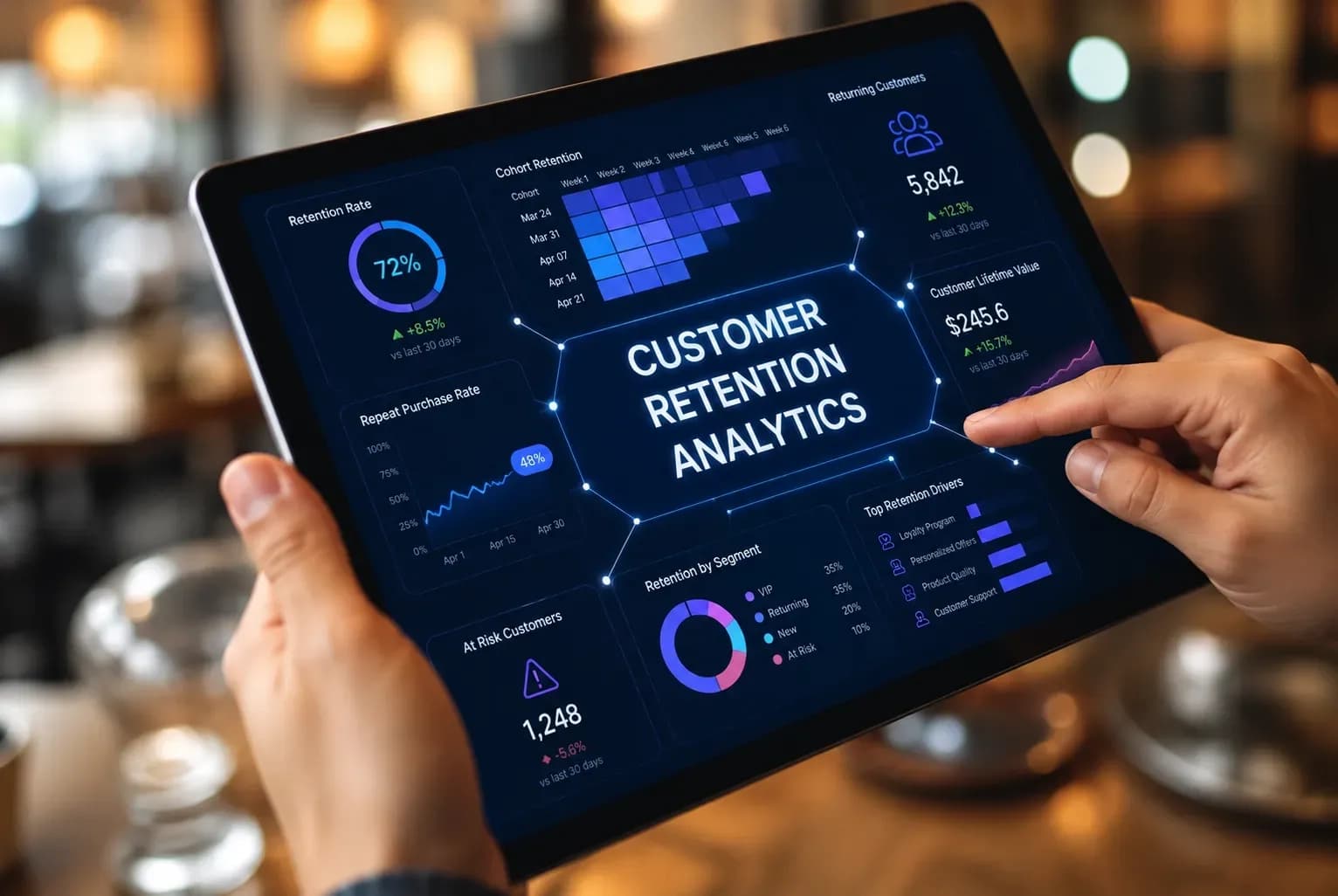 Loyalty Strategy
Customer Retention Analytics: Turn Your Data Into Retention Action
Most retention guides stop at the numbers. This one shows how to read your retention data and turn each metric into a concrete loyalty play for your Shopify store.
Thomas Nguyen Loyalty Strategy
Customer retention benchmarks for ecommerce: What's a good rate?
A clear-eyed look at ecommerce retention benchmarks: the one number worth trusting, why most by-industry tables mislead, and how to benchmark against yourself.
Thomas Nguyen Loyalty Strategy
Customer Retention Goals: 5 Targets to Set (and How to Hit Them)
A goal-first guide to customer retention: the five targets worth setting, how to make each one SMART, and the strategy that hits it.
Thomas Nguyen-f9ebcc.webp&w=3840&q=75) Loyalty Strategy
Loyalty StrategyCustomer Engagement and Loyalty: Strategies and How to Measure Them
Customer engagement and loyalty aren’t the same thing. Here’s how they differ, seven strategies that build both, and the metrics that tell you it’s working.
Thomas Nguyen