
Low Customer Loyalty: Why Customers Don't Return (and How to Fix It)
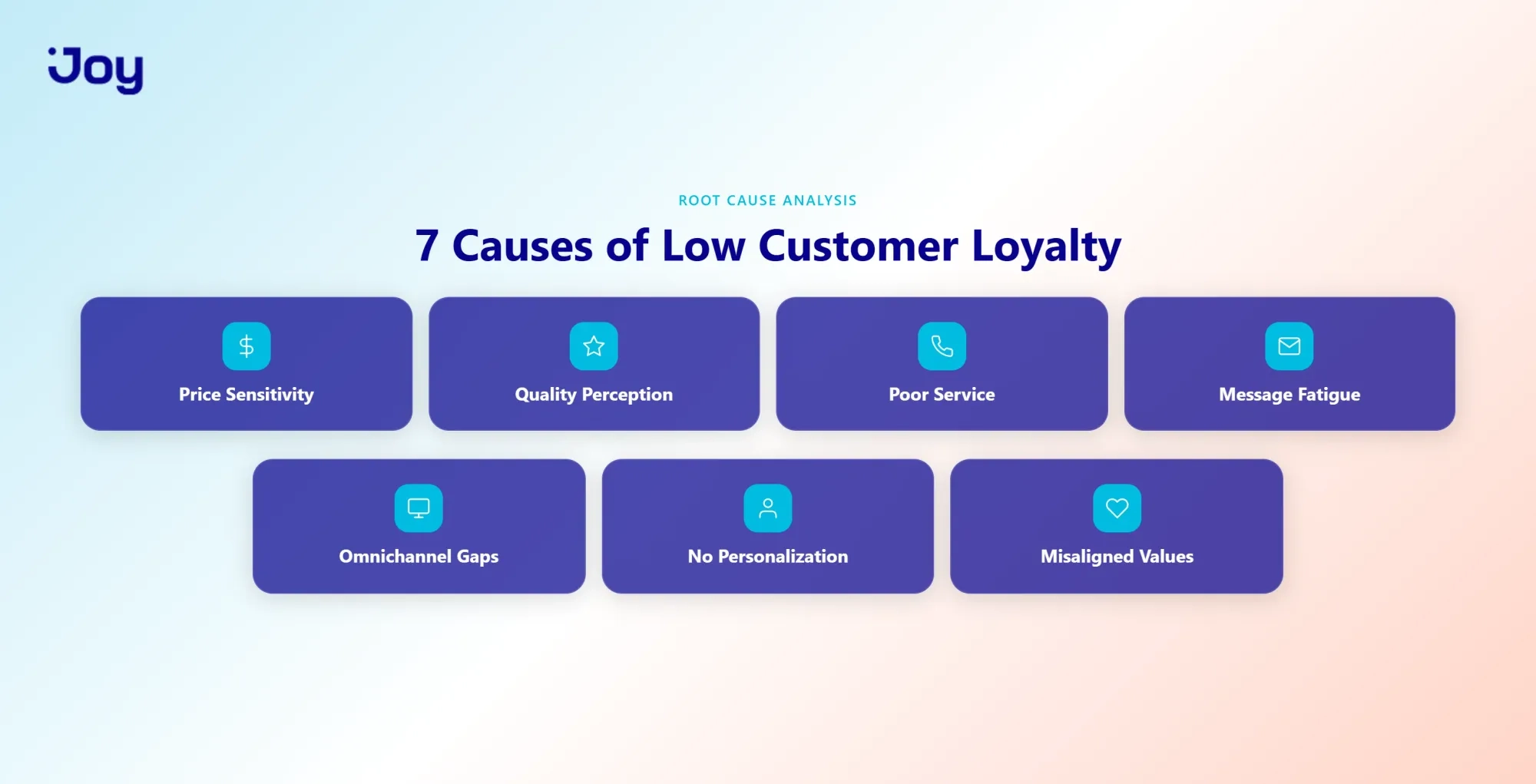
Customers rarely leave at random. Repeat purchases usually stall for one of seven reasons — price sensitivity, slipping quality, poor service, message fatigue, disconnected channels, no personalization, or misaligned values. This guide diagnoses each one and names the metric that gives it away.

Summarize this post with AI
Customer loyalty fell hard in a single year and never climbed back. It is not still collapsing. It is not recovering either. And the brands treating that plateau as the new normal are quietly bleeding revenue every quarter.
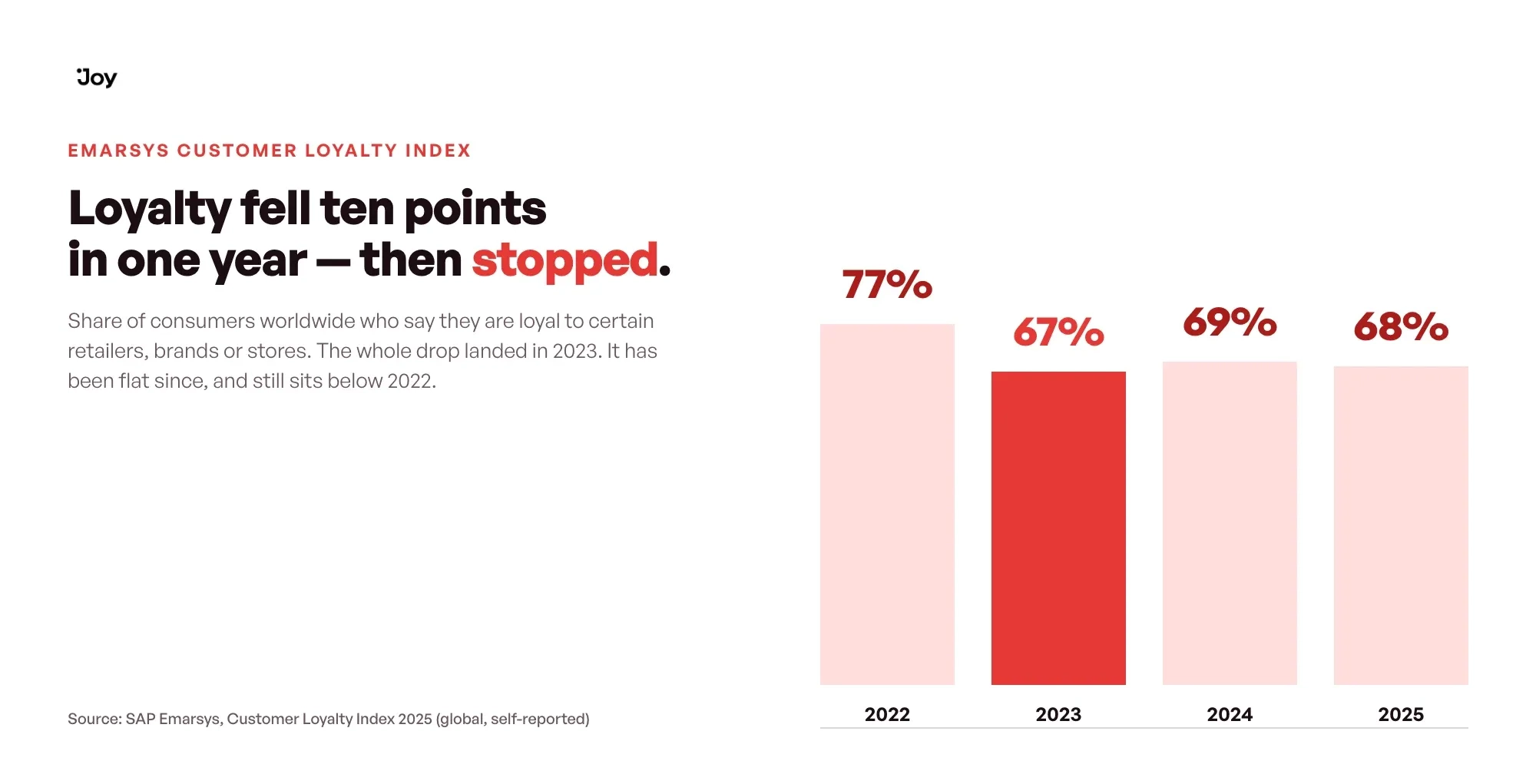
SAP Emarsys' Customer Loyalty Index asks consumers a simple question: do you consider yourself loyal to certain retailers, brands or stores? Globally, 77% said yes in 2022. In 2023 that fell to 67%, and it has stayed there since — 69% in 2024, 68% in 2025 (Customer Loyalty Index 2025). Ten points lost in one year, and three years on, almost none of it has come back. For ecommerce brands already battling rising acquisition costs, that creates an unsustainable equation: you're paying more to acquire customers who are less likely to come back than they were three years ago.
That matters because a 5% increase in customer retention can produce a 25% to 95% increase in profits, per Bain & Company's research. Yet most brands keep pouring budgets into acquisition while ignoring the structural reasons customers leave.
So what's actually driving this loyalty collapse? And what can you do about it?
Below, we break down the data behind the decline, identify seven root causes of low customer loyalty, and outline what research shows is working to reverse the trend.
Is Customer Loyalty Really Declining?
It did fall. Then it stopped falling. Both halves of that matter.
The entire drop happened in one year. Emarsys' index went from 77% in 2022 to 67% in 2023, then edged back to 69% in 2024 and 68% in 2025. Note what that number measures: consumers reporting how loyal they feel, not what they actually bought. So the useful question is no longer whether loyalty is still sliding, because it isn't. It's why a tenth of the market walked in a single year and hasn't walked back. Low customer loyalty isn't inevitable. In the right conditions, brands still earn it.
Take Sephora. Its Beauty Insider program hit a record 45 million members in North America in 2025 — growth straight through the years the index says loyalty slipped (Sephora newsroom, January 2026). The brand didn't escape the broader downturn through luck. It earned loyalty through deliberate program design and personalized experiences.
The Generational Shift
Younger consumers are redefining what loyalty looks like altogether. Lower product quality is the number one loyalty disruptor in SAP Emarsys' 2025 index, named by 54% of consumers. Gen Z are also the generation least likely to name quality as a reason they stay loyal at all (45%, against 64% of Boomers). This generation holds brands to higher standards and tolerates far less inconsistency.
What's telling is how values now shape purchasing decisions for younger cohorts. Ethical loyalty rose from 24% in 2021 to 30% in 2024, then slipped back to 27% in 2025. Gen Z and millennials increasingly prioritize mission alignment and community over discounts alone. They aren't disloyal by nature. They're loyal to different things.
The Real Question
So are customers becoming more fickle, or are brands failing to earn loyalty?
The evidence points to the latter. When brands deliver consistent quality, personalize experiences, and align with customer values, loyalty types still emerge. The gap between a market-wide number that stopped improving and the brands that kept growing through it points to seven specific, diagnosable causes.
7 Root Causes of Low Customer Loyalty
Customers don't leave randomly. They leave for specific, identifiable reasons that most brands either overlook or fail to address until it's too late.
While acquisition campaigns dominate marketing budgets, seven structural problems quietly drive customers away. Understanding each one is the first step toward identifying which factors cost your business the most revenue.
1. Price Sensitivity and Economic Pressure
Inflation and economic uncertainty have made consumers more aggressive about comparing prices. When acquiring a new customer costs more than that customer spends in a single transaction, the math breaks.
That's where retention economics become critical. Even small improvements in customer retention compound dramatically over time. Each returning customer carries zero acquisition cost, so what looks like a modest shift in repeat purchase behavior translates into outsized profit gains.
The deeper issue: price sensitivity often masks a lack of perceived value. Customers who recognize unique, ongoing value in a brand relationship become far less sensitive to price swings. But brands competing purely on discounts? They train customers to wait for sales. Over time, this erodes both margins and loyalty at once.
2. Declining Product Quality Perception
Even customers who aren't price-sensitive will leave when they feel product quality has slipped. One bad experience can end a customer relationship permanently. And recovering that trust takes far more effort than maintaining it ever did.
This hits Gen Z especially hard. As noted above, a slip in quality is the single biggest loyalty disruptor, named by 54% of consumers in 2025. Their expectations run higher than older cohorts, and their tolerance for inconsistency runs lower.
What makes quality-driven churn so dangerous is how silent it is. Most dissatisfied customers never complain. They just leave. Without active feedback loops, brands often don't realize quality perception is the root cause of declining retention until the numbers have already cratered. Proactive communication about sourcing, materials, and testing processes can close this gap before customers walk away.
3. Poor Customer Service
If quality keeps customers from leaving, service is what brings them back. And the data makes the stakes clear.
Microsoft's 2017 research found that 96% of customers say customer service is a critical factor in their brand loyalty decisions. Not a differentiator. A baseline expectation.
Service failures create an emotional response that's harder to recover from than pricing or quality issues, because they feel personal.
Inconsistency compounds the damage. One exceptional experience followed by one poor interaction produces a net negative impression. And with customers now expecting the same service quality across phone, email, chat, and social channels, the opportunities for inconsistency have multiplied. Prevention always costs less than recovery.
4. Message Fatigue and Over-Communication
Poor service drives customers away through frustration. Over-communication drives them away through exhaustion. Different paths, same destination: disengagement.
Over-messaging leads to unsubscribes, brand fatigue, and what's often called "noise blindness." When customers receive too many emails or notifications, they stop opening any of them.
Irrelevant offers accelerate the problem. Generic promotional blasts signal that a brand doesn't know or care about individual preferences. Instead of feeling valued, customers feel like entries in a database.
There's a paradox at work here. When brands notice declining engagement, they often respond by increasing email frequency. That accelerates the very decline they're trying to reverse. A brand sending three promotional emails per week to customers who haven't opened one in months isn't fighting disengagement. It's reinforcing it.
Smart segmentation and frequency capping prevent fatigue, while personalized, behavior-based messaging makes each touchpoint feel valuable rather than intrusive. If your unsubscribe rate or per-segment engagement is deteriorating, you're likely over-communicating.
5. Omnichannel Gaps and Fragmented Experience
Message fatigue is a communication problem. But even brands that get their messaging right can lose customers through a different disconnect: fragmented experiences across channels.
Today's customers expect a connected experience across online stores, physical locations, mobile apps, and social media. They don't think in channels. They think in relationships. When those channels operate in silos, customers feel unrecognized and frustrated.
Common failure points: loyalty points that don't sync between channels, purchase history invisible to support teams, inventory information that conflicts between online and in-store systems. These disconnects force customers to repeat themselves and lose progress. That signals the brand doesn't truly see them as one customer.
The most telling example? A customer buys in-store, then receives a "we miss you" email the next day. That kind of disconnect doesn't just feel impersonal. It actively erodes trust. The fix is straightforward: a unified, data-driven customer view where information follows the customer, not the channel.
6. Lack of Personalization
Fragmented experiences make customers feel unseen. But even when channels work together, a lack of personalization makes customers feel replaceable. And that distinction matters enormously for revenue.
Motista's two-year study of more than 100,000 customers of over 100 retailers, published in 2018, found that emotionally connected customers deliver 306% higher lifetime value than merely satisfied ones, and stay with a brand 5.1 years on average against 3.4. That difference is one of the largest untapped opportunities in ecommerce.
The practical difference is striking. Transactional customers will leave for a 10% discount from a competitor. Emotionally loyal customers stay through price changes because the relationship itself holds value. And with 74% of first-time buyers never placing a second order in Bluecore's 2023 data, the customers who do feel connected carry a disproportionate share of your revenue.
What does personalization actually look like? Behavior-based segmentation, purchase-informed recommendations, and lifecycle-specific messaging that reflects where each customer stands in their relationship with your brand.
7. Misaligned Brand Values and Sustainability
All six causes above focus on what brands do. This final cause is about what brands stand for. For a growing number of consumers, it matters just as much.
Modern consumers, especially Gen Z and millennials, increasingly choose brands that reflect their personal values. This isn't fringe behavior — the generational data above shows ethical loyalty rising across five years, with a dip in 2025. Sustainability, social responsibility, and authenticity have shifted from nice-to-have qualities to actual purchase criteria.
Brands that ignore values alignment lose customers who would otherwise remain loyal based on product quality and pricing alone. The community dimension matters here, too. Customers want to belong to something larger than a transactional relationship. Without that sense of community, brands rely entirely on product and price, which leaves them vulnerable to any competitor offering a marginal improvement on either front.
Purpose-driven brands like Patagonia and REI demonstrate that mission can function as a loyalty moat. Their customers stay not just because of product quality, but because the brand represents something they identify with. For any brand, sharing your story, values, and impact builds connection that goes far beyond the product itself.
Which Fix Goes With Which Cause
Diagnosis without a next step is just a diagnosis. Each root cause has a matching intervention, and the order you run them in matters more than the list itself.
- Causes 1 and 4 — price sensitivity, message fatigue → a loyalty program that moves value perception off the single transaction
- Causes 4 and 6 — message fatigue, lack of personalization → behavior-based segmentation instead of higher send frequency
- Causes 6 and 7 — emotional loyalty, misaligned values → community and purpose, not deeper discounts
- Causes 3 and 5 — service consistency, omnichannel gaps → one customer identity across every channel
Building those four in the wrong order is the most common way this goes wrong. Our 7-step system to enhance customer loyalty walks the build in sequence, from baseline audit to ROI measurement.
Read Your Metrics Back to a Cause
A declining CLV points toward pricing or value perception. A dropping NPS suggests service or quality. A flat repeat rate usually signals personalization or engagement gaps. Let the metric tell you which of the seven causes to open first — then baseline it properly before you change anything.
Conclusion
Low customer loyalty isn't a mystery. It's seven diagnosable problems, each with proven solutions backed by research.
Price sensitivity responds to loyalty programs that shift how customers perceive value. Quality and service issues require trust-building through consistency. Message fatigue and personalization gaps demand a shift from frequency to relevance. Values misalignment calls for purpose-driven connection. And omnichannel fragmentation needs a unified customer experience that follows the customer, not the channel.
The numbers above point one way. The brands that hold on to customers are the ones that fix the specific cause they have, not the ones that discount hardest. The question isn't whether to invest in loyalty. It's which cause to address first.
Your next steps:
- Audit: Which of the seven root causes is your biggest leak?
- Measure: Baseline your CLV, NPS, and repeat purchase rate today.
- Act: Start with the cause that costs you the most revenue.
Wondering what it looks like when a loyalty platform addresses all seven causes together? Explore Joy Loyalty to see the approach in action.

Written by
Thomas Nguyen is the CEO & Co-founder of Joy, a loyalty solution for Shopify and eCommerce brands. With years of experience building high-performance Shopify apps, Thomas aims to help merchants grow through customizable and retention-focused tools.
Related reading
 Loyalty Strategy
Customer Acquisition vs Retention: Where to Put Your Next Dollar
Customer acquisition and retention aren't a contest. Here's what each really costs, when to prioritize which, and a simple LTV:CAC way to decide your split.
 Thomas Nguyen
 Loyalty Strategy
6 Key Factors That Affect Customer Loyalty
Loyalty isn't luck or a good Black Friday sale — it's built on six specific, measurable factors. This guide breaks down each one: why it matters, how to measure it, and how to put it into action, with examples from brands that got it right.
Thomas Nguyen Loyalty Strategy
How to set up customer retention automation (without a big team)
A step-by-step guide to automating customer retention across the customer lifecycle, from onboarding to win-back.
Thomas Nguyen Loyalty Strategy
The Customer Loyalty Loop: Why Retention Beats Acquisition
More than half of loyalty memberships sit inactive — the fix isn't a better funnel, it's a loop. Here's the 4-stage customer loyalty loop framework, where most Shopify programs break down, and how to diagnose which stage yours is missing.
Thomas Nguyen Loyalty Strategy
Customer Retention Goals: 5 Targets to Set (and How to Hit Them)
A goal-first guide to customer retention: the five targets worth setting, how to make each one SMART, and the strategy that hits it.
Thomas Nguyen Loyalty Strategy
The Customer Loyalty Life Cycle: 5 Stages and Where Most Brands Lose Customers
Ad costs keep climbing, but customers buy once and disappear. The customer loyalty life cycle is the framework that shows exactly where the journey breaks; five stages, the warning signs of each stage failing, and how to diagnose your weakest link before it costs more revenue.
Thomas Nguyen