
Loyalty Customer Service: How Service Quality Drives Revenue
80% of customers say experience matters as much as products (Salesforce). Loyalty customer service isn't a cost center — it's a revenue lever. This guide covers Harvard's Service-Profit Chain, the service-to-revenue mechanism, and a 5-step recovery system any ecommerce brand can run.

Summarize this post with AI
Eighty percent of customers say the experience a company provides matters as much as its products, per Salesforce's State of the Connected Customer report. Yet most ecommerce brands still treat customer service as a cost center. Something to minimize, not invest in.
That's a problem. Merchants pour budget into loyalty programs, referral systems, and email campaigns, but overlook the interaction that shapes loyalty more than any of those: how they treat customers when something goes wrong, or when a simple question needs answering. Service quality and customer loyalty are directly linked. Every single service interaction is either building loyalty or quietly destroying it.
This guide walks through the Harvard Service-Profit Chain applied to ecommerce, a structured service recovery system, and the metrics that connect service performance to retention revenue. Because if you want to provide great service and inspire customer loyalty, the starting point isn't a new tool. It's a shift in how you think about service itself.
Why Loyalty Customer Service Is Your Most Powerful Retention Lever
The business case for investing in customer service isn't soft or sentimental. It's financial. And the data consistently shows that service quality is the single biggest factor separating brands that retain customers from brands that lose them.
The Cost Equation - Retention vs. Acquisition
Acquiring a new customer costs five to 25 times more than retaining an existing one, per Bain & Company research. On top of that, a five percent increase in retention can boost profits by 25% or more, depending on the industry.
For Shopify merchants spending $30 to $100+ per customer through paid ads, every churned customer represents wasted acquisition cost. And the cheapest retention tool most brands already have? It's sitting right in front of them: their customer service team. You're already paying for the headcount. The question is whether those interactions are building loyalty or just closing tickets.
Shifting even a small percentage of churn into retention can reshape your unit economics entirely.
Service Quality and Customer Loyalty - What the Data Says
The link between service and loyalty isn't theoretical:
- 73% of customers point to experience as a key factor in purchasing decisions, according to PwC's Future of Customer Experience report
- Repeat customers spend 67% more than first-time buyers (Bain & Company), making every service-driven retention win worth more than the initial sale
- Customers who trust a brand are 88% more likely to buy again, based on Deloitte's Four Factors of Trust research covering 350,000+ survey responses
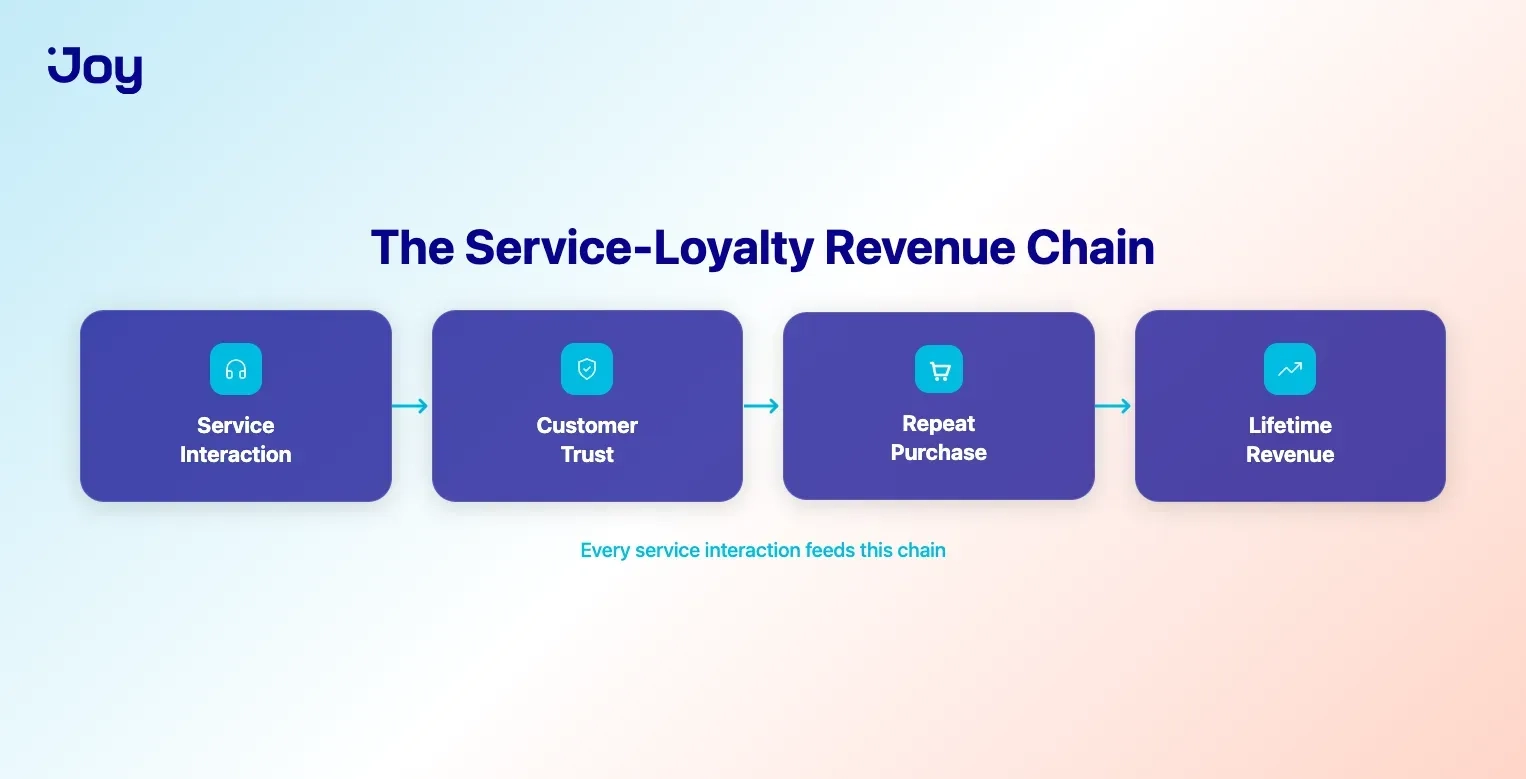
So what does that chain actually look like? Service quality builds trust. Trust drives repeat purchases. Repeat purchases compound into loyalty. That's not sentiment. It's a measurable sequence.
Yet most merchants track NPS in isolation without connecting it to repeat purchase rate or customer lifetime value. The metric exists, but the insight doesn't.
Why Most Ecommerce Brands Get This Wrong
Three mistakes show up again and again across ecommerce brands:
Mistake one: treating service as a cost to minimize. The goal becomes fewer tickets and fewer agents, rather than higher-quality interactions that drive retention.
Mistake two: investing in loyalty programs but underfunding the team that talks to customers daily. A points program means nothing if the support experience frustrates the very people you're trying to retain.
Mistake three: measuring service by speed alone. Response time and resolution rate matter operationally, but they don't capture whether the interaction actually strengthened or weakened loyalty.
The cost of getting this wrong adds up fast. According to Qualtrics XM Institute, more than half of consumers cut spending after a poor experience. And most never tell you why. They simply buy less, or leave. Meanwhile, after more than one bad experience, roughly 72% of consumers switch to a competitor.
What ties all three mistakes together? Most ecommerce stores have a loyalty program and a helpdesk, but no connection between them. That gap is where retention revenue goes to die.
The Service-Profit Chain - A Proven Framework for Loyalty Customer Service
Most service advice stops at "be empathetic" or "respond faster." But there's a research-backed framework that explains exactly how service quality translates into profit. It's called the Service-Profit Chain, and it's been validated across industries for over three decades.
What Is the Service-Profit Chain?
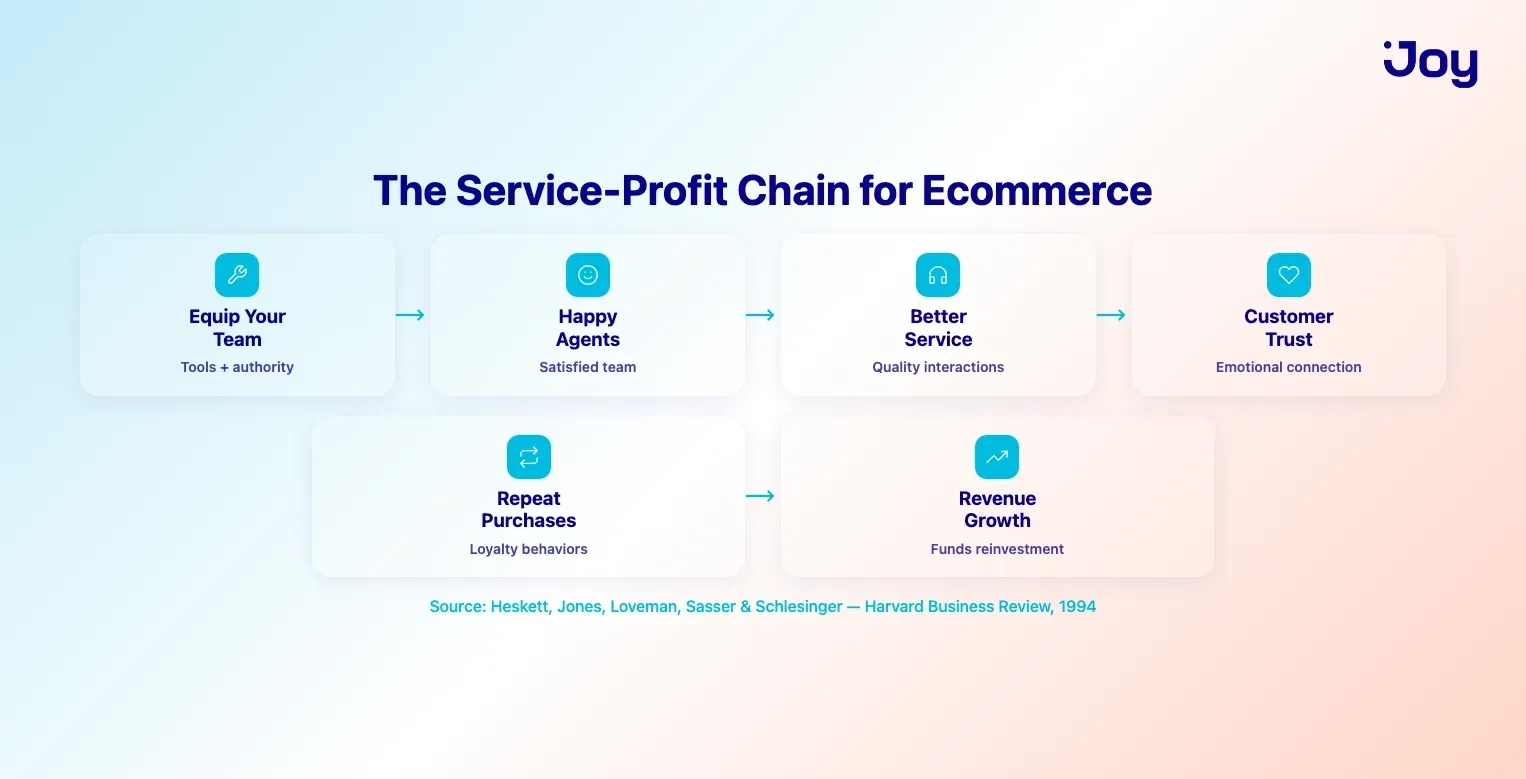
The Service-Profit Chain was introduced by Heskett, Jones, Loveman, Sasser, and Schlesinger in Harvard Business Review in 1994. The framework maps a direct chain of cause and effect:
Internal service quality → Employee satisfaction → Employee loyalty → Productivity → External service value → Customer satisfaction → Customer loyalty → Revenue and profit
The researchers validated this chain at companies including American Express, Southwest Airlines, Ritz-Carlton, Banc One, and USAA. Their strongest findings? The tightest relationships exist between profit and customer loyalty, between employee loyalty and customer loyalty, and between employee satisfaction and customer satisfaction.
Customer loyalty starts with how you treat your employees. Not your customers. That insight alone changes how you should think about building a service team.
How to Apply the Service-Profit Chain to Ecommerce
The framework translates to ecommerce more directly than you'd expect. Each link in the chain maps to a Shopify merchant's reality:
Internal service quality means equipping support agents with the right tools (helpdesk access, CRM data, loyalty platform visibility) plus training on product knowledge and the authority to make real decisions. Refunds, replacements, bonus points: agents need to act without waiting for approval on every case.
Employee satisfaction comes from competitive pay, clear escalation paths, and recognition tied to retention outcomes rather than just ticket volume. When agents are measured only on speed, they optimize for closing conversations. Not for building relationships.
External service value shows up as personalized responses (not canned templates), proactive outreach like order updates and loyalty milestone notifications, and fast, complete resolution.
The customer loyalty outcome is measurable: repeat purchases, referral program engagement, higher-tier membership, and growing lifetime value.
One brand that illustrates this chain well is Ritz-Carlton. Every Ritz-Carlton employee has up to $2,000 in discretionary authority to resolve guest issues. No manager approval required. For ecommerce, the dollar amount isn't the point. The principle is: give agents the authority to issue loyalty points, upgrade tiers, or send a surprise reward without navigating three levels of approval.
You don't need Ritz-Carlton's budget. You need their mindset.
Customer Loyalty Services That Drive the Chain Forward
Customer loyalty services aren't software features. They're deliberate actions your team takes to turn routine interactions into retention opportunities. Five that directly feed the Service-Profit Chain:
- Proactive order issue resolution - Contact customers before they contact you. Shipping delays, stock problems, fulfillment errors: reaching out first signals that you're paying attention
- Post-purchase follow-up - Check satisfaction seven days after delivery. This is also a natural moment to introduce your loyalty program to customers who haven't joined yet
- Personalized service interactions - Use purchase history and loyalty tier data to shape responses. A VIP customer with 20 orders deserves a different tone and priority than a first-time buyer
- Service-triggered rewards - Award loyalty points for completing post-support surveys or leaving reviews after a resolved issue. This turns a support interaction into a loyalty touchpoint
- Escalation-to-delight - When a complaint is resolved well, follow up with a personalized thank-you and bonus points. Don't just close the ticket. Close the loop
These aren't abstract strategies. They're workflows a team can start running this week.
Service Recovery - How to Turn Complaints Into Loyalty
Every competitor article mentions empathy and complaint handling. Almost none provides a structured recovery framework with measurable outcomes. And that gap starts with a paradox most merchants have never heard of.
The Service Recovery Paradox - When Failures Build Stronger Loyalty
The Service Recovery Paradox, first described by McCollough and Bharadwaj in 1992, captures a counterintuitive finding: customers who experience a service failure followed by exceptional recovery can end up more loyal than customers who never had a problem at all.
When does this actually work? Three conditions need to be present: the failure is perceived as a one-time event (not a pattern), the recovery response exceeds expectations, and the response is swift with genuine empathy. According to Salesforce Research, 78% of customers who receive satisfactory resolutions remain loyal.
A caveat worth noting: meta-analyses show mixed behavioral outcomes. The paradox is real, but it's not guaranteed. It works best when recovery is genuinely exceptional, not merely "adequate." Don't engineer failures. But when they happen, treat them as the highest-priority loyalty opportunity you have.
The 5-Step Service Recovery System for Ecommerce
Most service recovery happens ad hoc. An agent makes a judgment call, the customer gets a refund, and everyone moves on. That's not a system. It's improvisation. Here's a structured alternative:
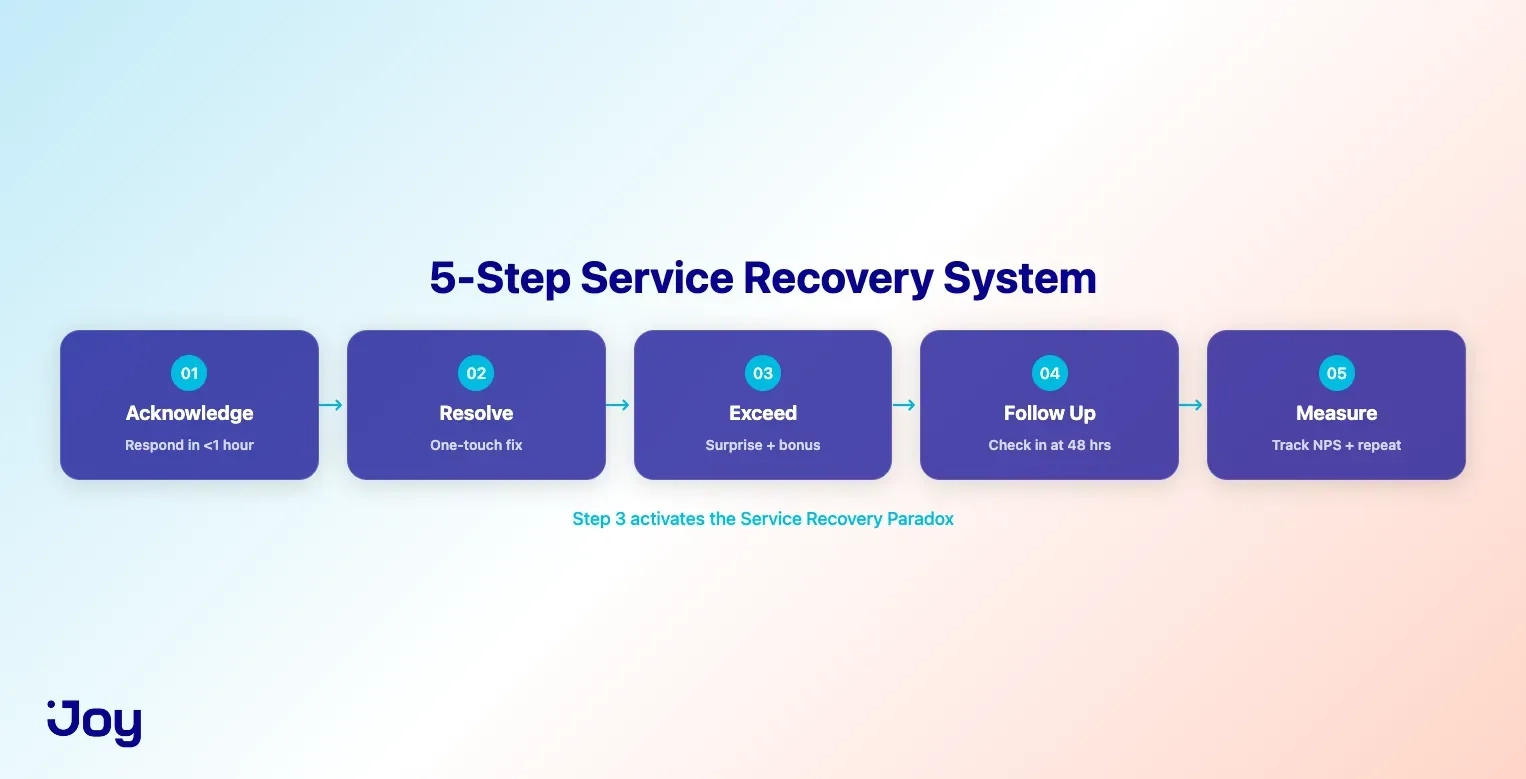
Step 1 - Acknowledge immediately. Respond within one hour. Name the specific issue. Reference the customer's order, product, and situation rather than reaching for a template. "I can see your order #4521 arrived with the wrong color - that's on us" hits differently than "We apologize for any inconvenience."
Step 2 - Resolve completely. Fix the actual problem: refund, replacement, expedited shipping. Don't offer partial solutions or coupon codes as a substitute for making it right. One-touch resolution is the goal.
Step 3 - Exceed expectations. This is the step that activates the paradox. Go beyond the fix. Add bonus loyalty points, upgrade their tier for a month, or include a handwritten note. The customer expected a resolution. They didn't expect generosity. That gap is where loyalty forms.
Step 4 - Follow up. Forty-eight hours after resolution, check in. "Was everything resolved to your satisfaction?" This closes the emotional loop and shows you care beyond the ticket lifecycle.
Step 5 - Measure the impact. Track post-recovery NPS, repeat purchase rate within 30, 60, and 90 days, and referral activity. Compare recovered customers against customers who never complained. That's how you prove the system works.
In practice: a customer receives the wrong color item. Your agent sends the correct item the same day, adds 200 bonus loyalty points to their account, and includes free expedited shipping. Two days later, a follow-up email confirms everything arrived correctly. The customer, impressed by how smoothly it was handled, posts a positive review. That's not damage control. That's loyalty building.
How to Provide Great Service and Inspire Customer Loyalty Through Recovery
Why does recovery create such strong loyalty? Because emotional engagement is built in moments of vulnerability. And a complaint is the highest-vulnerability touchpoint in the customer journey.
According to Capgemini's Loyalty Deciphered report, which surveyed over 9,000 consumers, 82% of emotionally engaged consumers always buy the brand they're loyal to. Compare that to just 38% of consumers with low emotional engagement. The gap is enormous. And service recovery is one of the fastest ways to bridge it.
Recovery done right creates an emotional bond. That bond drives repeat purchases. Repeat purchases compound into lifetime value. The research confirms every link in that chain.
Zappos built its entire brand reputation on this principle. Stories of agents sending flowers to grieving customers, upgrading shipping without being asked, and spending hours on the phone to solve a single problem aren't just PR. They're the engine behind legendary word-of-mouth and customer advocacy.
The practical takeaway: after resolving a complaint well, that's the ideal moment to invite the customer into your loyalty program or referral program. The goodwill is fresh. Capture it.
How to Measure Service Quality and Customer Loyalty Impact
Most merchants track service metrics and loyalty metrics in completely separate dashboards. Response time lives in the helpdesk. NPS lives in a survey tool. CLV lives in a spreadsheet. Nobody can answer the most important question: is our customer service actually generating revenue?
Service Metrics That Predict Customer Loyalty
Four service metrics serve as leading indicators of whether a customer will come back:
CSAT (Customer Satisfaction Score). A post-interaction survey asking "How satisfied were you with this support experience?" It's the most direct predictor of immediate repurchase intent.
First Contact Resolution (FCR). The percentage of issues resolved in a single interaction. Higher FCR means lower customer effort, and lower effort consistently predicts higher loyalty. (This one's underrated. Most brands don't track it.)
Response Time. Speed still matters. According to Salesforce, 72% of customers remain loyal to brands that provide fast service. But speed alone isn't enough. A fast, unhelpful response is worse than a slightly slower, thorough one.
Customer Effort Score (CES). How easy was it for the customer to get help? In multiple studies, CES outperforms CSAT as a loyalty predictor. The logic is intuitive: customers don't reward you for delighting them as much as they punish you for making things difficult.
These aren't just "support metrics." They're leading indicators of retention. Track them as such.
Loyalty Metrics That Prove Service Quality Works
On the other side of the dashboard, four loyalty metrics show whether your service investment is paying off:
Customer Retention Rate (CRR). The formula: ((E - N) / S) x 100. Track this monthly and quarterly. It's the most fundamental measure of customer loyalty.
Net Promoter Score (NPS). Promoters (9-10) minus Detractors (0-6). Service quality is the number one driver of NPS movement in ecommerce.
Customer Lifetime Value (CLV). Average order value multiplied by purchase frequency multiplied by customer lifespan. Service quality extends lifespan and increases frequency. A double compounding effect.
Repeat Purchase Rate. The percentage of customers who buy again within 90 days. The most direct behavioral link between a service interaction and a loyalty outcome.
The real power comes from correlation. Build a dashboard that maps service metrics against loyalty metrics over time. When CSAT improves, does CLV follow? Those correlations are where you find actionable insight, not in any single number.
Service-Attributed Revenue - Closing the Measurement Loop
One metric ties everything together: service-attributed revenue. This tracks orders that can be traced back to a positive service interaction through loyalty program engagement. Discount code redemptions, referral link usage, post-interaction purchases.
The flow: a customer has a great service experience, joins your loyalty program, earns points, redeems a discount code, and that order is tracked as service-attributed revenue. You can trace the revenue directly back to the service interaction that started the chain.
Can your team answer "how much revenue does our service department generate?" Most can't. Service-attributed revenue provides that answer. And once you have it, the conversation shifts from "how do we cut costs?" to "how do we invest more?"
Some loyalty platforms track this as a built-in metric. When evaluating tools, look for features like "assisted orders" or similar attribution tracking that connects service touchpoints to measurable loyalty outcomes.
Technology That Amplifies Loyalty Customer Service
The frameworks and systems above are human-driven. But the right technology stack amplifies every part of them, from personalization to measurement. The key isn't adding more tools. It's connecting the ones you already have.
The Loyalty-Service Technology Stack for Ecommerce
Every ecommerce brand running loyalty customer service needs three layers:
- Helpdesk layer - Manages tickets, response time, and resolution. Tools like Gorgias, Zendesk, or Freshdesk handle this.
- Loyalty platform layer - Manages points, tiers, rewards, and referrals. This is where platforms like Joy Loyalty, Smile.io, or LoyaltyLion operate.
- Data and analytics layer - Connects service data to loyalty outcomes. This can live in built-in dashboards or a separate BI tool.
The problem most brands face isn't a missing layer. It's that layers one and two don't talk to each other. The helpdesk doesn't know a customer's loyalty tier. The loyalty platform doesn't know about a recent support interaction. And neither system feeds into a shared analytics view.
When a service agent can see a customer's loyalty tier, point balance, and purchase history during a support interaction, every response becomes personalized and loyalty-aware. That's the difference between "here's your refund" and "here's your refund, and I've added 150 bonus points to your Gold tier account as a thank-you for your patience."
It's not about more software. It's about connection.
How AI and Automation Enhance Customer Loyalty Services
AI adds a layer of scale and speed to the human-driven system, but it doesn't replace it. Where automation helps most:
- Automated post-purchase follow-ups - Trigger a satisfaction check seven days after delivery, without manual effort
- Sentiment detection - Flag negative interactions for priority human follow-up before they escalate
- Personalized loyalty notifications - "You're 50 points away from your next reward" triggered automatically by interaction data
- Automated recovery workflows - Complaint resolved? Auto-trigger bonus points plus a follow-up email at 48 hours
One important distinction: AI handles the routine and the predictable. Humans handle the emotional and the complex. The service recovery system should always be human-led. The empathy and judgment that activate the Service Recovery Paradox come from people, not algorithms. Automation frees agents to focus on the interactions that actually build loyalty.
Loyalty Customer Service - Every Interaction Builds or Breaks Loyalty
Customer service isn't a support function. It's a loyalty strategy. And the research backs that up at every level.
The Service-Profit Chain proves that investing in your service team feeds directly into customer loyalty and revenue. The Service Recovery Paradox shows that complaints, handled exceptionally well, create stronger bonds than smooth transactions ever could. And service-attributed revenue finally closes the measurement gap between "we think service matters" and "here's exactly how much revenue it generates."
The research is consistent: emotionally engaged consumers stick with their preferred brands at rates that dwarf transactional buyers. Those emotional connections aren't built through marketing campaigns or discount codes. They're built in the moments when something goes wrong and your team makes it right.
Where to start: audit your current stack. Does your helpdesk talk to your loyalty platform? Can your service team see a customer's loyalty tier during a support interaction? Pull up your 10 most-contacted customers this month and check their repeat purchase rate. The gap between service effort and loyalty outcome is your biggest opportunity.
Loyalty platforms like Joy Loyalty are built to connect service interactions to retention outcomes, from tracking assisted orders to integrating with your helpdesk. If your service and loyalty systems are running in separate silos, that connection is the first thing worth fixing.
FAQ
What is loyalty customer service?
It's the practice of treating every service interaction, from support tickets to post-purchase follow-ups, as an opportunity to build customer loyalty and drive repeat purchases. It reframes service as a revenue driver rather than a cost center.
How does customer service affect customer loyalty?
Directly. 73% of customers point to experience as a key purchasing factor (PwC), and 80% say experience matters as much as products (Salesforce). On the flip side, more than half of consumers cut spending after a poor experience, often without telling you why.
What is the Service-Profit Chain?
A framework from Harvard Business Review (1994) showing that internal service quality leads to employee satisfaction, which leads to employee loyalty, then productivity, then external service value, then customer satisfaction, then customer loyalty, and finally revenue. It proves that loyalty starts with how you treat your team.
What is the Service Recovery Paradox?
Customers who experience a service failure followed by exceptional recovery can become more loyal than customers who never had a problem. It works when the failure is seen as a one-time event, recovery is swift and empathetic, and the response exceeds expectations.
How do you turn customer complaints into loyalty?
Follow a structured recovery system: (1) acknowledge immediately and name the specific issue, (2) resolve completely with a one-touch fix, (3) exceed expectations with bonus points or a surprise gesture, (4) follow up after 48 hours, and (5) measure the impact on repeat purchases and referrals.
What metrics connect service quality to customer loyalty?
Leading indicators: CSAT, Customer Effort Score (CES), and First Contact Resolution (FCR). Lagging indicators: Customer Retention Rate (CRR), Net Promoter Score (NPS), and Customer Lifetime Value (CLV). The real insight comes from correlating service metrics with loyalty metrics over time.
What is service-attributed revenue?
Revenue traceable to a positive service interaction through loyalty program engagement: discount code redemptions, referral link usage, or post-interaction purchases. It answers the question most service teams can't: "How much revenue does our department actually generate?"
What technology do you need for loyalty customer service?
Three layers: a helpdesk for ticket management (Gorgias, Zendesk), a loyalty platform for points, tiers, and referrals, and a data layer connecting them. The critical factor isn't having all three (most brands do). It's making sure they share customer data so every service interaction is loyalty-aware.

Written by
Thomas Nguyen is the CEO & Co-founder of Joy, a loyalty solution for Shopify and eCommerce brands. With years of experience building high-performance Shopify apps, Thomas aims to help merchants grow through customizable and retention-focused tools.
Related reading
 Loyalty Strategy
The Customer Loyalty Loop: Why Retention Beats Acquisition
More than half of loyalty memberships sit inactive — the fix isn't a better funnel, it's a loop. Here's the 4-stage customer loyalty loop framework, where most Shopify programs break down, and how to diagnose which stage yours is missing.
 Thomas Nguyen
 Loyalty Strategy
Customer Retention Goals: 5 Targets to Set (and How to Hit Them)
A goal-first guide to customer retention: the five targets worth setting, how to make each one SMART, and the strategy that hits it.
Thomas Nguyen Loyalty Strategy
The Customer Loyalty Life Cycle: 5 Stages and Where Most Brands Lose Customers
Ad costs keep climbing, but customers buy once and disappear. The customer loyalty life cycle is the framework that shows exactly where the journey breaks; five stages, the warning signs of each stage failing, and how to diagnose your weakest link before it costs more revenue.
Thomas Nguyen Loyalty Strategy
Customer retention benchmarks for ecommerce: What's a good rate?
A clear-eyed look at ecommerce retention benchmarks: the one number worth trusting, why most by-industry tables mislead, and how to benchmark against yourself.
Thomas Nguyen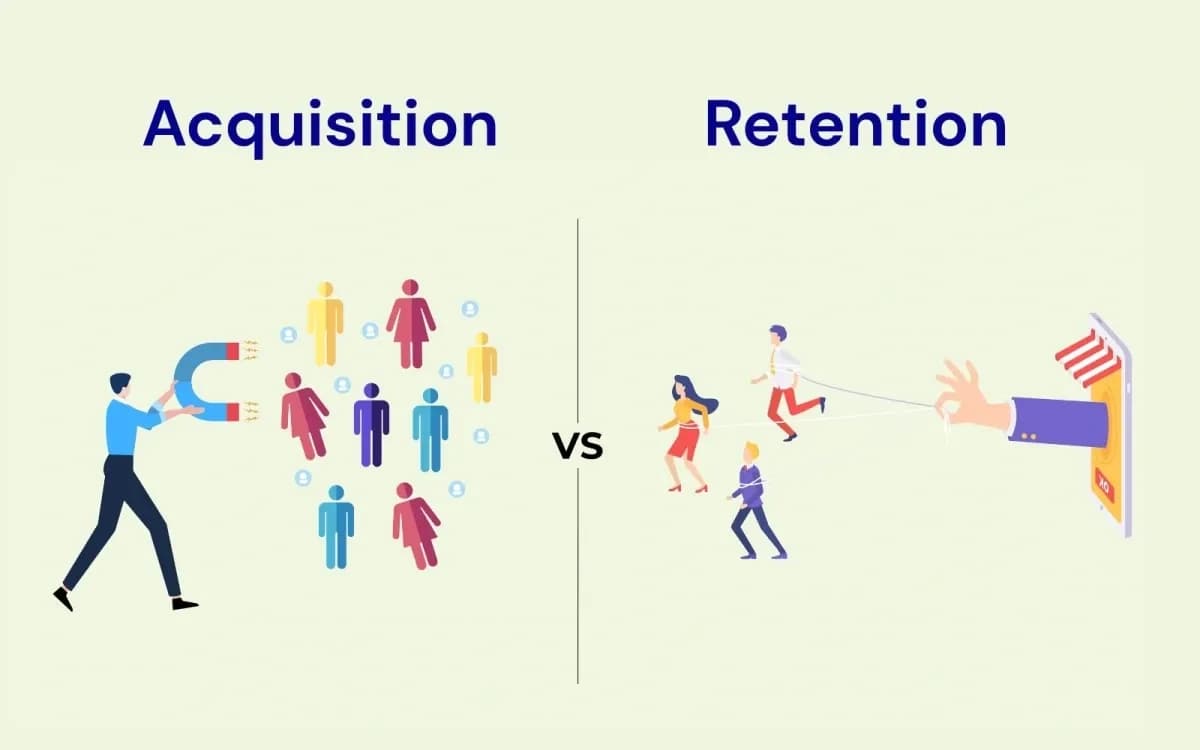 Loyalty Strategy
Customer Acquisition vs Retention: Where to Put Your Next Dollar
Customer acquisition and retention aren't a contest. Here's what each really costs, when to prioritize which, and a simple LTV:CAC way to decide your split.
Thomas Nguyen Loyalty Strategy
How to set up customer retention automation (without a big team)
A step-by-step guide to automating customer retention across the customer lifecycle, from onboarding to win-back.
Thomas Nguyen