
Customer Loyalty Meaning: The Framework Most Brands Miss
89% of executives think customer loyalty is up. Only 39% of consumers agree — a 50-point perception gap (PwC, 2025). The fix starts with knowing what customer loyalty actually means. This guide breaks down the dual nature, 6 types, and a 2x2 matrix to diagnose your brand.
Summarize this post with AI
A number that should make every ecommerce brand uncomfortable: 89% of executives say customer loyalty has grown in recent years. But only 39% of consumers agree. That's a 50-point perception gap, straight from PwC's 2025 Customer Experience Survey of 5,511 consumers and 406 executives.
The disconnect isn't random. It starts with how businesses define loyalty in the first place. Most stop at "repeat purchases" and call it a day. But that definition misses the entire emotional dimension, and it's exactly why so many brands overestimate the loyalty they've actually earned.
What follows is a framework for understanding what customer loyalty really means: the dual nature that separates real loyalty from illusion, the six types most businesses can't distinguish, the metrics that expose false signals, and the "loyalty illusion" that almost nobody talks about. To define customer loyalty correctly, you need to see both what customers do and how they feel about your brand.
Customer Loyalty Definition - The Dual Nature Most Businesses Miss
What Is Customer Loyalty? Beyond the Dictionary Definition
The standard definition sounds simple: customer loyalty is a customer's willingness to repeatedly choose your brand over competitors. But that description captures behavior, not loyalty. A customer who buys from you because there's no alternative isn't "loyal." They're captive.
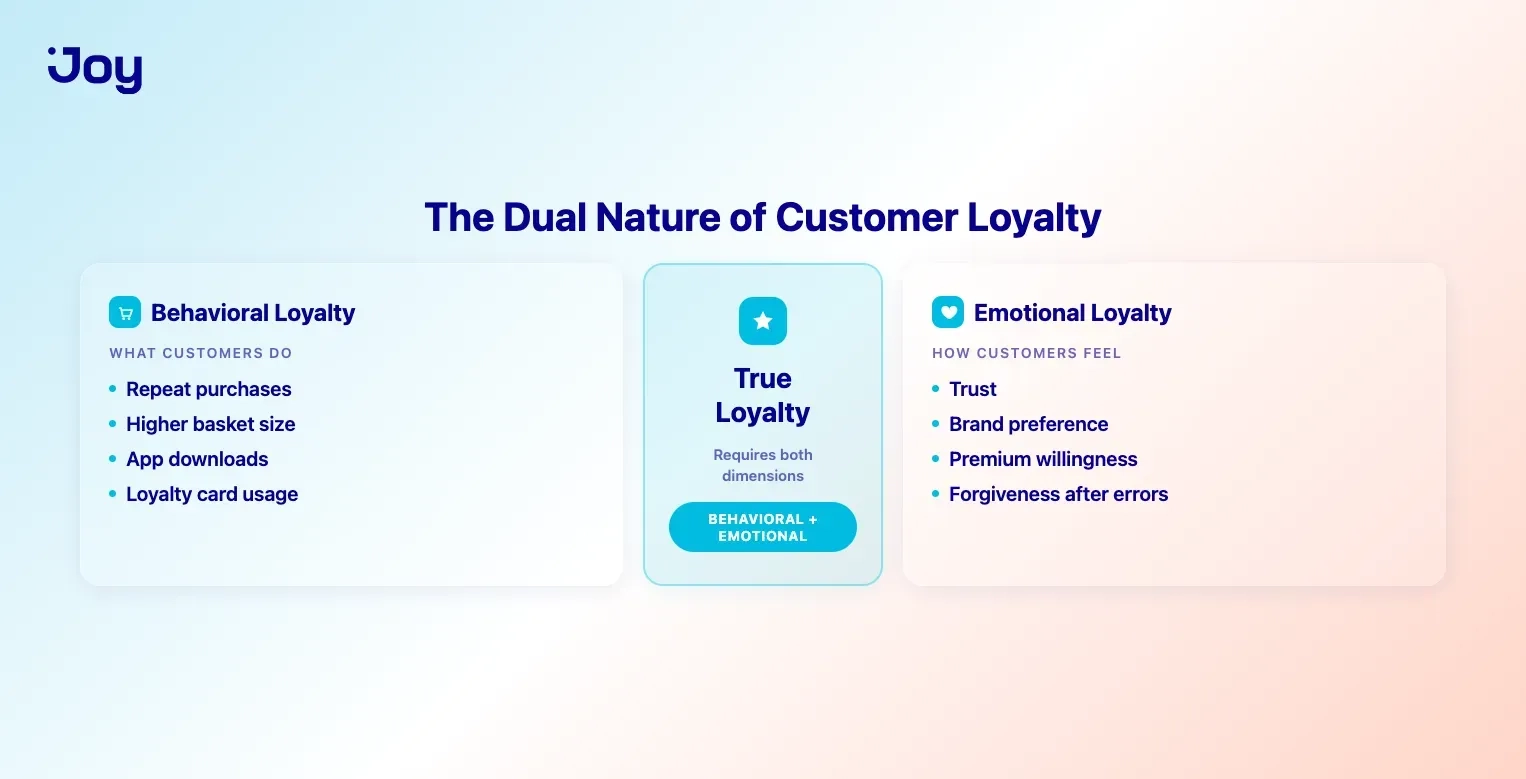
Genuine customer loyalty combines two distinct dimensions. Behavioral loyalty is what customers do: repeat purchases, referrals, higher spending, ongoing engagement. Emotional loyalty is how they feel: trust, genuine preference, advocacy even when better alternatives exist.
The data makes this concrete. According to Capgemini's "Loyalty Deciphered" research across 9,213 consumers, 82% of consumers with high emotional engagement always buy from their loyal brand, compared to just 38% with low engagement. The emotional dimension is what separates a loyal customer from a habitual one. That gap isn't subtle.
Customer loyalty isn't what people do. It's what they do even when they have every reason not to.
Behavioral Loyalty vs Emotional Loyalty - The Concept of Customer Loyalty Explained
So what does each dimension actually look like?
Behavioral loyalty shows up in observable actions. According to the SAP Emarsys Customer Loyalty Index 2025, a study of over 10,000 consumers across five countries, 63% of consumers shop frequently with their favorite brands, 48% recommend those brands to friends and family, and 41% demonstrate loyalty by using loyalty cards or schemes.
Emotional loyalty runs deeper. It's the internal commitment: trust in the brand, willingness to pay a premium, and the tendency to forgive mistakes rather than walk away.
Here's the critical distinction: behavioral loyalty can exist without emotional loyalty. Price convenience, lack of alternatives, or plain habit can all produce repeat purchases that look like loyalty but aren't. Researchers call this "spurious loyalty," and it's fragile.
Consider Costco. Members renew at a 93% rate, which looks like extraordinary loyalty. But is that loyalty to Costco specifically, or loyalty to low prices? If a competitor matched Costco's pricing, would those members switch? That question reveals whether behavioral loyalty has emotional roots or sits on borrowed time.
Behavioral loyalty without emotional loyalty is a revenue stream with an expiration date. The moment a better option appears, it disappears.
The 6 Types of Customer Loyalty - A Loyalty Spectrum, Not a Binary
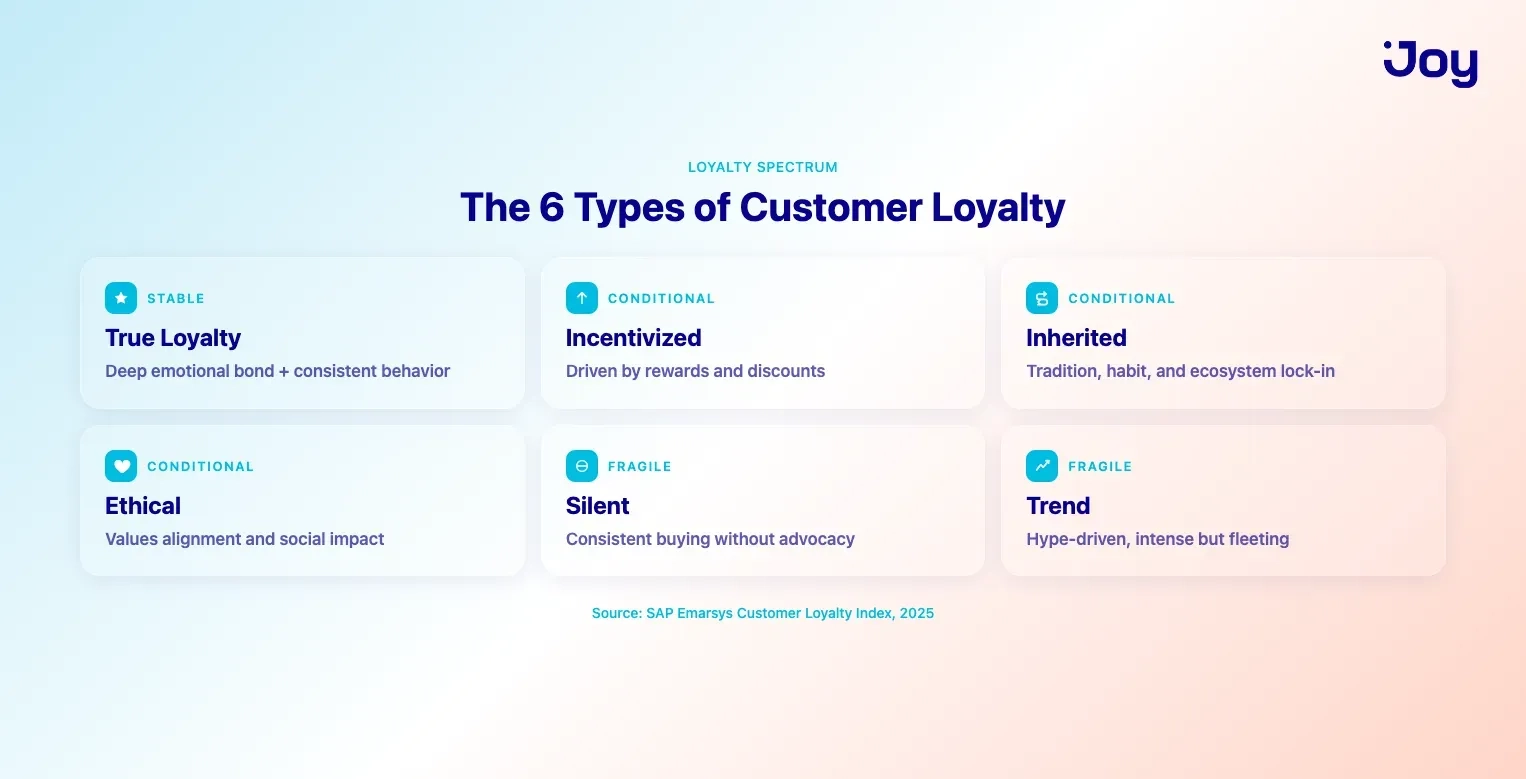
If loyalty has two dimensions, different customers combine them in different ways. Not all loyal customers are created equal. And understanding the meaning of customer loyalty requires recognizing that loyalty exists on a spectrum, not as a yes-or-no question. The SAP Emarsys Customer Loyalty Index 2025 maps six distinct types of customer loyalty, from the deeply committed to the dangerously fleeting.
True Loyalty - The Loyal Customer Definition Every Brand Wants
True loyalty is the gold standard: a deep emotional bond paired with consistent purchasing behavior. These customers advocate for your brand, forgive mistakes, and willingly pay premiums. Starbucks is a textbook example. Their most loyal customers don't just buy coffee. They identify with the brand, use the app daily, and participate in seasonal challenges.
The uncomfortable reality? SAP's 2025 data shows true loyalty fell to just 29%, down five points from 2024. The "holy grail" of loyalty now applies to fewer than one in three consumers, and it's declining year over year. Most businesses assume the number is much higher.
Incentivized, Inherited, and Ethical Loyalty - The Middle Ground
Between true loyalty and its fragile counterparts sit three conditional types.
Incentivized loyalty is driven by discounts, points, and rewards. It's the most common outcome of loyalty programs: points programs, tiered VIP systems, referral rewards, and spend-based incentives all create this type. It's the largest loyalty category, but also the most transactional. Remove the incentive and the loyalty vanishes with it.
Inherited loyalty is rooted in tradition, family habits, or ecosystem lock-in. Apple is a prime example: many users inherited the ecosystem from family or workplace, and the switching cost keeps them loyal. Stable, but not driven by active choice.
Ethical loyalty comes from values alignment: sustainability, fair trade, social impact. But SAP's 2025 data shows this type declined to 27%, down from 30% in 2024. Ethical consumers say they care, but cost and convenience often win when put to the test.
All three types share something: they're conditional. Remove the specific condition (the incentive, the tradition, the values proof) and the loyalty wavers.
Silent Loyalty and Trend Loyalty - The Dark Side of Customer Loyalty
These two types cause the most damage, precisely because they're the hardest to see.
Silent loyalty describes customers who buy consistently but never advocate. They don't leave reviews, don't refer friends, don't engage on social media. They're invisible to NPS scores and nearly every other emotional metric. Their behavioral commitment is real, but their emotional commitment? Unknown. And unknowable through standard measurement.
Why does this matter? Silent loyal customers are typically the first to defect when a competitor makes a better offer. They give no warning signals because they were never vocally committed in the first place.
Trend loyalty is new to SAP's 2025 framework, and it's growing. Fourteen percent of consumers now qualify as "Trend Loyal": hype-driven, emotionally intense, but fleeting. In fact, 29% of consumers admit they quickly lose interest once a product stops trending. Think Stanley cups, Dubai chocolate, or any TikTok-viral product. Massive short-term demand, minimal long-term retention.
Both silent and trend loyalty look like genuine commitment in the data. But both are structurally fragile and can vanish overnight without warning.
The Loyalty Illusion - What 89% of Executives Get Wrong About Customer Loyalty
Every section so far has been building toward a single insight: the gap between perceived loyalty and actual loyalty is systematic, measurable, and far larger than most businesses realize. This is where the customer loyalty meaning gets uncomfortable.
The Executive Blind Spot - PwC's Loyalty Illusion Data
Back to that headline stat: 89% of executives say customer loyalty has grown, while only 39% of consumers agree. That's not a rounding error. That's a 50-percentage-point perception gap.
Why does it happen? Executives measure loyalty through internal data: purchase frequency, program enrollment, retention rates. Consumers experience loyalty through emotions: trust, satisfaction, feeling valued. The two groups are measuring entirely different things.
And it runs deeper than that. PwC's same survey found that 52% of consumers have stopped buying from a brand due to a bad experience. Executives consistently underestimate how quickly loyalty breaks.
Perhaps most telling: 46% of executives themselves believe their loyalty program will be irrelevant within three years, and 57% say their loyalty systems aren't delivering needed outcomes. So executives simultaneously believe loyalty is growing and that their programs are failing. That cognitive dissonance is the loyalty illusion in action, and it's exactly the kind of blind spot that causes loyalty programs to fail.
Spurious Loyalty - The Most Dangerous Type of Customer Loyalty
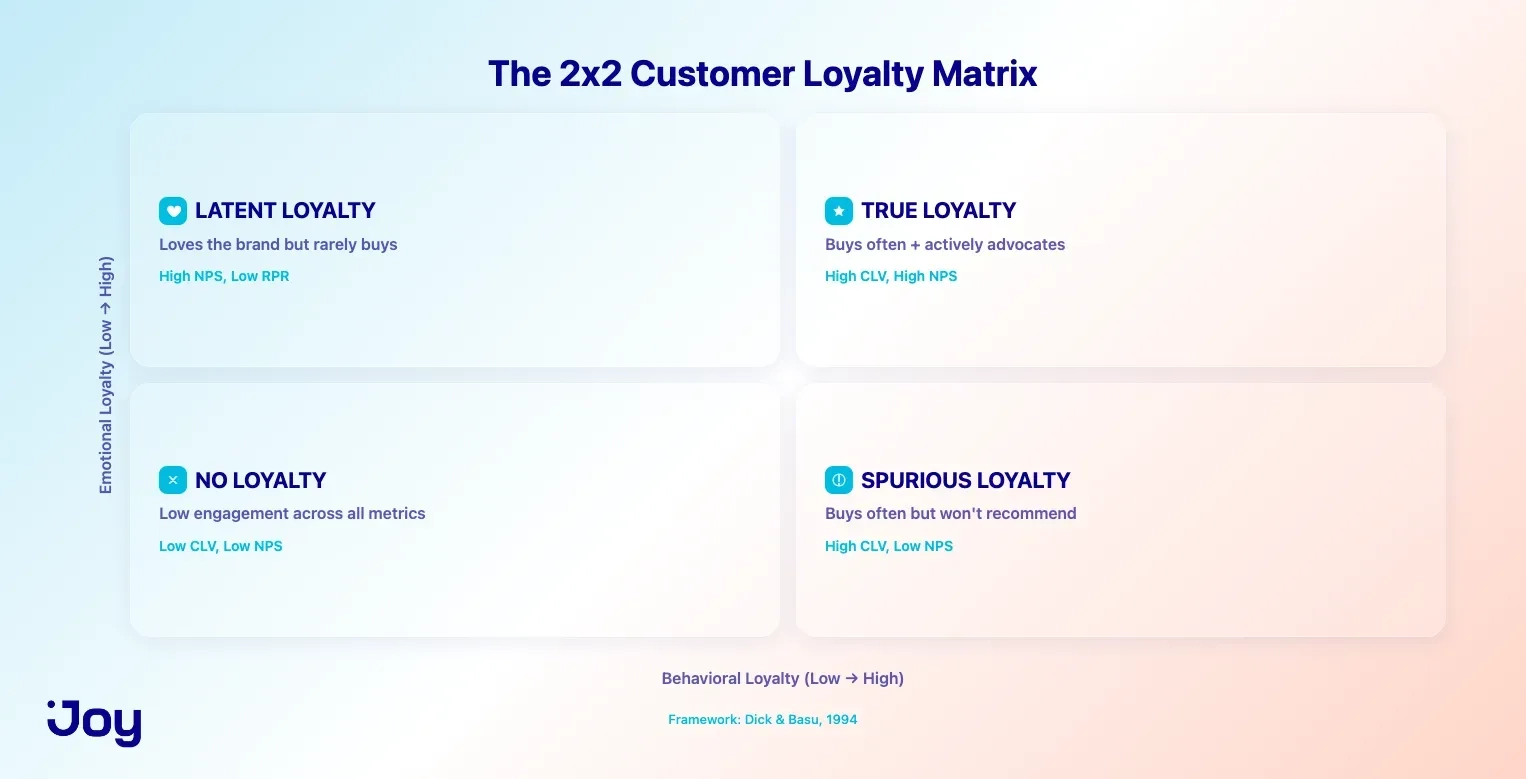
To explain customer loyalty at a deeper level, it helps to map it on a 2x2 matrix, a framework originally developed by researchers Dick and Basu in 1994 (and still just as relevant today).
The matrix plots behavioral loyalty on one axis and emotional loyalty on the other, creating four quadrants:
- High behavioral + High emotional = True Loyalty. The ideal. Customers who buy often and genuinely care about your brand.
- High behavioral + Low emotional = Spurious Loyalty. Looks loyal, isn't. Customers who keep buying out of habit, convenience, or lack of alternatives, not because they're committed.
- Low behavioral + High emotional = Latent Loyalty. Loves your brand but doesn't buy enough. Often constrained by price, access, or circumstance.
- Low behavioral + Low emotional = No Loyalty. No meaningful relationship exists.
Spurious loyalty is the quadrant that should keep ecommerce brands up at night. These customers show up in your retention metrics as "loyal," but they'll leave the moment switching becomes easy. Picture a customer who buys monthly because you're the only brand that ships to their ZIP code. They look loyal in every dashboard. They'll leave the day a competitor enters their market.
Spurious loyalty inflates your metrics while hiding your vulnerability. It looks like retention in the dashboard and feels like defection in the quarterly report.
Why Customer Loyalty Matters - The Business Case in Numbers
Now that you understand what customer loyalty meaning truly encompasses (and how easily it's misread), the question becomes: what's the actual business impact? The importance of customer loyalty becomes clear when you look at the economics. And the numbers make the case on their own.
Retention Economics - Why Keeping Customers Outperforms Acquiring Them
Acquiring a new customer costs five to 25 times more than retaining an existing one, per Harvard Business Review citing Bain & Company research. And that gap is widening. Customer acquisition costs have risen 222% over eight years, per SimplicityDX research, while retention costs have remained relatively stable.
The probability gap is just as stark. Selling to an existing customer has a 60% to 70% success rate, compared to just 5% to 20% for a new prospect, per Marketing Metrics by Paul Farris and colleagues at Wharton.
But these numbers only hold for genuinely loyal customers. Spurious loyalty customers (the ones from that dangerous quadrant in the 2x2 matrix) switch at acquisition-like costs the moment alternatives appear. The definition of customer loyalty isn't academic. It directly determines which customers your retention budget actually protects.
The Profit Multiplier - Small Retention Gains, Massive Profit Impact
The most cited stat in retention economics comes from Bain & Company: a 5% increase in customer retention produces a 25% to 95% increase in profit, depending on the industry.
Why is the multiplier so large? Retained customers cost less to serve over time. They buy more as the relationship deepens. They refer others organically. And they become less price-sensitive. Each factor compounds on the others.
In ecommerce terms: for a store doing $500K a year, a 5% retention improvement could translate to $125K to $475K in additional profit. That's not a moonshot. That's the math of genuine loyalty.
But this multiplier works hardest with true loyalty customers. Incentivized loyalty customers erode the margin through the cost of rewards while delivering smaller multiplier effects. The type of loyalty you're retaining matters as much as the retention rate itself.
How to Measure Customer Loyalty - Metrics That Separate Real from Illusion
Understanding the customer loyalty meaning is one thing. Measuring it accurately is another. The key is grouping your metrics into two categories that mirror the dual-nature framework: behavioral metrics that track what customers do, and emotional metrics that track how they feel. You need both to avoid falling into the loyalty illusion.
Behavioral Metrics - Tracking What Customers Do
Three core metrics capture the behavioral side:
- Customer Retention Rate (CRR) measures the percentage of customers retained over a period. It's the baseline metric, but on its own, it can't distinguish true loyalty from spurious loyalty. A customer who stays because there's no alternative counts the same as a devoted fan.
- Customer Lifetime Value (CLV) captures the total revenue from a customer over the entire relationship. Higher CLV signals stronger loyalty, but it doesn't reveal the reason behind the spending.
- Repeat Purchase Rate tracks how often customers come back. Combined with CLV, it provides a solid behavioral loyalty score.
The limitation across all three is the same: they measure behavior, not commitment. A high-CRR customer could be silently loyal with zero advocacy, or spuriously loyal with no emotional connection whatsoever.
Behavioral metrics tell you who stays. They can't tell you who stays because they want to versus who stays because they have to.
Emotional Metrics - Tracking How Customers Feel
To capture the other half of the loyalty equation, you need emotional metrics:
- Net Promoter Score (NPS) asks "How likely are you to recommend us?" It measures advocacy intent, the emotional dimension. Its weakness: silent loyal customers score low on NPS despite being consistently retained.
- Customer Satisfaction (CSAT) captures post-interaction satisfaction. Good for measuring touchpoint quality, but doesn't reflect long-term loyalty.
- Customer Loyalty Index (CLI) is a survey-based composite score that asks about repeat purchase intent, recommendation likelihood, and upsell willingness. It's the most holistic single metric, but it requires active survey participation.
The gap here mirrors behavioral metrics exactly. Emotional metrics reveal commitment, but only for customers willing to tell you how they feel. Silent loyalty remains invisible to every emotional metric on this list.
The Combined View - Why You Need Both to Explain Customer Loyalty
This is where the 2x2 matrix becomes a practical measurement framework:
- High behavioral + High emotional metrics = Confirmed true loyalty
- High behavioral + Low emotional metrics = Likely spurious loyalty (worth investigating)
- Low behavioral + High emotional metrics = Latent loyalty (an opportunity)
- Low behavioral + Low emotional metrics = At risk or no loyalty
The practical application: run behavioral metrics (CRR, CLV, Repeat Purchase Rate) alongside emotional metrics (NPS, CSAT, CLI) and map each customer segment to a quadrant. The goal isn't just "how many loyal customers do we have?" It's "what type of loyalty do our customers show?"
Measuring loyalty requires both behavioral and emotional data. One without the other is exactly how businesses fall into the loyalty illusion.
What Drives Genuine Customer Loyalty - The Factors Behind the Meaning
The definition, the types, the illusion, the metrics. All of it leads to one final question: what actually creates genuine loyalty? Not tactics or program design. The underlying factors that research consistently identifies as the difference between loyalty that lasts and loyalty that breaks.
Product and Service Quality - The Non-Negotiable Foundation
No amount of points, rewards, or gamification compensates for a bad product. Quality is the table-stakes factor. Full stop.
PwC's 2025 data puts a number on it: 52% of consumers stopped buying from a brand due to a bad product or service experience. That makes poor quality the single biggest loyalty destroyer, ahead of price, competition, or anything else.
Before investing in loyalty programs or measurement systems, make sure the core product experience actually justifies loyalty. Programs amplify existing satisfaction. They don't create it from nothing. Without quality, you can only achieve incentivized or spurious loyalty. Both conditional. Both fragile.
Emotional Connection and Personalization - The Loyalty Multiplier
If product quality is the foundation, emotional connection is the multiplier. Capgemini's research shows that 82% of high-emotional-engagement consumers always buy their loyal brand, compared to just 38% with low engagement. Emotional connection nearly doubles purchase commitment.
And personalization is the mechanism that delivers it. SAP's 2025 data reveals that nearly one in four consumers stay more loyal to brands that match offers directly to their needs.
Starbucks illustrates this well. The brand builds emotional connection through personalized app recommendations, the name-on-cup ritual, and seasonal exclusives. It's not just coffee. It's recognition. That emotional layer is what transforms incentivized loyalty into true loyalty: the bridge from "I buy here because of rewards" to "I buy here because they know me."
Trust and Consistency - Why Customer Loyalty Meaning Includes Reliability
Trust is built through consistent delivery: same quality, same service, same values, every single interaction. And it's remarkably easy to lose. That PwC finding bears repeating: 52% of consumers stop buying after a bad experience. One interaction can undo years of loyalty.
Consistency also means honesty. PwC's loyalty illusion data shows that customers detect inauthenticity. When brands claim loyalty but deliver purely transactional experiences, the gap erodes trust over time.
Trust is the emotional anchor that gives behavioral loyalty its staying power. Without it, every repeat purchase is one competitor offer away from ending.
If you're starting to question whether your current retention numbers reflect genuine loyalty or something more fragile, you're asking the right question. Explore what a loyalty program designed around these frameworks actually looks like in practice.
From Definition to Diagnostic Framework
Customer loyalty meaning goes far beyond "repeat purchases." It's a dual concept (behavioral + emotional), a spectrum (six distinct types), and a measurement challenge that most businesses haven't fully addressed.
The loyalty illusion is real, and the data confirms it: a 50-point gap between what executives believe and what customers report. The 2x2 matrix isn't optional. It's how you avoid mistaking spurious loyalty for the genuine thing.
Understanding the meaning of customer loyalty is step one. The next step is building systems that create, measure, and protect genuine loyalty, not just incentivize repeat behavior. That means pairing behavioral data with emotional insight, recognizing which types of loyalty your customers actually exhibit, and investing in the factors that convert conditional loyalty into the lasting kind.
For a deeper look at the data behind these patterns, see our breakdown of key loyalty program statistics that put this framework into measurable context.
Customer loyalty isn't a metric. It's a framework. And the businesses that understand that framework will outperform those that merely count repeat purchases.
Frequently Asked Questions
What is customer loyalty in simple words?
It's when customers repeatedly choose your brand over competitors, not out of habit or convenience, but because they genuinely trust and prefer you. Real loyalty combines what customers do (repeat purchases, referrals) with how they feel (trust, emotional connection).
What are the main types of customer loyalty?
Six types: true loyalty (emotional + behavioral), incentivized loyalty (driven by rewards), inherited loyalty (tradition and habit), ethical loyalty (values alignment), silent loyalty (buys but doesn't advocate), and trend loyalty (hype-driven and fleeting). Each has different stability and business value.
What is the difference between behavioral and emotional loyalty?
Behavioral loyalty is what customers do: repeat purchases, higher spending, referrals. Emotional loyalty is how they feel: trust, brand preference, willingness to forgive mistakes. Behavioral loyalty without emotional loyalty is fragile. It can disappear overnight when a better option shows up.
What is spurious loyalty and why is it dangerous?
It's when customers keep buying from you out of habit, convenience, or lack of alternatives, not because they're genuinely committed. It looks like real loyalty in your metrics but vanishes the moment switching becomes easy. It inflates retention numbers while hiding vulnerability.
How do you measure customer loyalty?
Combine behavioral metrics (Customer Retention Rate, Customer Lifetime Value, Repeat Purchase Rate) with emotional metrics (Net Promoter Score, Customer Satisfaction, Customer Loyalty Index). Using both types together lets you distinguish true loyalty from spurious loyalty through the 2x2 loyalty matrix.
Why is customer loyalty important for ecommerce?
Acquiring new customers costs five to 25 times more than retaining existing ones, and a 5% increase in retention can increase profits by 25% to 95%. Loyal customers also spend more, refer others, and are less price-sensitive. But these benefits only apply to genuinely loyal customers, not spuriously loyal ones.
What is the loyalty illusion?
The gap between how businesses perceive loyalty and how customers actually feel. PwC's 2025 data shows 89% of executives believe loyalty has grown, but only 39% of consumers agree. That 50-point perception gap leads businesses to overestimate their customer loyalty, sometimes dramatically.
What drives genuine customer loyalty?
Three core factors: product and service quality (the non-negotiable foundation), emotional connection and personalization (the loyalty multiplier), and trust through consistency (the anchor). Without quality, you can only achieve conditional loyalty. Emotional connection is what converts conditional loyalty into true loyalty.

Written by
Thomas Nguyen is the CEO & Co-founder of Joy, a loyalty solution for Shopify and eCommerce brands. With years of experience building high-performance Shopify apps, Thomas aims to help merchants grow through customizable and retention-focused tools.
Related reading
 Loyalty Strategy
How Apple Applies Customer Loyalty: 4 Principles Behind 89% Retention
Apple has 89% customer retention and no points program, no VIP tiers, no rewards. Loyalty comes from four deliberate principles applied across every touchpoint. Here's how each one works, and what results it drives.
 Thomas Nguyen
 Loyalty Strategy
The Impact of Social Media Marketing on Brand Loyalty: 7 Key Insights
Likes don't equal loyalty. This guide breaks down how social media marketing actually builds brand loyalty — through two-way communication, user-generated proof, omnichannel touchpoints, influencer collaboration, and measurable ROI. 7 key insights for Shopify merchants in 2026.
Thomas Nguyen Loyalty Strategy
Customer Loyalty Models Explained: From Framework to Action
Most brands launch loyalty programs on gut instinct — then wonder why members never redeem. A customer loyalty model is the diagnostic framework that fixes that. This guide breaks down 6 proven models and how to pick the right one for your brand.
Thomas Nguyen Loyalty Strategy
Brand Loyalty Pyramid: 5 Strategic Levels for 2026 Growth
Not all customers are loyal in the same way. The brand loyalty pyramid maps 5 strategic levels - from price-sensitive switchers to fanatic advocates - using David Aaker's framework. This guide breaks down each tier and the tactics to move customers up the ladder in 2026.
Thomas Nguyen Loyalty Strategy
Customer Loyalty Pyramid: 5 Stages to Brand Advocacy
Your best customers don't quit — they quietly drift away. The customer loyalty pyramid maps all five stages of the relationship, shows where customers get stuck, and gives you tactics to move them up before stealth attrition takes hold.
Thomas Nguyen Loyalty Strategy
Customer Loyalty Levels: Why Not All Customers Are Equal
Not all customers are equal — and most stores treat them like they are. This guide breaks down the four customer loyalty levels, how to spot where each customer sits, and a 30-day plan to move them up the ladder, with real case studies and metrics to track.
Thomas Nguyen