
Relationship Marketing and Customer Loyalty: The 4-Pillar Framework
True customer loyalty is declining for the first time in 5 years (SAP, 2025). Discount-driven marketing is hitting diminishing returns. Relationship marketing flips the model: build trust and shared value first, then watch loyalty follow. Here's the 4-pillar framework.

Summarize this post with AI
For the first time in five years, true customer loyalty is declining. SAP's Customer Loyalty Index 2025 puts it at 29%, down from 31% the year before. Something fundamental is breaking.
And yet, most brands keep running the same playbook: acquire customers through paid ads, offer a discount to close the sale, then hope they come back. That's transactional marketing at its core. The problem? Discounts don't build loyalty. They build dependency. Customers trained on discounts wait for the next one, or find a competitor offering a better deal.
Relationship marketing and customer loyalty represent a fundamentally different approach. Instead of chasing new customers with ever-increasing acquisition budgets, this framework focuses on building relationships that make existing customers stay by choice. Not by habit. Not by accident.
This article breaks down the framework behind relationship marketing, translates it into ecommerce language, and explains why each pillar matters for building genuine customer loyalty. The path: definition, business case, core pillars, modern application, and measurement.
One distinction matters before we begin: transactional marketing creates repeat buyers. Relationship marketing creates loyal customers. And that difference determines whether your brand survives the next disruption.
What Is Relationship Marketing and Customer Loyalty?
Before applying relationship marketing, it's worth understanding what it actually means, and more importantly, how it differs from the transactional model most ecommerce brands default to.
Relationship Marketing Defined: From Transactions to Relationships
Think about the last brand you bought from more than once. Was it because they sent you a 15%-off coupon? Or was it because the experience felt right? The product matched the description, support responded when something went wrong, and each interaction made you more confident in the brand.
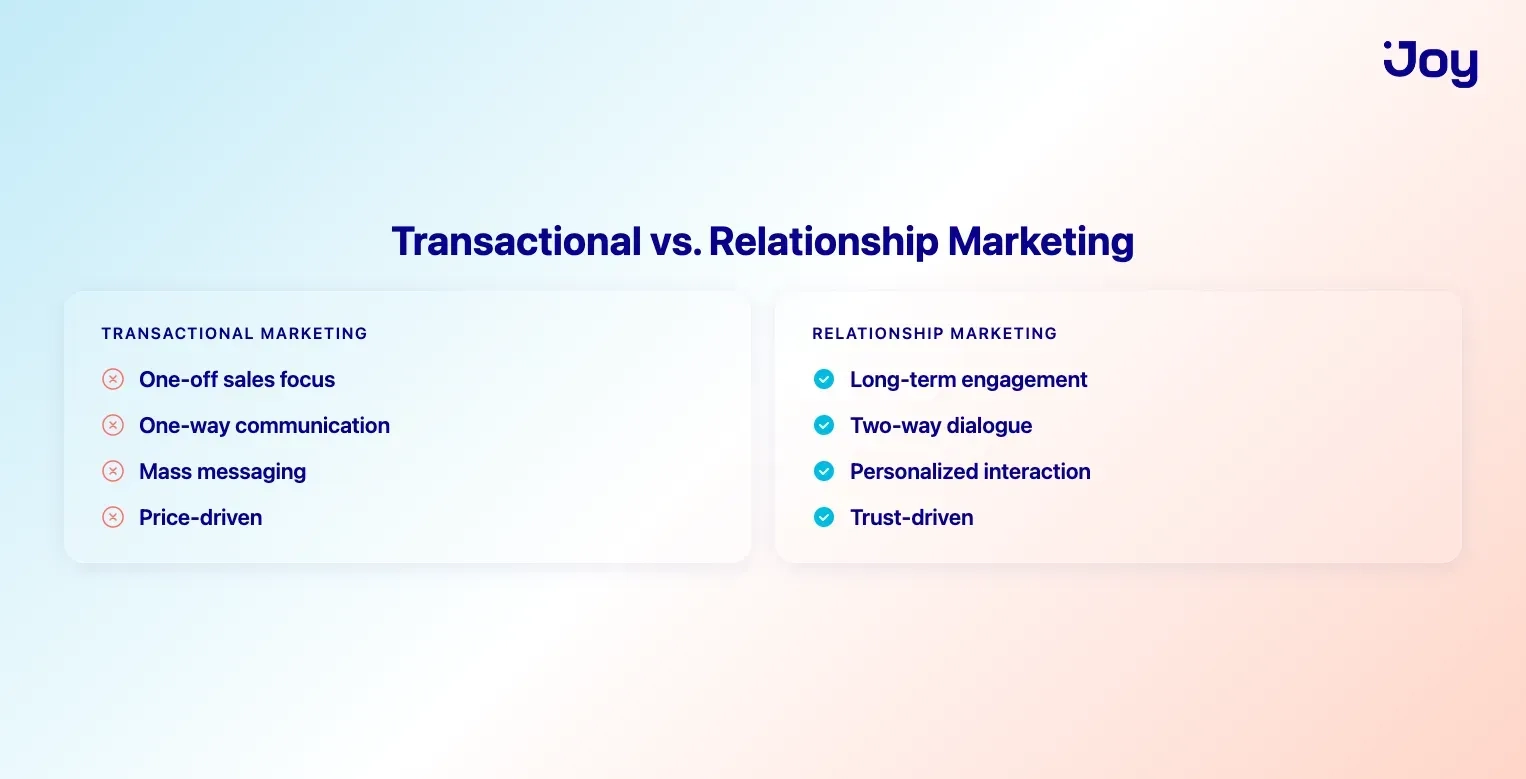
That's the difference between transactional and relationship marketing in practice. Transactional marketing chases individual sales: run a flash sale, blast a promotion, hope customers come back. Relationship marketing builds the reasons they choose to come back, through consistent experience, honest communication, and earned trust over time.
Long-term engagement replaces short-term transactions. Two-way dialogue replaces broadcast messaging. Personalized interaction replaces mass campaigns. Retention-first metrics replace acquisition-only thinking.
This isn't just a philosophical shift. Morgan and Hunt's Commitment-Trust Theory established that trust and commitment are the two constructs that determine whether a business relationship succeeds or fails. Everything else (communication, conflict handling, shared values) flows through these two pillars. Gronroos's foundational work framed it as the effort to "establish and maintain lasting relationships between firms and their customers for mutual benefit."
The takeaway for ecommerce: relationship marketing isn't a vague philosophy about "being nice to customers." It's a strategic framework with measurable constructs, and measurable outcomes.
Customer Loyalty vs. Customer Inertia: The Distinction Most Brands Miss
So what exactly is customer loyalty? It's not just repeat purchases. A customer who buys from you every month because your subscription is hard to cancel isn't loyal. They're stuck. Real loyalty means a customer keeps choosing you even when competitors make it easy to switch.
That's the gap between loyalty and inertia. And too many brands confuse the two. Customers who stay because of habit, switching costs, or a lack of alternatives aren't loyal. They're inert.
Two types of commitment explain why:
- Calculative commitment: "I stay because switching is expensive or inconvenient." Rational. Also fragile, because the moment a competitor reduces switching friction, the customer leaves.
- Affective commitment: "I stay because I genuinely value this relationship." Emotional. And durable, because competitors can't easily replicate how someone feels about your brand.
What does this look like in practice? A customer who stays because your subscription is hard to cancel will leave the moment someone makes cancellation easy. But a customer who stays because they trust you will defend your brand when competitors offer deeper discounts. Night and day.
SAP's CLX 2025 data reinforces the point: 53% of customers exhibit "silent loyalty," staying without active engagement. That's closer to inertia than genuine loyalty. Ndubisi's research on relationship marketing calls real loyalty a "deep commitment to re-buy despite situational influences and marketing efforts." Most brands don't clear that bar.
Why the Shift from Transactional to Relational Marketing Is Happening Now
Several forces are converging to make this shift unavoidable. First, acquisition costs have become unsustainable. Merchants now lose an average of $29 on every new customer acquired, per SimplicityDX, up from $9 in 2013. That's a 222% increase in just over a decade.
Market saturation compounds the problem. Products and prices are increasingly interchangeable. When customers can find the same product at a similar price from a dozen competitors, the relationship becomes the differentiator.
Consumer expectations have shifted too. Salesforce research found that 84% of customers say being treated like a person, not a number, is crucial to winning their business. Generic mass messaging doesn't cut it anymore.
And then there's the loyalty data itself. True loyalty at 29% and falling means transactional approaches are measurably failing. The conclusion is hard to avoid: brands that don't shift from transactional to relational marketing will compete solely on price. That's a race to the bottom.
The Business Case for Relationship Marketing and Customer Loyalty
The conceptual argument for relationship marketing is compelling. But as a business owner, you want the numbers before committing to a new framework. So let's look at the economics.
The Retention Economics: Why Keeping Customers Beats Chasing New Ones
The core math is striking: acquiring a new customer costs five to 25 times more than retaining an existing one. On top of that, Bain & Company found across 100+ companies that a 5% increase in retention can drive 25% to 95% more profit.
Put those numbers alongside the SimplicityDX acquisition data and the picture gets clear. You're spending $29 to acquire a customer who makes one purchase and leaves versus spending a fraction of that to retain a customer who makes five purchases over two years. The ROI isn't debatable.
But these aren't just "retention" statistics. They're the economic argument for why relationship-building is a better investment than customer-chasing. Retention is the outcome. Relationship marketing is the mechanism that produces it.
Customer Lifetime Value: The Revenue Multiplier of Relationship Marketing
Beyond cost savings, relationship marketing directly multiplies revenue per customer. Oracle CX Research found that 70% of emotionally connected consumers spend twice as much on brands they love. That emotional connection, a direct product of relationship marketing, doesn't just prevent churn. It increases spend.
And the multiplier effect doesn't stop at individual spending. Loyal customers also become advocates. Repeat customers spend 33% more than new customers (Flowium), and customers referred by loyal advocates spend 50% more than non-referred customers (Bain & Company). Advocacy functions as its own revenue multiplier. Each loyal customer brings in higher-value new customers at a fraction of paid acquisition cost.
This is where Customer Lifetime Value becomes the north-star metric. Relationship marketing shifts the measurement from "cost per acquisition" to "lifetime value per customer." CLV compounds over time: a customer who trusts you buys more, refers others, and forgives occasional mistakes. Each positive interaction deepens the relationship and increases their value.
CLV isn't just a metric. It's the outcome of successfully applying the relationship marketing pillars: trust, commitment, communication, and conflict handling.
The Core Framework: 4 Pillars of Relationship Marketing and Customer Loyalty
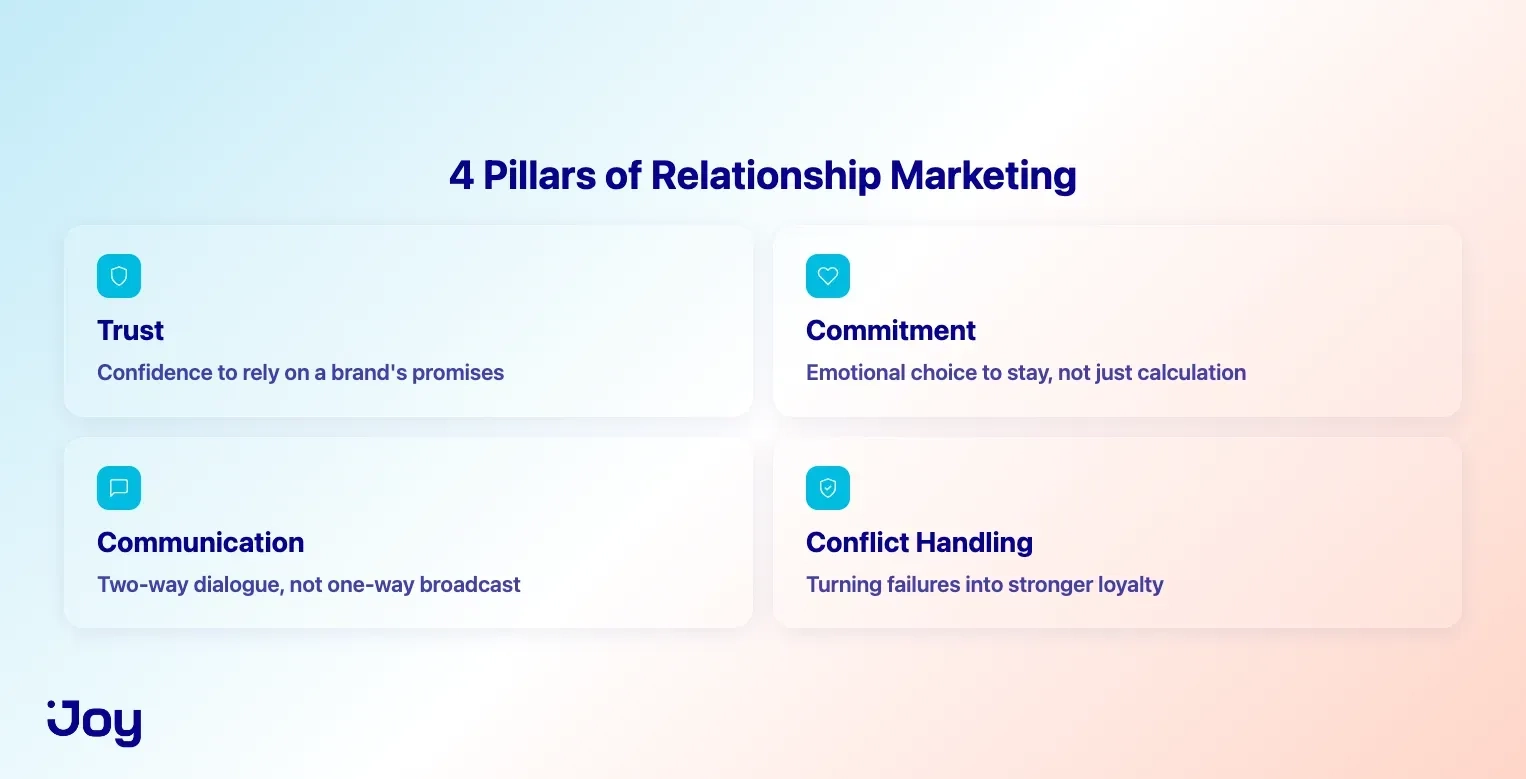
This is where the framework becomes actionable. Four pillars determine whether your customer relationships hold up or fall apart. Each one has a direct ecommerce translation and real consequences for getting it right or wrong.
Trust: The Foundation of Everything
Without trust, nothing else in this framework works. Commitment without trust is just lock-in. Communication without trust is just noise. And 81% of consumers say trust is a deciding factor in whether they buy at all.
In ecommerce, trust is built through specifics: transparent pricing with no hidden fees, honest product descriptions, reliable delivery promises, responsive customer service, and consistent brand behavior across every touchpoint. It's destroyed just as specifically: overpromising and underdelivering, hiding terms in fine print, inconsistent quality, ignoring complaints.
Patagonia is a clear example. Their radical transparency about supply chain practices, environmental impact, and product durability builds trust that survives competitor discounting. Customers don't buy Patagonia because it's cheapest. They buy because they trust the brand. And that trust creates loyalty no discount can replicate.
Commitment: Why Customers Stay (and When They Leave)
With trust established, commitment determines whether customers actually stay. But not all commitment is equal (and this distinction matters). Affective commitment ("I want to buy from this brand because I believe in what they do") creates genuine loyalty. Calculative commitment ("I stay because switching costs are high") creates the illusion of loyalty that collapses under competitive pressure.
The trap? Many brands mistake calculative commitment for the real thing. A customer locked into a subscription isn't necessarily loyal. They're calculating. The moment a competitor reduces switching friction, the calculation changes.
Relationship marketing builds affective commitment through shared values, emotional resonance, and consistently positive experiences. Loyalty and rewards programs are one of the most common tools here, but their design determines which type of commitment they create. A program built on progression and shared values (earn, unlock, belong) creates affective commitment. A program built on "cancel and lose your points" creates calculative lock-in.
With true loyalty at 29% (SAP CLX 2025), the data suggests most brands are building the wrong type.
Communication: The Difference Between Talking At and Talking With Customers
Most brands think communication means sending more emails. It doesn't. It means building genuine two-way dialogue: providing timely, trustworthy information and actually listening to what customers say back.
The contrast is sharp. Transactional communication looks like blast promotions, generic newsletters, and one-way announcements. Relational communication looks like personalized messages, feedback loops, transparent updates about orders and issues, and proactive outreach before problems escalate.
A simple test: look at your last post-purchase email. Does it ask "How was your experience?" or does it push "Buy more now"? The first builds a relationship. The second treats the customer like a transaction. And customers can tell the difference instantly.
Here's what brands miss. When you only broadcast but never listen, you create irrelevant messaging. And irrelevant messaging, over time, erodes the trust and commitment built by the other factors driving customer loyalty.
Conflict Handling: The Pillar Most Brands Ignore Until It's Too Late
The fourth pillar is the one most brands underinvest in. They treat service recovery as a cost center, something to minimize, rather than what it actually is: one of the most powerful loyalty drivers available.
The stakes are severe. PwC's research found that one in three customers leave after just one bad experience. And 92% completely abandon a company after two to three negative interactions. Not much room for error.
But there's a counterintuitive finding: effective conflict resolution can actually strengthen loyalty. This is the service recovery paradox. A customer whose problem was resolved well often becomes more loyal than one who never had a problem in the first place. The resolution demonstrates that the brand values the relationship enough to make things right.
In ecommerce, this translates to fast refund processing, proactive shipping delay notifications, and empowered support teams who can resolve issues without escalation. Amazon's no-questions-asked returns policy is a textbook example, turning potential conflict into trust reinforcement.
How you handle failures defines your brand more than how you handle successes. And 92% of customers will prove that with their wallets.
The Modern Layer: How Personalization and Emotional Connection Deepen Customer Loyalty
The four pillars provide the foundation. But modern relationship marketing adds two critical layers that turn the framework into a real competitive advantage: data-driven personalization and emotional connection.
Data-Driven Personalization: Relationship Marketing at Scale
Relationship marketing was originally about personal, one-to-one interactions. A shopkeeper who knew every customer by name. The challenge for ecommerce brands is obvious: you're serving thousands or even millions of customers. So how do you maintain that relational quality at scale?
Personalization is the answer. By using customer data (purchase history, browsing behavior, stated preferences), brands can deliver individualized experiences that feel personal even at scale. Product recommendations based on past purchases. Birthday rewards. Tier-specific perks. Re-engagement campaigns for lapsing customers. Loyalty programs are a natural vehicle here, since tiered rewards automatically personalize the experience based on each customer's engagement level.
There's an important trust connection, though. Personalization only works when customers trust you with their data, which links directly back to Pillar 1. Personalization without permission doesn't feel relational. It feels invasive. The difference between "we noticed you like running shoes" and "we're tracking everything you do" is the difference between building a relationship and breaking one.
Emotional Connection: When Loyalty Becomes Unbreakable
Beyond trust, beyond commitment, there's a deeper layer: emotional connection. It creates the most durable form of loyalty that exists.
The revenue impact is massive. As noted earlier, emotionally connected consumers spend twice as much. This isn't just retention. It's revenue multiplication driven by how customers feel.
What drives emotional connection? Shared values (Patagonia's environmental mission), community belonging (Nike's running clubs), and personal identity alignment (Apple's "Think Different" culture). Each of these creates a bond that price-matching competitors simply cannot replicate.
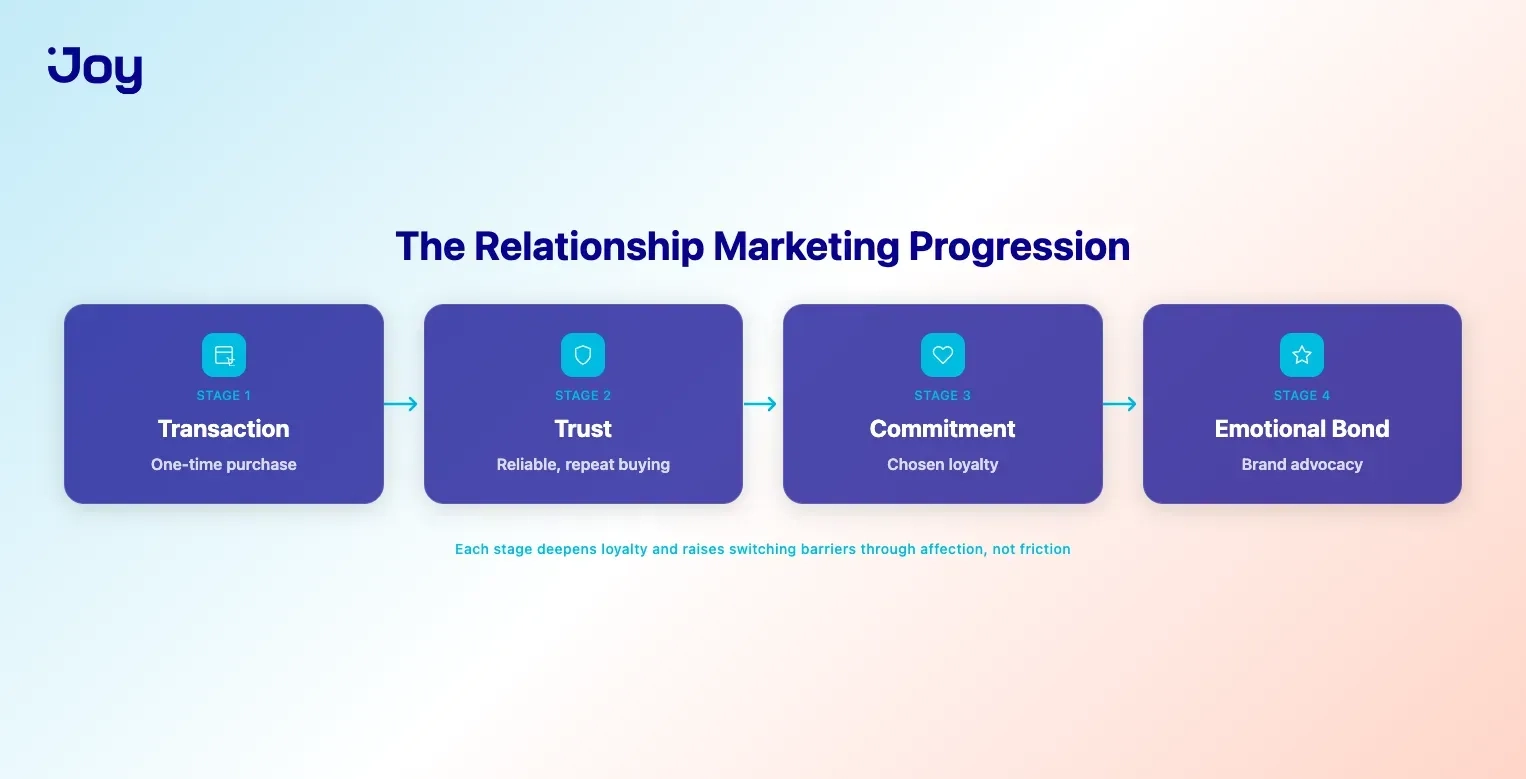
Think of it as a progression: transaction leads to trust, trust leads to commitment, commitment leads to emotional bond. Each stage deepens loyalty and raises switching barriers, but through affection, not friction. Brands that add a values layer to their loyalty program (charitable point donations, eco-friendly reward options, community contribution) create emotional connection that survives any competitor's discount.
Meanwhile, SAP CLX 2025 data shows "Trend Loyalty" (driven by hype rather than trust) rising at 23% among Gen Z. That's the antithesis of emotional connection, and it's inherently fragile. The brands that invest in genuine emotional bonds rather than trend-chasing will be the ones still standing when the hype fades.
Emotional connection is the ultimate moat. Competitors can match your prices, copy your products, and outspend your ads. They can't replicate how customers feel about your brand.
Measuring Relationship Marketing and Customer Loyalty
One of the most persistent myths about relationship marketing is that it's "soft," all philosophy, no measurement. That's wrong. Relationship marketing produces concrete, measurable outcomes. The key is knowing which metrics to track and what they actually reveal.
Key Metrics That Track Relationship Marketing Success
Five metrics, working together, tell the complete story:
- Customer Lifetime Value (CLV): The north-star metric. Total revenue a customer generates across their entire relationship with your brand. CLV directly reflects relationship quality.
- Repeat Purchase Rate: The percentage of customers who buy more than once. A high rate signals that relationship marketing is working. A low rate? You're still stuck in transactional mode.
- Net Promoter Score (NPS): Measures willingness to recommend, and serves as a proxy for affective commitment. Customers who recommend you feel loyal, not just behave loyal.
- Customer Retention Rate: The percentage of customers you keep over a given period. This is the baseline health metric for any customer loyalty analytics system.
- Referral Rate: Customers who actively bring others to your brand. The ultimate signal that trust, commitment, and emotional connection are all firing together.
No single metric tells the full story. But together, they reveal whether you're building genuine relationships or just processing transactions.
From Framework to Action: What These Metrics Tell You
What makes these metrics powerful isn't just tracking them. It's reading them as a diagnostic system:
- High CLV + High NPS = strong relationship marketing. Trust and emotional connection are working.
- High retention + Low NPS = possible inertia, not loyalty. Customers stay but don't recommend. That's a sign of calculative commitment.
- Low retention + High acquisition = classic transactional trap. Spending to acquire, failing to retain.
The diagnostic pattern matters most. If your retention rate is strong but your referral rate is weak, you likely have inertia rather than loyalty. The fix? Revisit the commitment and emotional connection pillars.
Understanding these patterns is the first step. The next is building ecommerce customer retention systems that move each metric in the right direction.
The Framework That Turns Customers Into Advocates
Relationship marketing isn't a tactic. It's a strategic shift from chasing transactions to building relationships founded on trust, commitment, communication, and conflict resolution.
The distinction that matters most: loyalty versus inertia. The brands winning in 2025 and beyond are the ones building affective commitment, emotional bonds that customers choose to maintain, rather than calculative lock-in that crumbles under competitive pressure.
The stakes are clear. With true loyalty at 29% and falling, brands that don't invest in relationship marketing will compete solely on price. The question becomes operational: how do you turn this framework into daily practice, tracking relationship health, personalizing at scale, and rewarding the behaviors that deepen loyalty over time?
Relationship marketing doesn't ask "how do I get more customers?" It asks "how do I make the customers I have never want to leave?"
That's the question that changes everything.
FAQ
What is relationship marketing?
It's a strategy focused on building long-term customer connections through trust, personalized communication, and consistent positive experiences, rather than chasing one-off transactions. The goal is to increase customer lifetime value by making customers choose to stay.
How does relationship marketing build customer loyalty?
By investing in four pillars (trust, commitment, communication, and conflict handling), brands create emotional bonds that go beyond price or convenience. Customers who feel genuinely valued develop affective commitment, making them resistant to competitor offers and more likely to advocate for the brand.
What is the difference between relationship marketing and transactional marketing?
Transactional marketing focuses on individual sales through promotions and mass messaging. Relationship marketing focuses on the ongoing customer relationship through personalized engagement, two-way dialogue, and retention-first metrics like CLV and repeat purchase rate.
What are the 4 pillars of relationship marketing?
Trust (reliability and transparency), Commitment (emotional attachment vs. rational calculation), Communication (two-way, timely, personalized dialogue), and Conflict Handling (turning service failures into loyalty-strengthening moments). These were identified in Ndubisi's research as the key underpinnings that drive customer loyalty.
What is the Commitment-Trust Theory?
Trust and commitment are the two forces that determine whether a business relationship succeeds or fails. Trust leads to commitment, and commitment leads to loyalty, but only when it's emotional ("I want to stay"), not rational ("I can't afford to leave"). Morgan and Hunt's original paper laid the groundwork for how businesses think about customer relationships today.
What is the difference between customer loyalty and customer inertia?
Loyalty means choosing to stay because you value the relationship. Inertia means staying because switching is inconvenient or alternatives aren't obvious. Inertia looks like loyalty in your metrics, until a competitor makes switching easy and the illusion collapses.
How do you measure relationship marketing success?
Track CLV, repeat purchase rate, NPS, retention rate, and referral rate as a connected system. High retention paired with low NPS may signal inertia rather than genuine loyalty, meaning your commitment and emotional connection pillars need work.
Why is relationship marketing important for ecommerce?
Acquisition costs have risen 222% since 2013, making customer retention essential for profitable growth. Relationship marketing builds the trust and emotional connection that keep customers returning and advocating, without relying on unsustainable discount cycles.

Written by
Thomas Nguyen is the CEO & Co-founder of Joy, a loyalty solution for Shopify and eCommerce brands. With years of experience building high-performance Shopify apps, Thomas aims to help merchants grow through customizable and retention-focused tools.
Related reading
 Loyalty Strategy
The Impact of Social Media Marketing on Brand Loyalty: 7 Key Insights
Likes don't equal loyalty. This guide breaks down how social media marketing actually builds brand loyalty — through two-way communication, user-generated proof, omnichannel touchpoints, influencer collaboration, and measurable ROI. 7 key insights for Shopify merchants in 2026.
 Thomas Nguyen
 Loyalty Strategy
Marketing and Customer Loyalty: The 5-Component System That Drives Retention Revenue
Most marketing chases new buyers while loyal customers quietly do the heavy lifting. This guide treats marketing and customer loyalty as one connected system: 5 components, a growth loop that compounds, and 4 principles to beat loyalty fatigue.
Thomas Nguyen Loyalty Strategy
Customer Loyalty Meaning: The Framework Most Brands Miss
89% of executives think customer loyalty is up. Only 39% of consumers agree — a 50-point perception gap (PwC, 2025). The fix starts with knowing what customer loyalty actually means. This guide breaks down the dual nature, 6 types, and a 2x2 matrix to diagnose your brand.
Thomas Nguyen Loyalty Strategy
How to set up customer retention automation (without a big team)
A step-by-step guide to automating customer retention across the customer lifecycle, from onboarding to win-back.
Thomas Nguyen Loyalty Strategy
Brand Loyalty Pyramid: 5 Strategic Levels for 2026 Growth
Not all customers are loyal in the same way. The brand loyalty pyramid maps 5 strategic levels - from price-sensitive switchers to fanatic advocates - using David Aaker's framework. This guide breaks down each tier and the tactics to move customers up the ladder in 2026.
Thomas Nguyen Loyalty Strategy
Customer Loyalty Models Explained: From Framework to Action
Most brands launch loyalty programs on gut instinct — then wonder why members never redeem. A customer loyalty model is the diagnostic framework that fixes that. This guide breaks down 6 proven models and how to pick the right one for your brand.
Thomas Nguyen