The Customer Loyalty Life Cycle: 5 Stages and Where Most Brands Lose Customers
Ad costs keep climbing, but customers buy once and disappear. The customer loyalty life cycle is the framework that shows exactly where the journey breaks; five stages, the warning signs of each stage failing, and how to diagnose your weakest link before it costs more revenue.
Summarize this post with AI
Most businesses share the same frustration: ad costs keep rising, yet most customers buy once and vanish. Revenue depends on constantly finding new buyers rather than retaining existing ones. And no matter how much the marketing budget grows, repeat purchase rates barely move.
That's what a broken customer loyalty life cycle looks like from the outside. You feel it as rising acquisition costs and stagnant retention. But those are symptoms, not the root cause. The real problem sits somewhere in the journey between a customer's first purchase and the moment they either become a loyal repeat buyer or quietly disappear. Without a framework to diagnose where that journey fails, every fix is a guess.
That's exactly what the customer loyalty life cycle gives you. Five stages, the warning signs that each one is breaking, and how to pinpoint where your customers are actually dropping off.
What Is the Customer Loyalty Life Cycle?
The customer lifecycle covers the acquisition funnel: awareness, consideration, and first purchase. It ends when the transaction happens. The customer loyalty life cycle begins at that exact moment. It's the journey that determines whether a customer ever comes back, and what shapes their decision to go deeper or walk away at each step.
These aren't the same thing, even though they share a starting point. The customer lifecycle is about getting someone to buy. The customer loyalty life cycle is about everything that happens after.
Why does this distinction matter? Because without it, businesses end up treating every customer identically. A first-time buyer gets the same email as someone who's purchased ten times. A brand-new customer sees the same homepage as a loyal advocate. And across these different types of customer loyalty, the nuances that separate a habitual buyer from an emotionally attached one get completely ignored.
That kind of generic treatment is precisely what drives customers out. PwC found that 32% of customers will stop doing business with a brand they loved after just one bad experience. So the real question isn't whether your customers will churn. It's at which stage they'll churn, and whether you'll catch it before the damage compounds.
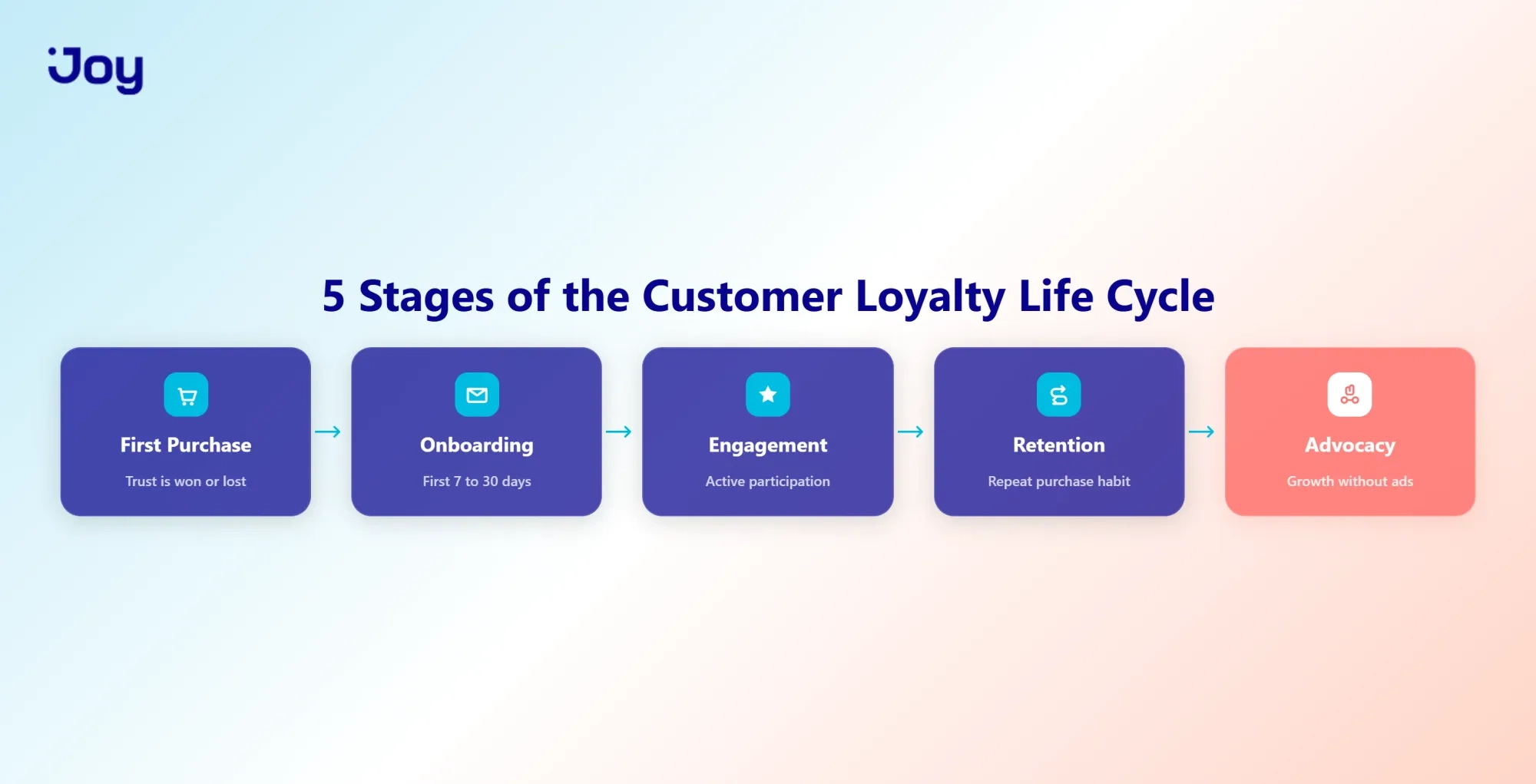
Stage 1: First Purchase, Where Loyalty Begins (or Dies)
The customer loyalty life cycle starts with the first transaction. But the first purchase is the starting line, not the finish line.
What happens in the hours and days immediately after that transaction determines whether the customer ever returns. And for many businesses, that window is completely silent. No follow-up email. No order confirmation beyond a generic receipt. No reason for the customer to believe the brand cares about anything beyond the initial sale.
At the same time, friction during checkout itself plants seeds of doubt before the product even arrives. Forced account creation, limited payment options, and an unclear return policy. Each one creates micro-moments of hesitation. And while they seem small individually, they accumulate into a feeling: this brand made it hard to buy from them.
The warning signs at this stage are straightforward. If your first-purchase volume is strong but second-purchase rates sit near zero, the post-purchase experience is almost certainly the problem. If customer support tickets spike within the first 48 hours, expectations weren't set clearly during or after checkout. And if post-purchase email engagement is low? It's often because no meaningful emails are being sent in the first place.
This is often the single biggest reason repeat purchase rates stay low. Not because the product failed, but because nothing after the purchase gave the customer a reason to return. PwC found that 59% of U.S. consumers will walk away after several bad experiences, while 17% will leave after just one. The product can be excellent, and the customer can still never come back.
Stage 2: Onboarding, the Window Most Brands Miss Entirely
The first seven to 30 days after a purchase represent one of the most important yet most neglected windows in the customer loyalty life cycle.
During this period, customers form their lasting impression of your brand. They decide whether this was a one-time transaction or the beginning of an ongoing relationship. For most businesses? This window passes in complete silence.
What typically goes wrong: the brand assumes the product will speak for itself. There's no welcome sequence, no guidance on how to get the most out of the purchase, and no invitation into any kind of continuing relationship. If emails do go out, they tend to be generic catalog promotions rather than anything connected to what the customer actually bought.
The result: customers never create an account. They never learn about the loyalty program. Nobody gave them a reason to come back, so they don't.
Klaviyo's email benchmarks quantify the missed opportunity: welcome emails average a 45% open rate, compared to 15-25% for standard campaigns. That's when customers are most receptive. When account creation rates are low, welcome email open rates are poor (or there's no welcome sequence at all), and loyalty program enrollment is near zero, the onboarding stage is where the breakdown is happening.
What makes this particularly costly is that the customer already made the hardest decision: they chose to buy. All they needed was a reason to stay engaged. Instead, they got silence. Every customer lost at this stage becomes another one-time buyer, which is why the business has to spend more on acquisition just to keep revenue flat.
Stage 3: Engagement, the Difference Between a Customer and a Contact in Your Database
There's a meaningful gap between a customer who's "enrolled" and one who's "engaged." An enrolled customer exists in your system. An engaged customer opens emails, earns rewards, leaves reviews, and revisits your store between purchases. The difference between these two determines whether your retention numbers hold up over time.
Most businesses struggle here because they treat engagement as a volume game. Send more emails. Run more promotions. Push more notifications. But volume without relevance is just noise. A customer who recently browsed a product page needs a different message than one who just earned a reward. When everyone receives the same broadcast, the signal gets lost.
Beyond that, many businesses only recognize purchases as meaningful customer actions. Reviews, social follows, account updates, and other micro-interactions go unnoticed. When customers feel invisible between transactions, they gradually disengage.
How a Stage 3 breakdown shows up in your data: your email list grows, but open and click rates decline. Customers are enrolled in your program but earn nothing between purchases. Review and UGC submission rates stay near zero despite a growing customer base. You've got contacts, not customers. And when engagement fails, the business ends up paying to recapture attention it already had. That's where the ad spend spiral quietly begins.
Stage 4: Retention, Where Loyalty Economics Actually Kick In
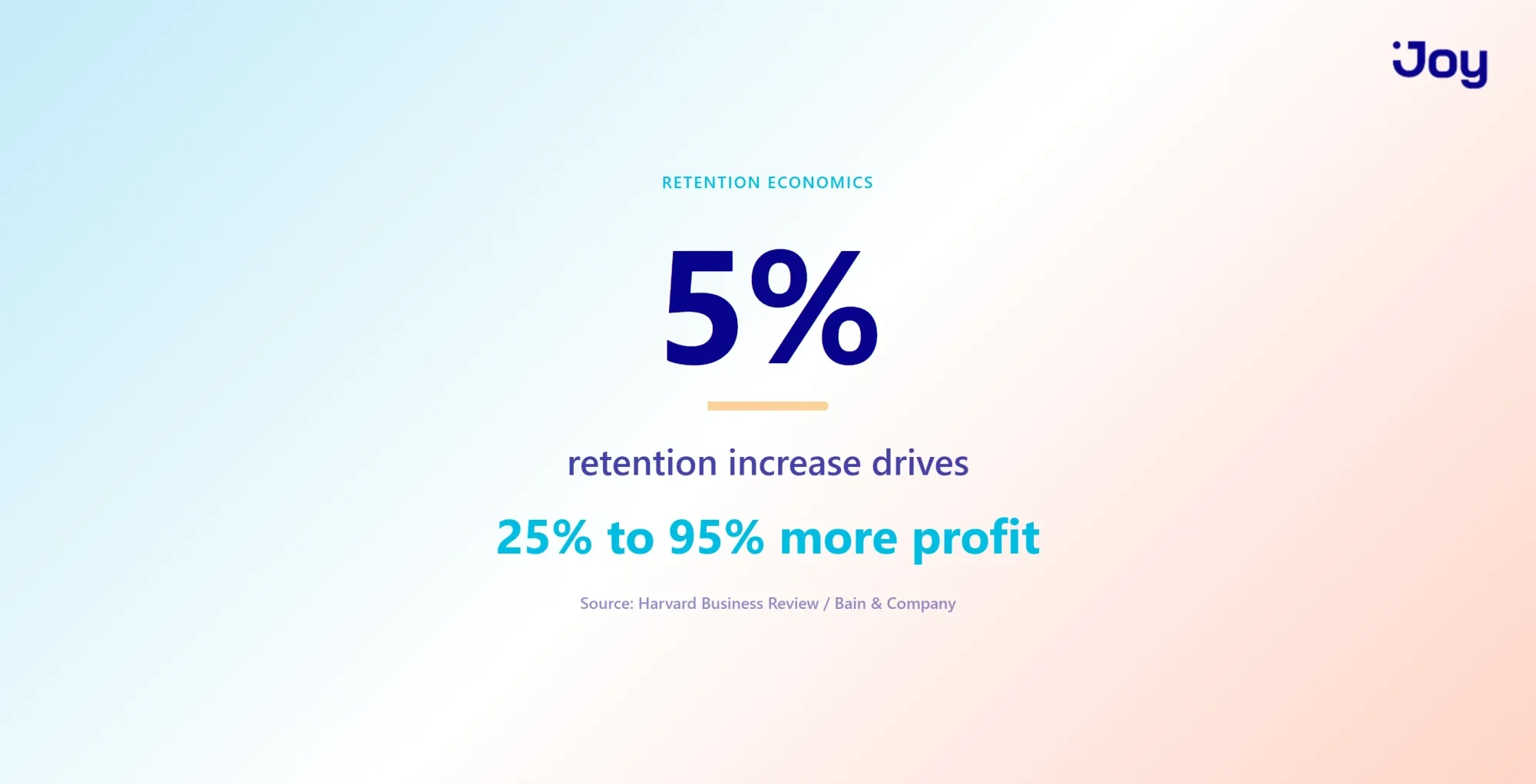
This is the stage where the financial case for loyalty becomes undeniable.
A customer who's purchased more than once and is developing a buying pattern represents something fundamentally different from a first-time buyer. HBR and Bain & Company's research found that a 5% increase in customer retention rates can increase profits by 25% to 95%. Separately, HBR found that repeat customers in apparel ecommerce spend more than twice as much in months 24 through 30 as they did in their first six months.
The longer a customer stays, the more they spend. But only if the relationship deepens over time.
What goes wrong at this stage typically comes down to one of three patterns. First, repeat customers are treated the same as new ones: same emails, same offers, same experience. There's no recognition of their loyalty, and no increase in value for staying. Second, businesses rely on discounts as their primary retention tool, which trains customers to wait for sales rather than buy at full price. Third (and perhaps most damaging), there's no proactive re-engagement before churn. By the time someone notices a regular customer has disappeared, it's usually six months too late.
Warning signs: customers making two or three purchases and then vanishing, churn rates climbing without anyone noticing until revenue dips, and repeat customers showing no increase in average order value over time.
When any of these appear, the retention stage is leaking. These are customers who have already proved they'd come back. They were willing. The business just didn't give them a strong enough reason to continue. The repeat purchase rate should be climbing, but it flatlines instead. The economics never shift from acquisition-dependent to retention-driven.
Stage 5: Advocacy, When Loyal Customers Become Your Growth Engine
At this stage, the customer doesn't just buy. They refer friends, leave reviews, share their experience on social media, and actively bring new customers to your brand. Your most loyal customers become your most cost-effective acquisition channel.
But satisfied customers don't automatically become advocates. Satisfaction is passive. Advocacy requires a trigger.
Most businesses never provide that trigger. There's no referral mechanism, so word of mouth stays informal and untrackable. Reviews are requested at the wrong time (often immediately after purchase, rather than after the customer has actually used the product). And there's no system for recognizing or rewarding the customers who do promote the brand organically.
The symptoms are easy to spot once you know what to look for. High customer satisfaction scores alongside near-zero referral activity. Few organic reviews despite a loyal customer base. Customers who love your brand privately but never say so publicly. That gap between satisfaction and action is the missed trigger.
Advocacy compounds in a way no other stage does. One referral generates a new customer, who can then become a repeat buyer and eventually an advocate themselves. It's the only stage in the loyalty life cycle that feeds back into acquisition without additional ad spend. When it works, it directly reduces the pressure on paid acquisition, which makes customer costs feel unsustainable. And yet, for most brands, it stays completely untapped.
How to Diagnose Where Your Lifecycle Is Breaking Down
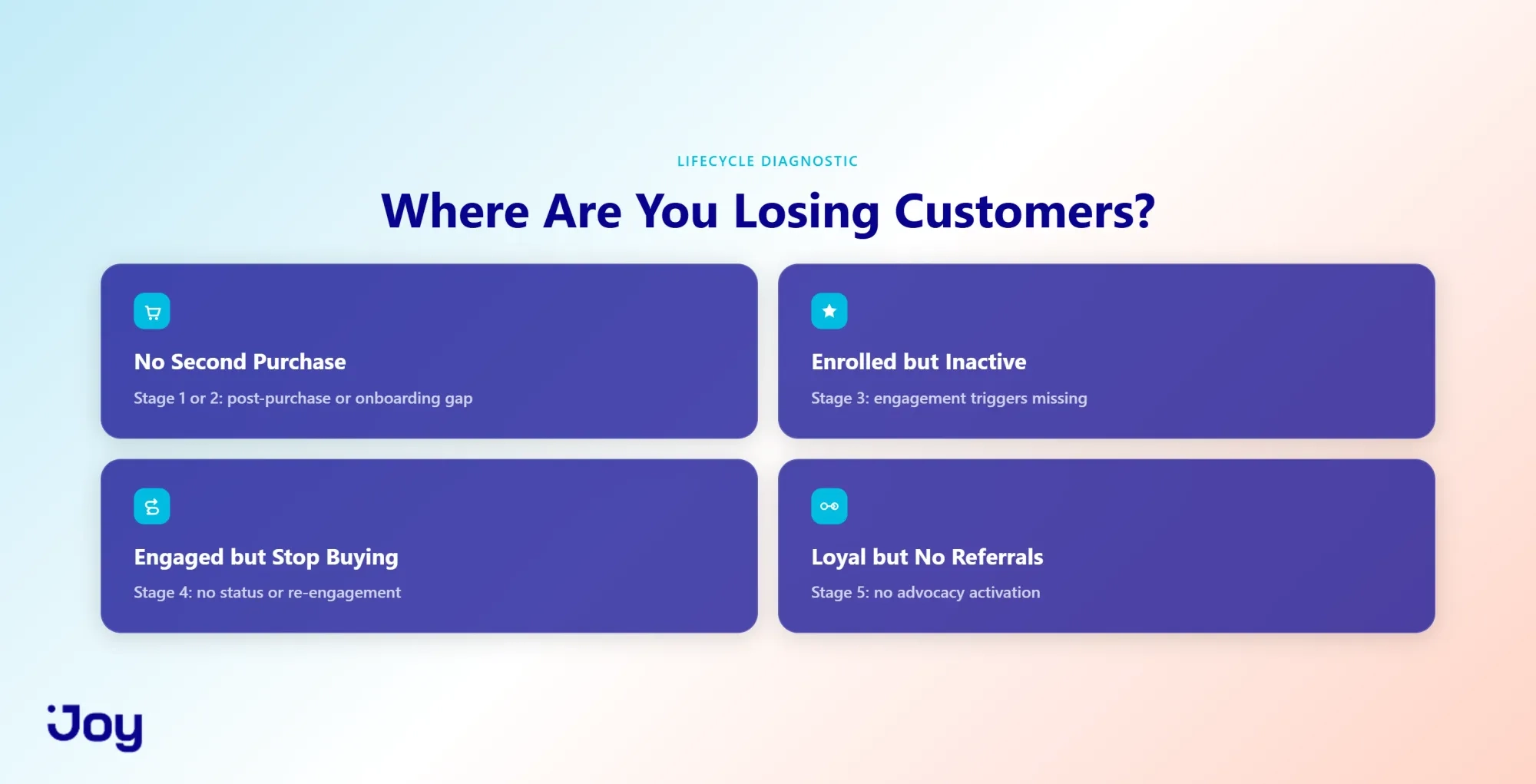
Remember the pattern from the beginning: rising acquisition costs, flat repeat-purchase rates, and revenue that depends on constantly finding new buyers. That pattern almost always traces back to one or two of these stages. Most businesses don't have a loyalty problem across all five. They have a specific stage where customers disappear, and everything else works reasonably well. Finding that stage is worth more than trying to optimize everything at once.
A straightforward diagnostic framework:
If customers don't return after their first purchase, the problem sits in Stage 1 or Stage 2. The post-purchase experience or the onboarding flow isn't giving them a reason to come back. Look at your first-to-second purchase rate and your welcome sequence engagement.
If customers are enrolled in your programs but remain inactive, the problem is in Stage 3. Your engagement triggers are either missing or irrelevant. Look at program activity rates and email engagement trends over time.
If engaged customers stop buying, the problem is in Stage 4. There's no status differentiation or proactive re-engagement before churn. Look at your repeat purchase rate, churn rate, and retention trends.
If loyal customers generate no word-of-mouth, the problem is in Stage 5. There's no referral activation or review system in place. Look at referral conversion rates and organic review volume.
The key insight is directional, not prescriptive. Once you identify the stage, you can investigate the specific cause. And in most cases, the fix is simpler than expected. The problem isn't that the business is doing something wrong at every stage. It's that one critical handoff between stages is broken, and everything downstream suffers.
Frequently Asked Questions
What is the difference between the customer lifecycle and the customer loyalty lifecycle?
The customer lifecycle covers acquisition: awareness, consideration, and first purchase. The customer loyalty life cycle picks up where that ends, mapping the post-purchase journey through onboarding, engagement, retention, and advocacy. The first one focuses on getting customers. The second one focuses on keeping them.
How long does it take to move a customer from first purchase to advocacy?
No fixed timeline. It depends on your product category, purchase frequency, and how deliberately you manage each stage. In fast-moving consumer goods, the journey can take weeks. In higher-consideration categories, months or even years. What matters more than speed is whether each stage actively moves customers forward rather than letting them stall.
What metrics matter most for measuring loyalty lifecycle health?
The most useful metrics map directly to each stage: first-to-second purchase rate (Stage 1), program enrollment rate (Stage 2), program activity and email engagement (Stage 3), repeat purchase rate and churn rate (Stage 4), and referral conversion rate and review volume (Stage 5). Tracking these together gives you a lifecycle view rather than isolated snapshots.
Can small brands build a loyalty lifecycle without expensive tools?
Yes. The lifecycle framework is strategic, not technical. A well-timed email sequence, a simple points program, and a basic referral incentive can cover Stages 2 through 5. What matters is recognizing the stages and deliberately designing the customer experience around them, not the sophistication of the tools involved.
Every customer who buys from you enters this lifecycle whether you manage it or not. The only question is whether you can see where they drop off, and whether you're set up to do something about it. If you're curious what a structured approach to loyalty looks like in practice, exploring a purpose-built loyalty platform is a good place to start.

Written by
Thomas Nguyen is the CEO & Co-founder of Joy, a loyalty solution for Shopify and eCommerce brands. With years of experience building high-performance Shopify apps, Thomas aims to help merchants grow through customizable and retention-focused tools.
Related reading
 Loyalty Strategy
Customer retention benchmarks for ecommerce: What's a good rate?
A clear-eyed look at ecommerce retention benchmarks: the one number worth trusting, why most by-industry tables mislead, and how to benchmark against yourself.
 Thomas Nguyen
 Loyalty Strategy
Low Customer Loyalty: Why Customers Don't Return (and How to Fix It)
Customers rarely leave at random. Repeat purchases usually stall for one of seven reasons — price sensitivity, slipping quality, poor service, message fatigue, disconnected channels, no personalization, or misaligned values. This guide diagnoses each one and names the metric that gives it away.
Thomas Nguyen Loyalty Strategy
How to set up customer retention automation (without a big team)
A step-by-step guide to automating customer retention across the customer lifecycle, from onboarding to win-back.
Thomas Nguyen Loyalty Strategy
The Customer Loyalty Loop: Why Retention Beats Acquisition
More than half of loyalty memberships sit inactive — the fix isn't a better funnel, it's a loop. Here's the 4-stage customer loyalty loop framework, where most Shopify programs break down, and how to diagnose which stage yours is missing.
Thomas Nguyen Loyalty Strategy
Customer Acquisition vs Retention: Where to Put Your Next Dollar
Customer acquisition and retention aren't a contest. Here's what each really costs, when to prioritize which, and a simple LTV:CAC way to decide your split.
Thomas Nguyen Loyalty Strategy
Loyalty Customer Service: How Service Quality Drives Revenue
80% of customers say experience matters as much as products (Salesforce). Loyalty customer service isn't a cost center — it's a revenue lever. This guide covers Harvard's Service-Profit Chain, the service-to-revenue mechanism, and a 5-step recovery system any ecommerce brand can run.
Thomas Nguyen