
Dimensions of Customer Loyalty: Why Discounts Alone Never Create Real Loyalty
Most loyalty programs run the same points-for-purchase mechanic—and customers bounce the moment a competitor offers more. Real loyalty has four dimensions, and brands that activate all four see 2–3× better retention. Here's what they are, and how to spot which one your program is missing.

Summarize this post with AI
If your loyalty program is built on points alone, here's the uncomfortable truth: the moment a competitor offers more points, your customers leave.
That's not disloyalty, that's how single-lever programs work. Real loyalty, the kind that holds when a competitor undercuts you, comes from layering multiple bonds at once.
Ogilvy One's research identifies four dimensions: financial, potential, cultural, and community. Brands that activate all four see two to three times better retention. Most programs activate only one.
Below, you'll see the full framework, why most programs over-invest in transactional mechanics, and how to spot which dimensions your store is missing.
Why Most Loyalty Programs Fail at Retention
85% of consumers say loyalty programs feel similar and undifferentiated (Ebbo, 2024). When every program runs the same points-for-purchase mechanic, customers bounce the moment a competitor dangles a better deal. That's not a branding problem. That's a retention failure, and the cost is measurable: a Motista study (100,000+ customers, 100+ retailers) found that emotionally connected customers carry a 306% higher lifetime value than satisfied but unemotional ones.
Most merchants pour nearly everything into transactional mechanics, while the dimension that drives the most value sits completely unbuilt. So if discounts alone don't create lasting loyalty, what actually does?
Ogilvy One's research (3,532 adults surveyed) pinpointed four distinct dimensions of genuine loyalty. Brands that activate all four see two to three times better retention. This article breaks down what those dimensions are, why most programs only cover one, and how to diagnose which ones your program is missing.
Why Four Dimensions Instead of One?
Most loyalty approaches double down on a single lever. Each one works for a while. But each one also carries a blind spot:
- Points-based loyalty rewards purchases with redeemable points. The problem: it only activates the Financial dimension, leaving your program exposed the moment a competitor offers a higher return.
- Tiered loyalty adds VIP levels based on spending. Still the same financial incentive, just with marginal status perks layered on top. No real emotional connection.
- Gamified loyalty introduces badges, leaderboards, and challenges. This activates the Potential dimension but ignores Cultural and Community bonds entirely. Fun, yes. Shallow, also yes.
- Community-first loyalty builds forums, member events, and peer recognition. Excellent for retention, yet without a financial incentive to join, participation stays low.
The pattern here is obvious: each approach over-invests in one dimension and neglects the rest. And the emotional dimension alone accounts for the largest share of business value, yet most merchants allocate their budgets to transactional mechanics that competitors can replicate overnight.
The Four Dimensions approach layers all four bonds simultaneously. Financial incentives fund the program. Potential keeps members engaged through growth and aspiration. Cultural alignment turns customers into advocates. And Community turns them into unpaid marketers through peer-to-peer connections.
What makes this more than theory? The evidence. Ogilvy One's research shows that brands activating all four dimensions see two to three times better retention. When a customer is held by growth, shared values, and peer relationships, a competitor's discount becomes irrelevant. And unlike community-first approaches that demand heavy moderation at scale, this framework works for stores doing $50K per month and $500K per month alike.
The Four Dimensions of Customer Loyalty
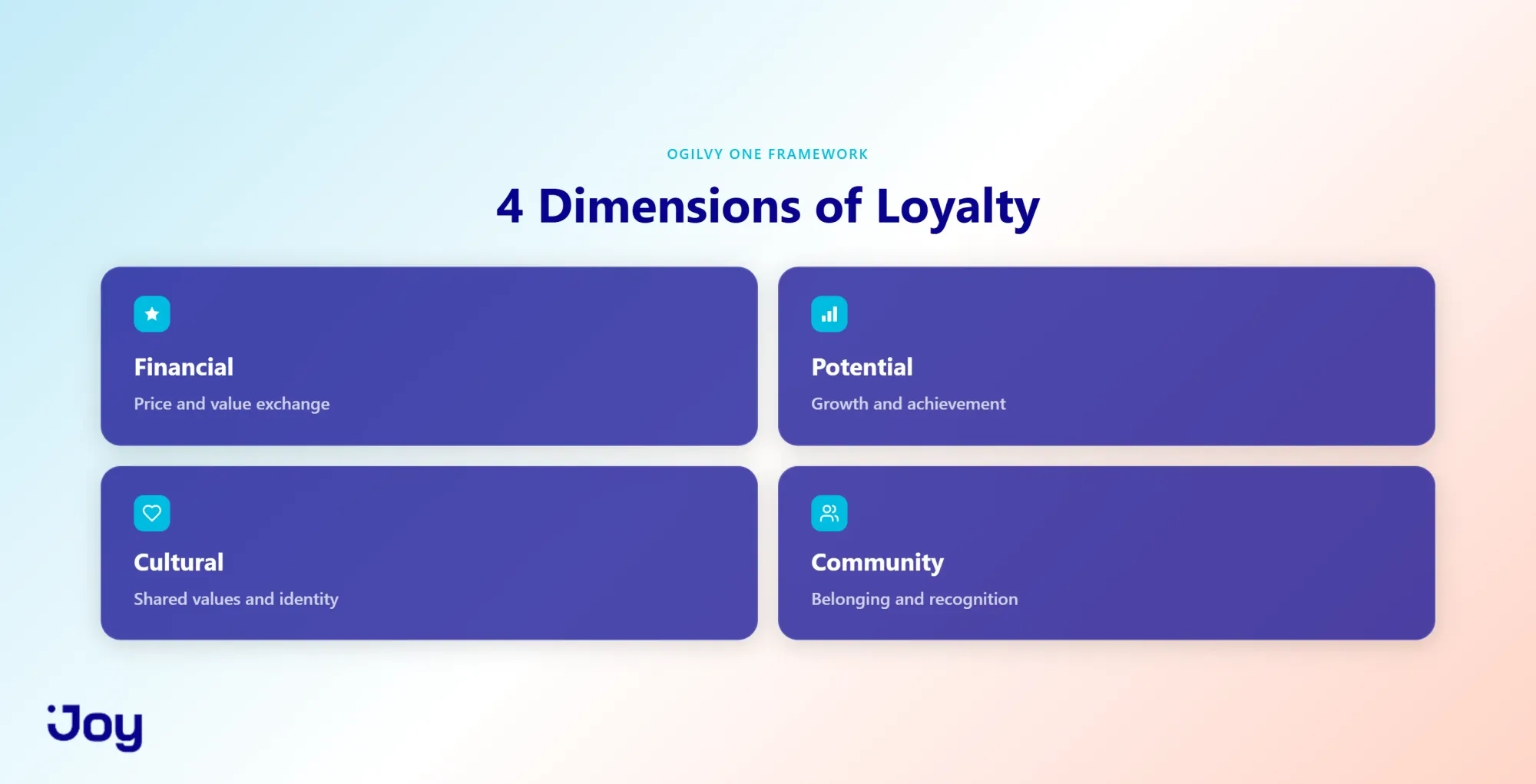
Ogilvy One's research found that genuine loyalty isn't a single feeling. It's four distinct bonds working together. No single dimension creates defensible loyalty on its own. All four together create both emotional and rational lock-in.
A quick overview:
- Financial: Price and value exchange (where most brands stop)
- Potential: Growth, achievement, and aspiration
- Cultural: Shared values, mission, and identity
- Community: Belonging, social connection, and peer recognition
Financial Loyalty: The Foundation, Not the Whole Story
Financial loyalty is the rational bond. Customers earn points, redeem discounts, and come back because the math works in their favor. A customer earning 2% back in points might stay loyal until a competitor offers 3%. That's it. That's the ceiling.
This dimension is the easiest to activate, but also the easiest to break. Most brands get stuck right here.
The trap works like this: customers trained on discounts learn to wait for promotions rather than buying at full price. Without an emotional buffer, any cheaper option becomes a reason to leave. Over time, this commoditizes the brand itself. Loyalty becomes about price, not about the relationship. And when your program looks identical to everyone else's points-for-purchase mechanic? You've turned loyalty into a commodity rather than a competitive advantage.
Financial loyalty isn't the enemy, though. It's a necessary foundation. Points programs with clear redemption paths give customers a visible value ladder. Tiered rewards incentivize increased spending while creating the first hints of status. The key is framing these rewards as recognition of loyalty, not as a transaction.
Patagonia offers a useful example. They run a rewards program that ties rewards to cause-driven actions rather than pure spending. That connection between financial incentive and brand values is the first hint of what multi-dimensional loyalty looks like.
The critical gap: Financial loyalty alone offers no defense. The gap between transactional and emotional loyalty shows up directly in lifetime value, and it's not marginal. Brands that stop at this one dimension leave their highest-value customer segment completely unbuilt.
Potential Loyalty: Growth, Aspiration, and Gamification
If Financial loyalty is the rational bond, Potential loyalty is the emotional incentive. It taps into something fundamental: the desire to grow, achieve, and reach something better.
Consider Lululemon's membership tiers, which progress from Local to Studio to Ambassador. Members don't just earn rewards. They feel like they're moving toward exclusive status. Ogilvy One's research confirms this, finding that millennials are especially attuned to growth-oriented programs.
Why do most brands neglect this dimension? Because it requires design thinking beyond the purchase button. Most brands treat points as purely transactional currency rather than achievement milestones. Reframing that psychology takes intention (and it's rarer than it should be).
In practice, Potential loyalty shows up as gamified challenges and badge unlocks that turn loyalty into a quest rather than a grind. Progressive unlock systems let members earn points for reviews, referrals, and social shares, not just purchases. This diversifies how customers engage with the brand. Social milestones and leaderboards add peer recognition, which connects directly to the Community dimension.
The business impact is measurable. Potential loyalty increases engagement, not just purchase frequency. It drives word of mouth as a natural byproduct of referral mechanics. And it reduces reliance on discounts because status becomes more motivating than a 5% coupon.
Cultural Loyalty: Values Alignment and Brand Identity
Cultural loyalty is the value bond. It's when a customer says, "I believe in what you stand for. I'm not just a buyer. I'm an advocate."
Patagonia is the clearest example. Customers stay despite premium pricing because they share the environmental mission. The brand's visible commitment to sustainability becomes part of the customer's own identity. Ogilvy One's research reinforces this: millennials are most attuned to values alignment and willing to pay a premium for it.
Yet most brands miss this entirely. Building Cultural loyalty requires genuine clarity on your values, not generic "sustainability" talk. It demands authentic action rather than performative marketing. And unlike Financial loyalty, it's hard to measure directly. How do you quantify "felt alignment"?
Brands that build it activate Cultural loyalty through cause-linked rewards, where every transaction reinforces identity. VIP naming that reflects the brand's mission (think "Advocates" instead of "Platinum Members") makes membership feel like purpose rather than status. Exclusive access to brand storytelling, behind-the-scenes content, and founder Q&As deepens the emotional connection over time.
The competitive moat here is significant. Once a customer is culturally aligned, they become resistant to price competition. They turn into unpaid marketers, sharing because of shared values rather than referral incentives. And because these referrals are organic and high-intent, they cut acquisition costs.
Community Loyalty: Belonging, Peer Recognition, and Social Currency
Community loyalty is the social bond. It goes beyond brand mission into something more personal: "I'm part of a group. These people get me. I belong here."
Peloton built its early success on exactly this. Members showed up for the workout community and culture, not just the fitness outcome. Riders followed each other, competed together, and celebrated milestones collectively. That social fabric is what makes Community loyalty the hardest dimension for competitors to replicate.
Most brands overlook this because it requires building culture inside the program, not just adding a rewards structure. It takes dedicated community management. And it requires facilitating customer-to-customer interaction, which is fundamentally different from brand-to-customer communication. Not easy. Not optional.
When brands do invest here, the mechanisms include peer recognition programs that highlight members and celebrate wins. Member-only social spaces (Discord, Facebook Groups, or branded hubs) create connections between customers rather than just with the brand. Co-created content and feedback loops, where members shape the brand's direction through surveys and product voting, build an ownership mentality.
The network effect is powerful. Once a customer has peer relationships inside your community, switching costs skyrocket. They'd lose their social network, not just their points balance. Community members also recruit organically because referrals become natural social sharing rather than prompted actions.
Which Dimensions Is Your Program Missing?
Most merchants sense something is off with their loyalty program, but can't pinpoint what. The data quantifies this gap: 71% of consumers expect personalized interactions, yet 45% have already disengaged from brands that fail to deliver specific, relevant experiences (McKinsey, 2021; Twilio Segment, 2021). Merchants know retention is leaking. They just can't name which dimension is causing it.
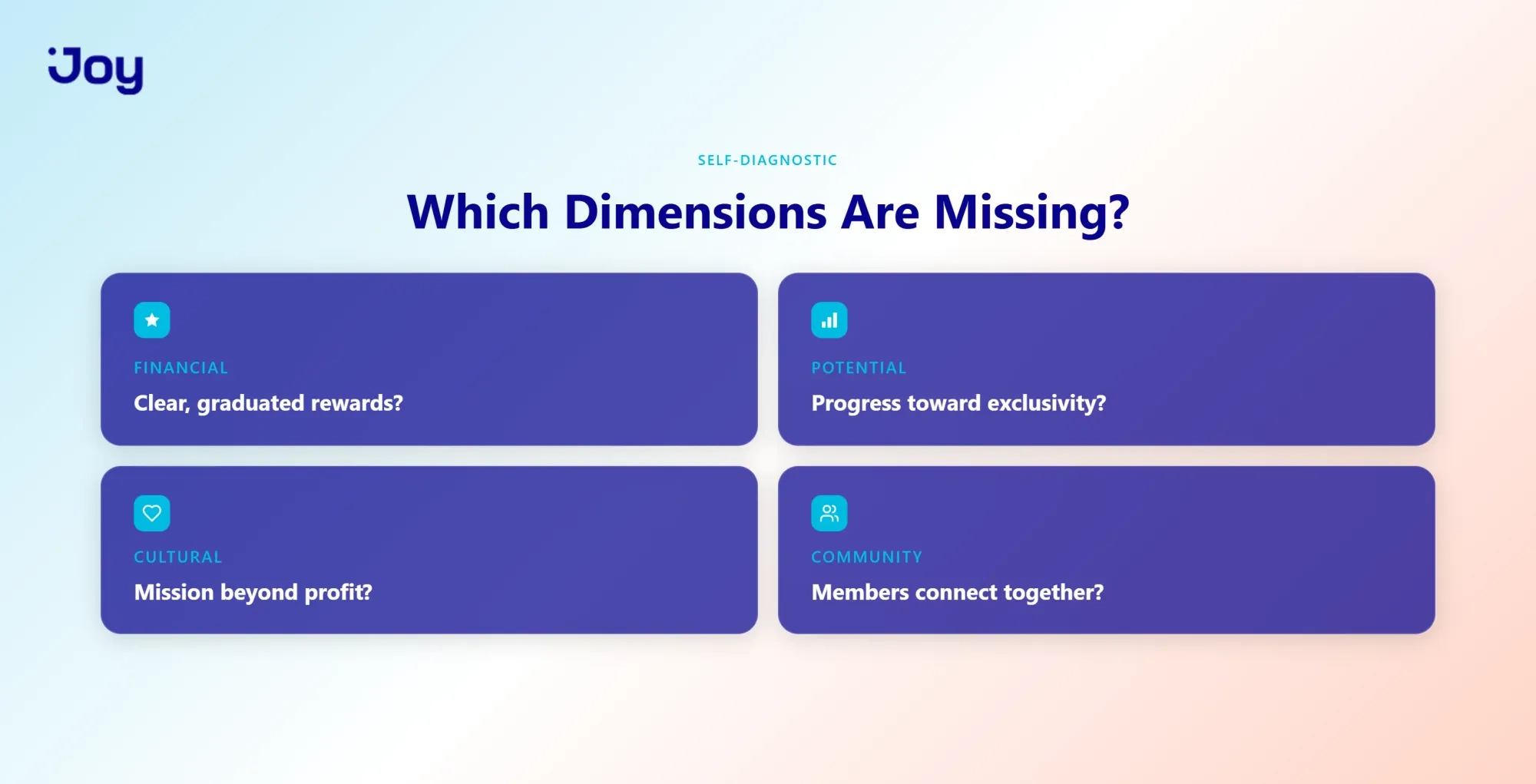
This diagnostic turns that vague feeling into a specific answer. Ask yourself four questions, one per dimension:
Financial: "Do we offer clear, graduated rewards?" If the answer is no, customers have no baseline incentive to join or stay.
Potential: "Do members feel like they're progressing toward something exclusive?" If not, engagement dies after the first purchase. There's no reason to come back beyond the next discount.
Cultural: "Do members know why our brand exists beyond profit?" Without this, you have zero emotional defense against competitors, and you're missing the dimension that drives 306% higher lifetime value (Motista, 2018).
Community: "Can members connect with each other, not just with our brand?" If the answer is no, you have no word-of-mouth engine. Churn stays high and retention depends entirely on ongoing discounts.
The strongest brands activate all four. Patagonia layers Cultural and Financial. Lululemon combines Potential with Community. Glossier fuses Potential with peer-to-peer Community. Peloton leads with Community and Potential. None of them relies on a single dimension.
If your program only covers one or two dimensions, that gap is your biggest retention vulnerability.
Where to Start: Layering Dimensions in the Right Order
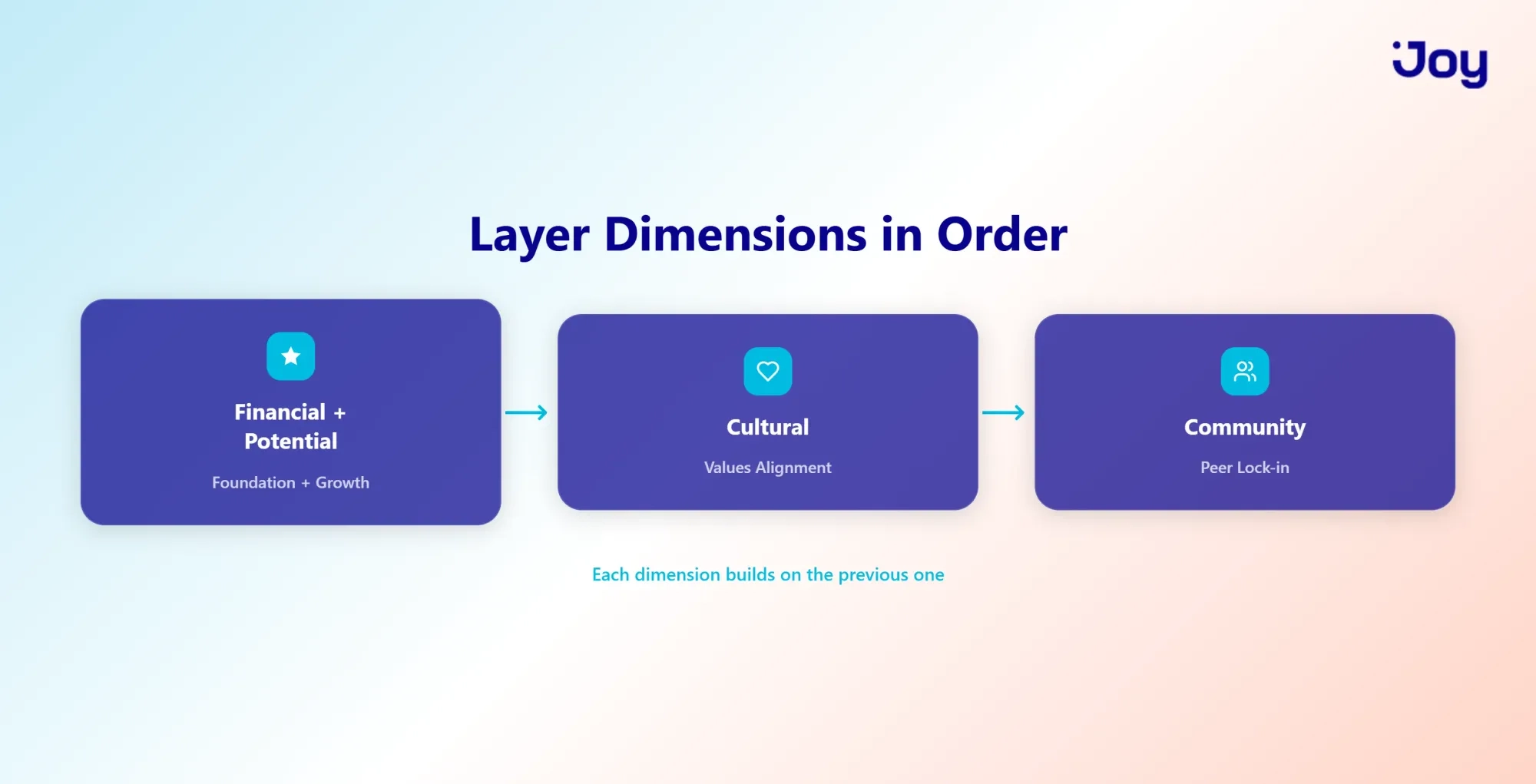
You don't activate all four dimensions at once. Each one has different prerequisites and effort levels, so the sequence matters.
Finance is the foundation. Without baseline rewards, there's no incentive to join. Most brands already have some version of this in place.
Potential builds directly on the financial infrastructure. It uses the same points and tier mechanics but reframes the psychology from transaction to achievement. That makes it the lowest-lift dimension to add next.
Culture requires a different kind of investment: brand clarity and authentic storytelling. You can't shortcut this because you can't fake values alignment.
Community demands the most ongoing investment. Active moderation, peer-to-peer infrastructure, and member spotlights all require sustained effort. But it also creates the strongest lock-in. Nothing else comes close.
A practical sequencing approach:
- Start with Financial + Potential. Most brands already have financials in place. Adding gamification, referral challenges, and badge unlocks reframes the same mechanics toward growth and achievement.
- Layer in Cultural. Once members are engaged, deepen the emotional bond through values alignment, cause-linked rewards, and mission-driven tier naming.
- Build Community last. It requires the most infrastructure: community spaces, moderation, and member recognition. But once established, it creates switching costs that no competitor can match through discounts alone.
At each stage, measure what matters for that dimension. Track repeat purchase rate and CLV for the Financial team. Monitor engagement rate and program interaction frequency for Potential. Survey brand affinity and referral attribution for Cultural. And watch member retention, peer interaction counts, and organic referral rates for Community.
Common Pitfalls When Building Multi-Dimensional Loyalty
Even brands that understand the four dimensions framework make predictable mistakes in execution. The four most common:
"We'll build all four at once." The ambition is right, but execution falls apart. Launching everything simultaneously creates overwhelm and guarantees poor execution across the board. Brands that get this right layer them sequentially: Financial and Potential first (lowest lift), then Cultural and Community once the foundation is solid.
"Community loyalty will happen naturally." Turning on a leaderboard and waiting for organic engagement is a recipe for silence. Community requires active curation and moderation. Brands that build genuine community invest in dedicated moderation, regular member features, and clear norms from day one.
"Cultural loyalty means being 'woke.'" Inauthentic cause alignment, or generic sustainability messaging, backfires fast. Customers spot performative marketing quickly. Brands that succeed here pick one cause that genuinely reflects their founder's values and take action beyond marketing: partnering with one or two organizations, measuring impact, and reporting results to members.
"Higher rewards equal higher loyalty." After a baseline return of one to two percent, increasing point values or tier benefits produces diminishing returns. The real retention gains come from Potential, Cultural, and Community. Effective programs maintain consistent point values and redirect investment toward the other three dimensions.
The Real Loyalty Equation
Three problems most programs face are now visible: most are stuck on a single dimension, the cost of that over-investment is measurable in lifetime value, and the missing dimension is usually invisible until customers are already gone.
The four dimensions create layered lock-in: Financial brings them in, Potential keeps them engaged, Cultural makes them advocates, and Community turns them into the most effective acquisition channel you'll ever build.
If you're curious what a loyalty program built across all four dimensions looks like in practice, explore how it works.
Your next step: run the diagnostic from earlier in this article. Identify which dimensions you're covering and which ones are missing. Then study the brand examples for the dimension you need to strengthen. The gap you can't see today is the one that will cost you tomorrow.
Loyalty isn't about how much you discount. It's about how much you matter to your members, and how much they matter to each other.

Written by
Thomas Nguyen is the CEO & Co-founder of Joy, a loyalty solution for Shopify and eCommerce brands. With years of experience building high-performance Shopify apps, Thomas aims to help merchants grow through customizable and retention-focused tools.
Related reading
 Loyalty Strategy
Customer Satisfaction and Brand Loyalty: 2026 Growth Guide
25-35% of satisfied customers still switch silently. This guide explores the gap between customer satisfaction and brand loyalty — and the 4 metrics (NPS, CES, redemption rate, LTV) that turn happy buyers into emotionally connected advocates when acquisition costs are 4× higher.
 Thomas Nguyen
 Loyalty Strategy
Customer Loyalty Models Explained: From Framework to Action
Most brands launch loyalty programs on gut instinct — then wonder why members never redeem. A customer loyalty model is the diagnostic framework that fixes that. This guide breaks down 6 proven models and how to pick the right one for your brand.
Thomas Nguyen Loyalty Strategy
Customer Loyalty Pyramid: 5 Stages to Brand Advocacy
Your best customers don't quit — they quietly drift away. The customer loyalty pyramid maps all five stages of the relationship, shows where customers get stuck, and gives you tactics to move them up before stealth attrition takes hold.
Thomas Nguyen Loyalty Strategy
Brand and Customer Loyalty: The Difference That Determines Whether You Win or Race to the Bottom
Customer loyalty keeps people buying until a better offer arrives. Brand loyalty keeps them buying even when better offers already exist. Most merchants build only the cheaper, more fragile ones - here's the upgrade path.
Thomas Nguyen Loyalty Strategy
The Impact of Social Media Marketing on Brand Loyalty: 7 Key Insights
Likes don't equal loyalty. This guide breaks down how social media marketing actually builds brand loyalty — through two-way communication, user-generated proof, omnichannel touchpoints, influencer collaboration, and measurable ROI. 7 key insights for Shopify merchants in 2026.
Thomas Nguyen Loyalty Strategy
Customer Loyalty Levels: Why Not All Customers Are Equal
Not all customers are equal — and most stores treat them like they are. This guide breaks down the four customer loyalty levels, how to spot where each customer sits, and a 30-day plan to move them up the ladder, with real case studies and metrics to track.
Thomas Nguyen