
Building Customer Loyalty: The Framework That Actually Works
Stable revenue can mask something uncomfortable: customers returning out of habit, not preference. When they find a better option, they leave without warning — and you pay full CAC to replace them. Here's how to build the loyalty they actually feel, not the one you assume.

Summarize this post with AI
PwC surveyed over 4,000 consumers and 410 executives and found a gap most brands don't want to talk about: 61% of executives believe their customers are more loyal today than before the pandemic. Yet only 20% of consumers say the same. The remaining 75% report no change in their loyalty.
That gap has a name: the loyalty confidence trap.
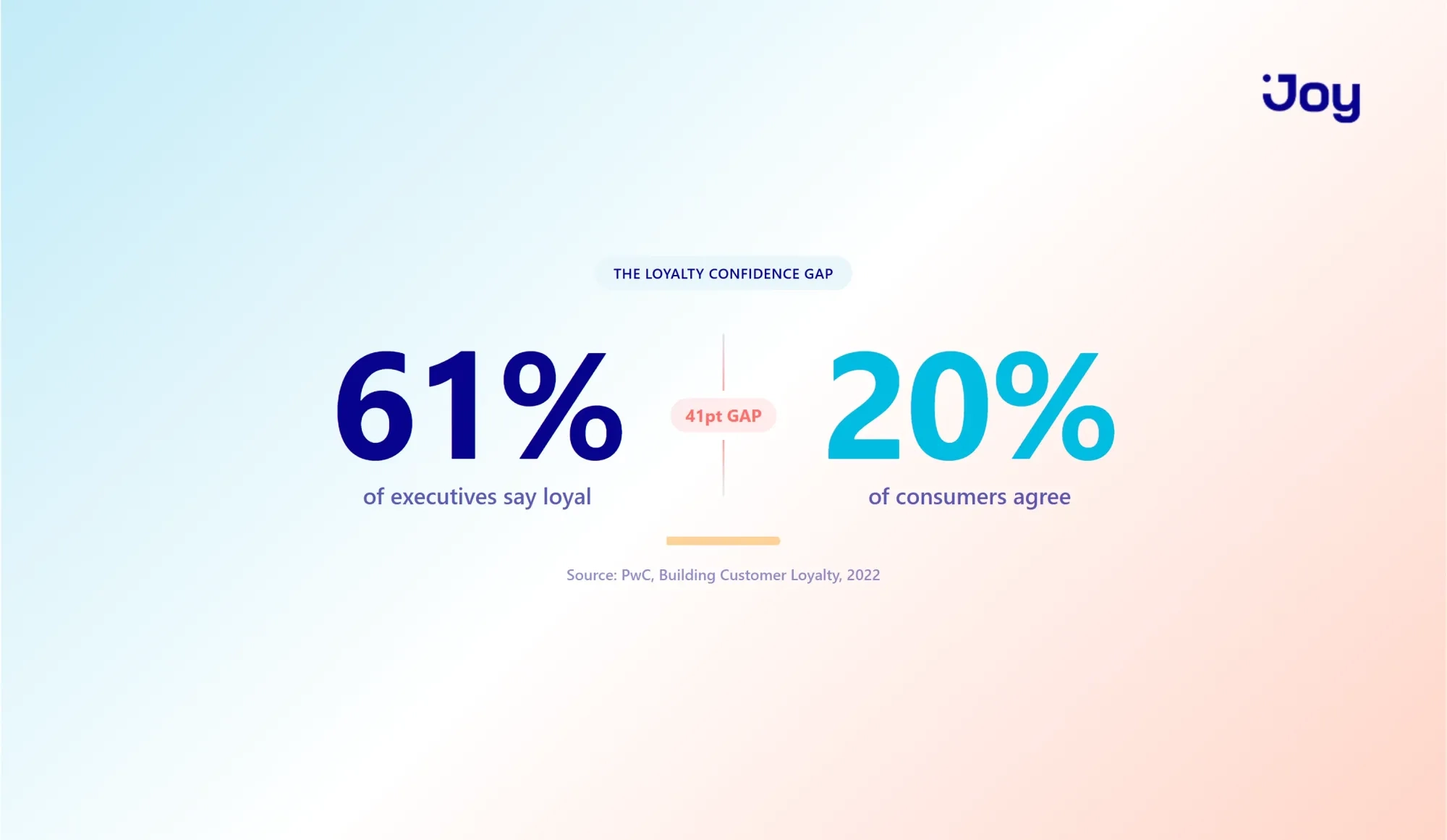
For ecommerce merchants, that gap is expensive. Every customer you lose to a competitor you assumed was "loyal" is a customer you'll pay to re-acquire at full CAC.
This article delivers a two-part framework, Foundation and Build, that closes the distance between what merchants think is working and what customers actually experience. First, you'll understand what loyalty really is and what destroys it. Then you'll build the program that earns it back.
What Customer Loyalty Actually Is (And What It Isn't)
Most merchants define customer loyalty as "they keep buying from me." That definition isn't wrong, but it's dangerously incomplete. Loyalty exists on a spectrum, and the economics at each level are wildly different.
Transactional loyalty sits at the bottom. These customers come back because of a discount, a coupon, or a price advantage. Every return visit is funded by your margin. The relationship survives only as long as the incentive does. The moment a competitor matches or undercuts your offer, these customers leave with zero hesitation. This is where most ecommerce stores operate without realizing it.
Habitual loyalty occupies the middle ground. These customers return because switching takes effort. Maybe they've saved their payment info. Maybe they're familiar with your site navigation. More stable than transactional loyalty, but not resilient. A price hike, a shipping delay, a frustrating return experience, and habitual customers will put in the effort to switch.
Emotional loyalty sits at the top, and it looks nothing like the other two. These customers buy because the brand connects to something they value: their identity, their community, their principles. They pay full price, forgive mistakes, and (most importantly) they tell other people. This is the only level that generates genuine advocacy.
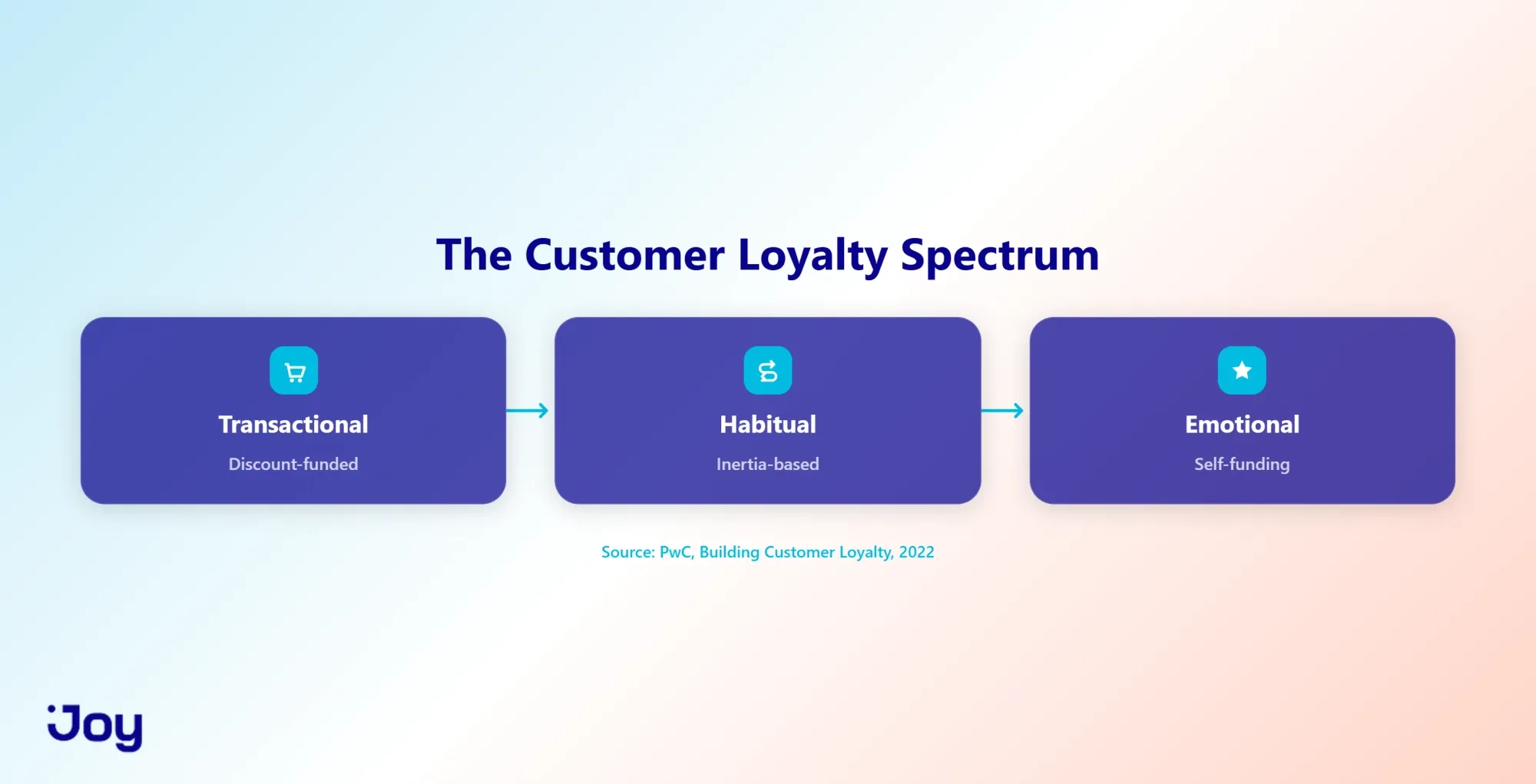
The margin difference between these three levels is significant. With transactional loyalty, you fund every repeat purchase through discounts and promotions. With emotional loyalty, customers fund their own return because they genuinely want to come back. Same revenue line. Opposite margin impact.
There's also what you might call a loyalty buffer. Emotionally loyal customers give brands room to make mistakes. A late shipment, a quality issue, or an out-of-stock moment: these customers absorb it because they've built up goodwill over time. Transactional loyalty has zero buffer. One bad experience and the relationship is over.
PwC's data reinforces this: 60% of consumers show loyalty by recommending brands to friends and family, making word of mouth the number one loyalty signal. Not repeat purchases. Only emotional loyalty produces advocacy at that scale.
So the real diagnostic question isn't "are my customers buying again?" It's "which level of the spectrum are most of my customers sitting on?" Because the answer determines whether your customer retention loyalty is built on a real foundation or on borrowed time.
Related reading: 7 Types of Customer Loyalty and How to Strengthen Them
The Real Reason Customers Lose Loyalty
Before thinking about how to build customer loyalty, it's worth understanding what destroys it. Most merchants skip this step entirely. That's a mistake.
PwC found that 37% of consumers leave a brand due to a poor product or service experience. Another 32% leave due to poor customer service. Combined, nearly 70% of customer defection is experience-driven. Not price-driven. Not competition-driven. Something the merchant can directly influence.
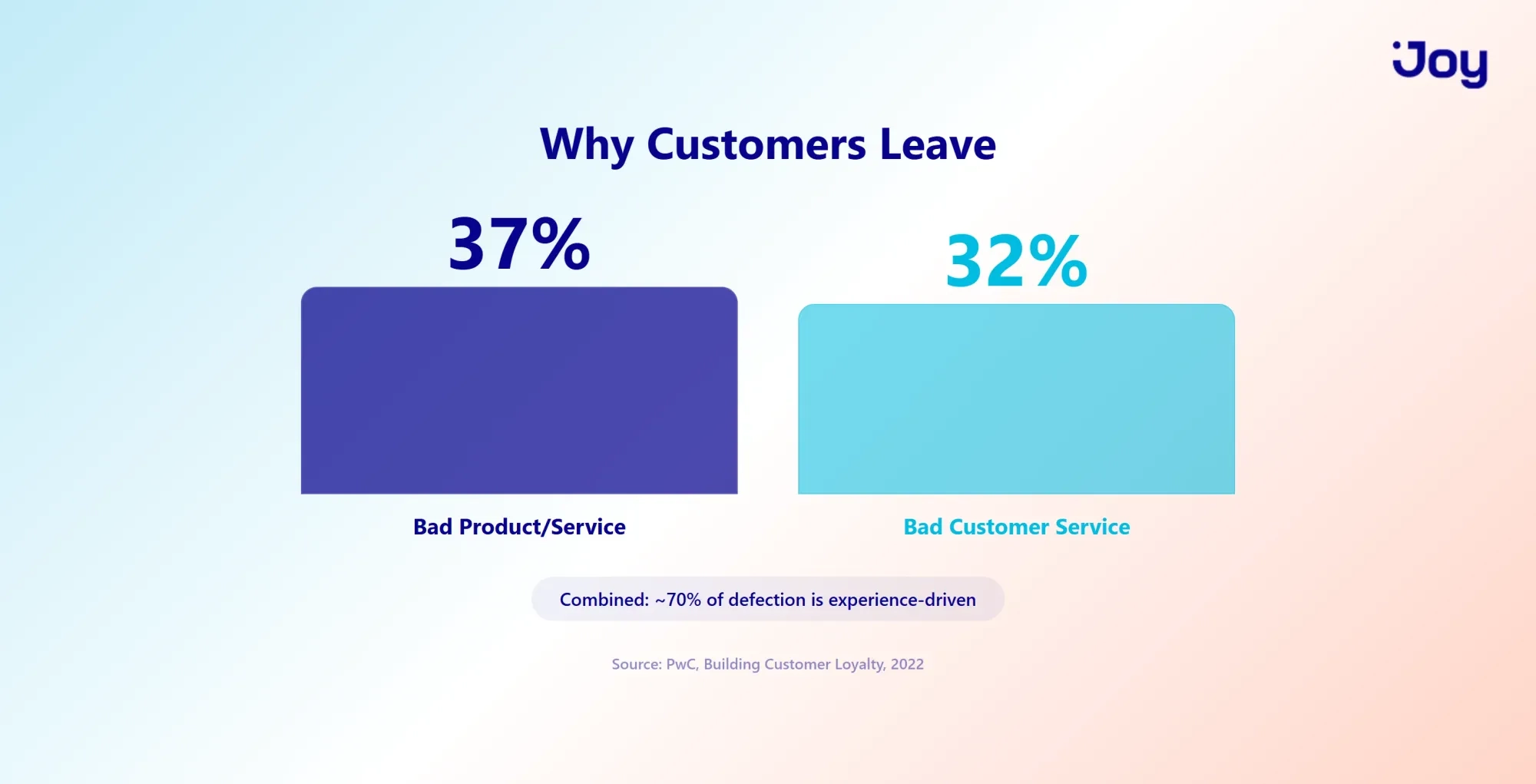
This reframes the loyalty conversation. A loyalty program doesn't fix a broken product or a frustrating support process. It amplifies what's already there, good or bad. Launching a points program on top of a poor post-purchase experience is like turning up the volume on a bad song.
Timing matters here, too. The first 90 days after a first purchase represent the highest churn risk. If a new customer doesn't receive a meaningful touchpoint in that window (a follow-up email, a recognition moment, a clear reason to return) they default to transactional mode or disappear entirely. And most of them won't complain on the way out. They just stop buying.
Three diagnostic questions worth asking before building anything:
- Do first-time buyers get a post-purchase follow-up within seven days?
- Is the return and refund process frictionless, or does it create resentment?
- After their first purchase, can a new customer name one reason your brand is different?
If the answer to any of these is no, that's the loyalty leak. No customer loyalty program compensates for a broken first impression.
Related reading: Why Loyalty Programs Fail: Understanding the Mistakes and How to Overcome Them
What Actually Builds Customer Loyalty: The Full Picture
Most merchants jump straight to launching a loyalty program when they think about building customer loyalty. Programs matter, but they're one lever among many. And not even the most important one.
for
The full picture of what drives loyalty includes six strategic levers:
Product and service quality is the single largest loyalty driver in every consumer survey. No program compensates for a product customers don't trust or a service that frustrates them. This is the floor everything else stands on.
Customer experience across touchpoints determines whether the buying, delivery, returns, and support journey builds trust or erodes it. When 32% of customers leave over bad service alone, experience isn't a secondary concern. It's a retention gate.
Trust and transparency in pricing, data practices, and communication during problems are the prerequisites for every other lever.
From that foundation, three levers amplify what's already working. Emotional connection and brand identity move customers to the top of the loyalty spectrum. Customers who see themselves in a brand pay full price, forgive mistakes, and tell friends. Community and belonging create switching costs that no competitor can undercut. Recognition and rewards programs give customers a visible, trackable reason to return, formalizing the relationship through points, tiers, and referrals.
Most merchants invest heavily in that last lever and stop there. The ones who build lasting customer loyalty invest across all six.
For the rest of this article, we'll go deeper into that rewards lever, because it's where merchants have the most direct control and where the execution details matter most.
Related reading: Ecommerce Customer Retention: Everything You Need to Know and 8 Strategies to Increase It
Choose the Right Customer Loyalty Program Type
The first decision, choosing the right program type, matters more than most merchants realize.
Three types consistently work for ecommerce:
| Program Type | Best for | Core mechanic | CLV impact |
|---|---|---|---|
| Points-based | High-frequency stores (3+ orders/year) | Earn points per purchase, redeem for rewards | Medium: drives repeat purchase frequency |
| Tiered/VIP | Mid-to-high AOV stores | Unlock tiers by spend or points, better perks at each level | High: top 20% of customers spend 3 to 5x more |
| Paid membership | High-loyalty, subscription-ready stores | Pay for premium access like free shipping or exclusive pricing | Highest: members pre-pay for the relationship |
How to decide: map your order frequency against your average order value. High frequency with low AOV points toward a points program. Low frequency with high AOV favors tiers. Strong community with a recurring need? Membership.
But here's the critical nuance: PwC reports that 80% of loyalty programs look identical to competitors. That means the program type you choose matters less than how you differentiate within it. Points-based programs are everywhere. The merchants who stand out design their programs to reward different behaviors, not just purchases.
Related reading: 5+ Types of Loyalty Programs and Their Benefits
Build a Customer Loyalty Earn Structure That Drives the Right Behaviors
Most loyalty programs only reward purchases. That's table stakes. A loyalty program strategy that actually differentiates rewards for the full customer relationship, not just the transaction.
Earn rules fall into four categories, each serving a different purpose:
Transactional earn is the baseline: points per dollar spent. Every program has this.
Relationships earn rewards for customers for investing beyond a purchase: account creation, profile completion, and birthday opt-in.
Advocacy earns is where the highest ROI lives. Points for leaving reviews, following on social media, and referring friends. When a referral converts into a new customer, that's the most measurable ROI event in a loyalty program. PwC confirms the opportunity: 60% of consumers show loyalty by recommending brands to friends and family. Building the mechanic that captures and rewards this behavior turns passive loyalty into measurable revenue.
Re-engagement earns targets the moment habitual loyalty starts to decay: bonus points for returning after 60 or more days of inactivity.
Beyond the earn categories, two principles separate effective programs from invisible ones.
Reward-to-first-value speed is the most reliable predictor of long-term engagement. If a new member needs eight to ten purchases to earn their first meaningful reward, the loyalty window has already closed. A welcome bonus of 50 to 100 points at signup creates early momentum and reduces the psychological distance to that first redemption. Customers who experience value quickly stay engaged. Those who don't disengage within weeks.
Non-purchase earn triggers create emotional association. Build at least two from launch (reviews, referrals, or milestones). These cost nothing in margin and produce something purchase-only programs never generate: the feeling that the brand noticed something the customer didn't expect to be noticed.
Related reading: Loyalty and Referral Programs: The Ultimate Combination for Ecommerce Growth
Design Customer Loyalty Tiers That Pull Customers Upward
Tiers work because of the endowed progress effect: once customers accumulate points, they don't want to lose them. A tiered structure creates a visible ceiling to chase, and that turns passive point collection into active pursuit.
What works in practice:
- Three tiers maximum for most ecommerce stores. More complexity creates more confusion, and confused customers disengage.
- Thresholds can be points-based or spend-based. Points-based rewards action frequency. Spend-based rewards AOV. Choose based on which behavior you want to accelerate.
- Benefits must escalate meaningfully. Free shipping at tier two. Exclusive early access at tier three. Personal service at the top. Each tier should feel like a genuine upgrade, not a marginal bump from the last.
PwC highlights a common trap here: 91% of executives agree their loyalty programs should provide more rewards and benefits. But the risk isn't under-rewarding. It's offering benefits customers don't actually value. The two benefits consumers want most are discounts and rebates (48%) and flexible loyalty rewards (43%). Flexibility beats novelty every time. Let customers choose how they redeem rather than offering a longer menu of options they never asked for.
One often-overlooked differentiator: tier names that signal identity, not rank. "Bronze, Silver, Gold" is invisible. Customers can't even remember which tier they're in. The programs that build emotional loyalty name their tiers after their brand story. A fitness brand uses the Starter, Athlete, and Champion tiers. A beauty brand uses the Member, Insider, and Icon tiers. When a customer thinks "I'm a Champion" instead of "I'm Gold tier," that's emotional loyalty made structural.
Related reading: VIP Loyalty Programs: How Top Brands Drive Customer Retention
Personalize Your Customer Loyalty Program Without Crossing the Line
Personalization is the most frequently recommended approach across customer loyalty guides. The advice isn't wrong, but it consistently ignores a core obstacle: the consent gap between what merchants want and what customers are willing to share.
PwC's data makes this visible:
| Data type | Merchants collecting it | Customers willing to share |
|---|---|---|
| Email address | 73% | 61% |
| Birthday/age | 66% | 47% |
| Phone number | 49% | 30% |
| Location data | 32% | 10% |
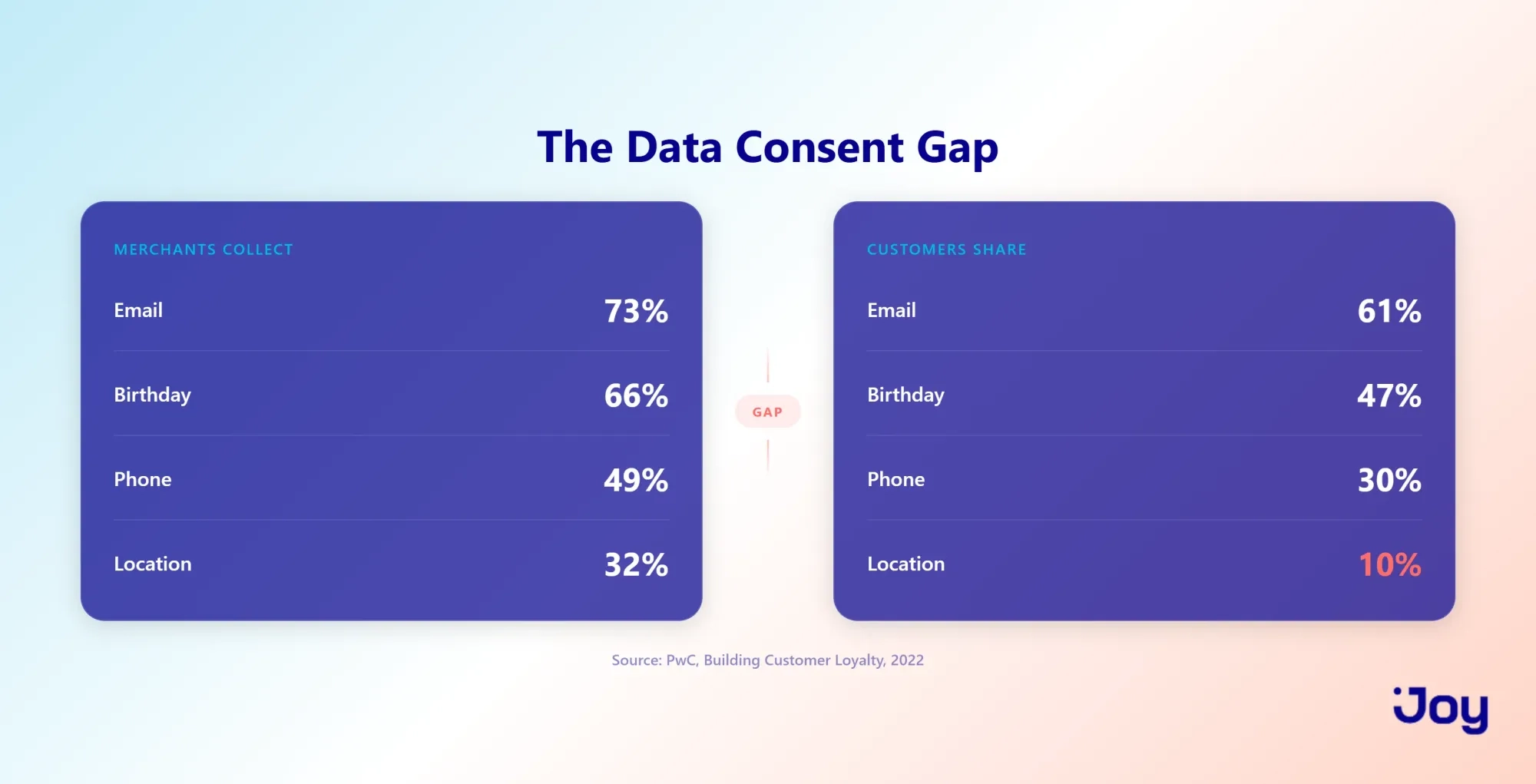
Location data is the widest gap. Nearly a third of merchants collect it, but only 10% of consumers will share it. Any personalization strategy based on location data relies on information most customers refuse to share. That's not a strategy. That's a guess.
The pattern holds across every data type: the more personal the information, the wider the gap. And it's growing as consumers become more privacy-aware and regulations continue to tighten.
So what actually works? Focusing on the data customers willingly provide:
- Zero-party data: Ask directly at opt-in for birthday, category preferences, or occasion type. Customers are willing to share this when there's a clear reward in return.
- Behavioral signals: Use purchase history to trigger relevant rewards. A customer who buys skincare monthly doesn't need a generic "come back" email. They need a replenishment reminder with a tier bonus attached.
- Birthday and milestone triggers: Easy to set up, high perceived value, and zero privacy friction.
Related reading: The Ultimate Guide to Data-Driven Loyalty Programs
Building Customer Loyalty Is a System, Not a Single Tactic
The merchants who build real customer retention loyalty aren't the ones with the fanciest program. They're the ones who treat loyalty as revenue architecture: every earn rule, every tier benefit, every referral link is a decision about how much of your next order comes from a relationship you already built versus an ad you paid for.
Building customer loyalty starts with seeing the full picture. Product quality, customer experience, trust, community, and emotional connection form the foundation. The rewards program is the visible layer that ties them together. Most merchants get the order backward: they build the program first and hope the foundation follows. The ones who win build the foundation first and let the program amplify what's already working.
Six levers. Two phases. One commitment: diagnose before you prescribe, and never stop closing the gap between what you think is working and what your customers actually feel.
Curious what a loyalty framework looks like when these gaps are closed? See how other merchants approach it →
Frequently Asked Questions
What is the most effective way to build customer loyalty?
Fix the customer experience first. PwC research shows 46% of consumers say loyalty comes from product quality, before any program enters the picture. Once that foundation is solid, build a rewards structure that goes beyond purchases by rewarding referrals, reviews, and milestones. The most effective approach invests across all six loyalty levers, not just one.
What makes customers loyal to a brand?
Product quality is the foundation. Customer service, personalization, emotional connection, trust, and community all play supporting roles. Programs formalize the relationship but don't create it. The brands with the deepest loyalty invest across multiple levers simultaneously, not just rewards.
How long does it take to build customer loyalty?
A loyalty program can be configured and launched within a week. Transactional loyalty through discounts can appear quickly, but it's fragile and margin-negative. Emotional loyalty, where customers actively advocate and pay full price, takes six to twelve months of consistent experience. The first 90 days after a first purchase are the highest-risk window for losing customers entirely.
Why do most loyalty programs fail?
80% of programs look identical to competitors, according to PwC. The most common failure patterns: rewards that take too many purchases to earn, points that expire without adequate warning, and benefits designed around what merchants want to offer rather than what customers want to receive. Programs also fail when they're layered on top of a broken customer experience.
How much does a loyalty program cost for an online store?
Costs vary by platform and store size. PwC data shows that enterprise brands typically allocate roughly 5% of revenue to loyalty budgets. Dedicated loyalty apps start at accessible tiers and scale with order volume.
Source: All statistics cited in this article are from PwC's primary survey, "Building Customer Loyalty," conducted with 4,036 consumers (May 2022) and 410 executives (October to November 2022). [View the full report →]

Written by
Thomas Nguyen is the CEO & Co-founder of Joy, a loyalty solution for Shopify and eCommerce brands. With years of experience building high-performance Shopify apps, Thomas aims to help merchants grow through customizable and retention-focused tools.
Related reading
 Loyalty Strategy
How to set up customer retention automation (without a big team)
A step-by-step guide to automating customer retention across the customer lifecycle, from onboarding to win-back.
 Thomas Nguyen
-f9ebcc.webp&w=3840&q=75) Loyalty Strategy
Loyalty StrategyCustomer Engagement and Loyalty: Strategies and How to Measure Them
Customer engagement and loyalty aren’t the same thing. Here’s how they differ, seven strategies that build both, and the metrics that tell you it’s working.
Thomas Nguyen Loyalty Strategy
Customer retention benchmarks for ecommerce: What's a good rate?
A clear-eyed look at ecommerce retention benchmarks: the one number worth trusting, why most by-industry tables mislead, and how to benchmark against yourself.
Thomas Nguyen Loyalty Strategy
Ecommerce Customer Retention: Everything You Need To Know & 8 Strategies To Boost It
Customer retention in ecommerce is a business's ability to encourage existing customers to continue purchasing over time. You can boost ecommerce customer retention by offering excellent customer support, personalizing the customer experience, implementing a loyalty program, etc
Thomas Nguyen Loyalty Strategy
Customer Retention Goals: 5 Targets to Set (and How to Hit Them)
A goal-first guide to customer retention: the five targets worth setting, how to make each one SMART, and the strategy that hits it.
Thomas Nguyen Loyalty Strategy
How to Retain Customer Loyalty: 7 Proven Strategies
Acquiring a customer costs 5 to 25x more than keeping one — yet most brands keep pouring budget into acquisition. Here are seven proven strategies to retain customer loyalty, each with action steps and real metrics, plus a Day 0 to 60 playbook you can run immediately.
Thomas Nguyen