The Customer Loyalty Loop: Why Retention Beats Acquisition
More than half of loyalty memberships sit inactive — the fix isn't a better funnel, it's a loop. Here's the 4-stage customer loyalty loop framework, where most Shopify programs break down, and how to diagnose which stage yours is missing.

Summarize this post with AI
54% of loyalty memberships sit completely inactive (COLLOQUY Loyalty Census). More than half. Customers sign up, collect a few points, and quietly disappear. The program keeps running. The results never arrive.
If your loyalty program feels like it's running on autopilot with zero impact on repeat purchases, you're not alone. And the problem isn't your customers. It's the model itself.
Most programs follow a linear funnel: attract, convert, done. But the brands that consistently drive repeat revenue operate on a fundamentally different framework. It's called the customer loyalty loop, and it replaces the one-and-done funnel with a circular, self-reinforcing cycle where every positive experience feeds the next purchase.
This article walks you through exactly where traditional programs break down, what a customer loyalty loop looks like in practice, and how to diagnose which stage of the loop your store is missing.
Why Traditional Loyalty Programs Fail
Before introducing a new framework, it's worth understanding why the current one keeps producing the same disappointing results. The failure patterns are remarkably consistent across ecommerce stores, and recognizing them is the first step toward building something that actually works.
The Sign-Up-and-Forget Trap
You launch a points program. Customers sign up during checkout. Initial enrollment numbers look promising. Then engagement flatlines.
Customers accumulate points but never redeem them. The program becomes invisible, buried in the footer of your store where nobody looks twice. COLLOQUY's research confirms this pattern: 54% of memberships go inactive after initial enrollment.
Why? The root cause is structural, not motivational. Points-for-purchases programs without post-purchase engagement have no mechanism to remind customers that the program exists, let alone why it matters to them.
Discount Dependency
Without a loop to sustain engagement, most programs default to the only lever they know: discounts. Buy now, save 15%. Spend more, earn more off. The cycle repeats until margins shrink and customers train themselves to wait for the next sale.
That's price conditioning, not loyalty. And it attracts exactly the type of customer who'll leave the moment a competitor offers a better deal.
The Communication Cliff
After the purchase confirmation email, most merchants go silent. No thank-you sequence. No behavioral triggers. No check-in at 30, 60, or 90 days. The customer relationship effectively ends at checkout, and the entire investment in acquiring that customer produces a single transaction.
Research from Forbes shows that 83% of consumers say experience influences their purchasing decisions. Yet most programs invest everything in the pre-purchase experience and nothing in what happens after the sale. That gap is where retention dies.
The Funnel Illusion
The traditional model follows a straight line: Awareness, Consideration, Purchase, and then... nothing. The funnel treats each customer as a one-time conversion. There's no mechanism to bring them back, no system for turning satisfaction into advocacy, and no way to recover customers who drift away.
The math makes it worse. Frederick Reichheld's foundational research in the Harvard Business Review found that acquiring a new customer costs five times more than retaining an existing one, with modern estimates ranging from 3x to 25x depending on the industry. So most programs hemorrhage the very value they already paid to create.
What Is the Loyalty Loop? The Framework That Changes Everything
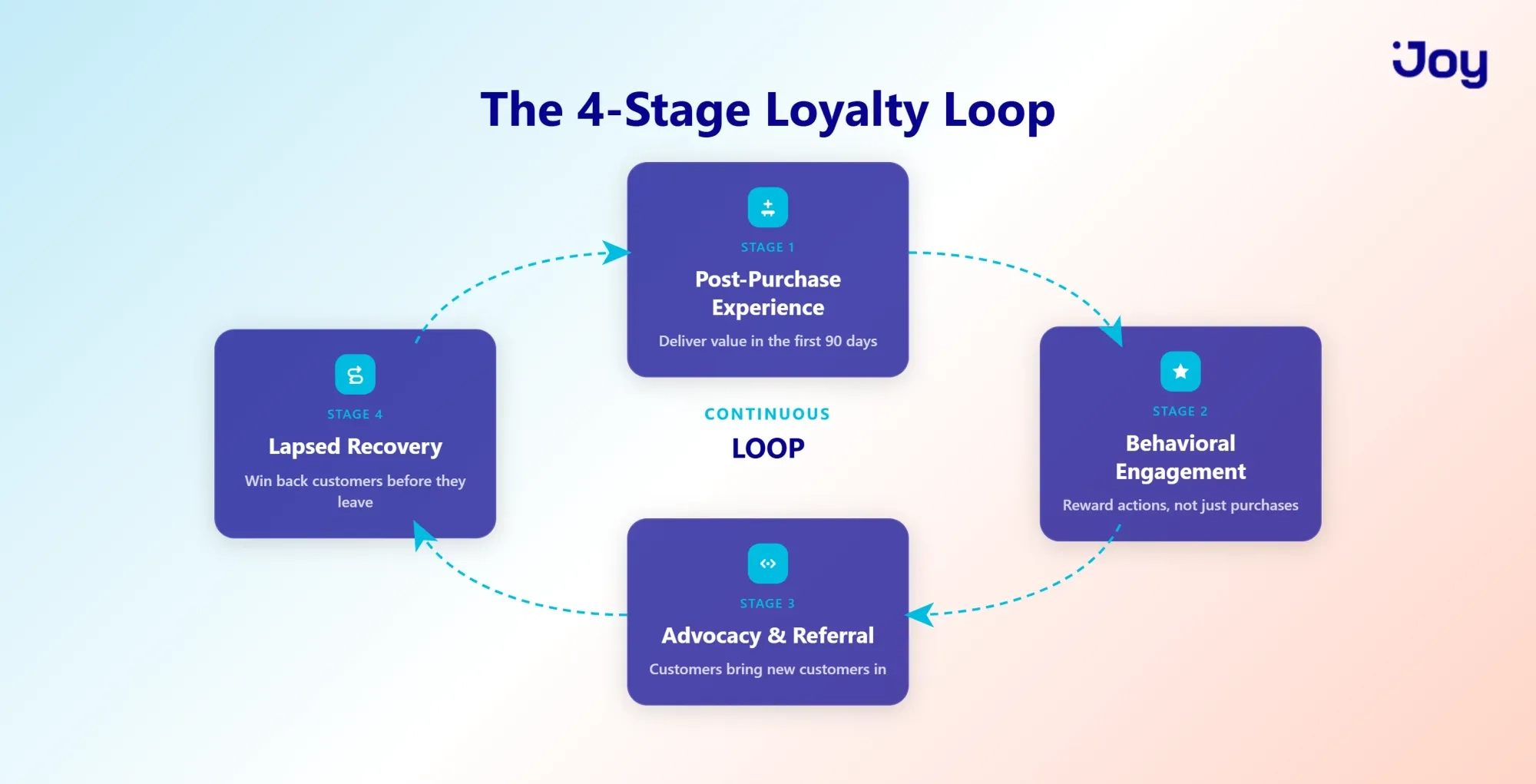
The customer loyalty loop is a circular model where the customer journey doesn't end at purchase. Instead, it continues through experience, engagement, advocacy, and back into repeat purchase, forming a self-reinforcing cycle.
To understand why this matters, consider how customers actually behave. Yes, they go through consideration and evaluation before buying. That's the traditional funnel, and it still applies. But the loyalty loop starts where the funnel ends: post-purchase. This is where most merchants drop the ball entirely, and where the biggest retention gains live.
Linear Funnel vs. Circular Loop
The difference is structural, not cosmetic. A traditional funnel moves in one direction: Awareness leads to Consideration, which leads to Purchase, which leads to... exit. The customer leaves, and you start the acquisition process all over again.
The loyalty loop moves in a continuous circle. Purchase leads to Experience, which leads to Advocacy, which leads to Repeat Purchase, which feeds back into an even deeper Experience. There's no single exit point. Each positive interaction strengthens the next cycle.
Why does this work? Anchoring bias. The first post-purchase experience sets the tone for the entire relationship. When that experience is positive, it creates what researchers call a "loyalty spiral," where each good interaction compounds the customer's commitment to the brand.
And the economics reinforce the psychology. Since retention costs a fraction of acquisition (remember the 5x rule from Reichheld's research), every customer who stays in the loop represents compounding value rather than sunk cost.
Why the Loop Matters for Ecommerce Merchants
For ecommerce merchants specifically, the loyalty loop addresses the three core problems identified above. It replaces post-purchase silence with intentional engagement. It substitutes discount dependency with behavioral rewards. And it transforms one-time buyers into advocates who bring new customers into the loop organically.
The concept builds on existing types of customer loyalty, but structures them into a continuous system rather than treating them as isolated tactics.
The 4 Stages of the Customer Loyalty Loop
The loyalty loop breaks down into four distinct stages, each serving a specific function in keeping customers cycling back. The critical point: the loyalty loop only works when all four stages connect. When brands fail at retention, it's almost always because one or more of these stages is missing. As you read through them, ask yourself which stage represents the weakest link in your current program.
Stage 1: Post-Purchase Experience (The First 90 Days)
The first 90 days after purchase determine whether a customer becomes a repeat buyer or a one-time transaction. This is where the loyalty loop begins, and where most programs fail.
The principle is straightforward: deliver unexpected value after the sale, not just before it. A personalized welcome message. Surprise bonus points on their first order. An instant discount code for their next purchase. Small moves that signal the relationship didn't end at checkout.
Data from Extend's merchant network of over 500 partners shows that customers with a positive post-purchase experience have a 4.5% higher repeat purchase rate. And according to Accenture, 94% of customers consider speed of problem resolution critical to their loyalty, with positive support experiences creating customers who are twice as loyal as those who never had an issue.
Sephora demonstrates this well with its Beauty Insider program. Within days of a customer's first purchase, they receive a personalized welcome with a birthday gift offer, creating immediate value beyond the initial transaction. The program doesn't wait for the customer to come back. It gives them a reason to.
Stage 2: Behavioral Engagement (The Active Loop)
Once the post-purchase experience sets the foundation, the next stage keeps customers engaged between purchases. This is where the loyalty loop shifts from rewarding transactions to rewarding actions.
Traditional programs operate on a simple formula: spend $100, earn 100 points. Behavioral engagement goes further. It rewards referrals, product reviews, social shares, milestone purchases, and even engagement streaks. The shift is from "buy more to earn more" to "participate more to earn more."
Personalization becomes essential at this stage. Different customers need different engagement paths. A VIP who buys monthly needs different triggers than a casual buyer who purchases quarterly. Segmenting customers by behavior (not just spend) makes sure each person receives the right incentive at the right time.
Gymshark offers a strong example. The brand rewards social sharing and workout check-ins alongside purchases, turning customers into community members who stay engaged between buys. The result: a community that interacts with the brand even when they're not shopping.
Stage 3: Advocacy and Referral (Closing the External Loop)
When customers feel genuinely valued by Stages 1 and 2, they naturally become advocates. This is where the loyalty loop extends beyond your existing customer base and begins generating new customers organically.
The numbers back this up. American Express's Global Customer Barometer (2017) found that happy customers refer approximately 11 people on average. Every satisfied customer in your loop is a potential acquisition channel, one that costs a fraction of paid advertising.
The key is making advocacy easy and rewarding. Incentivize referral programs where both the referrer and the new customer receive value. Encourage product reviews and user-generated content. Turn your best customers into brand ambassadors who actively bring new people into the loop.
LSKD, an activewear brand, demonstrates this effectively. Their referral program gives both the referrer and the referee store credit, creating a self-perpetuating acquisition channel that runs on customer enthusiasm rather than ad spend.
Stage 4: Lapsed Customer Recovery (Closing the Internal Loop)
Even the best loyalty loop breaks. Customers get distracted, priorities shift, purchase frequency drops. More than 50% of subscription and repeat-purchase customers churn at some point. The question isn't whether your loop will break. It's whether you have a system to repair it.
Lapsed customer recovery closes the internal loop by identifying churn signals early and triggering targeted win-back sequences before customers disappear entirely. Common signals include no purchase in 60 days, referral activity going quiet, or engagement dropping to zero.
But not all lapsed customers are equal. A VIP who's bought five times and suddenly goes silent deserves a different approach than an impulse buyer who made a single purchase. Segmenting lapsed customers by value makes sure your recovery efforts match the opportunity.
For example, a VIP customer who hasn't purchased in 45 days might receive a targeted email: "We noticed you've been away. Here's 20% off plus free shipping on your next order." That's cheaper than acquiring a new customer, and the existing trust means conversion rates are significantly higher than cold outreach.
From Cadence to Behavioral Triggers: Why Engagement Rules Are Outdated
Understanding the four stages is one thing. Knowing when to activate each stage is another. Traditional engagement thinking follows a calendar-based cadence: contact every customer every 90 days, regardless of their behavior. Modern loyalty loops replace that with behavioral triggers that fire based on what each customer actually does.
The Old Model: One-Size-Fits-All Cadence
Noah Fleming's Customer Loyalty Loop framework introduced the 90-45 Rule: a 15-minute touchpoint every 90 days for all customers, and every 45 days for the top 10%. While this was an improvement over no system at all, it has a fundamental problem for ecommerce: it ignores individual behavior.
A customer who bought yesterday doesn't need the same touchpoint as one who bought three months ago. A VIP spending $500 per order doesn't need the same message as a first-time buyer who spent $30. Calendar-based cadence treats every customer identically. And that's exactly why 54% of loyalty memberships end up inactive.
The New Model: Event-Driven Behavioral Triggers
Behavioral triggers replace the calendar with customer actions. Each trigger fires based on a specific event:
- Purchase completed: launches a post-purchase welcome sequence
- Churn signal detected (no purchase in 60 days): triggers a win-back offer
- Referral activity stalled: sends a re-engagement nudge with incentive
- Tier milestone reached: delivers a surprise bonus reward
The advantages are clear. Behavioral triggers are personalized, delivering the right message to the right customer at the right moment. They're timely, firing based on actual behavior rather than arbitrary dates. They're scalable, running automatically once configured. And they're measurable, making it possible to track exactly which triggers produce which results.
The Personalization Principle
At the core of this shift is a simple truth: each customer's loop runs at its own pace. A VIP who buys monthly needs different engagement than a casual buyer who shops quarterly. Behavioral triggers respect this natural rhythm instead of forcing everyone onto the same schedule.
That's why personalization isn't a bonus feature. It's the operating system of a functional loyalty loop. Without it, you're back to calendar-based guesswork, which is where most programs started and where most programs still fail.
Lapsed Customer Recovery: Your Biggest Retention Opportunity
Every loyalty loop breaks for some customers. That's not a failure. It's expected. What separates high-performing programs from mediocre ones is whether they have a systematic approach to recovering those customers.
The opportunity is enormous. With 54% of loyalty memberships inactive (COLLOQUY), most brands are sitting on a massive pool of lapsed customers who already know the product, already trust the brand, and are significantly cheaper to reactivate than new customers are to acquire.
Identifying Churn Signals
Recovery starts with detection. The most common churn signals for ecommerce include:
- No purchase in 30, 60, or 90 days (depending on your typical purchase cycle)
- Referral activity dropping to zero after being previously active
- Email engagement declining or stopping entirely
- Points balance sitting untouched for extended periods
The specific thresholds depend on your business. A brand with a 60-day average purchase cycle should flag customers at 90 days, not 180.
Segmenting Lapsed Customers by Value
Not every lapsed customer warrants the same recovery effort. Segment them into three tiers based on lifetime value:
VIP lapsed (five or more lifetime purchases, high average order value) deserve premium win-back treatment: exclusive discounts, personal outreach, or early access to new products. Standard lapsed (one to two purchases) receive a standard win-back: a basic discount with a reminder of what they're missing. Low-value lapsed (single impulse purchase, low engagement) get a light-touch approach, or you archive them to keep your active list clean.
Building a 3-Touch Win-Back Sequence
Effective recovery follows a graduated sequence that increases urgency with each touch:
Touch 1 is a soft email sent when the churn signal triggers. The tone is warm and the incentive is mild: "We haven't seen you in a while. Here's 10% off your next order."
Touch 2 follows 48 to 72 hours later via SMS or push notification. Add urgency: "Your 10% discount expires in five days."
Touch 3 is the final email, sent three to five days after Touch 2. Increase the incentive: "Last chance: 20% off or a free gift with your next purchase."
The ROI math works in your favor. Since retaining a lapsed customer costs roughly one-fifth of acquiring a new one (based on Reichheld's 5x cost differential), even modest recovery rates produce meaningful CLV gains.
Omnichannel Sync: Keeping the Loop Consistent Across Channels
A loyalty loop that works on email but breaks on SMS, or tracks tiers in-app but ignores them at the point of sale, isn't really a loop. It's a collection of disconnected touchpoints that confuse customers and waste the engagement you've already built.
The Problem: Channel Silos Break the Loop
Consider this scenario: a customer receives an email offering 20% off as a VIP reward, but when they open the app, their tier status isn't reflected. Or they click a referral link from SMS, but the attribution doesn't carry over to their next purchase. Each disconnection chips away at trust and creates friction that pushes customers out of the loop.
The principle behind omnichannel loyalty is that the customer should see one consistent experience regardless of where they interact with your brand.
The Solution: Unified Customer View
Keeping the loop consistent requires a unified data layer where every channel reads from and writes to the same customer profile. In practice, this means:
- One loyalty tier that displays consistently across email, SMS, in-app notifications, and POS
- One referral link that tracks attribution regardless of which channel the customer shares it through
- Consistent messaging everywhere: "You're two purchases away from VIP" should appear the same in email, SMS, and your loyalty widget
How Each Channel Feeds the Loop
Each channel plays a specific role in keeping the loop moving:
Email drives awareness and education, nurturing customers through post-purchase sequences and tier progression updates. SMS drives urgency for time-sensitive offers, win-back sequences, and flash campaigns. In-app notifications drive real-time engagement, showing tier progress, instant reward availability, and points balance updates. Referral links drive advocacy by making it easy for customers to share across any platform.
All four channels feed the same loop. When they work in sync, each interaction reinforces the last and primes the next. When they operate in silos, you're fighting against your own system.
Building Your Loyalty Loop: What to Look For
Understanding the customer loyalty loop as a concept is valuable. Building it requires a platform that supports the right capabilities. Not every loyalty tool is designed for loop-based retention. Many are built for simple points-for-purchases programs and stop there.
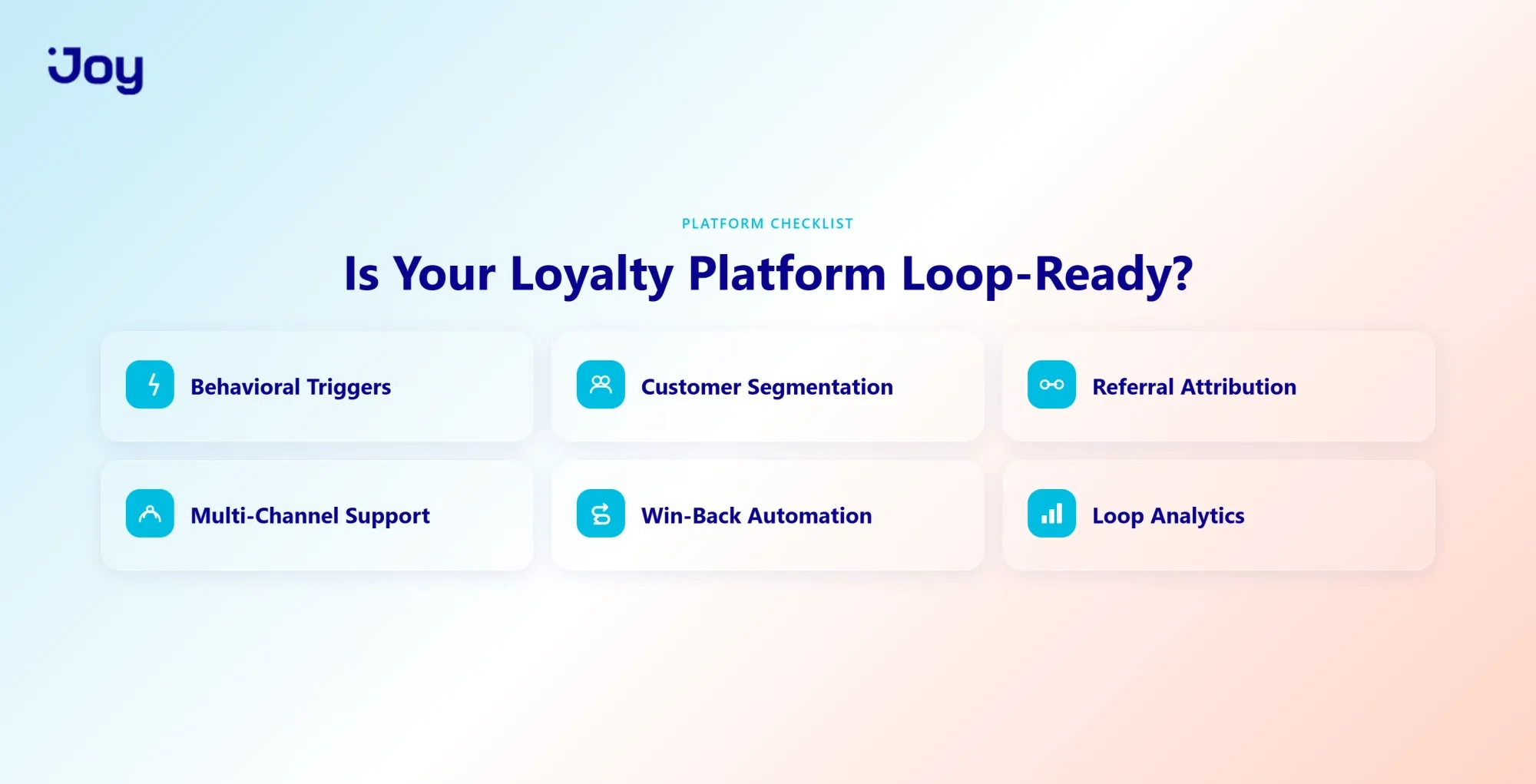
Checklist for a Loop-Ready Loyalty Platform
When evaluating platforms, look for these six capabilities:
- Behavioral trigger engine that fires rules based on customer actions, not just transactions
- Customer segmentation that distinguishes VIP, at-risk, and lapsed customers with different treatment for each
- Referral tracking with attribution so you know exactly which orders came from referrals
- Multi-channel support that delivers email, SMS, and in-app experiences from one data source
- Win-back automation that detects churn signals and triggers recovery flows automatically
- Analytics dashboard that tracks repeat rate, churn rate, and referral revenue in one place
If your current platform doesn't support at least four of these six, it's built for a funnel, not a loop.
Joy Loyalty is built for exactly this: behavioral rules, referral attribution tracking, omnichannel support, and segment-based reward rules. It's designed for ecommerce merchants who want a loyalty loop, not just a points program. You can explore Joy Loyalty to see how it maps to this checklist.
Measuring Loop Health and Putting It All Together
A loyalty loop without measurement is just a theory. To know whether your loop is functioning, improving, or breaking down at a specific stage, you need to track the right metrics consistently.
Five Metrics That Reveal Loop Health
Repeat Purchase Rate measures the percentage of customers who buy two or more times. This is the most direct indicator of loop strength. Higher repeat rates mean more customers are cycling through the loop rather than exiting after one purchase.
Churn Rate tracks the percentage of customers inactive for 60 or more days. A healthy loop shows declining churn over time as behavioral triggers and win-back sequences do their work.
Referral-Sourced Revenue measures the revenue generated through referral links. This number reveals how well Stage 3 (advocacy) is performing and whether your loop is generating organic acquisition.
Tier Progression Rate shows the percentage of customers advancing to higher loyalty tiers. Strong tier progression indicates that behavioral engagement (Stage 2) is working and customers are deepening their commitment.
Lapsed Recovery Rate tracks the percentage of win-back sequences that result in a re-purchase. This metric tells you whether Stage 4 is effectively closing the internal loop.
Benchmarks to Aim For
Data from Extend's merchant network shows that engaged loyalty program members achieve a 4.5% higher repeat purchase rate than non-members. With 54% of traditional memberships inactive, that gap represents your baseline to beat. And with happy customers referring approximately 11 people on average (American Express, 2017), a functional advocacy stage can meaningfully reduce your reliance on paid acquisition.
The Loyalty Loop in Summary
The customer loyalty loop replaces the linear funnel with a continuous, self-reinforcing system built on four stages: post-purchase experience, behavioral engagement, advocacy and referral, and lapsed customer recovery.
Traditional programs fail because they stop at purchase. The loyalty loop succeeds because it never stops. Each positive experience feeds the next cycle, each behavioral trigger keeps the momentum going, and each recovered customer strengthens the loop for another rotation.
Start by diagnosing which stage is weakest in your current program. Post-purchase silence? Missing behavioral triggers? No referral system? Lapsed customers slipping away without a recovery sequence?
Fix the weakest stage first. Then build outward. That's how you stop running a loyalty program and start running a loyalty loop.
If you want a platform designed for this, explore Joy Loyalty. It's built for ecommerce merchants who want retention, not just rewards.
FAQ
What is a customer loyalty loop?
It's a circular framework where each positive post-purchase experience feeds back into repeat purchases, referrals, and deeper engagement. Unlike a traditional funnel that ends at conversion, the loop continues indefinitely: purchase leads to experience, which leads to advocacy, which leads to repeat purchase, and the cycle begins again.
What is the difference between a loyalty loop and a sales funnel?
A sales funnel is linear. It moves from awareness to consideration to purchase, and then the customer exits. A loyalty loop continues after purchase: experience leads to engagement, which leads to advocacy, which leads to repeat purchase, which loops back to experience. The funnel acquires customers. The loop retains them.
What are the 4 stages of the loyalty loop?
Post-purchase experience (delivering value in the first 90 days), behavioral engagement (rewarding actions beyond transactions), advocacy and referral (turning customers into brand ambassadors), and lapsed customer recovery (identifying churn signals and running win-back sequences to bring customers back). All four must connect for the loop to function.
Why do most loyalty programs fail?
54% of loyalty memberships are inactive, according to COLLOQUY's Loyalty Census. The most common reasons: sign-up-and-forget programs with no post-purchase engagement, discount dependency that erodes margins, the communication cliff where merchants go silent after purchase, and treating the customer journey as a one-time funnel instead of a continuous loop.
How do you measure if your loyalty loop is working?
Five metrics: repeat purchase rate (percentage of customers who buy two or more times), churn rate (percentage inactive for 60 or more days), referral-sourced revenue (revenue from referral links), tier progression rate (percentage advancing to higher tiers), and lapsed recovery rate (percentage of win-back sequences that result in re-purchase). A healthy loop shows improving repeat rates and declining churn over time.

Written by
Thomas Nguyen is the CEO & Co-founder of Joy, a loyalty solution for Shopify and eCommerce brands. With years of experience building high-performance Shopify apps, Thomas aims to help merchants grow through customizable and retention-focused tools.
Related reading
 Loyalty Strategy
How to set up customer retention automation (without a big team)
A step-by-step guide to automating customer retention across the customer lifecycle, from onboarding to win-back.
 Thomas Nguyen
 Loyalty Strategy
Loyalty Customer Service: How Service Quality Drives Revenue
80% of customers say experience matters as much as products (Salesforce). Loyalty customer service isn't a cost center — it's a revenue lever. This guide covers Harvard's Service-Profit Chain, the service-to-revenue mechanism, and a 5-step recovery system any ecommerce brand can run.
Thomas Nguyen Loyalty Strategy
Low Customer Loyalty: Why Customers Don't Return (and How to Fix It)
Customers rarely leave at random. Repeat purchases usually stall for one of seven reasons — price sensitivity, slipping quality, poor service, message fatigue, disconnected channels, no personalization, or misaligned values. This guide diagnoses each one and names the metric that gives it away.
Thomas Nguyen Loyalty Strategy
Customer retention benchmarks for ecommerce: What's a good rate?
A clear-eyed look at ecommerce retention benchmarks: the one number worth trusting, why most by-industry tables mislead, and how to benchmark against yourself.
Thomas Nguyen Loyalty Strategy
Customer Retention Goals: 5 Targets to Set (and How to Hit Them)
A goal-first guide to customer retention: the five targets worth setting, how to make each one SMART, and the strategy that hits it.
Thomas Nguyen Loyalty Strategy
6 Key Factors That Affect Customer Loyalty
Loyalty isn't luck or a good Black Friday sale — it's built on six specific, measurable factors. This guide breaks down each one: why it matters, how to measure it, and how to put it into action, with examples from brands that got it right.
Thomas Nguyen