Customer Loyalty Platforms: How to Choose the Right One
Customer loyalty platforms generate 15% to 25% revenue lift for top performers — and the wrong one quietly drains budget for months. Most brands pick based on feature lists and demo calls. This guide gives you 8 evaluation criteria and a scoring framework to choose objectively.

Summarize this post with AI
Customer loyalty platforms generate 15 to 25% revenue lift for top performers. The wrong one sits idle for months before you rip it out.
That gap between winning and wasting isn't about loyalty itself. Bain & Company found that returning customers spend 67% more than first-time buyers. The value is proven. What separates high-ROI programs from expensive failures is the platform powering them.
Most brands still choose based on feature lists, pricing pages, or a single demo call. And that's why so many programs underperform.
This guide gives you the eight criteria that separate high-ROI customer loyalty platforms from low performers, plus a scoring framework to evaluate any platform objectively. No guesswork. No marketing fluff.
Why Platform Choice Matters (And Why Most Brands Choose Wrong)
Most Loyalty Platforms Fail the Same Way
The numbers tell the story: 67% of brands now operate loyalty programs. Yet only about 20% report measurable ROI above twice the program cost. Massive disconnect between adoption and actual results.
Not all customer loyalty software is built for the same brand. Some platforms optimize for enterprise with complex rule engines. Others serve entry-level stores with basic point systems. When you pick one designed for a different growth stage, the misalignment shows up fast.
And the cost goes beyond subscription fees. A poorly matched platform means six to twelve months of wasted implementation time, frustrated staff wrestling with limitations, and customer churn that re-accelerates once the initial excitement fades. Brands that match platform to need? They typically see ROI emerge within 90 days.
Platform Choice = Strategic Bet on Your Retention Flywheel
So why does this matter beyond avoiding a bad purchase?
Your loyalty platform isn't just a tool. It's the infrastructure behind your entire retention strategy. Customer data, reward mechanics, and offer engines all funnel into a single system. When that system works, everything compounds. When it doesn't, every team feels the friction.
Roughly 75% of a loyalty platform's value comes from integration with your existing stack (CRM, email marketing, POS, and third-party apps). A platform that connects deeply lets you personalize, automate, and iterate. Shallow integrations? Manual workarounds and siloed data. That's the tradeoff.
Speed matters just as much. Ecommerce brands using platforms with frictionless onboarding go live in four to eight weeks. Rigid platforms with custom configurations stretch that to three to six months. Every extra week before launch is a week without ROI.
Before evaluating any platform's feature list, reframe the decision. You're not picking a tool. You're choosing the backbone of your retention flywheel. Get that choice right for your growth stage and integration needs, and the compound effect starts immediately.
The 8 Evaluation Criteria (What Separates Winners from Waste)
Not all customer loyalty tools score equally on the factors that drive ROI. These eight criteria, drawn from SERP consensus across 50+ sources and primary research, form your evaluation arsenal. Master them, and you'll separate platforms that deliver from those that drain budget.
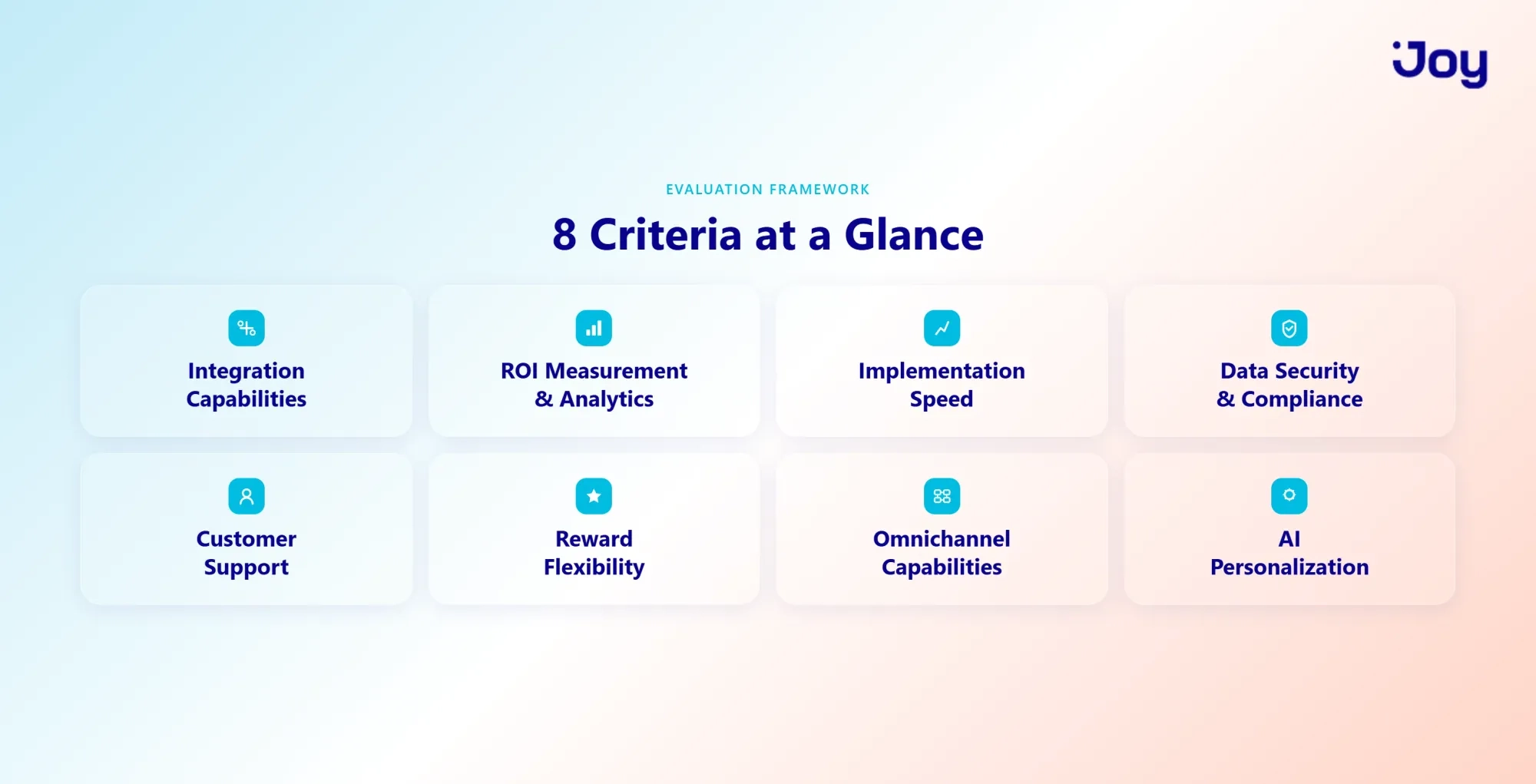
1. Integration Capabilities (APIs, Shopify, POS, CRM)
Integration is where platform value starts. Poor integrations mean manual data entry, inconsistent customer views, and missed upsell signals. Strong integrations mean unified data flowing between your loyalty platform, CRM, email tools, and POS system.
What to evaluate: API depth, native Shopify compatibility, CRM sync capabilities, and email marketing hooks. Platforms with native Shopify integration cut implementation time by roughly 50% compared to custom API builds.
Red flags include "custom integration required," manual CSV exports, or no public API documentation. If integration feels like a project, the platform is already costing you time.
2. ROI Measurement and Analytics Dashboards
You can't manage what you can't measure. Most loyalty program owners report positive ROI, yet the majority struggle to prove it without proper dashboards. And if leadership can't see the numbers, budget renewal gets harder every quarter.
Evaluate platforms on pre-built ROI dashboards, revenue attribution, segment performance breakdowns, and real-time reporting. The best platforms show you loyalty analytics including customer LTV by segment, program-attributed revenue, referral performance, and redemption patterns.
Red flags: custom reports only, data delayed by 24+ hours, or no revenue attribution at all.
3. Implementation Speed and Ease
Fast deployment drives faster ROI. Platforms with no-code customization let you iterate without developer overhead. And onboarding quality directly correlates with six-month program success.
What to look for: days to first launch, no-code rule builders, responsive onboarding support, and pre-built templates. Platforms that go live in four to eight weeks outperform those requiring three to six month custom setups. The reason is simple: they start generating data and revenue sooner.
Red flags: "three-month implementation," "developer required for customization," or manual configuration for basic features.
4. Data Security and Compliance (GDPR, ISO, Audit Trails)
Security isn't a differentiator. It's a baseline. According to Genesys research, 31% of customers switch after one poor support or security experience. A data breach doesn't just cost money. It destroys trust permanently.
Evaluate: GDPR compliance, ISO certifications, SOC 2 Type II attestation, encryption standards, audit trails, and data residency options. Enterprise customers and regulated markets will reject platforms without these safeguards. No exceptions.
Red flags: "we're working on compliance," no certifications listed, or unclear data handling policies.
5. Customer Support Quality
Even the most intuitive platform hits friction during deployment. When it does, you need responsive support within hours, not days.
Support quality directly correlates with launch success. Evaluate on SLAs for response time and resolution, onboarding support depth, technical team responsiveness, and available community resources.
That same Genesys study showing 31% customer switching applies here too. If the platform's own support experience is poor, what does that signal about the experience they'll power for your customers?
Red flags: support only via email, no SLAs published, or slow response times exceeding 48 hours.
6. Reward Flexibility and Customization
Support and security protect your foundation. Now for the criteria that determine your program's ceiling. One-size-fits-all reward programs create mercenary customers who chase the next discount. Flexible reward programs create emotional connections that deepen over time.
What to evaluate: points earning and redemption rules, tiered program structures, referral mechanics, bonus levers, and experiential rewards. Also look for gamification capabilities like badges, challenges, spin-to-win mechanics, and leaderboards. Platforms with built-in gamification see two to three times higher engagement compared to static point systems.
Red flags: fixed points formulas, limited tier options, no custom reward types, or no gamification support.
The real question: can you evolve from transactional to emotional loyalty as your program matures? If the platform locks you into a rigid model today, you'll outgrow it within a year.
7. Omnichannel Capabilities (Web, App, POS, In Store)
Customers expect to earn online and spend in store, or vice versa. Fragmented channels create friction. Unified earning and redemption across all touchpoints drives two to three times higher engagement than web-only programs.
A strong customer loyalty app isn't optional anymore. With 80% of loyalty adoption now mobile first, POS integration unlocking in-store programs, and notification timing driving re-engagement, omnichannel isn't a premium feature. It's table stakes.
Red flags: "web only," "app planned for later," or "POS integration requires custom work."
8. AI Driven Personalization and Smart Segmentation
Omnichannel gets customers interacting across touchpoints. But how relevant do those interactions feel? According to McKinsey, 71% of consumers expect personalized interactions. Generic broadcast offers fail. AI-driven rule engines let you segment and target without hiring data scientists, and smart segmentation delivers three to five times lift in offer redemption compared to blanket promotions.
Evaluate: rule engine flexibility (conditions, actions, automation), segment-based offers, behavioral triggers, and predictive scoring. The best platforms adapt in real time based on customer behavior rather than relying on static segments you update manually.
Red flags: manual segment creation only, no automation capabilities, or limited rule flexibility.
The Evaluation Framework (How to Score Any Platform)
Now that you know what to evaluate, you need a system for scoring. Intuition and feature comparison charts won't cut it. This weighted framework turns platform evaluation from guesswork into a data-driven decision.
Rate each platform on all eight criteria using a 0 to 10 scale, then weight each criterion based on your specific priorities:
| Criterion | Suggested Weight | Scoring (0 to 10) | ROI Impact |
|---|---|---|---|
| Integration Capabilities | 25% | [Your score] | Slow integration = slow ROI |
| ROI Measurement and Analytics | 20% | [Your score] | Can't measure = can't improve |
| Implementation Speed | 20% | [Your score] | Months wasted = costs compounded |
| Data Security and Compliance | 15% | [Your score] | Non-negotiable baseline |
| Customer Support Quality | 10% | [Your score] | Determines launch success |
| Reward Flexibility | 5% | [Your score] | Enables program evolution |
| Omnichannel Capabilities | 5% | [Your score] | Expected by customers |
| AI Driven Personalization | Varies | [Your score] | 3 to 5x offer lift |
How to use it: Adjust weights based on your situation. Ambitious ecommerce brands in the $50K to $500K monthly revenue range typically prioritize Integration and Implementation Speed. Enterprise brands weigh Security and Analytics more heavily.
Score each platform after demos, trial periods, and reference calls. Total your weighted scores. An 80+ signals a strong fit. A 60 to 79 is workable but requires compromise. Below 60 means significant risk.
This framework won't tell you which platform is "best." It gives you command over the decision by revealing which platform is best for your brand, right now.
Implementation Checklist (From Selection to Launch)
With your scoring complete, the path from evaluation to live program follows four clear phases. Each one builds on the previous, and skipping steps is how brands end up re-platforming within a year.
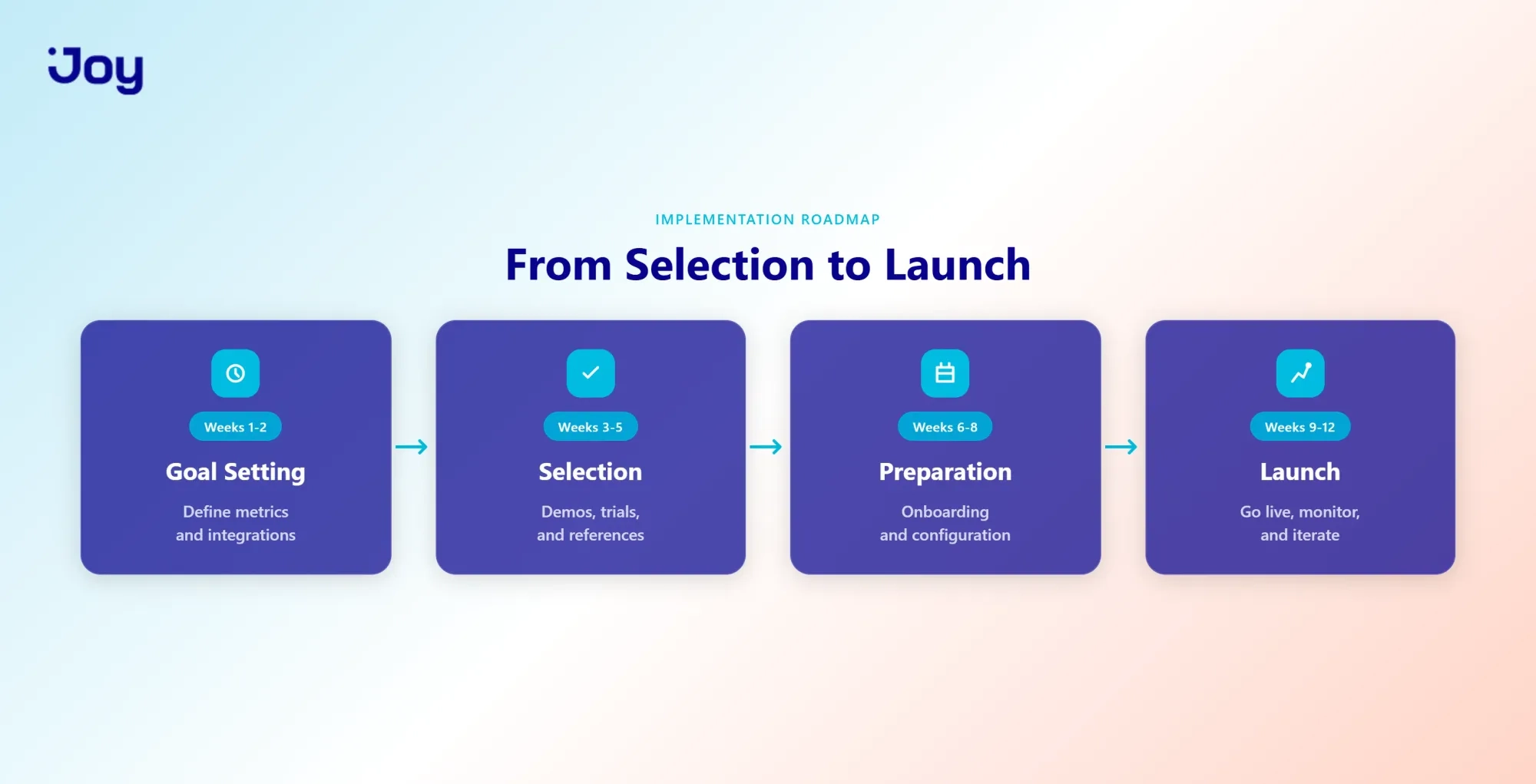
Phase 1: Pre-Selection (Weeks 1 to 2) — Clarify Your Goals
Before scheduling a single demo, quantify where you stand today. Document your current churn rate, repeat purchase rate, AOV, and customer acquisition cost. Then set a clear 12-month goal: "Reduce churn by 10%," "Increase repeat purchase rate by 25%," or "Drive 5% revenue lift through loyalty."
Next, map your integration needs. Which CRM, email platform, POS system, and third-party apps must connect? The output of this phase is a one-page goals document and an integration requirements map.
Phase 2: Selection (Weeks 3 to 5) — Demos, Trials, References
Run formal demos with your scoring framework in hand. Not casual calls. Structured evaluations. Request demos from your top three candidates based on pre-screening scores, then use the evaluation table from the previous section to score each one live.
After demos, request a two to four week trial with real customer data. Then talk to two or three customer references in your industry and revenue tier. Ask about implementation speed, support quality, and how long it took to see measurable ROI.
Phase 3: Launch Preparation (Weeks 6 to 8) — Planning and Kickoff
Good platforms have structured onboarding programs. Use them. Kick off with a timeline call covering dependencies, team roles, and milestones. Map your customer data to the platform's fields. Configure initial rules, rewards, and tiers. Start simple.
Plan your launch date and customer communication. The output is an implementation calendar and clear team responsibilities.
Phase 4: Launch and Optimization (Weeks 9 to 12) — Go Live, Monitor, Iterate
Don't wait for perfection. Soft launch to 10 to 20% of your customer base first. Monitor daily: enrollment rate, offer acceptance, redemption rate, and repeat purchase lift.
Iterate based on what the data shows. Fix friction points, adjust offer mix, and personalize based on actual behavior. Once soft launch metrics are solid, roll out to your full customer base.
Brands that outperform their competitors don't launch and forget. They launch, measure, and iterate until the data confirms ROI.
Joy: The Platform for Ambitious Brands
Throughout this guide, the evaluation criteria pointed to a specific profile: platforms that combine deep Shopify integration, flexible reward mechanics, real-time analytics, and responsive support. For ambitious Shopify brands running $50K to $500K monthly revenue, that profile matches Joy Loyalty.
Joy scores against the eight criteria:
- Integration (Criterion 1): Shopify-native integration. Four-week launches versus twelve-week custom builds. Over 30 pre-built integrations with major CRM, email, and POS systems.
- Analytics (Criterion 2): Real-time ROI dashboards tracking Assisted Orders, repeat purchase lift, and customer LTV impact. No waiting 24 hours for yesterday's data.
- Implementation Speed (Criterion 3): No-code rule builder. Pre-built templates. Responsive onboarding. Most stores go live within weeks, not months.
- Security (Criterion 4): Enterprise-grade security with GDPR compliance and audit trails.
- Support (Criterion 5): Success-focused onboarding with technical responsiveness that doesn't disappear after launch.
- Reward Flexibility (Criterion 6): Unrestricted rule engine. Build any reward model, including points, tiers, referrals, and experiential rewards, without writing code.
- Personalization (Criterion 8): Segment-based reward rules and flexible automation. Target the right offer to the right customer at the right time.
With 10,000+ stores and 200+ advanced and enterprise customers, Joy is built for brands that see loyalty as their Assisted Orders engine, not a cost center. For brands under $20K monthly revenue or those needing only a basic points program, a simpler platform may be a better starting point.
Mistakes to Avoid (Platform Choice Pitfalls)
Even with a solid evaluation framework, four common mistakes still derail platform selection. Each one wastes six to twelve months and tens of thousands of dollars.
1. Choosing by price alone. Most mid-market platforms range from $50 to $200 per month. Enterprise platforms run $500 plus. But subscription cost is the smallest line item. Factor in implementation time, integration effort, and ongoing support overhead. A $50/month platform with a three-month setup often costs more in total than a $150/month platform that goes live in two weeks and delivers ROI within 90 days.
2. Picking an enterprise platform for growing brand needs. Over-engineered platforms with six-month implementations and bloated feature sets create friction for brands that need speed and flexibility. Match platform complexity to your current maturity level.
3. Settling for "good enough" integration. Poor integration means manual work, data silos, and missed personalization signals. Integration quality determines whether your loyalty data actually flows into actionable insights or sits in a silo nobody checks.
4. Ignoring support quality during selection. Platforms that skimp on support look fine during the sales process. The problems surface during launch, exactly when you need hands-on guidance the most.
The fix: evaluate all eight criteria, not just price or feature count. Match the platform to your maturity level. Demand strong integrations upfront. And always talk to customer references about their support experience.
Next Steps: From Evaluation to Launch
You now have the framework to evaluate customer loyalty platforms like an insider: eight criteria, a weighted scoring method, an implementation checklist, and the pitfalls to avoid.
From here, three paths forward:
- Start evaluation immediately. Use the framework from Section 4 and the checklist from Section 5 to create a loyalty program assessment for the platforms you're considering. Score objectively. Let the data decide.
- Go deeper on loyalty fundamentals. Want to validate which reward model fits your brand before selecting a platform? Explore what a loyalty program delivers at each stage of customer maturity.
- Talk to a Joy specialist. Get expert input on your specific integrations, ROI goals, and program design. The team that built this evaluation framework can walk you through how Joy scores on every criterion for your exact use case. Book a demo or explore Joy on Shopify.
Platform choice decides your ROI. Use this framework, score with confidence, and make the call that drives results within 90 days.
Frequently Asked Questions
What features should a customer loyalty platform have?
Core features include a points program, referral program, VIP tiers, analytics dashboards, and integrations with CRM, email, and POS. Advanced platforms add AI personalization, gamification mechanics, and omnichannel support. Prioritize based on your business stage. Start with points and referrals, then scale to tiers and AI-driven segmentation as your program matures.
How much does a loyalty platform cost?
$0 to $500+ per month, depending on tier. Most mid-market platforms fall between $50 and $200 per month. But subscription cost alone doesn't tell the full story. Factor in implementation time, integration effort, and ongoing support. Cheap platforms with slow setups often cost more long term through poor ROI.
What's the difference between customer loyalty software and CRM?
CRM manages customer relationships and data broadly. Customer loyalty software specializes in reward mechanics (points, tiers, referrals) plus program-specific analytics including redemption rates and program ROI. The best results come from integrating both. Loyalty data feeds CRM segments while CRM triggers personalized loyalty offers.
How long does it take to implement a loyalty platform?
Two to four weeks for Shopify-native platforms. Three to six months for custom enterprise solutions. Key factors: integration complexity, data migration scope, and team readiness. The fastest path is choosing a platform with pre-built integrations for your existing stack.
Can a loyalty platform integrate with Shopify POS?
Yes, but not all platforms support it equally. Look for native Shopify POS integration that enables both earning and redemption in store, not just online. The key is unified customer profiles across online and in-store purchases so loyalty data stays consistent everywhere.
How do you measure loyalty platform ROI?
Track repeat purchase rate lift, AOV increase, program-attributed revenue, customer LTV change, and churn reduction. Good platforms provide these dashboards out of the box. Top performers deliver 15 to 25% revenue lift within 90 days of launch.
Should growing brands use a loyalty platform?
Yes, if customer retention matters to your revenue model. Start with a free or low-cost platform offering simple points and referrals. Scale features as you grow. The key decision: choose a platform that scales without forcing a painful migration down the road.
What are the biggest mistakes when choosing a loyalty platform?
Choosing by price alone, picking enterprise tools for growing brand needs, ignoring integration quality, and skipping customer reference checks. Use a weighted evaluation framework like the one in this guide to avoid these traps and make a confident, data-driven decision.

Written by
Thomas Nguyen is the CEO & Co-founder of Joy, a loyalty solution for Shopify and eCommerce brands. With years of experience building high-performance Shopify apps, Thomas aims to help merchants grow through customizable and retention-focused tools.
Related reading
 Loyalty Strategy
The Loyalty Program Business Model: How to Structure Your Store Around Keeping Customers
Most stores bolt on a rewards program and hope for the best. A loyalty program business model builds growth around keeping customers. Here's how to do it.
 Thomas Nguyen
 Loyalty Strategy
How to Retain Customer Loyalty: 7 Proven Strategies
Acquiring a customer costs 5 to 25x more than keeping one — yet most brands keep pouring budget into acquisition. Here are seven proven strategies to retain customer loyalty, each with action steps and real metrics, plus a Day 0 to 60 playbook you can run immediately.
Thomas Nguyen Loyalty Strategy
Omnichannel Loyalty Programs: Best Programs by Industry (2026)
Your loyalty program might work on your website. But does it work in-store? On mobile? Across every channel your customers use?
Thomas Nguyen Loyalty Strategy
Channel Loyalty Platform: The Complete Guide to Building Partner Programs That Drive Revenue
Most B2B brands lose channel partners not to better products — but to better incentives. A channel loyalty platform is the system that makes your brand the easy choice for distributors, dealers, and resellers. Inside: 5 incentive models, implementation, and ROI.
Thomas Nguyen Loyalty Strategy
Value-Based Loyalty Programs: 9 Strategies That Turn Shoppers Into Brand Advocates
Here are nine strategies to build one that drives real retention.
Thomas Nguyen Loyalty Strategy
Building Customer Loyalty: The Framework That Actually Works
Stable revenue can mask something uncomfortable: customers returning out of habit, not preference. When they find a better option, they leave without warning — and you pay full CAC to replace them. Here's how to build the loyalty they actually feel, not the one you assume.
Thomas Nguyen