SaaS Referral Programs: How to Build One That Actually Converts
Most SaaS referral programs spike at launch, then fade. The fix isn't a better announcement. It's treating referral as an operation, not a campaign. Here's how to build one that keeps producing.

Summarize this post with AI
Here's how most SaaS referral programs go. A team ships the feature, writes a launch post, blasts the whole user list, and watches signups spike for a week. Then the line flattens. Three months later, someone asks how the referral program is doing, and nobody really knows.
The program didn't fail because the idea was wrong. It failed because it was launched like a campaign instead of being built like an operation, something that lives inside the product and runs every day, not a one-time announcement.
This guide walks through what a SaaS referral program is, why its mechanics differ from a typical "refer a friend" offer, how B2B and consumer SaaS pull these programs in opposite directions, and the seven steps to build one that keeps producing.
Key takeaways
- A SaaS referral program turns existing users into a pay-for-performance acquisition channel. You only reward when a referral actually converts.
- B2B and consumer SaaS need different designs. B2B rewards a long sales cycle with multi-step payouts and CRM tracking; consumer SaaS wins on one-click, in-app sharing.
- The strongest SaaS rewards are usually product value (account credits, a free month, a trial extension), not cash.
- Most programs stall because they're launched once. A referral program needs to live in the product and run continuously.
- Track referral rate, invite acceptance, and activation of referred users, not just raw signups, to know whether the loop compounds.
What Is a SaaS Referral Program?
A SaaS referral program is a system that gives each customer a unique link or code, tracks who signs up through it, and rewards both the customer and the referrer when that referral becomes a user or a paying customer. Your happiest users become a quiet acquisition channel, and you only pay when the introduction turns into something real.
What makes it a SaaS program, rather than a generic refer-a-friend offer, comes down to three things:
- Reward: product value, not a discount. Account credits, a longer trial, and a free month.
- Placement: inside the product, when someone is getting value.
- Payoff: In B2B, it can lag by weeks or months while the referral is evaluated.
It's also worth separating three terms people use interchangeably.
- Referral: rewards your existing customers for introducing peers.
- Affiliate: rewards outside marketers, usually with cash commission.
- Partner: rewards agencies or consultants who bring in clients.
More on each of these below. They're not the same program, and trying to run them as one is a common mistake.
Why Referral Works for SaaS (the Mechanics, Not the Myth)
Referral fits SaaS for reasons you can reason through from first principles, without needing a viral case study to sell you on it.
- It's pay-for-performance. You spend nothing until a referral converts, which makes it structurally lower risk than paid acquisition, where you pay for clicks whether or not they convert into customers.
- Referred prospects arrive warm. Someone they trust already vouched for you, so they show up further along in their evaluation than a cold lead from an ad.
- It fits how software grows. In a product-led model, the product is the thing people share, so a referral program adds a reward to a habit your best users may already have.
Now the honest part. You've probably seen the same handful of statistics repeated across every article on this topic: a certain file-storage company growing thousands of percent, referred users being some exact percentage more likely to stick around.
Those numbers are real in the sense that someone published them at some point, but most of them date back well over a decade and describe a specific product at a specific moment. Treat them as illustrations of why the mechanism works, not as benchmarks you'll reproduce. Your own baseline is the only number that matters, and you won't have it until you launch.
B2B vs Consumer SaaS: Different Mechanics
This is where a lot of generic advice falls apart, because B2B and consumer SaaS pull a referral program in different directions.
Consumer SaaS runs on volume. Deals are small, decisions are fast, and the same person decides and signs up in one sitting. That rewards simplicity: one-click sharing inside the app, an instant two-sided reward, and mechanics simple enough to build in-house. The job is to remove every step between "I like this" and "here's your link."
B2B SaaS is the opposite shape. Deals are larger, cycles are longer, and several people weigh in before anything closes. A single reward paid on signup doesn't fit, because a signup isn't the win. A closed account is, and that might be months away. This is also where you'll find partner and reseller tracks, and where CRM-based tracking becomes mandatory. (If you sell to other businesses, our guide to building a B2B referral program goes deeper on that motion.)
Here's the split at a glance:
| Deal size / cycle | Low value, short | High value, long |
|---|---|---|
| Reward timing | Instant, two-sided | Multi-step (lead, then closed) |
| Tracking | In-app link | CRM and attribution |
| Reward type | Credits, a free month | Cash, gift cards, account perks |
| Who runs it | Often in-house | Often partner or affiliate-led |
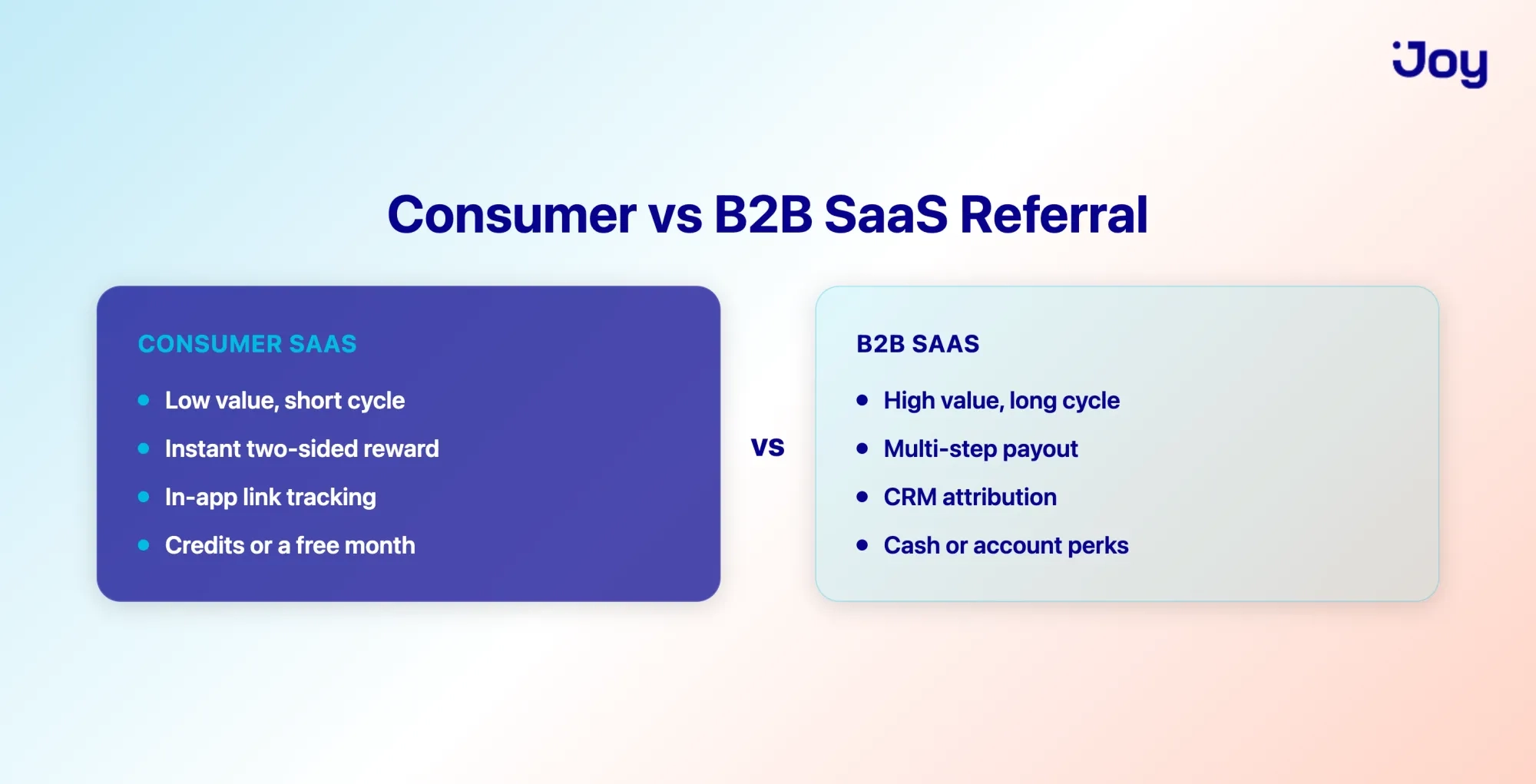
The practical takeaway: pick the model that matches your motion. A few companies run both a consumer-style and a partner-style program in parallel, but most do better choosing one and doing it well.
The Types of SaaS Referral Programs
Those two motions show up as four concrete program shapes, and almost everything you'll see is one of them. They're not mutually exclusive, but each suits a different kind of company.
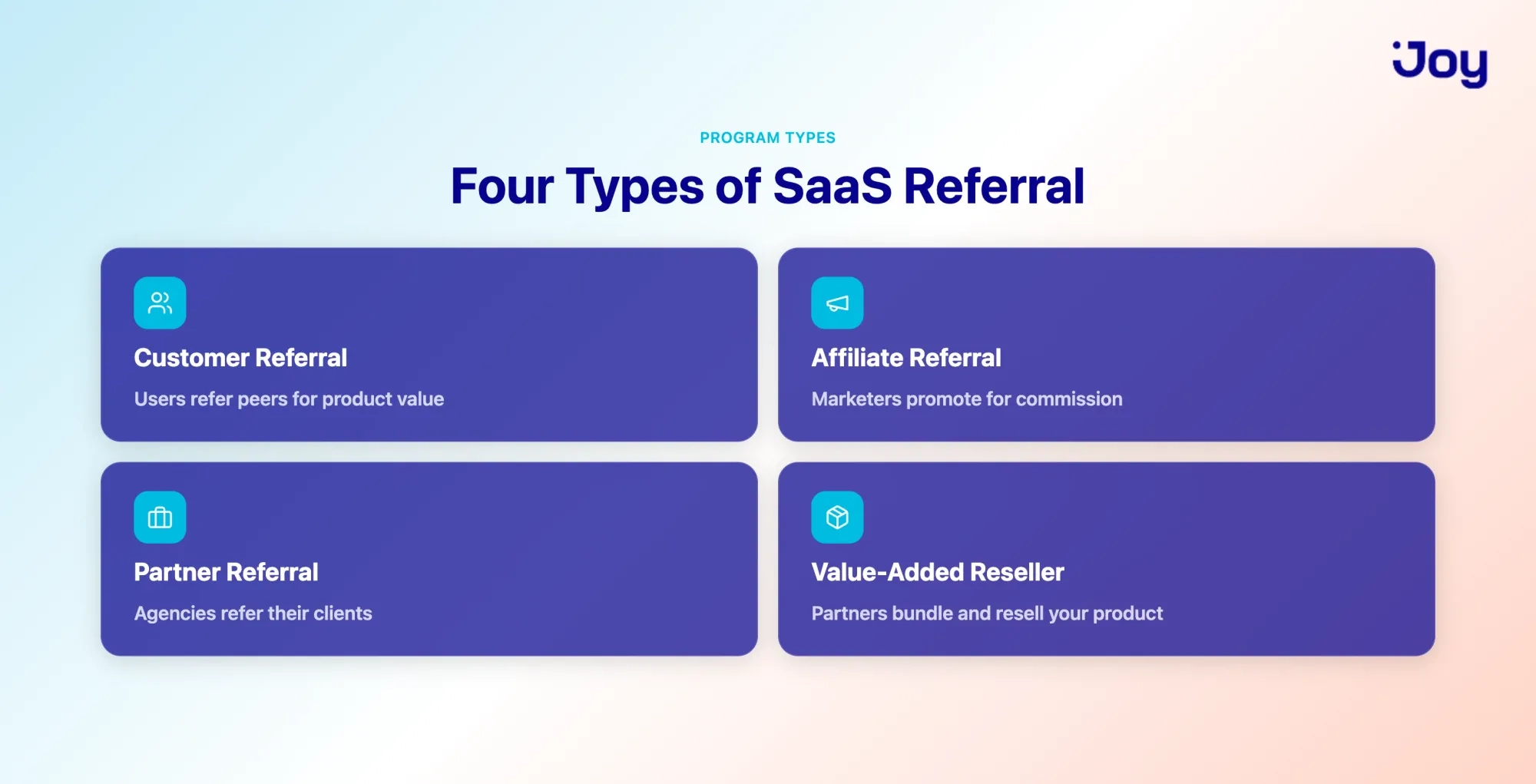
Customer (or user) referral. Existing users refer peers, and the reward is product value. This is the default for product-led companies, because the people who love the product are already inside it.
Affiliate referral. Content creators, bloggers, and marketers promote you for a commission. It's transactional and scales with volume, making it a good fit for publishers with steady traffic.
Partner or agency referral. Agencies and consultants refer the clients they work with, the model behind most "solutions partner" programs. Volume is lower, but each referral is high-value and relationship-driven.
Value-added reseller (VAR). A partner bundles or resells your product as part of their own offering. It's the deepest commercial tie of the four, and the most hands-on to manage.
How to Build a SaaS Referral Program in Seven Steps
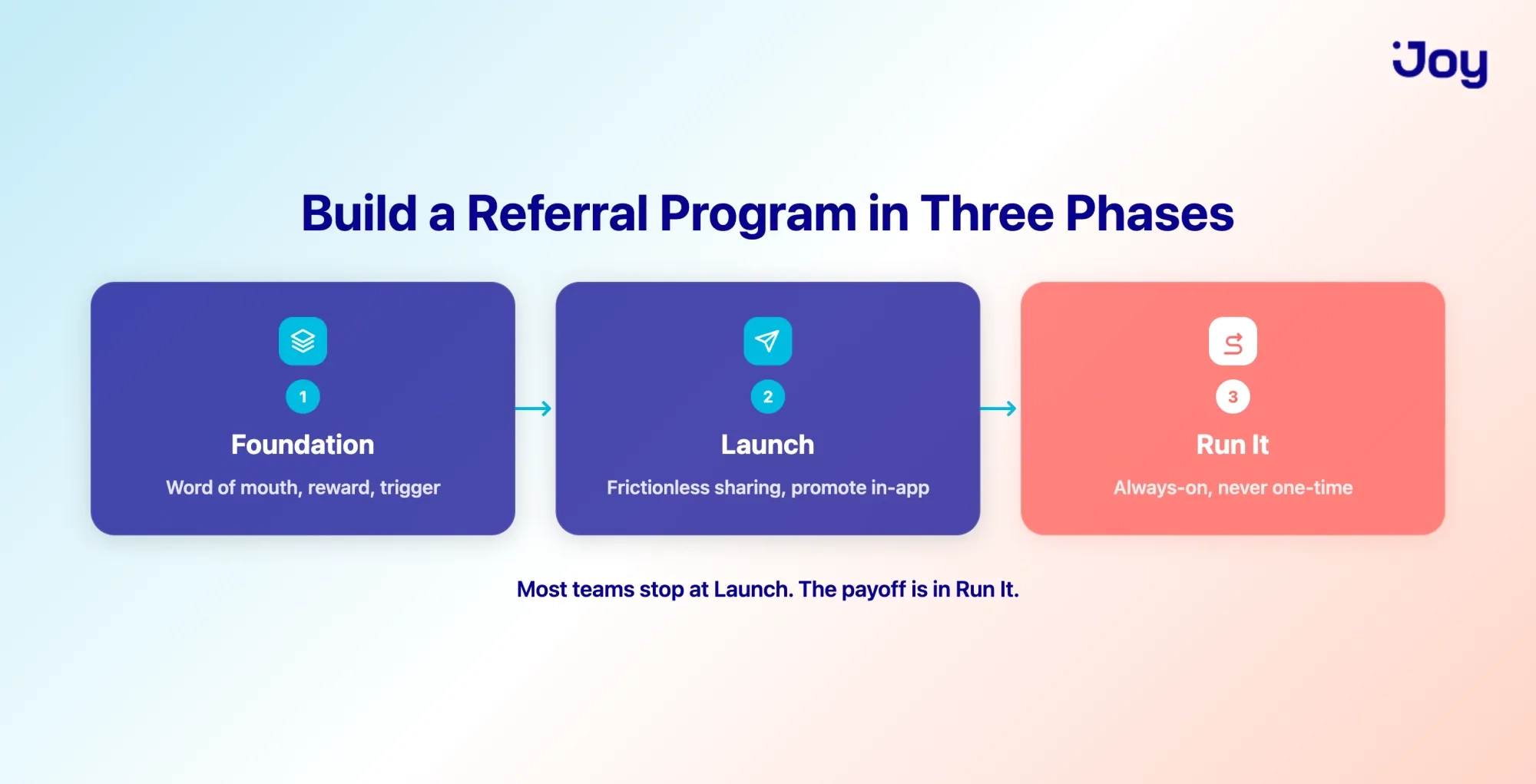
The seven steps below move from foundation to launch, then to the part most teams skip: keeping it running.
Step 1: Make sure you have word-of-mouth worth capturing
A referral program amplifies how people already feel about your product. If retention is shaky or users aren't reaching value, a referral offer just pays people to invite friends to something that won't stick. Fix the product experience first. Referral is a multiplier, and multiplying a weak number doesn't help.
Step 2: Pick the model and the reward
Start two-sided, rewarding the referrer and the person they bring in, because a one-sided offer asks your users to spend social capital for nothing in return. For most consumer SaaS products, product value beats cash: account credits, a free month, or a trial extension all pull the referrer deeper into the product rather than just out the door. For B2B, cash or a multi-step payout usually better fits the longer cycle.
Step 3: Define what actually earns the reward
This is where most programs leak. Decide what triggers the payout: a signup, an activated user who reaches a value, or a paying customer. Rewarding raw signups invites tire-kickers and fake accounts. Rewarding activation or payment costs you only when you get something real. In B2B, split it: a smaller reward when the referral becomes a qualified lead, a larger one when they close.
Step 4: Make sharing effortless
Every extra step costs you, participants. Give users a one-click share inside the app, pre-filled messages they can send without thinking, and a dedicated referral landing page that spells out the offer, the reward, and the next move. When someone forwards your link, the person who lands on it should immediately understand what they're being offered.
Step 5: Promote where the habit already is
Don't rely on a single launch email. Surface the program inside the product at moments of value, right after someone completes a key action or hits a result worth celebrating. Back that with lifecycle emails to both the referrer and the referred. The goal is steady visibility, not one big spike.
Step 6: Choose software that fits your sales model
Consumer SaaS with simple, instant rewards can often build referral logic in-house. B2B with long sales cycles, CRM tracking, and partner tiers usually perform better with dedicated referral software that can retain attribution across months and integrate with the rest of your stack. Match the tool to the motion, not to a feature list.
Step 7: Run it as an operation
This is the one that separates programs that compound from programs that fizzle. A referral program isn't a launch. It's something you monitor and adjust. Watch which rewards land, test the copy and placement of in-app prompts, and keep it always-on. The companies that win here treat referral like any other channel that needs ongoing attention.
The Metrics That Tell You It's Working
Raw signups are the vanity number. They tell you the program got attention, not whether it's healthy. A handful of metrics tell you more, just as good customer loyalty analytics looks beyond surface numbers to those that signal real health.
Referral rate: the share of active users who actually refer someone. If it's near zero, your prompt is either invisible or the incentive doesn't land.
Invite acceptance rate: the share of invited prospects who take the offer. This is a read on your message and your reward, not your product.
Activation rate of referred users: Do the people who come in through referrals actually deliver value, or do they sign up and then vanish? This is the number that protects you from optimizing for empty accounts.
Referral CAC: What a referred customer costs you compared to your blended acquisition cost across all channels.
Reward redemption rate: whether people claim the rewards they earn. Low redemption usually signals friction in the flow or a reward nobody actually wants.
One caution on benchmarks. You'll find plenty of "a healthy SaaS referral rate is X percent" claims online, but they come from individual vendors describing their own customers, and they vary wildly by product and motion. Use them loosely if at all. Your real benchmark is your own trend line: is activated referral volume going up over time, or flat?
Pitfalls That Quietly Kill SaaS Referral Programs
Most programs don't fail loudly. They fade because of a few avoidable mistakes:
- Launching it as a campaign. Big announcement, short spike, slow fade. The fix is to make it always-on and live inside the product.
- Rewarding signups instead of activation. Pay for raw signups, and you'll attract people who never use the product. Trigger the reward on activation or payment.
- One distant payout in B2B. If the only reward comes after a months-long close, referrers lose interest halfway through. Split it into multiple steps so there's something to earn along the way.
- Hiding the program. A referral program nobody can find doesn't get used. Surface it at the moments users are happiest.
- Over-incentivizing. A reward rich enough to be gamed will be gamed. Cap it, verify conversions, and watch for fake accounts.
Build It to Run, Not to Launch
Most of what kills a SaaS referral program comes down to one thing: treating it as an event rather than an operation. Match the mechanics to your motion, reward the outcomes you actually want, put the prompt where users already are, and keep adjusting it. That's the whole game.
One note, if you landed here from the ecommerce side rather than the software. If you run a Shopify store rather than a SaaS product, the mechanics look a little different: rewards are usually points or store credit, and loyalty and referrals tend to live in one app rather than separate tools. If that's you, it's worth seeing how a loyalty referral program works as a single system, how a Shopify referral program fits a store, or the steps to set up a referral program on Shopify.
Frequently Asked Questions
How is a SaaS referral program different from an affiliate program?
Referral programs reward your existing customers for introducing peers, usually with product value. Affiliate programs reward external marketers for promoting, usually with a cash commission. Many SaaS companies run both side by side.
What's the best reward for a SaaS referral program?
For most SaaS products, product value beats cash: account credits, a free month, or a trial extension all pull the referrer deeper into the product. B2B companies often layer in cash or a multi-step payout to match a longer sales cycle.
How do I track referrals through a long B2B sales cycle?
Use referral software that connects to your CRM and supports multi-step attribution. That lets you reward at the qualified-lead stage and again at the closed-won stage, rather than waiting for a single payout months down the line.
Should I build a referral program in-house or buy software?
Consumer SaaS with simple, one-click sharing can often be built in-house. B2B with long cycles, CRM tracking, and partner tiers usually benefit from dedicated referral software that holds attribution over time.
What's a good referral rate for SaaS?
It varies so much by product and motion that a published figure won't tell you much. Benchmark against your own baseline instead, and focus on whether activated referrals, not raw signups, are trending up.

Written by
Thomas Nguyen is the CEO & Co-founder of Joy, a loyalty solution for Shopify and eCommerce brands. With years of experience building high-performance Shopify apps, Thomas aims to help merchants grow through customizable and retention-focused tools.
Related reading
-f9ebcc.webp&w=3840&q=75) Loyalty Strategy
Loyalty StrategyCustomer Engagement and Loyalty: Strategies and How to Measure Them
Customer engagement and loyalty aren’t the same thing. Here’s how they differ, seven strategies that build both, and the metrics that tell you it’s working.
 Thomas Nguyen
 Loyalty Strategy
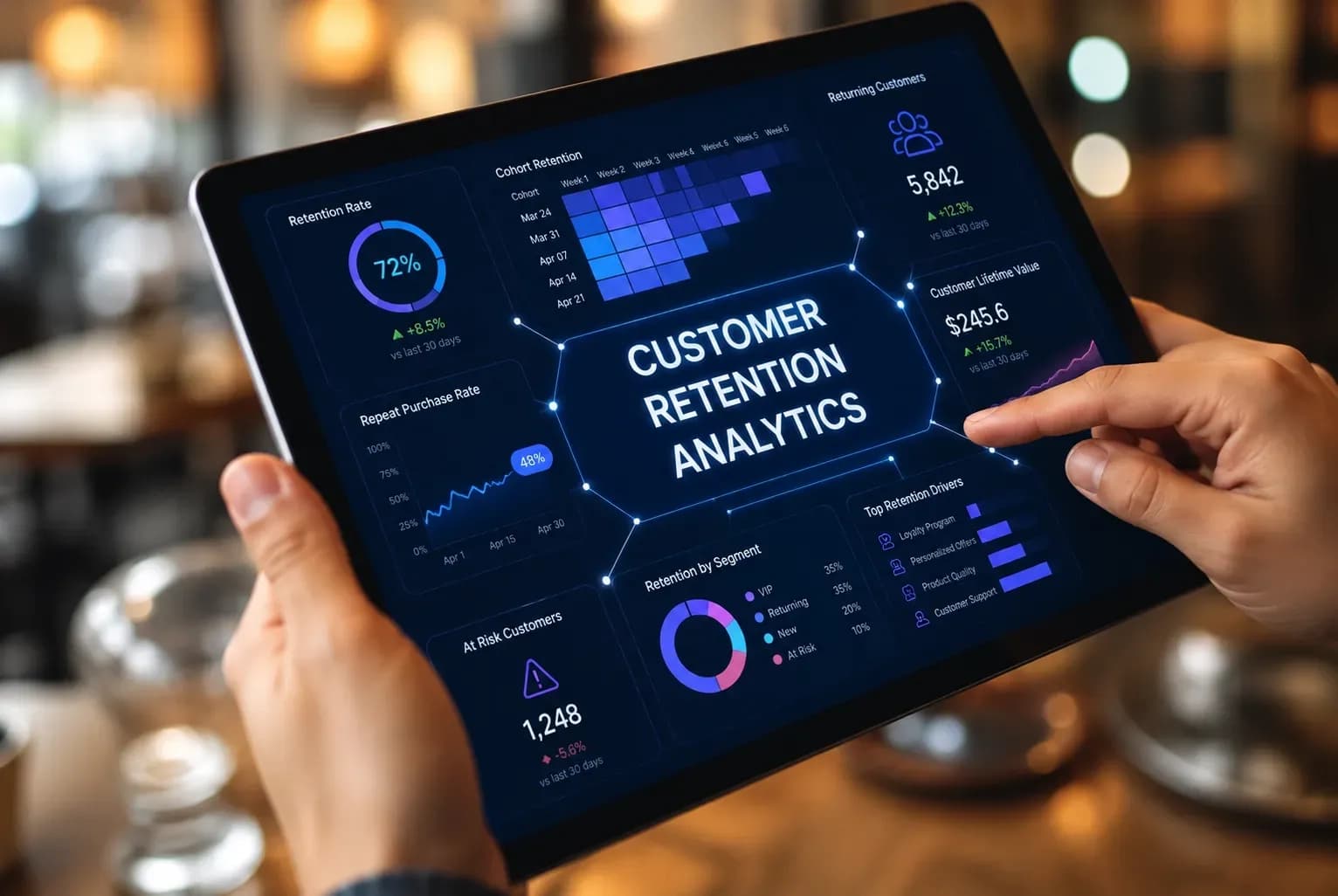
Customer Retention Analytics: Turn Your Data Into Retention Action
Most retention guides stop at the numbers. This one shows how to read your retention data and turn each metric into a concrete loyalty play for your Shopify store.
Thomas Nguyen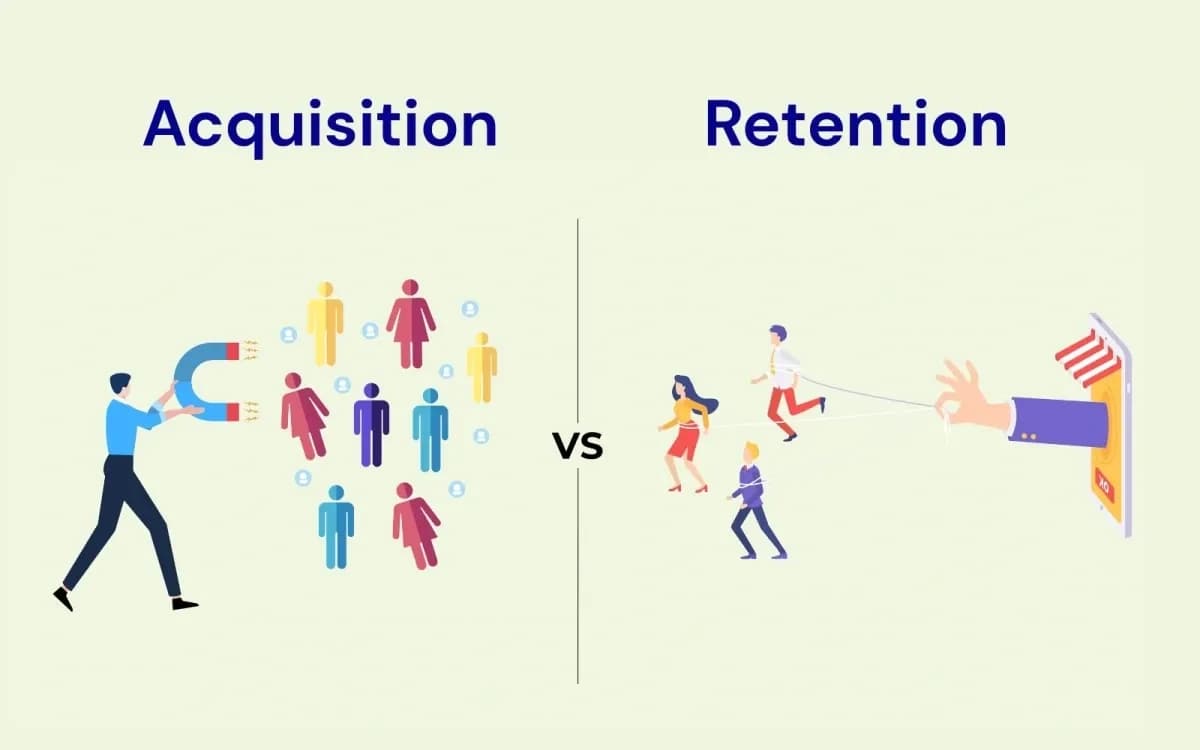 Loyalty Strategy
Customer Acquisition vs Retention: Where to Put Your Next Dollar
Customer acquisition and retention aren't a contest. Here's what each really costs, when to prioritize which, and a simple LTV:CAC way to decide your split.
Thomas Nguyen Loyalty Strategy
Customer Retention Goals: 5 Targets to Set (and How to Hit Them)
A goal-first guide to customer retention: the five targets worth setting, how to make each one SMART, and the strategy that hits it.
Thomas Nguyen Loyalty Strategy
The Real Cost of a Loyalty Point: What Real Shopify Programs Reveal
Calculate effective cashback, expected redemption cost, and loyalty liability using observed Shopify program designs and clear caveats.
Thomas Nguyen Loyalty Strategy
When a Referral Program Beats a Points Program
Use product cadence, advocacy, margin, and fraud risk to decide when referrals should lead your retention strategy instead of points.
Thomas Nguyen