Brands spend more on marketing every year, yet customer acquisition costs have risen 222% since 2013, according to SimplicityDX. The math is breaking.
The cause isn't complicated: marketing without customer loyalty is a leaky bucket. You pour budget into acquisition, but without a system to retain and grow those customers, you're paying full price for every sale, every time. And the default response ("just launch a points program") doesn't cut it anymore either. The average consumer already belongs to 16.7 loyalty programs. Another one won't stand out.
This guide breaks down why marketing works better with customer loyalty, introduces a five-component system that connects them, and shows how to design against the loyalty fatigue threatening to undermine it all.
Why Marketing Works Better With Customer Loyalty
The economic case comes first, because everything else builds on it. The connection between marketing and customer loyalty isn't philosophical. It's financial. And the numbers point in one direction.
The Leaky Bucket - Acquisition Without Retention Is Broken
Acquiring a new customer costs five to 25 times more than retaining an existing one, per Harvard Business Review. Worse still, merchants lose an average of $29 on every new customer acquired (SimplicityDX, 2022). Meanwhile, a foundational study by Reichheld and Sasser found that a 5% increase in retention drives 25% to 95% more profit.
Put those numbers together. Without loyalty, every marketing dollar buys a one-time transaction. You pay full acquisition cost again for the next sale, and again for the one after that. It's a bucket with a hole in the bottom, and no amount of ecommerce customer retention spending fixes it unless you plug the leak first.
Retention fixes the cost side. But the real power is what loyalty does to customer value.
The Growth Loop - Retain, Multiply, Recruit
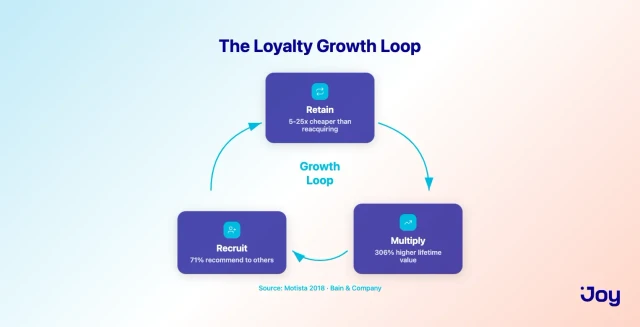
Loyalty doesn't just save money. It compounds value through a three-stage growth loop that feeds itself:
- Retain: A loyalty system keeps customers coming back at a fraction of acquisition cost (five to 25 times cheaper than reacquiring them)
- Multiply: Emotionally connected customers have 306% higher lifetime value (Motista, 2018), visit 32% more often, and spend 46% more per transaction (Gallup)
- Recruit: Those same customers recommend your brand at a rate of 71%, compared to just 45% for merely satisfied buyers (Motista). Referral costs run $5 to $15 versus paid CAC of $45 to $300 or more. Each cycle through the loop reduces your blended acquisition cost
According to Bain & Company, loyalty leaders who maintain this loop grow revenues twice as fast as their industry peers. The reason is structural: acquisition feeds the top, loyalty retains the middle, and emotional connection drives referrals at the bottom.
The catch? The loop only works as a connected system. Remove any piece and the whole thing stalls. So how do you actually build it?
The loop proves WHY marketing and customer loyalty belong together. The five-component system shows HOW.
The 5-Component Loyalty Marketing System
The growth loop makes the case for connecting marketing and customer loyalty. But a loop without structure is just a circle. The five-component system gives it bones.
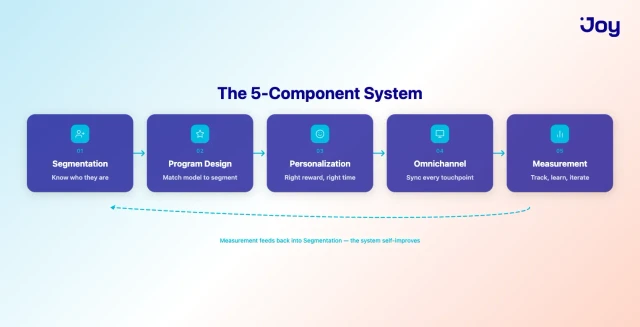
Think of customer loyalty marketing as a pipeline with five connected stages: Segmentation, Program Design, Personalization, Omnichannel, and Measurement. Each component feeds the next. Skip one and the system breaks. Bain & Company found that loyalty leaders who integrate these components grow revenues twice as fast as industry peers.
How each piece works, and why it matters.
Component 1 - Segmentation (Know Who Your Customers Are)
Segmentation divides your customer base into groups based on behavior, not demographics. The gold standard is RFM: Recency (when did they last buy?), Frequency (how often?), and Monetary Value (how much?).
Why does it matter this much? RFM-targeted campaigns yield up to 77% higher ROI compared to one-size-fits-all approaches. Segmented emails achieve 50% higher click-through rates. Without segmentation, you're sending the same message to a first-time buyer and a three-year VIP. No wonder engagement stays low.
A Shopify brand with 5,000 customers runs RFM scoring and identifies five distinct segments:
- Champions (high R, F, M) - VIP treatment, early access, referral prompts
- Loyal (high F, M) - tier upgrade nudges, exclusive rewards
- At-Risk (low R, high historical F, M) - re-engagement offers with urgency
- New (high R only) - welcome sequences, immediate first rewards
- Dormant (low everything) - win-back campaigns or sunset
Instead of one generic blast, each segment gets different rewards, messaging, and timing. That's five targeted programs running from the same customer loyalty analytics foundation.
Segmentation tells you WHO your customers are. Program design tells you WHAT structure matches each segment.
Component 2 - Program Design (Choose the Right Model)
With segments defined, the next step is choosing a program structure that matches each group. Without segmentation feeding into it, program design is guesswork. Four core models:
- Points-based: Earn on any action (purchase, review, referral, social share) and redeem for rewards. Maximum flexibility. Best for brands wanting to incentivize multiple behaviors across segments.
- Tiered/VIP: Status levels with progressively better perks (Silver, Gold, Platinum). Aspirational motivation. Best for brands with strong repeat purchase cycles.
- Referral: Reward customers for recruiting new ones. This feeds the growth loop from Section 1 directly. Best for brands with high satisfaction but low organic referral rates.
- Hybrid: Combine models, for example points plus tiers plus referral. Most effective approach, but only when each model targets a different segment. Without segmentation, hybrid programs add complexity without purpose.
McKinsey (2021) found that tiered programs deliver 1.8x higher ROI than single-tier alternatives. Top-performing programs boost revenue 15% to 25% annually from redeeming customers. On the flip side, Capgemini research shows that 77% of transactional-only programs fail within two years. Programs that rely solely on points, without emotional or tiered elements, simply don't survive.
A useful decision framework: points for breadth, tiers for depth, referrals for growth, hybrid for scale. In the context of loyalty program marketing, the right model creates the structure. Personalization fills it with relevant content for each segment.
Component 3 - Personalization (Right Reward, Right Customer, Right Time)
This is where segmentation and program design translate into actual customer experience. Personalization means delivering specific rewards and messaging to each segment. Not "same email to everyone." Each customer gets the offer most likely to drive their next action.
The gap is significant: 58% of brands list personalization as their top loyalty investment, but only 16% have actually achieved it. That intent-to-execution gap is the number one reason programs feel generic even when the underlying structure is sound.
And the payoff for closing it? McKinsey found that personalization lifts revenues 5% to 15% and increases marketing-spend efficiency by 10% to 30%. Separately, 80% of consumers say they're more likely to purchase from brands delivering personalized content.
Personalization maps directly to your segments:
- Champions get early access to new products, VIP-only rewards, and referral bonuses
- At-Risk customers receive re-engagement emails with urgency ("Your 500 points expire in seven days") and bonus multipliers
- New customers enter a welcome sequence with an instant reward to speed time-to-value, plus a guided first redemption
- Dormant customers get win-back offers with escalating incentives, or a sunset communication
Beyond manual triggers, an AI layer can add predictive capabilities: which reward type drives action for each segment, whether to re-engage or upsell or prompt a referral, and dynamic point multipliers based on real-time behavior.
Personalized content only works if it actually reaches customers wherever they are. Web, mobile, email, in-store. That's where omnichannel comes in.
Component 4 - Omnichannel (Sync the Experience Everywhere)
Omnichannel means the loyalty experience is consistent and connected across every customer touchpoint: web, mobile, email, and in-store POS. One identity, one point balance, one history, everywhere. It's the delivery layer for the personalization you built in Component 3.
The retention gap here is enormous. Aberdeen Group found that companies with strong omnichannel integration retain roughly 89% of their customers, compared to just 33% for brands with weak integration. Omnichannel shoppers also deliver 30% higher lifetime value. Most brands fall on the wrong side of that divide.
What does a connected journey look like? A customer earns 50 points purchasing on the web, sees the updated balance in a mobile app, receives a personalized email ("You're 100 points from Gold tier!"), redeems a reward via Shopify POS in-store, and that in-store purchase triggers the next personalized offer online. Every touchpoint reinforces the same loyalty identity. No gaps, no resets, no conflicting data.
Why do most brands fail at this? Siloed systems. Online loyalty doesn't talk to POS, email campaigns ignore loyalty status, and mobile shows stale balances. The result is a fractured experience that erodes trust (exactly the opposite of what relationship marketing requires).
Omnichannel isn't a technology checkbox. It's a relationship principle. Consistent experiences across channels build the trust that underpins customer loyalty. And once the delivery layer is working, there's one final question: is the whole system actually performing?
Measurement answers that.
Component 5 - Measurement (The Feedback Loop That Improves Everything)
Most brands track Customer Lifetime Value and call it done. CLV tells you the outcome, but not what's driving it. A complete loyalty marketing system needs six KPIs:
- Customer Lifetime Value (CLV) - total revenue per customer over the relationship. The north star metric.
- Repeat Purchase Rate (RPR) - percentage who buy again within a set period. Measures program stickiness.
- Redemption Rate - percentage of earned rewards redeemed. Low redemption equals low engagement, which equals a program at risk.
- Net Promoter Score (NPS) - willingness to recommend. Measures emotional loyalty and the growth loop driver from Section 1.
- Average Order Value (AOV) - revenue per transaction. Tiers and bonus events should push this up over time.
- Assisted Orders - orders attributed to referral links or loyalty-generated discount codes. Connects loyalty actions directly to revenue.
What makes measurement a system component (rather than just a report) is that each metric diagnoses a specific part of your loyalty system:
- Low redemption rate? That's a personalization problem. Rewards aren't relevant to the segment receiving them (Component 3).
- Declining repeat purchase rate? That's a segmentation issue. You're targeting the wrong cohorts (Component 1).
- High NPS but low assisted orders? That's a program design gap. Referrals aren't rewarded enough to drive action (Component 2).
- Rising AOV but flat CLV? That's an omnichannel gap. You're missing in-store or mobile customers entirely (Component 4).
McKinsey (2021) found that top-performing programs boost revenue 15% to 25% annually. The common thread? They measure, learn, and iterate. Each metric points back to a component. Without measurement, you're flying blind.
Overcoming Loyalty Fatigue - The Biggest Threat to Marketing and Customer Loyalty
The five-component system explains how to build effective customer loyalty marketing. But there's a force working against even the best-designed systems, and it's growing stronger every year.
The Loyalty Fatigue Problem - 16.7 Programs and Counting
Loyalty fatigue is what happens when consumers belong to so many programs that they stop engaging meaningfully with any of them. And it's accelerating.
The average American consumer now belongs to 16.7 loyalty programs. Fifty percent participate in five or more, up from 38% in 2024. On the behavioral side, 86% of consumers say they engage less with loyalty programs when it takes too long to earn rewards. And 50% of paid program cancellations happen within the first year.
This is what happens when brands treat loyalty as a standalone program rather than a connected marketing system. Another points catalog doesn't stand out against 16 competitors. It gets lost.
And this is precisely why each component of the system matters. Segmentation identifies who's fatigued. Personalization delivers relevance that cuts through. Measurement catches disengagement before it becomes churn.
Your biggest competitor for customer attention isn't another brand. It's the 16 other loyalty programs already in their wallet.
Designing Against Fatigue - 4 Principles That Cut Through
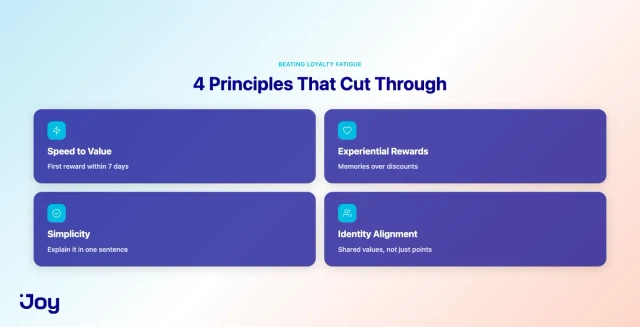
So how do you design a program that survives when consumers are drowning in options? Four principles, each connected back to the five-component system:
Speed to value. Deliver the first reward within seven days of signup, not after 10 purchases. Immediate gratification prevents the "forgot I joined" problem. This connects directly to personalization: the welcome sequence needs to deliver value fast.
Experiential rewards. Exclusive access, early launches, and VIP events create emotional memories that points alone can't match. Sephora's Beauty Insider program demonstrates this well: over 34 million members, with loyalty customers accounting for roughly 80% of annual sales. The tiered system (Insider to VIB to Rouge) makes experiential perks aspirational rather than transactional.
Simplicity. If members can't explain your program in one sentence, they won't use it. Complexity kills engagement. And this ties directly to omnichannel consistency: every touchpoint should reinforce the same simple message.
Identity alignment. REI Co-op works because members share the brand's values, not just its discounts. With over 23 million co-op members generating 92.4% of total revenue, REI proves that programs built around shared identity create loyalty that outlasts any competitor's offer.
Motista (2018) found that emotionally connected customers stay an average of 5.1 years versus 3.4 years for merely satisfied ones. Emotional design isn't a nice-to-have. It's the antidote to fatigue.
The programs that survive loyalty fatigue? They're the ones customers would miss if they disappeared.
FAQ
What is loyalty marketing?
It's a strategy that focuses on retaining existing customers through rewards, personalized experiences, and emotional engagement, rather than spending exclusively on acquiring new ones.
How does marketing affect customer loyalty?
Marketing builds awareness and trust, but without a loyalty system, those customers churn. When marketing and loyalty work together, each new customer enters a retention loop that compounds their value over time.
What are the main types of loyalty programs?
Four core models: points-based (earn and redeem), tiered/VIP (status levels with escalating perks), referral (reward for recruiting new customers), and hybrid (combining multiple models for different segments).
How do you measure customer loyalty?
Six KPIs: Customer Lifetime Value, Repeat Purchase Rate, Redemption Rate, Net Promoter Score, Average Order Value, and Assisted Orders. Each metric diagnoses a specific part of your loyalty system.
What is loyalty fatigue?
It's what happens when consumers belong to so many programs that they stop engaging meaningfully with any of them. The average US consumer belongs to 16.7 programs, and 86% engage less when rewards take too long to earn.
What is the difference between customer loyalty and brand loyalty?
Customer loyalty is behavioral: repeat purchases driven by rewards, convenience, or habit. Brand loyalty is emotional: customers choose you even when alternatives are cheaper or more convenient. The strongest programs build both.
What is relationship marketing and customer loyalty?
Relationship marketing focuses on building long-term customer connections rather than one-time transactions. Customer loyalty is the outcome. When relationship marketing works, customers stay longer, spend more, and refer others.
How much does a loyalty program cost to run?
Costs vary by model and scale. Points-based programs typically allocate 1% to 5% of revenue to reward liability. The ROI benchmark: top-performing programs boost revenue 15% to 25% annually from redeeming members.
Why do loyalty programs fail?
77% of transactional-only programs fail within two years, according to Capgemini. Common causes: rewards that are too hard to earn, no personalization, siloed channels, and no measurement feedback loop to catch problems early.
What is RFM segmentation?
RFM stands for Recency (when did they last buy?), Frequency (how often?), and Monetary Value (how much?). It divides customers into behavioral segments so each group gets targeted rewards instead of one generic program.
Marketing and Customer Loyalty - Build the System, Not Just the Program
Marketing without customer loyalty is a leaky bucket. Every dollar spent on acquisition leaks out without a system to retain, grow, and compound customer value.
The WHY is clear: retention costs five to 25 times less than acquisition, emotional loyalty multiplies customer value by 306%, and loyal customers become your cheapest growth channel through the benefits of loyalty programs.
The HOW is a five-component system where each piece reinforces the others:
- Segmentation - know who your customers are (77% ROI boost)
- Program Design - match the model to each segment (1.8x ROI for tiered)
- Personalization - deliver relevance at every touchpoint (5% to 15% revenue lift)
- Omnichannel - sync the experience everywhere (89% retention)
- Measurement - track, learn, iterate (15% to 25% annual revenue boost)
And the THREAT is real: loyalty fatigue means generic programs will keep failing. Only systems designed for emotional engagement survive when consumers are juggling 16.7 programs.
Platforms like Joy Loyalty help Shopify merchants connect these components, from segmentation and program design to measurement, without building from scratch.
Stop running a loyalty program. Start running a loyalty marketing system.