Customer Loyalty Levels: Why Not All Customers Are Equal
Not all customers are equal — and most stores treat them like they are. This guide breaks down the four customer loyalty levels, how to spot where each customer sits, and a 30-day plan to move them up the ladder, with real case studies and metrics to track.
Summarize this post with AI
Not all customers contribute equally to your revenue. Some buy once and disappear. Others come back month after month, spend more each time, and bring their friends along for the ride.
So what separates a one-time buyer from a lifelong advocate? It's not luck, and it's not random. The difference comes down to where each customer sits on the loyalty ladder.
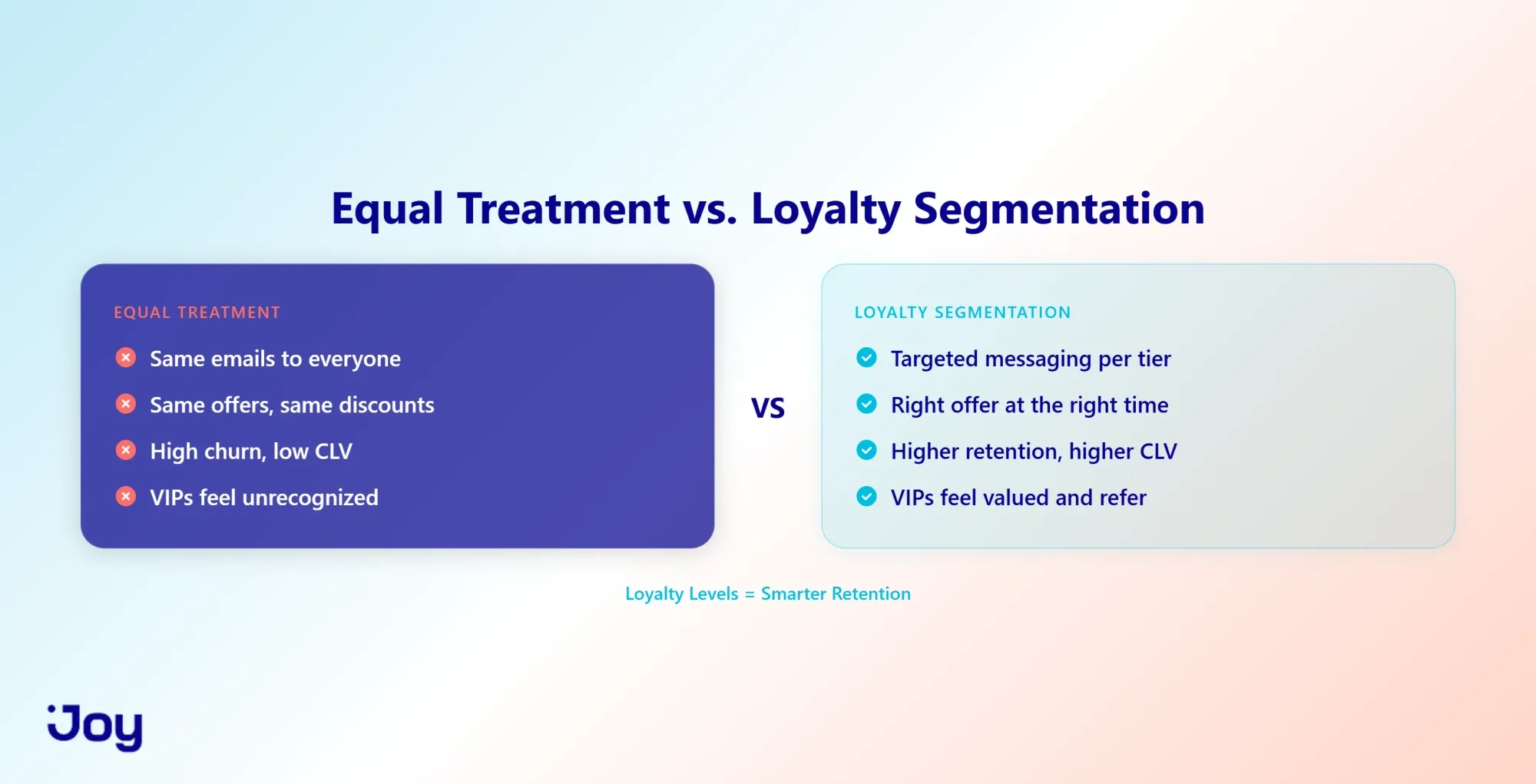
Bain & Company found that 20% of your customers generate 80% of your revenue. Think about that for a second. The vast majority of your customer base contributes a fraction of what your top tier delivers. And yet, most stores treat every customer exactly the same. Same emails. Same offers. Same experience. Whether someone just discovered your brand or has purchased from you twelve times, they get identical treatment.
Acquiring a new customer costs 5 to 25 times more than retaining an existing one, per Harvard Business Review. That gap makes one thing clear: the biggest growth opportunity for most ecommerce brands isn't chasing new traffic. It's moving the customers you already have up the loyalty ladder.
This guide breaks down the four customer loyalty levels, shows you how to identify where each customer sits, and gives you proven tactics to move them from passive browsers to active brand advocates. You'll see real case studies, concrete metrics to track, and a 30-day plan to put this framework into action.
What Are Customer Loyalty Levels?
Customer loyalty levels are a framework for categorizing your customer base by their depth of engagement, purchase behavior, and emotional connection to your brand.
Loyalty isn't binary. Customers aren't simply "loyal" or "not loyal." It operates on a spectrum, and at every stage, their behaviors, motivations, and revenue contribution look different.
There are many ways to classify loyalty (by emotion, by transaction type, by behavioral patterns), but a progression-based model gives you the clearest path forward. You can pinpoint exactly where each customer is on the journey and, more importantly, figure out what it takes to move them to the next level.
The 4 Customer Loyalty Levels: From Browser to Brand Advocate
While some models identify five, six, or even seven types of customer loyalty, this four-level model focuses on what you can actually measure and act on. It's a simplified, practical approach built for merchants who want actionable insights, not academic taxonomy.
Each level maps to specific customer behaviors, a measurable revenue contribution, and clear tactics that drive progression to the next stage.
Level 1: Browser (Price-Sensitive)
Browsers have visited your store, maybe added something to their cart, but haven't committed to a purchase yet. They're highly price-sensitive and still weighing their options.
Typical behavior: High cart abandonment rates. Clicks on discount codes. Compares your products against competitors before deciding. Visits your site through paid ads or social media but leaves without converting.
Revenue contribution: Zero. No purchase yet. But these visitors represent your largest pool of potential customers, which is why converting them matters so much.
What this looks like in practice: A shopper spends five minutes browsing your product pages, adds an item to their cart, then leaves without buying. They come back two weeks later only because you sent a 30% off email.
Level 2: First Buyer (Transactional)
First Buyers have made that initial purchase, but they treat it as a one-off transaction. No signals of a repeat visit yet.
Typical behavior: Single order at or near your average order value. Doesn't open post-purchase emails. Hasn't signed up for your loyalty program or newsletter. The purchase was likely driven by a discount or a specific immediate need.
Revenue contribution: One times your average order value. For most ecommerce stores, that's somewhere between $40 and $80. This is the starting point of actual revenue, but it barely covers the acquisition cost for many brands.
What this looks like in practice: A customer buys once after finding you through a Google ad. They received the product, never left a review, and haven't engaged with any follow-up communication. Without intervention, they'll likely never return.
Level 3: Repeat Buyer (Behavioral Loyal)
This is where things get interesting. Repeat Buyers have purchased two or more times and are showing consistent behavioral patterns. Their loyalty is largely habitual at this stage, driven more by convenience and satisfaction than deep emotional attachment.
Typical behavior: Purchases every 30 to 60 days. Opens your emails regularly. Uses loyalty rewards and promotional codes you send. Repeat Buyers also start showing engagement signals: interacting on social media, leaving product reviews, and participating in community content like polls or user-generated posts. These engagement behaviors bridge the gap between transactional repeat purchases and true emotional loyalty.
Revenue contribution: Three to five times your customer lifetime value through multiple orders and gradually increasing average order value over time.
What this looks like in practice: A customer buys every six weeks like clockwork. They click through your emails, redeem the promo codes you send, and left a product review last month. They're not yet an evangelist for your brand, but they're reliably profitable.
Level 4: VIP/Advocate (Emotional Loyal)
At the top of the loyalty ladder sit your VIP Advocates. These customers have an emotional connection to your brand. They buy frequently, spend more per order, and actively refer friends and family.
Typical behavior: Frequent, high-value purchases. Ignores competitor pricing because they trust your brand. Refers friends without being asked. Provides unsolicited feedback and engages with your brand on multiple channels.
Revenue contribution: Five to ten times your customer lifetime value, plus additional referral revenue from word-of-mouth. According to Harvard Business Review, satisfied loyal customers spend 140% more than those who had a negative experience. That makes this tier your most valuable growth engine.
What this looks like in practice: A customer buys weekly or biweekly. They don't wait for discounts. They've referred two friends who also became repeat buyers. When you launch a new product, they're among the first to order.
Knowing the levels is the starting point. Moving customers between them? That's where the revenue impact lives.
How to Move Customers Through Loyalty Stages: Proven Tactics for Each Level
Understanding the levels is only half the equation. The real value comes from knowing how to transition customers from one stage to the next. And here's what matters: moving a browser to a first buyer requires completely different tactics than moving a repeat buyer to a VIP advocate. Each transition has its own objective, its own playbook, and its own measurement criteria.
Transition 1: Browser to First Buyer
The objective: Convert browsing behavior into a completed first purchase.
This transition is all about reducing friction and giving hesitant shoppers a reason to commit. Three tactics consistently drive results:
Incentivized first-purchase offers. A 15 to 20% discount on the first order, combined with an email capture popup at exit intent, gives browsers a tangible reason to convert now instead of later. The email capture is equally important because it gives you a second chance to reach them even if they leave.
Social proof. Displaying testimonials, review counts, and user-generated photos directly on product pages reduces purchase anxiety. When a browser sees that 2,000 other customers rated a product 4.8 stars, the perceived risk of buying drops significantly.
Friction reduction. Offer guest checkout, display multiple payment options (including buy-now-pay-later), and make sure your mobile experience is fast. Every extra step in the checkout process is another opportunity for a browser to abandon.
Proof it works: MoxieLash implemented a tiered loyalty incentive that combined points for first purchases with referral bonuses. The result: a 3x increase in their second purchase rate. The right incentive at the right moment accelerates the browser-to-buyer transition.
How to measure: Track your conversion rate from site visitor to first order. If this number improves after implementing these tactics, you're successfully moving more browsers into the First Buyer level.
Transition 2: First Buyer to Repeat Buyer
The objective: Trigger that critical second purchase (statistically the hardest gap to close).
Once a customer has bought once, the window for securing a repeat purchase is narrow. If they don't come back within 90 days, the probability of them returning drops dramatically. So how do you close that gap?
Post-purchase follow-up sequence. Build a structured email sequence: Day 1 sends a thank-you plus product care tips. Day 7 delivers a related product recommendation based on what they bought. Day 14 offers an exclusive loyalty incentive. This sequence keeps your brand top-of-mind during the critical first two weeks.
Loyalty program enrollment. Make enrollment automatic after the first purchase, not optional. The type of program matters, too. Points-based programs (earn and burn) work well for most stores because customers earn points per dollar and redeem them for discounts. Tiered programs add a status motivation layer where customers unlock better rewards as they spend more. Value-based programs align rewards with your brand mission, such as donating to a cause per purchase.
Frequency-triggered offers. For consumable or replenishable products, send "you're due for a restock" emails based on typical product usage cycles. If your average customer uses up a product in six weeks, an email at the five-week mark with a small incentive can drive the repeat purchase before they even think about shopping elsewhere.
Proof it works: Ofra Cosmetics structured a tiered referral program where higher referral volume unlocked better rewards. The result: a 56% increase in repeat purchase rates and a 59% increase in customer spend.
How to measure: Track the number of days between first and second purchase (target: under 90 days) and your overall repeat purchase rate (target: above 25%).
Transition 3: Repeat Buyer to VIP/Advocate
The objective: Transform habitual purchasing into emotional loyalty and active referral behavior.
This transition requires a fundamentally different approach. You're no longer competing on price or convenience. You're building an identity-level connection between the customer and your brand.
VIP tier programs. Create exclusive perks that only your top customers can access: early access to new products, lower free shipping thresholds, birthday bonuses, and dedicated support channels. A visible tier badge in their account drives status motivation and makes the exclusivity tangible.
Referral programs. Offer high-value rewards for both the referrer and the referred friend. Make sharing frictionless through one-click referral links and email integrations. The easier it is to share, the more likely your repeat buyers will spread the word.
Community building. Invite top customers to exclusive events like livestreams, early product previews, or VIP-only bundles. Ask for their feedback on upcoming products. When customers feel like insiders, their emotional investment in your brand deepens.
Proof it works: Pulse Boutique launched a VIP tier program with exclusive perks and saw a 39% uplift in returning customers alongside a 19% increase in average order value.
How to measure: Track referral link clicks, repeat purchase frequency among your top tier, and Net Promoter Score (NPS) to gauge advocacy strength.
Each of these transitions requires different messaging, incentives, and timing. The goal is to make the next level feel like a natural progression, not a forced upsell.
Understanding Customer Loyalty Stages: How to Identify Where Each Customer Sits
Knowing the four levels is useful. But it only becomes powerful when you can accurately place each customer into the right tier. The difference between a Repeat Buyer and a VIP Advocate isn't always obvious from the surface. You need data to make that distinction clear.
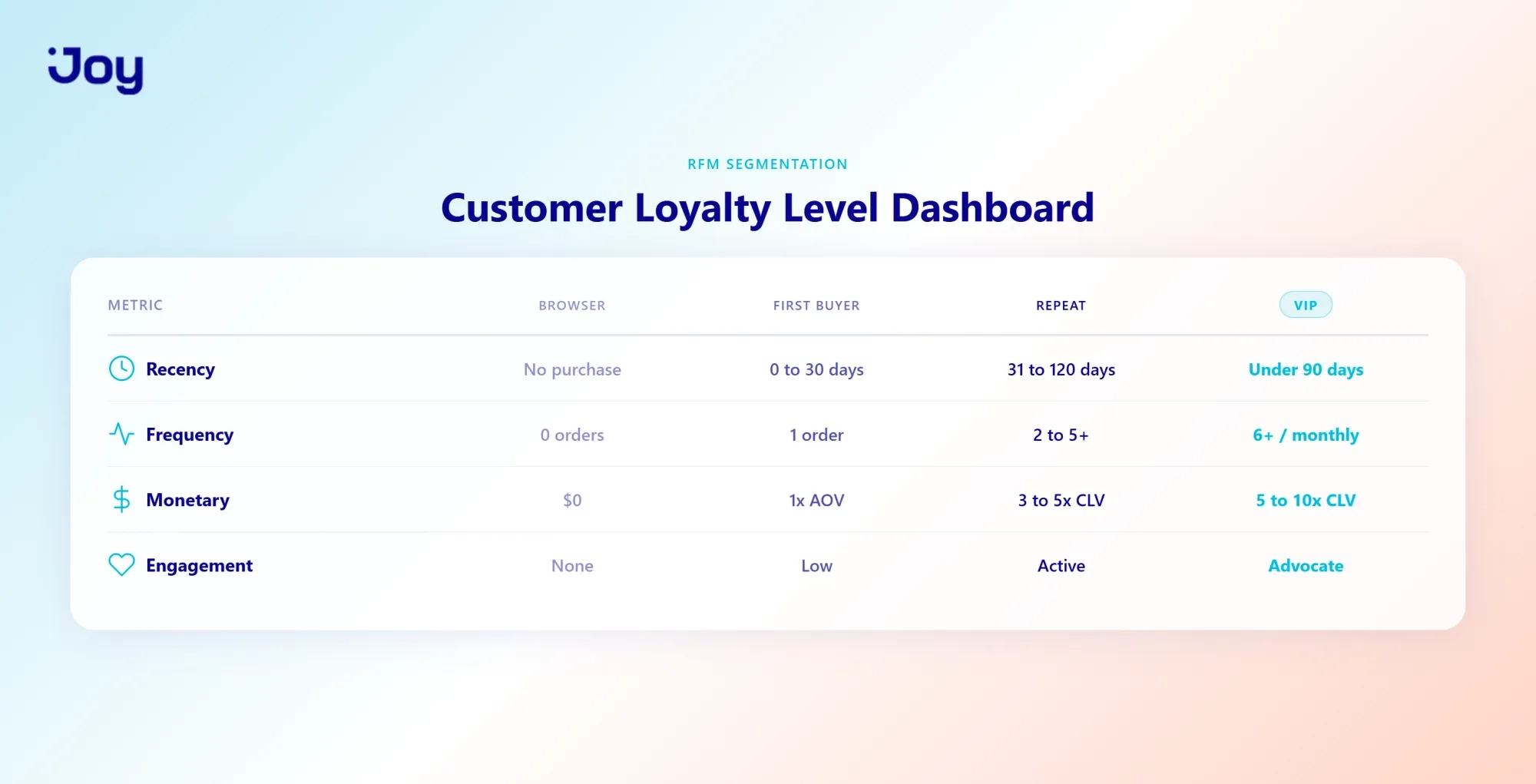
The RFM model (Recency, Frequency, Monetary value) provides the foundation for this segmentation. Here's how each metric maps to the four loyalty levels:
Recency: Days since last purchase
- Browser: No purchase yet
- First Buyer: 0 to 30 days since their only order
- Repeat Buyer: 31 to 120 days (purchases at regular intervals)
- VIP: Under 90 days with high frequency (they never go long without ordering)
Frequency: Total number of purchases
- Browser: Zero
- First Buyer: One
- Repeat Buyer: Two to five or more
- VIP: Six or more, or at least one per month
Monetary value: Average order value plus lifetime value
- Browser: $0
- First Buyer: Approximately one times your AOV
- Repeat Buyer: Three to five times your CLV
- VIP: Five to ten times your CLV, plus referral revenue
Purchase data alone doesn't tell the full story, though. Engagement signals add another layer of insight. Track email open rates and click-through rates to gauge communication engagement. Monitor loyalty program activity including enrollment status, points earned, and reward redemptions. And measure referral metrics: link clicks, completed referrals, and social shares.
Most loyalty platforms and your store's analytics dashboard can segment customers across these signals automatically. The key is setting up the tiers in your system and tracking consistently over time. Without that consistency, you're guessing at which customers belong where. And guessing leads to wasted marketing spend.
Once you've segmented your customer base, you can trigger different campaigns, offers, and messaging for each tier automatically. That's where the real return on investment from loyalty segmentation begins.
Protecting Loyalty Stages: What to Do When a VIP Customer Has a Bad Experience
Even with the best systems in place, things go wrong. A VIP customer experiences a shipping delay, receives a damaged product, or encounters poor customer service. Without a swift recovery, that VIP can downgrade to a Repeat Buyer or, worse, disappear entirely.
The financial stakes aren't equal across tiers. A VIP who churns represents $500 or more per year in lost revenue. A First Buyer who leaves costs you roughly $50. That disparity means your recovery effort should scale with the customer's loyalty level.
A three-step recovery playbook that protects your highest-value relationships:
1. Rapid response. Acknowledge the issue within 24 hours. Make it personal, not automated. A VIP customer who has spent hundreds of dollars with your brand deserves a human response that shows you recognize their value.
2. Over-deliver on the solution. Go beyond the minimum fix. Offer a refund plus a replacement, plus bonus points or an exclusive discount on their next order. The goal isn't just to resolve the problem. It's to reinforce that their loyalty is noticed and valued.
3. Close the loop. After the resolution, follow up with a personal email or call. Explain what went wrong and what you're doing to prevent it from happening again. Research from CustomerGauge shows that closing feedback loops rapidly increases customer retention by up to 8.5%.
One practical tip: flag VIP-tier customers in your support system so your team can identify and prioritize them immediately. When a high-value customer submits a ticket, your team should know before they even read the message.
Build Your Customer Loyalty Levels Framework: 30-Day Implementation Plan
You don't need to build a complete loyalty infrastructure overnight. A focused 30-day plan gets you from zero to a functioning loyalty level framework.
Week 1: Segment your existing customers. Use your store's purchase data and the RFM criteria outlined above to categorize your current customer base into the four levels. Even a simple spreadsheet works for this first pass. The goal is visibility, not perfection.
Week 2: Identify your highest-impact transition. Look at your data and find the gap where you're losing the most value. For most stores, that's either Browser to First Buyer (high traffic, low conversion) or First Buyer to Repeat Buyer (lots of one-time purchasers who never return). Pick one. Launch your first tactic targeting that specific transition.
Week 3: Add loyalty program enrollment. Integrate a loyalty program into your post-purchase flow. Automatic enrollment removes the friction of manual signup and immediately gives first-time buyers a reason to come back.
Week 4: Monitor, measure, and adjust. Track repeat purchase rates, referral activity, and tier movement. Review what's working and double down. Cut what isn't delivering results and test new approaches.
A loyalty platform like Joy can handle segmentation, tier tracking, and automated campaign triggers, so you can focus on strategy instead of manual tagging.
Customer Loyalty Levels Are Your Fastest Path to Revenue Growth
The four-level loyalty framework gives you something most merchants lack: a clear, measurable system for understanding where your customers are and what it takes to move them forward.
Remember that Harvard Business Review finding: loyal customers spend 140% more than dissatisfied ones. Your existing customer base (the people who've already found you, already bought from you) is your fastest and most cost-effective path to revenue growth.
The mindset shift is simple but powerful. Stop asking "How many new customers can we acquire?" and start asking "How can we move our existing customers up the loyalty ladder?"
Every browser who becomes a first buyer, every first buyer who returns for a second purchase, and every repeat buyer who starts referring friends represents compounding revenue growth that no amount of paid advertising can match.
Start segmenting your customers into loyalty levels this week. Tools like Joy make it straightforward for ecommerce merchants to set up tiers, track progression, and automate the tactics that drive customers from one level to the next.
Frequently Asked Questions
How many customer loyalty levels should my business use?
Four levels work well for most ecommerce businesses: Browser, First Buyer, Repeat Buyer, and VIP/Advocate. It's simple enough to act on while capturing the meaningful behavioral differences between customer segments. Some larger brands use five to seven tiers, but additional complexity only adds value if you have the resources to create distinct strategies for each level.
What is the difference between customer loyalty levels and loyalty program tiers?
Customer loyalty levels describe where a customer sits based on their actual behavior, regardless of whether you have a formal program. Loyalty program tiers are the structured reward levels you create within a loyalty program (like Silver, Gold, Platinum). The levels inform your strategy. The tiers are one tool for executing it.
How long does it take to move a customer from one loyalty level to the next?
It depends on the transition. Converting a Browser to a First Buyer can happen in a single session with the right offer. Moving a First Buyer to a Repeat Buyer typically takes 30 to 90 days. The Repeat Buyer to VIP transition is the longest, often requiring three to six months of consistent engagement and positive experiences.
What metrics should I track to measure customer loyalty levels?
The RFM model: Recency (days since last purchase), Frequency (total number of orders), and Monetary value (average order value and lifetime value). Layer in engagement signals like email open rates, loyalty program participation, and referral activity for a complete picture.
Can small ecommerce stores benefit from loyalty level segmentation?
Absolutely. Smaller stores often see faster results because their customer base is manageable enough to personalize outreach for each tier. You don't need enterprise software to segment customers. Start with your store's built-in analytics and a simple spreadsheet, then scale to a dedicated loyalty platform as your customer base grows.

Written by
Thomas Nguyen is the CEO & Co-founder of Joy, a loyalty solution for Shopify and eCommerce brands. With years of experience building high-performance Shopify apps, Thomas aims to help merchants grow through customizable and retention-focused tools.
Related reading
 Loyalty Strategy
The Customer Loyalty Ladder: Stages, Models & How to Build Advocates
Not all customers are equal — some buy once and vanish, others return twenty times and bring friends. The customer loyalty ladder maps that gap. This guide breaks down the stages, compares the 5-, 6-, and 7-rung models, and shows how to move customers from first purchase to full advocacy.
 Thomas Nguyen
 Loyalty Strategy
The Customer Loyalty Loop: Why Retention Beats Acquisition
More than half of loyalty memberships sit inactive — the fix isn't a better funnel, it's a loop. Here's the 4-stage customer loyalty loop framework, where most Shopify programs break down, and how to diagnose which stage yours is missing.
Thomas Nguyen Loyalty Strategy
Disney Castaway Club Loyalty Program: Case Study for Shopify Brands 2026
Most loyalty programs compete on generosity. Disney's Castaway Club competes on access. This case study breaks down the 4 structural mechanics behind it — early booking access, voyage-count tiers, Pearl tier scarcity, and zero-effort enrollment — and what Shopify brands can steal.
Thomas Nguyen Loyalty Strategy
Relationship Marketing and Customer Loyalty: The 4-Pillar Framework
True customer loyalty is declining for the first time in 5 years (SAP, 2025). Discount-driven marketing is hitting diminishing returns. Relationship marketing flips the model: build trust and shared value first, then watch loyalty follow. Here's the 4-pillar framework.
Thomas Nguyen Loyalty Strategy
Three Stages of Brand Loyalty: Mastering the 2026 ROI Strategies
From "knowing" your brand to "refusing" any other. The three stages of brand loyalty — Recognition, Preference, Insistence — map how customers actually move from awareness to advocacy. This guide breaks down each stage and the tactics to climb the ladder when acquisition costs are 4× higher.
Thomas Nguyen Loyalty Strategy
Enterprise Plus Loyalty Program: Case Study for Ecommerce Strategists 2026
Most loyalty programs are built to feel generous. Enterprise Plus was built to make leaving expensive. This case study breaks down the 3 structural levers — milestone tiers, status lock-in, and concrete rewards — that added 2M members without ad spend, and which ones translate to Shopify.
Thomas Nguyen