
McDonald’s Loyalty Program: A Strategic Case Study on Digital Retention
Decode the McDonald's loyalty program: the exact retention mechanics and software tools that turn anonymous buyers into repeat customers for your Shopify store.
Summarize this post with AI
McDonald’s loyalty program is more than a rewards scheme. It is a large-scale retention engine designed to turn everyday transactions into repeat visits, richer customer data, and measurable revenue growth. In 2024, McDonald’s reported approximately $30 billion in systemwide sales to loyalty members across 60 markets, up 30% year over year.
Since launching MyMcDonald’s Rewards in 2021, McDonald’s has used points, personalized offers, and digital ordering to build a direct relationship with millions of customers. Each purchase generates another signal, helping the brand improve relevance, increase frequency, and shorten the path to the next visit.
This article explores how that system works, from reward mechanics to personalization and customer psychology, then translates the key lessons into what Shopify merchants can build with Joy.
The Evolution of "MyMcDonald's Rewards"
McDonald's ran analog loyalty for decades: Monopoly game pieces, paper cups, coffee stamp cards. None of it built a customer database. Every transaction from a cash buyer was invisible: no name, no purchase history, no way to re-engage.
The 2021 launch of MyMcDonald's Rewards changed that. A single digital identity tied together Drive-Thru, in-store kiosk, and delivery under one customer record. By the end of 2025, the platform had reached 210 million 90-day active users across 70-plus markets. That's a proprietary first-party data asset built in four years.
The pivot wasn't about free food. It was about transforming a transaction-based business into a relationship-based one. McDonald's didn't just build a loyalty program. It built the infrastructure to identify its customers for the first time.
Anatomy of the "Earn and Burn" Mechanism
The math is simple by design. In the US, members earn 100 points for every dollar spent, and redemption begins at 1,500 points. At the entry tier, customers can redeem for smaller items like a Hash Brown or Cheeseburger, while higher tiers open up items like medium Fries, Filet-O-Fish, and a Big Mac.
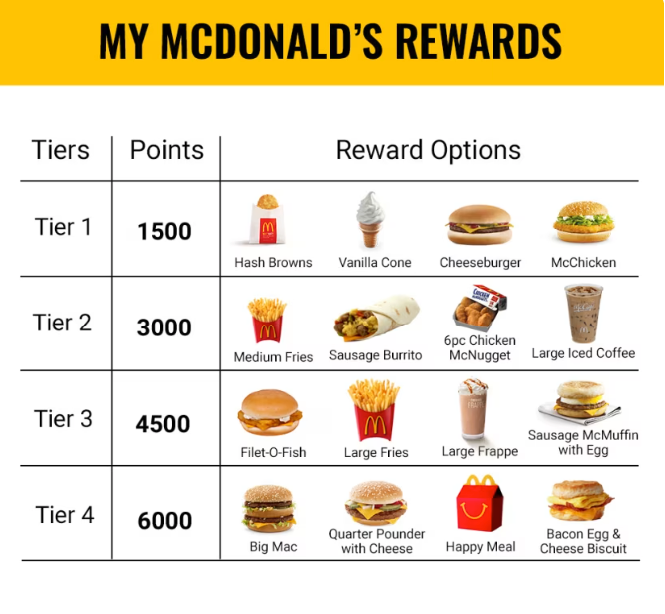
Source: McDonald’s
If you want to understand how point values are calculated for your store, our guide to loyalty points breaks it down in detail.
The omnichannel integration is what makes the earn side work. Points accumulate whether the customer orders through the app, taps a kiosk, or pulls through the Drive-Thru. No channel is excluded, so the program captures spending that would have been invisible under a single-channel model.
The expiry policy is where the behavioral engineering gets interesting. Points expire on the first day of the month after the sixth month from the date they were earned.
On the surface, that looks like a standard loyalty rule. In practice, it acts as a built-in re-engagement trigger. When customers realize they are about to lose points they have already earned, they have a concrete reason to come back. That pressure is often more effective than a generic promotion because it taps into loss aversion: people are more motivated to avoid losing value than to chase a new discount.
How to Redeem MyMcDonald's Rewards
Redeeming points is simple by design. The entire process happens inside the McDonald’s app, which keeps the experience fast and friction-light.
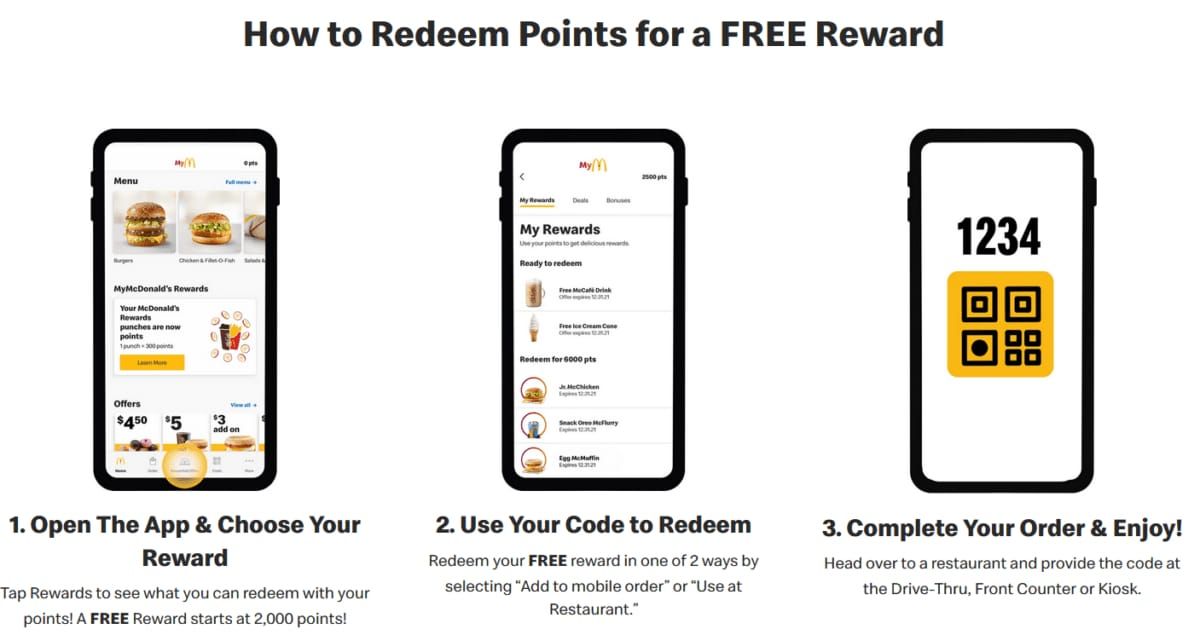
Step 1: Open the app and choose your reward.
Go to the Rewards section to see which items are available at your current balance. In the U.S., redemption starts at 1,500 points, so customers can unlock a reward relatively quickly instead of waiting too long for value. The app shows only the rewards the member is eligible for, eliminating guesswork and making the next step obvious.
Step 2: Select how you want to redeem it.
After choosing a reward, members can either select “Add to Mobile Order” to apply it directly in the app, or choose “Use at Restaurant” to generate a 4-digit code for in-store or Drive-Thru use. McDonald’s also says rewards can be used on McDelivery orders placed through the McDonald’s app.
Step 3: Complete the order and redeem the reward.
The customer then checks out in the app or gives the code to the crew before ordering at the counter or Drive-Thru. The reward is applied immediately, with no separate coupon, voucher, or extra redemption step. McDonald’s limits members to one reward per order, which keeps the process simple while still encouraging additional spending in the same transaction.
Strategic Pillars: Why the Pivot to Digital?
McDonald’s shift to digital was not just about keeping up with customer behavior. It was a strategic move to protect margins, increase visit frequency, and build a stronger first-party data advantage.
The first pillar is channel economics. Orders placed through third-party delivery platforms can help expand reach, but they also come with platform costs and weaker ownership of the customer relationship. McDonald’s has been pushing in the opposite direction: using its app, loyalty program, and integrated delivery experience to bring more ordering behavior into its own ecosystem. That priority is clear in the company’s long-term targets, which include generating 30% of delivery sales through integrated delivery by the end of 2027.
The second pillar is frequency at scale. Digital loyalty gives McDonald’s a direct way to keep customers engaged between visits and bring them back with more relevant offers. By the end of 2024, McDonald’s had more than 175 million 90-day active loyalty users across 60 loyalty markets, and those members generated approximately $30 billion in systemwide sales during the year. Those numbers show that digital is no longer a side channel. It is already a major revenue engine.
The third pillar is data ownership. Through its digital tools, McDonald’s can connect ordering behavior, loyalty activity, and offer engagement in one system. The company describes this as a way for customers to access personalized offers, participate in loyalty, and order through the mobile app, while giving McDonald’s a stronger foundation for targeted engagement. In other words, the brand is not just driving transactions through digital channels. It is building a system that helps it understand customers better and market to them more precisely over time.
That is what makes the digital pivot so important. It helps McDonald’s keep more value inside its own ecosystem, create more opportunities for repeat purchases, and rely less on rented access from third-party platforms. The company’s 2027 goals make that ambition even clearer: 250 million 90-day active loyalty users and $45 billion in annual systemwide loyalty sales.
CTA:
Build your own retention engine on Shopify. McDonald's loyalty architecture works at any scale. See how Joy replicates each pillar for Shopify merchants. [Install Joy free →]
Gamification & Psychology: Engineering the Habit Loop
The obvious appeal of MyMcDonald’s Rewards is free food. But free food is the surface-level hook. The real mechanism is behavioral economics.
Every purchase moves customers closer to a reward, and that visible progress makes the program feel immediately valuable.
Rewards begin at 1,500 points, which makes the first milestone feel reachable, while higher tiers extend the engagement cycle and encourage customers to keep going.
Users keep opening the app to check their progress even when they're not actively hungry. The habit loop operates independently of appetite.
The Personalization Engine: Data-Driven Offers
McDonald’s investment in personalization became much more visible in 2019, when it acquired Dynamic Yield, a decision-logic platform that it said would help tailor digital menu displays and recommendations. Reuters reported the deal was worth more than $300 million, and McDonald’s said the technology would be used to adjust Drive-Thru menus based on factors like time of day, weather, restaurant traffic, and trending items.
At the app level, personalization means segmented offers: specific add-ons pushed to customers with small point balances (clearing liability from the balance sheet while increasing check size), different deals for breakfast-only visitors vs. dinner regulars, and re-engagement messages timed to lapsed customers' typical visit window.
The lesson for merchants is not to build a $300 million AI stack. It is to use the customer data you already have, such as purchase history, order timing, and visit patterns, to make offers more relevant.
Financial Impact: Measuring the ROI of Loyalty
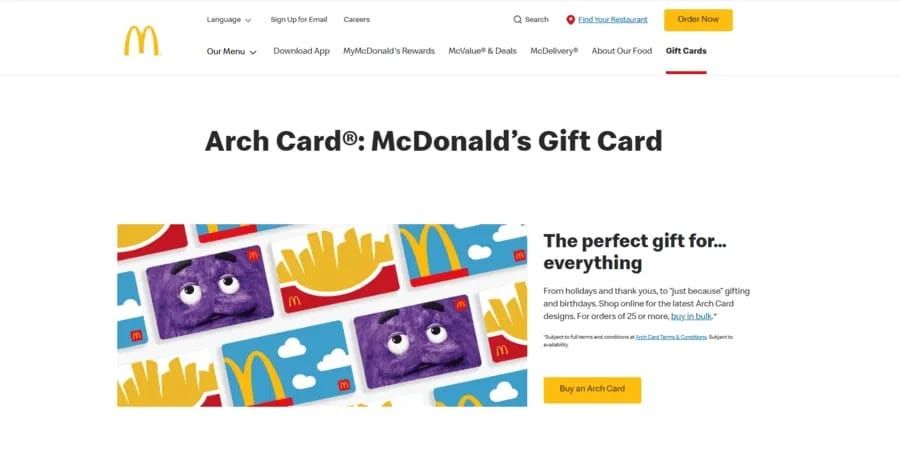
The numbers validate the entire strategy, proving that the points system prints money for the brand. The system generates over $20 billion in total systemwide sales growth, which proves the McDonald's loyalty program works.
Furthermore, the digital sales mix is massive, with digital sales accounting for over 40% of total sales in top markets.
Through a precise ROI analysis, we see that a loyalty member buys more than a non-member. Since the average check size is much larger and the points encourage extra add-ons, this drives up same-store sales.
The brand highlights this in every quarterly earnings report because the McDonald's rewards program is a core revenue driver that shows free items lead to bigger baskets.
Challenges and Friction Points in the Ecosystem
Although the growth is impressive, no digital system is perfect. The brand faces daily operational hurdles, such as scanning codes at the window, which creates bad user friction and slows the service (SOS) speed. This damages overall operational efficiency, while the six-month point expiry creates anger.
Even though the business needs to manage liability, customers hate losing points, which leads to a drop in customer sentiment. Additionally, app glitches add to the pain because a frozen screen stops the Drive-Thru line.
The tech gap also alienates older buyers who prefer cash and want counter service. Therefore, the brand must balance digital push with physical reality as the My McDonald's Rewards program still needs refinement.
3 Key Lessons for Shopify Merchants
You do not need billions to build a strong system, provided that you have the proper mechanics. The McDonald's loyalty program provides a perfect blueprint that we map to real Shopify stores using the Joy app.
Lesson 1: Keep Joining Simple (The Allbirds Example)
Since high barriers kill sign-ups, you must make joining instant. McDonald's uses a single tap to join, and Allbirds copied this low barrier by using the Joy app.
They let online buyers log in with KakaoTalk while offline buyers participate without creating an account. This simplicity drove massive success, resulting in a 1700% return on investment.
Lesson 2: Master the Omnichannel Experience (The SwitchBot Example)
Because customers shop everywhere, your points must follow them. Just as McDonald's connects the app and the Drive-Thru, SwitchBot does the same.
SwitchBot used the Joy API to create a unified omnichannel points system that lets customers earn points across the website, Amazon, and the mobile app. This deep Shopify integration solved their fragmented loyalty problem by unifying the customer journey.
Lesson 3: Use Tiers to Drive "VIP" Behavior (The Acrysty Co. Example)
Since status drives spending, you must reward your best buyers. McDonald's uses high tiers to lock in top spenders, and Acrysty Co. built a similarly strong tiered rewards system.
They used Joy to offer exclusive perks such as pre-orders and workshops. While Allbirds offered automatic discounts, Acrysty Co. saw 40% of its revenue come from loyalty members, proving that proper customer retention software makes this easy.
The Bottom Line
The McDonald's loyalty program is not just a discount app; it's a data-collection powerhouse that secures the future of retail. The system future-proofs the brand because the loss of tracking cookies makes a strict zero-party data strategy vital.
By owning the customer relationship, they build massive brand equity and guarantee sustainable growth. The My McDonald's Rewards program shows the exact path forward: you capture data, reward habits, and grow revenue.
Since small stores can do this too, you should build your system now to start tracking your buyers and copying the big players.
FAQs
How does McDonald's loyalty program drive revenue?
The revenue model relies on frequency because the program increases visits. One extra visit per year from millions of users adds massive sales while also increasing the average check size.
What is the difference between McDonald's App and MyMcDonald's Rewards?
The app is the shell, whereas the rewards are the engine. While the app allows ordering and payment, the My McDonald's Rewards program is the specific point system that tracks purchases.
How does McDonald's use gamification in loyalty?
Gamification builds habits by using visual progress bars and tiered goals. This creates a dopamine loop where users feel a strong need to complete the progress bar.
Why do McDonald's rewards points expire?
Expiration manages debt because unused points are a financial liability. Expiring them clears the balance sheet and creates urgency to force the customer back to the store.
Can small businesses replicate McDonald's loyalty strategy?
Yes, because the tools exist today. Small stores use the Joy app to build the same mechanics, using tiers and omnichannel tracking so that the strategy scales down perfectly.

Written by
Thomas Nguyen is the CEO & Co-founder of Joy, a loyalty solution for Shopify and eCommerce brands. With years of experience building high-performance Shopify apps, Thomas aims to help merchants grow through customizable and retention-focused tools.
Related reading
 Examples & Inspiration
Taco Bell Rewards Program: Complete Guide to Tiers, Points & Maximizing Value (2026 Update)
What can a fast-food chain teach ecommerce about retention? See how the Taco Bell Rewards program turns points into habit, frequency, and higher LTV.
 Thomas Nguyen
 Examples & Inspiration
American Airlines Loyalty program: $30B secret + Retention tricks
The American Airlines loyalty program is a $30B engine, not a perk. See how AAdvantage turns points into status, partners, and a retention flywheel you can copy.
Thomas Nguyen Examples & Inspiration
Hilton Honors 2026 Review: The Easiest Path to VIP Status?
The Hilton loyalty scheme just made elite status far easier to reach. See how Hilton Honors tiers, points sweet spots, and perks stack up for 2026 travelers.
Thomas Nguyen Examples & Inspiration
Gymshark Loyalty Program: XP, Tiers & Rewards Breakdown
After 13 years without one, Gymshark just launched its first loyalty program — powered by XP, workouts, and a 4-tier progression system. This breakdown covers the mechanics, the gaming psychology, the manual-opt-in strategy, and what Shopify brands can actually replicate.
Thomas Nguyen Examples & Inspiration
World of Hyatt Guide 2026: Tiers, Rewards & Sweet Spots
The Hyatt loyalty program (World of Hyatt) offers the best value per point in travel. See how to earn free nights, unlock elite tiers, and find the top sweet spots.
Thomas Nguyen Examples & Inspiration
Lufthansa loyalty scheme: Case study and strategic breakdown for e-commerce (2026)
What can an airline teach your store about retention? See how the Lufthansa loyalty scheme builds status, monetizes miles, and turns loyalty into infrastructure.
Thomas Nguyen