
Sephora Loyalty Program: How Beauty Insider Built the Gold Standard in Customer Retention
Sephora's Beauty Insider has 45M members in North America alone — more than Canada's population. This breakdown covers the three-tier structure, experiential rewards, gamification, and what Shopify brands can actually copy.
Summarize this post with AI
Forty-five million. That's how many Beauty Insider members Sephora now has in North America alone, according to a January 2026 Sephora Newsroom press release. More than the entire population of Canada.
Those members aren't just collecting points for fun, either. Beauty Insider members drive the majority of Sephora's sales (Modern Retail). And in LVMH's 2024 annual report, Sephora delivered double-digit growth in both revenue and profit. For a beauty loyalty program that launched back in 2007, those numbers point to something far deeper than discounts and birthday gifts.
So what makes this program actually work? And which parts can an ambitious Shopify brand replicate without Sephora's budget?
This article breaks down seven pillars of Sephora's Beauty Insider program with verified data from primary sources. For each one, we'll filter what's replicable at your scale versus what needs multi-billion-dollar backing.
Inside the Sephora Beauty Insider Program: How the Three-Tier Structure Drives Aspirational Spending
Everything in Beauty Insider builds on one foundation: the three-tier structure. Without it, the experiential rewards, gamification, and emotional loyalty discussed later would have no framework to sit within. The tiers come first.
Insider, VIB, and Rouge: The Spending Thresholds
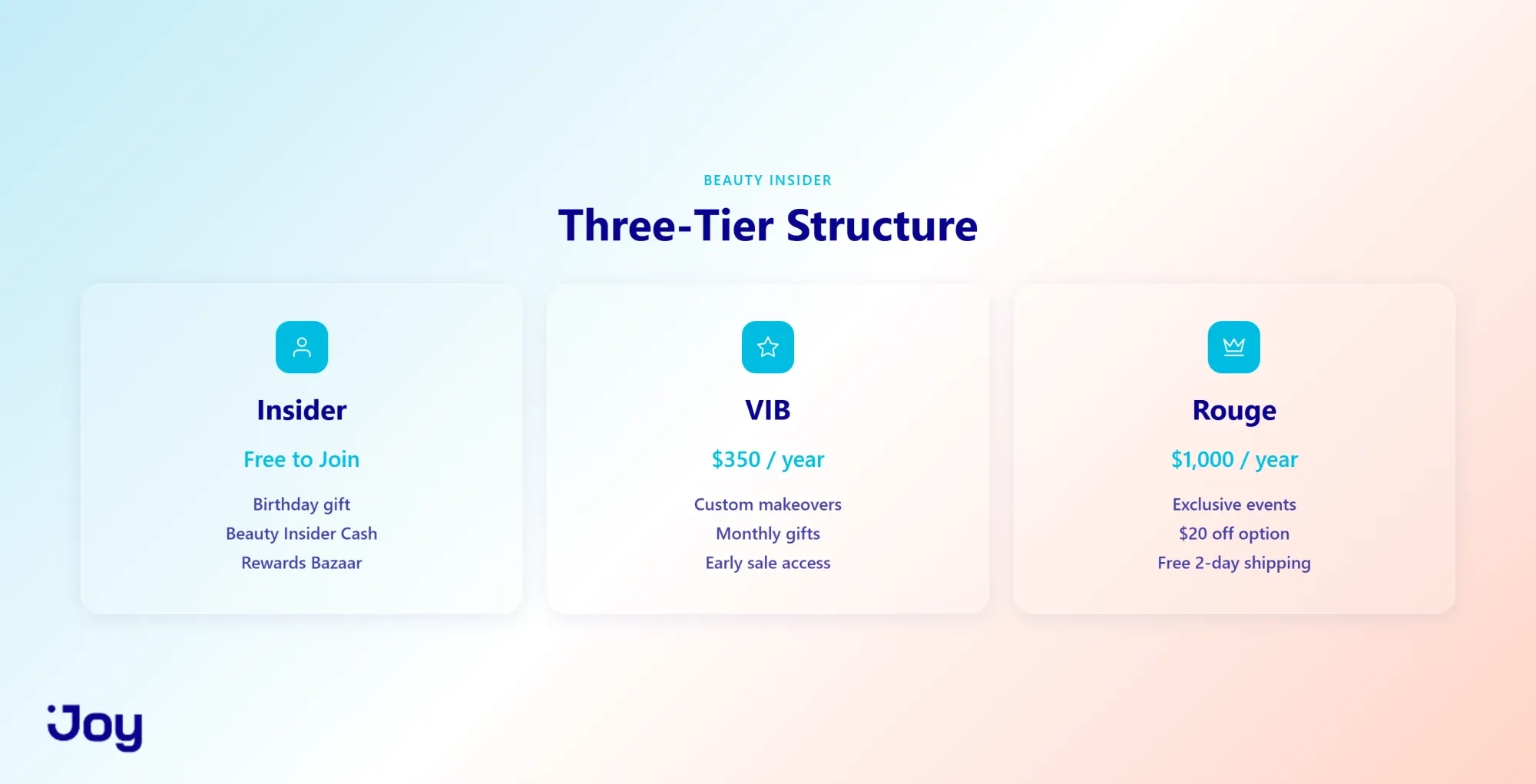
The entry point is frictionless. Insider tier is free to join with no minimum spend, and it gives members immediate access to birthday gifts, Beauty Insider Cash, and the Rewards Bazaar.
From there, the tiers escalate:
- VIB: $350 per year in spending unlocks custom makeovers, monthly gifts, and early access to sales events.
- Rouge: $1,000 per year unlocks exclusive access to the Rouge Celebration event, free two-day shipping, a private beauty advisor hotline, and an exclusive 1,000-point = $20 off redemption option.
All tiers earn at the same rate: one point per dollar spent (Sephora.com). Redemption works through Beauty Insider Cash, where 500 points convert to $10 off. Rouge members also get an exclusive 2,500 points for a $100 redemption, which works out to a 4% return.
Seasonal savings events reinforce the aspiration, too. All tiers can access these sales (typically twice per year), but discount percentages go up by tier. Rouge gets the highest percentage and the earliest access. That alone gives Insider and VIB members one more reason to push toward the next level.
These thresholds aren't arbitrary. $350 catches mid-frequency shoppers who are already engaged. $1,000 isolates the highest-value advocates. Together, they create a ladder that pulls customers upward. For a deeper look at how this works across industries, see these tiered loyalty programs that use the same principle.
Why 6% of Sephora Beauty Insider Members Drive Outsized Value
This is where the tier structure shows its real power. According to Emmy Berlind, Sephora's SVP of Loyalty, in an October 2025 BeautyMatter interview, Rouge members represent only 6% of total Beauty Insider membership.
Six percent. And yet Rouge members are the highest-frequency shoppers, lead in birthday gift redemptions, hold the largest share of Sephora credit cards, and participate in challenges at the highest rates (BeautyMatter).
This mirrors a pattern familiar to anyone who studies VIP loyalty programs: a small top tier generates disproportionate revenue and engagement. The Pareto principle, playing out in real time.
But the value isn't only in what Rouge members spend. It's in what their visible status does to everyone else. Insider and VIB members see Rouge benefits, recognize the gap between where they are and where they could be, and increase spending to close it. The tier works as both a reward AND a growth driver. And that psychology applies at any scale. Brands with as few as 500 members can create visible tier targets that motivate spending. No 45-million-member base required.
The Point Math: How Beauty Insider Cash Creates Perceived Value
The math is straightforward. One point per dollar, 500 points for $10 off. That's an effective return rate of 2% cashback.
Rouge's new 2025 option of 1,000 points for $20 off still equals 2%, yet it feels bigger because the numbers are larger. Psychological framing at work.
The real play, though, is the Rewards Bazaar. Instead of converting points to dollars, members can redeem for deluxe samples, limited-edition products, and exclusive experiences. The perceived value of these rewards far exceeds their dollar equivalent. And that gap? Completely intentional.
Sephora's strategy is clear: keep monetary returns low to protect margins while delivering high perceived value through exclusivity and scarcity.
Sephora Beauty Insider Rewards Program: Why Experiences Beat Discounts
The tier structure creates aspiration. The next question writes itself: what do those tiers actually unlock? For Sephora, the answer isn't bigger discounts. It's exclusive experiences that money alone can't buy.
The Rouge Celebration Event: Sephora's Signature Experience
In August 2024, Sephora launched its first Rouge Celebration, a four-day event spanning in-store and online activations. The scale was significant: 30 brands activated across 13 stores, and over 300,000 Rouge members shopped during the event (BeautyMatter, executive data).
The 2025 follow-up delivered double-digit year-over-year sales growth and a 40%+ increase in average order volume (BeautyMatter). A four-times points promotion on Sephora Collection items exceeded forecasts by a triple-digit increase.
Rewards included exclusive merchandise, virtual masterclasses, early product access, and brand-specific activations. As Emmy Berlind put it: "Anyone can offer a discount." The point is to create experiences that only Sephora can deliver.
What makes this especially effective is the double duty. The Rouge Celebration rewards existing Rouge members for their loyalty while simultaneously motivating VIB members to hit $1,000 in annual spending. One event, two retention functions.
Brand Partnerships That Extend the Rewards Beyond Beauty
Sephora's experiential strategy goes well beyond its stores. Recent partnerships include DoorDash for same-day delivery, Lyft ride credits that incentivize store visits, and Venmo as a payment option. On the entertainment side, Golden State Valkyries game tickets showed up as an experiential reward.
These partnerships expand the loyalty ecosystem beyond cosmetics entirely. Members get value from the program even when they're not buying beauty products, and every partnership touchpoint reinforces Sephora's lifestyle positioning.
The principle worth noting here: the more places a loyalty program delivers value, the harder it becomes for members to leave.
How Sephora Beauty Insider Members Build Emotional Loyalty, Not Just Transactional
Tier psychology creates aspiration. Experiential rewards justify the spend. But what keeps 45 million members coming back isn't either of those things alone. It's the emotional connection that makes leaving feel like a personal loss. And understanding this distinction separates surface-level programs from the ones that actually endure.
Emotional vs. Transactional Loyalty: The Distinction That Changes Everything
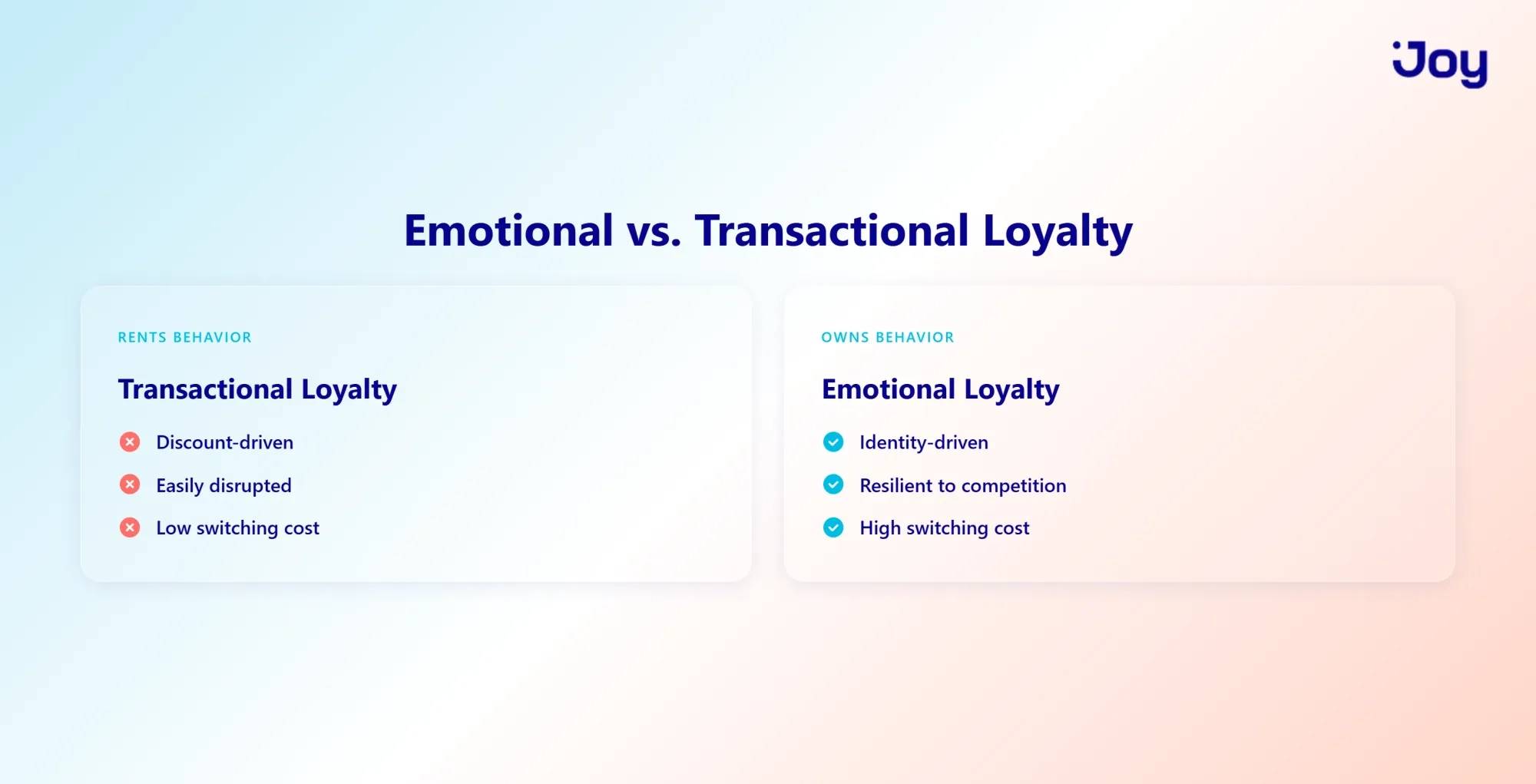
Transactional loyalty is fragile. "I buy here because I get points" works right up until a competitor offers better points. One promotion away from defection.
Emotional loyalty runs deeper. "I buy here because I belong, because I'm understood, because I identify with this brand." That kind of connection is resilient, resistant to competitor offers, and the foundation of organic advocacy.
Sephora's explicit strategy, described across multiple executive interviews, is to move beyond what industry insiders call "need and greed" toward genuine emotional connection. In practice? A member choosing Sephora over a competitor not because of a coupon, but because they feel part of something.
The business outcome is measurable: emotionally connected customers carry higher lifetime value, lower churn rates, and become advocates who generate new customers without additional acquisition spend.
The Beauty Insider Community: How Sephora Operationalizes Belonging
Where emotional loyalty gets concrete is the Beauty Insider Community platform. Members use forums to share reviews, beauty tips, product recommendations, and advice. The content is peer-to-peer, not top-down, which means the value comes from the community itself.
These interactions generate zero-party data at scale: shade preferences, skin concerns, product interests, routine details. All of it feeds back into Sephora's personalization engine (more on that in the omnichannel section).
The community also creates a switching cost that's easy to overlook. A member's review history, community reputation, and connections don't transfer to Ulta or Amazon. Leaving means starting over from scratch.
As Berlind put it: "We're not just offering rewards. We're creating a community that feels valued and understood."
The community isn't a feature. It's a moat.
Inside the Beauty Insider Program Gamification Strategy: Challenges That Tripled Expectations
Tiers create structure. Experiences justify spending. Community builds emotional bonds. But between purchases, members need a reason to stay engaged. That's where gamification fits into Sephora's model. And the results exceeded even their own projections.
How Beauty Insider Challenges Work: The Task-Based Engagement Model
Launched in 2023, Beauty Insider Challenges were Sephora's first gamified loyalty feature. The format is task-based rather than spend-based. Big difference.
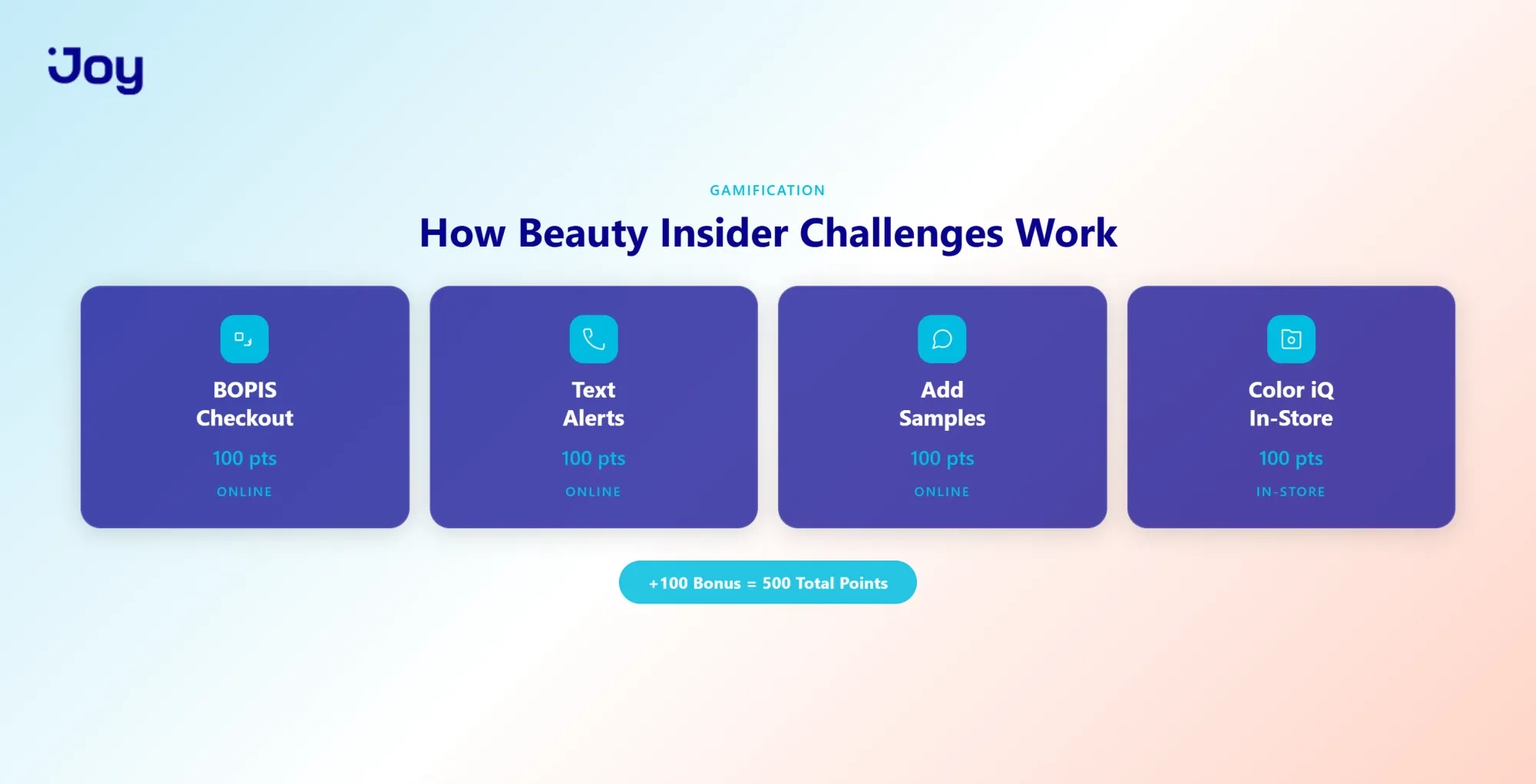
Take the "Ready, Set, Sephora" challenge. It includes four tasks: complete a BOPIS (Buy Online, Pick Up In-Store) checkout, sign up for text alerts, add samples at online checkout, and try Color iQ shade matching in-store. Each task earns 100 points, plus a 100-point bonus for completing all four, totaling 500 points ($10 value).
Two design choices stand out. First, the tasks mix purchase and non-purchase actions, lowering the barrier to participation. Second, they deliberately bridge online and in-store channels. A member starts online and finishes in-store, or vice versa.
Challenges are available to all tiers. That's important. They don't just engage the top; they drive participation at every level of the program.
The Results: Why Gamification Is Sephora's Growth Engine
The first two Beauty Insider Challenges tripled Sephora's expected participation (Glossy, citing Sephora). Over two million new Beauty Insider signups participated in challenges (Glossy). Rouge members participated at the highest rate (Emmy Berlind, BeautyMatter).
Industry benchmarks support the investment. Research from Snipp Interactive found that companies using gamification see a 47% rise in engagement and a 22% rise in brand loyalty. And roughly 60% of Gen Z and millennials play digital games at least once per week (Gartner, 2021). Gamification speaks a language this demographic already uses daily.
Passive point-earners turned into active participants. And two million new members signed up in the process.
Sephora's Beauty Insider Program Omnichannel Strategy: Consistent Across Every Touchpoint
Gamification bridges online and in-store behavior. But for that bridge to hold, the underlying experience needs to feel identical no matter where a member interacts. That's where Sephora's omnichannel architecture comes in, connecting app, store, and digital into one unified system.
The Omnichannel Architecture: App, Store, and Digital in Sync
Sephora's mobile app handles product discovery, reviews, purchase history, point balances, and reward redemption, all synced in real time with in-store activity. In physical locations, tools like Color iQ (a skin-tone analysis system) deliver personalized recommendations that feel native to the experience.
Cross-channel bridges show up everywhere. Challenges require both online and in-store actions. DoorDash enables same-day delivery. Lyft ride credits push members toward store visits. As Emmy Berlind explained: "We try to make sure that the experience feels seamless across both retail and digital."
Whether a member earns points from their phone at midnight or at a counter on Saturday afternoon, the experience is the same.
Personalization Powered by Zero-Party Data
Every touchpoint in Beauty Insider also serves as a data-collection point. Color iQ results, beauty quizzes, wish lists, community reviews, purchase history, challenge participation: all of it qualifies as zero-party data (information customers intentionally and proactively share).
Sephora uses this data for specific product recommendations, targeted promotions, personalized beauty advice, and customized notifications. Berlind noted: "Customers are expecting increasing amounts of personalization. It's not just about earning points."
What makes this especially powerful is the compounding effect. Every interaction generates data that makes the next interaction more relevant, which drives more interaction, which generates more data. A self-reinforcing loop that competitors can't shortcut. And the longer a member stays, the wider the gap becomes.
The Sephora Loyalty Program Business Impact: The Numbers Behind the Strategy
The strategic pillars above sound impressive. But does all this investment in tiers, experiences, and personalization actually translate to revenue? The data says yes, and the trajectory is accelerating.
Membership Growth and Sales Contribution
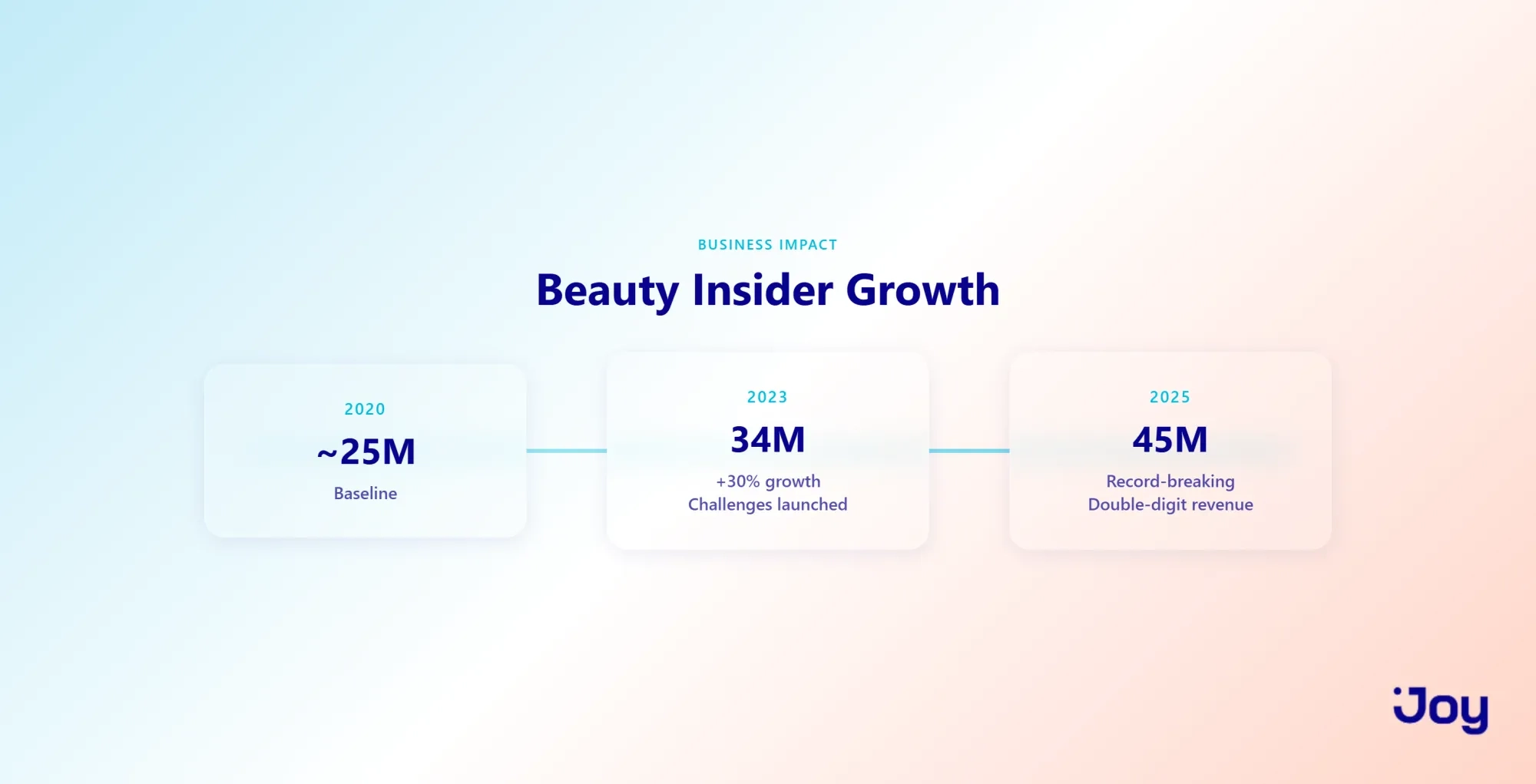
Beauty Insider's growth curve tells the story: approximately 25 million members in 2020, 34 million by 2023 (a 30% increase), and 45 million in North America by 2025. A record-breaking milestone (Glossy; Sephora Newsroom).
Those members drive the majority of Sephora's sales (Modern Retail). On the corporate side, LVMH's Selective Retailing division (which includes Sephora, DFS, and Le Bon Marche) reported 18.26 billion euros in revenue in 2024, reflecting 6% organic growth. Sephora specifically delivered double-digit growth in both revenue and profit (LVMH 2024 Annual Results).
The Kohl's partnership adds another dimension: $1.4 billion in Sephora at Kohl's sales in 2023, rising to $1.8 billion in 2024, with projections exceeding $2 billion by 2025 across 1,000+ locations (Kohl's Corporate).
For Shopify brands tracking loyalty-generated revenue, Joy's Assisted Orders metric provides the same clarity. It tracks exactly how many orders your loyalty program generates, proving ROI with the precision Sephora demonstrates to LVMH. Among loyalty program examples, this level of attribution distinguishes between guessing and knowing.
What the Competition Looks Like
Sephora doesn't operate in a vacuum. Ulta Beauty reported 42.2 million rewards members at the end of 2022, with 95% of its revenue attributed to rewards program members (Glossy). Across the broader retail space, 86% of U.S. shoppers belong to at least one loyalty program, and 31% of CMOs increased loyalty investment in 2024 (Modern Retail).
Sephora's edge isn't in member count. Both brands prove the same thesis: in beauty retail, the loyalty program is the business. Sephora's differentiation comes from its investment in experiential and emotional loyalty design. The pillars we've just covered.
What You Can Steal from Sephora's Beauty Insider Loyalty Program, and What Requires Sephora-Scale Resources
Every article on this keyword tells you to "learn from Sephora." None of them filter for feasibility. This section does. For each pillar above, here's what an ambitious Shopify brand at $50K to $500K per month can realistically replicate, and what needs multi-billion-dollar backing.
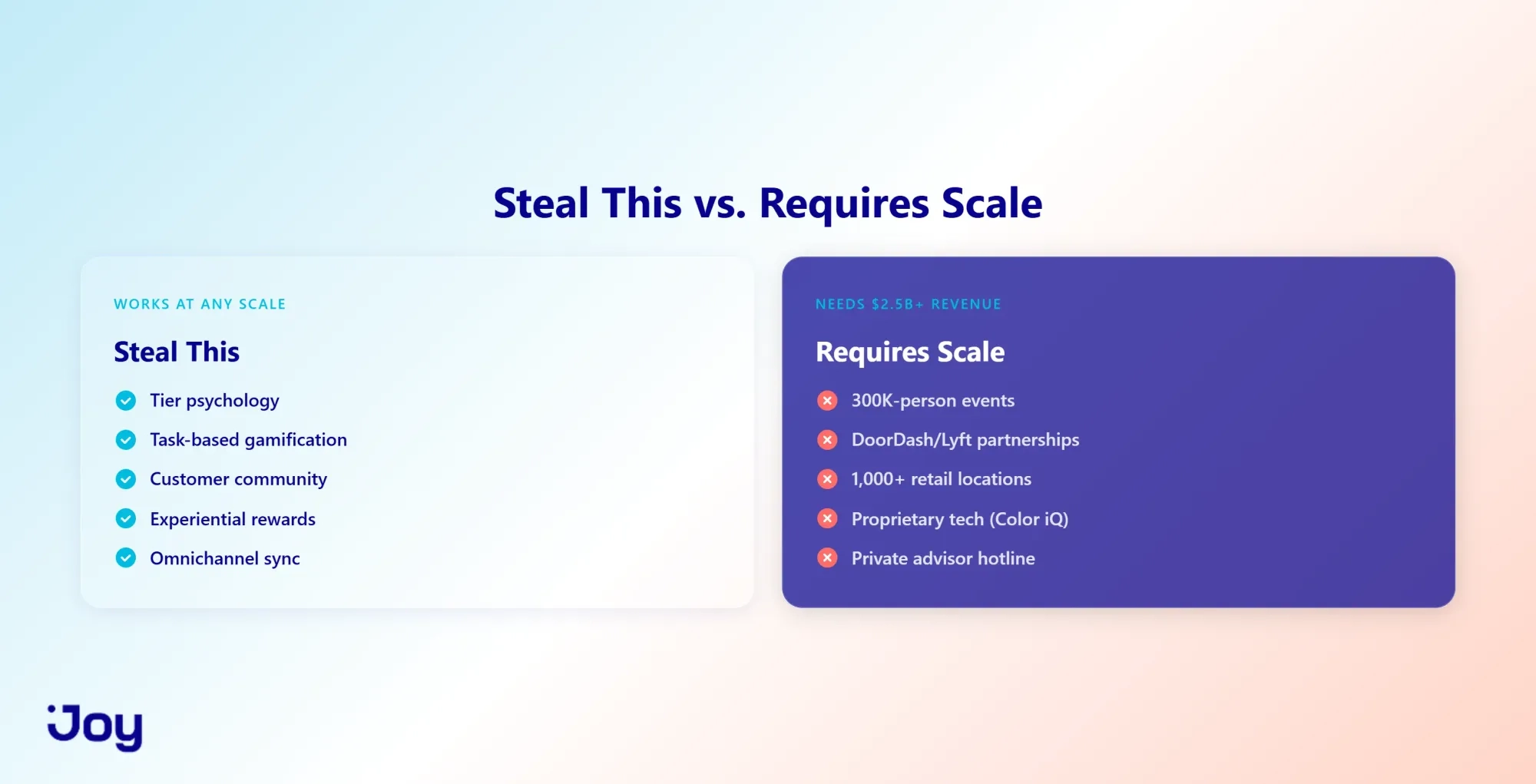
What You CAN Steal: Tactics That Work at Any Scale
Tier psychology. Set three tiers with clear spend thresholds. The aspiration works regardless of brand size. You don't need 45 million members for tier psychology to drive behavior. It works with 500.
Challenge-based gamification. Task-based point earning (review a product, follow on social, refer a friend, complete a quiz) creates the same behavioral nudges at any scale. Sephora's first challenge tripled expectations with simple tasks, not expensive technology.
Community features. Enable customer reviews, Q&A, and product tips. These build switching costs and generate zero-party data. Beauty Insider Community started as basic forums before evolving into what it is today.
Experiential rewards beyond discounts. Early product access, VIP-only sales, birthday perks, and exclusive content cost very little to deliver but create perceived value that far exceeds the monetary investment.
Point math with perceived value. Low cashback (2%) combined with high exclusivity means members feel rewarded without destroying your margins. The value is in access and status, not dollars off.
Omnichannel sync. Unified online and POS profiles are available to any Shopify brand with POS today.
The most powerful Sephora tactics demand intentional program design, not Sephora-scale budgets.
What Requires Sephora-Scale: Know Your Limits
Not everything transfers. And pretending otherwise wastes time and money.
- 300,000-person exclusive events across 13+ stores require a massive physical retail footprint and deep brand partner relationships.
- DoorDash, Lyft, and Venmo partnerships require negotiating power that comes with 45 million members and LVMH backing.
- 1,000+ Kohl's shop-in-shop locations took decades of scale to build.
- Proprietary technology like Color iQ requires significant R&D investment beyond most brands' reach.
- A private beauty advisor hotline requires staffing infrastructure that's hard to justify at a smaller scale.
The honest takeaway: don't copy these. Adapt the underlying principle (convenience, personalization, exclusivity) to your scale.
How Joy Makes Sephora-Style Loyalty Accessible
For the tactics that do work at any scale, Joy provides the Shopify-native foundation to execute them:
- Custom tiers with flexible spend thresholds and automatic progression
- Points for non-purchase actions like reviews, social follows, referrals, and birthdays
- Reward options beyond discounts, including early access and VIP status
- Shopify POS integration for unified earn-and-redeem across online and in-store
- Assisted Orders tracking to measure loyalty-generated revenue, the way Sephora tracks member sales contribution
The framing isn't "be the next Sephora." It's this: apply what Sephora proved works, at your scale, with a fraction of the complexity. If you're ready to create a loyalty program built on these principles, start with tiers, points, and one experiential reward. Then layer on gamification and community as you grow.
Start building on Shopify or book a demo to see how Joy fits your store.
Build Your Own Beauty Insider
Seven pillars. Tier structure, experiential rewards, emotional loyalty, gamification, omnichannel integration, personalization, and business impact. Each one compounds on the others, and together they form the retention engine behind 45 million memberships.
But here's what most analysis misses: Sephora didn't build Beauty Insider overnight. It launched in 2007 as a basic points program and evolved over 19 years into what it is today (Modern Retail).
You don't need to launch all seven pillars at once. Start with tiers, a points system, and one experiential reward. Layer gamification and community features as your program matures and your data grows.
The brands that dominate customer retention in 2026 won't be the ones with the biggest budgets. They'll be the ones that design the smartest loyalty programs and command the retention advantage that follows.
FAQ
Is Sephora Beauty Insider free to join?
Yes. The base Insider tier is completely free with no minimum spend. You earn one point per dollar and get access to birthday gifts, Beauty Insider Cash, and the Rewards Bazaar immediately.
How many tiers does Sephora Beauty Insider have?
Three: Insider (free), VIB ($350 per year), and Rouge ($1,000 per year). Each tier unlocks additional benefits like early sale access, exclusive events, and higher-value redemption options.
How many points do you need for Rouge status?
$1,000 in annual spending, which equals 1,000 points earned. According to Sephora's SVP of Loyalty, only about 6% of Beauty Insider members reach the Rouge tier.
What is Beauty Insider Cash?
It converts points to dollars off purchases: 500 points equals $10 off. Rouge members get an exclusive option of 1,000 points for $20 off. The effective return rate is approximately 2%.
When is the Sephora Rouge Celebration event?
The first was held in August 2024 across 13 stores. It's an annual event exclusive to Rouge members, featuring brand activations, exclusive merchandise, and bonus point promotions.
How do Beauty Insider Challenges work?
Task-based activities (like using BOPIS checkout or trying Color iQ in-store) that earn 100 points each, plus a bonus for completing all tasks. Available to all tiers.
Is Sephora's loyalty program better than Ulta's?
Different strengths. Sephora focuses on experiential rewards and emotional loyalty. Ulta offers higher cashback (up to 8%). Sephora has 45 million members; Ulta has 42.2 million. Both drive the majority of their company's sales through loyalty members.
Can smaller brands replicate Sephora's loyalty strategy?
For the core tactics, absolutely. Tier psychology, gamification, experiential rewards, and community features all work at any scale. What Sephora-level resources are needed for the massive events, brand partnerships, and proprietary technology?
What makes Sephora's loyalty program different from other beauty retailers?
The investment in emotional connection and experiences over discounts. The community platform, gamified challenges, and cross-category partnerships (DoorDash, Lyft) create value beyond beauty products. Most competitors focus on cashback; Sephora focuses on belonging.
How does Sephora use customer data from Beauty Insider?
Sephora collects zero-party data through Color iQ, beauty quizzes, wish lists, community activity, and purchase history. This feeds personalized recommendations, targeted promotions, and customized experiences across all channels.

Written by
Thomas Nguyen is the CEO & Co-founder of Joy, a loyalty solution for Shopify and eCommerce brands. With years of experience building high-performance Shopify apps, Thomas aims to help merchants grow through customizable and retention-focused tools.
Related reading
 Examples & Inspiration
Gymshark Loyalty Program: XP, Tiers & Rewards Breakdown
After 13 years without one, Gymshark just launched its first loyalty program — powered by XP, workouts, and a 4-tier progression system. This breakdown covers the mechanics, the gaming psychology, the manual-opt-in strategy, and what Shopify brands can actually replicate.
 Thomas Nguyen
 Examples & Inspiration
Taco Bell Rewards Program: Complete Guide to Tiers, Points & Maximizing Value (2026 Update)
What can a fast-food chain teach ecommerce about retention? See how the Taco Bell Rewards program turns points into habit, frequency, and higher LTV.
Thomas Nguyen Examples & Inspiration
American Airlines Loyalty program: $30B secret + Retention tricks
The American Airlines loyalty program is a $30B engine, not a perk. See how AAdvantage turns points into status, partners, and a retention flywheel you can copy.
Thomas Nguyen Examples & Inspiration
Hilton Honors 2026 Review: The Easiest Path to VIP Status?
The Hilton loyalty scheme just made elite status far easier to reach. See how Hilton Honors tiers, points sweet spots, and perks stack up for 2026 travelers.
Thomas Nguyen Examples & Inspiration
Avis Preferred 2026 Guide: Skip the Line & Earn Free Days
The Avis loyalty program (Avis Preferred) lets you skip the counter and earn free rental days. See how the tiers, points math, and status shortcuts work in 2026.
Thomas Nguyen Examples & Inspiration
Ulta Loyalty Program: The Strategy Behind 95% Sales
Ulta Beauty Rewards drives 95% of $12.4B in revenue with 46.7M active members. This breakdown covers the three-tier structure, point system, data personalization, and the rebrand strategy — plus what Shopify brands can actually replicate at their own scale.
Thomas Nguyen