
Customer Loyalty Pyramid: 5 Stages to Brand Advocacy
Your best customers don't quit — they quietly drift away. The customer loyalty pyramid maps all five stages of the relationship, shows where customers get stuck, and gives you tactics to move them up before stealth attrition takes hold.

Summarize this post with AI
Your best customers are leaving, and most of them won't tell you why.
It's called stealth attrition. Customers quietly slip away without a complaint, a bad review, or a cancellation email. One quarter, they're buying regularly. The next, they're gone. No alarm goes off, so businesses keep pouring resources into acquisition while the profitable customers disappear.
The customer loyalty pyramid gives you a way to see what's normally invisible. It maps every customer relationship across five distinct stages, from initial discovery to active brand advocacy. But the real value? It reveals exactly where customers get stuck, where they start sliding backward, and where a small intervention produces an outsized return.
Most companies concentrate their efforts at the bottom of the pyramid while ignoring the stages where emotional connection actually forms.
What follows is a breakdown of each stage in the customer loyalty pyramid, the behavioral and attitudinal forces that drive movement between them, and practical tactics to move customers upward before stealth attrition takes hold.
What Is the Customer Loyalty Pyramid? A 5-Stage Model
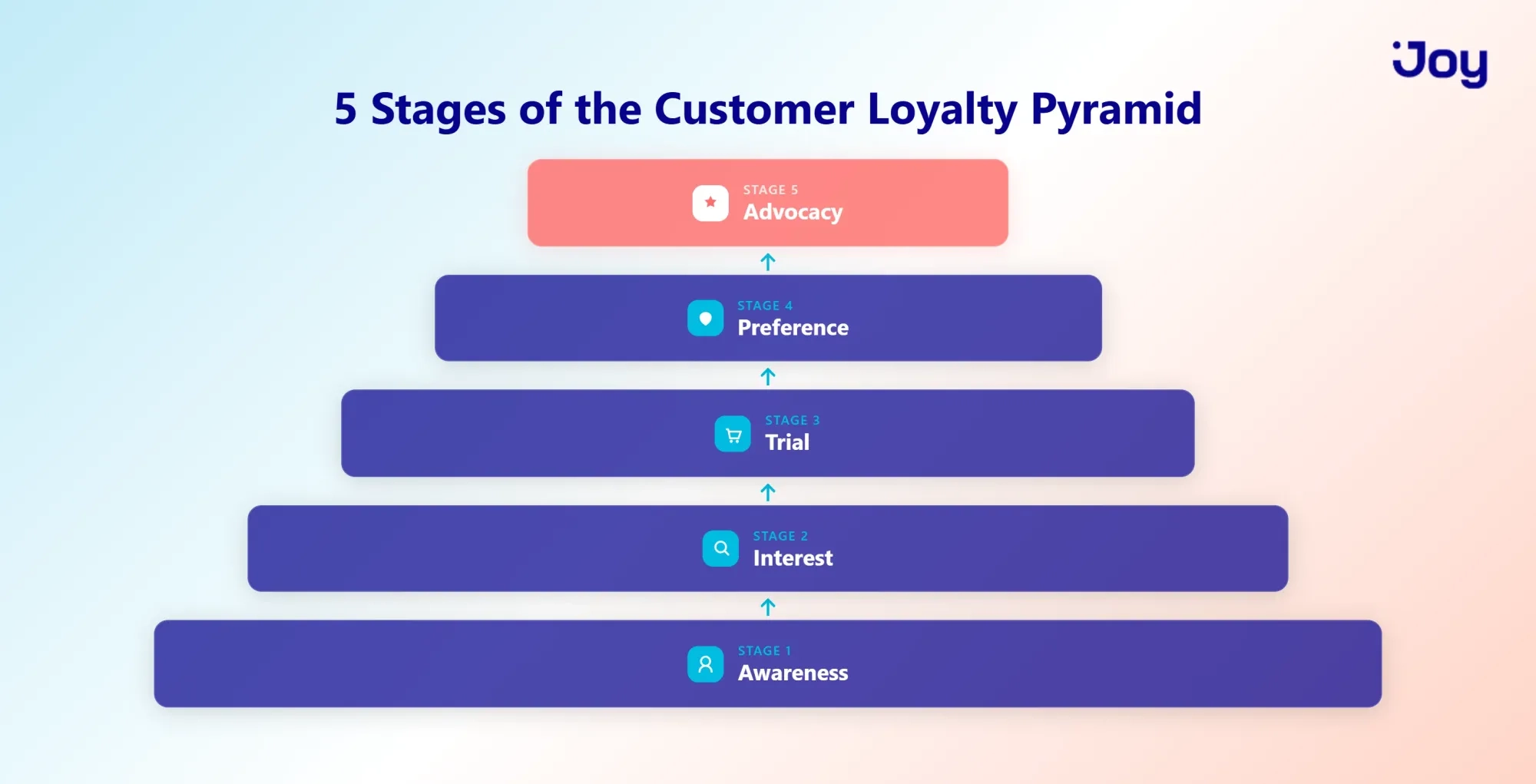
The customer loyalty pyramid organizes customer relationships into five progressive stages. Each one represents a deeper level of commitment, and together they form a visual hierarchy: a broad base of casual awareness narrowing to a small peak of passionate advocacy.
Think of it as a diagnostic tool, not just a theoretical model. When you map your customer base onto these five stages, you can immediately spot where people cluster, where they drop off, and which transitions need the most attention.
The Five Stages of the Customer Loyalty Pyramid
Stage 1: Awareness. The customer knows your brand exists but has zero personal experience with it. They may have seen an ad, stumbled onto your website, or heard your name in passing. You're one option among many, and the relationship is entirely superficial.
Stage 2: Interest. Something sparks curiosity. The customer starts researching your brand, reading reviews, comparing prices, or following you on social media. They're actively evaluating whether you deserve their attention. But they haven't committed a single dollar.
Stage 3: Trial. The first purchase happens. This is the moment of truth, where expectations meet reality. Product quality, the checkout experience, shipping speed, and post-purchase follow-up: all of it shapes whether this transaction becomes a relationship or a dead end.
Stage 4: Preference. The customer returns. They choose your brand over alternatives not because of a discount, but because of genuine preference. Repeat purchases begin, and price sensitivity starts declining. The relationship shifts from transactional to something more personal.
Stage 5: Loyalty and Advocacy. The customer becomes emotionally invested. They recommend you to friends, defend you in online conversations, and promote your products without being asked. Research from Motista shows that customers at this stage carry a 306% higher lifetime value, staying connected for 5.1 years on average compared to 3.4 years for merely satisfied customers.
Why Emotional Loyalty Is the Game-Changer in the Customer Loyalty Pyramid
Behavioral vs. Attitudinal Loyalty
Not all loyalty looks the same. Some customers buy from you regularly out of pure habit. Others genuinely prefer your brand but purchase infrequently. These two patterns reflect fundamentally different forces.
Behavioral loyalty shows up in the data: purchase frequency, order value, repeat buying patterns. A customer with high behavioral loyalty keeps coming back. But this loyalty can be fragile. If a competitor offers a better deal or a more convenient option, habitual buyers often switch without hesitation.
Attitudinal loyalty lives in the customer's mind. It reflects genuine emotional preference: the customer chooses your brand even when a cheaper alternative sits right next to it on the shelf. And it's far harder for competitors to replicate.
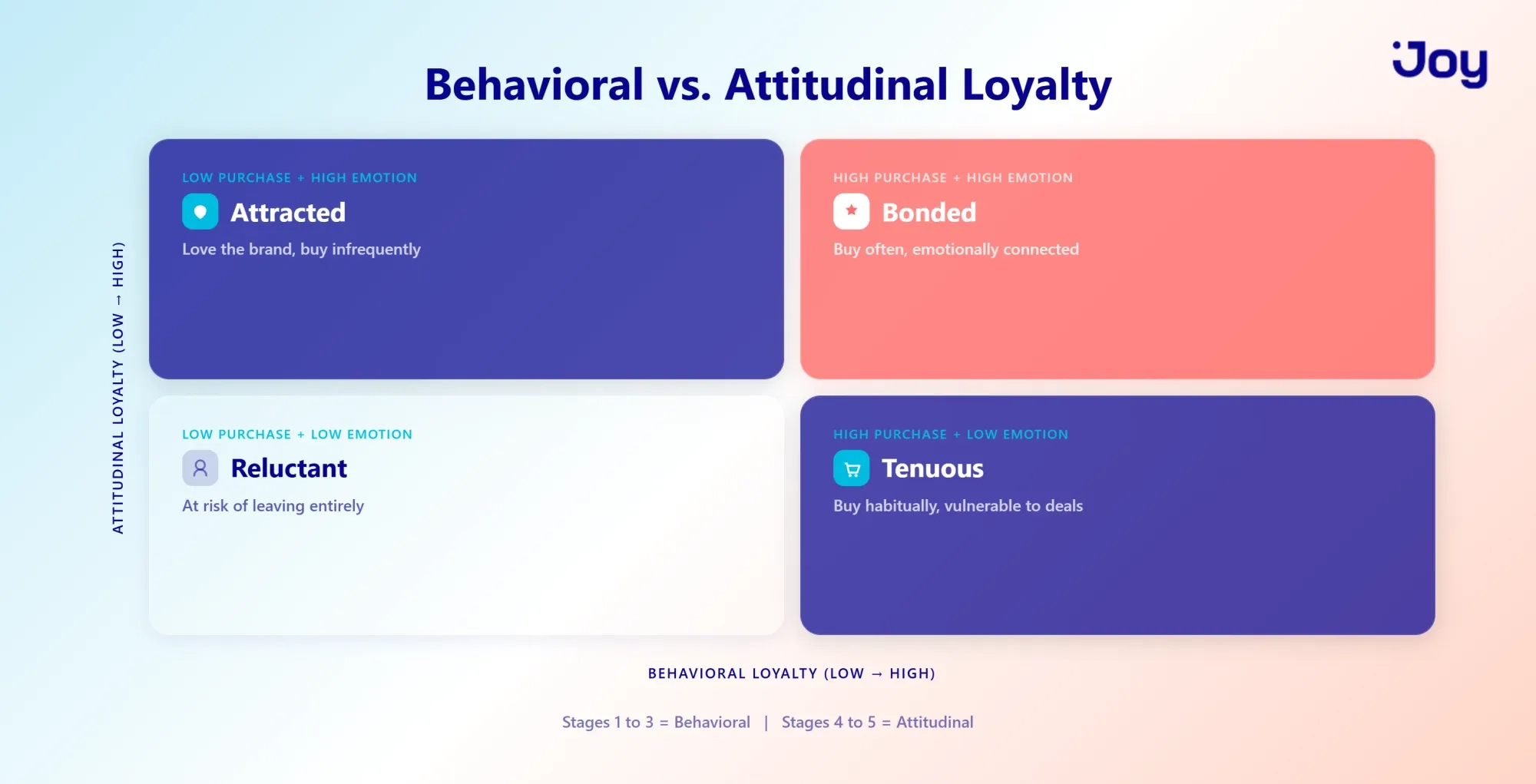
When you combine both dimensions, four distinct segments emerge:
- Bonded (high behavioral + high attitudinal): Your most valuable customers. They often buy and feel emotionally connected. Protect these at all costs.
- Attracted (low behavioral + high attitudinal): They love your brand but don't buy frequently. These customers need more touchpoints and reasons to purchase.
- Tenuous (high behavioral + low attitudinal): They buy out of habit or convenience, not emotion. Vulnerable to any competitor with a slightly better deal.
- Reluctant (low behavioral + low attitudinal): At risk of leaving entirely. Intervention is needed before they disappear.
So, where does this split matter in the pyramid? Stages 1 through 3 are driven primarily by behavioral factors. Customers at these levels interact with your brand because of price, convenience, or curiosity. But Stages 4 and 5 require attitudinal loyalty to sustain. Without an emotional connection, customers plateau at Trial and never progress to Preference. That's the gap most businesses don't see.
The Business Case for Emotional Loyalty
The numbers are hard to argue with. Harvard Business Review found that emotionally connected customers are 52% more valuable than those who are merely satisfied. And McKinsey reports that 78% of customers are more likely to repurchase when the experience feels personalized, one of the most effective emotional loyalty drivers.
What does this mean in practice? The transition from Stage 3 (Trial) to Stage 4 (Preference) is the single most important inflection point in the entire pyramid. And because emotional loyalty can't be bought with discounts alone, the tactics required at this stage are fundamentally different from those that work lower down.
The 80/20 Rule and the Customer Loyalty Pyramid
The Pareto Principle answers the resource allocation question directly. In most businesses, roughly 20% of customers generate 80% of total profits. Overlay this onto the customer loyalty pyramid, and the top two tiers (Preference and Advocacy) represent that profitable 20%.
How the Pareto Principle Applies to Pyramid Stages
Most businesses get this backward. The instinct is to pour marketing budgets into acquiring new customers at the Awareness and Interest stages. But the math points the other direction.
Research from Bain & Company confirms that a 5% increase in customer retention can produce up to a 95% increase in profits. Even in conservative scenarios, academic studies show that a 5 to 10% improvement in retention consistently delivers a 25 to 95% increase in profit when combined with behavioral analytics.
The highest return comes from investing in customers stuck in the middle tiers. Specifically, those at Stage 3 (Trial) who need a push toward Stage 4 (Preference). These customers have already demonstrated interest and made a purchase. The hardest part of the acquisition funnel is behind them. What they need now is a reason to come back. Not a coupon. A reason.
Stealth Attrition: Identifying Customers Leaving the Customer Loyalty Pyramid
Stealth attrition is the silent killer of customer loyalty programs. Unlike visible churn (canceled subscriptions, angry support tickets), stealth attrition happens without warning signals. Customers gradually pull away, reduce purchase frequency, ignore emails, and eventually vanish.
What Is Stealth Attrition?
The pattern is recognizable once you know what to watch for. A customer who once sat comfortably at Stage 4 (Preference) begins sliding back to Stage 3 or even Stage 2. They stop buying as frequently. They disengage from loyalty communications. They start comparing prices again, something they'd previously stopped doing. And because they never complain, their departure goes unnoticed until it's too late.
What drives it? In most cases, the emotional connection eroded. A competitor offered a slightly better experience. A personalized touchpoint was missing. Or the brand simply stopped giving the customer reasons to stay engaged beyond that initial purchase.
Pyramid-Based Early Warning Signs
The customer loyalty pyramid provides a built-in detection framework when you know what to watch for:
- Stage 3 stagnation: Customers who made a first purchase but show no signs of returning within a typical repurchase window. Stuck at Trial, not progressing.
- Stage 4 regression: Previously repeat customers whose order frequency drops or whose engagement with your brand content declines noticeably.
- Emotional disconnect signals: Customers who stop opening loyalty emails, ignore personalized recommendations, or disengage from brand communities they once participated in. Understanding loyalty types makes these signals easier to read.
- Renewed price sensitivity: Formerly loyal customers who begin using price comparison tools or wait exclusively for discounts before purchasing again.
Using the Pyramid to Prevent Attrition
The most effective prevention strategy is proactive monitoring. Track what percentage of your customer base sits at each pyramid stage and watch for downward movement. Set benchmarks (for example, targeting at least 30% of active customers at Stage 4 or above) and trigger interventions whenever regression signals appear.
Stealth attrition follows predictable patterns. They just become visible when you map customer behavior to pyramid stages.
Practical Tactics: Moving Customers Through Each Stage of the Loyalty Pyramid
Each transition in the customer loyalty pyramid requires a different approach. What works at the bottom fails at the top, and vice versa.
Stage 1 to Stage 2: Awareness to Interest
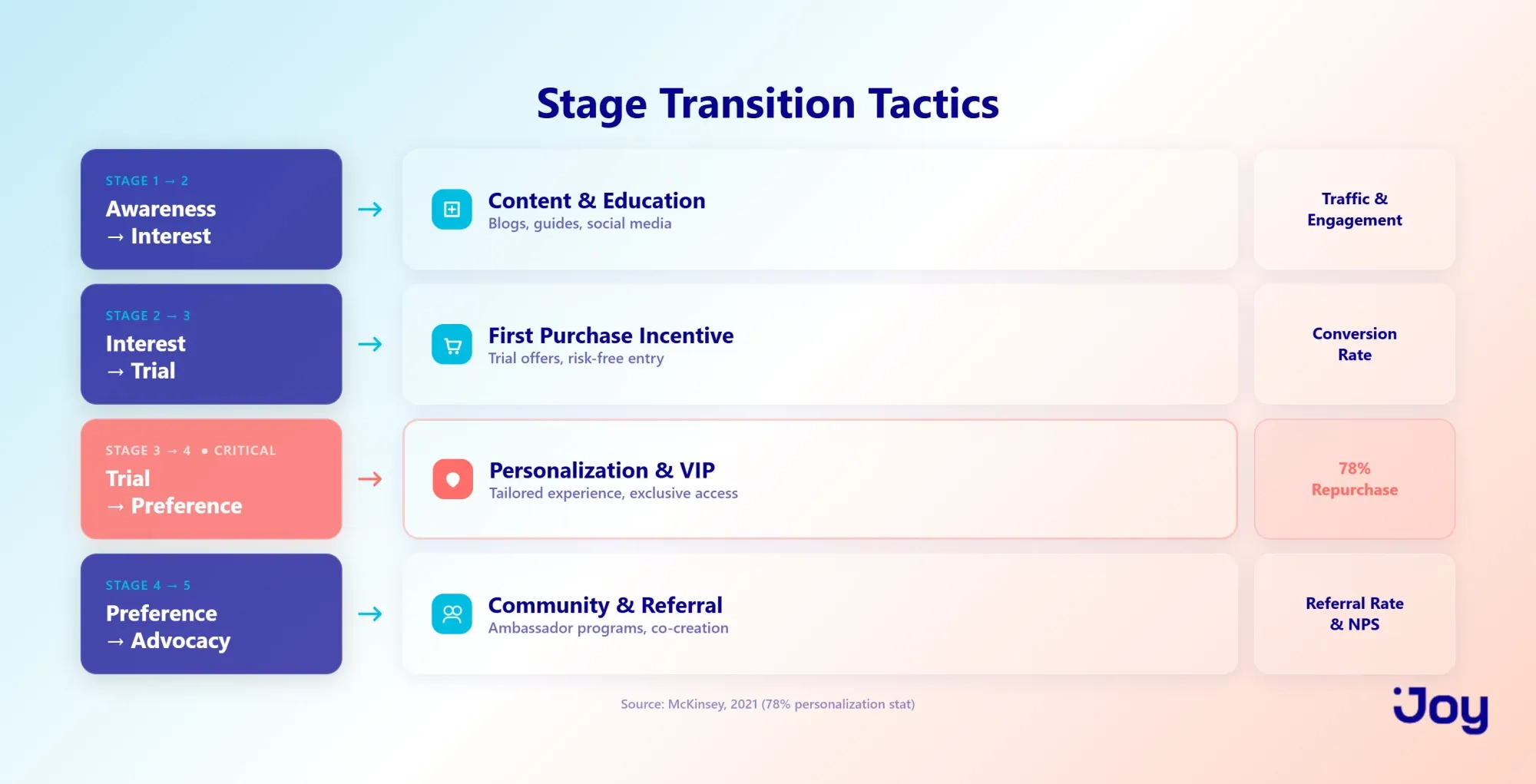
The goal here is simple: give curious prospects a reason to pay attention. Content marketing, educational resources, and social media presence do the heavy lifting. Blog posts, video guides, and thought leadership pieces give potential customers a reason to explore further.
What to measure: Website traffic growth, content engagement rates, social media follows.
Stage 2 to Stage 3: Interest to Trial
Once interest exists, the focus shifts to removing friction from the first purchase. Limited-time offers, introductory discounts, free samples, or risk-free trial periods all lower the barrier. The objective isn't to maximize revenue from the first transaction. It's to get the customer through the door.
What to measure: Conversion rate from visitor to first-time buyer, first-purchase volume.
Stage 3 to Stage 4: Trial to Preference (The Critical Shift)
This is where most businesses fail. And where the greatest opportunity lives.
Moving a customer from a single purchase to genuine preference requires more than a follow-up email. It demands personalization. McKinsey data confirms that 78% of customers are more likely to repurchase when their experience feels specific to them. That means personalized product recommendations, exclusive early access, birthday rewards, and VIP treatment that signals "you matter to us."
Consider how Sephora's Beauty Insider program pulls this off. Personalized recommendations based on purchase history, combined with birthday rewards and exclusive member events, transform one-time buyers into regulars who actively choose Sephora over competitors. Amazon Prime follows similar logic: free shipping, exclusive content, and member-only deals create a preference lock-in that goes well beyond price.
What to measure: Repeat purchase rate, customer lifetime value, time between purchases.
Stage 4 to Stage 5: Preference to Advocacy
The final transition requires community and a sense of belonging. Referral programs, ambassador initiatives, co-creation opportunities, and exclusive community spaces convert loyal customers into active brand champions.
Starbucks Rewards illustrates this well. Tiered programs combined with personalized offers turn regular coffee drinkers into advocates who share their rewards experiences on social media unprompted. Brands that invest in referral programs at this stage typically see advocates generate three to five times more lifetime value than customers acquired through paid channels.
What to measure: Referral rate, Net Promoter Score, word-of-mouth growth, retention metrics.
From Theory to Practice: Your Customer Loyalty Pyramid Strategy
The customer loyalty pyramid isn't just a framework to understand. It's a diagnostic tool to deploy.
Start by mapping your current customer base to the five stages. Identify which stage has the biggest drop-off, because that's your bottleneck. Then design interventions specifically for that transition, using the tactics outlined above.
For most businesses, the biggest untapped opportunity sits at the Stage 3 to Stage 4 boundary. Customers who've already purchased once represent a massive pool of potential repeat buyers. What they need isn't another discount code. They need a reason to believe your brand understands and values them personally.
The return on getting this right is substantial. Small retention improvements of just 5% can translate into profit increases of 25% to 95%, depending on the industry. Invest in moving your mid-tier customers upward, protect your top-tier advocates from slipping, and build the kind of emotional loyalty that no competitor can undercut with a lower price.
If you're looking for a structured way to implement pyramid-based loyalty, from points and tiers to referral programs and customer segmentation, explore Joy Loyalty.
Frequently Asked Questions About the Customer Loyalty Pyramid
What is the customer loyalty pyramid?
It's a framework that maps customer relationships across five stages, from initial awareness to full brand advocacy. It functions as a diagnostic tool, revealing where customers get stuck and what tactics move them forward.
What are the 5 stages of the customer loyalty pyramid?
Awareness (knows brand exists), Interest (actively researching), Trial (first purchase), Preference (repeat buying, chooses brand over alternatives), and Loyalty/Advocacy (emotionally connected, refers others).
What is the difference between behavioral and attitudinal loyalty?
Behavioral loyalty measures purchase frequency: customers buy habitually. Attitudinal loyalty measures emotional attachment: customers choose the brand even when cheaper alternatives are available. Lasting loyalty requires both dimensions working together.
Why do customers get stuck at Stage 3 (Trial)?
Most businesses focus on acquiring first-time buyers but don't invest in personalization or emotional connection after that initial purchase. Without those elements, trial customers have no compelling reason to return.
What is stealth attrition?
It's when customers leave without complaints or obvious signals. They quietly move from Stage 4 (Preference) back to Stage 2 or 3, often because the emotional connection that kept them loyal eroded over time.
How does the 80/20 rule apply to the customer loyalty pyramid?
The top 20% of customers (those at Stages 4 and 5) typically drive 80% of profits. Businesses should prioritize moving mid-tier customers upward rather than focusing solely on new customer acquisition.
How do you move customers from Trial to Preference?
Personalized experiences. Product recommendations, exclusive access, birthday rewards, and VIP treatment all signal that the customer matters beyond their wallet. McKinsey data shows 78% of customers repurchase when the experience feels personalized.
How can the loyalty pyramid prevent customer churn?
By tracking which stage each customer is in and monitoring for regression signals (such as repeat customers suddenly stopping orders), businesses can intervene with targeted tactics before customers leave.
What is the most important stage in the customer loyalty pyramid?
The Stage 3 to Stage 4 transition (Trial to Preference). This is where transactional relationships become emotional, and where most businesses lose customers due to underinvestment in personalization and engagement.
How do you measure progress through the customer loyalty pyramid?
Track stage-specific metrics: website traffic and content engagement (Stages 1 to 2), conversion rate (Stages 2 to 3), repeat purchase rate and customer lifetime value (Stages 3 to 4), and referral rate plus Net Promoter Score (Stages 4 to 5).

Written by
Thomas Nguyen is the CEO & Co-founder of Joy, a loyalty solution for Shopify and eCommerce brands. With years of experience building high-performance Shopify apps, Thomas aims to help merchants grow through customizable and retention-focused tools.
Related reading
 Loyalty Strategy
Enterprise Plus Loyalty Program: Case Study for Ecommerce Strategists 2026
Most loyalty programs are built to feel generous. Enterprise Plus was built to make leaving expensive. This case study breaks down the 3 structural levers — milestone tiers, status lock-in, and concrete rewards — that added 2M members without ad spend, and which ones translate to Shopify.
 Thomas Nguyen
 Loyalty Strategy
The Customer Loyalty Ladder: Stages, Models & How to Build Advocates
Not all customers are equal — some buy once and vanish, others return twenty times and bring friends. The customer loyalty ladder maps that gap. This guide breaks down the stages, compares the 5-, 6-, and 7-rung models, and shows how to move customers from first purchase to full advocacy.
Thomas Nguyen Loyalty Strategy
Relationship Marketing and Customer Loyalty: The 4-Pillar Framework
True customer loyalty is declining for the first time in 5 years (SAP, 2025). Discount-driven marketing is hitting diminishing returns. Relationship marketing flips the model: build trust and shared value first, then watch loyalty follow. Here's the 4-pillar framework.
Thomas Nguyen Loyalty Strategy
Brand Loyalty Pyramid: 5 Strategic Levels for 2026 Growth
Not all customers are loyal in the same way. The brand loyalty pyramid maps 5 strategic levels - from price-sensitive switchers to fanatic advocates - using David Aaker's framework. This guide breaks down each tier and the tactics to move customers up the ladder in 2026.
Thomas Nguyen Loyalty Strategy
The Customer Loyalty Loop: Why Retention Beats Acquisition
More than half of loyalty memberships sit inactive — the fix isn't a better funnel, it's a loop. Here's the 4-stage customer loyalty loop framework, where most Shopify programs break down, and how to diagnose which stage yours is missing.
Thomas Nguyen Loyalty Strategy
Customer Loyalty Models Explained: From Framework to Action
Most brands launch loyalty programs on gut instinct — then wonder why members never redeem. A customer loyalty model is the diagnostic framework that fixes that. This guide breaks down 6 proven models and how to pick the right one for your brand.
Thomas Nguyen