
IKEA Loyalty Program: How 170M Members Drive 50% of Revenue
IKEA Family has 170M members driving 50% of revenue — with zero tiers and a flat structure. After 73 years, the 2025 points refresh adds a new layer. This breakdown covers how it works, the emotional-loyalty playbook, hub-and-spoke architecture, and what Shopify brands can steal.
Summarize this post with AI
IKEA Family has 170 million members and zero tiers. No Silver, Gold, or Platinum. Every member gets the same benefits from day one. Most loyalty strategists would call that too simple to work, yet IKEA Family members generate 50% of the company's revenue (Ingka Group FY19). A flat program driving half of a $50B+ retailer's sales challenges every assumption about tiered loyalty design.
Then in May 2025, IKEA added a points-based earning system for the first time in 40 years. The biggest structural change the program has ever seen.
So how does that model work? Where does it fall short? And what can ambitious ecommerce brands actually take from it?
The IKEA Family Loyalty Scheme: 73 Years of "Democratic" Loyalty
IKEA's model didn't launch fully formed. It evolved over seven decades, shaped by a question most brands never bother asking: what should loyalty look like when you're building for everyone?
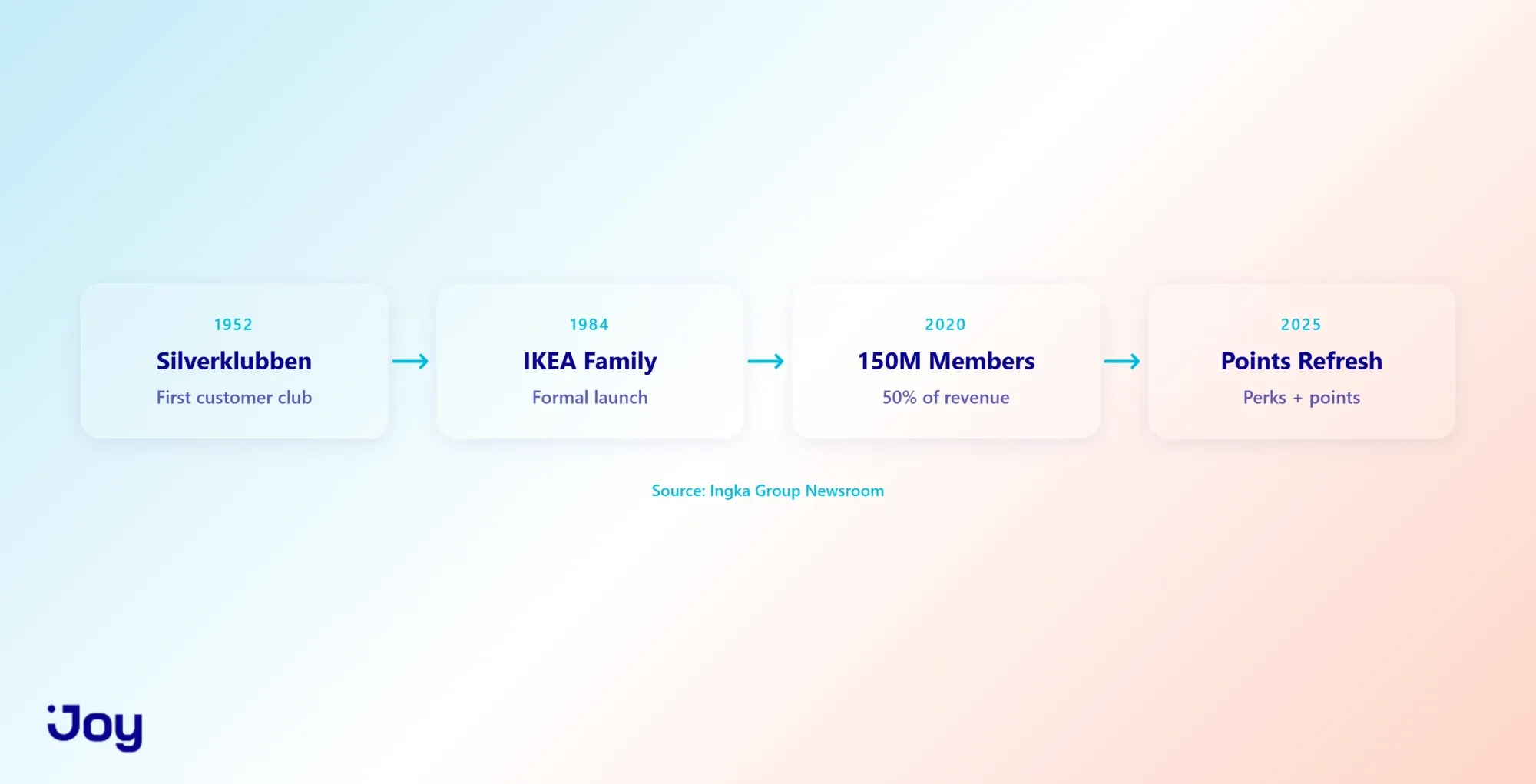
From Silverklubben to IKEA Family: A 73-Year Loyalty Evolution
In 1952, founder Ingvar Kamprad launched Silverklubben, IKEA's first customer club. This was long before loyalty schemes became standard in retail.
That early experiment got structure in 1984 when IKEA Family launched at the Linköping store in Sweden. No longer just a customer club: it was now a membership with defined benefits. By 2011, the program reached the U.S. market, where it now counts 24+ million members.
The growth numbers are striking. By August 2020, IKEA Family hit 150 million members globally. Tolga Öncü, Global Retail Operations Manager at Ingka Group, called the milestone "astonishing." At peak velocity? 1,800 new members joining every hour. Roughly 30 every minute (Ingka Group Newsroom). As of mid-2025, that number has crossed 170 million across 31 Ingka Group markets, representing approximately 90% of IKEA retail sales.
Why No Tiers? The "Democratic Ethos" Explained
At 170 million members, this structural choice deserves a closer look. IKEA's brand promise centers on "creating a better everyday life for the many people." That word "many" makes tier-based exclusivity philosophically impossible.
So there's no Silver, no Gold, no Platinum. No spending thresholds. No "elite" status. Whether you spend $50 a year or $5,000, you get identical benefits. IKEA's own words: "In our IKEA family we want to keep the focus on the individual and support each other."
But what do tiers actually do? They split your audience into "more valuable" and "less valuable" customers. IKEA rejects that segmentation entirely. The tradeoff, though (and most analyses skip this), is real: a flat structure builds massive scale but risks frustrating high-value, frequent shoppers who feel under-rewarded. There's zero competitive incentive to spend more.
Operationally, a single tier eliminates complex tier-management logic across 31 markets. And that simplicity became the foundation for the program's biggest structural change in 40 years.
How the IKEA Loyalty Program Works: Does IKEA Have a Rewards Program?
Yes. But the rewards program that exists today looks nothing like the IKEA Family of even two years ago. The 2025 points refresh changed the fundamentals of a model that had worked for four decades.
The 2025 Points Refresh: From Perks-Only to Points + Perks
For 40 years (1984 to 2024), IKEA Family was purely perks-based. Members scanned their card, got discounts on select products, enjoyed free coffee, attended workshops. No points accumulated. No currency to track.
Then came the catalyst. In 2022, IKEA introduced a popular 5% everyday in-store discount for members. In February 2024, they pulled it, replacing it with "New Lower Price" offers on hundreds of products (IKEA official). Members noticed the gap immediately.
On May 14, 2025, IKEA responded. "Rewards from IKEA Family" launched in the U.S., and for the first time in the program's history, members could earn points. Linda Ha, Global Customer Engagement and Loyalty Manager, framed it: "The new rewards programme builds on our promise to help more people have a better life at home."
The global rollout started in Australia, Italy, and Portugal, with all 31 markets targeted by end of 2025. Early results back up the decision. In Portugal, IKEA Family member sales share jumped to 58% after the refresh, up from the 50% global average.
Earning Points: $1 = 1 Point (But It's Not That Simple Globally)
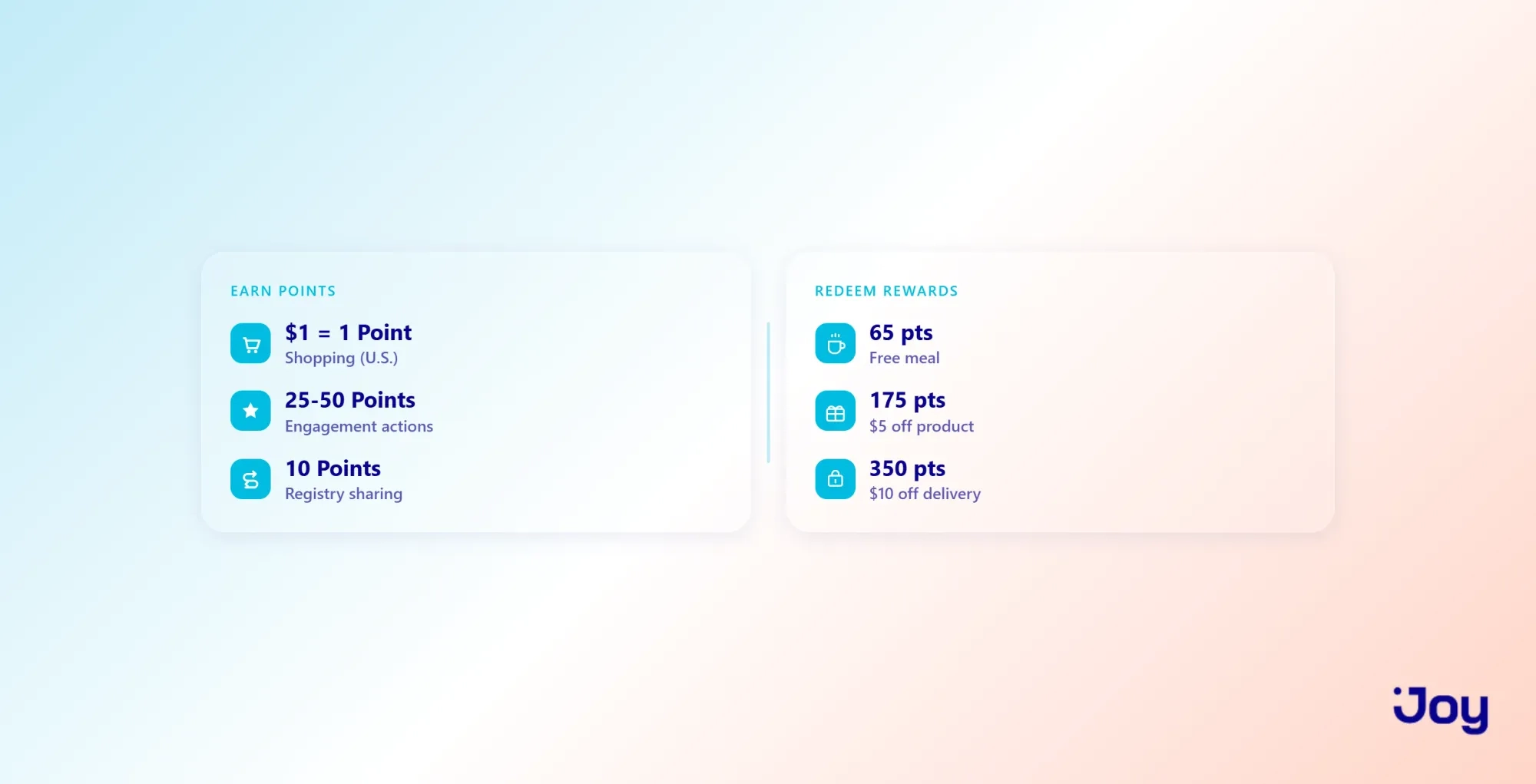
The U.S. earning rate is clean: 1 point per $1 spent, both online and in-store. Step outside the U.S., though, and the picture changes dramatically.
In the UK, members earn 1 point per £5 spent. A U.S. member buying a $500 KALLAX shelf earns 500 points. A UK member buying the same shelf at £229 earns just 45 points. Same program. Very different perceived value.
But IKEA also rewards actions that most programs ignore entirely. In the U.S., members earn 25 points for logging in, creating a wishlist, or using the Kitchen Planning Tool. Planning appointments and event attendance earn 50 points each. Even sharing a gift registry earns 10 points (IKEA U.S. Newsroom).
The UK scales these differently: 1 point for a weekly login, 5 for profile creation, 2 for a wishlist, 20 for event attendance. Nicole King, IKEA U.S. VP, captured the philosophy: "loyalty goes beyond a purchase" (Retail Customer Experience).
And this is where IKEA's global-local challenge shows up. $1 per point in the U.S. feels generous. £5 per point in the UK? Restrictive. Same brand, same program name, completely different member psychology.
Redeeming Points: Free Meals, Product Discounts, and Delivery Savings
On the redemption side, IKEA structured three clear thresholds:
| Points | Reward |
|---|---|
| 65 | Free food at IKEA Restaurant and Bistro |
| 175 | $5 off a product purchase |
| 350 | $10 off delivery |
Points expire after 18 months from the date earned, and redeemed rewards expire within 30 days if not used. Once you choose a reward, points can't be returned.
Notice what IKEA did here. The lowest-cost reward (free meal at 65 points) is experiential, not transactional. They start with food: the same micro-moment strategy as the free coffee benefit. And the 18-month expiration window is generous compared to programs like Gymshark (12 months). That reflects a reality most points programs ignore: furniture purchases are infrequent, and points need a longer runway.
The experiential focus over pure discounts isn't accidental. It feeds a deeper playbook: keeping members emotionally engaged between big purchases.
IKEA Membership Benefits: The Emotional Loyalty Playbook
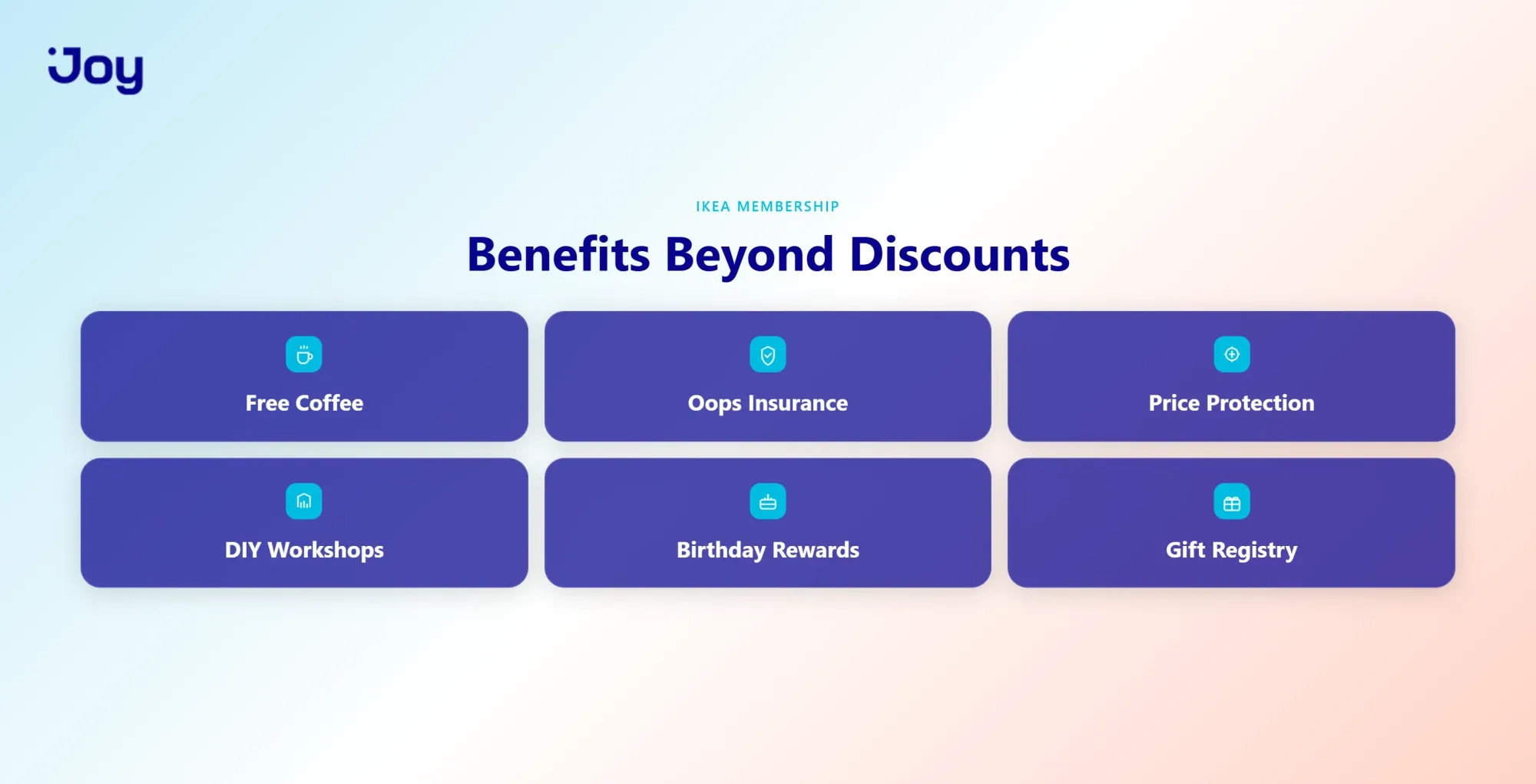
Points and earning rates matter. But they're not why IKEA Family works. The IKEA Family loyalty scheme stands apart because of its non-transactional benefits: perks designed to keep members connected during the long gaps between furniture purchases. These "micro-moments" are where IKEA's emotional loyalty strategy does its real work.
Free Coffee as a Micro-Moment Strategy
Free coffee and tea on weekday store visits is the simplest benefit in the program. And arguably the smartest.
Here's the problem it solves. IKEA's purchase cycle is long. Customers buy major furniture pieces every few years at most. Between those purchases, the brand risks becoming invisible. Free coffee fixes this directly: it creates a low-friction reason to visit the store regularly. Members stop by, browse the showroom, notice new products, and stay connected with the brand.
Each visit also generates a card scan. That's a behavioral data point. IKEA knows when members visit, how often, and can correlate those patterns with purchasing behavior. The cost? Pennies per cup. The return is wildly disproportionate: store traffic, data capture, and emotional warmth that no discount can replicate.
Oops Insurance and Price Protection: Solving Real Problems
Free coffee addresses visit frequency. IKEA's next layer of benefits targets something different entirely: purchase anxiety.
"Oops insurance" (the name varies by region: "Breakage Protection" in Canada, "Just-in-Case protection" in the UK) covers accidental damage during transport or assembly. Break a furniture part while putting it together? IKEA replaces it for free. Coverage windows vary from 14 days in Norway to 90 days in the UK, and you must have scanned your IKEA Family card at purchase.
Why does this matter strategically? Flat-pack furniture's biggest anxiety is assembly damage. Oops insurance directly addresses that barrier. And the deliberately casual naming ("Oops") normalizes mistakes, reducing the shame around assembly struggles. That's a subtle but sharp piece of brand psychology.
Then there's 90-day price protection. If an item drops in price within 90 days of purchase, IKEA Family members get a refund of the difference. No "should I wait for a sale?" hesitation. Gone.
These perks solve real problems instead of offering financial incentives dressed up as benefits. And they shift the emotional register from transactional ("I saved money") to relational ("this brand has my back"). That distinction drives retention in ways a 10% coupon never will.
Workshops, Events, and Life Milestones: Loyalty Between Purchases
IKEA extends the emotional playbook further through life integration. Free DIY workshops and "how-to" events position IKEA as a trusted advisor, not just a furniture vendor.
Gift registries tied to life milestones (housewarming, weddings, relocations) earn members 50 points for creating a registry and 10 for sharing it. Birthday rewards vary by market but typically include a free meal coupon and gift card ($15 in the U.S.). Even soft toy design competitions turn members' children into co-creators, with winning designs becoming real IKEA products.
For parents, an extra 30 minutes of supervised childcare in the Småland play area means more time to shop. And more time in-store translates directly to higher average spend.
Every one of these benefits serves the same purpose: keeping IKEA relevant in members' lives between major furniture purchases. But this engagement-first approach doesn't just drive retention. It also feeds a data collection system that's far more sophisticated than most retailers realize.
The Engagement-First Data Strategy: Why IKEA Rewards Wishlists and Logins
Every source covering IKEA Family mentions engagement-based earning. Almost none explain why it exists. The answer isn't generosity. It's intelligence gathering. Every non-purchase interaction generates a behavioral signal that IKEA converts into commercial advantage.
Non-Purchase Earning as a Data Collection System
Think about what each rewarded action actually tells IKEA:
Wishlist creation (25 pts): What products is this member considering? Which rooms are they planning? What price range are they exploring?
Kitchen Planning Tool (25 pts): This member is actively planning a renovation. That's a high-intent purchase signal, given that the average kitchen project runs $5,000 to $20,000.
Planning appointment (50 pts): The strongest intent signal in the system. A member booking expert time is almost certainly going to purchase.
Event attendance (50 pts): What topics interest this member? Sustainability? Small-space living? Organization? Each event preference reveals lifestyle data.
Put together, these signals feed IKEA's central intelligence layer for demand forecasting, product placement, and supplier innovation. When Nicole King says "loyalty goes beyond a purchase," the operational translation is clear: loyalty data goes beyond transaction records.
The Engagement Scoring Flywheel
These signals don't just sit in a database. They compound. A member logs in (25 pts), creates a wishlist (25 pts), uses the planning tool (25 pts), books an appointment (50 pts), attends an event (50 pts), purchases furniture (earning $1 = 1 pt), then returns for free coffee before creating a new wishlist. The cycle continues.
Each touchpoint tells IKEA where a member sits in their lifecycle: browsing, planning, buying, or maintaining. Most retailers only see the purchase. IKEA sees the entire pre-purchase journey: what rooms members are planning, what styles they prefer, and what budget they're working with.
That visibility is rare in furniture retail, where purchase cycles stretch long, and research phases can run for months. But running this data operation across 31 countries creates an architectural challenge worth digging into.
Hub-and-Spoke Architecture: How IKEA Loyalty Programs Run Across 31 Markets
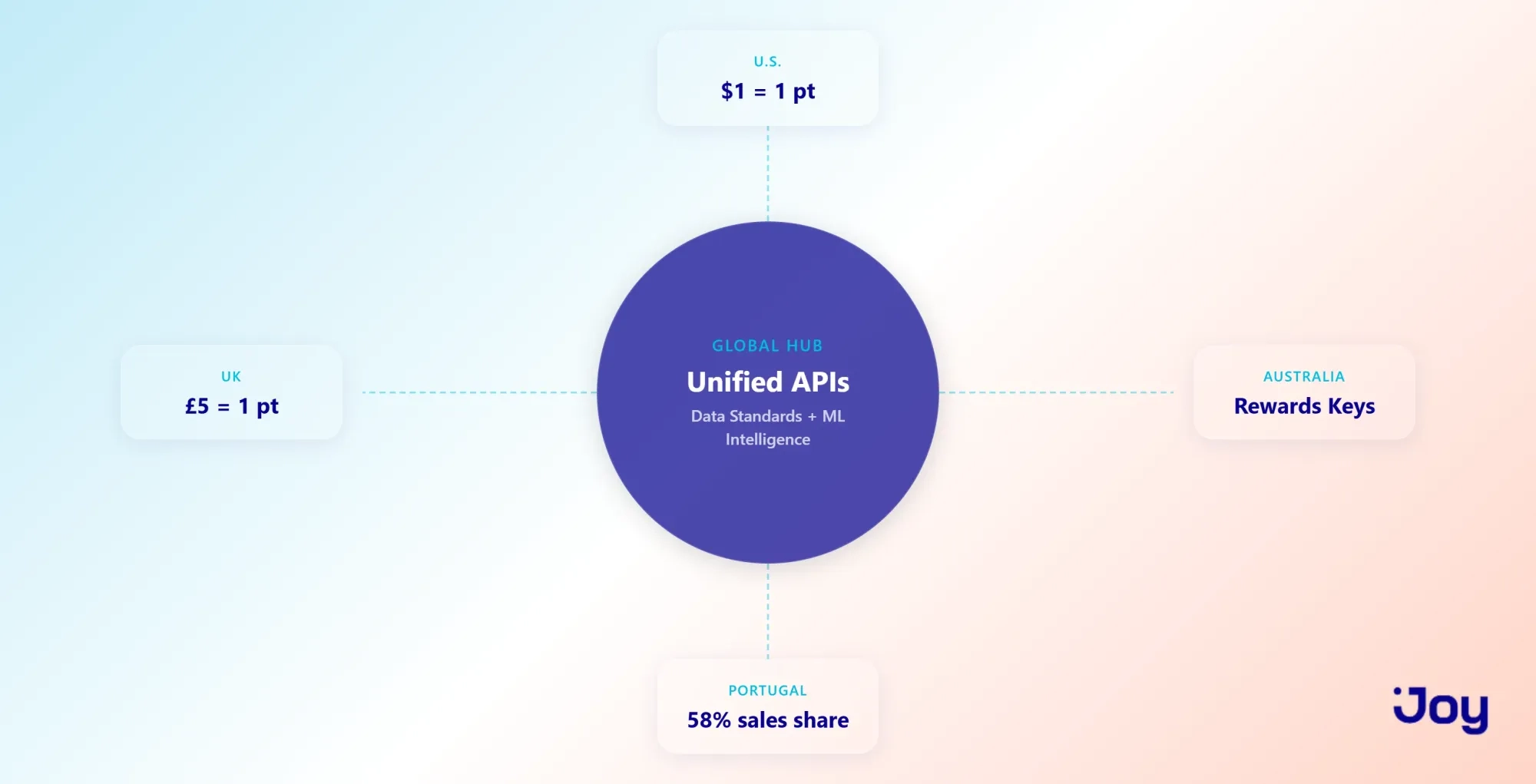
Running a single loyalty program across 31 countries with different currencies, regulations, and cultural expectations isn't a marketing problem. It's an infrastructure one. IKEA's solution, which industry analysts describe as a "hub-and-spoke" model, offers a blueprint for any brand planning international expansion.
API-First Global Platform with Regional Partners
The architecture splits into two layers:
Hub (central): Global data standards, unified member identity, a machine learning intelligence layer, and shared APIs that maintain consistency across all markets.
Spokes (regional): Local e-commerce systems, mobile apps, cultural adaptations, and regulatory compliance (GDPR, country-specific data laws) that handle the on-the-ground experience.
Regional partners operate locally but connect to the global hub through shared APIs. When IKEA enters a new country, the loyalty infrastructure plugs in. No ground-up build required.
The single-tier model simplifies this further. There's no complex tier-management logic to localize, so every market runs the same flat structure. The 2025 rewards rollout proved the system works: launching simultaneously in Australia, Italy, and Portugal meant three different regulatory environments, three currencies, one underlying platform.
Global-Local Calibration: Same Program, Different Value
Even with the right architecture, calibration remains a challenge. The earning rate disparity ($1 per point in the U.S. versus £5 per point in the UK) has real operational consequences: members comparing notes across borders see dramatically different value from the same program.
Regional benefit variations make it worse. And, insurance has different coverage windows (14 days in Norway, 90 days in the UK). Birthday rewards differ by market. The 5% discount existed in some stores but not others before being discontinued entirely. And IKEA Family cards are country-specific: a UK member visiting an IKEA in Sweden must register separately with a different email.
These regional inconsistencies are the practical cost of "democratic" loyalty on a global scale. No way around it.
What Brands Scaling Internationally Can Learn
Three lessons emerge from IKEA's architecture:
First, build API-first infrastructure. Don't create separate loyalty systems per market. Build one platform with regional integrations.
Second, calibrate rather than copy. Earning rates must reflect local economics. $1 per point doesn't translate to £1 per point. It must feel proportional to local purchasing power.
Third, accept regional variation. Some benefits will differ by market due to regulatory or cultural factors. Communicate this transparently rather than promising perfect consistency.
The single-tier model enables all three. Tier complexity multiplies exponentially across markets. IKEA's flat structure keeps global operations manageable. Yet even with this sophistication, the program has real gaps. And understanding those gaps matters just as much as studying the wins.
The Omnichannel Gap: Where the IKEA Loyalty Program Falls Short
No loyalty program operates without friction. But these gaps are worth studying because they exist despite IKEA's massive scale and decades of iteration. If a 170M-member program can't solve them, they're clearly harder than they look. For ecommerce brands building their own programs, these are the pitfalls to design around from the start.
Coupons Can't Be Used Online: The Digital-Physical Divide
IKEA Family coupons currently can't be redeemed online. That's a significant restriction on omnichannel functionality, especially when the rest of the digital experience (Apple Wallet, QR codes, the mobile app) works well.
It gets worse. The IKEA Family loyalty account is separate from the IKEA online shopping account. Members manage two identities instead of one. User reports cite regional inconsistencies where 5% discounts existed in some stores but not others, eroding trust. And welcome emails? Described as impersonal: a generic onboarding experience that doesn't use member data for a personalized first impression.
Why does a 170M-member program still have these gaps? Legacy systems are hard to unify. That's the lesson.
What These Gaps Teach: Lessons for Ecommerce Brands
Every friction point here maps to a preventable design decision.
Unify the account experience. If your loyalty program requires a separate login from your store account, you've created friction before the member even engages. Shopify-native solutions like Joy Loyalty eliminate this: one account, one identity, no fragmentation.
Maintain online-offline parity. Any in-store benefit must work online. No exceptions. If coupons only function in physical locations, you've excluded your digital-first customers.
Personalize the welcome. IKEA's generic onboarding wastes the richest data moment: the signup. Use enrollment data to personalize the first email. Acknowledge what the member signed up for and deliver immediate value.
Keep it consistent across all channels. If a benefit exists, it exists everywhere. Regional exceptions create confusion and erode trust fast.
IKEA's omnichannel gaps prove that even a 170M-member program gets the digital experience wrong. Shopify merchants have a structural advantage here: modern, platform-native tools eliminate the fragmented systems that plague legacy retailers. The real question is how to apply IKEA's proven principles without inheriting the same mistakes.
What the IKEA Loyalty Scheme Teaches: 5 Strategic Lessons for Ecommerce Brands
Five principles emerge from the IKEA Family case study. Each one maps a specific IKEA strategy to a broader principle that works well beyond furniture retail.
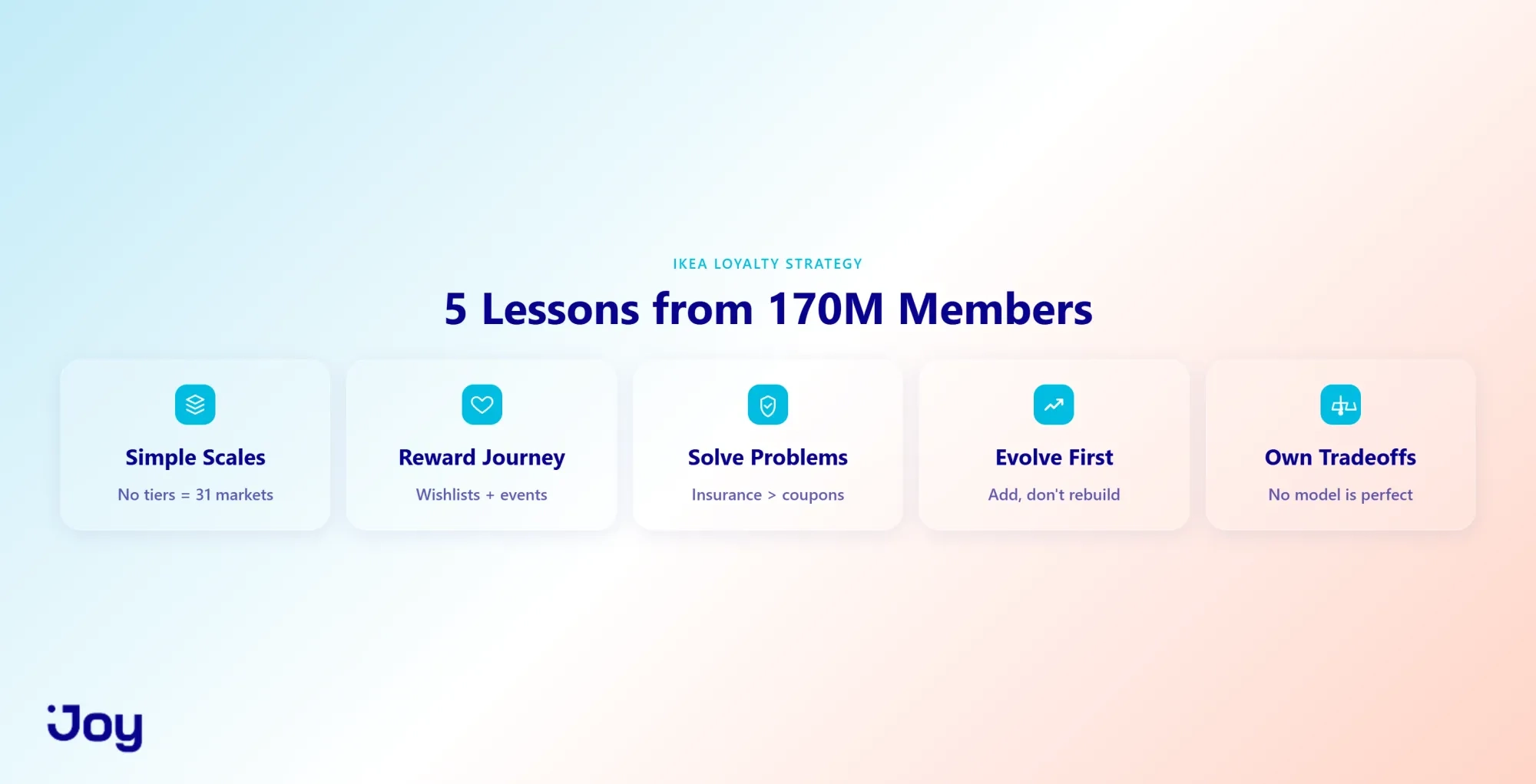
5 Lessons from the World's Largest Loyalty Program
Lesson 1: Simple structure scales. IKEA's no-tier model runs across 31 markets because there's no tier logic to localize. Complexity is the enemy of global scale. If your program can't be explained in one sentence ("join for free, earn points, get rewards"), it's too complex.
Lesson 2: Reward the journey, not just the purchase. IKEA earns 50% of revenue from members who are rewarded for wishlists, planning tools, events, and logins alongside transactions. Engagement-based earning captures intent data that spending-only programs miss entirely.
Lesson 3: Solve problems, don't just give discounts. Oops insurance solves assembly anxiety. Free coffee solves the visit frequency. Price protection solves purchase hesitation. Workshops solve knowledge gaps. See the pattern? The best loyalty perks address real customer problems, not financial incentives disguised as benefits.
Lesson 4: Evolution over revolution. IKEA didn't blow up a 40-year program. They added points on top of existing perks, launched in three markets first, and are rolling out globally through 2025. Test, iterate, expand. Don't rebuild from zero.
Lesson 5: Accept the tradeoffs of your model. IKEA's flat structure risks frustrating high spenders. Their global rollout creates regional inconsistencies. Their omnichannel experience has gaps. No loyalty model is perfect. The strategic skill is knowing which tradeoffs serve your brand and being transparent about the rest.
If there's one thread connecting all five, it's this: the best loyalty programs are strategically simple, operationally disciplined, and honest about their limitations.
Build IKEA-Level Loyalty on Shopify: With Joy
Every IKEA tactic analyzed above is replicable at the Shopify scale. You don't need 170 million members or a hub-and-spoke architecture. What you do need is the same design philosophy, paired with the right tools.
7 IKEA Tactics That Work at Shopify Scale
Flat or tiered: your choice. IKEA chose no tiers. That works. But it's not the only path. Joy lets you set up a single-tier program or multi-tier progression. Test both, and measure which drives more repeat purchases.
Points with custom earning rates. Set $1 = X points, customize per market. Joy's points engine is fully configurable, including custom point names that match your brand ("Stars," "Gems," whatever fits).
Engagement-based earning. Award points for social follows, product reviews, account creation, referrals, and birthdays. The same "beyond a purchase" philosophy that powers IKEA's wishlist and event rewards.
Problem-solving perks. IKEA's Oops insurance is a custom perk, not a discount. Joy lets merchants create custom rewards, such as free shipping on the first order, priority support, and exclusive content. Perks that address real purchase anxieties rather than just cutting prices.
Point expiration windows. IKEA uses 18 months. Joy lets you set any expiry window. Shorter for fast-moving goods, longer for infrequent purchases. The flexibility to match your product's purchase cycle is what makes this work.
Birthday automation. Every IKEA member gets birthday rewards. Joy automates birthday point delivery. Set once, runs forever.
Revenue attribution. Joy tracks every order placed via referral links or loyalty-generated discount codes, so you see exactly which revenue your loyalty program generated. Not a guess. A number.
What Requires IKEA's Scale: Know the Limits
Not everything translates directly. And honesty about that distinction matters.
170M-member data infrastructure. IKEA's global ML intelligence layer processes behavioral data across 31 markets. Most Shopify merchants don't need that scale. But they do need to use the data they already have. Joy's analytics surfaces member behavior patterns without requiring a data science team.
Hub-and-spoke architecture. Building regional API integrations across 31 countries isn't practical for most brands. But Shopify's native multi-currency and multi-region support handles international basics, and Joy adds the loyalty layer on top.
Free in-store experiences. Coffee, workshops, and Småland childcare require physical locations. Shopify merchants can translate these into digital equivalents: exclusive content, early access to collections, or live virtual events. Different format, same principle.
73 years of brand trust. IKEA's "democratic" model works partly because the brand has decades of goodwill behind it. Newer brands need to earn that trust before simplicity feels strategic rather than incomplete.
The principle stays the same: reward the journey, solve real problems, keep the structure simple, and use the right tools to execute without enterprise-level complexity.
Loyalty Without Hierarchy: The IKEA Lesson
IKEA Family proves that hierarchy isn't a prerequisite for commercial results. Half of a $50B+ retailer's revenue flows through a program with no tiers. But "simple" at a global scale still requires technology, operational discipline, and the willingness to accept tradeoffs.
What makes it work? Three things. Accessibility: don't gate the program behind spending thresholds. Engagement beyond the purchase: wishlists, events, and free coffee build emotional connection between transactions. And real problem-solving: insurance beats a 10% coupon because it addresses anxiety, not just price.
You don't need 170 million members or 31 markets to apply these principles. You need the same design philosophy: keep it simple, reward engagement, and make membership feel valuable from the moment someone joins.
Joy gives you the tools to execute this: custom points, engagement rewards, problem-solving perks, birthday automation, and direct revenue attribution. Explore Joy Loyalty and start building a program worth joining.
The brands that dominate retention don't need the most complex programs. They need the most compelling reason for members to show up. Build one.
FAQ
What is the IKEA loyalty program?
IKEA Family is a free program with 170+ million members worldwide. Members get member-only pricing, a points-based rewards system (launched May 2025), free coffee on weekday visits, DIY workshops, birthday rewards, and Oops insurance covering accidental damage during transport and assembly.
Does IKEA give loyalty points?
Yes, since May 2025. U.S. members earn 1 point per $1 spent, plus points for non-purchase actions: logging in (25 pts), creating wishlists (25 pts), attending events (50 pts). Redeem for free meals, product discounts, and delivery savings.
Is the IKEA loyalty program free?
Completely free. No membership fees, no paid tiers, no spending requirements. Every member receives the same benefits from day one.
Is it worth being an IKEA member?
For regular IKEA shoppers, yes. Member pricing, points toward rewards, 90-day price protection, and exclusive events and workshops. It costs nothing to join, so the only investment is a sign-up.
How do I redeem IKEA points?
Three thresholds: 65 points for a free meal at the IKEA Restaurant, 175 points for $5 off a product, or 350 points for $10 off delivery. Points expire 18 months from the date earned.
Does IKEA Family work online?
Partially. Benefits apply both in-store and online, but coupons can't be redeemed online, and the loyalty account is separate from the IKEA shopping account. It's a known friction point that IKEA hasn't resolved yet.
How does IKEA's loyalty program compare to other retailers?
IKEA Family is unique for its single-tier, no-hierarchy structure. Unlike Starbucks Rewards or Sephora Beauty Insider, which use tiered systems, IKEA prioritizes universal accessibility over exclusive perks for top spenders. For a broader comparison, see other loyalty program examples.
Can Shopify brands build a loyalty program like IKEA's?
Yes. The core strategies (points-based earning, engagement rewards, problem-solving perks, birthday automation) are replicable at any scale with a Shopify-native loyalty app. You don't need 170M members or global infrastructure. Create a loyalty program that aligns with your brand's strategies.

Written by
Thomas Nguyen is the CEO & Co-founder of Joy, a loyalty solution for Shopify and eCommerce brands. With years of experience building high-performance Shopify apps, Thomas aims to help merchants grow through customizable and retention-focused tools.
Related reading
 Examples & Inspiration
How Nectar loyalty scheme wins loyalty 2026 (And what to copy)
What can the UK's biggest coalition program teach your store? See how the Nectar loyalty scheme turns scale, shared data, and partner funding into retention.
 Thomas Nguyen
 Examples & Inspiration
World of Hyatt Guide 2026: Tiers, Rewards & Sweet Spots
The Hyatt loyalty program (World of Hyatt) offers the best value per point in travel. See how to earn free nights, unlock elite tiers, and find the top sweet spots.
Thomas Nguyen Examples & Inspiration
Avis Preferred 2026 Guide: Skip the Line & Earn Free Days
The Avis loyalty program (Avis Preferred) lets you skip the counter and earn free rental days. See how the tiers, points math, and status shortcuts work in 2026.
Thomas Nguyen Examples & Inspiration
American Airlines Loyalty program: $30B secret + Retention tricks
The American Airlines loyalty program is a $30B engine, not a perk. See how AAdvantage turns points into status, partners, and a retention flywheel you can copy.
Thomas Nguyen Examples & Inspiration
Lufthansa loyalty scheme: Case study and strategic breakdown for e-commerce (2026)
What can an airline teach your store about retention? See how the Lufthansa loyalty scheme builds status, monetizes miles, and turns loyalty into infrastructure.
Thomas Nguyen Examples & Inspiration
Brand Loyalty and Consumer Behavior: Strategic Case Study & Ecommerce Breakdown (2026)
Brand loyalty and consumer behavior are engineered, not accidental. See how Nike, Sephora, and others reshape buying habits - and how ecommerce brands can copy it.
Thomas Nguyen