
Customer Loyalty Models Explained: From Framework to Action
Most brands launch loyalty programs on gut instinct — then wonder why members never redeem. A customer loyalty model is the diagnostic framework that fixes that. This guide breaks down 6 proven models and how to pick the right one for your brand.

Summarize this post with AI
A customer loyalty model is a framework for understanding, measuring, and strengthening how customers connect with your brand. It cuts past surface-level metrics and reveals the patterns behind why some customers stick around for years while others vanish after a single purchase.
Yet most brands skip this step entirely. They launch loyalty programs based on gut instinct, then wonder why most enrolled members never redeem a single reward. The missing piece? A diagnostic framework that tells you where your customers stand and what drives their decisions.
This guide breaks down six proven customer loyalty models, explains how each one works, and shows you how to pick the right loyalty model framework for your brand.
Why Loyalty Models Matter
A now-classic finding from Bain & Company tells the story clearly: a 5% increase in customer retention produces a 25% to 95% increase in profits. Acquiring a new customer costs five to 25 times more than retaining an existing one, per Harvard Business Review.
So retention pays. But most brands go wrong at the next step.
They jump straight into points programs, discounts, and cashback offers without first understanding why customers leave. What happens? Customers chase deals, stack coupons, and switch to a competitor the moment someone offers a better price. Researchers call this the "mercenary trap," and it's real: these programs train customers to be disloyal.
Loyalty models fix this by giving you a diagnostic lens. Instead of guessing which customers are truly loyal and which ones are just hunting discounts, a well-chosen customer loyalty model reveals the underlying dynamics. Every retention investment becomes deliberate rather than hopeful.
Here are the six frameworks that matter most.
6 Customer Loyalty Models Explained
Each of these customer loyalty models addresses a different dimension of the loyalty puzzle. Some focus on how customers feel, others on what they do, and a few tackle why they stay.
The Apostle Model
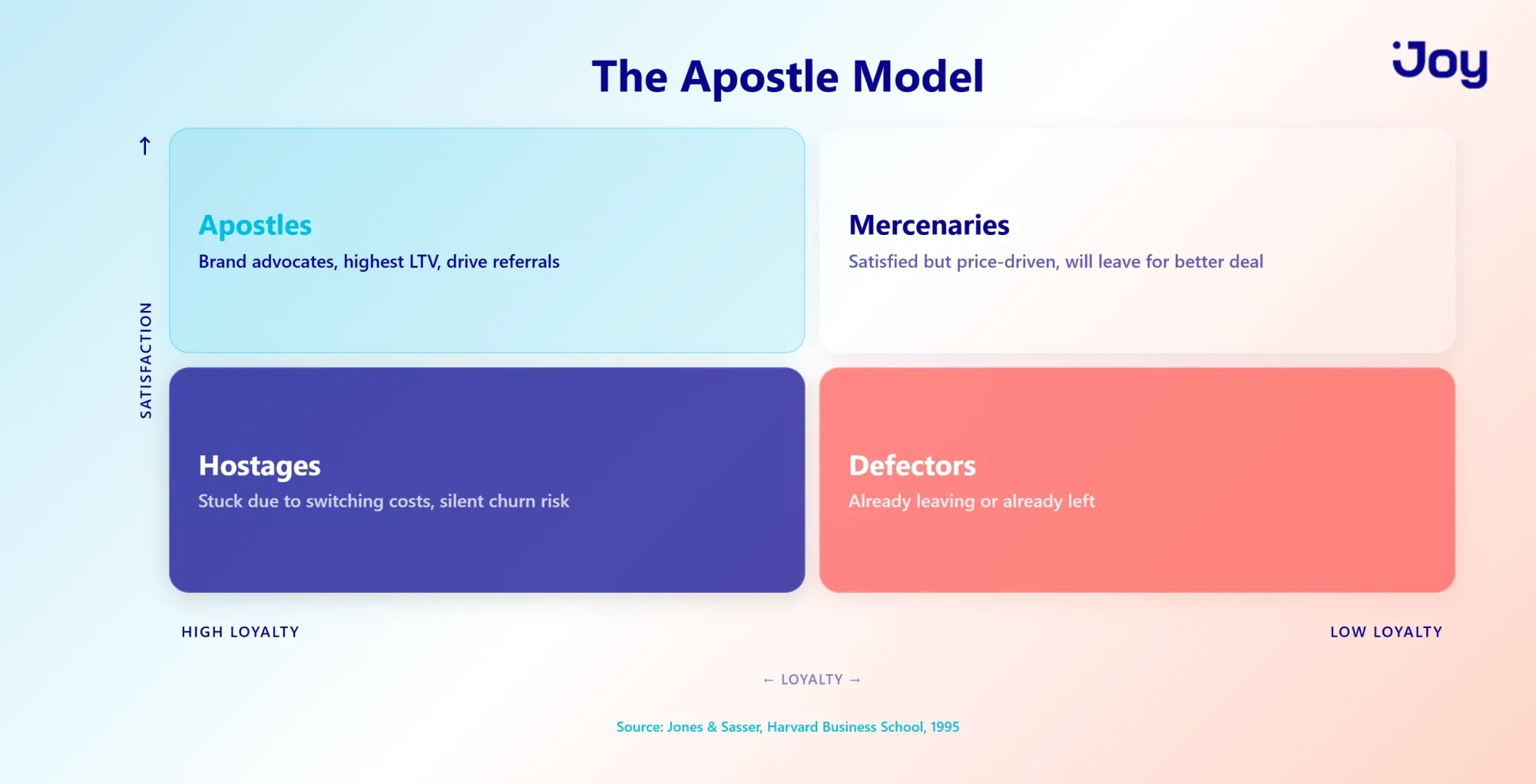
Developed at Harvard Business School in 1995 by Thomas Jones and W. Earl Sasser, the Apostle Model maps every customer on a two-axis matrix: satisfaction on one side, loyalty on the other. The intersection creates four distinct segments, and each one tells a different story.
Apostles score high on both satisfaction and loyalty. These are your brand advocates, your highest-LTV customers, the ones most likely to refer friends. They rarely churn. And they promote your brand without being asked.
Mercenaries are satisfied but not loyal. They enjoy your product, sure, but they'll leave for a 5% better deal elsewhere. Satisfaction alone doesn't guarantee retention. Mercenaries prove that every day.
Hostages show low satisfaction yet remain loyal, usually because switching costs keep them locked in. They won't advocate for your brand. Worse, they represent a silent churn risk because the moment a competitor makes switching easier, they're gone.
Defectors score low on both dimensions. They're already leaving or have already left.
How to use it: Run a simple two-question survey. Ask customers, "How satisfied are you with our brand?" (0 to 10) and "How likely are you to recommend us?" (0 to 10). Then map the results. Apostles score 8 to 10 on both questions. Mercenaries score 8 to 10 on satisfaction but 0 to 6 on recommendation. Hostages show the reverse pattern, and Defectors score low on both.
In most e-commerce businesses, Mercenaries outnumber Apostles by a wide margin. That gap is both the biggest risk and the biggest opportunity. If you don't know your segment mix, every loyalty investment is a guess.
The goal is clear: shift Mercenaries toward Apostles.
The Loyalty Ladder
While the Apostle Model captures a snapshot of where customers stand, the customer loyalty ladder tracks how they move over time. This progressive model maps five distinct stages, each with its own engagement needs.
Prospects are aware of your brand but haven't purchased yet. They need trust signals: reviews, social proof, and a compelling first impression.
First-time Customers have made a single purchase. Their experience in the first 48 hours determines whether they come back, so this stage demands a strong post-purchase follow-up.
Repeat Customers have bought multiple times. They're showing behavioral loyalty, and at this point, recognition and rewards start to matter.
Loyal Customers buy consistently and resist competitor offers. They've moved beyond transactional behavior and now expect exclusivity and deeper brand engagement.
Advocates actively promote your brand to others. They're your organic growth engine and the most valuable segment in any loyalty model framework.
How to use it: Map your customer base across these five stages, then find the stage with the highest drop-off rate. That's where your investment should go. Most brands pour resources into acquiring prospects while ignoring the repeat-to-loyal transition. That's exactly where the real ROI sits.
The RFM Model
Both the Apostle Model and the Loyalty Ladder require some form of qualitative input, whether through surveys or manual classification. The RFM Model takes a different approach: it relies entirely on purchase data you already have.
RFM stands for three dimensions:
Recency measures how recently a customer made a purchase. More recent buyers are more likely to buy again.
Frequency tracks how often they buy. Higher frequency signals stronger loyalty.
Monetary captures how much they spend per order and overall. Higher spenders tend to be more valuable long-term.
How to use it: Score each customer from one to five on all three dimensions. A customer who scored 5-5-5 is your best buyer: recent, frequent, and high-spending. But a customer who once scored 5-5-4 and now sits at 1-5-4? That's a red flag. They were loyal. They've stopped buying. That's your at-risk segment.
The biggest advantage of RFM is that it works with data already sitting in your order history. No surveys, no extra tools, no customer fatigue. It only tells you what customers do, though. To understand why they behave that way, pair it with the Apostle Model.
Attitudinal vs. Behavioral Loyalty Model
Richard L. Oliver's framework draws a critical line between what customers do and what they feel. That distinction matters more than most brands realize because a customer can behave loyally without being truly loyal (and vice versa).
Behavioral loyalty shows up in the numbers: repeat purchases, high order frequency, consistent spending. This is what RFM measures, and on the surface it looks like loyalty.
Attitudinal loyalty runs deeper. It reflects emotional commitment, brand preference, and a genuine willingness to recommend. Surveys and NPS scores capture this dimension.
The danger of measuring only behavior? It hides two costly blind spots. Hostages (from the Apostle Model) look behaviorally loyal because switching costs keep them buying, but they hold no real commitment. Mercenaries buy repeatedly during promotions yet have zero emotional connection to your brand. Behavioral data alone paints a misleading picture in both cases.
How to use it: Track both dimensions side by side. High behavioral loyalty plus low attitudinal loyalty signals churn risk. High attitudinal loyalty plus low behavioral loyalty points to untapped potential, perhaps a pricing or convenience barrier is holding purchases back.
True loyalty means scoring high on both. This model explains why types of customer loyalty can look identical in your analytics while carrying very different retention risks.
NPS as a Loyalty Framework
The Net Promoter Score is arguably the most widely adopted customer loyalty model in the world. It centers on a single question: "How likely are you to recommend us to a friend or colleague?" Respondents answer on a scale from 0 to 10, and that one answer sorts them into three groups.
Promoters (9 to 10) are enthusiastic advocates. They drive referrals and organic growth.
Passives (7 to 8) are satisfied but not excited. They won't actively recommend you, and they're vulnerable to competitor offers.
Detractors (0 to 6) are unhappy customers who can damage your brand through negative word-of-mouth.
How to use it: Calculate NPS by subtracting the percentage of Detractors from the percentage of Promoters. The result ranges from negative 100 to positive 100. Track this number quarterly, investigate Detractor feedback, and target 48-hour recovery for every Detractor response.
NPS works because it's simple. Easy to benchmark, easy to track over time, and it correlates with revenue growth. But NPS functions as a thermometer, not a diagnosis. It tells you the temperature, not the cause. For actionable insights, pair NPS with the Apostle Model (to understand why) or RFM (to understand what).
The Commitment-Loyalty Model
The final framework in this guide answers a question the other models don't fully address: why do customers stay? The Commitment-Loyalty Model identifies three distinct types of commitment, and each one produces a different quality of loyalty.
Affective commitment is an emotional bond. Customers who feel it say, "I love this brand." This is the strongest form of loyalty and the hardest for competitors to break. It's driven by shared values, community, and personal identity.
Normative commitment stems from obligation. Customers feel they should stay, often because of a long relationship, social norms, or a sense of reciprocity. It's stronger than pure calculation but weaker than genuine emotion.
Economic commitment is a rational equation. Customers stay because switching costs too much. This is the weakest form of loyalty, and it shatters the moment a competitor offers a better deal.
Most transactional loyalty programs only build economic commitment. The weakest kind. Emotional programs build affective commitment. The strongest kind. Understanding which type of commitment holds your customers reveals both what's keeping them and what could lose them.
The Emotional to Transactional Loyalty Spectrum
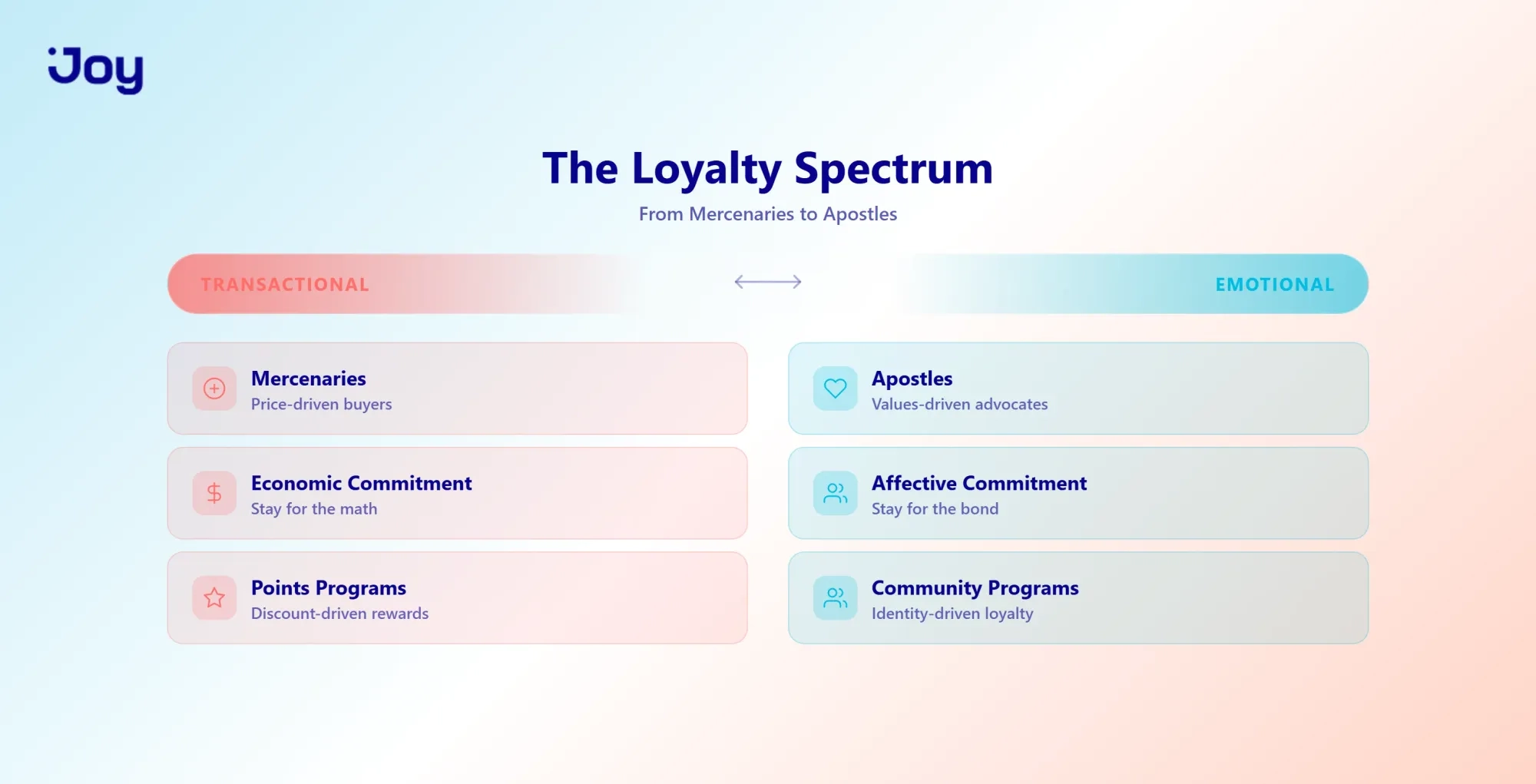
All six customer loyalty models, despite different approaches, point to the same fundamental divide: transactional loyalty versus emotional loyalty.
On the transactional end, you'll find customers driven by points, discounts, and convenience. In the Apostle Model, these are Mercenaries. In the Commitment-Loyalty Model, they hold only economic commitment. They buy because the math works, not because they care.
On the emotional end sit customers connected by values, identity, and community. These are your Apostles. They hold affective commitment. And they don't just buy repeatedly. They refer friends, defend your brand publicly, and resist competitive offers even when the price isn't the lowest.
Each model maps onto this spectrum in a predictable way. Loyalty Ladder stages progress from transactional (lower rungs) to emotional (upper rungs). RFM reveals customers stuck in transactional patterns when frequency drops despite high past spending. And the Attitudinal vs. Behavioral Model exposes the gap between doing and feeling.
The ROI case reinforces this direction. Emotionally loyal customers generate higher lifetime value, lower churn rates, and stronger referral volume. Brands that successfully shift even a portion of their customer base from transactional to emotional loyalty see measurable improvements across every retention metric.
So the strategic question becomes: now that you know where your customers sit on this spectrum, which program type moves them in the right direction?
From Models to Action: Choosing a Loyalty Program
Theoretical models give you the diagnosis. Program types give you the treatment. Choosing the wrong program for your customer base is like prescribing medicine without running a test first. Here are the four primary types of loyalty program and how each connects back to the models above.
Points-Based Programs let customers earn points on purchases and redeem them for discounts or rewards. This structure matches the Mercenary-to-Repeat Customer journey on the Loyalty Ladder and builds economic commitment quickly. The risk? Points alone keep customers transactional. They work best as an entry point, not an endpoint.
Tiered Programs create Bronze, Silver, Gold, and Platinum levels with escalating benefits at each stage. They mirror the Loyalty Ladder's progression directly and build normative commitment as customers think, "I've earned this status." The added switching costs and aspiration make this structure particularly effective for mid-funnel retention.
Subscription and Paid Programs charge a monthly or yearly fee in exchange for exclusive benefits. Because members have already invested financially, they hold both economic and normative commitment from day one. Predictable revenue and higher engagement among invested members follow naturally.
Community and Emotional Programs focus on membership, exclusive access, shared values, and referral programs. These are built for Apostle creation. They develop affective commitment, the strongest and most durable form of loyalty. Brands with community programs enjoy the highest lifetime value, the strongest word-of-mouth, and the deepest competitive moat.
The Decision Framework
Step one: Diagnose. Use the Apostle Model or RFM to map your current customer segments. Know who you're working with before choosing a program.
Step two: Direction. Determine where your customers sit on the emotional-to-transactional spectrum and where you want them to move.
Step three: Choose. If your base is heavily Mercenary, start with a points-based program for quick engagement, then layer in emotional elements over time. If you already have a loyal core, invest in community and emotional programs to create Advocates.
The most mature brands run a hybrid approach: points for entry, tiers for progression, and community for advocacy. But choosing a program is only half the equation. The other half is knowing whether it's working.
Measuring Loyalty Model Success
A customer loyalty model without measurement is just theory. To know whether your framework is actually working, you need the right metrics connected back to the model you've chosen.
Five core metrics anchor most customer loyalty measurement efforts:
Customer Lifetime Value (CLV) is the ultimate loyalty metric. If your model is working, loyal customers should be worth more over time.
Retention Rate tracks the percentage of customers who return within a given period. A rising retention rate means fewer customers are leaving.
NPS Trend reveals whether sentiment is moving in the right direction. Track it quarterly, not annually.
Repeat Purchase Rate measures how often customers come back to buy again. This is the behavioral side of loyalty.
Program Redemption Rate shows whether enrolled customers are actually engaging with your program. Low redemption signals a disconnect between rewards and customer expectations.
Match your metrics to your model. If you chose the Apostle Model, track segment migration over time: are Mercenaries becoming Apostles? For the Loyalty Ladder, measure stage progression rates. For RFM, watch how score distributions shift quarter over quarter.
Don't measure everything. Pick two to three metrics that directly connect to your chosen customer loyalty strategy, track them monthly, and review quarterly.
Build Your Loyalty Strategy
Every section of this guide follows the same logic. Theoretical models diagnose where your customers stand. The emotional-to-transactional spectrum reveals which direction to push them. Program types give you the vehicle. And metrics tell you whether it's working.
Three action steps to start:
- Run a diagnosis. Send the two-question Apostle survey to your customer base, or pull RFM data from your order history. Either approach gives you a clear picture of your current segments.
- Choose a program type based on what the data reveals. Match the program to your customers' position on the spectrum, not to what your competitors are doing.
- Track two to three metrics monthly. Pick the ones that connect directly to your chosen model and review results every quarter.
If you're looking to put these customer loyalty models into practice with a flexible loyalty program, explore how building customer loyalty connects to real-world program design. Joy Loyalty supports everything from points to VIP tiers, giving you the tools to act on whatever your model reveals.
Frequently Asked Questions
What is a customer loyalty model?
It's a framework for understanding, measuring, and categorizing how and why customers remain loyal to a brand. Models like the Apostle Model, RFM, and NPS help businesses diagnose loyalty patterns and make data-driven retention decisions.
What are the main types of customer loyalty models?
Six main theoretical models: the Apostle Model (satisfaction and loyalty matrix), the Loyalty Ladder (five-stage progression), the RFM Model (behavioral segmentation), the Attitudinal vs. Behavioral Model, the NPS Framework, and the Commitment-Loyalty Model. Each measures loyalty from a different angle.
What is the Apostle Model in customer loyalty?
It classifies customers into four segments based on satisfaction and loyalty: Apostles (high on both), Mercenaries (high satisfaction, low loyalty), Hostages (low satisfaction, high loyalty), and Defectors (low on both). Developed at Harvard Business School by Jones and Sasser in 1995.
What is the difference between theoretical models and program models?
Theoretical models (Apostle, RFM, NPS) are diagnostic frameworks that help you understand customer loyalty patterns. Program models (points, tiered, subscription) are execution strategies for building loyalty. Diagnose first with theoretical models, then choose a program to act on those insights.
How do I choose the right loyalty model for my business?
Start by identifying your goal. If you want to understand customer segments, use the Apostle Model. If you need to spot at-risk customers, choose RFM. If you're tracking overall sentiment, NPS works well. Most businesses benefit from combining two to three models for a fuller picture.
What is the RFM loyalty model?
RFM stands for Recency, Frequency, and Monetary value. It segments customers based on purchase behavior: how recently they bought, how often they buy, and how much they spend. It works entirely with existing order data and requires no surveys.
What is the difference between emotional and transactional loyalty?
Transactional loyalty is driven by price, discounts, and convenience. Customers stay because the deal is right. Emotional loyalty is driven by values, identity, and community. Customers stay because they believe in the brand. Emotional loyalty produces higher lifetime value and stronger advocacy.
How do I measure customer loyalty?
Track Customer Lifetime Value (CLV), retention rate, NPS score, repeat purchase rate, and program redemption rate. Match your metrics to your chosen model. For the Apostle Model, track segment migration. For RFM, monitor score distribution changes over time.
Can I use multiple loyalty models at the same time?
Yes, and most successful brands do. Use the Apostle Model for strategic segmentation, RFM for operational targeting, and NPS for tracking overall sentiment. Each model gives you a different lens on the same customer base.
What is the loyalty ladder model?
It maps customers across five stages: Prospect, First-time Customer, Repeat Customer, Loyal Customer, and Advocate. It helps brands identify where customers get stuck and design targeted strategies to move them up each stage.

Written by
Thomas Nguyen is the CEO & Co-founder of Joy, a loyalty solution for Shopify and eCommerce brands. With years of experience building high-performance Shopify apps, Thomas aims to help merchants grow through customizable and retention-focused tools.
Related reading
 Loyalty Strategy
Loyalty Customer Service: How Service Quality Drives Revenue
80% of customers say experience matters as much as products (Salesforce). Loyalty customer service isn't a cost center — it's a revenue lever. This guide covers Harvard's Service-Profit Chain, the service-to-revenue mechanism, and a 5-step recovery system any ecommerce brand can run.
 Thomas Nguyen
 Loyalty Strategy
The Customer Loyalty Loop: Why Retention Beats Acquisition
More than half of loyalty memberships sit inactive — the fix isn't a better funnel, it's a loop. Here's the 4-stage customer loyalty loop framework, where most Shopify programs break down, and how to diagnose which stage yours is missing.
Thomas Nguyen Loyalty Strategy
Customer Loyalty Meaning: The Framework Most Brands Miss
89% of executives think customer loyalty is up. Only 39% of consumers agree — a 50-point perception gap (PwC, 2025). The fix starts with knowing what customer loyalty actually means. This guide breaks down the dual nature, 6 types, and a 2x2 matrix to diagnose your brand.
Thomas Nguyen Loyalty Strategy
Low Customer Loyalty: Why Customers Don't Return (and How to Fix It)
Customers rarely leave at random. Repeat purchases usually stall for one of seven reasons — price sensitivity, slipping quality, poor service, message fatigue, disconnected channels, no personalization, or misaligned values. This guide diagnoses each one and names the metric that gives it away.
Thomas Nguyen Loyalty Strategy
The Customer Loyalty Life Cycle: 5 Stages and Where Most Brands Lose Customers
Ad costs keep climbing, but customers buy once and disappear. The customer loyalty life cycle is the framework that shows exactly where the journey breaks; five stages, the warning signs of each stage failing, and how to diagnose your weakest link before it costs more revenue.
Thomas Nguyen Loyalty Strategy
Brand Loyalty Pyramid: 5 Strategic Levels for 2026 Growth
Not all customers are loyal in the same way. The brand loyalty pyramid maps 5 strategic levels - from price-sensitive switchers to fanatic advocates - using David Aaker's framework. This guide breaks down each tier and the tactics to move customers up the ladder in 2026.
Thomas Nguyen