
The Customer Loyalty Ladder: Stages, Models & How to Build Advocates
Not all customers are equal — some buy once and vanish, others return twenty times and bring friends. The customer loyalty ladder maps that gap. This guide breaks down the stages, compares the 5-, 6-, and 7-rung models, and shows how to move customers from first purchase to full advocacy.

Summarize this post with AI
Most ecommerce brands already know that not all customers are equal. Some buy once and vanish. Others return five, ten, or twenty times and then start telling their friends about you. That gap isn't random. It follows a pattern, and the customer loyalty ladder is the framework that maps it.
But knowing the framework exists and actually using it? Two very different things. Most merchants have heard the term in a webinar or a competitor's blog post. They get the general idea. Then they look at their own store, and the picture gets uncomfortable: they can't tell which rung each customer sits on, they suspect most buyers are stuck near the bottom, and they have no system to change that.
This guide walks you through what the customer loyalty ladder is, why it matters more than most frameworks you've encountered, how to compare the three main models, and what it takes to move customers from first purchase to full advocacy.
What Is the Customer Loyalty Ladder?
The customer loyalty ladder is a framework that categorizes customers by how engaged and committed they are to a brand. At the bottom sit first-time prospects who barely know you exist. At the top are passionate advocates who actively promote your business to friends, family, and followers.
Murray Raphel first introduced the concept in relationship marketing literature back in the 1990s, and it's since become a foundational model across ecommerce, SaaS, and service industries. The core idea is straightforward: not all customers have the same value, and the ladder provides a visual map of the journey from stranger to superfan.
What sets the loyalty ladder apart from other retention models is its emphasis on progression. It doesn't just segment customers into buckets. It shows direction. Where each customer is heading, and more importantly, where they're getting stuck.
Why the Customer Loyalty Ladder Matters
Once you map the customer loyalty ladder onto your actual business, seven uncomfortable patterns tend to emerge. These aren't textbook problems. They're operational gaps that only become visible when you start thinking in rungs.
1. Merchants focus all their effort at the bottom of the ladder
As ActionCoach's Brad Sugars puts it in his Ladder of Loyalty framework: "Massive profits do not occur by bringing more suspects or prospects into your database, but rather by moving members to advocates and then to raving fans." Yet the typical ecommerce brand does the opposite. Marketing budgets skew heavily toward acquisition, paid ads, and top-of-funnel campaigns, while almost nothing goes toward pushing existing customers toward the top rungs. Most merchants are working the wrong end of the ladder.
2. Most customers are stuck at "first-time buyer" and never climb
Moving customers up the loyalty ladder isn't automatic. It takes deliberate strategies specific to each stage. Think about the friction involved: roughly 7 out of 10 online shoppers abandon their carts before completing a purchase (Baymard Institute, averaged across 50+ studies). And even among those who do buy, the path forward stalls fast. According to Zendesk's CX Trends Report, 88% of consumers say it takes three or more purchases before they consider themselves loyal to a brand. Yet most merchants have no mechanism to generate that critical second or third purchase. No follow-up sequence. No personalized incentive. Nothing.
3. Merchants have no visibility into which rung each customer is on
Without CRM segmentation or loyalty data, merchants treat all customers identically, regardless of where they sit on the ladder. A first-time buyer gets the same promotional email as a five-time repeat customer. A loyal advocate receives the same generic discount as someone who hasn't purchased in six months. The ladder framework makes this problem impossible to ignore, because once you see the rungs, you realize you have no idea who stands where.
4. The advocacy rung is the most valuable but the most neglected
Referred customers have a 37% higher retention rate than those acquired through other channels (Deloitte). That makes the advocacy rung the highest-value position on the entire ladder. And yet most merchants have no structured referral program to activate it. No referral incentives. No ambassador recognition. No system for turning loyal customers into active promoters. The most profitable rung on the ladder sits nearly empty.
5. Customers slide back down the ladder without merchants noticing
Loyalty isn't permanent. According to SAP Emarsys' Customer Loyalty Index 2024, based on over 12,000 respondents, more than half of consumers will lose loyalty if they feel product standards have dropped even slightly. Customers who took months to climb from first-time buyer to loyal repeat customer can slide back down after a single disappointing experience. And the real problem? Most merchants have no early warning system for this kind of regression. Customers quietly fall from loyal to inactive, and merchants only notice when revenue drops.
6. Merchants try to rush customers up the ladder
There's a natural temptation to accelerate the climb. Send more emails. Offer bigger discounts. Push harder for that next purchase. But as KernAgency points out, customers buy at their own pace, and if you try pushing them to buy faster through heavy-handed tactics or manipulation, you'll never create sustainable relationships, let alone brand advocates. Aggressive email sequences, over-discounting, and pressure tactics don't move people up the ladder. They push them off it entirely.
7. Silent loyalists are invisible and undervalued
Not every loyal customer is vocal about it. SAP Emarsys' Customer Loyalty Index found that silent loyalty (passive customer retention) declined slightly from 56% in 2023 to 53% in 2024 (The Future of Commerce). These are customers who buy repeatedly but never leave reviews, refer friends, or engage publicly with your brand. Most merchants don't even know this segment exists. So they have no strategy for converting silent loyalists into active advocates, the people who drive the highest return on the ladder.
Three Customer Loyalty Ladder Models Compared (5, 6 & 7-Rung)
One of the biggest gaps in existing loyalty ladder content is that most guides prescribe a single model as if it's the only option. In reality, three widely used frameworks exist, and choosing the wrong one creates more confusion than clarity.
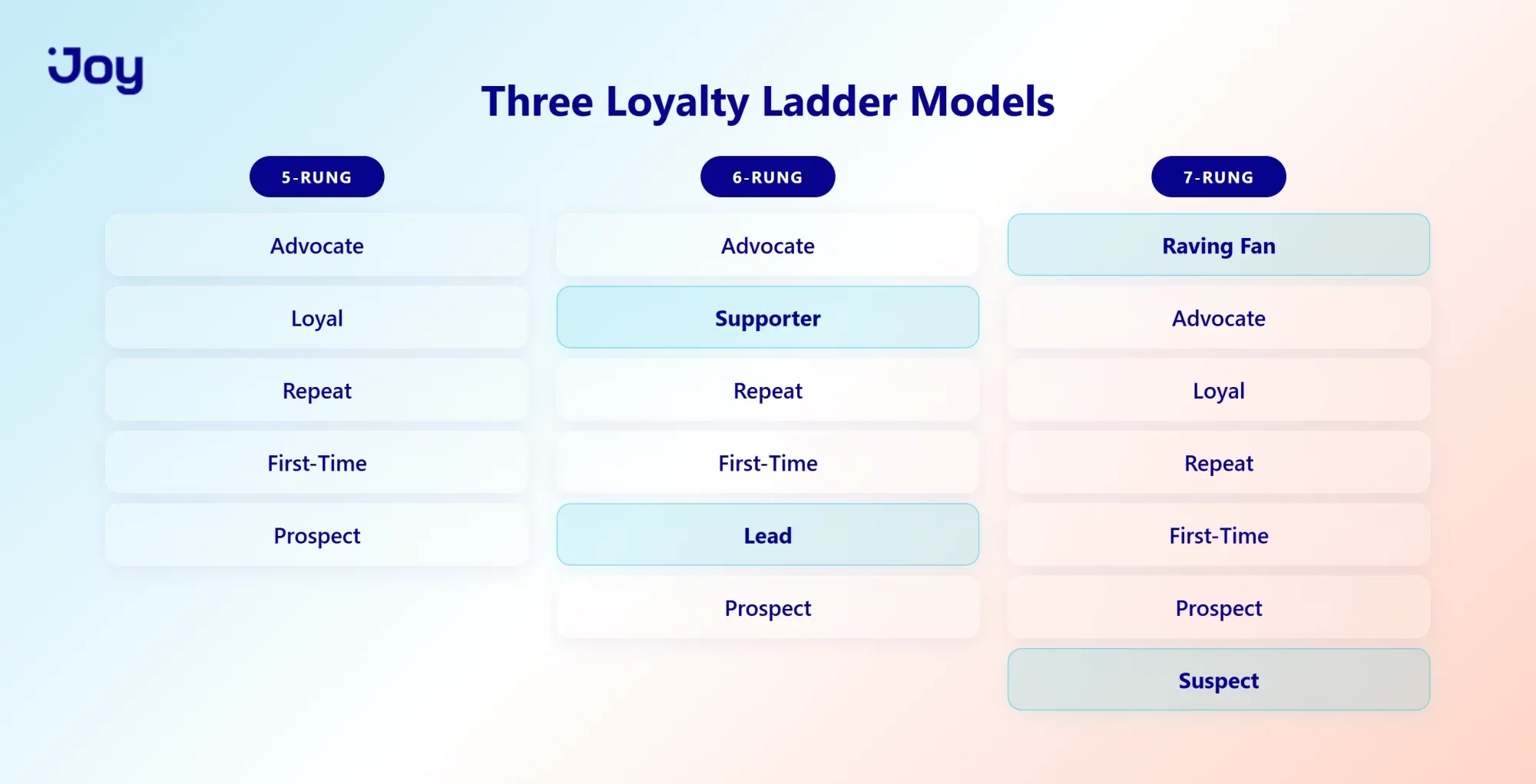
The Classic 5-Rung Loyalty Ladder Model
Rungs: Prospect → First-Time Buyer → Repeat Buyer → Loyal Customer → Advocate
This is the most common version and the easiest to implement. It works well for straightforward ecommerce businesses, particularly those in single-purchase categories like apparel, home goods, or consumables. The 5-rung model's strength is its simplicity: clear progression, minimal ambiguity, and easy integration with most CRM tools.
It does have a notable limitation, though. It collapses the journey between "repeat buyer" and "loyal customer" into a single leap. That can make it harder to spot the mid-tier behaviors that signal whether a customer is truly building a habit or just making occasional purchases. For more on the distinctions among loyalty behaviors, see our guide to types of customer loyalty.
The 6-Rung Loyalty Ladder Model
Rungs: Prospect → Lead → First-Time Buyer → Repeat Buyer → Supporter → Advocate
The 6-rung model adds two important nuances. First, it includes a "Lead" stage between prospect and first-time buyer, accounting for the nurture period where a potential customer has shown interest but hasn't converted yet. Second, it distinguishes between "Supporters" (loyal but haven't publicly advocated) and "Advocates" (those who actively promote your brand).
This model fits B2B ecommerce and high-touch retail best, where sales cycles run longer and the nurture phase is a distinct, measurable part of the journey. The tradeoff is operational complexity: more stages mean more touchpoints to manage, more automations to build, and more segmentation logic to maintain.
The 7-Rung Loyalty Ladder Model
Rungs: Suspect → Prospect → First-Time Buyer → Repeat Buyer → Loyal Customer → Advocate → Raving Fan
The 7-rung model, popularized by ActionCoach, extends the ladder in both directions. At the bottom, it adds "Suspect," representing the pre-awareness audience who fits your ideal customer profile but hasn't engaged yet. At the top, it introduces "Raving Fan," distinguishing between customers who advocate occasionally and those who champion your brand with genuine enthusiasm.
Premium and luxury brands with high-engagement community models tend to gravitate toward this version. But the additional rungs can create terminological overload, especially for smaller teams. If you can't clearly define and measure the difference between an Advocate and a Raving Fan, the extra rung becomes noise rather than signal.
Which Loyalty Ladder Model Should You Choose?
What the data consistently shows: most successful ecommerce brands don't adopt any standard model as-is. They customize a 4 to 6 rung framework based on their specific metrics. Some add a "high-LTV repeat" rung. Others create a "referral generator" stage distinct from general advocacy.
The practical guidance? Start with the 5-rung model. It covers the essential stages without overwhelming your operations. As your data maturity grows and you can measure more granular behaviors, add rungs where you see clear behavioral breaks. If you notice a meaningful difference between customers who buy three times versus those who buy six or more times, that's a signal to split "Repeat" into two distinct stages.
What matters isn't the number of rungs. It's your ability to define, measure, and act on each one.
The 5 Stages of the Customer Loyalty Ladder
Different models use different rung counts, but the underlying stages follow a consistent pattern. Here's what each stage represents, who sits in each stage, and what it means for your revenue.
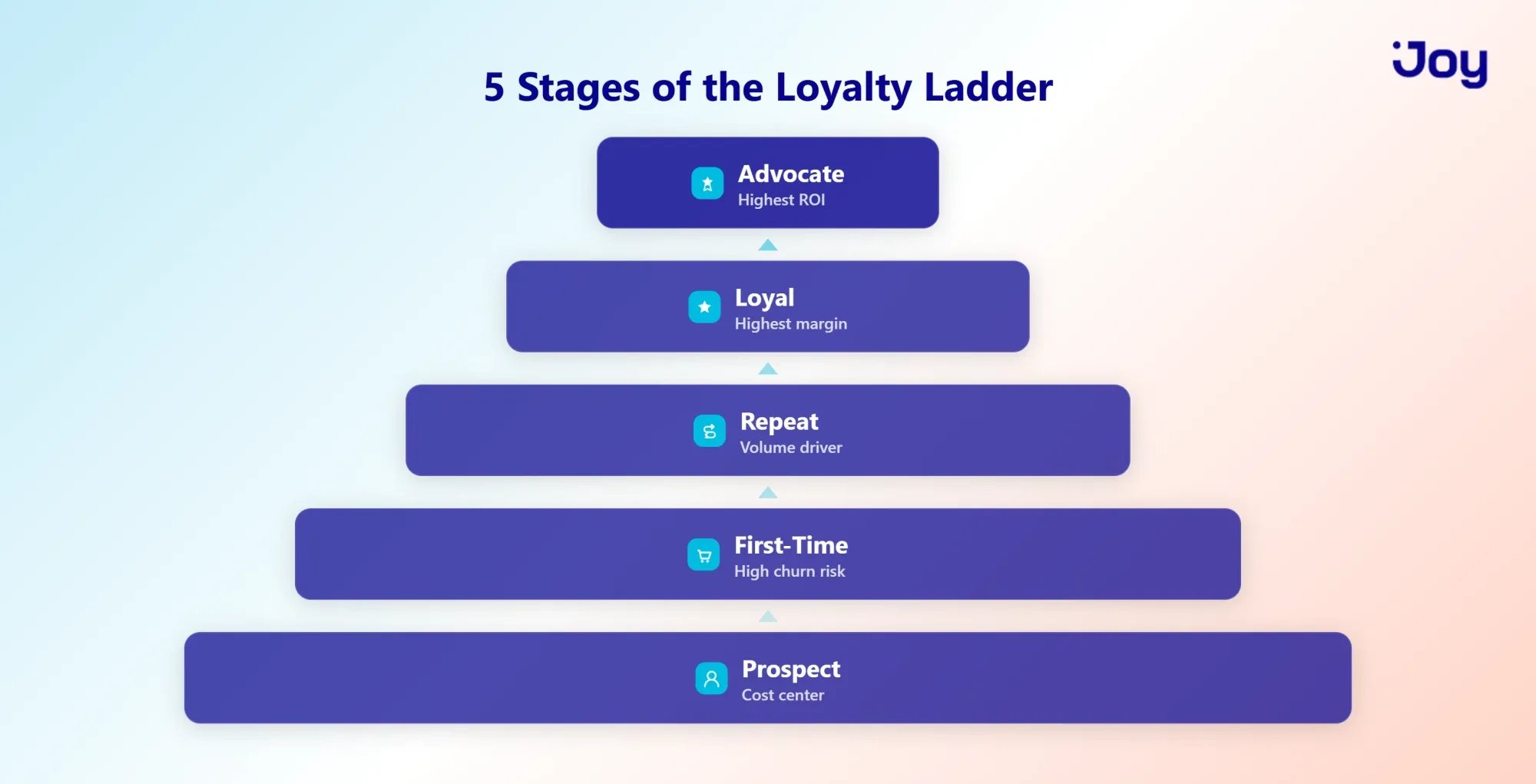
Stage 1: Prospect (Awareness)
Who they are: People who know your brand exists but haven't made a purchase. They may have visited your site, seen an ad, or stumbled across your social media.
Your goal: Convert awareness into a first purchase.
Revenue role: Pure cost center. You're spending on acquisition with no return yet.
Key tactics: Social proof on landing pages, educational content that builds trust, retargeting ads with customer testimonials, and a welcome offer in the range of 10 to 15% off. The focus here is on reducing the perceived risk of buying from an unfamiliar brand.
Stage 2: First-Time Buyer (Activation)
Who they are: Customers who've made exactly one purchase. They're still evaluating whether your product and experience warrant a return visit.
Your goal: Drive the second purchase within 60 days. This is the most critical transition on the entire ladder, because the longer a first-time buyer waits, the less likely they are to return.
Revenue role: A small share of total revenue with the highest churn risk. More than half of first-time buyers never come back.
Key tactics: Post-purchase thank-you email on day one, product care tips relevant to what they bought, and a follow-up offer at the 14-day mark. For more strategies on converting one-time buyers, see our guide on turning one-time buyers into repeat customers.
Stage 3: Repeat Buyer (Retention)
Who they are: Customers with 2 to 4 purchases who are developing a buying habit but haven't yet formed a deep emotional connection to your brand.
Your goal: Establish a consistent purchase pattern and hit spend milestones that signal genuine habit formation.
Revenue role: The largest share of total revenue for most ecommerce brands. This is the volume driver of your business.
Key tactics: Tiered rewards with clear spend milestones, exclusive early access to new products, loyalty program enrollment at this stage rather than earlier, and personalized product recommendations based on purchase history. For insights on designing effective tier structures, explore our guide on tiered loyalty programs.
Stage 4: Loyal Customer (Deep Retention)
Who they are: Customers with 6 or more purchases per year who feel emotionally connected to your brand. They choose you over alternatives even when competitors offer similar products at similar prices.
Your goal: Maximize customer lifetime value and begin activating these customers as referral sources.
Revenue role: A smaller share of total revenue than repeat buyers, but with the highest margin per customer. High average order value, low churn, and minimal acquisition cost.
Key tactics: VIP perks, birthday offers, personalized recommendations based on full purchase history, and direct referral program invitations. These customers have earned recognition, and providing it deepens the relationship.
Stage 5: Advocate (Expansion)
Who they are: Customers who actively promote your brand through reviews, referrals, social sharing, and word-of-mouth recommendations.
Your goal: Sustain advocacy over time and track the revenue it generates.
Revenue role: The smallest share of direct revenue, but the highest return on investment of any stage. Advocates drive new customer acquisition at near-zero cost.
Key tactics: Referral bonuses for both the referrer and the friend, ambassador recognition programs, user-generated content campaigns, and exclusive community access. The key is making advocacy feel valued, not transactional.
The bottom line: Your Loyal and Advocate customers, though they represent a smaller portion of your total base, consistently generate the highest revenue per customer and the strongest margins. The loyalty ladder isn't just a conceptual model. It's a revenue map that shows exactly where your highest-value customers live.
How to Move Customers Up the Customer Loyalty Ladder
Understanding the stages is one thing. Engineering the transitions between them is where most brands fall short. Each rung-to-rung shift requires a distinct strategy because the motivations and barriers differ at every level.
Prospect → First-Time Buyer
This transition is about reducing trust barriers and removing friction. The prospect knows you exist but hasn't committed.
- Welcome email or SMS sequence with a first-purchase incentive
- Retargeting ads featuring real customer testimonials and reviews
- Live chat engagement for high-intent visitors who are browsing but not buying
- Target metric: Conversion rate between 2 and 5%
First-Time Buyer → Repeat Buyer
This is the most fragile transition on the ladder. Most consumers don't consider themselves loyal until three or more purchases. Your job is to make that second and third purchase feel natural, not forced.
- Post-purchase thank-you plus product care email on day one
- Re-engagement email at the 14 to 21-day window with a second-purchase incentive
- Abandoned cart recovery for post-first-purchase browsers (they came back but didn't buy, and that's a signal worth acting on)
- Target metric: Second purchase within 60 days, with a benchmark of 25 to 40%
Repeat Buyer → Loyal Customer
At this stage, the customer already buys from you regularly. The goal shifts from generating purchases to deepening the relationship so they become resistant to competitor offers.
- Tiered rewards with spend milestones (for example, "$500 total spend unlocks 20% tier discount")
- VIP email sequence with exclusive sale access, birthday offers, and member-only events
- Early access to new product launches for top spenders
- Target metric: Lifetime value above $1,000 and 6 or more purchases per year, aiming for 15 to 25% of repeat buyers reaching this stage
Loyal Customer → Advocate
This is the transition most brands neglect entirely, as we identified in pain point number four. Loyal customers don't become advocates automatically. They need a reason and a mechanism.
- Referral program with tiered bonuses where both the referrer and their friend receive a reward
- Ambassador recognition for top referrers, including exclusive perks and social shoutouts
- Review and testimonial incentives such as store credit per published review
- User-generated content campaigns that reward social sharing
- Target metric: Referral-generated orders accounting for 5 to 10% of total revenue
Advocate Retention and Recovery
Even advocates don't stay advocates forever. Without ongoing attention, they quietly drift back down the ladder.
- Quarterly check-in with an exclusive offer and a feedback request
- Churn alert if purchase frequency drops more than 30% year-over-year
- Win-back sequence with personalized offers based on past behavior
- Target metric: Advocacy retention rate of 80% or higher
Common Mistakes That Break Your Customer Loyalty Ladder
Even with the right model and the right stages, brands consistently make the same five execution mistakes. Each one maps directly to the operational gaps we covered earlier.
Spending 80% of the budget on acquisition, 20% on retention. The most common and most costly inversion. The loyalty ladder proves that profit concentrates at the top rungs, not the bottom. Every dollar redirected from acquisition to retention, whether that's loyalty mechanics, personalized follow-ups, or referral programs, compounds over time. Yet most marketing plans still pour the vast majority of the budget into bringing in new prospects rather than advancing existing customers.
No strategy for the second purchase. Most consumers need three or more purchases before loyalty forms. We covered this earlier. And yet most merchants have zero post-first-purchase automation. No follow-up sequence. No second-purchase incentive. No behavioral trigger based on browsing after the first order. The gap between "first buyer" and "repeat buyer" is where the largest percentage of customers fall off the ladder for good.
Treating all customers the same. Without stage-based segmentation, personalization is impossible. A first-time buyer and a five-time loyal customer receive identical messages, identical offers, and identical experiences. The loyalty ladder's entire value comes from recognizing that these are fundamentally different audiences. Treating them identically wastes the framework.
Rushing customers with aggressive sequences. Over-discounting, daily email blasts, and pressure tactics feel urgent, but they accelerate churn rather than progress. Customers climb at their own pace. Trying to force faster movement through heavy-handed tactics creates resentment, not loyalty. The most effective approach is consistent, well-timed engagement that respects the customer's natural buying rhythm.
Ignoring silent loyalists. These are customers who buy repeatedly but never leave reviews, refer friends, or engage publicly. They represent hidden revenue, and because they don't visibly signal their loyalty, most merchants don't know they constitute a distinct segment. Without a strategy to identify and activate them, the highest-potential candidates for advocacy stay invisible.
The Hidden Engine: Why Data Makes or Breaks Your Customer Loyalty Ladder
You can have the perfect 5-rung model, clear stage definitions, and a detailed playbook for every transition. None of it works if you can't answer one fundamental question: which stage is each of your customers on right now?
The Problem: Most Brands Can't Track Stage Placement
Ask most ecommerce teams to assign every customer to a loyalty ladder stage, and they'll struggle. They might know their best customers by name. But placing 5,000 or 50,000 customers into distinct rungs in real time? That requires data infrastructure that most stores simply don't have.
Without real-time tracking, stage-based personalization becomes guesswork. You might send a VIP offer to someone who hasn't purchased in six months, or miss the window to re-engage a first-time buyer who's about to lapse. For a deeper look at how analytics drive better loyalty decisions, see our guide on customer loyalty analytics.
The Data Architecture Needed
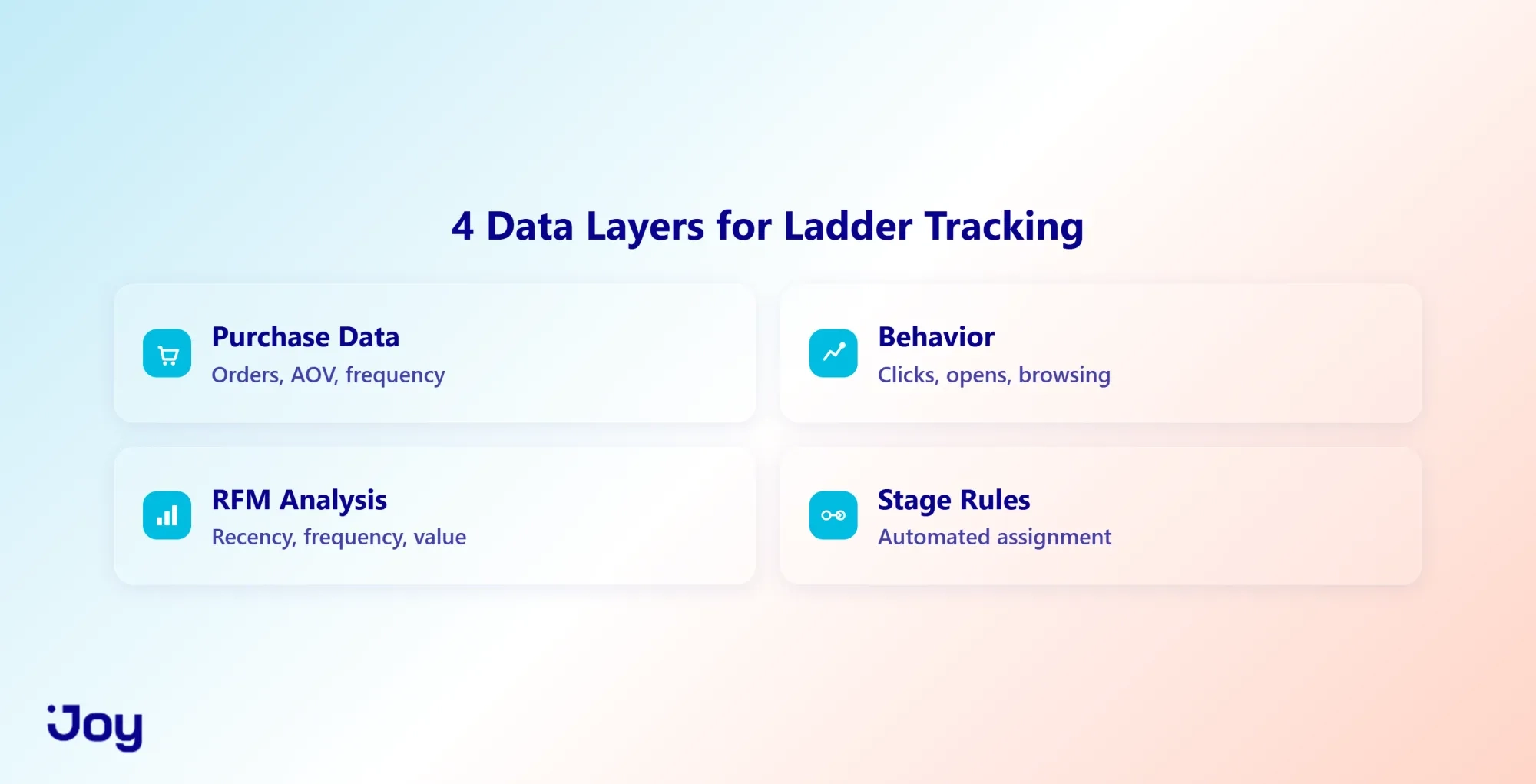
Effective loyalty ladder tracking requires four interconnected data layers:
Layer 1: Purchase tracking. Repeat purchase count, average time between purchases, and average order value. This is the baseline that determines which rung a customer occupies.
Layer 2: Behavioral signals. Email open rates, website browsing patterns, referral link clicks, and review submissions. These signals reveal whether a customer is moving up or sliding down, often before purchase data shows the shift.
Layer 3: RFM analysis. Recency (when they last bought), Frequency (how often they buy), and Monetary value (how much they spend). RFM scoring is the most reliable method for quantifying loyalty ladder position.
Layer 4: Stage assignment rules. Automated logic that assigns customers to stages based on the data above. For example: "3 or more purchases in the last 90 days, with an average order value above $75, equals Repeat Buyer moving toward Loyal." Without automated rules, stage assignment stays manual and inconsistent, which defeats the purpose.
What to Look for in a Platform
When you're evaluating tools that can support this kind of tracking, look for these capabilities:
- Flexible stage definitions that aren't locked into a rigid, one-size-fits-all model
- Real-time data sync with your ecommerce platform so stage assignments update as purchases happen, not in batches
- Cross-channel orchestration so email, SMS, and loyalty rewards all trigger from the same stage logic
- Referral revenue tracking that shows which sales came from advocates, versus organic, versus paid channels
The data layer is what separates brands that talk about the loyalty ladder from brands that actually use it.
Getting Started: Build Your Customer Loyalty Ladder Today
You don't need to build the entire system overnight. Start with these four steps, and expand as your data and capabilities grow.
Step 1: Choose Your Model
Start with the 5-rung model. Define what each stage means for your specific business using metrics you already track: purchase count, order frequency, and total spend. You can always add rungs later as you identify meaningful behavioral breaks in your customer data.
Step 2: Map Your Current Customers
Pull your purchase history and run a basic RFM analysis. Assign every customer to a stage retroactively. This exercise alone will reveal where your ladder is heaviest (likely the Repeat Buyer stage) and where it's thinnest (almost certainly Advocate). That's your growth lever.
Step 3: Activate Stage-Based Personalization
Create email and SMS sequences specific to each stage. Set up automations so that when a customer moves from one stage to another, their messaging changes accordingly. Even simple stage-based segmentation outperforms generic one-size-fits-all campaigns by a wide margin.
Step 4: Measure and Optimize
Track stage movement monthly. What percentage of customers are moving up versus sliding down? Where are the bottleneck transitions? Are your referral programs actually converting loyal customers into advocates? Adjust your tactics based on where the ladder breaks.
If you're looking for a loyalty platform that supports flexible stage definitions, tiered rewards, and referral tracking to power this kind of framework, explore what Joy Loyalty offers.
FAQ
What is the customer loyalty ladder?
It's a marketing framework that segments customers into stages based on their engagement and loyalty to a brand. The ladder typically ranges from prospects (people who know you but haven't bought) to advocates (customers who actively promote your brand). It helps businesses prioritize resources and build strategies specific to each stage.
How many stages does a loyalty ladder have?
It depends on the model. The classic version has 5 rungs (Prospect, First-Time Buyer, Repeat Buyer, Loyal Customer, Advocate). A 6-rung model adds Lead and Supporter stages for longer sales cycles. The 7-rung model includes Suspect and Raving Fan for maximum granularity. Most successful ecommerce brands customize a 4 to 6-rung version.
What is the difference between a 5-rung and 7-rung loyalty ladder?
The 5-rung model is simpler and easier to implement, covering the core progression from Prospect to Advocate. The 7-rung model adds pre-awareness (Suspect, those who fit your profile but haven't engaged) and an ultra-high tier (Raving Fan, those who enthusiastically champion your brand). Go with 5 rungs if you're starting out, and move to 7 only when your team can clearly define and measure each additional stage.
What is the hierarchy of customer loyalty?
Same concept as the loyalty ladder: Prospect → First-Time Buyer → Repeat Buyer → Loyal Customer → Advocate, ranked from lowest to highest engagement and value. Each level represents a deeper commitment to the brand.
How do you move customers up the loyalty ladder?
Through stage-specific strategies. Welcome offers and social proof for prospects. Post-purchase follow-ups and second-purchase incentives for first-time buyers. Tiered rewards and VIP perks for repeat buyers. Referral programs and ambassador recognition for loyal customers. Each transition requires a different approach because the motivations and barriers change at every level.
Why is the customer loyalty ladder important?
It exposes operational gaps that generic retention strategies miss. The ladder shows where customers get stuck, where they slide back, and where the highest-value opportunities (advocacy, referrals) remain untapped. Brands that map it discover most of their customers are concentrated at the lower rungs, with almost no system to push them higher.
What tools help track loyalty ladder progression?
Look for loyalty platforms that offer customer segmentation, RFM analysis, automated stage assignment rules, and referral tracking. The most important capability is real-time data sync with your ecommerce platform, so stage assignments update automatically as customer behavior changes. For a detailed comparison, see our guide on ecommerce loyalty programs.
Is the loyalty ladder the same as a loyalty program?
No. The ladder is a strategic framework for understanding and mapping customer stages. A loyalty program (points, tiers, referrals) is a tactic you use to move customers up the ladder. The ladder tells you where to focus. The program gives you the mechanics to do it. For more on loyalty programs as a tactic, see our overview of what a loyalty program is.

Written by
Thomas Nguyen is the CEO & Co-founder of Joy, a loyalty solution for Shopify and eCommerce brands. With years of experience building high-performance Shopify apps, Thomas aims to help merchants grow through customizable and retention-focused tools.
Related reading
 Loyalty Strategy
Loyalty Customer Service: How Service Quality Drives Revenue
80% of customers say experience matters as much as products (Salesforce). Loyalty customer service isn't a cost center — it's a revenue lever. This guide covers Harvard's Service-Profit Chain, the service-to-revenue mechanism, and a 5-step recovery system any ecommerce brand can run.
 Thomas Nguyen
 Loyalty Strategy
Relationship Marketing and Customer Loyalty: The 4-Pillar Framework
True customer loyalty is declining for the first time in 5 years (SAP, 2025). Discount-driven marketing is hitting diminishing returns. Relationship marketing flips the model: build trust and shared value first, then watch loyalty follow. Here's the 4-pillar framework.
Thomas Nguyen Loyalty Strategy
The Customer Loyalty Loop: Why Retention Beats Acquisition
More than half of loyalty memberships sit inactive — the fix isn't a better funnel, it's a loop. Here's the 4-stage customer loyalty loop framework, where most Shopify programs break down, and how to diagnose which stage yours is missing.
Thomas Nguyen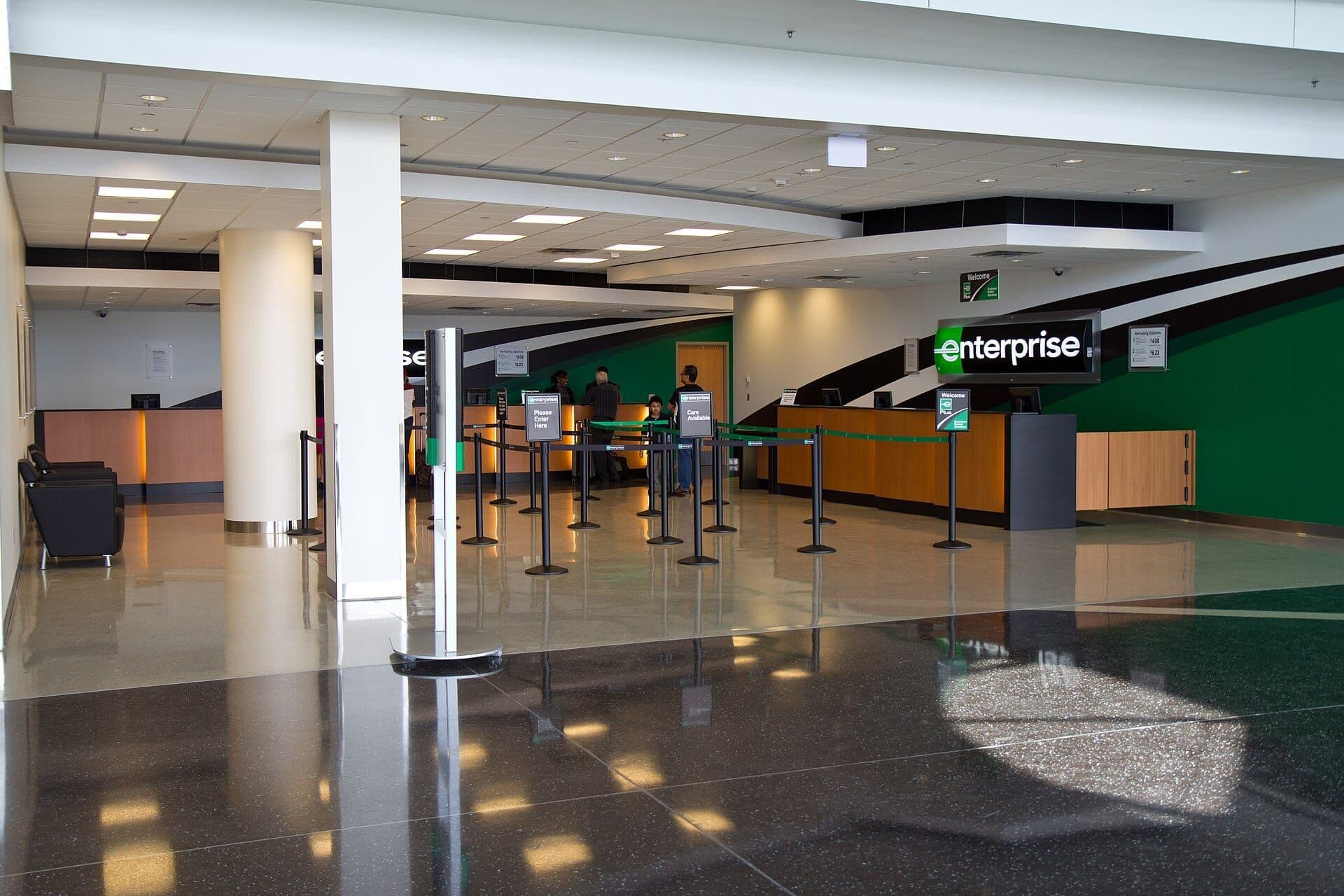 Loyalty Strategy
Enterprise Plus Loyalty Program: Case Study for Ecommerce Strategists 2026
Most loyalty programs are built to feel generous. Enterprise Plus was built to make leaving expensive. This case study breaks down the 3 structural levers — milestone tiers, status lock-in, and concrete rewards — that added 2M members without ad spend, and which ones translate to Shopify.
Thomas Nguyen Loyalty Strategy
Customer Loyalty Pyramid: 5 Stages to Brand Advocacy
Your best customers don't quit — they quietly drift away. The customer loyalty pyramid maps all five stages of the relationship, shows where customers get stuck, and gives you tactics to move them up before stealth attrition takes hold.
Thomas Nguyen Loyalty Strategy
Customer Loyalty Levels: Why Not All Customers Are Equal
Not all customers are equal — and most stores treat them like they are. This guide breaks down the four customer loyalty levels, how to spot where each customer sits, and a 30-day plan to move them up the ladder, with real case studies and metrics to track.
Thomas Nguyen