
How to Enhance Customer Loyalty: A 7-Step System That Works
A 5% lift in retention can drive 25–95% more profit — but most brands never close the gap between knowing loyalty matters and building a system that moves the numbers. Here is a 7-step system to enhance customer loyalty, from baseline audit to ROI measurement, with real brand examples.

Summarize this post with AI
A 5% increase in customer retention can drive a 25% to 95% jump in profits (Bain & Company). The figure comes from Bain & Company work published in Harvard Business Review in 2014, drawn largely from one bank's branch system, so read it as a direction to aim in rather than a forecast for your store. And yet most ecommerce brands still can't close the gap between knowing loyalty matters and building a system that actually moves retention numbers.
The problem isn't awareness. It's execution. Brands launch loyalty programs based on competitor imitation or gut feeling, skip foundational steps, and then wonder why results disappoint. Across hundreds of ecommerce loyalty programs, the pattern is consistent: brands that succeed treat loyalty as a sequential system, not a single tactic.
This article walks you through a 7-step system to enhance customer loyalty from the ground up. Each step builds on the one before it: audit, structure, personalize, support, community, consistency, and measurement. Skip steps, and the system collapses. Follow the sequence, and you get a real implementation playbook backed by brand examples, plus clear criteria for choosing the right tools at each stage.
Step 1: Audit Your Loyalty Baseline Before You Change Anything
Before enhancing anything, you need to know where you stand. Too many brands launch loyalty initiatives based on gut feeling or competitor imitation, without ever measuring their current loyalty health. That approach wastes budget and leads to fixes for the wrong problems.
Measure Your Current Loyalty Health
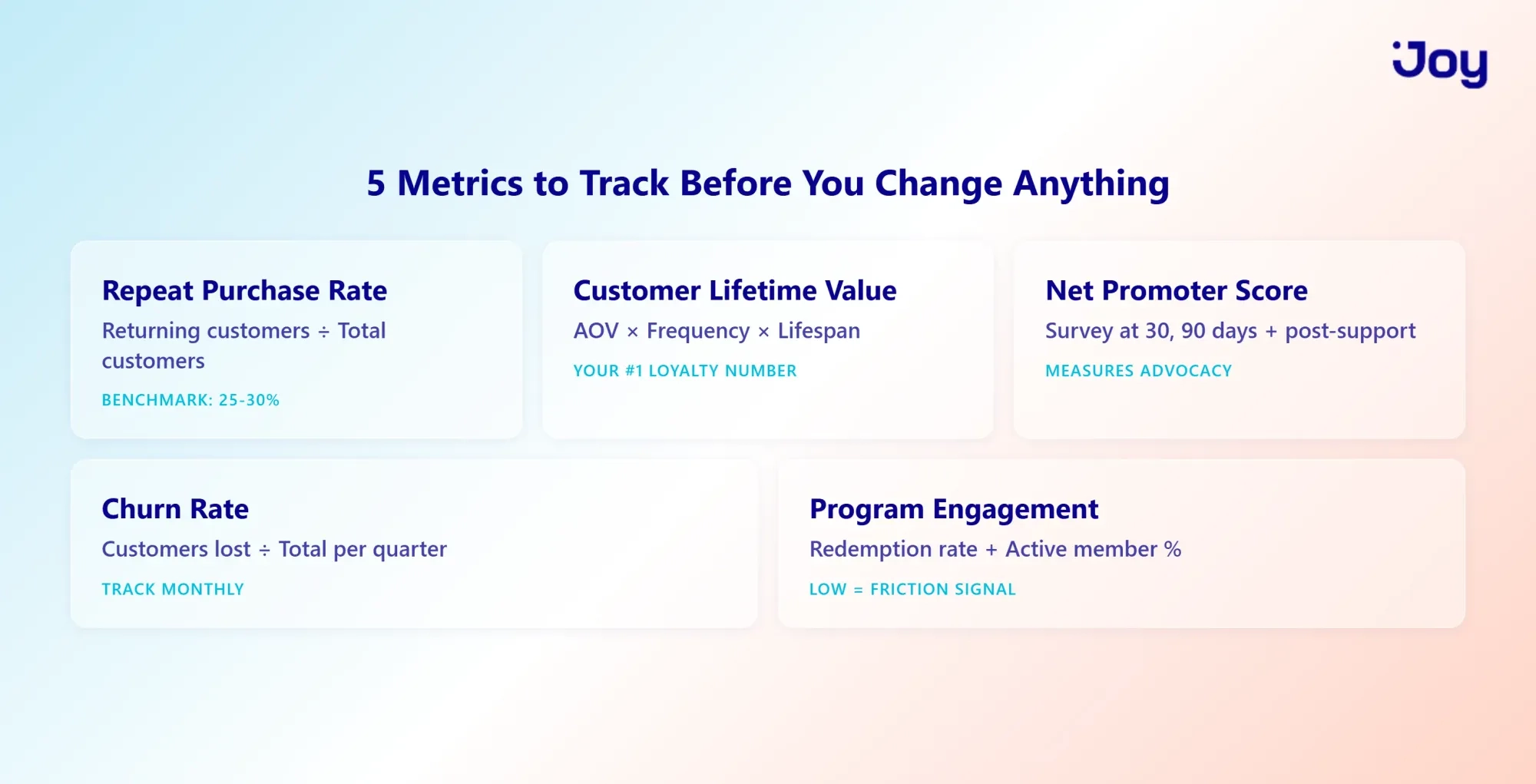
Start by tracking five baseline metrics that reveal exactly how your customers behave right now:
- Repeat purchase rate: the percentage of customers who buy more than once. Bluecore put the cross-vertical average at 16.5% for 2023, counting first-time buyers who came back for a second purchase, with health and beauty highest at 21.5%. Shopify's returning customer rate uses a different denominator, so read the two separately.
- Customer Lifetime Value (CLV): calculated as average purchase value multiplied by purchase frequency, multiplied by customer lifespan. This single number tells you what a loyal customer is worth.
- Net Promoter Score (NPS): survey customers at key touchpoints, such as 30 days after first purchase, 90 days in, and after support interactions.
- Churn rate: the percentage of customers lost per quarter. If you don't track this, you have no way to know whether your improvements are actually working.
- Program engagement: if you already have a loyalty program, track your redemption rate and active member percentage. Low redemption often signals that rewards are too hard to earn or just not compelling enough.
Together, these five metrics form your loyalty dashboard. Without them, every improvement you make is guesswork.
Segment Customers by Loyalty Level
Not all customers are equally valuable, and treating them the same wastes resources. Segment your customer base into three groups based on purchase behavior:
Advocates show high NPS scores combined with frequent purchases. They already love your brand and represent your highest ROI to activate through referrals and community. Passive loyals buy regularly but don't engage beyond transactions. Stable, but vulnerable to competitor offers. At-risk customers show declining purchase frequency or increasing time between orders. They're the cheapest to save, because they already know your brand.
Where you focus first depends on your situation. If churn is your primary problem, start with at-risk customers. If growth is the priority, activate your advocates.
Build a Customer Feedback Loop
Data tells you what customers do. Feedback tells you why. You need both.
Run post-purchase surveys that ask specific questions: "What do you value most about buying from us?" and "What would make you buy more often?" Deploy NPS surveys at key touchpoints rather than sending one generic annual survey. And dig into your reviews, looking for patterns in what customers praise, not just what they complain about.
The most important part of this process, though, is closing the loop. Act on what you learn, then communicate those changes back to customers. A simple "You asked, we delivered" message builds more trust than any discount. That's not a platitude. It's a retention mechanic.
Starbucks demonstrates this well. The company actively uses in-app feedback and customer input to shape its Rewards program features, and it reported 35.8 million 90-day active U.S. members for the quarter ended 28 June 2026 on its Q3 fiscal 2026 earnings call.
How to implement: Use your ecommerce platform's built-in analytics paired with a survey tool like Typeform, Hotjar, or Klaviyo post-purchase flows. Build your five-metric dashboard, track monthly, and review quarterly.
Step 2: Design Your Loyalty Program with Customer Loyalty Strategies That Scale
With baseline data in hand, you can design a program that targets the right behaviors rather than guessing at what might work. The choices you make here determine everything that follows.
Choose Your Program Model
There are four primary types of loyalty programs, and each suits a different business model:
Points-based programs work best for brands with high purchase frequency, where customers can accumulate and redeem points quickly. Tiered programs create aspirational loyalty by rewarding customers who climb through levels, each unlocking better perks. Paid or subscription programs charge a membership fee in exchange for premium benefits, best suited for brands with a strong value proposition. Hybrid programs combine elements from multiple models, ideal for brands with complex product catalogs or diverse customer segments.
Sephora's Beauty Insider program shows what tiered design can do. With 45 million members across North America in 2025 (Sephora newsroom), the three-tier system (Insider, VIB, and Rouge) unlocks exclusive experiences at each level rather than simply offering bigger discounts. Customers actively spend more to reach the next tier, because the perks feel genuinely worth earning. Not just bigger discounts. Better access.
Set Earning and Redemption Rules
The mechanics of your program determine whether customers engage or ignore it. On the earning side, define how customers accumulate value: points per dollar spent, bonus multipliers for referrals or reviews, and special campaigns for seasonal pushes.
On the redemption side, balance is everything. Set thresholds too low, and there's no aspiration. Too high, and customers feel frustrated. The sweet spot? Customers can see progress toward their next reward after every purchase.
The North Face's XPLR Pass is the useful counter-model here. It is free and has no tiers at all: one point per dollar, 100 points for a $10 reward. (Basecamp, Half Dome and Summit were tiers in VIPeak, the program XPLR Pass replaced in 2021.) What holds members is access rather than rank — early gear drops, product field-testing, member-only events. When what your customers want is to do something, a flat program can beat a tiered one.
Launch Strategy: Test Before You Scale
Don't go live to your entire customer base on day one. Soft launch with your top 10% of customers first. These are your advocates from Step 1. Gather their feedback, refine your rules, and iron out friction points.
Only then do you go wide with a full launch: site-wide announcement, email campaign, and homepage placement. The common mistake is launching site-wide without testing first, which leads to confusing rules and public rollbacks that erode trust before the program gains traction.
Joy's flexible rule engine lets you build custom point structures, tier rewards, and earning rules without coding. Set points-per-dollar, run bonus campaigns, and adjust tier qualification thresholds at any time as you learn what actually drives repeat purchases.
How to implement: When evaluating loyalty platforms, compare these criteria: Does the tool support your chosen model (points, tiers, or hybrid)? Can you customize rules without developer help? Does it integrate natively with your ecommerce platform? Flexibility of rules and ease of iteration matter more than feature count. For a worked example of those criteria on two apps outside the big established names, see Rivo vs BON.
Step 3: Personalize the Experience and Remove Friction to Improve Customer Loyalty
Generic programs underperform because they ignore the one thing customers notice most: whether you actually know them. McKinsey's 2021 Next in Personalization Report found that 71% of consumers expect personalized interactions, and 76% get frustrated when that doesn't happen.
How to Increase Customer Loyalty Through Personalized Triggers
The foundation of personalization is segmentation. Group customers by purchase history, order frequency, and average order value, then assign different reward triggers to each segment.
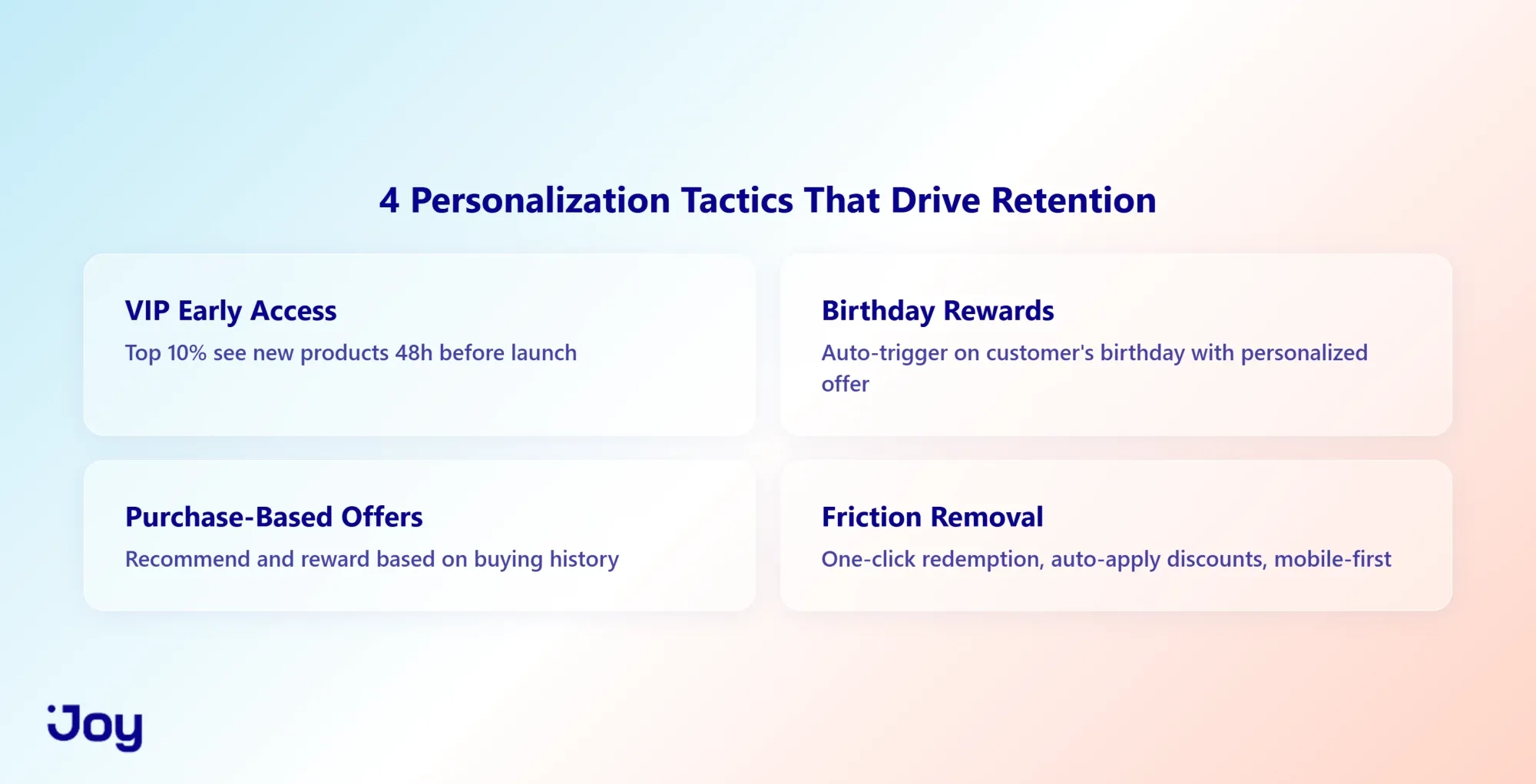
Your VIP customers should receive early access to new products and exclusive events. Frequent buyers benefit from double-points campaigns that accelerate their progress through tiers. Lapsed customers need targeted win-back offers with compelling incentives to return.
Beyond segments, build in personal milestones. Birthday rewards, purchase anniversary discounts, and product recommendations based on buying history all signal that your brand pays attention. Pair these with personalized email timing matched to each customer's shopping patterns, and you create moments that feel intentional rather than automated.
So what separates this from manual campaign management? Trigger-based rules that fire automatically on customer behavior. That's what turns personalization from a nice idea into a system that scales.
Remove Friction From the Loyalty Experience
Even the best rewards fail if the process of earning and redeeming them is painful. Friction is the silent killer of loyalty program engagement.
Simplify point redemption with one-click checkout and auto-applied discounts. Reduce the number of steps between earning rewards and using them. And prioritize mobile, because most loyalty interactions happen on a phone. If your redemption flow requires a desktop experience, you're losing engagement where it matters most.
Amazon Prime demonstrates this at scale. Prime members spend an average of $1,170 per year compared to $570 for non-members, according to CIRP. That $600 gap exists largely because Prime removes friction through free shipping, one-click ordering, and personalized recommendations, all working together to make the next purchase effortless.
Automate Without Losing the Personal Touch
Automation and personalization aren't opposites. The goal is to automate repetitive interactions (post-purchase thank-you messages, points balance updates, next-reward previews) while keeping high-stakes moments human.
When a VIP customer files a complaint, that's not the time for a chatbot. When someone reaches a major loyalty milestone, a personal note from your team carries more weight than an automated email. Research from Verint Systems found that 79% of consumers want human-driven customer service, particularly for complex issues.
Automate the repetitive. Personalize the moments that matter.
How to implement: Evaluate whether your loyalty platform supports segment-based rules, automatic triggers for birthdays and milestones, and integration with your email and SMS tools like Klaviyo or Omnisend. The key criteria are automation depth, segment granularity, and integration breadth. If that pick is still open, Klaviyo vs Omnisend compares the two on pricing and setup time.
Step 4: Make Support the Loyalty Superpower
The Emarsys Customer Loyalty Index 2025 found that 47% of consumers say poor customer service weakens their loyalty to a brand. That makes support quality the single fastest way to destroy everything you've built in Steps 1 through 3. Or the most powerful way to reinforce it.
Audit Your Support Quality
Start with three metrics that reveal your support team's impact on loyalty:
Average response time measures how quickly customers receive a first reply. For ecommerce, the benchmark is under four hours. First-contact resolution rate tracks the percentage of issues resolved in a single interaction. Aim for 75% or higher. CSAT score captures customer satisfaction immediately after support interactions.
Once you have these numbers, look for patterns. Where do loyal customers specifically experience friction? Are VIP customers getting the same response times as first-time buyers? (They shouldn't be.) Identifying these gaps reveals where small improvements yield the biggest retention gains.
Prioritize Loyal Customers With VIP Treatment
Your support team should know who your most valuable customers are the moment a ticket comes in. Train agents to recognize loyalty program members and apply tier-based service levels.
That means proactive outreach for shipping delays or stock issues before customers need to contact you. It means tier-based SLAs where Gold members receive priority support within two hours. And it means resisting the urge to over-automate the interactions that build real trust.
That Verint finding from Step 3 bites hardest right here. Chatbots and self-service work well for order tracking and basic questions. But when a loyal customer has a problem that matters to them, a real person needs to handle it.
Measure Support's Impact on Retention
Support quality compounds over time in ways that are easy to miss if you're not tracking the right cohorts. Compare retention rates between customers who contacted support and those who didn't. Track CSAT scores broken down by customer segment, separating loyal members from one-time buyers.
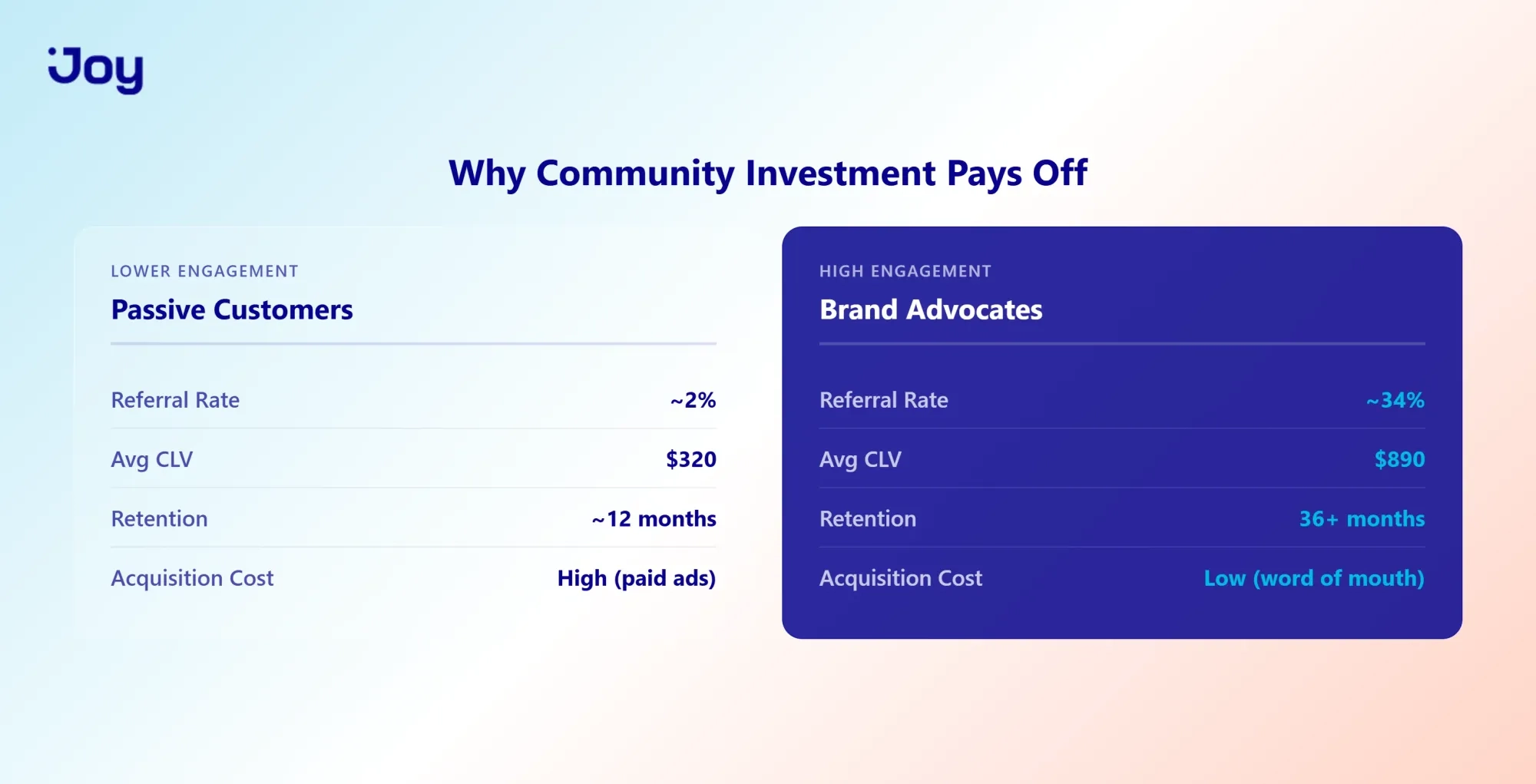
The compounding effect works like this: great support keeps a customer, that customer stays longer and spends more, their higher CLV generates more referrals, and those referrals lower your overall acquisition cost. Support isn't a cost center. It's your highest-ROI retention investment.
How to implement: Integrate your helpdesk (Gorgias, Zendesk, or Freshdesk) with your loyalty platform so agents see customer tier, points balance, and purchase history on every ticket. Set SLA targets by tier and track CSAT alongside retention cohorts monthly. If the helpdesk itself is still an open decision, Gorgias vs Zendesk compares per-ticket pricing against per-agent pricing.
Step 5: Build Community and Turn Customers Into Advocates
Transactional loyalty is fragile. A competitor with a slightly better discount or a faster shipping option can break it overnight. Emotional loyalty endures. And the fastest way to build emotional loyalty is through community and referral programs that give customers a role in your brand's story.
Launch Your Brand Community
Community doesn't require a massive investment. Start small by inviting your top 10% of loyal customers (the advocates you identified in Step 1) into an exclusive group. This could be a Facebook Group, a Discord server, a dedicated forum, or even a private segment of your email list with exclusive content.
Give members a reason to stay engaged: early product access, behind-the-scenes content, user-generated content features, and recognition through badges or exclusive rewards. The goal is to make membership feel like belonging, not just buying.
TOMS provides one of the strongest examples of community-driven loyalty. With over 100 million pairs of shoes donated and $200 million in grants and shoe donations since it started in 2006, the company built loyalty through shared values. Customers feel they're part of a mission, which creates a bond that no discount can replicate.
Activate Your Referral Engine
Once you have engaged advocates, give them a structured way to bring in new customers. Referral programs work because they reward both sides of the transaction. A "Give $10, Get $10" model, for example, gives the referrer an incentive to share and the new customer a reason to try.
Make the referral process as frictionless as possible: unique shareable links, one-click sharing to social media, and automated reward fulfillment so neither party has to wait. Then track the results. Compare referred customer CLV against organic customer CLV to quantify the true value of your advocacy engine.
How to implement: Evaluate whether your loyalty platform includes built-in referral features or whether you need a separate tool like ReferralCandy or Friendbuy. Built-in referral programs reduce tech stack complexity and keep attribution in one place. The key criteria are reward flexibility (points versus discount), tracking depth, and ease of sharing.
Step 6: Deliver Omnichannel Consistency for Customer Loyalty Strategies That Last
Customers don't think in channels. They interact with your brand through your website, mobile app, email, social media, and sometimes in-store, and they expect their loyalty status to follow them everywhere. When it doesn't, the inconsistency creates friction that undermines every step you've built so far.
Unify the Loyalty Experience Across Channels
The foundation of omnichannel loyalty is a unified customer profile. Purchase history, loyalty status, tier level, and preferences should sync across every touchpoint in real time. A Gold member must be recognized as Gold whether they're opening an email, browsing your website, shopping on their phone, or visiting a physical store. No exceptions.
On the earning and redemption side, points, discounts, and tier perks need to work regardless of which channel a customer uses. If someone earns points on your website but can't redeem them through your app, you've built a system that frustrates rather than rewards.
Starbucks Rewards demonstrates what strong omnichannel loyalty looks like in practice. Members earn and redeem stars whether they order through the app, in-store, at the drive-through, or via web ordering. That consistency is a large part of why the member base cited back in Step 1 keeps growing quarter over quarter.
Aberdeen Group research from 2013 found that brands with strong omnichannel strategies achieve 89% customer retention rates, compared to just 33% for brands with weak omnichannel engagement. The gap is staggering, and it comes down to one thing: consistency builds trust.
Avoid the Channel Fragmentation Trap
The most common failure mode is a loyalty program that works perfectly on desktop but breaks on mobile. This happens when different systems manage different channels without sharing a unified customer identity.
Data silos between your email platform, web store, POS system, and mobile app create disconnected experiences. The fix is making sure your entire tech stack shares one customer profile, so that every interaction, regardless of channel, contributes to and reflects the same loyalty status.
How to implement: Audit your tech stack with these questions: Does your loyalty platform sync across all sales channels? Does it maintain a single customer profile? Can customers earn and redeem points regardless of how they shop? The key criteria are integration breadth, real-time sync capability, and mobile experience quality.
Step 7: Measure Results and Prove Your System Works to Increase Customer Loyalty
Without measurement, loyalty is a cost center that gets cut in the next budget review. With measurement, it becomes a growth engine that earns its own expansion. This step transforms everything you built in Steps 1 through 6 into numbers that leadership can act on.
Calculate Your Core Loyalty Metrics
Three calculations anchor your loyalty program ROI:
Customer Lifetime Value (CLV): average purchase value multiplied by purchase frequency, multiplied by average customer lifespan. This is the number that proves loyal customers are worth more than one-time buyers.
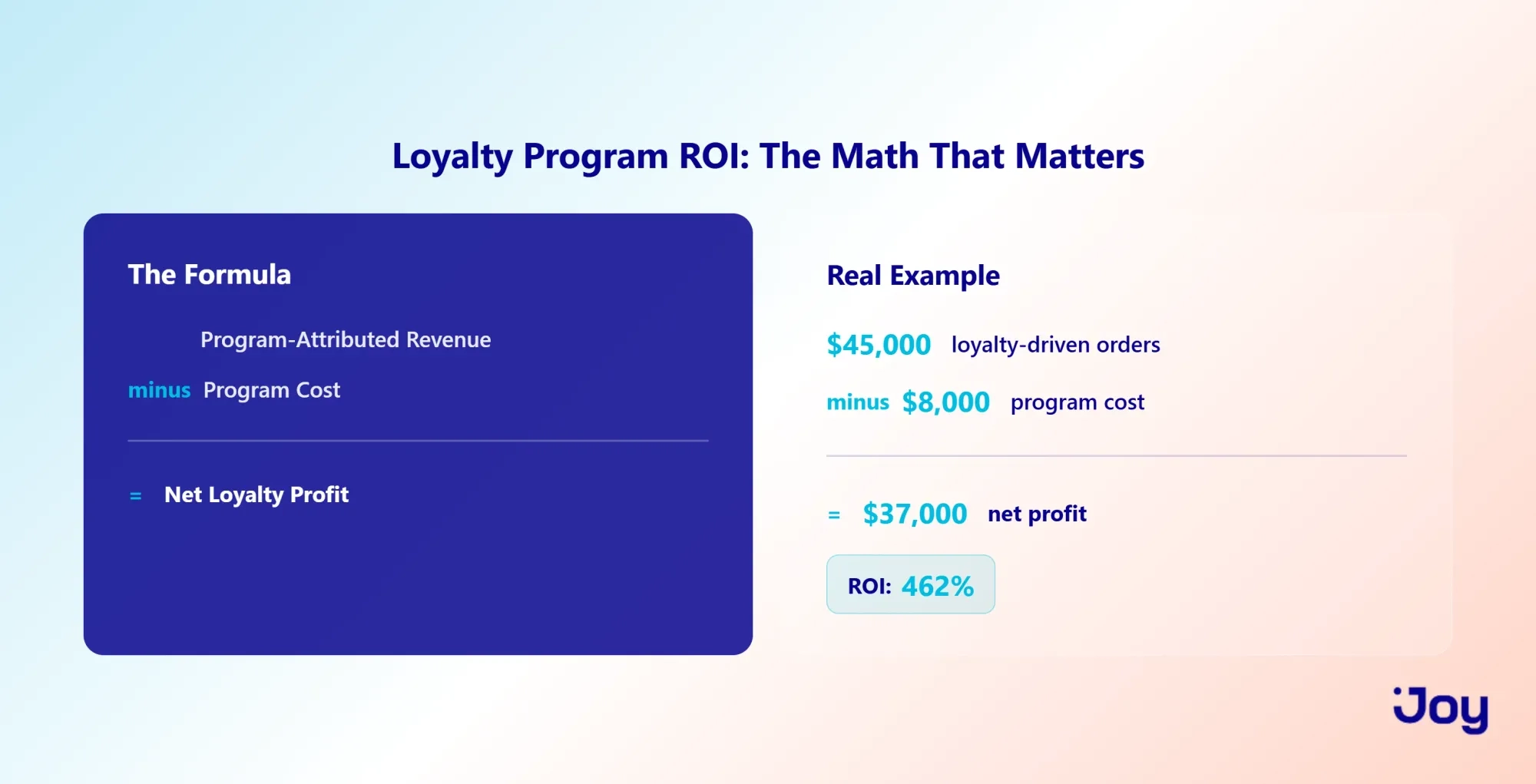
Program ROI: program-attributed revenue minus program cost equals net loyalty profit. This isolates the financial return of your loyalty investment from overall revenue.
Leading indicators: track repeat purchase rate trends, churn rate movement, and NPS changes on a monthly basis. These predict future CLV shifts before they show up in revenue, giving you time to adjust before problems compound.
To isolate your program's true impact, benchmark loyal cohorts against non-loyal cohorts on every metric. The difference reveals exactly how much value your loyalty system creates.
A 5% increase in retention drives a 25% to 95% profit increase according to Bain and Company. But that only happens if you track it systematically and optimize based on what the data reveals.
Optimize Monthly, Not Annually
Loyalty programs that optimize monthly outperform "set and forget" programs because customer behavior shifts constantly. Each month, run A/B tests on tier structures, reward mechanics, and messaging to identify what drives the strongest engagement.
Review which customer segments are growing and which are stalling. Adjust point thresholds, tier benefits, and personalization rules based on data rather than assumptions. Then report to leadership with a clear narrative: CLV trend, retention rate change, and program-attributed revenue versus program cost.
Joy tracks program-attributed revenue directly. Orders placed through referral links, loyalty-generated discount codes, and points redemptions all appear in one dashboard. You see exactly which repeat purchases your loyalty program influenced, making ROI reporting clear with no manual attribution required.
How to implement: When comparing loyalty platforms, ask these questions: Does the tool track program-attributed revenue automatically? Can you compare loyal versus non-loyal cohorts side by side? Does it support A/B testing for reward structures? The key criteria are attribution clarity, reporting depth, and the ability to export data for leadership presentations. For a deeper dive into the metrics, see our guide to customer loyalty analytics.
Build Loyalty Like a System, Not a Campaign
The 7-step system you just walked through follows a deliberate sequence: audit your baseline, design your program structure, personalize the experience, strengthen support, build community, unify your channels, and measure everything.
Each step depends on the one before it. You can't personalize without segment data from Step 1. You can't measure program ROI without the structure built in Step 2. And you can't build community without the trust established through Steps 3 and 4. That dependency is what separates a system from a collection of unrelated tactics.
The most common mistake brands make? Skipping steps. Launching a points program without understanding why customers stop coming back. Personalizing rewards without segmenting your customer base. Measuring outcomes without defining the baseline. Each shortcut weakens the system and produces results that disappoint.
One important caveat: loyalty programs aren't the right investment for every brand at every stage. If your repeat purchase rate is already above 50%, or if your product is a one-time purchase by nature, a formal program may not move the needle. Focus resources where the gap is largest.
For most ecommerce brands, though, expect 3 to 6 months of consistent execution before you see a stable retention lift. The first two priorities are the baseline audit (Step 1) and program structure (Step 2), because everything else depends on getting those foundations right.
For ecommerce brands ready to implement this system, Joy Loyalty provides the infrastructure: flexible program rules, VIP tiers, referral tools, and analytics that track program-attributed revenue directly. No coding required, with 30+ integrations built for brands that take loyalty seriously. Book a demo to see how it works for your store.
Frequently Asked Questions
What is customer loyalty, and why does it matter?
It's a customer's ongoing choice to return to your brand over competitors. Acquiring a new customer is 5 to 25 times more expensive than retaining an existing one, according to Harvard Business Review. Loyal customers also buy more frequently and refer others, compounding their value over time.
How long does it take to see results from a loyalty program?
Most brands see initial engagement within 1 to 3 months, but stable retention lift typically takes 3 to 6 months of consistent execution. Measuring from day one is critical so you can track progress and adjust as you go.
What's the difference between customer loyalty and customer retention?
Retention measures whether customers come back. Loyalty measures whether they choose to come back even when competitors offer alternatives. Retention is behavioral. Loyalty is emotional. A retained customer might leave for a better deal, while a loyal customer stays because of the relationship.
What type of loyalty program works best for ecommerce?
Points-based programs with tiered VIP levels. They combine transactional incentives (earning and redeeming points) with aspirational motivation (climbing tiers for better rewards), which drives both frequency and long-term engagement.
How do I measure customer loyalty ROI?
Track CLV, repeat purchase rate, and program-attributed revenue, then compare loyal customer cohorts against non-loyal cohorts. The difference isolates your program's actual impact. For a step-by-step guide, see our loyalty program ROI breakdown.
What's the biggest mistake brands make with loyalty programs?
Launching without understanding why customers leave. If your churn drivers are poor support or friction in the buying process, points alone won't fix the problem. Our breakdown of the seven root causes of low customer loyalty is the diagnosis step. Audit first, then build. The system works in sequence for a reason.
How does personalization improve customer loyalty?
McKinsey research found that 71% of consumers expect personalized interactions. Birthday rewards, purchase-history offers, and VIP exclusives build emotional connection beyond transactions. The differentiator is segment-based triggers that scale, rather than relying on manual campaigns.
Can smaller ecommerce brands benefit from loyalty programs?
Absolutely. Start simple with a points system and referral program. Add complexity like tiers and personalization as you grow. The key is choosing flexible tools that scale with your business rather than locking you into a structure you'll outgrow.
How do I win back customers who stopped buying?
Identify inactive customers early, at the 90-day mark, rather than waiting 12 months. Send personalized win-back offers with compelling incentives. Automate the process with trigger-based workflows so no at-risk customer slips through unnoticed. For more strategies, see our guide to ecommerce customer retention.
What metrics should I track for customer loyalty?
Core metrics: CLV, repeat purchase rate, churn rate, NPS, and program redemption rate. For advanced measurement, track program-attributed revenue, which is the revenue directly tied to your loyalty program actions like referral links, discount codes, and points redemptions.

Written by
Thomas Nguyen is the CEO & Co-founder of Joy, a loyalty solution for Shopify and eCommerce brands. With years of experience building high-performance Shopify apps, Thomas aims to help merchants grow through customizable and retention-focused tools.
Related reading
-d82615.webp&w=3840&q=75) How-to Guide
How-to GuideB2B Referral Program: How to Build One That Drives Revenue
Most B2B brands already get referrals by accident. Here’s how to turn them into a system: readiness checks, a 5-step build, and why most programs stall.
 Thomas Nguyen
 How-to Guide
Building Brand Loyalty for Ecommerce Brands in 2026: A Complete Playbook
Building brand loyalty is how smart ecommerce brands grow without chasing ads. Learn simple ways to turn buyers into repeat fans.
Thomas Nguyen How-to Guide
BFCM Readiness: Shopify Tests Checkout, Nobody Tests Your Widget
Shopify scale-tests checkout at 80,000 a minute. The risk you own is the storefront, measured on the signed-in path.
Thomas Nguyen How-to Guide
How to Build a Customer Loyalty Survey That Prevents Churn
Most brands feel churn coming but never ask why. A well-designed customer loyalty survey flags at-risk customers while they're still buying — covering NPS, CSAT, and CES, question design, and how to turn feedback into retention action.
Thomas Nguyen How-to Guide
Loyalty Program Management: What It Actually Takes to Run a Program That Grows
If your loyalty program launched strong and then quietly stopped moving, this is the guide that fixes it
Thomas Nguyen How-to Guide
Why Loyalty Programs Fail: Understanding the Mistakes and How to Overcome Them
why loyalty programs fail. 1-Lack of clear goals, 2-Select the wrong type of loyalty program, 3-Ineffective program design, 4-Lower customer engagement
Thomas Nguyen