
Inside Domino’s loyalty program: 2M members and key lessons
How did Domino’s add 2M members in months? Learn the "low-floor" strategy and 3 psychological hooks to build your brand's loyalty.

Summarize this post with AI
Your CAC is climbing, and first-time buyers aren't coming back. You've probably looked at loyalty programs and probably dismissed most of them as expensive point-redemption theater.
Domino's 2023 relaunch is the case study that changes that calculation. They added 2 million members in the months after their September 2023 relaunch, not by spending more on ads, but by making three design changes to their program. The earning floor dropped from $10 to $5.
An "Emergency Pizza" mechanic forced a second transaction. And the reward structure matched how often people actually order pizza. By the end of 2024, Domino's Rewards had grown to 35.7 million active members, up 2.5 million from the previous year.
This article breaks down those three hooks, translates them into a 3-stage framework for Shopify brands, and gives you the four metrics that tell you whether your program is building CLV or quietly redistributing margin.
What actually drove 2M new Domino’s loyalty members
The 2 million members didn't come from a bigger budget or a promotional spike. They came from three design changes that made the program feel worth joining.
The low-floor strategy: lower the barrier, unlock the flywheel
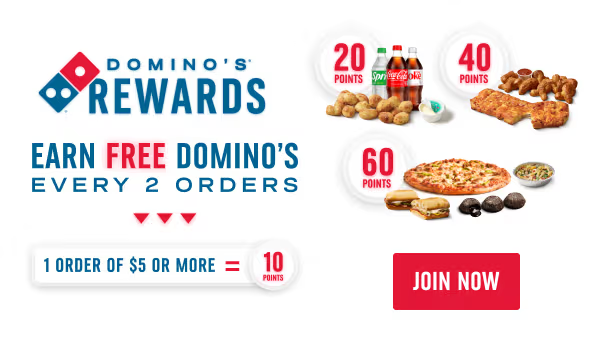
Domino's lowered the minimum qualifying spend from $10 to $5. That sounds like a minor configuration change. Behaviorally, it was a transformation.
High entry thresholds kill loyalty programs before they start. When the first reward feels far away, customers mentally opt out, not because they don't want the reward, but because the brain stops prioritizing goals that feel out of reach.
Cutting the floor in half did two things at once: it doubled the pool of qualifying transactions, and it made the earning loop feel achievable within a single visit. Small wins create momentum. Momentum creates habit. Habit creates repeat revenue.
Starbucks built one of the most powerful loyalty programs in retail on this same principle. Their Stars-per-dollar model is calibrated to deliver visible progress on every transaction, including a $3 drip coffee. Lowering the floor almost never increases total reward cost. It almost always increases purchase frequency.
Joy's earn rule engine lets you set any qualifying spend threshold: $3, $5, $7, whatever matches your order economics. That's the same lever Domino's used to double the number of eligible transactions, configurable in minutes without a developer.
“Emergency Pizza” created a forward commitment, not just an incentive
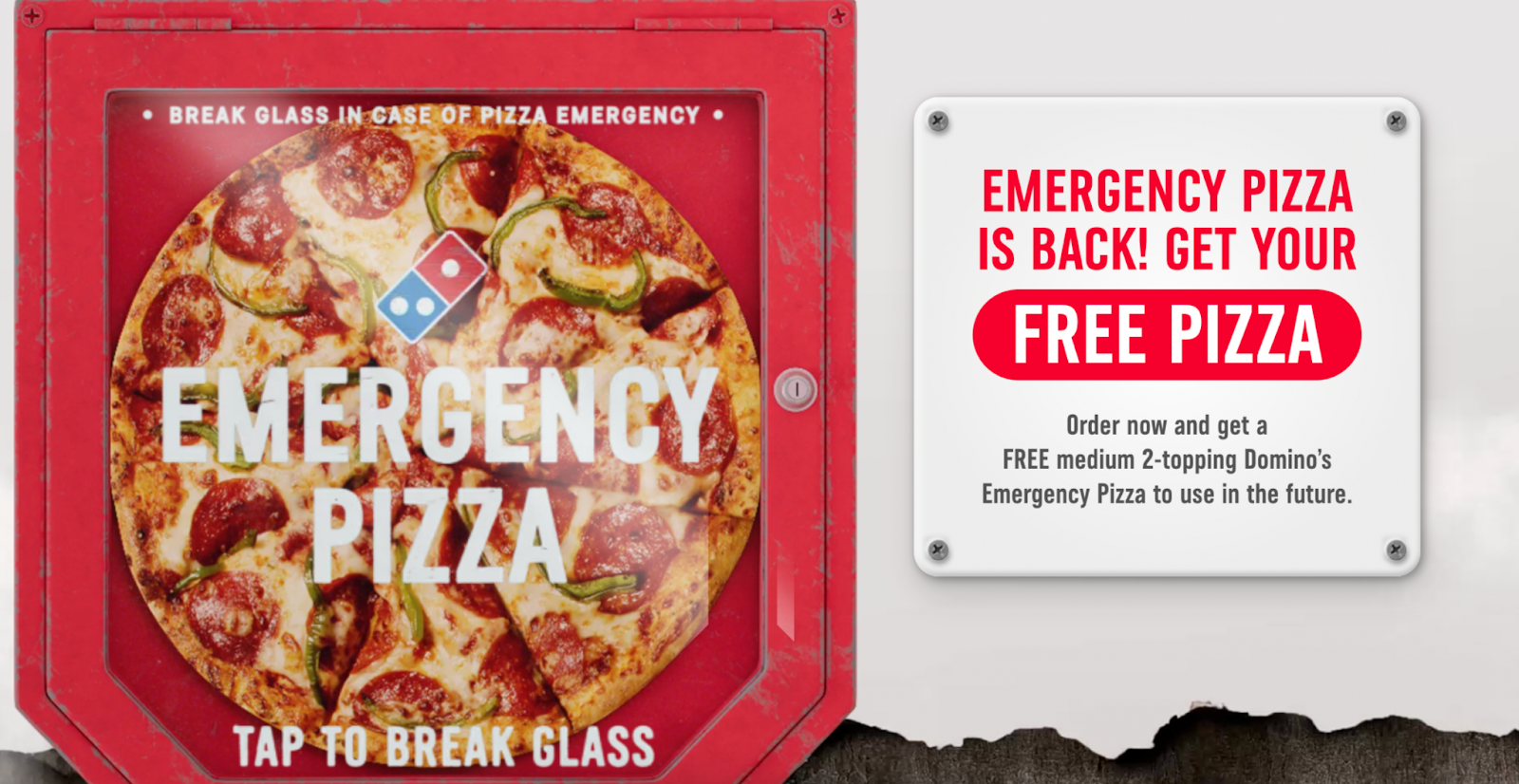
In late 2023, Domino's introduced the "Emergency Pizza" program, a free pizza earned after a qualifying $7.99+ order, redeemable at a later date. This mechanic drove a 10% increase in loyalty membership almost immediately. The program ran October 2023 through February 2024, and drove U.S. same-store sales up 2.8% in Q4 2023, the strongest quarterly comp in two years.
This worked because of two behavioral principles working together: Loss Aversion and Future Commitment.
To "claim" the free pizza, the customer had to join the loyalty program, converting anonymous guest checkout data into a trackable member ID. By offering the reward for future use, Domino's guaranteed a second transaction.
A 2023 study by Antavo found that 60.1% of loyalty program members cite the ability to "earn for the future" as a primary driver of repeat spend. Instead of a 10% discount today, offer a "Return Credit" valid only for the next 30 days. You aren't just discounting. You're purchasing a future visit.
That's a fundamentally different trade.
Loyalty reinforced an existing frequency loop
Domino's success depended on category frequency; loyalty amplified an existing habit rather than creating a new one.
Pizza is a short repurchase-cycle category. Many customers order multiple times per month. High frequency means rewards accumulate faster, and every visit locks the habit in a little more.
Loyalty compounds when:
- Repurchase cycles are under 60–90 days
- Consumption is habitual
- Emotional utility is stable
If the purchase cycle is 6–12 months, the compounding effect collapses. The reward velocity drops too low to move the behavior. This is why furniture and electronics brands rarely see material lift from pure points systems.
Loyalty multiplies existing frequency. It does not manufacture it.
Don’t just copy-paste: where ecommerce brands fail
Domino’s wins don’t translate 1:1. Most e-commerce copies flop. Here’s why, and how to avoid it.
High frequency does not equal high-value loyalty
A points program only works when customers buy often enough for rewards to feel close and achievable.
Domino’s operates in a high-frequency category. Many customers order multiple times per year, and often monthly. That means reward progress builds fast. Fast progress increases motivation. This is supported by the “goal-gradient effect,” which shows that people increase effort as they get closer to a reward (Kivetz, Urminsky & Zheng, 2006, Journal of Marketing Research).
Now compare that to furniture.
Major furniture purchases often happen over multi-year cycles. The U.S. Bureau of Economic Analysis shows that durable goods like furniture are long-lasting, not weekly consumption items.
If a customer buys once every 12 months and needs 3 purchases to unlock a reward, it may take 3 years to see value. Most customers will not stay engaged that long.
Honestly, the math here isn't subtle:
- Short cycle = fast progress = visible value
- Long cycle = slow progress = low motivation
Before launching loyalty, calculate your median time between purchases. If it exceeds 6 months, a high-frequency reward structure will likely underperform.
Discounts vs behavioral rewards
Unconditional discounts reduce price; behavioral rewards change behavior.
Many loyalty programs quietly fail because they reward actions customers would have taken anyway.
Example: “10% off your next order.”
If the customer already planned to buy again, the discount does not increase frequency. It only reduces the margin.
McKinsey has documented that poorly structured promotions often shift demand timing rather than increase total demand. Revenue moves forward, but profit doesn't. That's the trap.
Instead of rewarding “any purchase,” tie incentives to actions like:
- Second purchase within 30 days
- Cross-category exploration
- Product bundle purchases
- Review submissions
Now the reward is conditional. It pays for incremental behavior, not existing demand.
If most of your loyalty costs come from automatic discounting, your program can look active but still lose money.
Why “more members” is the wrong success metric
Total members is a marketing number. Retention lift is a business number. A loyalty program can add millions of members and still fail. That's exactly the trap most Shopify brands fall into.
The only metric that proves success is Incremental Repeat Purchase Rate (IRPR):
Did members buy more because of the program, or would they have bought anyway?
To measure this, compare:
- Members vs. similar non-members
- Purchase frequency before and after enrollment
If buying behavior does not increase, the program is not driving growth. It is redistributing margin.
Vanity metrics create confidence. Incremental lift creates profit.
When loyalty programs actually work for e-commerce
Not every store needs loyalty. Here’s who wins, and who wastes time.
E-commerce business models that benefit most from loyalty
Loyalty programs compound fastest when customers reorder often. If your repeat cycle is 60–90 days or less, points and rewards build momentum just like Domino's weekly pizza habit did.
Here's who wins big, and why.
| Business type | Typical repeat cycle | Loyalty fit | Joy feature to use |
|---|---|---|---|
| Consumables & supplements | 30–60 days | Strong | Low-floor earn rules + auto reminders |
| Beauty & skincare | 45–90 days | Strong | Tier benefits + routine-based bonuses |
| Coffee & food subscription | 14–30 days | Very strong | Points multipliers + referral rewards |
| Apparel (frequent buyer) | 60–90 days | Moderate | VIP tiers + early access |
| Electronics/furniture | 12–36 months | Weak | Referral program beats points |
When loyalty is the wrong tool
Loyalty probably isn't the right move if:
- You're an early-stage brand still finding product-market fit
- Your median repeat cycle exceeds 6 months
- Your post-purchase experience (shipping, packaging, support) is inconsistent
Retention starts with product quality and experience. Loyalty amplifies what already works. It doesn't fix broken systems. No exceptions.
How to build your “Domino’s style” framework
You shouldn't copy the pizza, but you should absolutely copy the structure.
Stage 1: Retention before rewards
A loyalty program can't fix a broken customer journey. It can only amplify a functional one. Before issuing a single point, make sure your baseline retention is solid through automated CRM flows.
Focus on your Onboarding and Post-Purchase sequences. If a customer does not receive a clear "Thank You" or a "How to Use" guide, they are unlikely to return, regardless of points.
Data from Gartner shows that nearly one-third of loyalty members are inactive because the initial brand experience failed to stick. It’s a good idea to optimize your reorder reminders based on your product's actual depletion cycle before adding the complexity of a rewards engine.
Stage 2: Simple incentives tied to behavior
Once your foundation is solid, introduce incentives that trigger high-value actions. Domino's used the "Emergency Pizza" to force a second transaction. You should use a similar "Low-Floor" incentive to drive specific, profitable behaviors rather than general spending.
Instead of rewarding "any order," tie your points to the Next Purchase Command.
- Second purchase within 30 days
- Buying from a new category
- Leaving a verified review
Behavior-linked rewards work because they create commitment loops. When a customer completes a second purchase quickly, habit formation accelerates.
Stage 3: Emotional loyalty, not transactional points
While points drive short-term activity, emotional connection creates long-term brand preference.
Research from Bond Brand Loyalty shows that 79% of consumers say loyalty programs make them more likely to continue doing business with a brand when the rewards feel "exclusive."
After customers demonstrate repeat behavior, layer status and identity signals:
- Create tiers that offer "Free Shipping for Life" or "Early Access" to new drops.
- Use your loyalty program to grant access to private groups or expert content.
Transactional loyalty increases frequency. However, emotional loyalty increases lifetime value.
Both are necessary for a truly resilient brand.
4 metrics that prove your loyalty program works (beyond signups)
Signups measure marketing reach. They do not measure business impact. A loyalty program only works if it changes buying behavior in a profitable way.
Below are the four metrics that prove whether it does.
H3: Incremental repeat purchase rate
The most vital metric is the Incremental Repeat Purchase Rate. This measures the additional orders you gained specifically because of the program. To find this, you must use Control Groups.
Compare a group of members to a group of non-members with the same shopping history. According to a Bain & Company study, even a 5% increase in customer retention can boost profits by more than 25%.
If your members are not buying more frequently than the control group, your rewards are likely just "subsidizing" people who were going to buy anyway.
Cost Per Retained Customer (CPRC)
You must calculate the Cost Per Retained Customer. This is the total cost of your rewards and software, divided by the number of customers who remained active through the program.
For example, if it costs you $10 in rewards to keep a customer, but $40 in Facebook ads to find a new one, your program is a massive win.
According to Shopify’s retention research, acquiring a new customer can cost 5–25 times as much as retaining an existing one. Loyalty should reduce overall retention cost, not exceed acquisition cost.
Loyalty ROI vs paid acquisition
Compare incremental revenue from loyalty-driven repeat purchases with the cost of rewards.
If the ROI from retention exceeds the ROI from paid ads, the program is defensible.
If not, it is a discount engine.
Final takeaways: what Domino’s teaches, and what it doesn’t
Domino’s success is real, but it is highly contextual. They succeeded because they matched their rewards to a high-frequency habit. For most e-commerce brands, the lesson is not to copy their points, but to copy their logical precision.
- Loyalty is a System, Not a Feature: You cannot simply "bolt on" a rewards app and expect growth. It must be integrated into your emails, your checkout, and your product experience.
- Adaptation, Not Imitation: If you sell high-cost, low-frequency items like mattresses, do not use a "points per dollar" system. Instead, use a "referral and service" model that rewards customers for spreading the word.
Domino’s proved that reducing friction (the $5 floor) and adding urgency (Emergency Pizza) works. Your job is to find the "Emergency" in your own customer’s journey and build a bridge to their next purchase.
FAQs
1. How does the Domino’s rewards program work?
Customers earn points per qualifying order. Once they reach a threshold, they can redeem a free item. Recent changes lowered the spend required to earn points, making rewards easier to access.
2. Can e-commerce brands replicate Domino’s loyalty success?
Yes, but only if the category supports frequent purchases. Brands must adapt the structure to their repeat cycle and margin profile instead of copying pizza-style points directly.
3. Do loyalty programs really increase repeat purchases?
They can. But only if rewards drive incremental behavior. If customers had purchased anyway, loyalty may just reduce margin.
4. Is a loyalty program better than subscriptions for e-commerce?
It depends on your model. Subscriptions work well for predictable replenishment. Loyalty programs work well for encouraging repeat purchases without locking customers in.
5. What’s the biggest mistake ecommerce brands make with loyalty?
Focusing on total member count instead of retention lift. Growth in signups doesn’t equal growth in profit.

Written by
Thomas Nguyen is the CEO & Co-founder of Joy, a loyalty solution for Shopify and eCommerce brands. With years of experience building high-performance Shopify apps, Thomas aims to help merchants grow through customizable and retention-focused tools.
Related reading
 Examples & Inspiration
Starbucks Loyalty Program: Complete Breakdown of the 2026 Rewards Overhaul
Starbucks Rewards members spend 2.5-3x more than non-members — 35.5M members driving $13B in annual revenue. This 2026 breakdown covers Green/Gold/Reserve tiers, earning mechanics, gamification, the backlash, and what Shopify merchants can actually replicate.
 Thomas Nguyen
 Examples & Inspiration
American Airlines Loyalty program: $30B secret + Retention tricks
The American Airlines loyalty program is a $30B engine, not a perk. See how AAdvantage turns points into status, partners, and a retention flywheel you can copy.
Thomas Nguyen Examples & Inspiration
World of Hyatt Guide 2026: Tiers, Rewards & Sweet Spots
The Hyatt loyalty program (World of Hyatt) offers the best value per point in travel. See how to earn free nights, unlock elite tiers, and find the top sweet spots.
Thomas Nguyen Examples & Inspiration
McDonald’s Loyalty Program: A Strategic Case Study on Digital Retention
Decode the McDonald's loyalty program: the exact retention mechanics and software tools that turn anonymous buyers into repeat customers for your Shopify store.
Thomas Nguyen Examples & Inspiration
Hilton Honors 2026 Review: The Easiest Path to VIP Status?
The Hilton loyalty scheme just made elite status far easier to reach. See how Hilton Honors tiers, points sweet spots, and perks stack up for 2026 travelers.
Thomas Nguyen Examples & Inspiration
Lufthansa loyalty scheme: Case study and strategic breakdown for e-commerce (2026)
What can an airline teach your store about retention? See how the Lufthansa loyalty scheme builds status, monetizes miles, and turns loyalty into infrastructure.
Thomas Nguyen