Gymshark Loyalty Program: XP, Tiers & Rewards Breakdown
After 13 years without one, Gymshark just launched its first loyalty program — powered by XP, workouts, and a 4-tier progression system. This breakdown covers the mechanics, the gaming psychology, the manual-opt-in strategy, and what Shopify brands can actually replicate.

Summarize this post with AI
For 13 years, Gymshark built one of the world's most loyal fitness communities without a loyalty program. No points. No tiers. No formal rewards. Just influencers, community events, and a cult-like gym culture that turned a garage operation into a billion-dollar brand.
Then, on May 20, 2025, that changed. Gymshark launched its first-ever loyalty program, and it doesn't look like anyone else's. Instead of "points," they chose "Experience Points." Instead of rewarding only purchases, they reward workouts. The language is borrowed from video games, not retail.
And the timing? It tells its own story. Revenue growth slowed from 9% to 6.4%, pre-tax profits dropped from £11.9M to £7M. Gymshark needs to convert 10M+ customers and 18M social followers into a retention engine.
This article breaks down every mechanic, analyzes the gaming psychology behind XP, maps the workout-loyalty flywheel, and shows what ambitious Shopify brands can replicate. Gymshark didn't just launch a loyalty program. They launched a gamified retention system disguised as one.
Why Now? The Strategic Timing Behind Gymshark's First Loyalty Program
A brand that thrived without formal loyalty for over a decade suddenly decided it needed one. Why?
The Financial Trigger: Revenue Growth Slowing, Profits Falling
The numbers explain the urgency. In FY24, Gymshark posted revenue of £607.3M, up 9% year over year, with gross margins improving to 63% and pre-tax profit at £11.9M (FashionUnited). FY25 told a different story: revenue reached £646M (just 6.4% growth), while pre-tax profit dropped to £7M, a 41% decline (Modaes Global, FashionNetwork).
Gymshark's growth was powered by social media and influencer partnerships. That strategy built massive reach, but social reach doesn't equal owned data. You can't segment Instagram followers. You can't personalize to them or reactivate them when they drift. A loyalty program converts anonymous followers into named, trackable members.
The timing wasn't coincidental. You launch loyalty when growth slows so the retention infrastructure is in place before pressure intensifies.
From Garage Startup to £1B Brand: The Gymshark Origin Story
That financial context hits harder when you know how Gymshark got here. In 2012, Ben Francis was a 19-year-old Aston University student and pizza delivery driver who started Gymshark in his parents' garage with a sewing machine, screen printer, and £1,000 in savings. One year later, the brand's Luxe tracksuit went viral at BodyPower, generating £30,000 in sales within 30 minutes.
Francis pioneered influencer marketing before the term existed, sending free gear to small fitness YouTubers and building authentic relationships that drove organic growth. By August 2020, General Atlantic purchased a 21% stake for £275M, making Gymshark the first UK DTC brand to achieve unicorn status at a £1B+ valuation with no prior external funding. Today: 10M+ customers, 18M+ social followers, 180+ countries.
The loyalty program isn't a new strategy. It's the formalization of the community-first DNA that made the brand a unicorn.
How the Gymshark Loyalty Program Works: XP, Tiers, and Rewards Breakdown
With that strategic backdrop, here's what Gymshark actually built. Every earning method, tier threshold, and reward.
Experience Points (Gymshark XP): How Members Earn
Gymshark calls its loyalty currency "Experience Points," or XP. Not "points." Not "stars." The naming is deliberate because Gymshark's Gen Z audience grew up earning XP in video games. Here's how members earn:
Shopping XP: £1 GBP = 10 XP | $1 USD = 8 XP | €1 EUR = 8 XP | $1 CAD = 6 XP | $1 AUD = 5 XP
Non-purchase XP: App download = 50 XP | Email signup = 25 XP | Text signup = 25 XP
Workout XP: Training App download (iOS only) = 50 XP | Each workout logged = 10 XP (max five per week = 50 XP/week cap)
Here's the critical distinction: XP can't be spent. It only counts toward tier progression. This is a status system, not a spend-and-redeem system. CDO Carly Natalizia captured the philosophy in three words: "Shop, share, show up."
The 4 Gymshark Loyalty Tiers: From Entry to VIP
Those XP earnings feed into a four-tier structure. Each level adds value on top of the last.
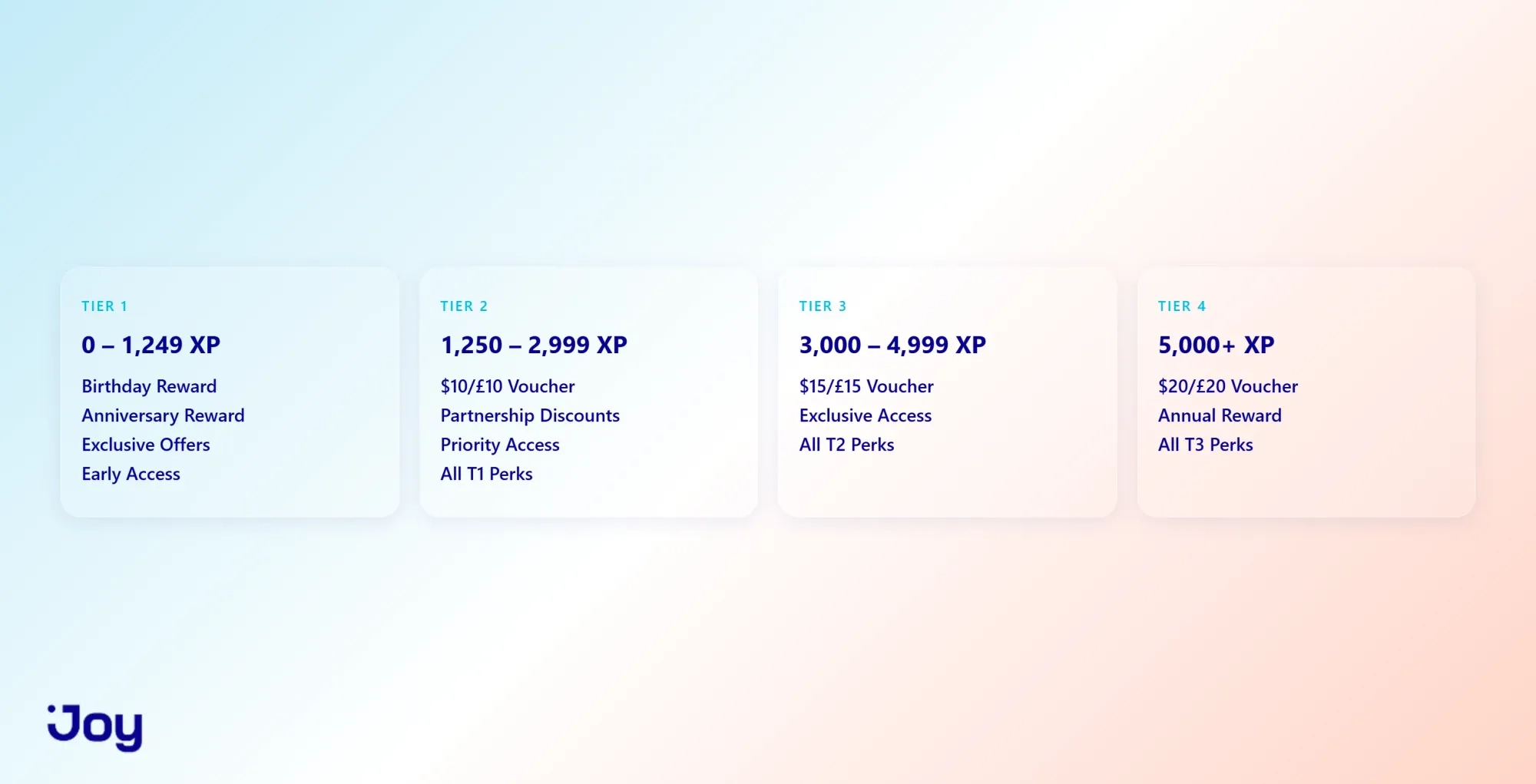
Tier 1 (0 to 1,249 XP): Birthday reward, anniversary reward, exclusive offers, early access
Tier 2 (1,250 to 2,999 XP): All Tier 1 perks + $10/£10 reward voucher + partnership discounts (coming soon) + priority access
Tier 3 (3,000 to 4,999 XP): All Tier 2 perks + $15/£15 reward voucher + exclusive access
Tier 4 (5,000+ XP): All Tier 3 perks + $20/£20 reward voucher + annual member reward (undefined)
In spending terms: reaching Tier 2 in the US requires $156.25. Reaching Tier 4 costs $625. But here's what makes this tiered loyalty program unique: a member who trains five times a week earns 50 XP weekly from workouts alone, reaching Tier 2 in roughly six months without spending a dollar.
XP Expiry, Tier Maintenance, and Return Policy
Gymshark built in mechanics that create ongoing urgency. XP operates on a 12-month rolling window: XP earned today expires in 12 months if it hasn't contributed to tier progression. Once you reach a new tier, that status locks for 12 months. After that window closes, if you haven't earned enough XP to maintain your current tier, you drop one level.
Returns are handled fairly. XP from returned items gets deducted, but tier status already achieved stays intact. XP and tier status can't be transferred to a new account. Enrollment requires manual opt-in through "Join the Club," a deliberate choice we'll get into later.
For early members, Gymshark offered Legacy XP: 2024 purchases converted to XP retroactively if you signed up before May 31, 2025, plus a 100 XP welcome bonus.
The Workout-Loyalty Flywheel: How the Gymshark Training App Turns Fitness Into XP
What makes Gymshark's approach genuinely different from other loyalty program examples isn't the tier structure or the XP naming. It's the workout integration. No other major ecommerce loyalty program rewards workouts as a core earning mechanism. That alone sets it apart.
Inside the Gymshark Training App: 450+ Free Workouts, Zero Cost
The Gymshark Training App offers 450+ free workouts and 700+ exercises spanning strength, HIIT, yoga, and mobility, all designed alongside Gymshark athletes and fitness professionals. Unlike Peloton or Apple Fitness+ ($12 to $30 per month), the entire library is free. No subscriptions. No ads.
The loyalty integration explains why: every completed workout earns 10 XP, up to five workouts per week (50 XP cap). Gymshark made premium training content free because the real value isn't a subscription fee. It's the loyalty data and engagement that daily workouts generate.
One significant limitation worth flagging: workout XP earning is currently iOS only. Android users can't earn XP through workouts, and no timeline for Android support has been announced.
The Flywheel: From Workout to Commerce
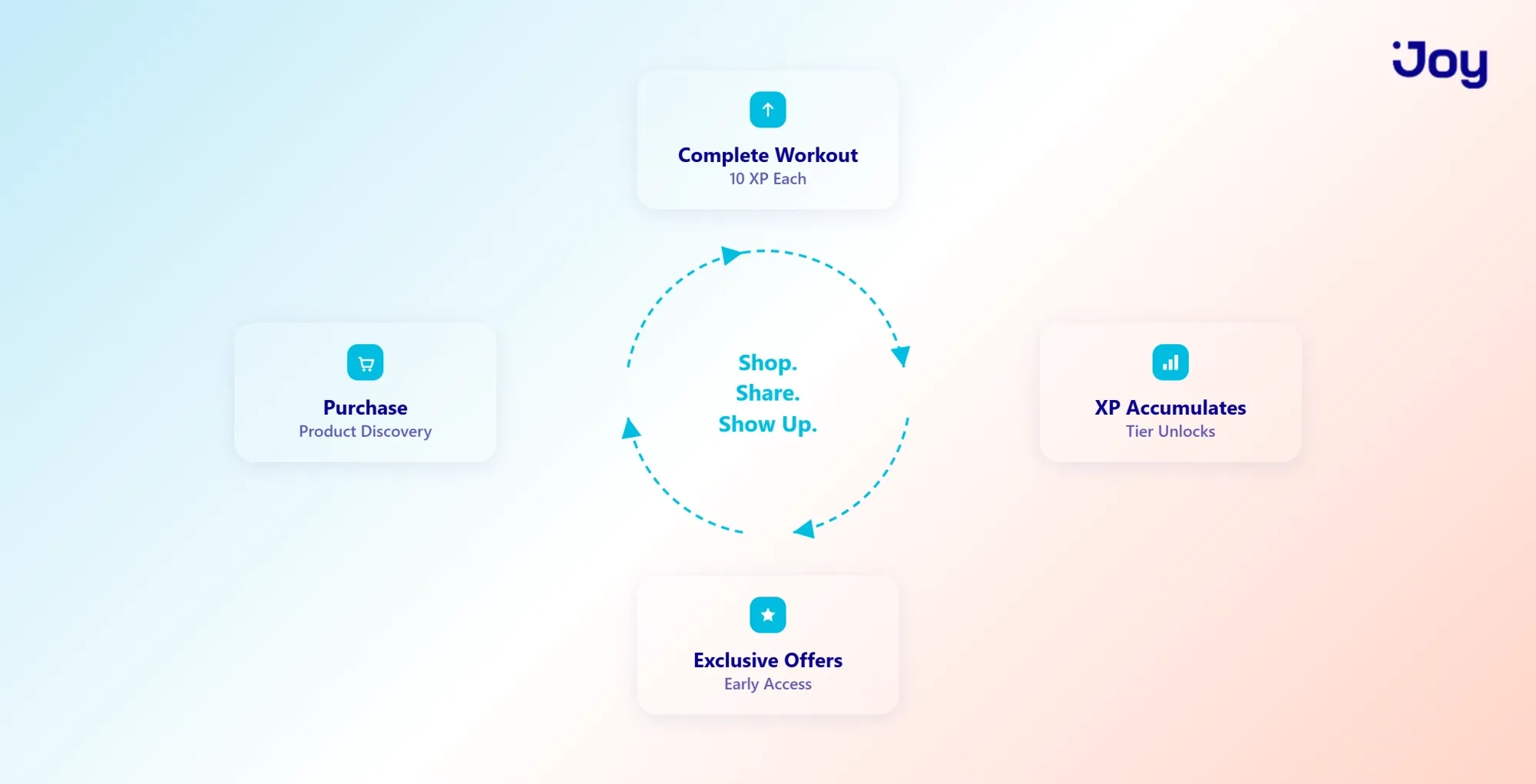
This integration creates a self-reinforcing loop. Download the Training App (50 XP), complete workouts (10 XP each), watch XP accumulate, unlock a new tier, receive exclusive offers, browse products, make a purchase (more XP), keep working out. Every rotation deepens the loop.
And each rotation generates two types of value. For the member, XP toward tier rewards. For Gymshark, lifestyle data: workout frequency, exercise preferences, training consistency. A member doing heavy strength five times a week is a different customer than one doing yoga three times a week. That data powers product development and marketing personalization.
Why "Show Up" Matters: Non-Purchase Earning as a Retention Strategy
Two of the three earning pillars ("share" and "show up") are entirely non-transactional. A member who never buys anything can earn 50 XP per week from workouts alone, reaching 2,600 XP in a year. That's Tier 2 status earned entirely through training.
So what's the real play here? Members who haven't purchased yet are being "warmed" through daily app interaction. When they're ready to buy, Gymshark is already top of mind. Compared to Adidas AdiClub and Nike NRC/NTC, Gymshark's approach is the most explicit: non-purchase actions earn the same currency as purchases. No asterisks.
Gaming Psychology in Loyalty: Why Gymshark Chose XP Over Points
The workout flywheel explains what Gymshark built. But the decision to call it "XP" instead of "points" reveals something deeper about how they want members to feel. That naming choice carries more strategic weight than most coverage acknowledges.
Gymshark XP vs. Points: More Than a Name Change
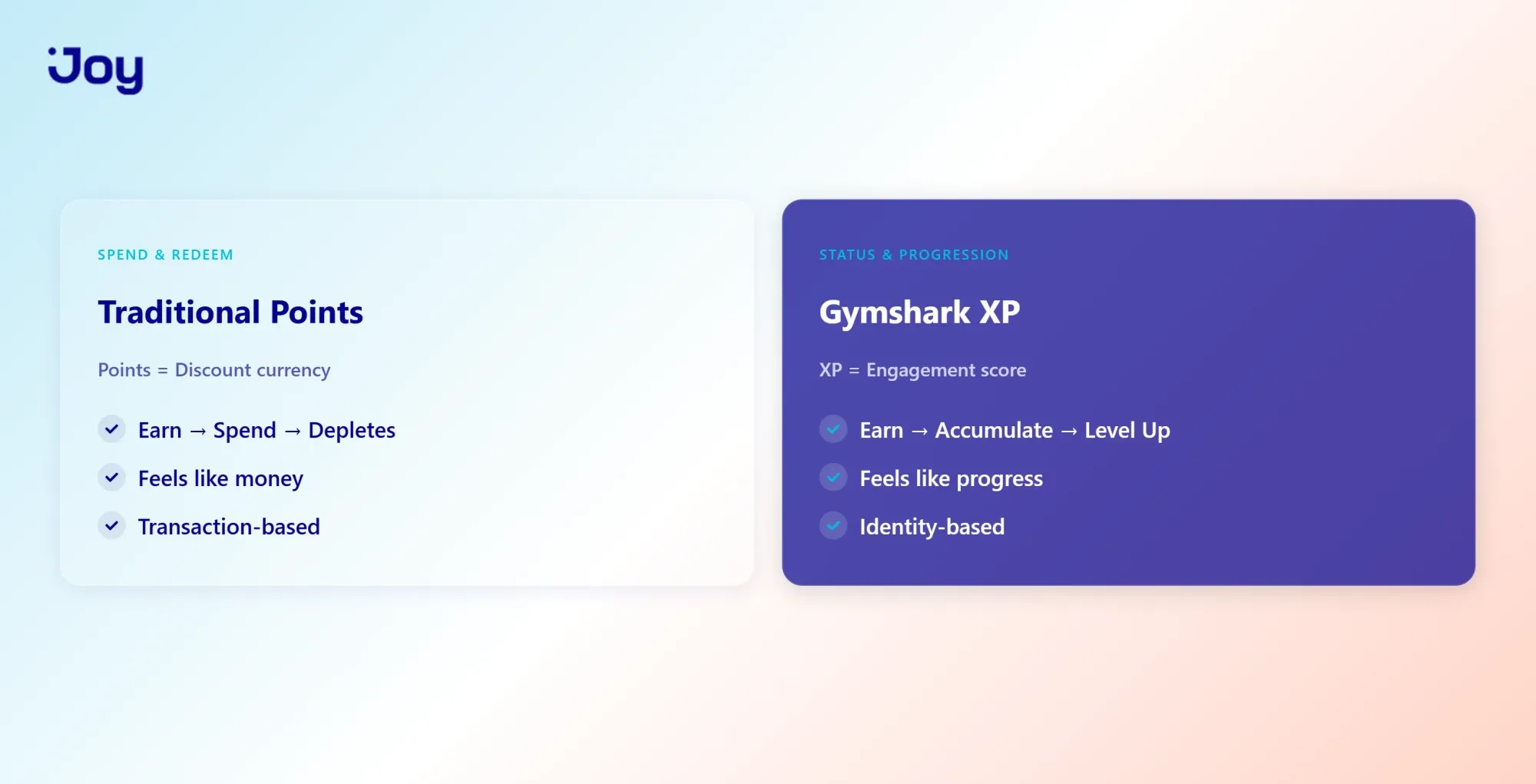
Traditional loyalty programs use "points" as a currency you earn and spend. Earn 100 points, redeem for $10 off. The relationship is transactional. Points are a discount delivery mechanism.
Gymshark's XP works differently. Experience Points can't be spent. They accumulate toward tier status. You don't "use up" XP. You level up. Your XP total is a permanent record of engagement.
Points feel like money: spend it before it expires. XP feels like progress: your level represents who you are. That's not just branding. It's psychology.
The gaming parallel is direct. In video games, players don't "spend" XP. They watch it grow. The number itself signals status. Gymshark's audience (Gen Z, ages 18 to 28) grew up with XP in Fortnite, Call of Duty, and Pokémon Go. The terminology is native to them.
There's a business advantage, too. XP doesn't deplete, so there's no liability on Gymshark's balance sheet from unredeemed points. Rewards are fixed per tier, not variable based on accumulation. For merchants exploring gamified loyalty programs, this liability-free model is worth noting.
"Leveling Up": Why Tier Progression Drives More Engagement Than Flat Rewards
Flat rewards programs (spend $100, get $10 off) offer no progression narrative. Every transaction is isolated. There's no story to follow.
Gymshark's four-tier progression creates a visible journey. Each level unlocks better rewards, and members can see exactly where they stand. CEO Ben Francis described it directly: "As you earn XP, you'll move up the tiers and you'll have more access to exclusive products and get early access to products, as well as perks at events."
The "level up" framing borrows gaming's most addictive mechanic: the progress bar. Seeing 1,100/1,250 XP creates the "almost there" pull that drives one more purchase or five more workouts. Combined with a 12-month expiry, members are always chasing the next tier or protecting their current status.
Tier progression turns loyalty from a discount tool into a game. And games are harder to quit than coupons.
The "Join the Club" Strategy: Why the Gymshark Loyalty Program Uses Manual Opt-In
The XP mechanics and gaming psychology explain how the program engages members. But there's an equally important design decision in how people enter it.
Why Manual Opt-In Is a Feature, Not a Friction Point
Most loyalty programs auto-enroll customers at checkout. Big member numbers. Low engagement. Gymshark chose the opposite.
"Join the Club" requires a deliberate action. The act of choosing creates commitment: members who opt in are pre-qualified as engaged. The trade-off? A smaller initial member base. But Gymshark is betting on depth over breadth. Auto-enrollment gives you a big number. Manual opt-in gives you a committed community. Gymshark chose community.
Legacy XP and the Welcome Bonus: Converting Existing Customers
Manual opt-in introduces one obvious risk: existing loyal customers might not bother joining. Gymshark handled this with two incentives. Legacy XP allowed anyone who made 2024 purchases to convert those orders to XP retroactively by joining before May 31, 2025. A welcome bonus of 100 XP sweetened the deal (roughly equivalent to spending $12.50 USD).
The deadline created urgency: join now or lose your Legacy XP forever. Classic scarcity applied to loyalty enrollment. Gymshark used incentives to seed the member base initially, then let the program's ongoing value drive organic enrollment long-term.
What's Missing: The Gaps Gymshark Hasn't Addressed Yet
No program analysis is complete without acknowledging what's unclear. Gymshark has left several meaningful details undefined.
The Unanswered Questions
Annual Member Reward (Tier 4): Listed as a top-tier benefit but never defined. What's it worth? Nobody knows.
Partnership Discounts: Listed for Tier 2+ as "coming soon" with no partners named and no timeline.
Sharing XP Mechanics: CDO Natalizia says members are rewarded for "sharing," but no sharing-specific XP method exists on the official page.
iOS-Only Workout XP: Android users can't earn workout XP. No timeline announced.
"Early Access" vs. "Exclusive Access": Tier 1 gets one, Tier 3 gets the other. The distinction? Never defined.
XP Per Workout Consistency: Do all workout types (15-minute yoga vs. 60-minute strength) earn the same 10 XP? Not specified.
These gaps don't invalidate the program, but they create uncertainty that could frustrate engaged members as they climb the tiers.
Gymshark vs. Nike, Adidas, and Lululemon: Where the Gymshark Rewards Program Fits
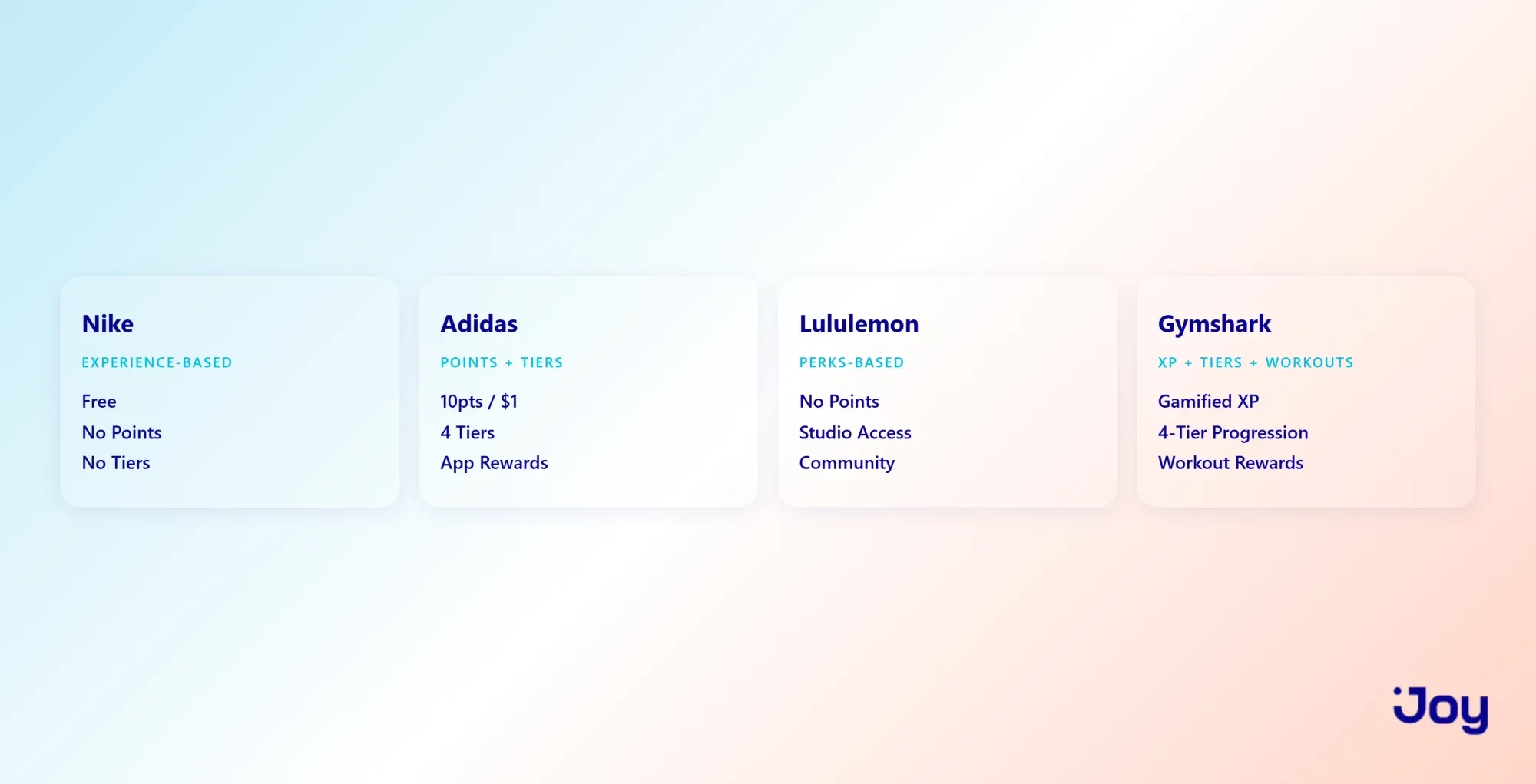
Gymshark's gaps and strengths become clearer against the competition. Four brands, four different approaches, each with lessons for merchants designing their own types of loyalty programs.
Four Brands, Four Loyalty Models
Nike Membership: Free, no tiers, no points. Over 300M members get immediate access to exclusive products, apps (NRC, NTC, SNKRS), and birthday rewards. Members spend 3x more. No formal progression system.
Adidas AdiClub: Free, points-based with four tiers. 10 points per $1 spent, plus rewards for app workouts, reviews, and events. Won Bond Loyalty Report's "best apparel loyalty" in 2021 and 2022. The most traditional model of the four.
Lululemon: Free, perks-based with no points at all. Studio membership offers 10,000+ workouts, in-store classes, and early event access. Signed 9M members in five months. Community-driven, not transaction-driven.
Gymshark: Free, XP-based with four tiers. A hybrid combining gamified XP, tiered progression, and workout rewards. It borrows Adidas's tiered structure, Nike's community philosophy, and wraps it all in gaming-native language.
The key differentiator: Gymshark is the only sports loyalty program that uses gaming-native terminology (XP, leveling up) and explicitly rewards workouts within the tier progression system.
What Each Model Teaches Shopify Merchants
Each approach carries a distinct lesson for merchants building ecommerce loyalty programs.
From Nike: Give value immediately. Don't make members earn before they benefit.
From Adidas: Clear tiers with defined rewards create aspiration and transparency.
From Lululemon: Perks that improve lifestyle build deeper loyalty than discounts.
From Gymshark: Language matters. Naming your points "XP" and framing tiers as "levels" changes how members feel. Reward non-purchase behavior alongside spending.
The unified lesson: loyalty programs that reward the relationship, not just the receipt, drive deeper retention.
What Brands Can Steal from Gymshark and Build with Joy
Gymshark's program contains tactics that are directly replicable at any scale, alongside elements that require specific circumstances.
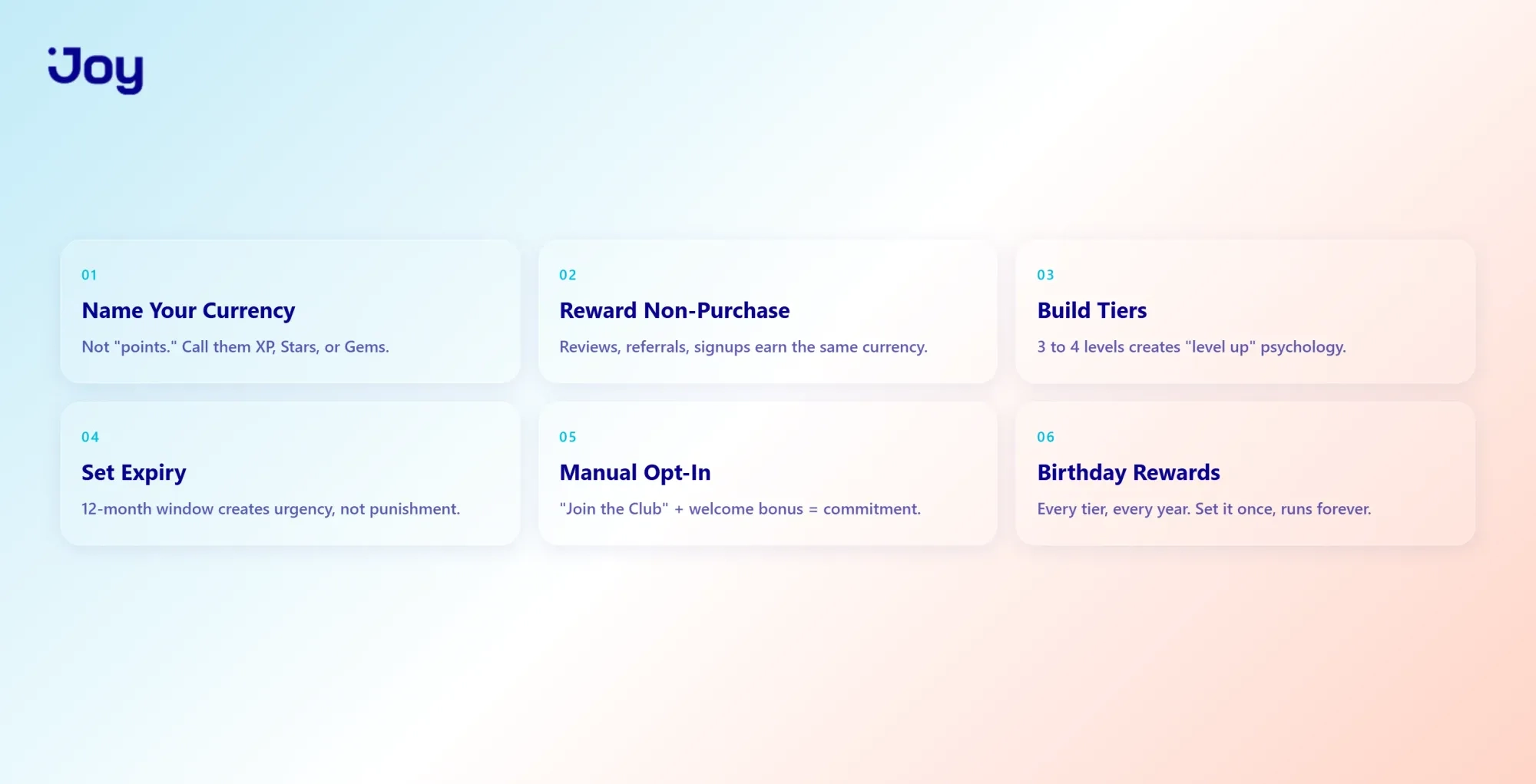
6 Tactics That Work at Any Scale
Name your currency. Don't default to "points." Call them "XP," "Stars," "Gems," or something brand-native. Gymshark proved that naming creates identity. Joy lets you customize your currency name to anything that fits.
Reward non-purchase behavior. Social shares, reviews, referrals, account creation, and email signups. Build "shop, share, show up" into your program. Joy supports 15+ earning actions beyond purchases.
Build tiered progression. Three to four tiers with escalating rewards create the "level up" psychology. Joy's tier system is fully customizable with unlimited tiers.
Set point expiration. Gymshark's 12-month window creates urgency without feeling punitive. Joy lets you set custom expiry windows matching your business cycle.
Use manual opt-in with incentives. Create a "Join the Club" moment with a welcome bonus. Joy's sign-up widget supports welcome bonuses and customizable enrollment flows.
Automate birthday rewards. Every tier in Gymshark's program includes birthday rewards. Joy automates birthday point delivery. Set it once, runs forever.
What's Unique to Gymshark: Know Your Limits
Not everything Gymshark does is replicable. Recognizing those boundaries prevents wasted effort.
Training App integration. Gymshark built a 450-workout app over the years before connecting it to loyalty. Not practical for most brands, but rewarding app downloads, course completions, or community participation? Absolutely achievable.
18M social following. Gymshark announced the program to millions organically. Smaller brands need paid promotion or influencer partnerships for awareness.
iOS-only workout tracking. Even Gymshark hasn't solved cross-platform XP. This is a technology challenge, not a strategy you need to match.
13 years of community trust. The opt-in strategy works because Gymshark already had deep brand love. Newer brands need to earn that trust first.
The takeaway: don't copy Gymshark's infrastructure. Copy their principles: gamify the experience, reward the lifestyle, and make members feel like they're building something.
Build Loyalty Like Gymshark, Without Being Gymshark
Gymshark built a £646M brand and 10M customers without a loyalty program for 13 years. When they finally launched one, they borrowed XP from gaming, rewards from workouts, and urgency from tier progression.
Three principles made it work. Make the currency feel like progress, not money. Reward the lifestyle, not just the purchase. Let members choose to join, because committed communities outperform passive databases every time.
You don't need a training app or 18M social followers. You need the same design thinking: gamify the experience, reward beyond purchases, and make membership feel earned. Joy gives you the tools: custom XP naming, tiered progression, non-purchase rewards, point expiry, birthday automation, and Assisted Orders tracking.
The brands that dominate retention don't have the most members. They have the most engaged ones. Build a program worth showing up for.
Frequently Asked Questions
Does Gymshark have a loyalty program?
Yes. Gymshark launched its first-ever loyalty program on May 20, 2025, where members earn Experience Points (XP) for shopping, signing up, and completing workouts.
How do you earn XP in the Gymshark loyalty program?
Three ways: shopping (£1 = 10 XP, $1 USD = 8 XP), engagement (email signup = 25 XP, app download = 50 XP), and workouts (10 XP per workout, max 50 XP/week via the Training App on iOS).
What are the Gymshark loyalty tiers?
Four tiers: Tier 1 (0 to 1,249 XP), Tier 2 (1,250 to 2,999 XP), Tier 3 (3,000 to 4,999 XP), Tier 4 (5,000+ XP). Higher tiers unlock better vouchers and exclusive access.
Is Gymshark loyalty free?
Completely free. Sign up by clicking "Join the Club" on your Gymshark account page.
What is Gymshark's Tier 4 annual reward?
Undefined. Gymshark hasn't disclosed what the "Annual Member Reward" includes as of launch.
Can you spend Gymshark XP like money?
No. XP only counts toward tier progression. It's a status system, not spend-and-redeem.
Does Gymshark XP expire?
Yes. XP has a 12-month rolling expiry. Tier status locks for 12 months, then recalculates based on the previous year's XP.
Can you earn workout XP on Android?
Not currently. Workout XP is iOS-only. No Android timeline has been announced.

Written by
Thomas Nguyen is the CEO & Co-founder of Joy, a loyalty solution for Shopify and eCommerce brands. With years of experience building high-performance Shopify apps, Thomas aims to help merchants grow through customizable and retention-focused tools.
Related reading
 Examples & Inspiration
Avis Preferred 2026 Guide: Skip the Line & Earn Free Days
The Avis loyalty program (Avis Preferred) lets you skip the counter and earn free rental days. See how the tiers, points math, and status shortcuts work in 2026.
 Thomas Nguyen
 Examples & Inspiration
Sephora Loyalty Program: How Beauty Insider Built the Gold Standard in Customer Retention
Sephora's Beauty Insider has 45M members in North America alone — more than Canada's population. This breakdown covers the three-tier structure, experiential rewards, gamification, and what Shopify brands can actually copy.
Thomas Nguyen Examples & Inspiration
Starbucks Loyalty Program: Complete Breakdown of the 2026 Rewards Overhaul
Starbucks Rewards members spend 2.5-3x more than non-members — 35.5M members driving $13B in annual revenue. This 2026 breakdown covers Green/Gold/Reserve tiers, earning mechanics, gamification, the backlash, and what Shopify merchants can actually replicate.
Thomas Nguyen Examples & Inspiration
McDonald’s Loyalty Program: A Strategic Case Study on Digital Retention
Decode the McDonald's loyalty program: the exact retention mechanics and software tools that turn anonymous buyers into repeat customers for your Shopify store.
Thomas Nguyen Examples & Inspiration
World of Hyatt Guide 2026: Tiers, Rewards & Sweet Spots
The Hyatt loyalty program (World of Hyatt) offers the best value per point in travel. See how to earn free nights, unlock elite tiers, and find the top sweet spots.
Thomas Nguyen Examples & Inspiration
Ulta Loyalty Program: The Strategy Behind 95% Sales
Ulta Beauty Rewards drives 95% of $12.4B in revenue with 46.7M active members. This breakdown covers the three-tier structure, point system, data personalization, and the rebrand strategy — plus what Shopify brands can actually replicate at their own scale.
Thomas Nguyen