
Starbucks Loyalty Program: Complete Breakdown of the 2026 Rewards Overhaul
Starbucks Rewards members spend 2.5-3x more than non-members — 35.5M members driving $13B in annual revenue. This 2026 breakdown covers Green/Gold/Reserve tiers, earning mechanics, gamification, the backlash, and what Shopify merchants can actually replicate.

Summarize this post with AI
Starbucks Rewards members spend 2.5 to 3x more than non-members. With 35.5 million active U.S. members, that's over $13 billion in annual member spend and roughly 60% of all U.S. company-operated revenue (Starbucks Q1 FY2026 earnings). This isn't a loyalty perk. It's the business model.
On March 10, 2026, Starbucks launched the most significant overhaul in the program's history. The old flat-rate earning structure? Gone. In its place: three distinct tiers called Green, Gold, and Reserve, each with escalating earning rates, exclusive perks, and a clear progression path. The reimagining is a centerpiece of CEO Brian Niccol's "Back to Starbucks" turnaround strategy, and it landed alongside the first positive transaction growth in eight quarters.
But the rollout also triggered one of the biggest loyalty backlashes of the year.
This article breaks down every mechanic behind the 2026 Starbucks rewards program, from tier structure and earning rates to gamification and the partnership ecosystem. More importantly, it extracts the strategies that Shopify merchants can replicate to build their own high-performing loyalty programs.
The Starbucks loyalty scheme isn't magic. It's architecture. And that architecture is available to any merchant who commands it.
What Is the Starbucks Loyalty Program? From "My Starbucks Rewards" to the 2026 Reimagining
To understand where Starbucks Rewards stands today, you need to understand two pivotal shifts that built the foundation for the current program.
The Origin of Starbucks Rewards: Visit-Based to Spend-Based (2016)
Starbucks launched its original program as "My Starbucks Rewards," awarding one star per visit regardless of spend. A $2 drip coffee earned the same star as a $7 latte. That model rewarded frequency over value.
On April 12, 2016, Starbucks flipped to spend-based: 2 stars per $1 (PYMNTS, GeekWire). The change killed transaction-splitting, where customers broke purchases into multiple visits to game the system, and redirected rewards toward high-value buyers. It was the first signal that Starbucks viewed loyalty as a revenue lever, not just a retention tactic.
The "Back to Starbucks" Strategy: Why 2026 Changed Everything
When CEO Brian Niccol joined in 2024, he identified that the rewards program had become "too focused on discounts." At Starbucks Investor Day on January 29, 2026, he announced the three-tier reimagining as a cornerstone of the "Back to Starbucks" turnaround.
Early results are promising. U.S. comparable sales climbed 4% in the quarter ending December 2025, marking the first transaction growth in eight quarters (Fast Casual, Starbucks Q1 FY2026 earnings). Alongside the loyalty overhaul, Starbucks cut its menu by 25 to 30%, rolled out 650 Green Apron pilot stores outperforming the fleet by 200 basis points, and added over 25,000 cafe seats (CNBC, Fortune).
The loyalty reimagining isn't isolated. It's embedded in a company-wide reset that's already delivering results.
Starbucks Rewards at Scale: The Numbers Behind 35.5 Million Members
With that strategic context, consider the scale. Starbucks Rewards hit 35.5 million active U.S. members in Q1 2026, an all-time high, up from 34.6 million in Q1 2025 (Starbucks Investor Relations). Members generate roughly 60% of U.S. company-operated revenue, exceeding $13 billion annually (PYMNTS).
At this scale, even minor mechanics changes affect millions of transactions daily. And understanding the specific architecture behind these numbers is what separates surface-level coverage from actionable intelligence.
Starbucks Rewards Program Tier Structure: Green, Gold, and Reserve Explained
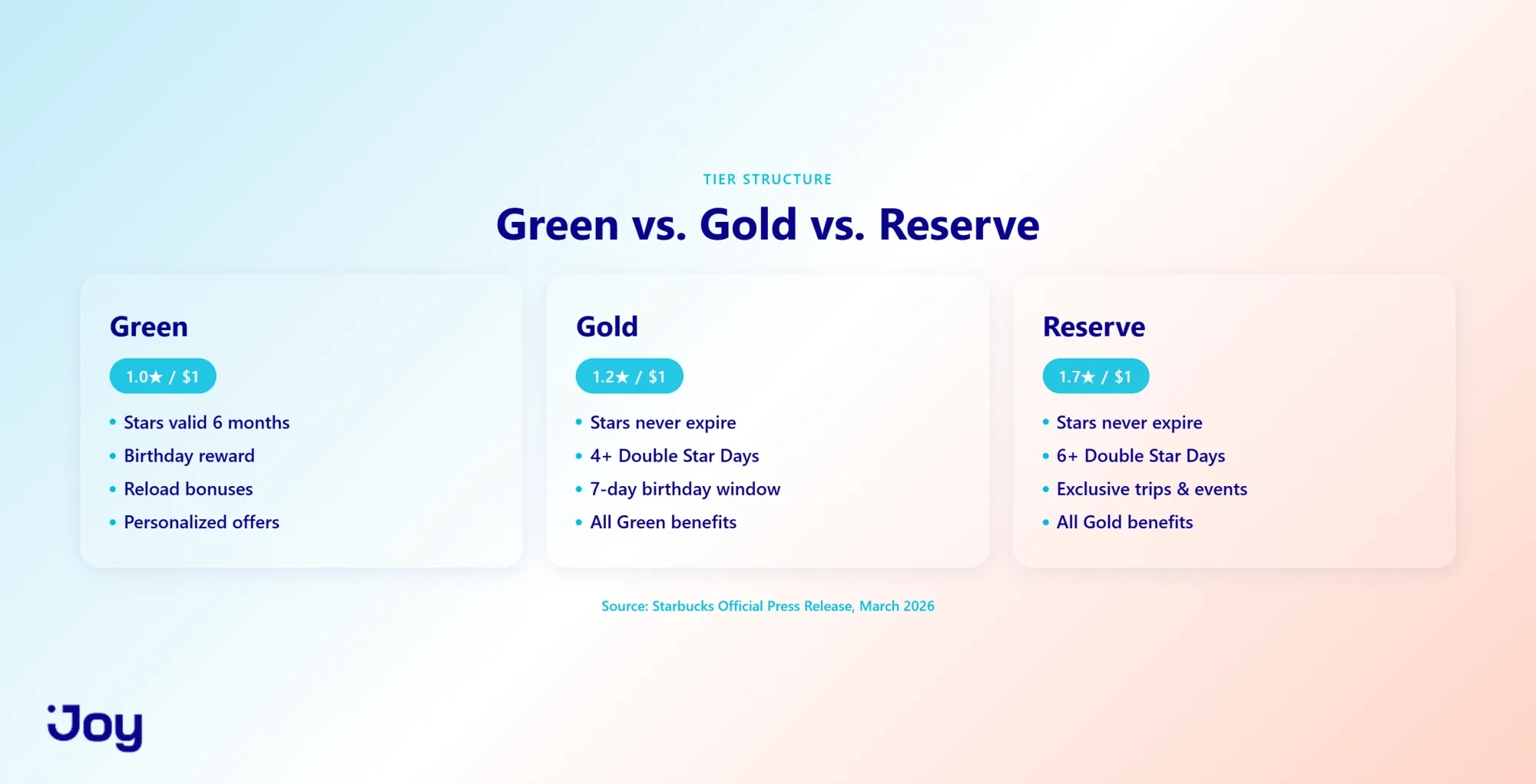
The 2026 reimagining introduced a three-tier structure that replaced the old flat-rate system. Each tier serves a distinct behavioral purpose, and together they create an aspiration ladder that drives spending upward.
Green Member: The Entry-Level Starbucks Rewards Tier
Green is where every Starbucks Rewards member starts. Free, automatic. Members earn 1 star per $1 spent, with stars valid for 6 months. That expiration window is extendable by one month through any qualifying activity like a purchase, digital reload, or redemption (Starbucks FAQ).
Green benefits include a birthday reward (free beverage or food item), personalized offers, access to the Starbucks for Life sweepstakes, and early access to new menu items. Digital reload bonuses add extra earning power: 10 stars for a $30-plus reload and 25 stars for $50-plus (ABC News).
Green isn't a "low" tier. It's designed as the widest possible funnel with enough immediate value to keep casual customers engaged. But the 6-month expiration creates a natural nudge to keep spending. That tension is intentional.
Starbucks Rewards Gold: The Mid-Tier Status That Sparked Backlash
Gold requires earning 500 stars within 12 months, roughly $500 in spend. In return, members earn 1.2 stars per $1, a 20% bump over Green. And arguably more important: stars at Gold level never expire, removing the urgency-based anxiety that pushes some members away from programs entirely.
Gold members also get a birthday reward with a 7-day redemption window, a minimum of 4 Double Star Days per year, and all Green benefits.
Here's where it gets complicated. Starbucks discontinued Gold status back in 2019, then reintroduced the tier name in 2026. Many longtime members logged in to find themselves labeled "Green" and assumed they'd been demoted. The backlash was swift. On top of that, the earning rate dropped from the pre-2026 flat rate of 2 stars per $1 to just 1.2 at Gold. Only the tier perks compensate for that reduction. The full backlash story unfolds in the change management section below.
Reserve Member: Starbucks' Answer to VIP Loyalty
At the top sits Reserve, requiring 2,500 stars within 12 months (approximately $1,470 in spend at the 1.7 stars per $1 rate once at Reserve, or roughly $2,500 starting from Green). Reserve members earn the highest rate in the program, and their stars never expire.
The real differentiator is experiential. Reserve unlocks exclusive merchandise, curated events, and all-expenses-paid trips to destinations like Tokyo, Milan, and Costa Rica to explore coffee culture (Starbucks press release, March 2026). The birthday reward window extends to 30 days, and members receive a minimum of 6 Double Star Days per year.
Reserve is deliberately out of reach for casual members. It targets Starbucks' most valuable customers, the ones spending $200-plus per month, and transforms them into brand ambassadors through emotional loyalty that no discount can replicate. For merchants studying tiered loyalty programs, this aspirational design is worth noting.
How the Starbucks Loyalty Scheme Earning Mechanics Work
The tier structure defines who the members are. The earning mechanics define how they progress. And mastering this engine matters because it reveals how Starbucks balances accessibility for new members with accelerated rewards for top spenders.
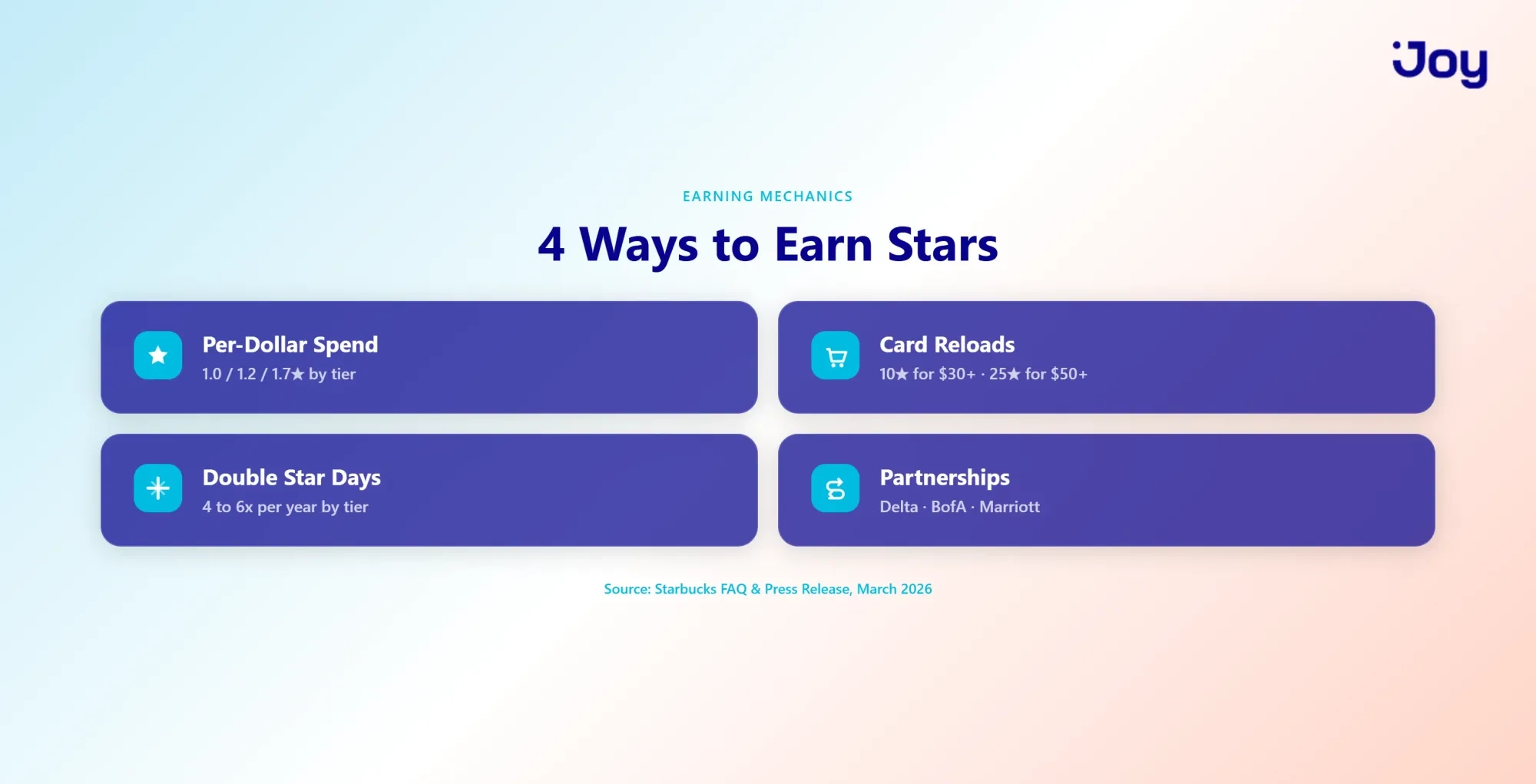
Spend-Based Star Earning: 1.0, 1.2, and 1.7 Stars Per Dollar
Every dollar spent earns stars at a rate tied to the tier. Green members earn 1.0 star per $1. Gold earns 1.2. Reserve earns 1.7 (Starbucks official press release, March 2026).
Before the 2026 overhaul, all members earned 2 stars per $1 on preloaded Starbucks Card purchases and 1 star per $1 on other payment methods. The restructure lowered the base earning rate but introduced tier multipliers that reward consistent high-value spending. Base members now earn a minimum of 25% fewer stars per dollar (One Mile at a Time, PYMNTS), while Reserve members come out ahead.
The tradeoff is instructive for any points program design. Tiered earning rates segment customers automatically. High-value buyers get rewarded faster without manual targeting, and entry-level members have a clear incentive to increase spend.
Starbucks Loyalty Card Reload Bonuses and Double Star Days
Beyond per-dollar earnings, Starbucks layers on two additional channels that speed up star accumulation.
Digital reload bonuses award 10 stars for any reload of $30 or more and 25 stars for $50 or more (Starbucks FAQ, ABC News). These bonuses incentivize preloading funds onto the Starbucks loyalty card, which locks in future spending and increases visit frequency. Once money is on the card, the switching cost jumps significantly.
Double Star Days amplify earnings during specific windows. Gold members get a minimum of 4 per year, while Reserve members get at least 6. The timing is personalized based on individual purchase behavior, not a blanket promotion.
Strategic partnerships push earnings further. The Delta SkyMiles partnership (launched October 2022) adds bonus miles on Starbucks purchases. The Bank of America partnership (launched February 2024) provides 2% cash back plus 1 star per $2 on linked card purchases (CNN, Starbucks press release).
Star Expiration Rules: How Starbucks Prevents Disengagement
Expiration policy completes the earning picture, and it reveals a deliberate two-speed strategy.
Green members' stars expire after 6 months, extendable by one month through qualifying activity. Gold and Reserve members' stars never expire (Starbucks FAQ, March 2026).
Why does this matter? The 6-month window nudges Green members to stay active, creating a recurring reason to visit. Removing expiration for Gold and Reserve signals trust and eliminates the anxiety that causes mid-tier members to disengage. For any merchant designing point expiration rules, this tiered approach is a proven model.
Starbucks Rewards Benefits: Redemption Tiers and Free Perks
Earning stars is only half the equation. The redemption structure determines whether members perceive the program as valuable enough to keep engaging. Starbucks' 2026 redesign introduced a five-tier redemption ladder with dollar caps, a new entry-level reward, and universal perks designed to close the gap between signup and first meaningful redemption.
Starbucks Rewards Redemption Tiers: From $2 Off to $20 Merchandise
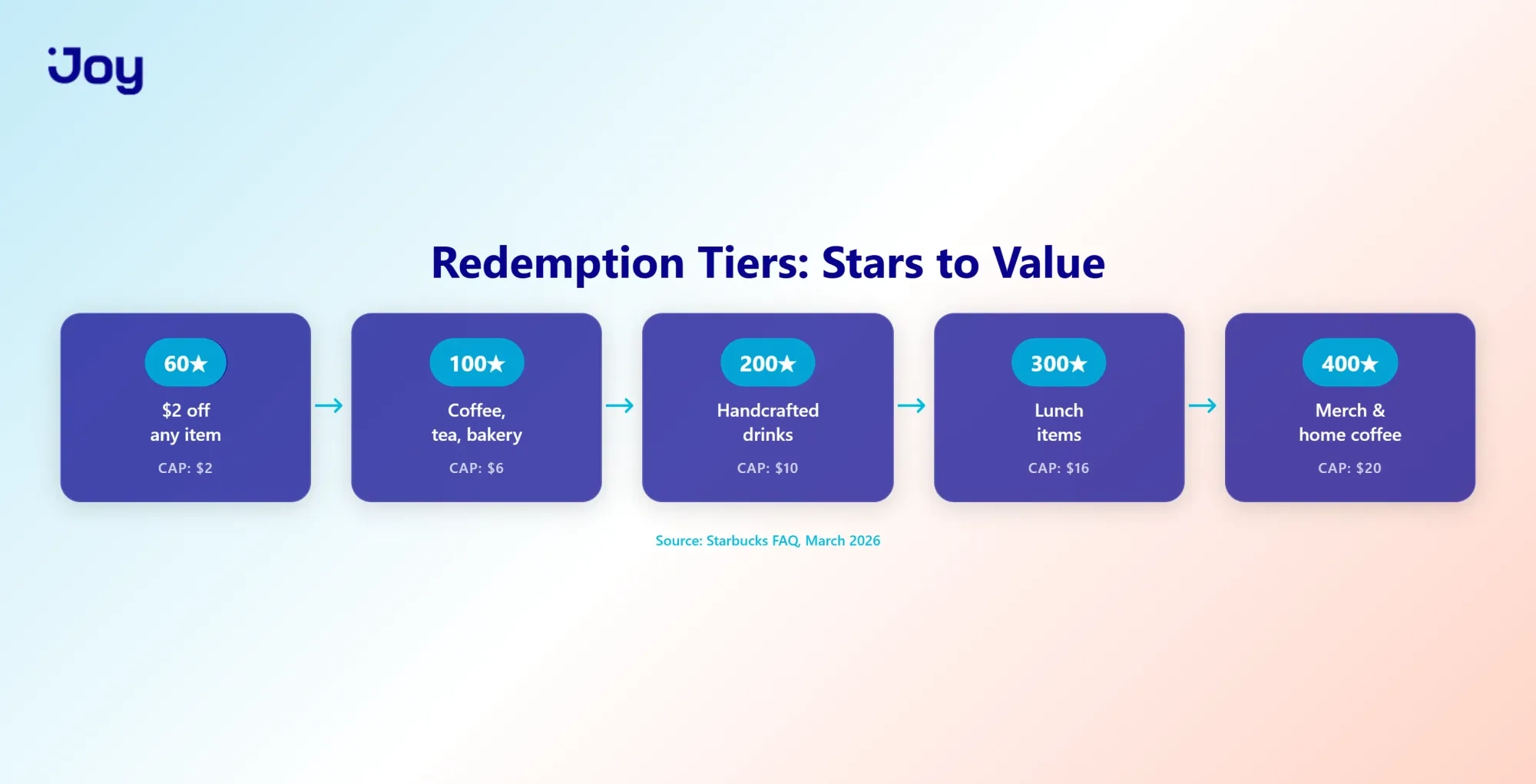
The 2026 program restructured redemption into five tiers, each with a clear dollar cap that controls margin exposure (Starbucks FAQ, ABC News):
| Stars | Reward | Dollar Cap |
|---|---|---|
| 60 | $2 off any item (new in 2026) | $2 |
| 100 | Brewed coffee, tea, bakery items | $6 |
| 200 | Handcrafted drinks, hot breakfast | $10 |
| 300 | Lunch items, protein boxes | $16 |
| 400 | Merchandise, home coffee products | $20 |
If an item exceeds the cap, the member pays the difference. Starbucks gets to offer tangible rewards at every level without letting margins erode on premium items.
The 60-star tier is the smartest addition. Previous redemption started at 100 stars, meaning new members had to stack roughly $100 in spend before their first reward. By dropping that barrier to approximately $60, Starbucks pulls members into the earning-redeeming cycle faster. That first redemption is what transforms a casual signup into an active participant.
Starbucks Rewards Free Coffee and Free Mod Mondays
Beyond star-based redemption, Starbucks introduced universal perks that deliver value before members accumulate enough stars to redeem.
Free Mod Mondays give every member, regardless of tier, one free beverage modification (up to $2 value) on one Monday per month (Starbucks press release, March 2026). Birthday rewards provide a free beverage or food item, with the redemption window expanding by tier: standard for Green, 7 days for Gold, and 30 days for Reserve.
Members also gain access to the annual Starbucks for Life sweepstakes and early access to new beverages and food.
These perks solve a critical problem that plagues many loyalty programs: the dead zone between signup and first meaningful reward. When new members receive immediate value through free coffee modifications and birthday perks, early dropout decreases, and long-term engagement increases.
Reserve-Exclusive Experiences: Starbucks' Emotional Loyalty Play
At the highest tier, redemption shifts from transactional to experiential. Reserve members unlock all-expenses-paid trips to Tokyo, Milan, or Costa Rica, exclusive merchandise unavailable to other tiers, and curated events.
These aren't discounts. They're status symbols and story-generators. Forrester's research backs this up: "well over half" of loyalty members say getting special treatment is an important part of program membership. For brands building a VIP loyalty program, experiential rewards at the top tier create aspirational pull that no dollar-off coupon can match.
The Starbucks Rewards App: Mobile-First Loyalty Strategy
With the earning and redemption architecture in place, the next question is delivery. How do 35.5 million members actually interact with these mechanics daily? For Starbucks, the answer is the mobile app. And the numbers show why embedded loyalty outperforms standalone portals.
Mobile Ordering and the Starbucks Loyalty Card: 31% of All U.S. Transactions
Mobile order and pay now accounts for 31% of all U.S. company-operated transactions, up from 27% year-over-year and 25% two years prior (GeekWire, Starbucks earnings). Combined with drive-thru, mobile plus in-car channels represent over 70% of total sales.
The app integrates order-ahead, GPS store location, digital wallet (the preloaded Starbucks Card), rewards tracking, and instant redemption into a single interface. No waiting in line. No fumbling for payment. No separate portal to check star balances.
This integration proves a fundamental principle. Loyalty adoption accelerates dramatically when the program is the purchase experience, not an afterthought that members visit separately. apps for loyalty space confirms this: the fewer steps between "browse" and "earn," the higher participation climbs.
Data-Driven Personalization: How Starbucks Rewards Members Get Tailored Offers
The mobile app also powers Starbucks' personalization flywheel. Purchase history, favorite items, seasonal patterns, and visit frequency all feed behavioral targeting that shapes every offer a member sees.
Double Star Days are personalized per member, not a blanket calendar event. Challenge thresholds adjust to individual behavior, stretching members just beyond their normal frequency or basket size. Promotional timing aligns with each member's demonstrated visit rhythm.
Forrester's Retail Topic Insights 2 Survey (2025) found that 76% of consumers want to engage with loyalty programs even when they're not making a purchase. Starbucks capitalizes on this through in-app challenges, personalized recommendations, and game-based sweepstakes that keep members engaged between transactions.
The resulting flywheel is straightforward: data produces personalized offers, personalized offers drive higher engagement, higher engagement generates more data, and better data produces sharper offers. Any data-driven loyalty strategy can set this cycle in motion, even by starting with basic purchase history segmentation (first-time, repeat, VIP).
Gamification in the Starbucks Loyalty Rewards Program: Challenges, Games, and Urgency
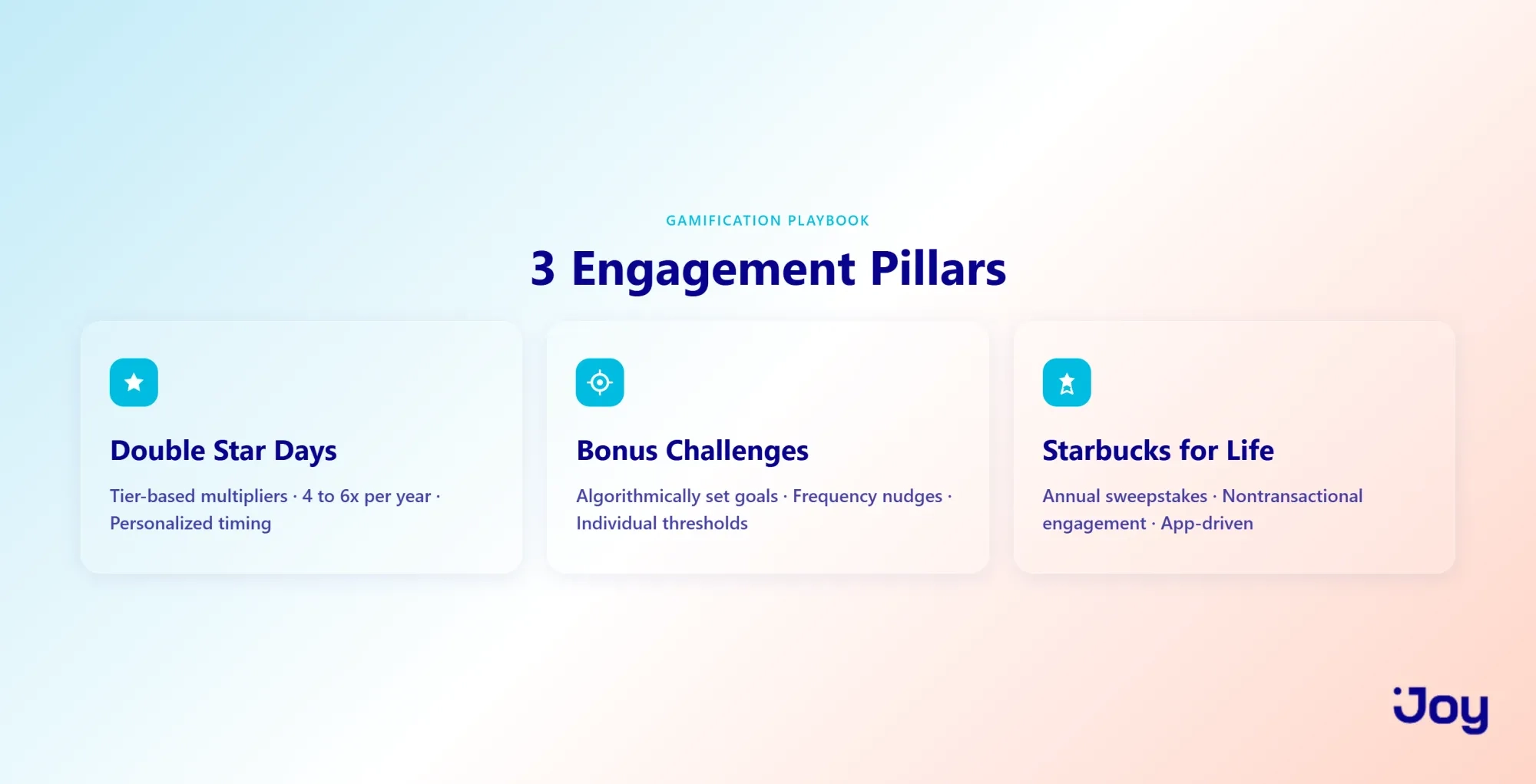
Personalization determines what members see. Gamification determines how they feel. Starbucks layers three distinct gamification pillars on top of the core earning mechanics, each targeting a different engagement behavior.
Double Star Days and Bonus Star Challenges: Creating Earning Urgency
Double Star Days give Gold members at least 4 multiplier events per year and Reserve members at least 6. Scheduling is personalized based on individual purchase patterns, targeting periods when a member is most likely to respond.
Bonus star challenges add another layer. These are customized goals ("Buy 3 lattes this week, earn 50 bonus stars") with thresholds algorithmically set to stretch members just beyond their normal purchasing behavior.
The psychology behind both mechanics is powerful. Limited-time earning multipliers create urgency without discounting. Members spend more to earn faster, not to save money. That distinction is critical for margin preservation. This "earn more" framing is central to gamified loyalty design and consistently outperforms "save more" in driving incremental revenue.
Starbucks for Life and Seasonal Campaigns: Long-Term Engagement Loops
Beyond short-term urgency, Starbucks maintains engagement through longer-horizon campaigns. The annual Starbucks for Life sweepstakes opens to all members, driving app engagement even during periods when a member isn't actively purchasing.
Seasonal campaigns tie earning bonuses to new product launches, from pumpkin spice season to holiday beverages. Members get early access to new items, creating an "insider" feeling that reinforces emotional attachment to the brand.
These campaigns address the nontransactional engagement gap. Games, challenges, and seasonal events keep the program top-of-mind during slow purchasing periods and give members reasons to open the app even when a coffee run isn't planned.
Starbucks Rewards Partnership Ecosystem: Earning Beyond the Store
Gamification keeps members active within the Starbucks ecosystem. Partnerships extend that ecosystem's boundaries, turning the Starbucks loyalty rewards program into a lifestyle platform where members earn stars from activities that have nothing to do with coffee.
Delta SkyMiles, Bank of America, and Marriott Bonvoy: How Starbucks Members Earn Everywhere
Three flagship partnerships define Starbucks' "earn everywhere" strategy:
Delta SkyMiles (launched October 2022): Linked accounts earn miles on Starbucks purchases and 2 miles per $1 on $100-plus reloads. Members also receive Double Stars on Delta travel days.
Bank of America (launched February 2024): Linked eligible cards earn 2% cash back plus 1 star per $2 spent at Starbucks on the linked card (CNN, Starbucks press release).
Marriott Bonvoy: Linked loyalty programs enable cross-earning through the "Rewards Together" integration (Restaurant Dive).
Each partnership serves a strategic purpose. Delta captures the traveling professional. Bank of America embeds star earning into everyday financial activity. Marriott links hotel loyalty to coffee loyalty. Together, they transform Starbucks Rewards from a single-brand program into a cross-category loyalty network.
Extending Earning Surfaces: Why "Earn Everywhere" Increases Retention
The retention logic is simple. Every additional earning channel raises the switching cost. A member earning stars through flights, banking, and hotel stays has far more invested in the Starbucks ecosystem than one earning only through coffee purchases. Cross-earning also accelerates tier qualification: Bank of America's everyday spending at 1 star per $2 means faster Gold and Reserve progression.
For Shopify merchants, referral programs and platform integrations serve the same function. Extending earning beyond the store to social shares, reviews, and friend referrals creates the same multi-channel "web" of loyalty that makes leaving feel expensive. Understanding how this applies to customer retention is essential for any growing brand.
Starbucks Loyalty Program Changes: The 2026 Backlash and Change Management Lessons
The partnership ecosystem and gamification demonstrate what Starbucks got right. This section examines what went wrong because the 2026 rollout triggered one of the most visible loyalty backlashes in recent memory. For merchants planning to evolve their own programs, these lessons are arguably more valuable than the mechanics themselves.
What Went Wrong with the 2026 Starbucks Loyalty Program Changes
On March 10, 2026, members logged into the app and found their status labeled "Green." Many assumed they'd been demoted.
The root cause was a communication gap. Starbucks discontinued Gold status back in 2019, but the 2026 relaunch reopened that wound. Longtime members who remembered being "Gold" members seven years ago saw the Green label as a loss, even though they hadn't actively held Gold status since it was removed.
And the earning rates told an uncomfortable story. Base members now earn a minimum of 25% fewer stars per dollar than under the old structure (One Mile at a Time, PYMNTS). Only Reserve members come out ahead on raw star earnings. As Forrester analyst John Pedini wrote, "the brand unintentionally sparked a sense of loss before customers ever reached the positive changes."
Social media amplified the reaction. Coverage from Newsweek, The Takeout, and PYMNTS captured widespread "I am so done" sentiment across platforms.
Forrester's Analysis: Communication Failures and the "Perceived Downgrade" Problem
Forrester identified three critical communication failures in the rollout:
- No expectation audit. Starbucks didn't assess what members believed their current status was before announcing changes. The brand assumed everyone understood Gold had been discontinued in 2019.
- Loss-framing. The announcement led with structural changes (new tiers) rather than benefits. Members saw what they "lost" before they saw what they gained.
- Assumed comprehension. There was no education campaign explaining the transition. Members were expected to figure out the new system themselves.
Forrester's guidance was direct: "Audit member expectations, prepare transparent explanations, create a communication plan that reinforces value at every step." Their research reinforces that "well over half" of loyalty members consider special treatment important, which means perceived status loss triggers disproportionate backlash regardless of the actual value changes.
For merchants who want to avoid this outcome, examining why loyalty programs fail reveals that communication breakdowns are consistently the top cause.
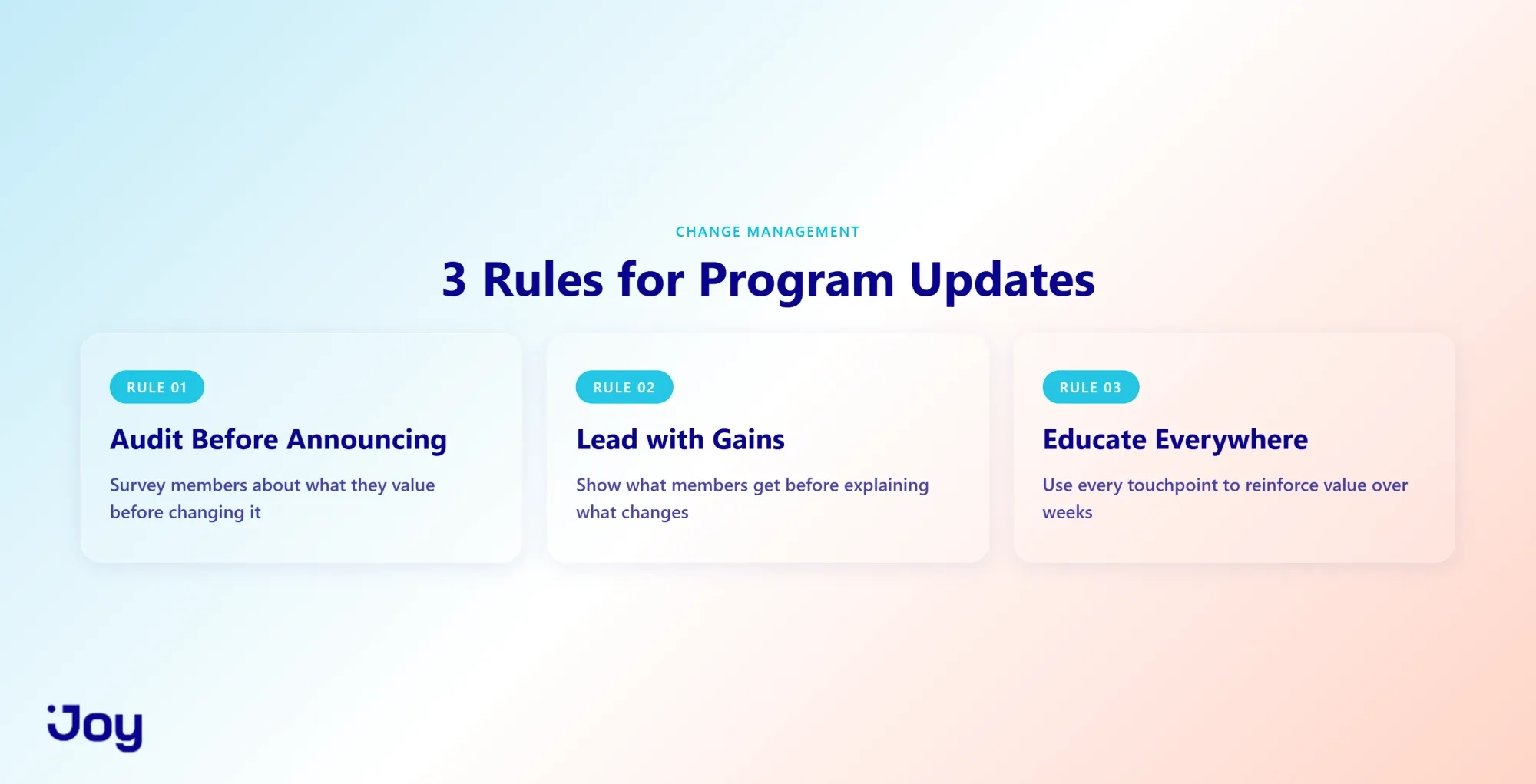
3 Change Management Rules for Merchants Evolving Their Loyalty Programs
Drawing from Forrester's analysis and the Starbucks experience, three rules emerge for any merchant planning program changes:
Rule 1: Audit before announcing. Survey existing members about what they value most. Understand the mental model of their current status before changing anything. What a brand believes members think and what members actually think are rarely the same.
Rule 2: Lead with gains, not structure. Frame every change as "here's what you're getting" before "here's what's changing." Benefits first, mechanics second. Starbucks did the opposite, and the reaction was immediate.
Rule 3: Educate across every touchpoint. One email doesn't explain a major program overhaul. Use app notifications, website banners, FAQ pages, and social content to reinforce the value story over weeks, not days. Repetition builds understanding; a single announcement invites misinterpretation.
These rules apply whether you're adding a tier, adjusting point values, or restructuring rewards entirely. The psychology of perceived loss doesn't scale with the size of the change.
What Shopify Merchants Can Learn from the Starbucks Rewards Program
Everything above describes what Starbucks built. This section translates those mechanics into strategies that Shopify merchants can deploy today. Each subsection maps a Starbucks tactic to a specific Joy Loyalty feature and a measurable outcome.
Build Starbucks-Style Tiers Without a Custom App
Starbucks uses Green, Gold, and Reserve to create aspiration and segment customers by value. Joy's VIP Tiers replicate the same psychology: custom tier names, spending thresholds, tier-specific earning multipliers, and exclusive reward unlocks, all configurable from a no-code dashboard.
The implementation path is straightforward. Set three tiers based on annual spend, assign escalating earning multipliers (for example, 1x, 1.5x, and 2x points), and create tier-exclusive rewards that make progression feel worthwhile. Starbucks invested in a custom app with a dedicated engineering team to achieve this. Shopify merchants get the same structure without writing a single line of code.
Create Earning Urgency with Bonus Point Events
Starbucks' Double Star Days and personalized challenges drive traffic spikes without discounting. Joy's Bonus Point Events offer the same mechanic: scheduled multiplier campaigns that create urgency around earning, not saving.
Schedule 2x point events on your slowest sales days. Layer in non-purchase earning actions like reviews, referrals, and social follows to extend engagement between transactions. Forrester's finding that 76% of consumers want to engage beyond purchases (loyalty program statistics) confirms that giving members ways to earn without buying strengthens retention measurably.
Measure Loyalty ROI Like Starbucks: Track Assisted Orders
Starbucks measures loyalty through member revenue contribution (60% of U.S. revenue), spend multipliers (2.5 to 3x versus non-members), and transaction growth. Joy's north-star metric, Assisted Orders, captures the same insight: orders placed via referral links or loyalty-generated discount codes.
Tracking Assisted Orders in the Joy dashboard lets merchants compare member versus non-member average order value, calculate loyalty program ROI directly, and prove that the program generates revenue rather than consuming budget. The mental shift from "loyalty as a cost center" to "loyalty as a revenue engine" is exactly the transformation Starbucks executed. And it's available to any Shopify merchant measuring the right metric.
The Starbucks Loyalty Blueprint: Your Next Move
The Starbucks rewards program is a $13 billion revenue engine powered by 35.5 million active members. The mechanics behind it (tiered earning, strategic redemption, gamification, data-driven personalization, and cross-brand partnerships) aren't proprietary secrets. They're design principles that any ambitious merchant can adapt.
The 2026 reimagining also proved that even the world's most recognized loyalty program can stumble when communication fails. The Forrester backlash is a reminder that what you change matters less than how you communicate the change.
For Shopify merchants ready to build a loyalty program with Starbucks-caliber mechanics, Joy Loyalty provides the tiers, gamification, earning rules, and analytics to turn one-time buyers into repeat customers at any scale.
Install Joy on Shopify and start building your own loyalty engine, or book a demo to see how the platform maps to your brand's specific goals.
FAQ
How many Starbucks Rewards members are there?
35.5 million active U.S. members as of Q1 2026, an all-time high (Starbucks Investor Relations). These members drive approximately 60% of U.S. company-operated revenue, exceeding $13 billion annually. The program grew from 34.6 million active members in Q1 2025.
What are the Starbucks Rewards tiers?
Three tiers as of the 2026 reimagining: Green (free entry, 1.0 star per $1), Gold (500 stars per year, 1.2 stars per $1), and Reserve (2,500 stars per year, 1.7 stars per $1). Green stars expire after 6 months, while Gold and Reserve stars never expire.
Is the Starbucks loyalty program free to join?
Yes. All customers can join the Green tier for free. Enrollment is automatic upon sign-up through the Starbucks app or website. Green members immediately access birthday rewards, personalized offers, Free Mod Mondays, and the Starbucks for Life sweepstakes.
What changed in the 2026 Starbucks loyalty program update?
The March 10, 2026, update replaced the flat earning structure with a three-tier system (Green, Gold, Reserve). Key changes include tiered earning rates (1.0 to 1.7 stars per dollar), a new 60-star redemption tier ($2 off), Free Mod Mondays for all members, and Reserve-exclusive experiences like international trips. Base earning rates decreased from the pre-2026 standard of 2 stars per dollar.

Written by
Thomas Nguyen is the CEO & Co-founder of Joy, a loyalty solution for Shopify and eCommerce brands. With years of experience building high-performance Shopify apps, Thomas aims to help merchants grow through customizable and retention-focused tools.
Related reading
 Examples & Inspiration
Avis Preferred 2026 Guide: Skip the Line & Earn Free Days
The Avis loyalty program (Avis Preferred) lets you skip the counter and earn free rental days. See how the tiers, points math, and status shortcuts work in 2026.
 Thomas Nguyen
 Examples & Inspiration
Hilton Honors 2026 Review: The Easiest Path to VIP Status?
The Hilton loyalty scheme just made elite status far easier to reach. See how Hilton Honors tiers, points sweet spots, and perks stack up for 2026 travelers.
Thomas Nguyen Examples & Inspiration
Sephora Loyalty Program: How Beauty Insider Built the Gold Standard in Customer Retention
Sephora's Beauty Insider has 45M members in North America alone — more than Canada's population. This breakdown covers the three-tier structure, experiential rewards, gamification, and what Shopify brands can actually copy.
Thomas Nguyen Examples & Inspiration
Lufthansa loyalty scheme: Case study and strategic breakdown for e-commerce (2026)
What can an airline teach your store about retention? See how the Lufthansa loyalty scheme builds status, monetizes miles, and turns loyalty into infrastructure.
Thomas Nguyen Examples & Inspiration
Gymshark Loyalty Program: XP, Tiers & Rewards Breakdown
After 13 years without one, Gymshark just launched its first loyalty program — powered by XP, workouts, and a 4-tier progression system. This breakdown covers the mechanics, the gaming psychology, the manual-opt-in strategy, and what Shopify brands can actually replicate.
Thomas Nguyen Examples & Inspiration
Inside Domino’s loyalty program: 2M members and key lessons
How did Domino’s add 2M members in months? Learn the "low-floor" strategy and 3 psychological hooks to build your brand's loyalty.
Thomas Nguyen