Nike Loyalty Program: How Free Membership Drives 3x Spending
300M members, 3x spending, zero points or tiers. Nike Membership threw out the loyalty playbook and proved experience beats transactions. This breakdown covers all 7 pillars — and shows what Shopify brands can actually steal at their own scale.
Summarize this post with AI
300 million members. 3x spending versus non-members on Nike.com. Zero points. Zero tiers. Zero paid membership. Nike Membership didn't just bend the loyalty playbook. It threw it out and proved that experience beats transactions (Nike FY2021 Q4 earnings).
But the story isn't all triumph. Nike's FY2025 revenue dropped 10% to $46.3 billion, digital sales fell 20%, and net income plummeted 44% to $3.2 billion (Nike FY2025 earnings release). 300 million members didn't prevent that.
Most articles on Nike's program recycle the "100 million members" stat from 2017 and praise the ecosystem without examining what's actually working, what failed spectacularly (Web3), and what's quietly reshaping retail loyalty (Connected Partnerships). This article does something different.
We'll dissect the 7 pillars of Nike's loyalty model with verified data from earnings calls, Dune Analytics, and retail trade sources. Then we'll show how ambitious brands can adapt each one, whether you're running 400 orders a month or 40,000. Because Nike's most powerful loyalty tactics aren't locked behind a $46.3 billion budget. They're locked behind design decisions.
Inside the Nike Membership Program: Why No Points, No Tiers, No Fee Works
Nike Membership Benefits: What the Free Model Replaced Points With
Nike Membership is free. No annual fee, no point accumulation, no tier progression. You sign up with an email and get immediate access to every member benefit.
So what do members actually get instead of points? Exclusive product access, early launches, birthday rewards, free shipping on orders $50+, a 60-day wear test, Nike By You customization, expert training content, and member-only events.
The logic is straightforward. By killing the "earn before you benefit" friction, Nike eliminated the biggest barrier in traditional loyalty programs. Members get value from day one. No points to stack up. No threshold standing between signup and reward. Higher activation rates follow naturally when there's zero delay between joining and benefiting.
Nike's bet comes down to a simple exchange: give value upfront, earn data in return, use data to personalize, then deepen the relationship. The inverse of earn-and-burn. Benefit first, data second, loyalty as a consequence.
Experience-Based Loyalty vs. Transaction-Based Loyalty
Why does this model outperform tradition? Consider the fundamental difference. In a conventional program, you spend $1, earn 1 point, redeem at 100 points. The relationship stays purely transactional. Members optimize discounts, not brand connection.
Nike flipped that equation. Join for free, access exclusive content and products, form an emotional connection, and spending increases as a byproduct. Not the goal.
The proof is in the data. Nike members spend 3x more than non-members on Nike.com (Nike FY2017 Q3 earnings). Not because they're chasing points, but because the membership makes the entire Nike experience feel personal. In points-based programs, the reward IS the loyalty. In Nike's model, the experience IS the loyalty. Spending follows from there.
That experience-first philosophy only works when the touchpoints are rich enough to sustain it. So how does Nike deliver that experience at scale across wildly different customer needs?
The Nike Loyalty Program's 4-App Ecosystem: One Login, Four Experiences
The Four Apps and Their Loyalty Functions
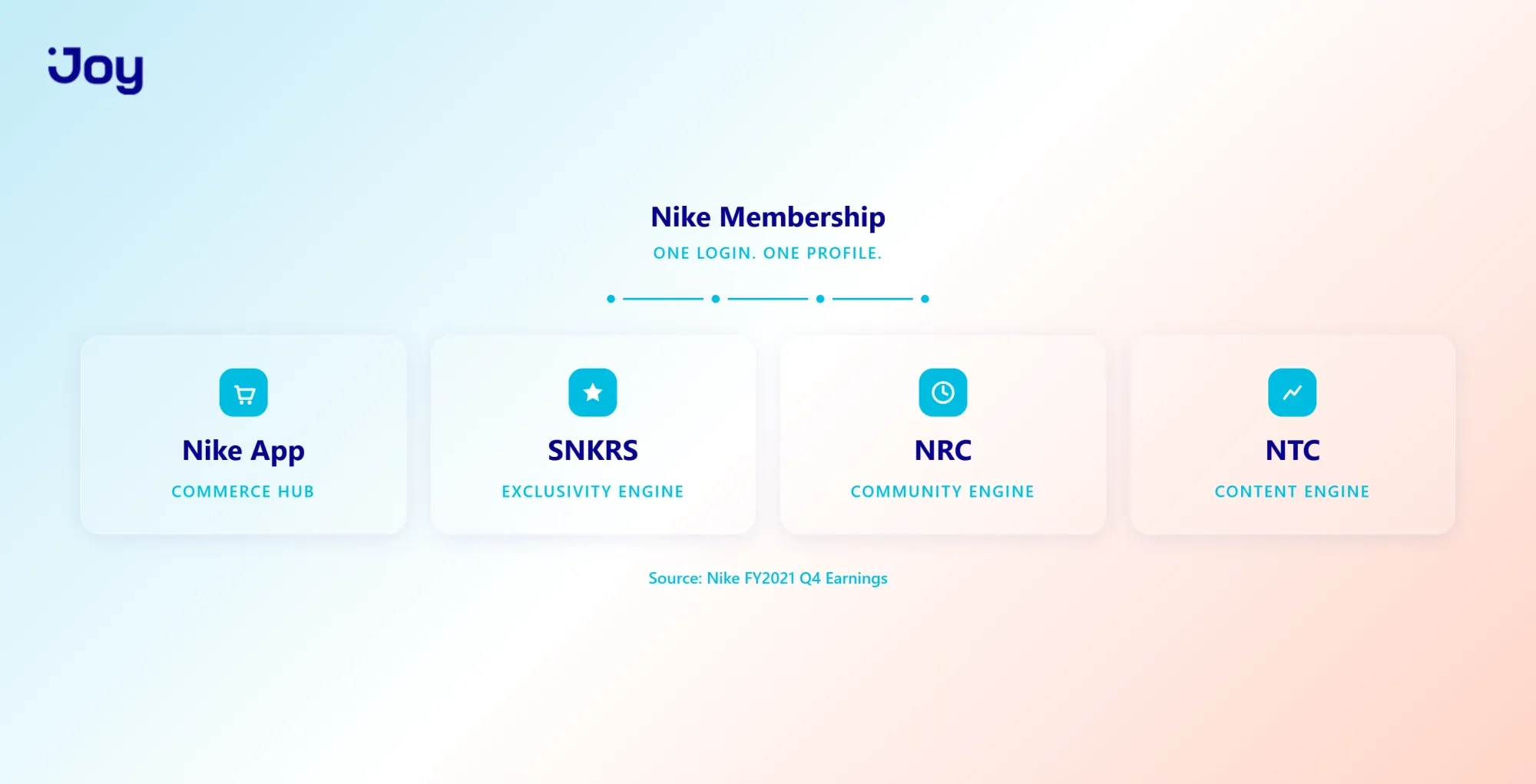
Nike doesn't have one loyalty app. It has four, each targeting a distinct lifestyle vertical.
Nike App is the central hub. Members browse exclusive products, manage rewards, get personalized recommendations, and scan for in-store benefits. This is the commerce engine.
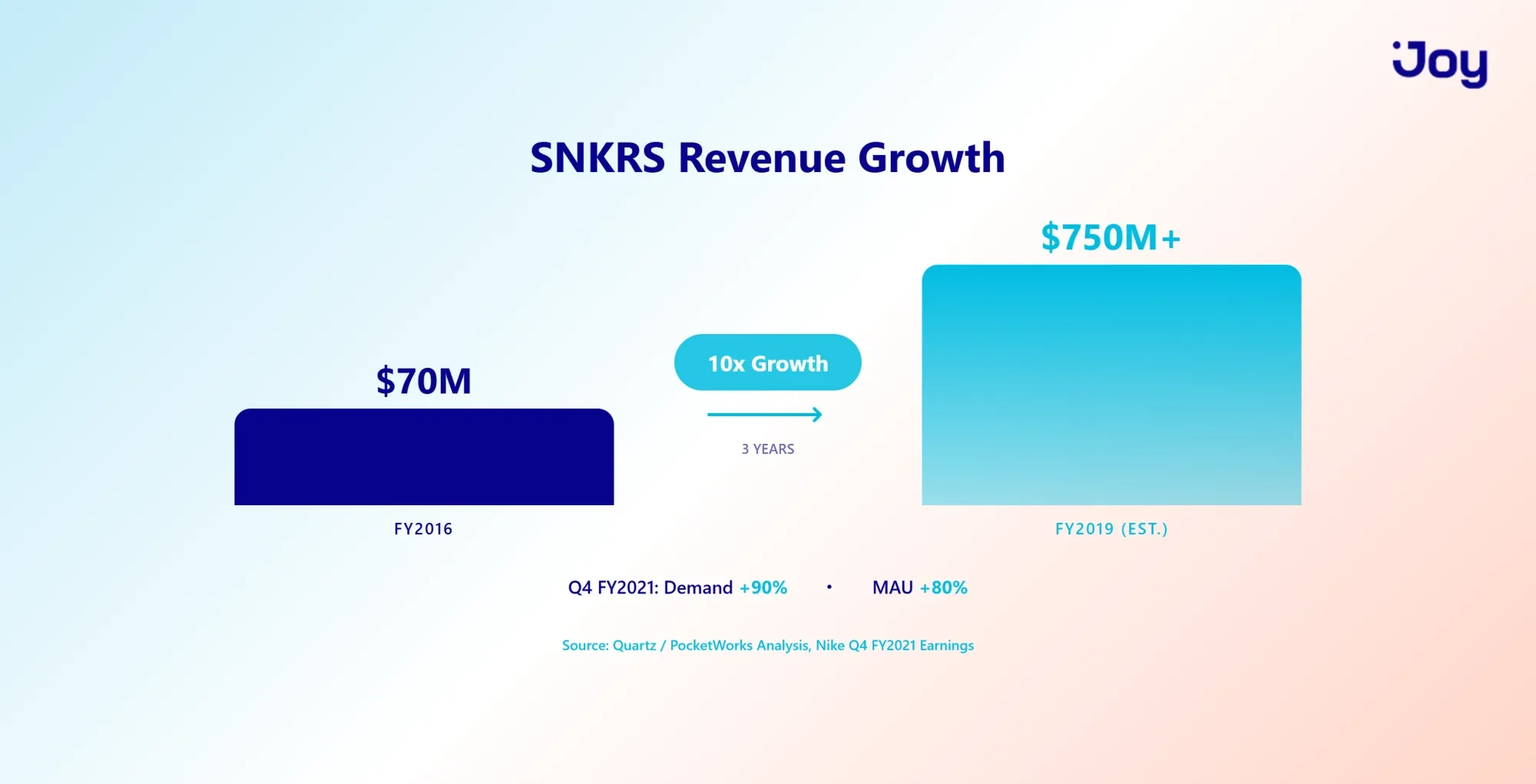
SNKRS is the exclusivity engine. Limited-edition sneaker drops, early access, and the "draw" raffle system for coveted releases generated an estimated $750 million+ in annual revenue by FY2019 (Quartz/PocketWorks). Demand grew over 90% in Q4 FY2021 alone (Nike earnings).
Nike Run Club (NRC) is the community engine. GPS run tracking, guided runs, challenges, and leaderboards turn daily exercise into social connection with the brand.
Nike Training Club (NTC) is the content engine. Over 200 free workouts, expert-led programs, and personalized training plans deliver ongoing value that keeps members engaged between purchases.
All four apps share a single login, and activity in any app enriches the unified member profile.
Why a Multi-App Strategy Generates Better Data Than a Single App
Single-app programs capture purchase data. Nike's 4-app ecosystem captures lifestyle data: what you buy, what you collect, how you run, how you train.
That creates a 360-degree member profile. A runner who buys trail shoes, collects Jordan retros, and does HIIT workouts three times a week gives Nike insight into product preferences, fitness goals, aesthetic taste, AND buying patterns all at once. One person, four data streams.
The unified login is what makes it work. Without it, four apps become four silos. Nike stitches all activity into one identity, and the scale matters: apps drove over 40% of Nike's digital business, with digital accounting for 21% of total brand revenue (Nike FY2021 Q4 earnings).
The trade-off worth noting: maintaining four apps is expensive and complex. This is a "big brand" strategy that ambitious brands should adapt, not copy directly. The lesson isn't "build four apps." It's "build one identity across all your touchpoints."
With that unified identity generating rich data across every touchpoint, Nike unlocked something even more powerful: the ability to manufacture cultural urgency. And no part of the ecosystem shows that better than SNKRS.
Exclusivity and SNKRS Drops: How Nike Turns Scarcity Into Loyalty
The SNKRS Drop Model: Scarcity as a Loyalty Mechanic
SNKRS runs on controlled scarcity. Limited-edition sneakers released at specific times, available only to Nike members. The "draw" system lets members enter a raffle for coveted releases, but not everyone wins. That tension creates anticipation, social sharing, and repeat app engagement.
The revenue trajectory tells the story. SNKRS went from roughly $70 million in FY2016 to an estimated $750 million+ by FY2019. That's 10x growth in three years (Quartz/PocketWorks analysis). By Q4 FY2021, SNKRS demand surged over 90% and monthly active users grew nearly 80% (Nike earnings).
The psychological hook goes deeper than product scarcity. "Winning" a draw feels like an achievement, not a purchase. Members develop emotional attachment to being selected. And that engagement creates a halo effect: members who engage with drops buy more across the entire Nike brand.
Nike Membership Benefits: Member-Only Products and Everyday Exclusivity
Beyond SNKRS drops, Nike maintains a rotating catalog of roughly 170 member-exclusive products available at any time. These aren't just limited editions. They include exclusive colorways, early access to mainline releases, and member-priced items.
Birthday rewards reinforce the annual engagement cycle. Priority event access gives members first tickets to Nike-sponsored events and workshops. The strategy combines everyday exclusivity (there's always something member-only available) with event exclusivity (drops, launches, cultural moments).
For any brand studying how scarcity and VIP access drive retention across the fashion loyalty space, the SNKRS model proves you don't need 300 million members to create urgency. Even 500 members can feel that pull when the gamification mechanics are designed with intention. Joy's VIP tiers and bonus campaigns let Shopify brands create the same member-only access and time-limited urgency without Nike's scale.
Exclusivity pulls members in through product desire. But Nike's most underrated retention weapon works through a completely different emotion: identity. That's where NRC and NTC come in.
Community-Led Retention: How NRC and NTC Turn Fitness Into Nike Loyalty
Nike Run Club: Building Loyalty One Kilometer at a Time
NRC turns running into a social, gamified experience. GPS tracking, guided runs with Nike coaches, audio workouts, distance challenges, and leaderboards. Layers of engagement that have nothing to do with buying shoes.
Members don't just use NRC. They become part of a community. Running groups, city challenges, and milestone celebrations create social bonds tied directly to the Nike brand. And here's what makes this a retention weapon: a member who tracks 500 runs on NRC has 500 reasons to stay. Their running history, personal records, and social connections all live inside Nike's ecosystem. Switching costs, without the friction.
From a data perspective, NRC captures running frequency, pace improvement, preferred distance, and time-of-day patterns. All of that feeds product recommendations. A member training for trail races receives trail-shoe suggestions. A marathon runner sees lightweight racing flats. The community generates the data, and the data fuels the personalization.
Nike Training Club: Content as a Loyalty Engine
NTC provides over 200 free workouts led by Nike Master Trainers, covering yoga, HIIT, strength, and mobility. The value is striking: members get premium fitness content at no cost, which would run $10 to $30 per month on competing platforms like Peloton or Apple Fitness+.
What NTC creates is something no points program can replicate: daily brand touchpoints outside of shopping. A member may buy Nike shoes quarterly but uses NTC weekly. Free training content drives daily app opens, building brand familiarity and increasing purchase consideration when the next buying cycle arrives.
NRC and NTC together prove that rewarding participation (not just purchases) builds loyalty that outlasts product cycles and seasonal trends. Among sports loyalty programs, this community-first approach sets Nike apart from competitors still relying solely on transactional rewards. But even with four apps generating deep engagement data, Nike recognized a fundamental limitation: members only interact with Nike inside Nike-owned channels. So they built a system to extend membership beyond their own walls.
Connected Partnerships: How the Nike Membership Program Extends Beyond Nike
This is the most underexplored angle in the entire SERP. Only one of seven competitor articles mentions a retail partner. None covers the full picture.
The Connected Partnership Model: How It Works
Nike doesn't just sell through retail partners. It connects its membership with theirs. Customers link their Nike Membership with a retail partner's loyalty account through the partner's app or website. Once linked, benefits flow both ways.
For members, that means access to member-only Nike products at partner stores, early access to select launches, curated collections, and exclusive experiences. For Nike, it extends membership reach beyond Nike-owned channels while capturing purchase data from partner transactions. For partners, it drives foot traffic and app downloads by offering Nike's exclusive products.
In practice, this works like a coalition model without the coalition complexity. Nike keeps brand control while partners get access to the Nike member base.
The Three Launch Partners: Dick's, Zalando, and JD Sports
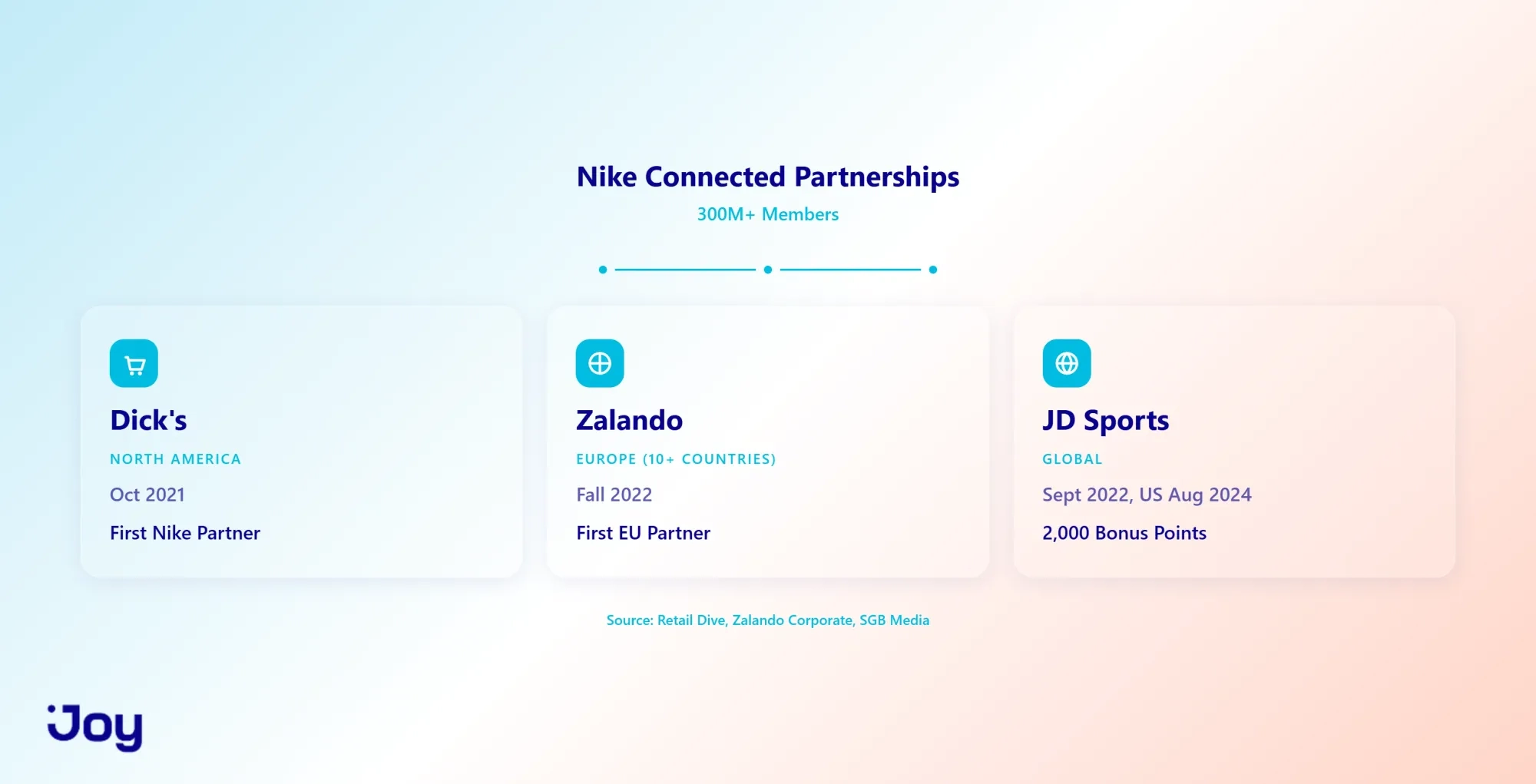
Dick's Sporting Goods became the first Nike Connected partner, launching in October 2021 in North America. Members link Nike Membership with Dick's SCORECARD to access member-exclusive Nike products at Dick's stores and online (SGB Media).
Zalando followed as the first European partner in Fall 2022. Starting in Austria, the partnership expanded to Germany, the Netherlands, France, Belgium, Denmark, Sweden, Finland, Italy, and Poland. Members connect through the Zalando App (Zalando Corporate).
JD Sports launched as the first global partner in September 2022 across Europe, then expanded to the U.S. in August 2024. Linking JD STATUS with Nike Membership unlocks an immediate 2,000 bonus points ($10 STATUS Cash), plus access to curated collections, early product access, and exclusive experiences (Retail Dive, Retail TouchPoints).
Three partners across two continents in three years. The expansion follows Nike's market priority: North America first, then Europe, then global. For brands thinking about extending loyalty reach beyond their own store, the principle is worth studying. You don't need Zalando or JD Sports. Even partnering with complementary stores creates the same "earn everywhere" effect through a well-designed loyalty program. Joy's referral program lets Shopify brands apply this same principle: extend loyalty reach through referral networks without enterprise-level negotiations.
With membership now extending through partner channels, every interaction feeds back into the same system. And that brings us to the engine that makes all of it compound: Nike's data flywheel.
Personalization and the Data Flywheel: The Engine Behind the Nike Loyalty Program
The Data Flywheel: How 300M Members Power Personalization
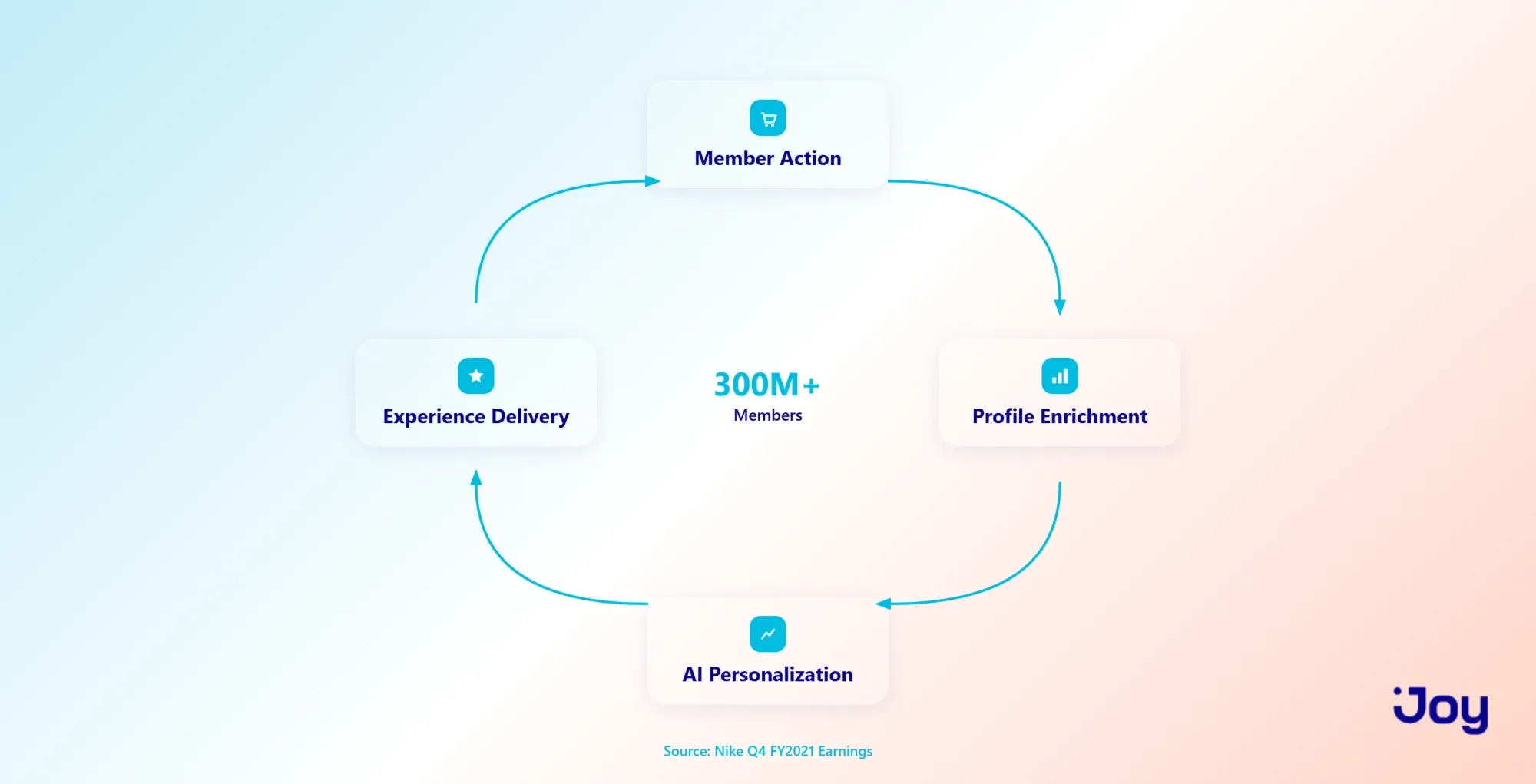
Every purchase, SNKRS draw entry, NRC run, NTC workout, app browse session, and in-store scan feeds into one unified member profile. The 4-app advantage means Nike captures purchase data, collection interests, fitness habits PLUS training preferences. That's a lifestyle portrait, not a transaction log.
Nike uses predictive analytics and AI to spot patterns, anticipate what a member needs next, and serve personalized recommendations. The output shows up everywhere: personalized product suggestions in the Nike App, curated SNKRS alerts, training plans matched to fitness goals, event invitations based on location and interests.
The flywheel effect is what makes this self-reinforcing. Each interaction generates data. Data improves personalization. Better personalization drives more interaction. More interaction generates more data. And as former CEO John Donahoe put it: "The more you have it, the more you can use it. You can use that consumer insight...personalizing a recommendation or anticipating a need" (Nike Q4 FY2021 earnings).
Nike's Foot-Scanning Technology: Personalization Meets Product
Nike integrated augmented reality foot-scanning into the Nike App. Members scan their feet, and AI recommends the perfect shoe size and fit. This solves a real problem. Online shoe returns due to sizing issues cost the industry billions annually.
The data from scans enriches member profiles with physical measurements, a data layer competitors can't replicate without their own scanning technology. This is where data-driven loyalty crosses from "personalized marketing emails" into "the product fits me better because I'm a member."
Why the Flywheel Has Limits: The FY2025 Warning
Despite 300 million members and best-in-class data capabilities, Nike's FY2025 told a different story. Revenue landed at $46.3 billion (down 10%). Nike Direct dropped to $18.8 billion (down 13%). Digital fell 20%. Net income sank to $3.2 billion (down 44%) (Nike FY2025 earnings release).
What the data flywheel can't fix: product strategy missteps (overreliance on classic silhouettes), wholesale relationship damage (cutting too many retail partners then reversing course), and market share erosion to competitors like New Balance, On Running, and Hoka.
The lesson for ambitious brands is critical. A loyalty program amplifies your strategy. If the strategy is wrong, the flywheel spins faster in the wrong direction. Membership is a multiplier, not a replacement for fundamentals. Understanding your retention metrics early is what prevents a flywheel from becoming a downward spiral. Joy's analytics dashboard gives Shopify brands the same flywheel visibility at their scale: tracking what members do, spotting what drives orders, and catching strategic issues before they compound.
That warning extends to Nike's boldest bet yet. If a bad product strategy can undermine 300 million members, imagine what happens when a brand pours millions into technology its customers never asked for.
Web3, .Swoosh, and RTFKT: What the Nike Loyalty Program's Biggest Bet Teaches Us
The Rise: $185M in NFT Revenue and the Swoosh Vision
In December 2021, Nike acquired RTFKT, a digital sneaker studio creating NFTs and virtual collectibles. By August 2022, Nike had pulled in $185 million in NFT sales revenue: $93 million from primary sales and $92 million in royalties, generating $1.3 billion in secondary trading volume (Dune Analytics).
In November 2022, Nike launched .Swoosh, a Web3 platform for digital collectibles and co-creation. The May 2023 "Our Force 1" NFT drop moved roughly 100,000 boxes to over 30,000 buyers for approximately $2 million in revenue (NFT Plazas, Ledger Insights). In total, 379,095 .Swoosh IDs were claimed.
The vision was ambitious: extend Nike Membership into virtual worlds through digital sneakers, token-gated experiences, and co-created products. And for a brief window, the numbers backed it up.
The Retreat: RTFKT Shutdown, Lawsuit, and Lessons Learned
Then came the reversal. In January 2025, Nike shut down RTFKT operations. Less than three years after the acquisition (The Block, Decrypt).
The aftermath was swift. A class-action lawsuit filed in Brooklyn federal court alleged that Nike's abrupt shutdown collapsed NFT values, with plaintiffs claiming the NFTs were unregistered securities sold without proper disclosures.
What went wrong? The crypto market downturn of 2022 to 2023 cratered NFT demand. The .Swoosh community never hit critical mass beyond early adopters. Maintaining a Web3 platform required significant ongoing investment with diminishing returns.
Nike's pivot tells the story: shifting from collectibles to "in-game wearables," digital products worn in video games rather than traded on blockchains. The lesson for ambitious brands: innovation in loyalty is essential, but follow the customer, not the hype. Nike's core membership (apps, exclusivity, community) thrives. Web3 was a bet that didn't pay off at scale.
The honest takeaway? Even a $46 billion brand can misread customer demand. The pillars that work (free membership, exclusivity, community, data) share one thing: they solve problems customers actually have. The pillar that failed solved a problem most customers didn't know existed.
So after examining all seven pillars, the practical question is: what can brands at $50K to $500K per month actually replicate?
What Shopify Brands Can Steal from the Nike Loyalty Program: And Build Today
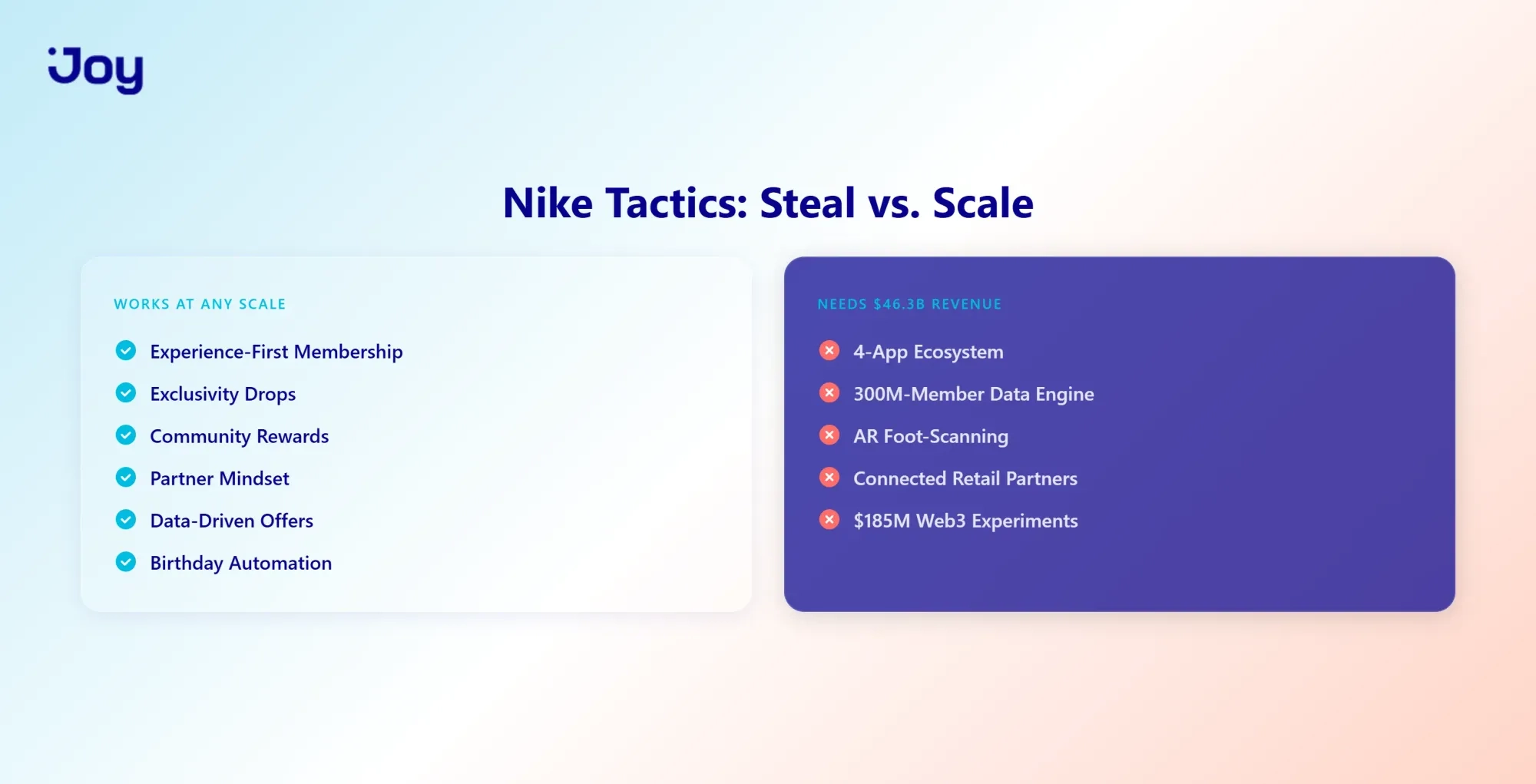
What You CAN Steal: Tactics That Work at Any Scale
Not every Nike tactic requires a $46.3 billion revenue base. These six translate directly:
Experience-first membership. Give value upfront. Free membership with immediate perks like birthday bonuses, exclusive access, and social rewards. Don't make members "earn" before they benefit. Nike proved that removing friction drives activation.
Exclusivity drops. Create member-only product launches, early access windows, or limited-edition items. SNKRS proves scarcity drives engagement. And you only need 500 members to create urgency, not 300 million.
Community engagement rewards. Reward actions beyond purchases: social shares, reviews, referrals, and UGC creation. NRC and NTC prove that non-transactional engagement builds deeper loyalty than any points program alone.
Connected partnerships mindset. Extend your loyalty reach through referral programs and cross-brand collaborations. You don't need Zalando or JD Sports. Even partnering with complementary stores creates the same "earn everywhere" effect.
Data-driven personalization. Track what members do (not just what they buy) and use those patterns to personalize offers. The flywheel works at any scale. It just spins faster with more data.
Birthday rewards. Simple, automated, proven. Nike does it. Starbucks does it. Every successful loyalty program does it. No reason not to.
What Requires Nike-Scale: Know Your Limits
Some pillars demand resources only a global brand can marshal:
A 4-app ecosystem with unified login requires dedicated mobile development teams, significant infrastructure, and ongoing UX investment. A 300-million-member data engine generates personalization depth that only global volume can produce. AR foot-scanning technology demands proprietary hardware plus software with significant R&D. Connected Partnerships with major retailers require enterprise-level negotiations. And $185 million in Web3 experiments exceeds the entire annual revenue of most brands.
Adapt the principles (experience-first, data-driven, community-led) at your scale. Don't chase the infrastructure.
How Joy Makes Nike-Style Loyalty Accessible on Shopify
For Shopify brands ready to put these principles into action, Joy Loyalty enables the replicable Nike tactics without enterprise complexity:
Free membership with instant perks through loyalty programs with immediate birthday bonuses, welcome rewards, and social engagement points. VIP tier access and member-only product recommendations that create SNKRS-style exclusivity. Community rewards for reviews, social shares, referrals, and account creation are the same non-transactional engagement that powers NRC and NTC. Analytics and segmentation to track member behavior, spot patterns, and personalize offers. Shopify POS integration for unified member profiles across online and in-store.
Same principles. Shopify-native execution. A fraction of the complexity.
Explore Joy on Shopify or book a demo to see how Nike-proven loyalty principles work at your scale.
Build Loyalty Like Nike: Without Being Nike
300 million members. 3x spending. Zero points. And yet: FY2025 revenue down 10%. That paradox runs through every section of this analysis. Membership amplifies strategy. It doesn't fix it.
The seven pillars (free membership model, 4-app ecosystem, exclusivity drops, community retention, connected partnerships, data flywheel, and the Web3 cautionary tale) each compound on the others. Nike's loyalty program works not because of any single tactic, but because every tactic feeds data back into the system, making the next interaction more relevant.
You don't need 300 million members or four apps to build a loyalty engine. Start with experience-first membership, add exclusivity and community rewards, then layer in personalization and partner reach as you grow. Joy gives you the foundation to start building today: Nike-proven principles, Shopify-native execution, measurable ROI.
The brands that dominate retention don't have the biggest membership bases. They have the smartest loyalty systems. Start building yours.
Frequently Asked Questions
Is Nike membership free?
Yes, completely free. No annual fee, no paid tiers, no point thresholds. Sign up with an email and get immediate access to all member benefits, including free shipping on $50+ orders, birthday rewards, and exclusive product access.
What do you get with a Nike membership?
Free shipping on orders $50+, 60-day wear test returns, early access to new launches, member-exclusive products (roughly 170 items at any time), birthday rewards, Nike By You customization, and free training content through Nike Run Club and Nike Training Club apps.
How many members does Nike have?
Over 300 million globally as of FY2021. Members spend 3x more than non-members on Nike.com (Nike FY2017 Q3 earnings). But that scale didn't prevent Nike's FY2025 revenue from declining 10% to $46.3 billion. Membership alone doesn't guarantee growth.
Does Nike have a points or rewards system?
No. Nike deliberately avoided points, tiers, and earn-and-burn mechanics. Members get value from day one through exclusive access, personalization, and community experiences. The approach: give value upfront, earn data in return, build loyalty as a consequence.
What is Nike Connected Partnership?
It links Nike Membership with retail partners' loyalty programs. Members connect accounts with Dick's Sporting Goods (launched October 2021), Zalando (Fall 2022), and JD Sports (September 2022, U.S. August 2024) to access member-exclusive Nike products at partner stores.
What happened to Nike's NFT program?
Nike earned $185 million from NFTs and launched the .Swoosh platform after acquiring RTFKT in December 2021. But in January 2025, Nike shut down RTFKT operations. A class-action lawsuit followed, alleging the NFTs were unregistered securities. Nike pivoted to in-game wearables instead.
How much more do Nike members spend?
3x more than non-members on Nike.com (confirmed in Nike FY2017 Q3 earnings). Not driven by points or discounts. It's the membership experience making Nike feel more personal and exclusive that drives spending up.
Can smaller brands copy Nike's loyalty program?
The principles, yes. The infrastructure, no. Experience-first membership, exclusivity drops, community rewards, birthday automation, and data-driven personalization all work at any scale. What requires Nike's $46.3 billion scale: the 4-app ecosystem, 300-million-member data engine, AR foot-scanning, and Connected Partnerships with major retailers. For a deep dive into replicating these tactics, see our guide on creating loyalty programs.

Written by
Thomas Nguyen is the CEO & Co-founder of Joy, a loyalty solution for Shopify and eCommerce brands. With years of experience building high-performance Shopify apps, Thomas aims to help merchants grow through customizable and retention-focused tools.
Related reading
 Examples & Inspiration
JCPenney Rewards Analysis 2026: The Strategic Mechanics of "CashPass"
The JCPenney rewards program turns points into a branded "CashPass" currency. See how its earn rates, stacking, and 45-day expiry are engineered to drive sales.
 Thomas Nguyen
 Examples & Inspiration
Avis Preferred 2026 Guide: Skip the Line & Earn Free Days
The Avis loyalty program (Avis Preferred) lets you skip the counter and earn free rental days. See how the tiers, points math, and status shortcuts work in 2026.
Thomas Nguyen Examples & Inspiration
Ulta Loyalty Program: The Strategy Behind 95% Sales
Ulta Beauty Rewards drives 95% of $12.4B in revenue with 46.7M active members. This breakdown covers the three-tier structure, point system, data personalization, and the rebrand strategy — plus what Shopify brands can actually replicate at their own scale.
Thomas Nguyen Examples & Inspiration
Sephora Loyalty Program: How Beauty Insider Built the Gold Standard in Customer Retention
Sephora's Beauty Insider has 45M members in North America alone — more than Canada's population. This breakdown covers the three-tier structure, experiential rewards, gamification, and what Shopify brands can actually copy.
Thomas Nguyen Examples & Inspiration
American Airlines Loyalty program: $30B secret + Retention tricks
The American Airlines loyalty program is a $30B engine, not a perk. See how AAdvantage turns points into status, partners, and a retention flywheel you can copy.
Thomas Nguyen Examples & Inspiration
Lufthansa loyalty scheme: Case study and strategic breakdown for e-commerce (2026)
What can an airline teach your store about retention? See how the Lufthansa loyalty scheme builds status, monetizes miles, and turns loyalty into infrastructure.
Thomas Nguyen