
Ulta Loyalty Program: The Strategy Behind 95% Sales
Ulta Beauty Rewards drives 95% of $12.4B in revenue with 46.7M active members. This breakdown covers the three-tier structure, point system, data personalization, and the rebrand strategy — plus what Shopify brands can actually replicate at their own scale.

Summarize this post with AI
46.7 million active members. 95% of total sales. $12.4 billion in annual revenue. Ulta Beauty Rewards isn't a loyalty perk. It is the business.
In January 2024, Ulta pulled off its biggest program overhaul in over a decade, rebranding from "Ultamate Rewards" to "Ulta Beauty Rewards." And the changes went well beyond a name swap: birthday gift choice, richer tier benefits, and deeper data integration all came with it.
Most breakdowns of this program list the tiers and stop there. None explains why the $500 and $1,200 thresholds work, how the data loop compounds retention, or what the actual rules are for point expiration and returns.
We're going to dissect six pillars of Ulta Beauty Rewards using verified data from SEC filings, 10-K reports, and executive interviews. For each pillar, we'll show what ambitious Shopify brands can replicate at their own scale. If you're studying loyalty program examples from the biggest names in retail, Ulta's is one of the most instructive.
Inside the Ulta Rewards Program: How the Three-Tier Structure Drives Aspirational Spending
Every pillar of Ulta Beauty Rewards builds on one foundation: the three-tier structure. Without it, the point system, multiplier gamification, and data personalization we'll cover later would have no framework to operate within.
Member, Platinum, and Diamond: The Spend Thresholds That Shape Behavior
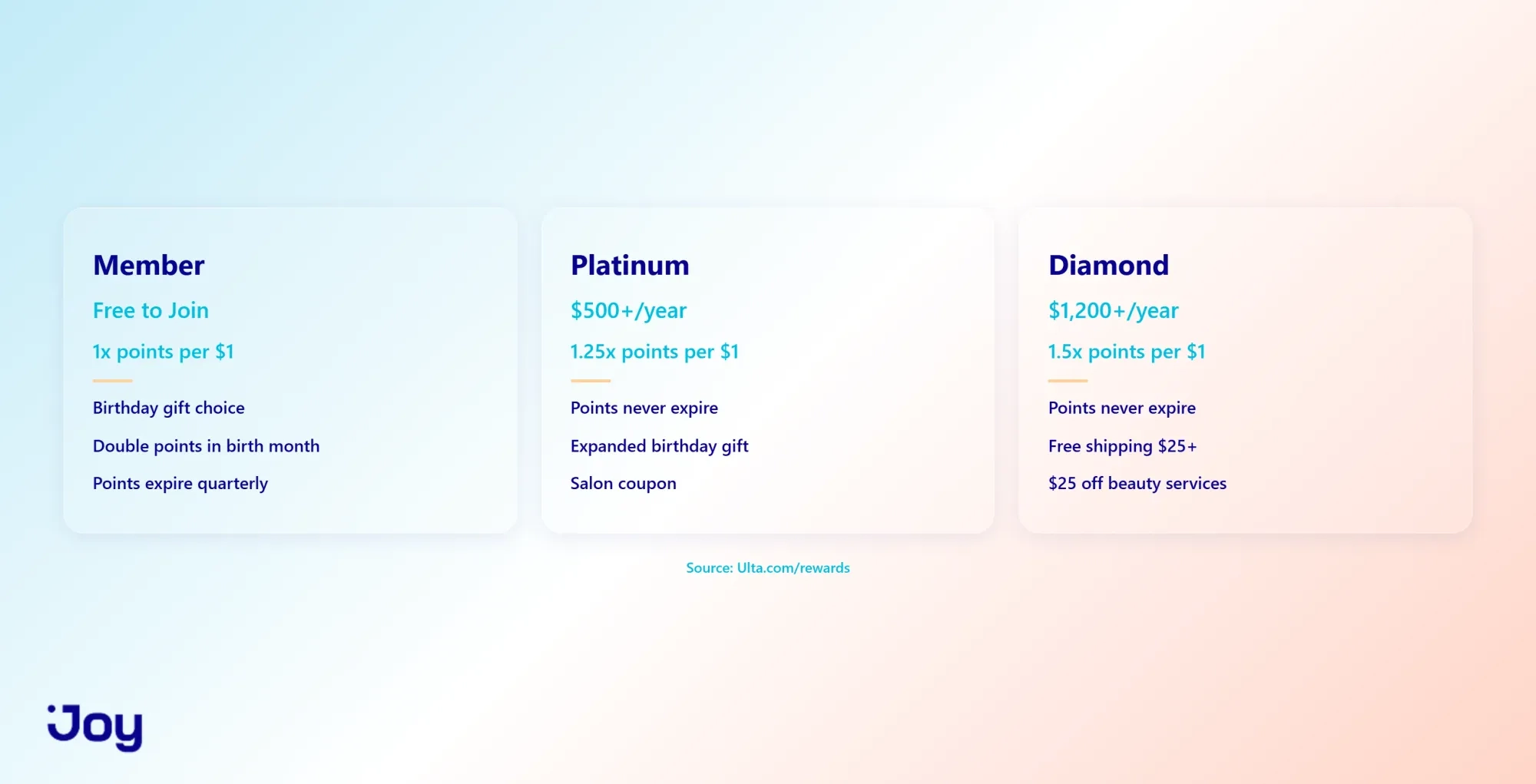
The entry point costs nothing. The Member tier is free to join with zero minimum spend, and it gives you immediate access to one point per dollar, a birthday gift choice, and double points during your birth month.
From there, tiers escalate:
- Platinum ($500/year): 1.25x points per dollar. Points never expire. Free birthday gift from an expanded selection, plus a salon coupon.
- Diamond ($1,200/year): 1.5x points per dollar. Points never expire. Free standard shipping on $25+ orders, a full-size qualification gift, and $25 off any beauty service.
One structural detail matters more than it appears: tier status resets annually. That means spending pressure never fully goes away. Across all three tiers, Ulta counts 46.7 million active members as of fiscal 2025 (Ulta Q4 FY2025 Earnings Release).
The majority sit at the base tier. But what makes this structure effective is how it pulls members upward through clear, visible thresholds. For more on how tiered loyalty programs create this kind of aspiration, we've covered 15 examples across industries.
Why $500 and $1,200 Thresholds Work: The Behavioral Psychology
These thresholds aren't round-number defaults. They're calibrated to hit members at psychologically achievable spend points.
As members approach $500 or $1,200, spending accelerates. That's the goal gradient effect at work. People want to "finish" a threshold rather than stop short, so a member sitting at $420 in annual spend is far more likely to push through $500 than stall.
Loss aversion reinforces this. Once you reach Platinum or Diamond, losing non-expiring points, better earn rates, and premium birthday gifts by dropping a tier creates retention pressure that discount-based programs can't touch.
The monthly math matters, too. $500 catches mid-frequency beauty shoppers spending roughly $42 per month. $1,200 captures dedicated enthusiasts at around $100 per month. Both feel achievable (not aspirational fantasy), and that's deliberate design. Platforms like Joy let Shopify brands set custom spend thresholds per tier, applying the same psychology at any scale.
Points That Never Expire: The Retention Lock at Higher Tiers
Point expiration works differently depending on the tier. Base Members see their points expire at the end of the quarter following their one-year anniversary. Platinum and Diamond members keep their points indefinitely, as long as they maintain tier status.
This creates a dual retention mechanism. At the base level, expiration drives urgency, keeping redemption rates high. At higher tiers, the lack of expiration creates accumulation. Members build a "points bank" they don't want to lose by dropping tiers.
So both expiration and non-expiration drive behavior. Just different behavior at different tiers.
The Ulta Beauty Rewards Program Point System: Where Simplicity Becomes a Weapon
With the tier structure established, the next question is obvious: what do members actually earn, and what are those points worth? Ulta's answer is deceptively simple on the surface but strategically layered underneath.
The Redemption Math: How Ulta Points Convert to Cash
Unlike programs that bury point values in complicated catalogs, Ulta publishes a transparent redemption chart (Ulta.com):
| Points | Discount | Value Per Point |
|---|---|---|
| 100 | $3 off | 3.0¢ |
| 250 | $8 off | 3.2¢ |
| 500 | $17.50 off | 3.5¢ |
| 1,000 | $50 off | 5.0¢ |
| 2,000 | $125 off | 6.25¢ |
Notice the pattern: the more points you save, the more each point is worth. That graduated value incentivizes accumulation over impulse redemption.
In practical terms, a base Member spending $1,000 per year earns 1,000 points and redeems them for $50. That's an effective return of 5% cashback. A Diamond member spending that same $1,000 earns 1,500 points, and if they save to the 2,000-point tier over time, each point is worth 6.25¢. The effective return jumps to 9.4%.
This kind of tiered redemption is rare. Most programs offer flat loyalty points values regardless of how many you stack up. Ulta's model rewards patience and commitment.
Daily Multipliers: The Gamification That Broke TikTok
Beyond base earn rates, Ulta layers on daily-changing point multipliers that turn routine purchases into a game.
On any given day, members can earn anywhere from 1x to 5x points per dollar on specific categories or brands. This creates a daily "check-in" habit where members open the Ulta app to see today's multiplier before deciding whether to buy now or wait for a better one.
The social media effect has been remarkable. TikTok and beauty forums light up every time 5x days appear, generating organic viral marketing at zero cost. The Ulta app itself reflects this engagement: 4.9/5 star rating, 1.8 million ratings, and the 27th most downloaded shopping app on the Apple App Store (Glossy, February 2025).
This is classic variable-ratio reinforcement (the same psychology behind slot machines) applied to retail. For brands looking to replicate it, Joy's bonus point campaigns enable time-limited 2x, 3x, or 5x point events on Shopify. Same gamified loyalty mechanic, without the enterprise complexity.
From Ultamate Rewards Program to Ulta Beauty Rewards: The Strategic Rebrand
The tier structure and point system provide the behavioral foundation. But in January 2024, Ulta overhauled the program's identity and added a financial layer that extends loyalty beyond the store. What changed, and why? That reveals how a mature program keeps evolving.
What Changed in the 2024 Rebrand
The name change from "Ultamate Rewards" to "Ulta Beauty Rewards" was the most visible shift, aligning the program name directly with the parent brand. But the real innovation was structural.
Previously, every member received the same birthday gift. After the rebrand, members now choose from a selection of products spanning multiple brands and categories. The result, according to Kelly Mahoney in a February 2025 Glossy interview, was a "significant uplift in redemptions."
That uplift isn't surprising when you understand the psychology. A member who chooses their reward feels ownership over it before they even receive it. That's the endowment effect in action. Not just a perk upgrade. Combined with double points during the birth month and an in-store salon coupon, the birthday moment became a multi-touch retention event. Among beauty loyalty programs, this level of birthday personalization is still rare.
The Credit Card Layer: Ulta Beauty Rewards Mastercard
The rebrand also coincided with Ulta leaning harder into its co-branded Mastercard, which extends the loyalty ecosystem beyond Ulta stores entirely.
The mechanics: 2x points per dollar at Ulta (one base point plus one card bonus), one point per $3 spent everywhere else, $0 annual fee, 20% off the first purchase, and 500 bonus points for $500 in outside spend within the first 90 days. The APR runs 22.49% to 31.49% (NerdWallet, January 2025), which is steep. But the target cardholder is a beauty enthusiast who pays in full.
The strategic purpose? Every coffee, every grocery run, every gas fill-up now earns Ulta points. The loyalty program stops being a beauty shopping perk and becomes a daily financial relationship. Every swipe reinforces the loop.
How the Ulta Points Program Uses Data to Personalize Everything
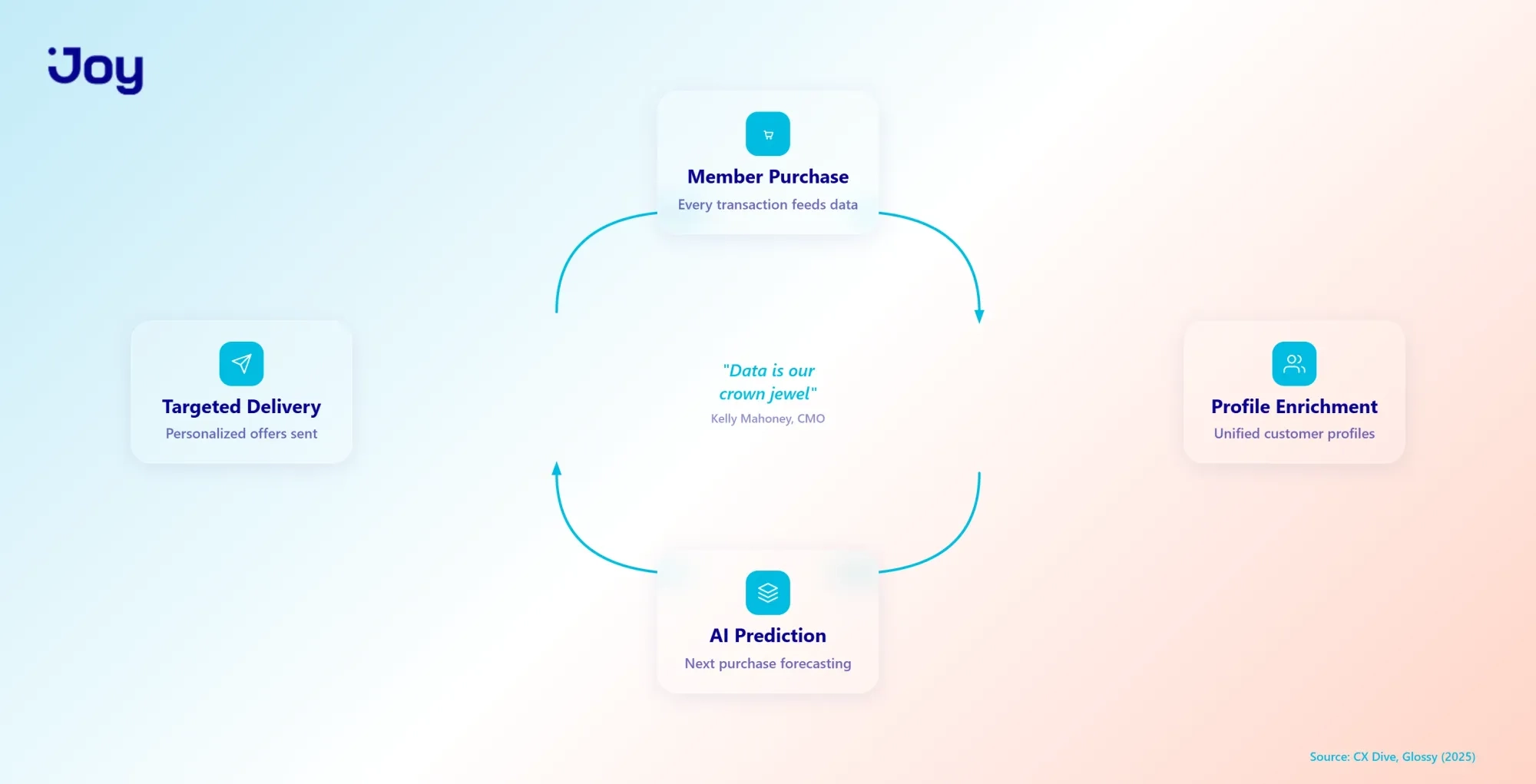
Tiers create the structure. Points create the currency. Data is what makes the entire system compound. As Kelly Mahoney put it: "Data is our crown jewel" (Glossy, February 2025). Here's how that crown jewel actually works.
The Closed-Loop Data System: From Purchase to Personalization
Every purchase, point redemption, app interaction, and in-store visit feeds into a unified customer profile. And here's the critical detail: 75% of loyalty members transact solely in-store (Ulta 10-K SEC Filing), which means the loyalty card is the primary data capture tool for offline shoppers.
Ulta centralized all previously siloed data (email, loyalty, in-store, and app behavior) into unified customer profiles stitched across channels (CX Dive, 2025). AI and ML models then predict each member's next likely purchase, powering personalized recommendations, targeted notifications, and category-specific messaging.
The system forms a compounding loop: purchase feeds profile enrichment, which feeds prediction, which feeds a personalized offer, which triggers the next purchase. It's a data-driven loyalty program where every member action makes the system smarter.
AI Skin Advisor: Personalization Powered by Loyalty IDs
In Q1 2025, Ulta wired loyalty IDs into its AI-enabled Skin Advisor (CX Dive). A member scans their skin, and the AI combines those results with purchase history and real-time store inventory to recommend a personalized regimen from products actually in stock.
This bridges digital and physical: a skin scan done in-store generates data that personalizes future online recommendations. Ulta's also piloting a virtual beauty advisor for product questions, store details, and loyalty queries.
Lapsed Member Retargeting: The Data-Driven Win-Back
The data system also powers Ulta's approach to members who stop buying. According to Kelly Mahoney's Glossy interview, Ulta uses "waterfall" communications to retarget lapsed members at escalating intensity. One-time shoppers get different messaging than regular customers who've gone quiet.
The escalation moves from personalized content to category-specific reminders to paid social retargeting, with discount offers as the final step. The target: reactivate lapsed members within 45 days of their last expected purchase. The data tells Ulta exactly when a purchase cycle is breaking, and the system steps in before full churn sets in.
Joy's analytics dashboard and email integrations give Shopify brands the same retention loop at a smaller scale. Track member behavior, identify at-risk segments, and use email integrations to reach members before lapse becomes permanent.
Ulta Beauty Rewards Program Rules Nobody Else Covers: Expiration, Returns, and the Fine Print
All of the strategies above matter. But so do the practical rules that affect members every day. Every competitor source on the SERP mentions "terms and conditions" in passing, yet none actually decode the mechanics. This section fills that gap.
Point Expiration: The Quarterly Calendar System
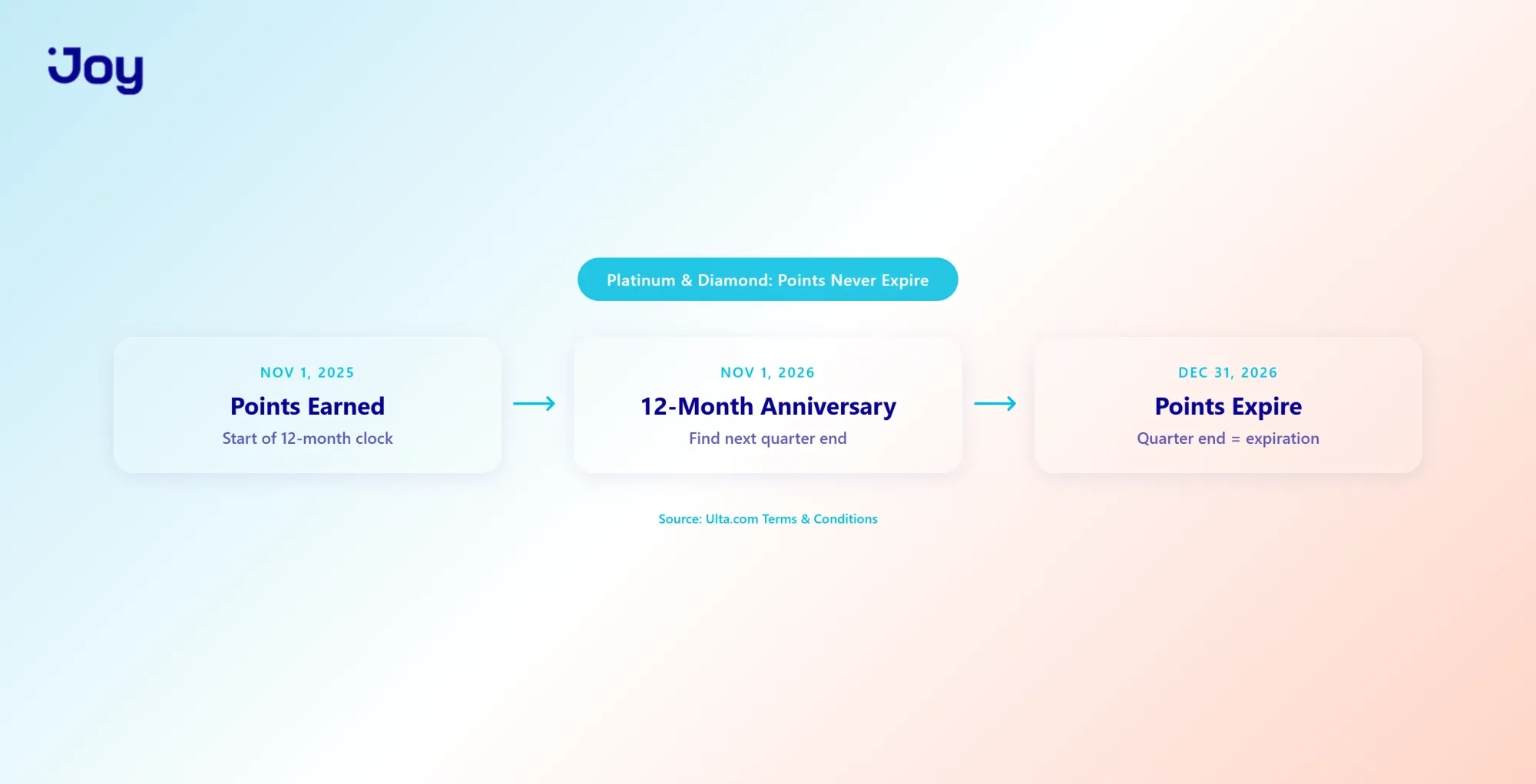
For base Members, point expiration follows a specific quarterly calendar. Points expire at the end of the calendar quarter following their 12-month anniversary.
The calendar quarter end dates are March 31, June 30, September 30, and December 31. Here's a concrete example: points earned on November 1, 2025, reach their 12-month anniversary on November 1, 2026. The next quarter end after that is December 31, 2026. That's when those points expire (Ulta.com Terms & Conditions).
Platinum and Diamond members don't face this at all. Their points never expire while they maintain tier status.
The practical takeaway for base members? Check the Ulta app or your receipt for the next expiration date, then either redeem before the deadline or push your annual spend to $500 to hit Platinum and kill expiration entirely.
What Happens to Points When You Return Products
Returns are where many loyalty programs get messy. Ulta's rules are refreshingly reciprocal.
Points earned on a returned product get deducted from the member's balance. Points redeemed toward that same product get added back. For partial returns on orders where points were used, a prorated number of points comes back.
The return window is 30 days for a full refund and 31 to 60 days for merchandise credit, with a receipt or Member ID lookup required (Ulta Guest Services).
The key implication: returns don't "game" the system. Points only count for products you actually keep. For high-volume beauty shoppers who frequently try and return products, the program stays fair without penalizing experimentation.
The Ulta Beauty Loyalty Program's Business Impact: The Scale Behind the Strategy
Each pillar above works in isolation. But together they compound into something much larger. This section consolidates every verified financial and operational metric to prove the loyalty program isn't a marketing cost center. It is the revenue engine.
Revenue and Membership Growth: The Compound Effect
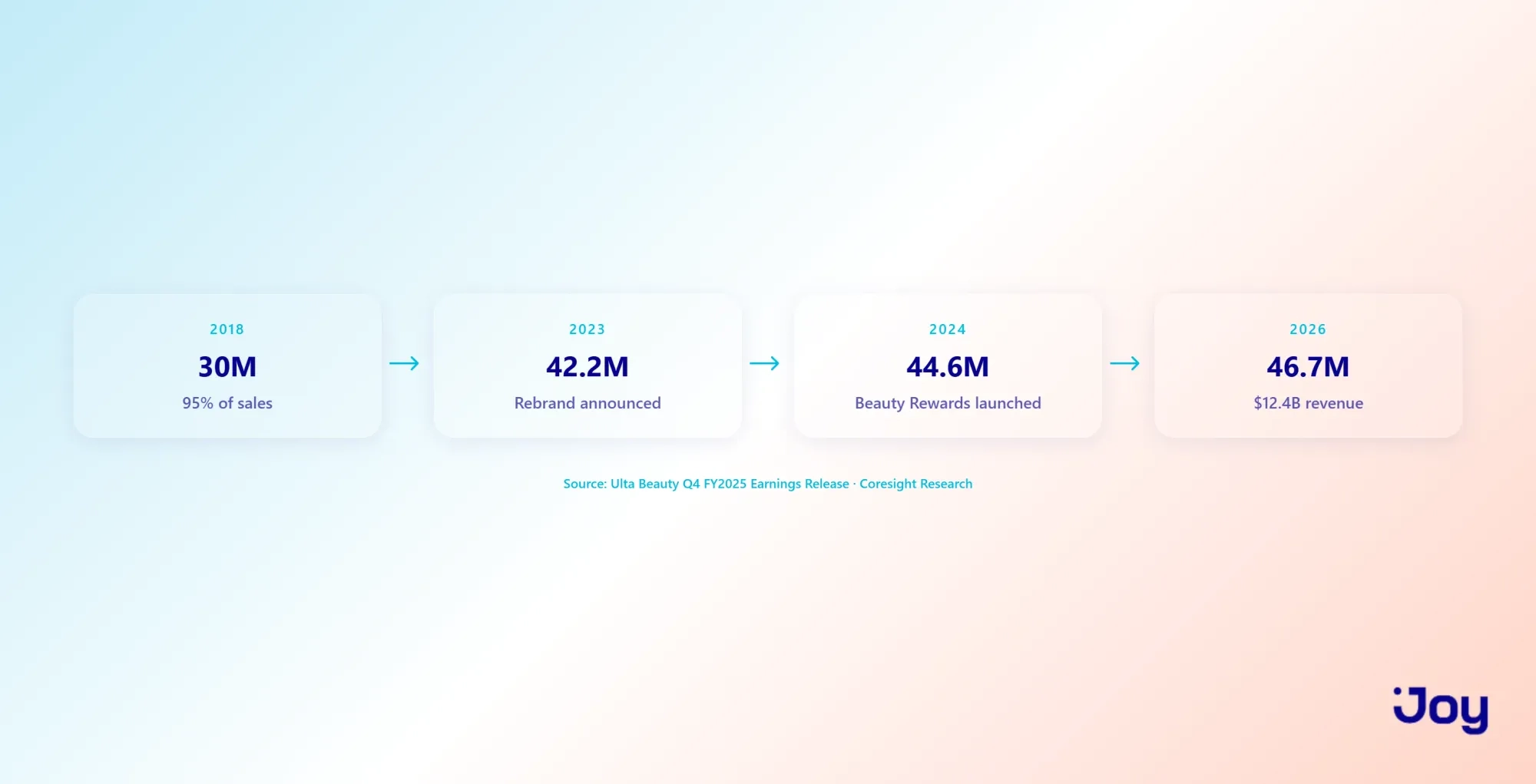
The membership trajectory tells the story:
- 2018: 30 million members, already driving 95% of sales (Coresight Research)
- 2023: 42.2 million members at year's end
- Q3 2024: 44.4 million members
- FY2024 end: 44.6 million members
- FY2025 end (January 31, 2026): 46.7 million members, a 5% year-over-year increase
Revenue followed the same trajectory. Net sales grew from $11.3 billion in FY2024 to $12.4 billion in FY2025, a 9.7% increase driven by comparable sales growth of 5.4% (Ulta Q4 FY2025 Earnings Release). Operating income reached $1.5 billion, representing 12.4% of net sales.
The most striking number: 95%+ sales penetration from loyalty members, confirmed in Ulta's 10-K SEC filing. That figure has held consistent for years. From 30 million to 46.7 million members over seven years, and the penetration rate hasn't budged. The program scales without diluting its impact. Not many programs can say that.
Ulta's footprint now spans 1,505 U.S. locations plus 86 international stores, with a public target of 50 million members by 2028 (Chain Store Age). When you look at loyalty program ROI at this scale, few retail programs can match it.
The 80/20 Rule: Why the Top Tier Drives the Business
Kelly Mahoney's 80/20 confirmation puts a number on the tier structure's impact. The top 20% of members (roughly 9.3 million people) drive approximately 80% of revenue. That's roughly $9.9 billion from one-fifth of the base.
These Diamond and high-Platinum members earn 1.5x and 1.25x points, receive premium birthday gifts, and never worry about point expiration. Ulta invests accordingly.
The lesson for any brand running a VIP loyalty program is direct: identify your top 20%, build your highest tier around them, and invest disproportionately in keeping them. Your top tier isn't your biggest. It's your most valuable.
What Brands Can Steal from the Ulta Loyalty Program: And Build with Joy
Every section above breaks down what Ulta does and why it works. Now the question becomes: which parts can you actually take? Not every tactic requires a $12.4 billion revenue base. Some of the most effective ones cost nothing to implement.
What You CAN Steal: Tactics That Work at Any Scale
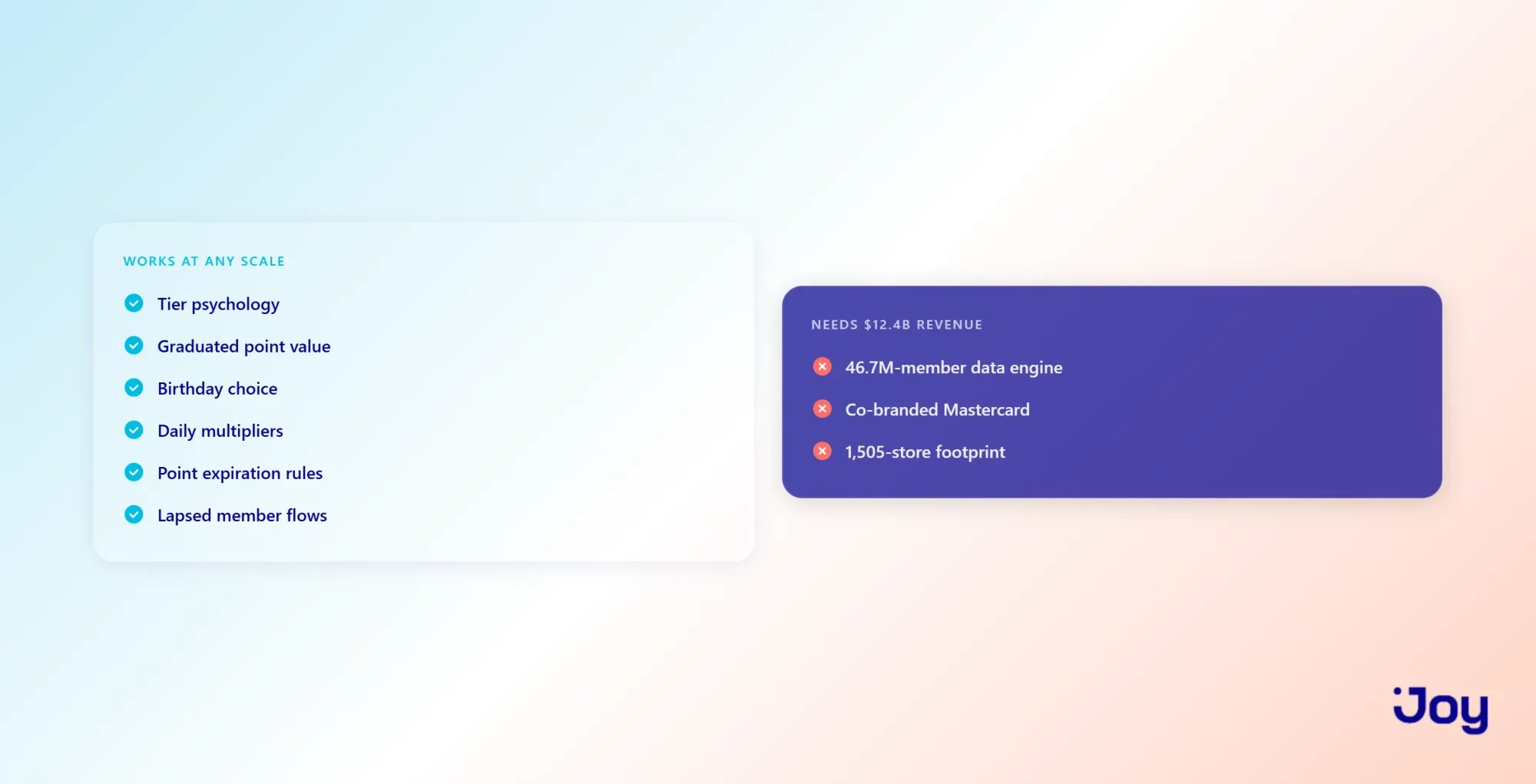
Six tactics from Ulta's playbook translate directly to Shopify brands:
- Tier psychology. Set three tiers with clear spend thresholds. The goal gradient effect works with 500 members just as well as 46.7 million.
- Graduated point value. Replicate Ulta's tiered redemption, where saving more points gets better value per point, pushing accumulation over impulse spending.
- Birthday rewards with choice. Offer a selection instead of one generic reward. Choice triggers the endowment effect, and Ulta saw measurable uplift after this switch.
- Time-limited multipliers. Create 2x, 3x, or 5x point events that mirror Ulta's daily gamification. These drive urgency and social sharing without ad spend.
- Point expiration as a tool. Use base-tier expiration to drive redemption, then remove expiration at higher tiers to create a retention lock.
- Lapsed member retargeting. Build email sequences that detect purchase cycle breaks and escalate offers, using the same waterfall logic Ulta applies.
These are loyalty program best practices that scale down. They require design thinking, not enterprise budgets.
What Requires Ulta-Scale: Know Your Limits
Not everything translates. And it's worth being honest about what sits beyond reach:
- 46.7 million-member data engine. The volume of behavioral data powering Ulta's AI personalization requires massive scale. Smaller brands can replicate the loop, not the depth.
- Co-branded Mastercard. Banking partner negotiations and regulatory approvals are unrealistic for most Shopify brands.
- 1,505-store omnichannel footprint. Physical retail scale built over decades, plus Alshaya Group's international expansion, requiring global infrastructure partnerships.
The honest takeaway: adapt the principles at your scale. Data-driven decisions, personalized member journeys, and omnichannel consistency don't require Ulta's infrastructure. They require intentional design.
How Joy Makes Ulta-Style Loyalty Accessible on Shopify
Joy puts every replicable Ulta tactic within reach on Shopify:
- Tiers: Custom thresholds with automatic progression, demotion, and different earn rates per tier.
- Graduated rewards: Multiple redemption tiers with increasing point values.
- Birthday rewards: Automated birthday point bonuses in the member's birth month.
- Multiplier campaigns: Time-limited bonus point events (2x, 3x, 5x), Shopify-native.
- Point expiration control: Set expiration rules per tier. Expire at base, preserve at VIP.
- Omnichannel: Shopify POS integration for unified earn and redeem, online and in-store.
- Assisted Orders: Track loyalty-generated revenue the way Ulta tracks member sales contribution, proving your program's ROI.
Same principles. Shopify-native execution. A fraction of the complexity.
Ready to build? Start with Joy on Shopify or book a demo to see how these mechanics work for your store.
Build Your Own Ulta Beauty Rewards
Ulta Beauty Rewards drives 95% of a $12.4 billion business not because of any single tactic, but because every tactic feeds data back into the system, making the next one more effective. Tiers create aspiration. Points create currency. Multipliers create urgency. Data creates personalization. And personalization creates the next purchase.
You don't need 46.7 million members to build a loyalty engine that compounds. Start with tiers, points, and birthday rewards. Then add multiplier campaigns and targeted email sequences as your program matures. Each layer reinforces the others, just as it does for Ulta.
Joy gives you the foundation to start building today. Ulta-proven principles, Shopify-native execution, measurable ROI through Assisted Orders. If you want a guided walkthrough, here's how to create a loyalty program on Shopify step by step.
The brands that dominate retention don't have the biggest budgets. They have the smartest loyalty systems. Start building yours.
FAQ: Ulta Loyalty Program
Does Ulta have a loyalty program?
Yes. Ulta Beauty Rewards is a free, three-tier points program with 46.7 million active members. Members earn points on every dollar spent at Ulta stores, online, and in the app.
Is Ulta Beauty Rewards free to join?
Completely free. The base Member tier has no cost. Platinum ($500/year) and Diamond ($1,200/year) tiers are earned through annual spend, not paid memberships.
How do Ulta points work?
One point per $1 at the base tier. Platinum earns 1.25x, and Diamond earns 1.5x. Points redeem for discounts starting at 100 points = $3 off, up to 2,000 points = $125 off.
How much are 2,000 Ulta points worth?
$125 off, which works out to 6.25 cents per point. That's the highest-value redemption tier. Saving more points always gives you better value per point.
Do Ulta points expire?
For base Members, yes. Points expire at the end of the quarter following their 12-month anniversary. Platinum and Diamond members' points never expire while they maintain their tier status.
What happens to Ulta points when you return a product?
Points earned on the returned item get deducted from your balance. Points you redeemed toward that item get added back. Partial returns receive prorated point adjustments.
What is the Ulta Beauty Rewards Mastercard?
A co-branded credit card earning 2x points per $1 at Ulta and one point per $3 everywhere else. $0 annual fee, 20% off the first purchase, and 500 bonus points for $500 in outside spend within 90 days.
What is the difference between Ultamate Rewards and Ulta Beauty Rewards?
Same program, rebranded in January 2024. The name changed alongside enhanced birthday gifts with member choice.
How do I maximize Ulta points?
Stack tier multipliers with daily bonus point offers in the app. Save points for 2,000-point redemptions for the best value. Shop during 5x multiplier days and use the Ulta Beauty Rewards Mastercard for double points.
What percentage of Ulta sales come from loyalty members?
95% of total sales. That's approximately $11.8 billion of $12.4 billion in FY2025 revenue, per SEC filings.

Written by
Thomas Nguyen is the CEO & Co-founder of Joy, a loyalty solution for Shopify and eCommerce brands. With years of experience building high-performance Shopify apps, Thomas aims to help merchants grow through customizable and retention-focused tools.
Related reading
 Examples & Inspiration
Lufthansa loyalty scheme: Case study and strategic breakdown for e-commerce (2026)
What can an airline teach your store about retention? See how the Lufthansa loyalty scheme builds status, monetizes miles, and turns loyalty into infrastructure.
 Thomas Nguyen
 Examples & Inspiration
JCPenney Rewards Analysis 2026: The Strategic Mechanics of "CashPass"
The JCPenney rewards program turns points into a branded "CashPass" currency. See how its earn rates, stacking, and 45-day expiry are engineered to drive sales.
Thomas Nguyen Examples & Inspiration
How Nectar loyalty scheme wins loyalty 2026 (And what to copy)
What can the UK's biggest coalition program teach your store? See how the Nectar loyalty scheme turns scale, shared data, and partner funding into retention.
Thomas Nguyen Examples & Inspiration
Sephora Loyalty Program: How Beauty Insider Built the Gold Standard in Customer Retention
Sephora's Beauty Insider has 45M members in North America alone — more than Canada's population. This breakdown covers the three-tier structure, experiential rewards, gamification, and what Shopify brands can actually copy.
Thomas Nguyen Examples & Inspiration
Nike Loyalty Program: How Free Membership Drives 3x Spending
300M members, 3x spending, zero points or tiers. Nike Membership threw out the loyalty playbook and proved experience beats transactions. This breakdown covers all 7 pillars — and shows what Shopify brands can actually steal at their own scale.
Thomas Nguyen Examples & Inspiration
World of Hyatt Guide 2026: Tiers, Rewards & Sweet Spots
The Hyatt loyalty program (World of Hyatt) offers the best value per point in travel. See how to earn free nights, unlock elite tiers, and find the top sweet spots.
Thomas Nguyen