
Best Healthy Reward Programs: What Top Brands Do (And How to Build Your Own)
Health customers start strong — then disappear. The products work. The habits don't stick. A rewards program creates the external motivation that keeps them coming back.

Summarize this post with AI
Health and wellness customers start strong. They buy the supplements, commit to the skincare routine, and sign up for the fitness plan. Then life gets in the way, and they disappear.
Here's the thing: that's not a motivation problem. That's a retention problem. DTC health and beauty brands spend $25 to $50 to acquire a single customer (Shopify, 2025), and cost-per-click in the beauty category climbed over 60% between 2019 and 2025. If that customer buys once and vanishes, you lose money on the transaction.
Reward programs help bridge the gap. 70% of wellness clients say rewards keep them coming back, and the best programs go far beyond simple discounts: they reinforce the behavior change your product depends on.
We build loyalty programs for Shopify health and wellness brands at Joy. Below, we break down eight reward programs across pharmacy, DTC skincare, fitness, and insurance: what makes each one work, what's broken, and the specific mechanics you can steal for your own store.
Key Takeaways
- Health brands lose customers not because the product fails, but because habits don't stick. Reward programs bridge that gap by creating external motivation until the routine becomes internal.
- The best wellness reward programs reward behavior (reviews, referrals, health check-ins), not just spending. Non-purchase actions keep customers engaged between orders.
- Set your first tier threshold just above what your average customer already spends. Make it feel like a reward for showing up, not a stretch goal.
- Budget 3-5% of order value for rewards. At 50-70% gross margins typical for health products, the math works for most brands.
- Pilot for 60 days with your top 15-20% of customers before a full launch. Your first version won't be your last.
I. Why Health and Wellness Brands Need Reward Programs
Most ecommerce loyalty programs reward spending. Health and wellness programs do something harder: they reinforce behavior change.
A skincare customer buys a cleanser, uses it for three weeks, then forgets to reorder. A supplement buyer starts a new routine, feels good for a month, then falls off.
The products work. The habits don't stick.
A rewards program creates external motivation (points, tier status, exclusive access) that keeps customers engaged until the routine sticks. You're not encouraging another purchase. You're closing the gap between "this product works" and "I actually use it consistently.
The financial case
Health products have natural repeat-purchase cycles. Skincare runs out. Supplements need refilling. Fitness gear wears down. Rewards shorten the gap between those repurchases.
According to Bain & Company research (Frederick Reichheld, published in Harvard Business Review), a 5% increase in customer retention can boost profits by 25% to 95%. And according to StampMe's wellness loyalty data, loyalty program members spend 34% more per visit than non-members.
For brands already spending $25-$50 per customer on acquisition, that extra spend from existing customers changes the math entirely.
Look, the retention math is clear. The real question: which reward model fits your product, your customer cycle, and your margin?
II. Best Healthy Reward Programs by Industry
We analyzed reward programs across four health verticals: pharmacy, DTC wellness, fitness, and insurance. Each takes a different approach. Here's how they compare at a glance:
| Program | Industry | Type | Key Mechanic | Best For |
|---|---|---|---|---|
| CVS ExtraCare | Pharmacy | Points + paid tier | Prescription-to-retail bridge | Cross-category health retailers |
| GNC myGNC Rewards | Health retail | Tiered + paid access | Spend thresholds match buying patterns | Supplement/vitamin brands |
| Walgreens myWalgreens | Pharmacy | Cashback | Failed health-tracking experiment (lesson) | Brands considering activity rewards |
| OSEA Sea Rewards | DTC skincare | Tiered + subscriber VIP | Subscription-loyalty fusion | Subscription-first wellness brands |
| 100% Pure Purist Perks | DTC clean beauty | Tiered + identity naming | 5x points multiplier psychology | Values-based wellness brands |
| REN Clean Rewards | DTC skincare | Tiered multiplier | Aggressive referral reward (200 pts) | Brands prioritizing referral growth |
| Humana Go365 | Insurance/fitness | Activity-verified rewards | Device-synced health tracking | Brands exploring behavior-based rewards |
| Lululemon Membership | Fitness apparel | Experiential (no points) | Access + community over discounts | Brands with strong cult following |
Now let's break down what makes each one work, and what you can steal.
Pharmacy and health retail
1. CVS ExtraCare
Most pharmacy loyalty programs reward spending. CVS rewards the prescription refill, and that changes everything.
The numbers:
- 2% back in ExtraBucks Rewards on all purchases
- Up to $50/year earned from filling prescriptions and getting vaccinations
- $5/month for ExtraCare Plus (adds $10 monthly bonus, 20% off CVS Health brand, free delivery)
- Pharmacy rewards are excluded in Arkansas, New Jersey, and New York
Why it actually works: In 2024, CVS folded its separate Pharmacy & Health Rewards into the main ExtraCare program. That merge is the real story. Before, customers had to opt into a separate health rewards track.
Now, filling a prescription automatically feeds the same rewards balance as buying shampoo. CVS turned a medical errand into a retail trigger. The customer picks up their medication and thinks, "I have ExtraBucks, might as well grab vitamins while I'm here." That cross-category pull is something most health brands overlook entirely.
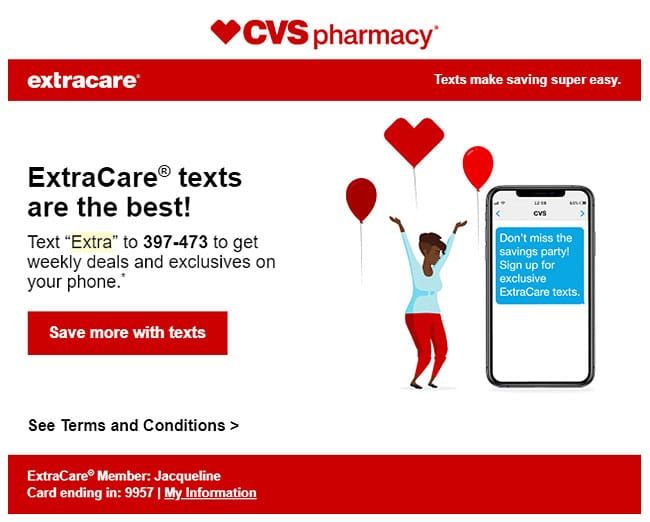
Honest caveat: The ExtraCare Plus paid tier ($5/month, $60/year) only makes sense for heavy CVS shoppers. If you spend less than $100/month at CVS, the math doesn't work. And the state-by-state pharmacy exclusions mean the core health-reward mechanic doesn't function for millions of customers.
Lessons for your brand: Reward the repurchase, not just the spend. A "refill bonus" for reordering the same product gives your version of CVS's pharmacy-to-retail bridge.
2. GNC myGNC Rewards
GNC scrapped its entire loyalty program in 2016 because it realized discounts alone don't build habits. The replacement is one of the better-designed tier structures in health retail.
The numbers:
| Tier | Qualification | Earning rate |
|---|---|---|
| Member | Free | 3% cash back |
| Silver | $200/year | 10% back for one month upon qualification |
| Gold | $500/year | Free shipping + 15% back PRO Days |
| PRO Access | $39.99/year | 10% back every day + 20% back events |
Why it actually works: The tier thresholds are set to align with natural supplement-buying patterns. Someone spending $20/month on protein and vitamins hits Silver without trying. That's intentional.
According to a Loyalty360 interview, GNC's loyalty team designed these tiers specifically to reward consistency over big one-off purchases. The paid PRO Access tier ($39.99/year) is smart too. It filters for the most committed buyers and gives them enough value ($150+ in annual perks) that the math obviously works in their favor. That self-selection creates a high-retention segment without any extra targeting.
Honest caveat: PRO Access costs $40/year, which is a real barrier for casual supplement buyers. If someone only buys protein powder twice a year, they'll never recoup the fee. The program is designed for committed buyers, and that's fine, but it means GNC accepts losing the casual segment.
Lessons for your brand: Set your first-tier threshold just above what your average customer already spends. Make it feel like a reward for showing up, not a stretch goal.
3. Walgreens myWalgreens
Walgreens ran one of the most ambitious health-behavior reward experiments in retail. Then they killed it. Both parts of that story are worth your attention.
The numbers (current program):
- 1% cash back on all purchases
- 5% back on Walgreens-branded products
- Points expire after 12 months of inactivity
Why it actually works (and why it stopped): The current myWalgreens program is table stakes. Nothing special. But the old Balance Rewards health tracking was genuinely innovative. It rewarded walking, weight tracking, and goal completion with loyalty points. The problem wasn't the concept.

It was the friction. Device syncing broke. Manual logging felt like homework. And at Walgreens' scale (8,000+ stores, millions of members), the operational cost of supporting all those integrations outweighed the engagement lift.
For a smaller, more focused wellness brand with an engaged community, that friction math looks completely different. You don't need Fitbit integration. You need a simple weekly check-in.
Lessons for your brand: Reward engagement beyond purchases (workout streaks, usage logs, challenge completions), but keep tracking dead simple. If it takes more than one tap, you'll lose people.
DTC wellness and skincare brands
These are the programs closest to what most readers can actually build. Smaller scale, Shopify-native, and designed for the kind of customer who buys skincare or supplements regularly.
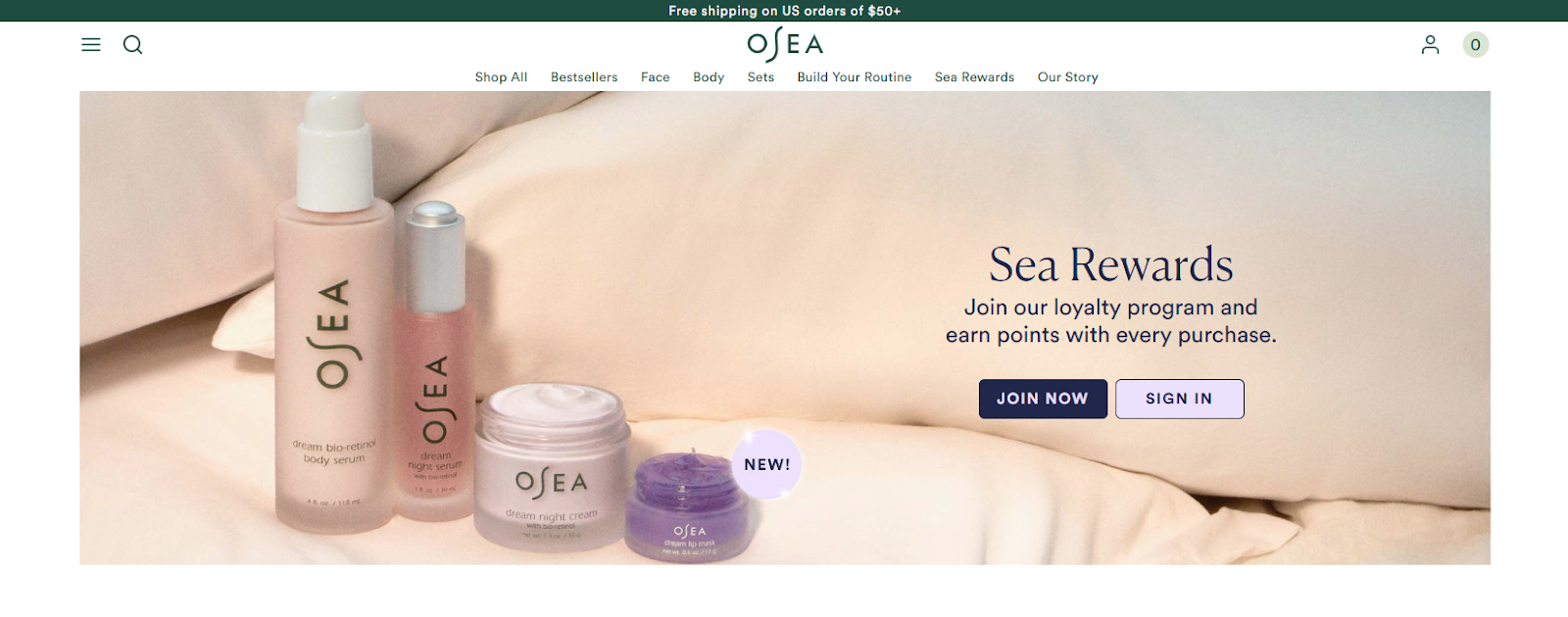
1. OSEA Malibu Sea Rewards
OSEA launched its first-ever loyalty program in 2024, and the early results suggest they got the structure right.
The numbers:
- 1 point per $1 spent (base rate for all tiers)
- 500 points = $5 off
- Four tiers: Ripple (free), Current ($200/year), Wave ($400/year), and a dedicated Subscriber tier
- 73,000+ accounts created within the first months of launch
- 3x higher purchase frequency among Subscriber tier members vs. non-members
Why it actually works: Most DTC brands treat loyalty and subscriptions as separate programs. OSEA combined them. Their Subscriber tier automatically grants VIP status to customers on a recurring order, giving them higher point multipliers and exclusive perks without requiring them to meet a spend threshold.
That matters because subscription customers are already your best buyers. Giving them loyalty perks on top of the subscription discount makes cancellation more costly (they'd lose both the savings and their tier status). OSEA also rewards non-purchase actions, such as writing product reviews, following on social media, and engaging with educational skincare content.
Honest caveat: The program launched in 2024, so there's limited long-term retention data. The 73K accounts and 3x frequency numbers are early-stage metrics. Whether they hold at scale is unproven. OSEA's niche audience (clean skincare, premium price point) also means this model may not transfer directly to mass-market wellness brands.
Lessons for your brand: If you run subscriptions, create a dedicated loyalty tier for subscribers. It reinforces the subscription commitment and gives you a retention point per dollar lever beyond the discount itself.
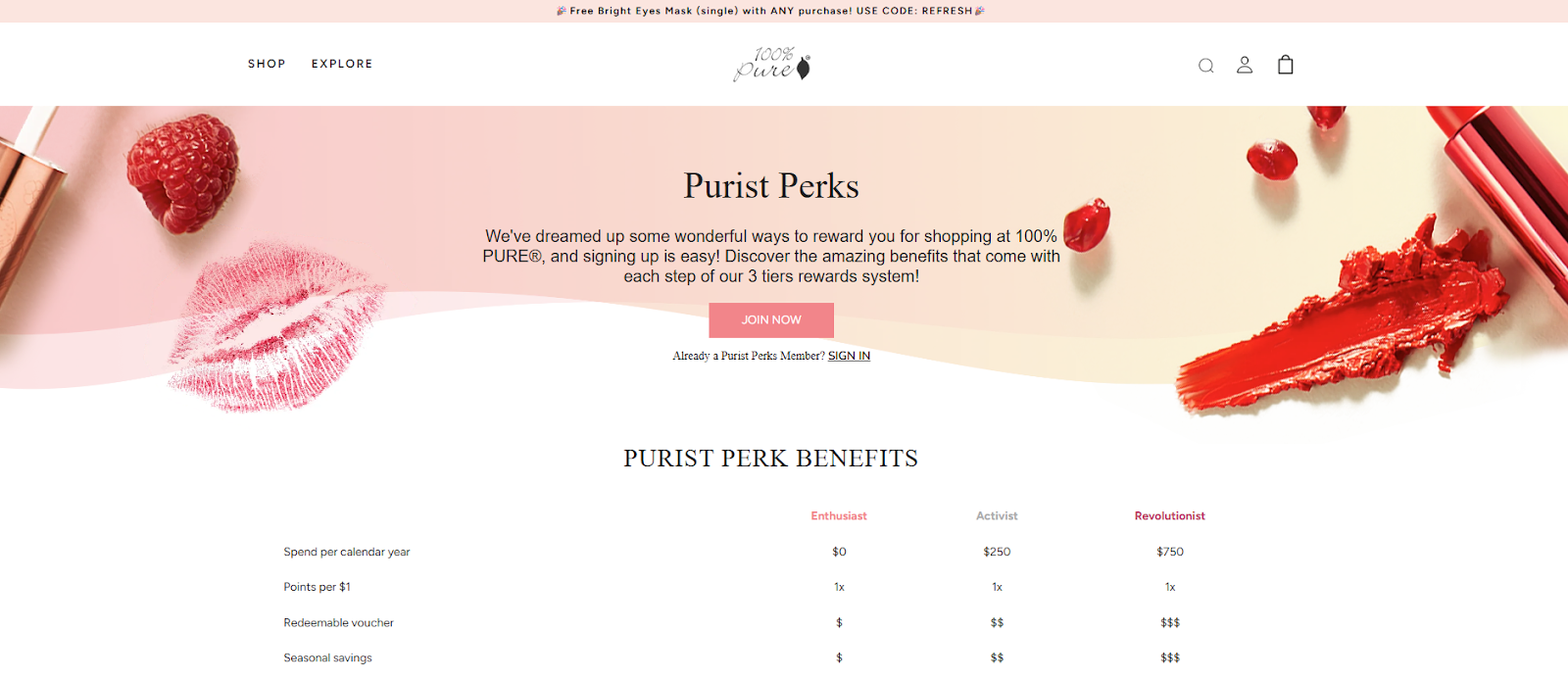
2. 100% Pure Purist Perks
100% Pure is a clean beauty brand that built its loyalty program around the idea that skincare shoppers want to feel like insiders, not just bargain hunters.
The numbers:
- 5 points per $1 spent on all purchases (online and retail)
- Four tiers: Enthusiast (free), Activist ($250/year), Revolutionist ($500/year), and VIP
- Bonus points for product reviews, social media follows, and birthdays
- Points expire after 12 months of no account activity
Why it actually works: The earning rate (5 points per dollar) feels generous compared to the standard 1 point per dollar most programs use. It's the same value mathematically, just with bigger numbers. But that psychological difference matters. Customers see their balance grow faster, which keeps them engaged.
The tier names also deserve attention. "Enthusiast," "Activist," "Revolutionist" aren't just creative labels. They align with 100% Pure's brand identity around clean beauty advocacy. Customers don't just move up a tier. They join a movement. That kind of identity-driven naming works especially well for values-based health and wellness brands where customers see their purchases as part of a lifestyle, not just transactions.
Honest caveat: The 12-month inactivity expiration is aggressive for a skincare brand, given that some products (like a face oil) can last 3-4 months. A customer who buys seasonally could lose their points before their next natural repurchase window.
Lessons for your brand: Use a higher points-per-dollar earning rate (even if the redemption value stays the same). Faster-growing balances keep customers checking their accounts. And name your tiers to match your brand story, not just metal colors.
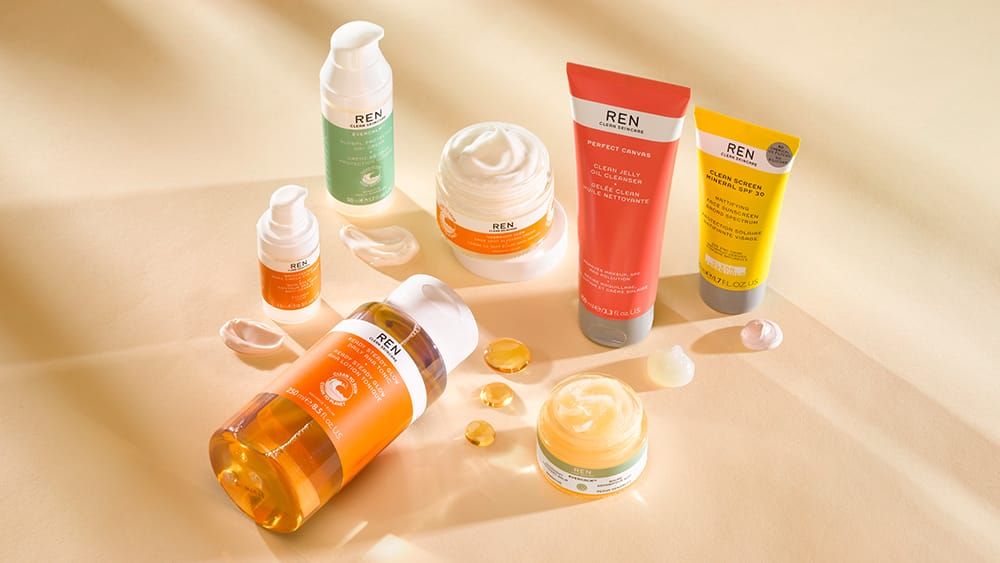
3. REN Clean Skincare (Clean Rewards)
REN takes a simpler approach than OSEA or 100% Pure, but their results speak clearly.
The numbers:
- Tier 1: 1 point per $1 spent
- Tier 2: 2 points per $1
- Tier 3 (Champion): 3 points per $1
- $10 off for every 100 points redeemed
- 200 points for each friend referred
- 50 points per product review
- 38% of total revenue comes from loyalty members
Why it actually works: REN's program is built around a multiplier that increases with tier status. A Champion member earning 3x points per dollar has a clear reason to consolidate all their skincare purchases with REN rather than spreading their spend across brands. That's the real job of a tier system: not just rewarding loyalty, but creating switching costs.
The referral reward (200 points) is aggressive. That's $20 in value for bringing one friend, which makes it worth sharing. Compare that to most DTC brands, which offer 50-100 points for referrals.
Lessons for your brand: If you want referrals to actually work, make the reward high enough that customers will talk about it without being asked.
Here's how the three DTC programs compare side by side:
| Feature | OSEA Sea Rewards | 100% Pure Purist Perks | REN Clean Rewards |
|---|---|---|---|
| Base earning | 1 pt/$1 | 5 pts/$1 | 1-3 pts/$1 (by tier) |
| Tiers | 4 (incl. Subscriber) | 4 (identity names) | 3 (multiplier-based) |
| Referral reward | Not highlighted | Points | 200 pts ($20 value) |
| Non-purchase actions | Reviews, social, education | Reviews, social, birthday | Reviews, referrals |
| Unique mechanic | Subscription-loyalty fusion | Psychology of high earning rate | Aggressive referral value |
| Best for | Subscription brands | Values-based brands | Referral-first brands |
Fitness and gym brands
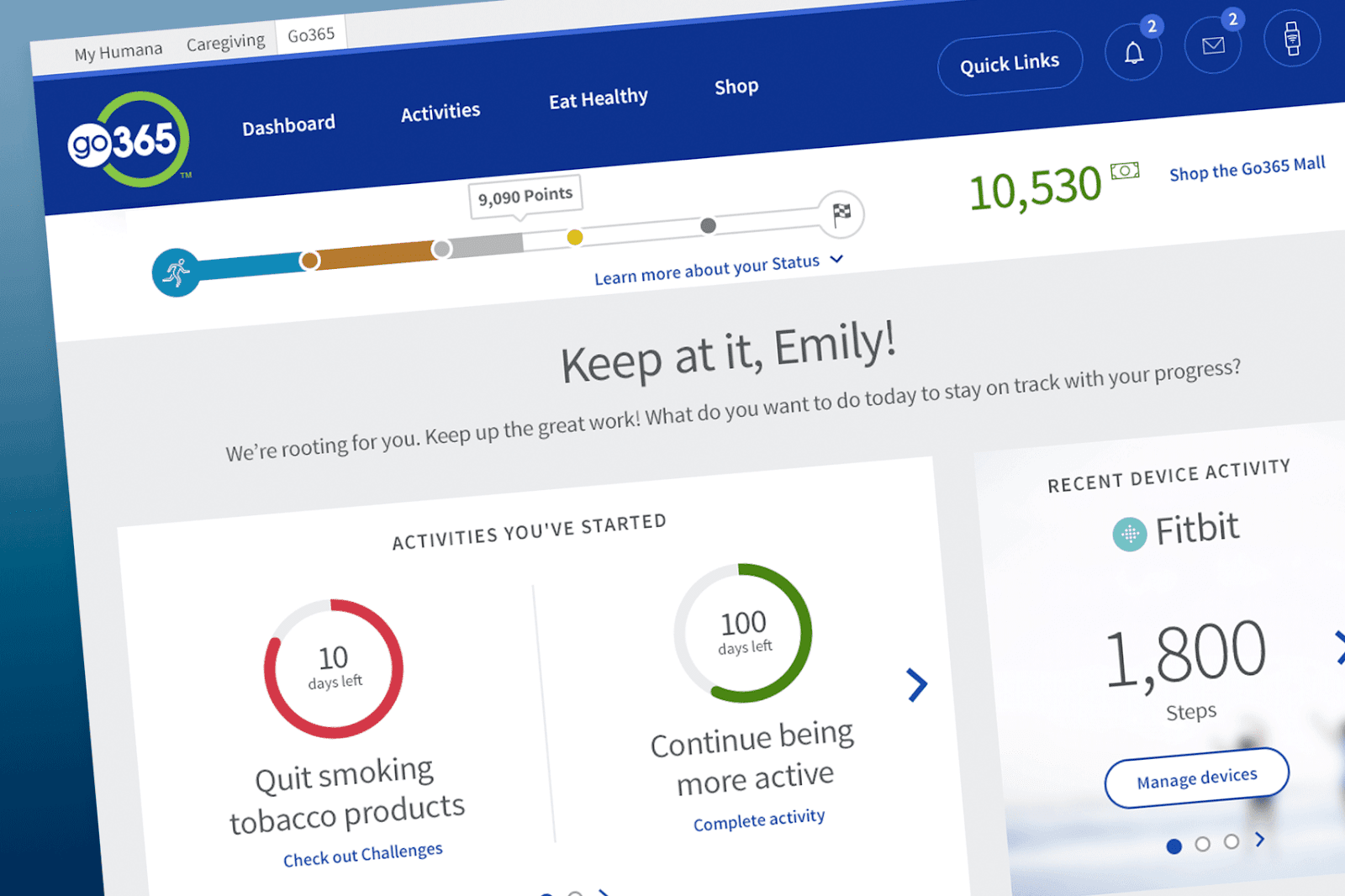
1. Humana Go365
This isn't a retail loyalty program. It's an insurance company paying people to exercise. And that makes it one of the most interesting reward models in health.
The numbers:
- $5 in rewards per month for completing 12+ verified workouts
- 5,000 steps/day = one "active day" (tracked via synced device)
- Rewards redeemable for gift cards (Shell, Walmart, and others) in the Go365 Mall
- Additional rewards for biometric screenings, annual wellness visits, and preventive care
- Compatible with Fitbit, Noom, Daily Burn, and other fitness apps
- All rewards expire on December 31 of the plan year (no rollover)
Why it actually works: Go365 rewards verified health outcomes, not self-reported ones. Members connect a fitness tracker, and the system automatically counts active days. That removes the honor-system problem that killed Walgreens' similar experiment.
The reward categories also go beyond exercise. Members earn for social activities (volunteering, art classes, social clubs), cognitive health (educational content), and preventive care (screenings, dental exams). That breadth matters because it reframes "wellness" beyond just "go to the gym," which keeps engagement high for members who don't identify as fitness-oriented.
Honest caveat: All Go365 rewards expire December 31 with no rollover. A member who joins in October has three months to earn what January members get twelve months to accumulate. The expiration structure penalizes late-year joiners, and the $5/month cap means the financial incentive is modest.
For DTC brands, the takeaway isn't to replicate Go365's insurance model. It's that verified activity tracking works when the friction is low (device sync, not manual logging) and the reward categories are broad enough that most customers can participate.
Lessons for your brand: If you reward health behaviors, automate the tracking. And define "wellness activities" broadly enough that customers who aren't gym regulars can still earn.
2. Lululemon Membership
Lululemon doesn't run a traditional points program. That's exactly what makes it worth studying.
The numbers:
- Three tiers: free (default), Collective ($500/year spend), Collective Plus ($1,000/year spend)
- No points system. No cashback. No earn-and-burn mechanics.
- Benefits include: early access to product drops, free hemming, receipt-free returns, access to Peloton classes, and curated member events
- Previously tested a $128/year paid membership that included exclusive products and fitness classes
Why it actually works: Lululemon bets that its customers value access and community more than discounts. The membership gives you early product drops (scarcity), free hemming (service), and fitness experiences (lifestyle alignment). None of these costs Lululemon much to deliver, but they create an emotional connection that a 2% cashback program never would.
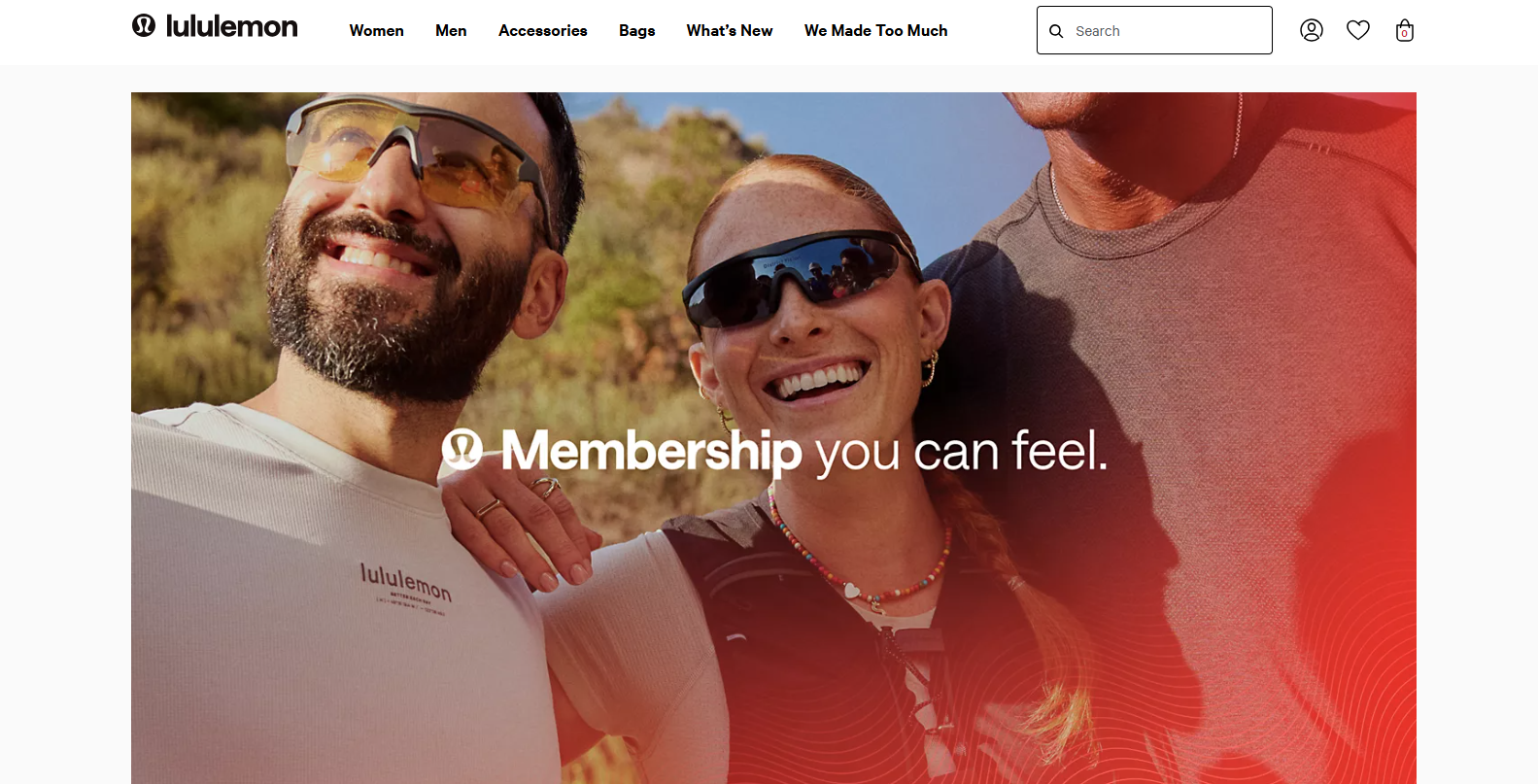
This approach works because Lululemon's audience already self-identifies as active and health-conscious. They don't need a financial incentive to buy leggings. They want to feel like they belong to something. The membership frames the brand as a fitness community, not just a clothing store.
The risk? No points means no switching cost. There's nothing to lose by shopping elsewhere. That's fine for a brand with Lululemon's cult following. For smaller fitness brands without that loyalty baseline, a hybrid model (points plus experiential perks) would be safer.
Lessons for your brand: Experiential rewards (early access, exclusive events, free services) can drive engagement without discounting your products. But only add them on top of a points foundation, not instead of one, unless your brand loyalty is already strong.
Eight programs, four industries, and very different mechanics. But the ones that actually drive retention share five patterns worth copying.
III. 5 Patterns the Best Healthy Reward Programs Share
1. They reward behavior, not just spending
OSEA gives points for reading skincare articles. Go365 rewards preventive screenings. GNC's tier system tracks consistency across months, not single transactions.
Purchases earn points. But non-purchase actions (reviews, referrals, social follows, health check-ins) keep customers engaged between orders. For health brands, this matters more than other categories. Your customers are trying to build habits. Reward the habit, not just the transaction.
Apply this now: Add two to three non-purchase earning actions to your program. Reviews and referrals are standard. For health brands, add a birthday bonus (to give you data) and social follows (to keep you visible between orders).
2. They use tiers to create progression
GNC's four tiers match supplement buying patterns. OSEA gives subscribers automatic VIP status. 100% Pure names its tiers after brand values ("Activist," "Revolutionist").
Health is a journey. Tiers mirror that journey. Even two tiers (Member and VIP) create enough progression to motivate repeat purchases.
Apply this now: Set your first tier threshold just above your average customer's annual spend. Name your tiers after your brand identity, not metals.
3. They make the math feel generous
100% Pure awards 5 points per dollar instead of 1, even though the redemption value remains the same. CVS gives ExtraBucks that feel like "free money" on a receipt. GNC's PRO Access members see 10% back on every purchase.
Perceived generosity drives engagement more than actual generosity. A points system where balances grow quickly keeps customers checking their accounts.
Apply this now: Use a higher point-per-dollar rate (5 or 10 points per $1) with a proportionally higher redemption threshold. The numbers feel bigger. The value stays the same.
4. They reduce friction everywhere
Lululemon's membership has no points to track. OSEA's subscriber tier requires zero extra steps. CVS merged two separate programs into a single program. REN's multiplier does the math for you.
Every step between "earning" and "redeeming" costs you engagement. The best programs make enrollment instant, passive earnings visible, and redemption visible at checkout.
Apply this now: Check your sign-up flow. If it takes more than an email address, you're losing people. Then check redemption. If customers manually copy and paste coupon codes, simplify the process.
5. They know when NOT to use points
Lululemon skips points entirely. Walgreens discontinued its activity-tracking program when the cost outweighed the benefits.
Not every health brand needs points and tiers. If your product has a strong subscription model, referrals plus smart cancellation flows might be enough. The worst loyalty programs exist because "everyone has one," not because they solve a real retention problem.
Apply this now: Before building your program, answer one question: What specific customer behavior are you trying to change? If you can't answer that clearly, you're not ready.
Those five patterns give you the playbook. Now here's how to put it together.
IV. How to Build Your Own Healthy Reward Program
Step 1: Define the behavior you want to change
This is where most brands get it backwards. Don't start with the reward. Start with the problem. Is it subscription churn? Low referral rates? Customers buying once and disappearing? Each problem points to a different program structure.
If your biggest gap is between first and second purchase, a simple points program with a "second order bonus" might be enough. If the problem is customers spreading spend across competitors, tiers with escalating multipliers (like REN's model) create switching costs that consolidate spending.
Step 2: Choose your program type
Based on the eight programs above, four models fit health and wellness brands:
- Points + tiers (GNC, REN, 100% Pure): Best for brands with a broad product catalog and repeat-purchase cycles under 90 days
- Subscription-loyalty hybrid (OSEA): Best for brands already running a subscription, where cancellation prevention is the priority
- Activity-based rewards (Go365, Walgreens lesson): Best for brands whose product value depends on consistent use (fitness, supplements)
- Experiential membership (Lululemon): Only works if your brand already has a strong community following.
Step 3: Set your economics
The standard benchmark: 3-5% of the order value returned as reward. Health products typically run 50-70% gross margins, so you have room.
Use a higher earning rate with a proportionally higher redemption threshold (Pattern 3). Set your first tier threshold just above your average customer's annual spend (Pattern 2). And if you add a paid tier, make sure the value is at least 3x the annual fee.
Step 4: Add non-purchase earning actions
Health brands have a unique advantage here. Your customers are building habits, so reward the habit:
- Product reviews (social proof + engagement)
- Referrals (acquisition at lower CAC)
- Birthday and profile completion (data collection)
- Social follows (brand visibility between orders)
- Content engagement, if trackable (education builds product stickiness)
Step 5: Launch small, measure, expand
Look, don't launch all eight features at once. Start with a basic points program and one tier threshold. Run it for 60 days. Track repeat purchase rate, redemption rate, and referral conversion. Then add complexity based on what the data tells you.
The programs in this article didn't start where they are today. CVS merged two programs. GNC scrapped its entire model and rebuilt. Walgreens killed a feature that wasn't working. Your first version won't be your last.
The Bottom Line
The best healthy reward programs work because they align with something their customers already want: better health habits, consistent routines, and a reason to stick with products that take time to show results.
Rewards don't replace a good product. But for health brands, where the gap between "this works" and "I stopped using it" costs you a customer, a well-designed program closes that gap.
See how Joy's reward programs work for health and wellness brands. Or if you want help choosing the right structure for your product cycle and margin, book a free walkthrough.
Frequently Asked Questions
Are healthy reward programs worth it for small brands?
Short answer: yes, if the program targets a specific behavior gap. A DTC wellness brand with a 90-day repurchase cycle and a 20% repeat purchase rate has clear room to improve. Even a basic points program that nudges that rate to 25-30% can pay for itself within two quarters. The key: don't over-engineer it. Start simple, measure the impact, and add features based on data.
What type of reward program works best for supplement brands?
Points-based programs with tiered multipliers. Supplements have predictable reorder cycles (30, 60, or 90 days), so a program that rewards consistency (like GNC's model) outperforms one-time discount codes. If you run subscriptions, add a dedicated subscriber tier (like OSEA) to reduce cancellation.
How much does it cost to run a wellness loyalty program?
Most Shopify loyalty apps cost $25 to $200/month depending on features and order volume. The bigger cost is the reward liability: plan for 3-5% of order value returned as rewards. On a $50 average order, that's $1.50 to $2.50 per transaction. At 50-70% gross margins (typical for health products), the math works.
Should I reward health behaviors like workout check-ins or usage tracking?
Only if you can automate the tracking. Walgreens proved that manual health logging doesn't scale. Go365 proved that device-synced tracking does. If your product connects to a health app or wearable, behavior-based rewards can be powerful. If it requires your customer to self-report, keep it simple: reward the repurchase instead.
How do I measure whether my reward program is working?
Track three metrics: repeat purchase rate (are customers coming back more often?), redemption rate (are members actually using their rewards? aim for 20-30%), and program-attributed revenue (what percentage of total revenue comes from loyalty members? REN hits 38%). If repeat purchase rate doesn't move within 90 days, the program structure needs adjustment, not more budget.

Written by
Thomas Nguyen is the CEO & Co-founder of Joy, a loyalty solution for Shopify and eCommerce brands. With years of experience building high-performance Shopify apps, Thomas aims to help merchants grow through customizable and retention-focused tools.
Related reading
 Industry Spotlight
Best Telecommunication Loyalty Programs: 7 Real Examples and What Makes Them Work
Telecom churn rates run between 20% and 50% annually. The carriers fighting back use loyalty programs that go beyond generic point systems.
 Thomas Nguyen
 Industry Spotlight
10 Best Rental Car Rewards Programs for Business Owners (2026 Guide)
Your sales team rented 47 cars last quarter. How many of those earned a free rental day? Most business owners don't track this and it's costing them.
Thomas Nguyen Industry Spotlight
Pharmacy Loyalty Programs: 4 Real Examples + How to Build One
How CVS, Walgreens, Boots, and Rite Aid built pharmacy loyalty programs that work, plus a 7-step playbook for your own.
Thomas Nguyen Industry Spotlight
Best Airline Loyalty Program: How Top Programs Drive Revenue, Retention, and Growth
Strip out loyalty revenue, and not a single major US airline turned a profit from flying alone in 2024. The flights are the loss leader. The loyalty program is the profit center.
Thomas Nguyen Industry Spotlight
Rent Rewards Programs: The Best Loyalty Programs for the Rental Industry
Rent rewards programs can cut turnover and boost NOI, but not every program fits every property.
Thomas Nguyen Industry Spotlight
Driver Loyalty Program: Best Examples and How to Build One That Works
Replacing a driver costs thousands. The typical loyalty program is a cash bonus nobody remembers by the next fuel stop. These six do it differently.
Thomas Nguyen